How to start 501c3 nonprofit: A Practical Guide to Launching Your Charity
How to start 501c3 nonprofit: A clear, practical overview of incorporation, IRS forms, bylaws, fundraising, and ongoing compliance.

Abdifatah Ali
Co-Founder
Starting a nonprofit is a journey. It involves defining your mission and board, incorporating in your state, getting a federal EIN, drafting bylaws, and then, the big one: applying to the IRS for 501(c)(3) tax-exempt status. Getting these foundational pieces right sets the stage for everything that follows, from legal compliance to successful fundraising.
Building Your Nonprofit Foundation Before the Paperwork
Before you even think about IRS forms or legal documents, the real work begins. I've seen too many passionate founders jump straight into the paperwork, only to hit a wall because their core idea wasn't fully baked. A strong foundation isn't built on legal filings; it's built on a clear purpose, solid planning, and the right people.
This initial phase is where you turn a great idea into a viable, mission-driven organization. Taking the time to plan strategically ensures your efforts are focused and that you’re solving a real community need—which is ultimately what attracts donors, volunteers, and a dedicated board.
This visual breaks down the essential first steps to tackle before you get tangled up in legal filings.

As you can see, it’s a logical flow: a powerful mission drives your research, which then helps you choose a name and build a strong board to support it all.
Solidify Your Mission and Vision
Your mission statement is the DNA of your organization. It's so much more than a tagline for your website; it has to be concise, compelling, and clear enough to guide every single decision you make. It answers the most fundamental question: Why do we exist?
A vague mission statement like "To help animals" is a non-starter. It's not actionable. A strong one, however, is specific: "To provide sanctuary, veterinary care, and adoption services for senior dogs abandoned in our county." That clarity is what grabs the right supporters and keeps your programs laser-focused.
Key Takeaway: Think of your mission statement as a tool, not just a slogan. It should be clear enough for a board member to use when evaluating a new program and powerful enough for a potential donor to instantly grasp your impact.
Conduct a Needs Assessment
Before you launch, you have to prove that the problem you want to solve is real and that people actually want your proposed solution. A simple needs assessment is the best way to validate your idea, and it doesn't have to be a massive academic study.
Here’s where to start:
- Research existing services: Who else is already doing this work? If others are in the space, is there a gap you can fill or a specific group you could serve better?
- Talk to potential beneficiaries: Get out and interview the people you want to serve. What are their biggest challenges? Would your services genuinely help them?
- Connect with community leaders: Speak with local officials, school principals, or heads of other nonprofits. Their on-the-ground insights can reveal unmet needs you hadn't considered and open doors to future collaborations.
This research isn't just for you—it proves your value to funders and ensures you aren't just duplicating someone else's efforts. As you're doing this groundwork, it's also the right time to think about your financial backbone. Setting up a solid chart of accounts for nonprofits from day one is critical for organizing your finances. For a more structured approach, you can create a https://www.fundsprout.ai/resources/plan-of-record to map out your nonprofit’s operational and strategic goals.
Choose a Name and Recruit a Board
Your organization's name needs to be memorable, professional, and—this is crucial—legally available. Do a thorough search on your state’s business filing website, check domain registrars, and look across social media to make sure the name is free and clear.
At the same time, you need to be recruiting your founding board of directors. Honestly, this might be the most important thing you do at this stage. Your board isn't just a legal formality; these are your strategic partners, your biggest champions, and often, your first donors.
You're looking for a mix of people who bring:
- Passion for the mission: This is non-negotiable. They have to truly believe in the cause.
- Essential skills: Find people with backgrounds in finance, law, marketing, or program management.
- Community connections: Board members who are known and respected in the community can open doors to partnerships and funding you couldn't access otherwise.
Resist the temptation to fill your board with only friends and family. A diverse, independent board provides the critical oversight and credibility that both the IRS and major donors demand.
Making It Official: State Incorporation and Legal Filings

Alright, you've got a powerful mission and a board that's ready to roll. Now it's time to take your idea from a concept to a real, legal entity. This is the moment your nonprofit is officially born, and it all starts at the state level.
Before you can even think about applying for federal 501(c)(3) status, you have to be a legally recognized entity in your state. For nearly everyone, this means becoming a nonprofit corporation. You'll do this by filing a document—usually called the Articles of Incorporation—with your Secretary of State's office.
Drafting Your Articles of Incorporation
Think of your Articles of Incorporation as the birth certificate for your nonprofit. It’s a public document that officially establishes your organization, its name, and its core purpose. While the specifics can differ from state to state, the core components are pretty standard.
You'll need to lock in a few key details:
- Your nonprofit's name: The one you researched and confirmed is available.
- The registered agent: This is a person or service with a physical address in your state who agrees to receive official legal mail on your behalf.
- Your initial directors: The names of your founding board members will go on this document.
Now, here’s a critical piece of advice: your Articles must include very specific language that the IRS requires for 501(c)(3) approval. This is not the place for flowery prose. You need precise clauses that spell out your charitable purpose and, crucially, how your assets will be handled if the organization ever dissolves.
Pro Tip: Your Secretary of State's website will likely have a template for nonprofit Articles. Use it as a guide, but don't just copy and paste. You must add the IRS-required language about your purpose and asset dissolution. This is a common mistake that holds up applications for months.
For example, a standard purpose clause might read something like: "Said organization is organized exclusively for charitable, religious, educational, and scientific purposes... under section 501(c)(3) of the Internal Revenue Code." This wording is a direct signal to the IRS that you’re built for public good, not private enrichment.
Securing Your Federal Employer Identification Number (EIN)
As soon as your state gives your incorporation the green light, your very next phone call (or, more likely, website visit) should be to the IRS to get an Employer Identification Number, or EIN.
An EIN is essentially a Social Security Number for your organization. You'll need this unique nine-digit number for just about everything.
Getting an EIN is free, and you can apply online directly on the IRS website in minutes. Don't let a third-party service charge you for this. You'll need your EIN to:
- Open a bank account in your nonprofit's name.
- Fill out the Form 1023 to apply for 501(c)(3) status.
- Hire any staff and manage payroll.
- Apply for state-level tax exemptions.
Getting this number is a fundamental step in learning how to start a 501c3 nonprofit and operate above board.
Don't Forget State-Specific Filings
Incorporating is a huge milestone, but your state-level paperwork isn't done yet. A frequently overlooked but critical step is registering for a charitable solicitation license, also known as fundraising registration.
In about 40 states, you have to register with a state agency (often the Attorney General's office) before you can legally ask for a single dollar from residents of that state. This applies to every channel—your website's "Donate" button, social media campaigns, email appeals, and direct mail.
Ignoring this can result in hefty fines and penalties, which is a terrible way to start your journey. The process typically involves an initial application and annual renewals. Make sure you check the laws in your home state and any other state where you plan to actively seek donations.
You're joining a sector that is more vital than ever. The number of registered 501(c)(3) organizations has soared by 85 percent since 2000, growing from about 819,000 to over 1.5 million by 2023. You can read more about the growth of the nonprofit sector to see the landscape you're entering—it’s a clear sign of how much our society relies on this work, and why getting the legal compliance right from day one is so important.
Crafting Your Core Governance Documents
Alright, with your incorporation paperwork filed, it's time to create the internal rulebook for your organization. These aren't just dusty documents destined for a shelf; they are the living, breathing framework that guides your board, protects you from risk, and builds trust with everyone from donors to the public.
Think of them as the constitution for your nonprofit.
Getting these documents right is absolutely crucial. They're what you'll show the IRS and major donors to prove you’re organized, accountable, and dead serious about your mission. This is where you define how you operate, how power is distributed, and how you’ll navigate the inevitable bumps in the road.
Drafting Your Nonprofit Bylaws
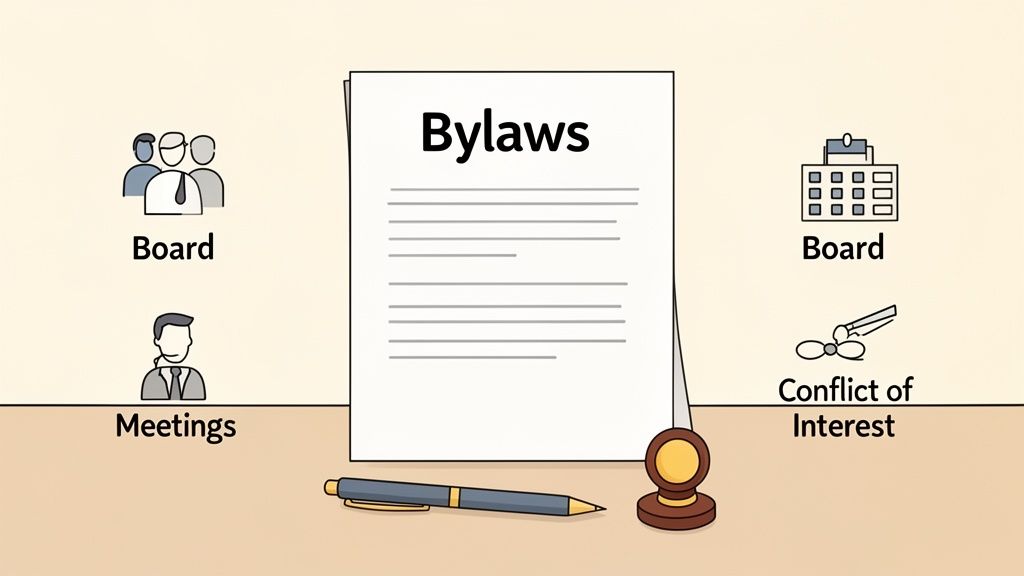
Of all your internal documents, your bylaws are the most important. This is the detailed operating manual for your board of directors. It lays out everything from how you elect officers to the exact number of people needed to pass a vote (a quorum). While templates are a fantastic starting point, you absolutely must tailor them to your organization's real-world needs.
At a minimum, your bylaws need to clearly spell out:
- Board Structure and Roles: How many directors will sit on your board? Do they have term limits? What are the specific duties of the President, Secretary, and Treasurer?
- Meeting Procedures: How often will the board meet? Who has the power to call a special meeting? What are the ground rules for voting?
- Committees: Will you have permanent committees, like a finance or fundraising committee? The bylaws should detail how they’re formed and what authority they have.
- Amending the Bylaws: How can you change these rules down the line? This is a critical clause that prevents a small faction from making unilateral changes.
Solid bylaws prevent a world of future confusion and conflict. They create a clear, fair process for making tough decisions when it matters most.
The Non-Negotiable Conflict of Interest Policy
Right alongside your bylaws, a Conflict of Interest Policy is a must-have. The IRS will be looking for this in your Form 1023 application, and for good reason. It’s your public promise that the organization's charitable mission will always come before any board member's personal financial interests.
So, what is a conflict of interest? It happens when a board member (or their family) could personally profit from a decision the nonprofit makes. Imagine a board member who owns a printing company—they can't vote on awarding a massive printing contract to their own business without a clear, transparent process to handle that conflict.
Key Insight: A strong policy doesn't just forbid conflicts. It creates a clear procedure for disclosing potential conflicts and requires the "interested" person to leave the room during the discussion and abstain from the vote. Transparency is everything.
Your policy has to require board members to sign a disclosure form every year, listing any potential conflicts. It should also require them to speak up immediately if a new one arises. This isn't about being suspicious of your board; it's about protecting them and safeguarding the organization's integrity.
You can find excellent templates and see what a comprehensive policy looks like by reviewing a conflict of interest policy sample for a non-profit. These two documents—your bylaws and your conflict of interest policy—are the bedrock of good governance and are absolutely foundational for your long-term success.
Tackling the IRS Form 1023 Application
Here it is—the final gatekeeper in your quest to start a 501(c)(3). The IRS Form 1023 is where you formally make your case for tax-exempt status. Think of it less like a form and more like a comprehensive exam of your organization's purpose, structure, and future plans.
Submitting this application can feel like the biggest hurdle in the entire process, and for good reason. A thorough, persuasive application can sail through review. A vague or incomplete one? It can get stuck in IRS limbo for a year or even longer. The key is to treat this document as the detailed business plan for your charitable mission.
Writing Your Narrative and Describing Your Activities
The real heart of your Form 1023 is the narrative—the detailed description of your activities. This is where you connect the dots for the IRS agent reviewing your file, showing them exactly how your day-to-day work fulfills the charitable purpose you’ve laid out.
Vague statements like "we will help the homeless" are a recipe for delays and follow-up questions. You have to be incredibly specific. Think like a journalist: who, what, where, when, and how.
- Who are you serving? Get specific. Instead of "at-risk youth," try "first-generation high school students in the downtown area."
- What are you actually doing? Don't just say "job training." Describe it: "a 12-week program offering resume writing workshops, mock interviews, and job placement assistance with local partners."
- Where will it all happen? Be clear about your geographic scope. Are you focused on a single neighborhood, an entire county, or a multi-state region?
- When will activities take place? Give a sense of frequency, like "workshops held on the first and third Saturdays of each month" or "an annual community cleanup event in April."
This is your chance to paint a vivid picture of your impact. Your goal is to leave absolutely no room for ambiguity. You need to prove, beyond a shadow of a doubt, that your organization is set up and will be operated exclusively for public benefit.
Projecting Your Finances and Budget
Your financial projections are just as critical as your narrative. The IRS requires you to provide detailed financial data, including a proposed budget for your first few years. This isn't just about showing you'll be responsible with donor money; it's about demonstrating that your entire plan is feasible.
A solid budget should clearly outline two things:
- Sources of Revenue: Where will the money come from? Be realistic about grants, individual donations, corporate sponsorships, and any program service fees you might charge.
- Detailed Expenses: How will you spend it? Break down your anticipated costs across your programs, administrative overhead (like rent and salaries), and fundraising activities.
A well-prepared budget tells the IRS you have a sustainable financial model. It proves you’ve actually thought through the real-world costs of running your programs and have a strategy to fund them—a key indicator of a viable, well-run organization.
Insider Tip: Never, ever project 0% for fundraising costs. The IRS agents reviewing your application know that it costs money to raise money. A zero in that column signals a lack of realism and could trigger extra scrutiny of your financials.
Navigating Sensitive Questions and Special Rules
The Form 1023 includes some very direct questions designed to ensure you understand and comply with the strict rules governing 501(c)(3) organizations. Two of the most critical areas involve political activity and private benefit.
First, as a 501(c)(3), you are absolutely prohibited from participating in partisan political campaigns. This long-standing rule, often called the Johnson Amendment, means you cannot endorse or oppose any candidates for public office. You must affirm in your application that you understand this and will comply.
Second, you have to prove that your activities won't result in private inurement. This is a legal term meaning that insiders—like founders, board members, or their relatives—cannot personally profit from the organization's income or assets. Your Conflict of Interest policy is your best evidence here, as it shows you have a formal process to prevent this. Your entire application needs to make it crystal clear that your organization exists to serve the public good, not private interests.
Activating Your Fundraising and Grant Readiness
Getting that 501(c)(3) determination letter from the IRS feels like the finish line, but it’s really just the starting gun. Your tax-exempt status is your license to fundraise, and now the real work begins: building the engine that will power your mission. It's time to shift gears from paperwork to outreach.
First things first, you need a place for the money to go. Before you can accept a single dollar, you have to open a dedicated business bank account in your nonprofit’s name, using that EIN you secured earlier.
I can't stress this enough: never mix personal funds with your organization's finances. A separate bank account is a non-negotiable firewall. It protects you and your board, makes bookkeeping a thousand times easier, and shows funders you’re a serious, professional operation.
Building Your Financial Foundation
With a bank account open, your next move is to finalize your operating budget. This isn't the high-level, three-year projection you sent the IRS. This is your nitty-gritty, real-world financial roadmap for the first year. It needs to be grounded in your actual program plans and realistic fundraising goals.
Think of your budget as more than just a spreadsheet. It’s a tool for transparency and a guide for strategic decisions, which is why your board must formally review and approve it. This document is also a cornerstone of becoming grant-ready—nearly every foundation is going to ask for it.
The other must-have document is your case for support. This is a powerful, internal narrative that clearly and emotionally explains why your organization deserves funding. It becomes the source material for all your fundraising appeals, grant proposals, and website copy down the line.
Your case for support should nail the answers to these questions:
- What specific problem are you solving?
- What’s your unique solution?
- What proof do you have that your approach works?
- How much will it cost, and what tangible impact will a donation make?
Launching a Sustainable Funding Strategy
Once your financial and narrative foundations are solid, it's time to build out your fundraising strategy. The goal is to create a diverse mix of revenue streams so you aren't dangerously dependent on a single source of income. This is where a clear plan and modern tools can make all the difference.
Platforms like Fundsprout are a huge help for new nonprofits. They help you find relevant grant opportunities and manage compliance, leveling the playing field so you don't need a huge, experienced team right out of the gate. You can find funders who are already looking for missions like yours, which saves you from wasting countless hours on dead-end research.
At the same time, you need to start cultivating individual donors. It’s crucial to know what’s working right now. For example, 57 percent of donors are now enrolled in recurring giving programs. This tells you just how important it is to build a base of monthly givers who provide predictable, stable income.
Likewise, Russell 1000 companies have increased their unrestricted matching gift programs by 48 percent in recent years. Tapping into corporate giving can be a powerful way to amplify your fundraising.
Key Takeaway: A diversified funding plan is your best defense against financial instability. Aim for a healthy mix of individual donations (both large and small), foundation grants, and corporate support to create a resilient organization.
For new organizations, learning how to start a 501c3 nonprofit is just the first part of the journey. Activating your fundraising is what brings the mission to life. Getting smart about digital marketing for nonprofits can give your outreach a massive boost and help you connect with those crucial first supporters online. To put all these pieces together, check out our guide on creating a fundraising plan format that actually works.
Keeping Your 501(c)(3) in Good Standing After Approval

That IRS determination letter is a huge win, but it’s really just the beginning of your relationship with federal and state regulators. The hard work of formation is done; now, your focus has to shift to maintenance. This isn't just about paperwork—it's about protecting your tax-exempt status and earning the trust of your donors, year after year.
Letting these annual requirements slide can bring serious headaches, from financial penalties to the worst-case scenario: automatic revocation of your 501(c)(3) status. The absolute best thing you can do is build solid habits for record-keeping and filing right from the start.
The Annual IRS Form 990 Filing
Every year, just about every 501(c)(3) needs to file an informational return with the IRS, known as the Form 990. Think of it less like a tax bill and more like a transparency report for the public and the IRS, showing how you’re putting your resources to work for your mission.
The version you file is all about your annual gross receipts:
- Form 990-N (the e-Postcard): This is for the little guys. If your gross receipts are normally $50,000 or less, you can do this quick online filing.
- Form 990-EZ: This is the middle ground for organizations with gross receipts under $200,000 and total assets under $500,000.
- Form 990 (the full form): For larger organizations with gross receipts of $200,000 or more, or total assets of $500,000 or more.
Don't Miss This Deadline: Your Form 990 is due by the 15th day of the 5th month after your fiscal year ends. For most nonprofits using a standard calendar year, that means May 15th. If you miss this deadline three years in a row, the IRS will automatically revoke your tax-exempt status. No exceptions.
State-Level Reports and Renewals
Compliance isn't just a federal game. Most states require you to file an annual report with the Secretary of State just to keep your corporate status active. This is completely separate from your IRS filing and is absolutely critical for staying in good standing.
On top of that, if you're fundraising, you’ll likely need to renew your charitable solicitation registration every year in each state where you ask for donations. These renewals usually involve sending in a copy of your Form 990 and paying a fee. Juggling these different deadlines is a key part of running a healthy nonprofit.
Good Habits for Ongoing Governance
At the end of the day, strong compliance comes from strong record-keeping. When you diligently document everything, you create a clear audit trail that proves you’re operating legally and in line with your mission and bylaws.
Getting into the habit of taking detailed board meeting minutes is non-negotiable. These minutes need to capture major decisions, financial approvals, and any elections. This isn't just busywork; these documents are the official history of your board's oversight and are often the first thing an auditor or major funder asks to see.
This discipline is more important than ever. New nonprofits are launching into a tough environment with shrinking government funding and higher compliance demands. You can get more insights on navigating the pressures on today's nonprofits to stay ahead of the curve.
Got Questions About Starting a Nonprofit? We've Got Answers.
Jumping into the world of 501(c)(3)s always kicks up a lot of questions. It's totally normal. Let's walk through the most common things founders ask so you can get a clear picture of the road ahead.
What’s the Real-World Cost?
There's no single price tag for starting a nonprofit; think of it more as a range. Your first cost is incorporating with the state, which usually lands somewhere between $50 and $200.
The main event, financially speaking, is the IRS application fee. This is where the path splits:
- Form 1023-EZ: If you qualify for this shorter form, the filing fee is $275.
- Form 1023 (Long Form): The standard, more detailed application comes with a $600 fee.
Keep in mind, these are just the direct government fees. If you bring in a lawyer or a consultant to handle the paperwork, their professional fees can easily add another $1,500 to $5,000 (or more) to your startup budget.
How Long Until We Get IRS Approval?
This is the part that requires some patience. If you're eligible for the streamlined Form 1023-EZ, you might see an approval letter in as little as 2 to 4 months.
However, the full Form 1023 is a different story. You should realistically plan for a 6 to 12-month wait. I've seen some take even longer.
Pro Tip: Your best bet for speeding things up is submitting a rock-solid, comprehensive application from the get-go. Vague answers or missing information are the number one cause of delays, sparking a drawn-out Q&A process with the IRS that can stall your approval for months.
Can I Pay Myself a Salary?
Yes, absolutely. Founders and executive directors can and should be paid for their work. The key word here, though, is reasonable.
The IRS looks at what similar organizations, in a similar location, pay for comparable roles. Your board of directors is responsible for setting and approving your salary based on this kind of research. To avoid a conflict of interest, you must recuse yourself from the final discussion and vote on your own pay.
What are the Most Common Application Mistakes?
I've seen a lot of applications get sent back, and it's almost always for the same handful of reasons. The biggest mistake by far is a fuzzy or poorly explained purpose. You need to be crystal clear about what your organization does.
Another classic error is forgetting to include the IRS-required purpose and dissolution clauses in your Articles of Incorporation. They are non-negotiable. Finally, submitting unrealistic financial data or an incomplete budget is a huge red flag for the IRS reviewer.
Fundsprout is the AI-powered platform built to help you navigate the entire grant lifecycle with confidence. From finding the perfect funding opportunities to crafting winning proposals and managing compliance, we give your mission the tools it needs to succeed. Learn more at Fundsprout.
Try 14 days free
Get started with Fundsprout so you can focus on what really matters.