SBA 8a Business Development Program: A Strategic Guide
Unlock federal funding by understanding the SBA 8a Business Development Program. Learn eligibility, benefits, and how to partner with 8(a) certified firms.

Abdifatah Ali
Co-Founder
Your development team is tired of living quarter to quarter. Grants close, new applications open, and the calendar fills with deadlines that rarely line up with program needs. You may already have strong community outcomes, trusted local relationships, and staff who can deliver services at scale. What you may not have is a revenue model that gives you more control.
That's where the sba 8a business development program becomes relevant, even if your nonprofit can't or won't seek 8(a) admission itself.
Most nonprofit leaders hear “8(a)” and assume it's a certification issue for small for-profit firms. That's too narrow. In practice, the 8(a) world is an ecosystem of prime contractors, subcontractors, joint venture partners, technical specialists, compliance requirements, and agency relationships. For a mission-driven organization, that ecosystem can open a different path into federal work.
A nonprofit might contribute program design, field delivery, workforce training, research support, outreach, data collection, or community trust that an 8(a) firm lacks. The 8(a) firm brings the federal contract vehicle, small business status, and contracting strategy. Done well, the relationship creates access to opportunities that sit outside the usual grant treadmill.
The catch is that this only works when leaders treat 8(a) partnerships as a business line, not a side project. You need a clear role, a contract structure you understand, and a realistic view of compliance. You also need a disciplined bid process. If your team is still sorting out the basic difference between solicitations, start with this practical overview of RFPs and RFQs for nonprofits.
Opening the Door to Federal Contracts
A nonprofit director usually reaches this topic after a familiar sequence. The organization has traction. Programs are working. Funders like the mission. But restricted grants don't cover enough overhead, renewals are uncertain, and staff capacity gets stretched by application volume.
Federal contracting can look attractive from a distance and hostile up close. The language is different. The timelines are harder. The buyer is not a foundation program officer. It's a contracting office with rules, documentation standards, and little patience for vague promises.
That's why many mission-driven organizations are better off approaching the market through partnership first.
Why 8(a) matters even if you're not seeking certification
The sba 8a business development program creates a lane for certain small businesses to develop capacity and compete for federal work. For nonprofits, the practical opportunity is indirect. You can align with an 8(a) participant that needs specialized delivery capability, subject-matter depth, trusted community access, or a lower-risk operating partner.
Common examples include:
- Service delivery support: A nonprofit performs outreach, intake, case management, training, or implementation under a subcontract.
- Subject-matter expertise: A mission-driven team contributes evidence-based programming, evaluation methods, or culturally competent engagement.
- Geographic reach: A local organization helps an 8(a) firm perform credibly in the communities an agency cares about.
- Pipeline expansion: A nonprofit-backed subsidiary or affiliated entity can pursue work that grants alone wouldn't support.
Nonprofits rarely win federal contracts just because their mission is compelling. They win when their role is specific, operationally useful, and easy for a prime contractor to price and manage.
Where nonprofit leaders usually misread the opportunity
The biggest mistake is assuming partnership means passive participation. It doesn't. A strong nonprofit partner still has to understand scopes, staffing plans, invoicing rules, deliverables, and conflicts.
A close second is chasing any 8(a) firm with a certification badge. Certification helps, but it doesn't tell you whether that firm can manage a contract, survive an audit trail, or build a bid around your strengths. Those questions matter more than the logo on a capability statement.
What Is the SBA 8(a) Program Really For
The simplest way to understand the sba 8a business development program is to think of it as a federal business accelerator with contracting advantages built in. It is not just a label a company puts on its website. It is a structured business-development framework designed to help a certain category of small business become stronger, more competitive, and more capable in the federal market.
According to the SBA's 8(a) Business Development program page, the program is a long-running federal contracting and business-development initiative authorized by Sections 7(j)(10) and 8(a) of the Small Business Act (15 U.S.C. §§ 636(j)(10) and 637(a)). Its core purpose is to help small businesses owned by socially and economically disadvantaged people compete more effectively in the U.S. economy through management, technical, financial, and procurement assistance. The same SBA page states that the firm must be at least 51% owned and controlled by U.S. citizens who are socially and economically disadvantaged.
Why the program exists
Federal contracting has always favored firms that already know the system. They understand proposal mechanics, pricing discipline, agency culture, and contract administration. New entrants often don't. The 8(a) structure exists because some firms face an additional challenge. They're trying to build those skills while also dealing with limited access to capital, relationships, and procurement networks.
That matters to nonprofits because it explains the behavior of many 8(a) companies. They are often looking for partners that help them perform credibly and grow deliberately. They don't just need resumes. They need delivery strength.
If your organization brings any of the following, you may be more valuable to an 8(a) firm than you expect:
- Community legitimacy: Agencies often care whether the contractor can reach the target population.
- Program operations: Nonprofits may already run services that map cleanly to a statement of work.
- Specialized trust: Some populations respond better to established mission-driven organizations than to a new commercial vendor.
- Outcome discipline: Strong nonprofits already collect impact data, maintain reporting routines, and work under funding restrictions.
What the program is not
It isn't a shortcut that erases the need for performance. It also isn't a permanent status. The program is built around development, not indefinite protection. That creates a different kind of partnership environment than many nonprofit leaders expect.
An 8(a) participant usually has two goals at once:
- Win work now.
- Build a business that can compete when program advantages taper off.
Those goals influence teaming decisions. An 8(a) firm may welcome a nonprofit partner that makes a proposal stronger, but it will hesitate if the nonprofit makes contract management harder, muddies control lines, or introduces governance issues.
Practical rule: The best 8(a) partnerships solve a prime contractor's execution problem, not just its outreach problem.
Why nonprofits should care about the spirit of the law
The law's intent shapes the kinds of firms you'll encounter. These are not random vendors. They are businesses admitted into a federally structured development environment because the government wants them to become more effective competitors.
That means your partnership discussions should focus on capacity-building questions, not just opportunity spotting:
- What capabilities is the 8(a) firm trying to strengthen?
- Where does your organization fit into that buildout?
- Will this partnership still make sense when the firm matures?
- Can both parties define a role that survives proposal pressure?
A nonprofit that understands that logic tends to choose better partners. Instead of chasing any small business with agency contacts, it looks for an 8(a) firm whose growth path aligns with the nonprofit's service model.
Decoding 8a Eligibility and Certification
If you're vetting a potential partner, you need a working grasp of who qualifies for the program and how certification is changing. This is no longer just a matter of asking whether a company “has 8(a).” You need to understand the gatekeeping rules well enough to spot risk.
At the baseline, an 8(a) participant must be a small business, must not have previously participated in the program, and must be at least 51% owned and controlled by U.S. citizens who are socially and economically disadvantaged. The disadvantaged owner generally must have personal net worth of $850,000 or less, adjusted gross income of $400,000 or less, and total assets of $6.5 million or less under the SBA's eligibility framework described on the official program page.
The shift that changed application strategy
One issue now matters more than many nonprofit leaders realize. As of January 2026 guidance from the SBA, the program's presumption of social disadvantage based on race is deemed unconstitutional, and the change took effect immediately, according to Ogletree's analysis of the January 2026 SBA guidance.
In plain terms, firms can't rely on the old assumption model. Applicants now need individualized evidence to prove social disadvantage. That changes how a serious 8(a) candidate prepares its file, how long the process may take, and how much legal and factual support it may need.
For nonprofits, this matters in two ways:
- Pipeline risk: A company that says it is “about to get 8(a)” may not be as close as it sounds.
- Partner screening: A firm with weak documentation habits at the application stage may also be weak in performance-stage compliance.
What to ask a prospective 8(a) partner
You don't need to underwrite their legal eligibility. You do need enough diligence to avoid tying your organization to a shaky prime.
Use questions like these in early conversations:
- Status clarity: Are you currently admitted, in process, or planning to apply?
- Timing realism: If you are in process, what is driving your expected timeline?
- Control evidence: Who owns and controls the company day to day?
- Documentation discipline: How do you maintain records supporting continued eligibility?
- Growth plan: What kinds of work are you pursuing inside the program, and what role do you need a partner to play?
A credible firm can usually answer these cleanly. A weak one often drifts into sales language.
A capable 8(a) partner talks about ownership, control, deliverables, and contract administration. An unstable one talks mostly about access.
Why this matters beyond admission
Certification isn't just an entry test. It shapes how the company is governed and how risk is managed. For a nonprofit director, that means the right question isn't “Can this firm win?” It's “Can this firm stay eligible, perform, and pay us on time while the government watches closely?”
That distinction saves a lot of trouble. The strongest nonprofit partnerships usually happen with 8(a) firms that are operationally boring in the best sense of the word. Their documents are organized. Their leadership is clear. Their proposal commitments match what they can deliver.
The 9-Year Lifecycle and Compliance Rules
The sba 8a business development program has a built-in clock. That clock shapes partner behavior, contract strategy, and risk tolerance more than many outside organizations realize.
A useful visual helps make the lifecycle concrete.
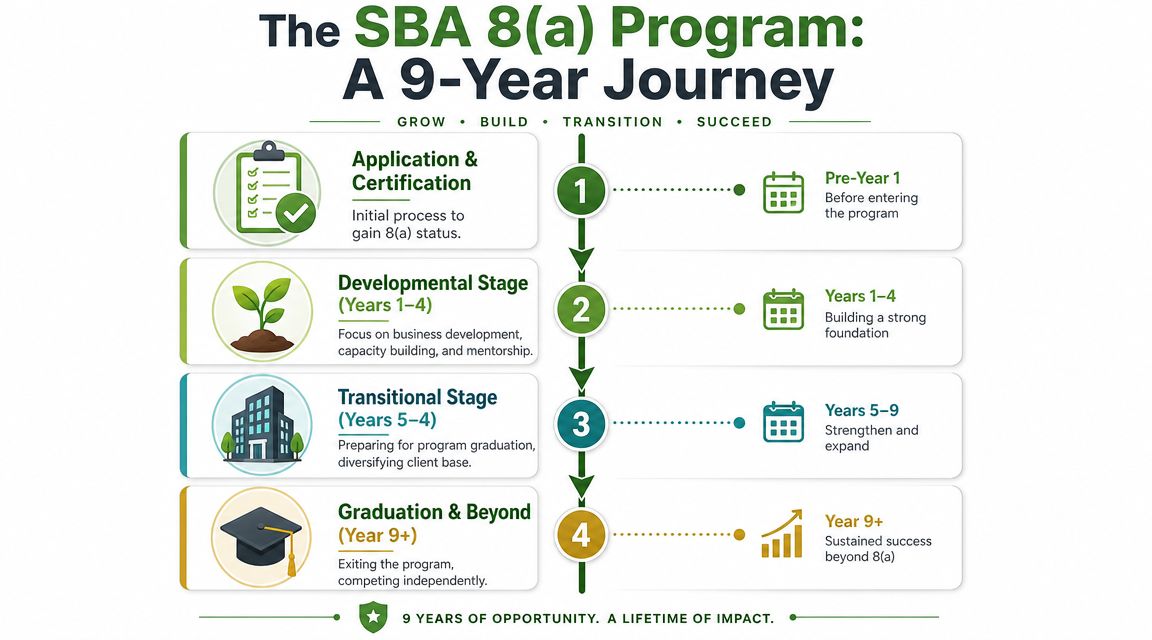
The program is a nine-year pathway, divided into a four-year development stage and a five-year transitional stage, as described in the Jackson Lewis overview of current 8(a) scrutiny and compliance risks. That same source notes that the Department of Defense announced an all-encompassing review of 8(a) contracts in January 2026 and highlights ongoing compliance pressures, including continued eligibility rules such as the owner's net worth staying under $850,000.
What different lifecycle stages mean for a nonprofit partner
A firm in the earlier part of the program often wants help building delivery credibility. It may need your staff, service model, local reach, or technical knowledge to support a proposal. These can be good partnerships, but they often require more structure because the prime contractor is still maturing.
A firm in the later stage usually thinks differently. It is preparing for open-market competitiveness and may be more selective about relationships. That can be a benefit. The company may have stronger systems, better pricing habits, and cleaner internal controls.
Here's a practical comparison:
| Lifecycle position | What the 8(a) firm often needs | What the nonprofit should watch |
|---|---|---|
| Earlier stage | Delivery partners, credibility, operational support | Undefined roles, immature systems, proposal overreach |
| Transitional stage | Strong specialty partners, scalable execution, past performance depth | Pressure to diversify, tighter margins, more aggressive bid choices |
| Near graduation | Partners that strengthen long-term positioning | Whether your role still fits after program exit |
Compliance isn't background noise
Many nonprofits treat federal compliance as the prime contractor's problem. That's a mistake. If your partner loses eligibility, gets pulled into a contract review, or stumbles on documentation, your work can stop even if your own team performed well.
This short briefing is worth a watch if your team needs a quick orientation to the lifecycle and what graduation means in practice.
The partnership models compared
A nonprofit has several ways to work with an 8(a) company. None is universally best. The right choice depends on your operational maturity, legal structure, and appetite for contract risk.
Subcontracting
This is often the cleanest entry point. The 8(a) firm remains the prime. Your organization delivers a defined slice of the work.
Pros
- Lower federal contracting burden than serving as prime
- Clear scope can map to your existing programs
- Easier to test fit before deep strategic alignment
Cons
- Limited control over client relationship
- Payment timing depends on prime administration
- Your brand may be invisible to the agency
Teaming arrangement before award
This works when the nonprofit's expertise materially strengthens the bid. You help shape the proposal, staffing plan, technical approach, or performance solution.
Pros
- Early influence on scope and delivery design
- Better chance to negotiate a meaningful role
- Lets both parties decide whether they work well together
Cons
- Considerable pre-award effort with no guarantee of revenue
- Poorly drafted arrangements can create confusion
- Mission drift happens fast if your role isn't narrowly defined
Formal joint venture or affiliated entity structure
This can make sense for organizations with substantial contracting ambitions, especially if leadership is willing to invest in legal, accounting, and operational infrastructure.
Pros
- Greater strategic control
- Stronger positioning for larger or more complex opportunities
- Better alignment if federal work will become a core revenue stream
Cons
- Higher complexity
- More governance scrutiny
- Easy to build something that is too heavy for the pipeline you have
Compliance risk travels through the relationship. If the prime contractor is sloppy, the subcontractor still feels the impact.
How Nonprofits Can Partner with 8a Firms
The best nonprofit and 8(a) relationships start with a blunt question. What exactly are you bringing that the prime contractor cannot easily hire somewhere else?
If the answer is “our mission,” that's not enough. If the answer is “we run the exact service model this agency needs, in the communities named in the scope, with trained staff and a reporting discipline,” then you have something usable.
The three partnership routes that usually make sense
Some organizations should start narrow. Others are ready to build a contracting arm. The choice depends less on ambition and more on internal readiness.
| Partnership Model | Primary Role | Risk/Complexity | Best For |
|---|---|---|---|
| Subcontracting | Deliver a defined portion of awarded work | Lower to moderate | Nonprofits entering federal work through a controlled scope |
| Teaming agreement | Shape proposal and planned performance before award | Moderate | Organizations with strong expertise but limited contracting history |
| Joint venture or related for-profit structure | Share strategy, delivery, and longer-term market positioning | Higher | Leaders building a durable federal revenue line |
Subcontracting first is often the smartest move
Subcontracting lets you learn the federal market without carrying the full prime contractor burden. You can focus on service delivery, staffing, documentation, and invoicing under a narrower scope.
This model works especially well when the nonprofit already runs a replicable program. Workforce development, technical assistance, outreach, training, case management, and evaluation support can fit cleanly if the prime knows how to scope them.
What doesn't work is vague language. If your subcontract says you'll provide “community engagement support,” expect confusion. If it says your team will recruit participants, manage intake, deliver workshops, maintain attendance documentation, and submit monthly performance data, the arrangement is much easier to manage.
Teaming is where strategy shows up
A teaming arrangement matters before the award. This is where your organization helps an 8(a) firm become more competitive, not just more staffed.
That may include:
- Technical design: You help shape the service model the agency will buy.
- Past performance framing: Your organizational experience strengthens the proposal narrative.
- Staffing logic: You identify which roles should sit with the nonprofit and which belong with the prime.
- Community credibility: You make the bid more believable when local trust is central.
Before you sign anything, review your governance basics. A lot of partnership stress comes from undisclosed board overlaps, personal relationships, or procurement conflicts. This nonprofit-focused conflict of interest policy guide is a useful checkpoint for leadership and counsel.
When a nonprofit should consider a separate entity
Some mission-driven organizations eventually decide that federal contracting deserves its own structure. That could mean a related for-profit subsidiary or another affiliated entity built for contract performance.
That route can be sensible when:
- Federal work is becoming a serious revenue strategy.
- The organization needs cleaner separation between charitable and commercial activity.
- Leadership wants dedicated staff, accounting, and contracting controls.
- Potential partners need a counterpart that looks and operates more like a business unit.
It can also fail badly. The common failure mode is building the entity first and the opportunity pipeline second. A shell company with no contracting discipline, no pricing method, and no owner-level attention won't help.
What works in real partnerships
Strong arrangements usually share a few traits:
- A narrow role at the start
- Clear deliverables
- Named points of contact
- Written invoicing rules
- An honest conversation about who owns the agency relationship
Weak arrangements usually break because everyone wanted the upside and nobody wanted to define control.
Beyond 8a Complementary Federal Programs
An 8(a) relationship shouldn't make you blind to the rest of the federal small business sector. Many opportunities sit in a broader ecosystem of certifications and set-aside strategies. If you understand only 8(a), you may miss why a partner is pursuing one bid and ignoring another.
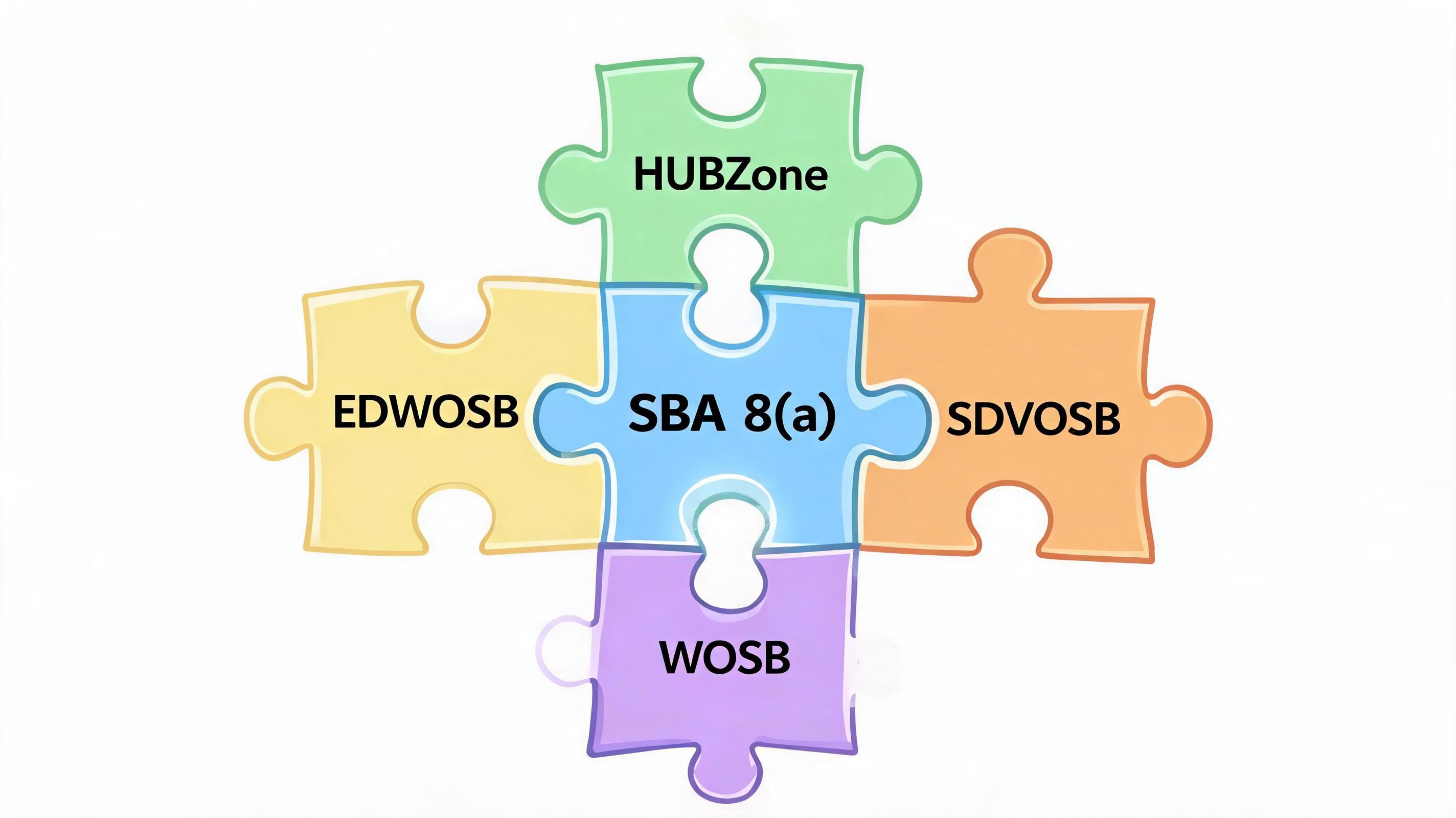
You'll commonly hear about SDVOSB, WOSB, and HUBZone alongside 8(a). For a nonprofit leader, the important point isn't memorizing each rule. It's understanding that your prospective partner may be evaluating multiple qualification paths, and those paths affect teaming strategy, follow-on opportunities, and competitive positioning.
Why this broader view matters
A nonprofit that knows only “we want an 8(a) partner” can end up overly narrow. Sometimes the better partner is a firm that operates across several small-business channels or is choosing among them based on agency demand.
That broader perspective also helps when reviewing outside guidance. If you want a practical industry-facing overview of how these certifications fit into a larger procurement strategy, this guide to government contracting success gives a useful field-level perspective.
A short checklist before you pursue any partner
Use this screen before committing business-development time:
- Certification fit: Does the firm's contracting strategy match the agencies you care about?
- Operational fit: Can your organization perform the work likely to be awarded?
- Relationship fit: Will your mission and the contractor's delivery model reinforce each other, or clash?
- Pipeline fit: Are there real opportunities in your program area, or just abstract ambition?
You should also keep scanning for opportunities beyond grants. A funding view that includes contracts, cooperative agreements, and public-sector solicitations leads to better strategy than treating every federal dollar as a grant prospect. This roundup of federal funding opportunities for nonprofits is a good starting point for that wider lens.
A nonprofit doesn't need to become a contracting expert overnight. It does need to recognize that federal revenue sits in a portfolio of vehicles, not a single lane.
Common Pitfalls and Your Next Steps
The most expensive mistakes in 8(a) partnering usually happen before any contract is signed. Leaders move too fast, trust the wrong signals, or assume legal structure will solve a strategy problem.
The first pitfall is choosing a partner based on access claims alone. If a firm talks mostly about agency contacts or “inside track” opportunities, be careful. Strong federal businesses talk about scopes, compliance, pricing, staffing, and delivery.
The second is underestimating the operational burden. Even as a subcontractor, your organization may need tighter timekeeping, cleaner cost allocation, stronger document retention, and more disciplined invoice support than your grant portfolio has required. Federal work can be worth it, but it rarely tolerates improvisation.
The mistakes I see most often
Treating partnership as business development theater
Some nonprofits spend months in capability-statement exchanges, introductory calls, and loose teaming conversations that never turn into a bid. That usually means nobody has identified a concrete role tied to an actual buying pattern.
Building too much structure too early
A related entity, a formal venture discussion, and outside counsel all have their place. But they should follow evidence of opportunity. If you don't yet know who would buy, what they would buy, and why your organization belongs in the delivery chain, keep the structure light.
Ignoring governance and compliance friction
Board overlap, executive side relationships, informal resource sharing, and undocumented staff allocation can all create headaches later. These issues are manageable when surfaced early. They become dangerous when discovered after award.
The right first deal is usually smaller and cleaner than leaders expect. That's a feature, not a limitation.
A practical first-moves checklist
Use this sequence if your organization wants to explore the sba 8a business development program through partnership rather than direct certification.
Audit internal readiness
Identify which services your organization can deliver under contract with clear outputs, staffing, and documentation.Define your contractable offer
Write a short internal brief that says exactly what you can do, where you can do it, and what proof you have.Screen likely 8(a) partners Focus on firms whose market, service line, and maturity match your strengths.
Run a compliance check with counsel and finance
Review conflicts, entity structure, invoicing capacity, staffing allocation, and recordkeeping.Start with one opportunity type
A narrow subcontracting role is often more useful than a broad but vague teaming ambition.Ask for draft documents early
Don't wait until award to look at subcontract language, reporting expectations, or payment terms.Study official SBA materials directly
When your team needs the governing baseline, use the official SBA 8(a) program resource for program structure and eligibility context.
A nonprofit doesn't need to become a prime contractor tomorrow to benefit from this market. It does need a deliberate strategy, a partner worth trusting, and enough internal discipline to perform without damaging the mission.
Fundsprout helps nonprofits turn scattered funding work into a managed pipeline. If your team is balancing grants, public funding opportunities, and partnership-based contract pursuits, Fundsprout can help you identify relevant opportunities, organize requirements, draft stronger submissions, and keep compliance tasks from slipping through the cracks.
Try 14 days free
Get started with Fundsprout so you can focus on what really matters.