Sample Nonprofit Board Meeting Agenda: Maximize Impact
Download our sample nonprofit board meeting agenda templates. Get step-by-step instructions to run effective meetings that boost engagement & fundraising.


Abdifatah Ali
Co-Founder
The board packet went out late. Half the trustees skimmed it in the parking lot. The treasurer wants to discuss every line of the financials. A board member raises a program issue that belongs with staff. Forty minutes disappear before anyone touches fundraising, donor pipeline, or the budget gap that weighs on everyone's minds.
That meeting is common. It's also avoidable.
A strong sample nonprofit board meeting agenda isn't a formality. It's the operating system for the meeting. When the agenda is structured well, people know what requires a vote, what requires discussion, and what should be received. More important, the board spends its energy where it can help the organization: setting direction, removing obstacles, opening doors, and aligning resources with mission.
From Chaotic Checklist to Strategic Tool
I've seen the same pattern in nonprofits of every size. The agenda looks complete because it has many items on it. In reality, it's only a checklist. Reports pile up. Discussion wanders. Decisions get deferred. Board members leave feeling busy but not useful.
The cost isn't just annoyance. A weak agenda pulls the board away from the work only the board can do. Fundraising gets treated as a side note. Mission priorities get buried under updates. The meeting becomes a recital instead of a governance forum.

What the bad version looks like
A chaotic board meeting usually has a few predictable symptoms:
- Reports dominate the room: Staff and committee chairs read information that could have been pre-read.
- The hardest issue comes too late: By the time the board reaches revenue, staffing, or strategic risk, people are tired.
- No one knows the intended outcome: Members can't tell whether an item is for information, discussion, or decision.
- Fundraising feels disconnected: The board hears updates about finances but doesn't connect them to donor strategy, grant readiness, or mission priorities.
That last point matters more than many boards realize. If the agenda doesn't make space for resource questions, the board can't help secure those resources.
What the better version does differently
A strategic agenda treats time as a governance asset. It puts the most important issue early, names the desired outcome for each item, and reserves enough room for actual discussion. Recent guidance reflects that shift. Strategic items can take 50–60% of meeting time, while routine updates should stay around 15–20%, according to the meeting guidance reflected in this nonprofit agenda sample.
A board meeting should answer a short list of consequential questions, not attempt to narrate everything the organization did since the last meeting.
That change affects fundraising directly. When the agenda makes space for one focused strategic issue, the board can discuss questions such as which programs should lead the next grant push, where board members can help with introductions, or how current revenue realities should shape service delivery. Those are mission questions and funding questions at the same time.
The agenda is where board culture shows up
Boards often talk about wanting more engagement. Engagement usually doesn't start with better icebreakers or a livelier chair. It starts with a better agenda.
A disciplined agenda tells trustees that their judgment matters. It respects their time. It gives smaller nonprofits a repeatable way to stay compliant without letting procedure consume the meeting. And it turns fundraising from “staff's problem” into a standing governance responsibility tied to mission, priorities, and accountability.
The Anatomy of an Effective Nonprofit Agenda
A weak agenda creates a predictable meeting. The board spends forty minutes on updates, rushes through the decision that matters most, and leaves without clear fundraising direction. A strong agenda prevents that. It sets the order, the purpose, and the level of attention each topic deserves.
The best nonprofit agendas follow a familiar structure, but the sequence matters less than the discipline behind it. Every item should answer three questions before it gets added: Why is this here, what does the board need to do with it, and how does it affect mission, money, or risk?

The core sections that keep a meeting moving
This is the structure I recommend most often for full board meetings, especially for organizations that need tighter oversight without turning every meeting into a compliance exercise.
Call to order
This opens the meeting formally, confirms quorum, and sets priorities.
Chair script: “I call the meeting to order. Let's confirm quorum and review the priorities for today.”Consent agenda
Use this for routine approvals such as prior minutes, standard committee reports, and other items that do not need discussion unless a member asks to pull one out. This is one of the easiest ways to protect time for decisions and strategy.
Chair script: “Does anyone want to remove an item from the consent agenda for discussion?”Key decision items
Put votes and time-sensitive matters early, while attention is still high. If a contract approval, budget revision, or policy vote affects program delivery or revenue plans, it belongs near the top.
Chair script: “This item requires board action today. The question before us is…”Executive director report
The report should cover exceptions, risks, and developments that require board judgment. A meeting is not the place to recite every operational update already included in the packet.
Chair script: “Please focus us on what needs board attention or board action.”Financial report
The board needs interpretation, not a line-by-line reading. Focus on cash position, revenue trends, spending variances, and what the numbers mean for staffing, program commitments, and fundraising targets.
The sections boards underuse, or use poorly
This is usually where agendas stop being strategic.
- Committee reports: Ask committees to bring recommendations. A report with no request, no choice, and no next step can usually stay in the packet.
- Old business: Use this to resolve unfinished matters, not to repeat prior discussion. If the board assigned a task last month, this section should show whether it was completed.
- Strategic discussion: Protect this slot. It is where the board should address donor concentration, earned revenue assumptions, campaign readiness, grant dependence, program growth, or board recruitment gaps. Those are governance issues, and they are fundraising issues too.
- Executive session: Reserve it for confidential matters such as executive performance, legal exposure, or sensitive governance concerns.
- Adjournment: End on time. Confirm who owns each next step before the meeting closes.
Practical rule: If an item does not require the board to learn, decide, or advise, it probably belongs in the board packet, not on the live agenda.
Small drafting choices that improve governance quickly
A sample nonprofit board meeting agenda gets better when each line shows the expected outcome. Use simple labels such as Info, Discuss, and Decide. They reduce confusion fast, especially for newer trustees and busy committee chairs.
It also helps to assign an owner and a time limit to every item. The chair should know when to facilitate. The executive director should know where a decision is needed. The treasurer should know which financial issue requires interpretation rather than routine review. That level of clarity makes meetings shorter and sharper.
For boards trying to tighten governance basics, pair agenda design with a review of your bylaws. A current nonprofit bylaws template can clarify notice requirements, voting rules, officer roles, and committee authority. For an outside perspective on agenda design and board process, this guide to stronger governance is useful.
Ready-to-Use Agenda Templates for Any Situation
One reason boards struggle is that they use one agenda format for every meeting. That rarely works. A regular board meeting, a special meeting, and a committee meeting need different levels of detail and different pacing.
Agenda type comparison
| Meeting Type | Primary Goal | Key Agenda Items |
|---|---|---|
| Regular board meeting | Oversight, decisions, and one strategic discussion | Consent agenda, financial review, executive director report, committee recommendations, strategic item, adjournment |
| Special meeting | Resolve one urgent or high-stakes matter | Call to order, statement of purpose, focused discussion, vote, next steps, adjournment |
| Committee meeting | Advance work in a specific area | Review current work, discuss obstacles, assign tasks, confirm recommendations to full board |
Template for a regular board meeting
Use this when the board needs routine oversight plus one real discussion topic.
Regular Board Meeting Agenda
- Call to order and quorum check
- Approve consent agenda
Include prior minutes, standard financial packet, and routine committee updates. - Key decision items
Put votes first. - Executive director report
Focus on exceptions, risks, and board-relevant developments. - Financial report
Discuss what the numbers mean for sustainability and mission delivery. - Committee reports
Governance, finance, fundraising, program, or other active committees. - Old business
- Strategic discussion
Keep this to one meaningful topic. Fundraising pipeline, campaign readiness, program prioritization, or board recruitment all fit here. - Executive session if needed
- Adjournment
This format works best when the chair insists on distinction between items that are informational and items that need board action.
Template for a special meeting
Special meetings should be narrow by design. If the purpose is budget approval, executive transition, a facility issue, or another major decision, don't dilute the agenda with routine business.
Special Board Meeting Agenda
- Call to order
- State the sole purpose of the meeting
- Brief context from chair or executive director
- Focused board discussion
- Motion and vote
- Implementation questions
- Confirm communication plan
- Adjournment
The trap here is allowing unrelated issues to sneak in. Don't do it. Special meetings work because they keep attention on one decision.
Template for a fundraising committee meeting
A fundraising committee agenda should be practical and task-oriented. This isn't the place for broad organizational reporting. It's the place to move donor and revenue work forward.
Fundraising Committee Agenda
- Opening and approval of prior notes
- Review current fundraising priorities
- Status of active grants, donor outreach, or campaign work
- Board member engagement needs
- Upcoming deadlines and external meetings
- Recommendations for the full board
- Task assignments
- Close
If the committee leaves without named owners for follow-up, the meeting was a discussion group, not a working session.
How to choose the right template
Use the regular meeting template for governance rhythm. Use the special meeting template when a single topic deserves the room. Use the committee template when a smaller group needs to produce recommendations or complete work between board meetings.
A sample nonprofit board meeting agenda should be copied, then edited ruthlessly. The right template doesn't add more agenda lines. It removes the ones that keep the board from doing its job.
How to Prepare and Distribute the Board Packet
A board packet usually fails in a familiar way. The finance report lands the night before. A committee chair forwards three attachments with no recommendation. The executive director is still editing the agenda an hour before send time. Then the board walks into the meeting cold, spends half the meeting getting oriented, and leaves without making the fundraising and program decisions that matter.
A good packet prevents that. It gives trustees enough context to exercise judgment before they enter the room. It also protects meeting time for the work only the board can do: weigh trade-offs, approve direction, and connect mission priorities to revenue reality.
Who owns what before the meeting
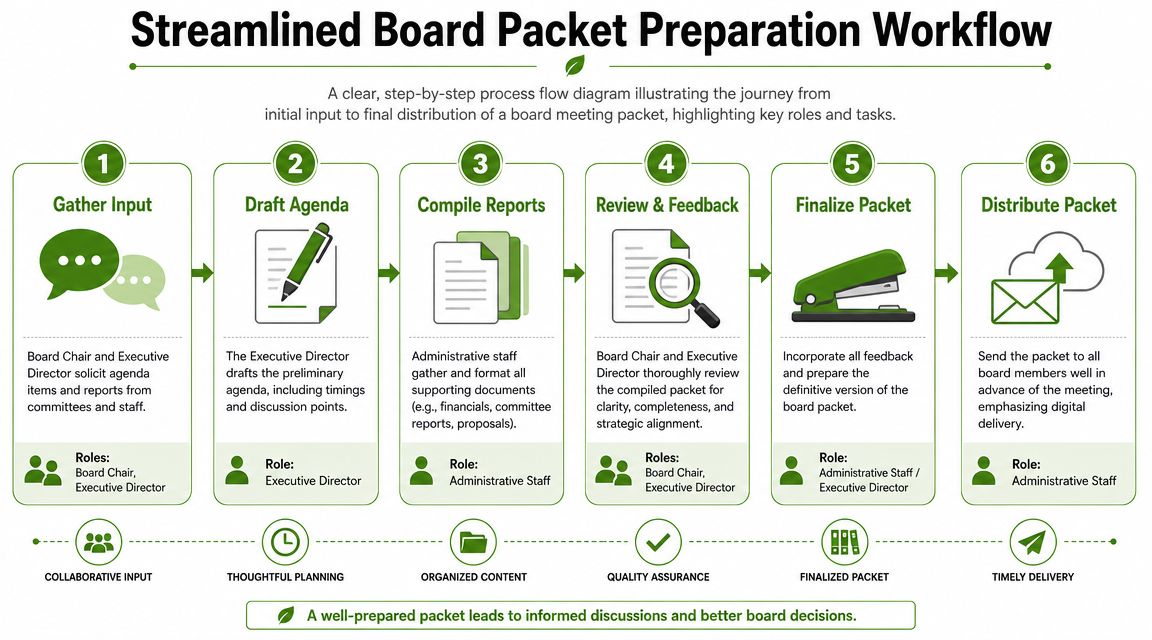
The cleanest setup is shared ownership between the board chair and executive director. The chair decides where the board needs to spend its attention. The executive director pulls together the information trustees need to make those decisions well.
That division matters.
Without it, packets turn into document dumps. Staff include everything because they do not know what the board needs. Board members read selectively, arrive with different facts, and discussion drifts.
A practical split looks like this:
- Board chair: Confirms priorities, tests whether agenda items belong at the board level, and makes sure key decisions are framed clearly.
- Executive director: Drafts the agenda, gathers staff and committee inputs, and prepares short explanations of issues that need discussion or a vote.
- Committee chairs: Submit concise updates with a recommendation, not just background.
- Secretary or administrator: Manages version control, compiles the packet, distributes it, and maintains the official record.
If your secretary role is loosely defined, this overview of the role of secretary in a nonprofit board gives a practical baseline.
A repeatable workflow for small teams
Small nonprofits do not need a fancy process. They need one that still works during grant deadlines, events, and staffing gaps.
Use a simple sequence:
Collect agenda items early
Ask one question: does this item require board information, board discussion, or board action?Build the packet around decisions
Start with the issues that affect mission delivery, cash flow, fundraising capacity, or risk.Request short supporting materials
A one-page memo often serves the board better than a ten-page report. If trustees need to approve a campaign, budget revision, or staffing change, spell out the recommendation, the financial effect, and the consequence of delay.Edit for clarity
Trustees should be able to answer three questions quickly: What is the issue? Why does it matter now? What is the board being asked to do?Send one final packet
Multiple follow-up emails create confusion about which version is current. If something changes after distribution, flag the revision clearly.
Board members should not first discover the real decision in the meeting itself.
Send the packet early enough for real review
The right timing depends on the weight of the agenda, but the standard is simple: send materials with enough lead time for trustees to read, ask questions, and come prepared to decide.
For a routine meeting, several days is usually workable. For budgets, executive evaluations, audits, strategic planning, or major fundraising decisions, boards need more runway. The test is practical, not technical. If members are still skimming documents on their phones five minutes before the call starts, the packet went out too late.
This has a direct effect on fundraising oversight. Boards cannot help with donor strategy, campaign risk, or revenue gaps if they are using live meeting time to decode financials. Early packets give members time to spot questions, offer contacts, and connect program demand with funding choices.
What belongs in the packet
Strong packets are selective. They contain what the board needs to govern, not everything staff produced that month.
Include:
- Final agenda: Mark items clearly as information, discussion, or decision.
- Consent agenda materials: Prior minutes and routine items that do not need live discussion.
- Financial materials: A summary, current statements, and a short note on variances, cash concerns, or revenue opportunities.
- Decision memos: Brief write-ups for approvals, policy changes, campaign choices, or strategic questions.
- Committee reports: Short updates with a recommendation or request for board action.
- Reference items: Only documents trustees need for that specific meeting.
One rule improves packet quality fast. Every major item should answer, in writing, why it matters to mission and what it means for funding. That discipline keeps the board from treating program and fundraising as separate conversations. In well-run organizations, the packet helps trustees see both at once.
What to leave out is just as important. Raw staff notes, duplicate drafts, dense background files, and reports with no clear purpose make the packet harder to use. A shorter packet with sharper framing almost always leads to better discussion and better follow-through.
Facilitating Meetings That Foster Engagement and Action
A well-built agenda can still fail in the room. I've watched chairs with solid materials let meetings drift because they saw their job as reading through the agenda line by line. Effective chairs facilitate. They don't just preside.
That difference changes board behavior. When the chair invites judgment, names the decision point, and keeps discussion tied to mission and funding realities, members participate with more purpose.
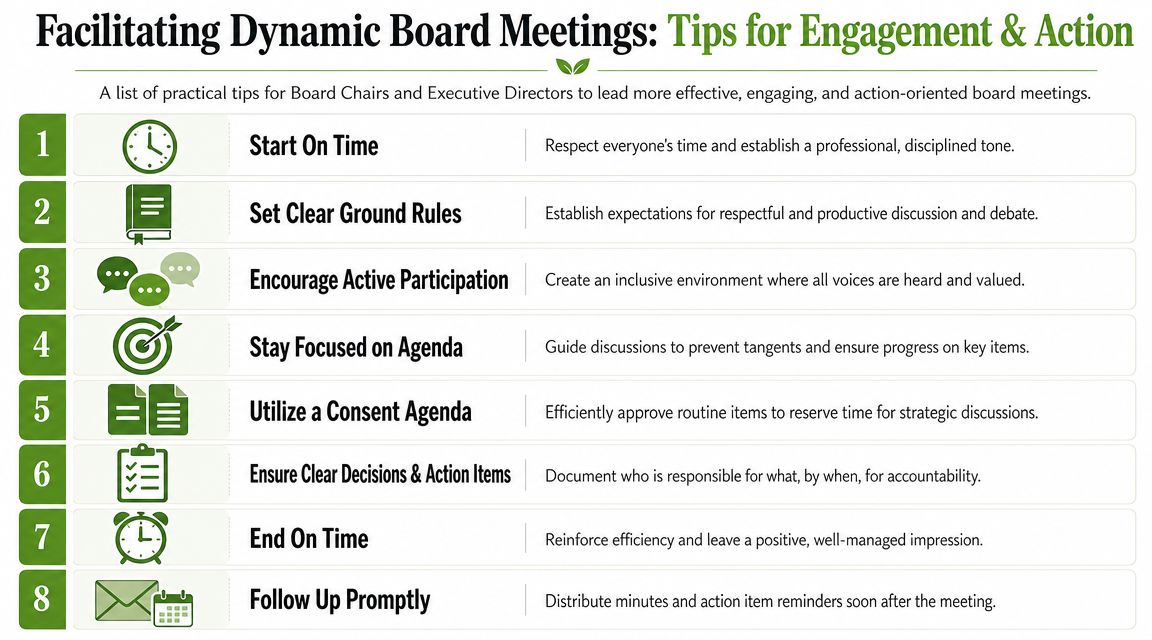
To support that style, this visual gives a concise set of meeting habits worth reinforcing.
The chair's job is to move the conversation from update to judgment
A passive question invites passive participation. Many chairs end a report with, “Any questions?” That usually gets silence or minor clarifications.
A stronger prompt is specific and decision-oriented:
- After a finance report: “What does this mean for our funding priorities over the next quarter?”
- After a development update: “Where can board members open doors that staff can't?”
- After a program report: “Do we need to adjust our fundraising case to reflect this shift in demand?”
Those questions make the board useful. They also connect mission oversight with fundraising effectiveness, which is where many nonprofits need the board most.
Practical ways to keep the room engaged
Use facilitation moves that create focus without shutting people down.
- Start with the outcome: State whether the board is receiving information, discussing options, or making a decision.
- Call on quieter members: Not to put them on the spot, but to widen the conversation.
- Interrupt tangents politely: “That's important, but it sounds operational. Let's capture it for staff follow-up.”
- Name trade-offs directly: Boards often stall because no one says the underlying tension out loud.
- Restate before voting: Summarize the motion, rationale, and implications.
A good chair also watches energy. If the board's attention is fading, shorten a low-value discussion and protect the strategic item.
This short training video is a useful companion for board leaders who want to sharpen meeting practice.
Fundraising belongs in governance, not at the end
Boards often say fundraising is a priority, then place it in the final minutes after everyone is mentally done. That placement tells the truth, even if no one says it.
Put fundraising where the board still has energy. Tie it to mission choices. If a program is growing, ask what revenue plan supports that growth. If grants are uncertain, ask what board relationships, partnerships, or campaign steps need attention. If trustees are unclear on their role, clarify expectations using this practical guide to nonprofit board member responsibilities.
The best fundraising discussions in board meetings aren't about begging for contacts. They're about aligning revenue strategy with what the organization says it wants to accomplish.
What skilled facilitation sounds like
You can hear the difference in a meeting run well:
- “What decision are we making today?”
- “What are the risks if we delay?”
- “How does this affect our ability to fund the mission?”
- “Who owns the next step?”
That language keeps the board out of trivia and inside its proper role.
Closing the Loop with Effective Follow-Up
Adjournment isn't the end of the board's work. It's the handoff point between discussion and execution. Without disciplined follow-up, even a strong meeting dissolves into fuzzy memory and uneven accountability.
Minutes should capture decisions, not everything said
Many nonprofit secretaries try to write a transcript. That creates long minutes that few people read and that don't help anyone act. Better minutes record the essentials: attendance, motions, votes, key decisions, and assigned follow-up.
A clean structure works well:
- Meeting details: Date, time, attendees, quorum.
- Actions taken: Motions, seconds, votes, approvals.
- Reports received: Briefly note what was presented.
- Discussion summary: Only what's needed for context.
- Action items: Owner, task, and expected follow-up.
A simple follow-up email template
The post-meeting email matters almost as much as the minutes. Send it promptly and keep it direct.
Sample follow-up email
Subject: Board meeting follow-up and action items
Hello Board Members,
Thank you for today's meeting. Key decisions included approval of the prior minutes, acceptance of the committee recommendations presented, and agreement on the next steps related to our strategic fundraising priorities.
Action items:
- [Name] will finalize the revised proposal for board review.
- [Name] will follow up on donor or partner outreach discussed in the meeting.
- [Name] will prepare the requested materials for the next board packet.
- [Chair or Secretary] will circulate draft minutes.
Please reply if any action item needs correction or clarification.
Thank you,
[Name]
Good follow-up removes ambiguity. Everyone should know what was decided, who owns the next task, and what needs to happen before the next meeting.
Keep the agenda connected to accountability
The best boards use the next agenda to revisit prior commitments. Old business shouldn't be a parking lot for unresolved topics. It should be where the board checks whether promised actions happened.
That's how a sample nonprofit board meeting agenda becomes more than a document. It becomes a cycle: prepare well, discuss the right issues, make decisions, assign ownership, and return to unfinished commitments with clarity.
If your board is trying to connect meeting discipline with stronger fundraising execution, Fundsprout can help on the funding side. It helps nonprofits identify relevant grant opportunities, organize application work, and keep proposal and reporting tasks from slipping through the cracks, which makes it easier for leadership and boards to align mission priorities with a realistic resource plan.
Try 14 days free
Get started with Fundsprout so you can focus on what really matters.