Unlocking Funding from the Sall Family Foundation
A complete guide to the Sall Family Foundation. Learn their funding priorities, grant sizes, and how to get noticed by this invitation-only funder.

Abdifatah Ali
Co-Founder
When you hear the name Sall Family Foundation, don't picture a group just writing checks. Think of them as a quiet but powerful force, strategically investing in projects where human well-being and the environment meet. Founded by SAS co-founder John Sall and his wife Virginia, this is a foundation that any nonprofit working on global development and conservation needs to understand.
The Mission and People Behind the Sall Family Foundation

At its heart, the Sall Family Foundation is all about making calculated, long-term bets on incredibly complex global problems. They aren't interested in sprinkling small grants across hundreds of projects. Instead, they focus on making deep, significant investments where they see a genuine opportunity for lasting change. This approach comes directly from the founders' backgrounds in data and analytics.
John Sall, one of the co-founders of the statistical software giant SAS Institute, and his wife, Virginia "Ginny" Sall, view their philanthropy through a unique lens. They believe that evidence, data, and measurement are just as essential in the nonprofit world as they are in business. This means they are naturally drawn to organizations that can do more than just run a program—they want partners who can prove their work is effective with real, tangible results.
A Commitment Forged by the Giving Pledge
The foundation's direction became crystal clear when John and Ginny Sall joined the Giving Pledge. This is a promise made by some of the wealthiest people in the world to give away the majority of their fortunes. By signing on, the Salls signaled an unwavering commitment to tackling some of the world's most persistent challenges.
Their pledge letter really gets to the point: "Our philanthropic priority is to join with others to help the world's poorest people lift themselves out of poverty." That single sentence acts as the north star for every grant, partnership, and decision the foundation makes.
This pledge is about more than just money; it's about a hands-on, problem-solving mindset. To really grasp what drives foundations like the Salls', it helps to understand what strategic giving is all about and how it creates real impact.
Core Motivation and Guiding Philosophy
The Sall Family Foundation’s work is ultimately about fostering self-sustaining change. They aren’t just looking to provide aid. Their goal is to build up a community's own capacity to solve its problems. Think of it less like giving someone a fish and more like investing in the entire local fishing industry—from better equipment and sustainable practices to new markets.
This mission rests on a few core beliefs that you'll see time and again in their funding choices:
- Integrated Solutions: They get that you can't solve poverty without addressing health, and you can't protect the environment if people are struggling to survive. These issues are woven together, so the solutions must be, too.
- Long-Term Partnerships: The foundation isn't looking for a one-off project. They prefer to build relationships with their grantees over many years, allowing for genuine collaboration, learning, and course correction along the way.
- A Focus on Evidence: Data is everything. Organizations that meticulously track their progress, measure their impact, and use that data to get better at what they do will always have an edge.
By understanding the people, the pledge, and the philosophy driving the Sall Family Foundation, you can start to see if your own mission clicks with their vision. It's the first and most critical step in figuring out if your work aligns with their goal of building a healthier, more equitable, and sustainable world.
What They Fund and Where They Focus
To figure out if the Sall Family Foundation is the right partner for your nonprofit, you have to look past the mission statement and see where they actually put their money. They don’t just give—they invest. Think of them as strategic investors looking for the highest possible human and environmental return on their capital.
Their funding isn't scattered across dozens of causes. Instead, it’s laser-focused on a few core areas where they believe they can make a significant, long-term impact.
At its core, the foundation operates at the intersection of environmental conservation, public health, and poverty reduction. They see these not as separate problems, but as deeply connected challenges. A community can't prosper if its natural resources are gone, and conservation efforts will fail if people don't have basic health and economic security.
This integrated philosophy is your first clue. A single grant might support a program that improves crop yields (addressing poverty), teaches better nutrition (improving health), and promotes sustainable farming (protecting the environment)—all at the same time.
The Three Pillars of Sall Family Foundation Funding
The foundation has built its strategy around three interconnected pillars. If your work doesn't fit squarely into one or more of these, it's probably not a match.
Poverty Reduction & Livelihood Development: A huge emphasis is placed on programs that help people become economically self-sufficient. They are major supporters of Village Savings and Loan Associations (VSLAs), cash transfer programs, and other initiatives that empower communities to build financial resilience from the ground up.
Community Health Systems & Nutrition: The foundation invests heavily in strengthening local health services and fighting malnutrition. They fund work that improves access to essential care and promotes better nutrition, with a special focus on mothers and children.
Environmental Conservation & Disaster Resilience: Protecting natural ecosystems is a cornerstone of their giving. This includes partnerships with major environmental groups as well as support for community-led efforts to build resilience against climate-related disasters.
This isn't about one-off grants. The foundation is known for building deep, multi-year partnerships. For example, their relationship with CARE spans 17 years and includes major awards like $7,600,000 for programmatic support, showing a real commitment to seeing complex projects succeed over the long haul.
To give you a quick snapshot, here’s a summary of the foundation's funding profile.
Sall Family Foundation Funding at a Glance
| Characteristic | Details |
|---|---|
| Total Assets | Over $136 million |
| Recent Giving | Over $33.9 million given in recent years |
| Primary Focus Areas | Poverty Reduction, Community Health, Environmental Conservation |
| Grant Type | Primarily long-term, multi-year program support |
| Key Regions | Sub-Saharan Africa, Latin America & the Caribbean, South & Southeast Asia |
| Typical Approach | Integrated, multi-sector projects are highly favored |
This table should help you quickly determine if your organization’s work aligns with the Sall Family Foundation's strategic priorities.
A Distinct Geographic Focus
The Sall Family Foundation’s work is overwhelmingly international. While a small number of grants go to local organizations in their home state of North Carolina, the vast majority of their funding is directed abroad.
If your work is based in the United States (outside of that specific NC focus), securing a grant here is highly unlikely. Their priorities are clear and consistent.
Their key geographic targets are:
- Sub-Saharan Africa
- Latin America and the Caribbean
- South and Southeast Asia
This geographic targeting isn't random. It aligns directly with their mission to support the world’s most vulnerable populations, concentrating on regions where poverty, health crises, and environmental threats are most severe. For grant seekers, this is a critical filter. Your work must not only match their program goals but also happen within these specific parts of the world.
The foundation's financial strength is substantial. With total assets over $136 million, they have the capacity for major investments, like a $4,600,000 award to the World Wildlife Fund. You can explore more of their financials and past awards in this overview of the Sall Family Foundation on Zeffy.com.
Understanding these funding pillars and geographic limits is your first and most important step. If your programs fall outside these lines, pursuing this funder likely isn’t a good use of your time. But if you see a strong overlap, it's time to dig deeper. Learning how to find winnable grants is all about this kind of targeted research, and the Sall Family Foundation is a perfect example of why it works.
What to Expect from Their Grant Sizes and Types
To really see if your organization aligns with the Sall Family Foundation, you have to look past the mission statement and dig into the numbers. The data tells the real story of their funding style, what they prioritize, and how much risk they're willing to take. Getting a handle on their typical grant sizes and the kinds of support they offer is like learning a funder’s native language—it helps you ask for what they're actually inclined to give.
Think of their grantmaking like a well-managed investment portfolio. While they're known for some huge, multi-million-dollar grants, that’s not the whole picture. A closer look reveals a more balanced approach, where they mix big bets on proven models with smaller, more targeted grants.
This snapshot gives you a quick, at-a-glance look at their recent giving habits. These are the key figures every nonprofit should be aware of before reaching out.
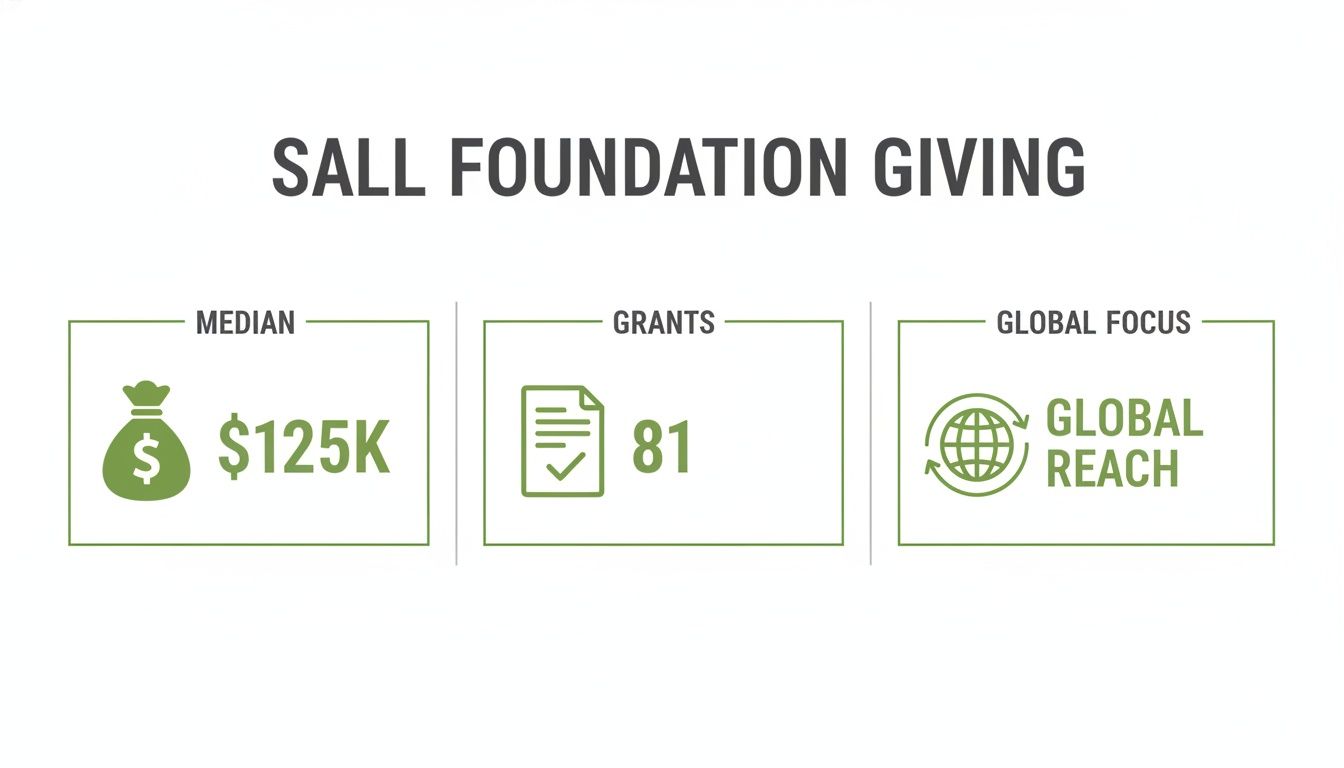
These numbers paint a clear picture: this is a highly selective foundation with a worldwide scope. That median award of $125,000 is a solid starting point, but it sits in the middle of a very, very wide range.
Decoding the Financial Landscape
That median grant amount, which often floats around $150,000, is an important number to know. It’s their "middle-of-the-road" award and gives you a sense of the project scale they're most comfortable with, especially for new partners. But don't let that median fool you; it's just one piece of the puzzle.
The foundation’s giving range is incredibly broad. We’ve seen smaller, strategic awards around $25,000 and, on the other end, massive, multi-year commitments topping $7.6 million. This tells us they have a flexible strategy. Those smaller grants, like a $25,000 award for science philanthropy, often act as seed funding for new ideas or niche projects.
In contrast, the seven-figure grants are almost always reserved for established, long-term partners who have already proven their impact. This dual approach allows the Sall Family Foundation to both explore new innovations and double down on what they know works.
Programmatic vs. General Operating Support
It's absolutely critical to understand the difference between how they fund projects versus how they fund organizations. They make a clear distinction between programmatic grants and general operating support (GOS).
- Programmatic Grants: This is funding tied to a specific project with its own set of goals, a clear timeline, and defined outcomes. This is, by far, their preferred way to make large investments.
- General Operating Support: This is flexible, unrestricted cash that a nonprofit can use for essentials like salaries, rent, or other overhead. While they do provide GOS, it’s not where you’ll typically see their biggest checks written.
The data couldn't be clearer: The Sall Family Foundation has a strong preference for programmatic support, especially when it comes to their multi-million-dollar awards. This is a huge signal that they are more interested in funding the "what"—the specific, scalable program—than simply the "who."
What this means for you is that a proposal for a well-defined, high-impact project will almost always get a better reception than a general request for overhead funding.
The Power of Long-Term Partnerships
When you look at their biggest grants, you see a deep commitment to environmental conservation and program depth. Just look at standout awards like $4,600,000 to the World Wildlife Fund Inc. and $2,900,000 to the Rocky Mountain Institute. These aren't one-off grants; they are the result of sustained investment in long-standing relationships.
Even though they're selective—with a 27.1% giving rate across tracked grants—their financial stability makes them a dependable partner for global initiatives. You can see more about how their funding patterns create opportunities by checking out the in-depth statistics from Hinchilla.com.
By understanding these tendencies—the wide grant range, the bias toward programmatic funding, and the value they place on long-term relationships—you can be realistic. This knowledge will help you frame your work in a way that truly resonates with the Sall Family Foundation's core strategy, whether you're a small but growing initiative or an established leader looking to scale.
How to Get Noticed by an Invitation-Only Funder
That "invitation-only" tag can feel like a brick wall. When there’s no application portal or public email, getting on the radar of a major player like the Sall Family Foundation seems impossible. But the strategy isn't about finding a secret password; it's about making your work impossible to ignore.
Forget chasing them down. Your real goal is to become so effective and visible in your field that you naturally draw their attention. An invitation, when it comes, should feel like the logical next step for an organization doing outstanding work—not a lucky break.
This means becoming a recognized leader in a niche that lines up perfectly with the foundation's priorities. If you work on community health in sub-Saharan Africa, for example, your aim is to be one of the most effective and well-regarded organizations doing that specific work.
Build Your Reputation Through Results
Invitation-only funders are constantly scouting for top performers. Their program officers use their networks, research, and industry reports to find organizations that are already delivering incredible results. The most powerful way to get noticed is to have a track record of undeniable, well-documented impact.
Here’s how you can make that happen:
- Publish Compelling Impact Reports: Go beyond just listing activities. Your reports should tell a data-rich story about the change you’re creating. Show your methodology, highlight your outcomes, and be honest about what you’ve learned along the way.
- Earn Third-Party Validation: Recognition from respected industry groups, awards, or features in major sector publications all act as powerful signals. This external validation proves you're not the only one who thinks your work is great.
- Become a Voice of Authority: Position your leadership as experts. Get them on stage at conferences, encourage them to publish articles, and have them contribute to the big-picture conversations happening in your field.
The goal is simple: make your results do the talking for you. When a program officer at the Sall Family Foundation is researching the most effective nutrition programs in Southeast Asia, your organization’s name should be one of the first they find.
This is a long game. It requires a deep commitment to excellence and patience. But it's the only sustainable way to attract high-value partners who are searching for proven impact, not just a promising pitch. For more on making a strong case, you might find some useful parallels in this Founders Guide to Creating Pitch Decks that Close Deals.
Network Strategically and Build Alliances
While a cold email won't work, strategic networking is absolutely essential. The philanthropic world is smaller and more interconnected than you might think. Your objective is to build genuine relationships within the foundation's entire ecosystem, not just try to get a meeting with them directly.
Think of it as building a web of trust that leads back to your work. A warm introduction from a respected peer is often the very thing that sparks an invitation.
- Connect with Current Grantees: Find organizations already funded by the Sall Family Foundation and collaborate with them. Share insights, partner on projects, and build real professional relationships. Their endorsement is incredibly valuable.
- Engage with Their Network: Funders talk to each other. If you build a strong reputation with other foundations working in the same area, word will travel.
- Show Up in the Right Places: Be present where their program officers are likely to be. Attending major conferences and symposiums on global health, conservation, or poverty alleviation is a must.
This isn't about passing out business cards and asking for money. It's about showing your value and building relationships based on shared goals. Your networking should pique their interest, making them want to learn more about you—much like a strong Letter of Inquiry. In fact, you can learn more about crafting a powerful LOI in our article. By focusing on results and relationships, you stop hoping for an invitation and start earning one.
Preparing for Your Invitation with Fundsprout

When you hear a foundation like the Sall Family Foundation is "invitation-only," it’s easy to feel like your hands are tied. But waiting around for a miracle call isn’t a strategy. The truth is, the most successful nonprofits don’t wait; they build a system of perpetual readiness. They are so organized, so proven, and so visible in their field that when a major opportunity arises, they’re ready to respond with confidence.
This is where a platform like Fundsprout can become an indispensable part of your toolkit. Even when you can't submit an LOI to your dream funder, our tools help you build the exact reputation and track record that gets you noticed. Think of it as your training ground for the big leagues.
Building Your Track Record with Lookalike Funders
From my experience, the path to an invitation from a major player like the Sall Family Foundation is almost always paved with successful grants from other, more accessible foundations. You have to prove your mettle first. That means demonstrating real impact, disciplined financial oversight, and a history of well-executed projects.
Fundsprout is designed to help you find those crucial stepping-stone opportunities. Instead of just dumping a massive list of grants on you, our AI helps you pinpoint funders whose priorities, geographic focus, and grant sizes mirror those of your ultimate goal.
- Find Aligned Funders: Use our search features to identify other foundations that also fund, for example, community health initiatives in sub-Saharan Africa or poverty alleviation in Latin America.
- Secure Real Wins: Every grant you win from these organizations becomes a proof point. It’s a tangible accomplishment you can add to your organizational resume, which is exactly what program officers at major foundations look for when scouting new partners.
- Become Known: When you're an active and successful grantee in a specific niche, people notice. Funders talk, and a reputation for excellence travels fast in philanthropic circles.
By systematically winning these aligned grants, you’re not just funding your current work. You're proactively building a compelling case for why a major investor like the Sall Family Foundation should come looking for you.
Developing a Master Case for Support
An invitation can land in your inbox at any time, often with a tight deadline. You simply won't have months to pull a proposal together from scratch. This is why I always tell nonprofits that having a "master case for support" is non-negotiable. It’s your core document, holding all your essential narratives, data, and organizational details, ready to be customized for any application.
A master case for support is your organization's story, quantified and ready to deploy. It’s the ultimate preparation tool, ensuring you never have to scramble for essential information when a high-stakes opportunity arises.
Fundsprout’s AI Writing Assistant was built for this exact purpose. You can feed it your past proposals, annual reports, and strategic plans, and it learns your organization's voice and key messages. When you need to draft a new narrative, it can generate sections that are already on-brand and backed by your proven data. For nonprofits looking to discover more winnable grants, having this repository of high-quality content ready to go is a game-changer.
This system of perpetual readiness turns grant-seeking from a reactive, stressful scramble into a calm, strategic operation. It ensures that when an invitation from the Sall Family Foundation—or any other top-tier funder—arrives, you aren't just ready to apply. You are ready to win.
Common Questions About the Sall Family Foundation
Even for a seasoned grant seeker, an invitation-only funder like the Sall Family Foundation can feel like a puzzle. Without a clear application process, you're left wondering how to even get a foot in the door. Getting straight answers to the most common questions is the first step in building a smart strategy.
Let's walk through what you really need to know. These insights can help you figure out if pursuing a relationship with this foundation is the right move for your organization.
Does the Sall Family Foundation Accept Unsolicited Proposals?
This is the first hurdle for everyone, and the answer is a straightforward no. The Sall Family Foundation operates on a strictly invitation-only model. They do not review unsolicited proposals or letters of inquiry, and you won't find an application form anywhere.
So, what does that mean for you? It means you have to shift your entire mindset from "applying" to "attracting." Getting on their radar depends completely on your organization's ability to demonstrate powerful, measurable results in their specific focus areas. The goal is for their team to discover your work on their own and be the ones to reach out.
What Is the Best Way for My Nonprofit to Get Noticed?
Getting noticed by the Sall Family Foundation isn't about a single campaign; it's the result of a long-term commitment to becoming a leader in your field. You need to be seen as the go-to expert.
Your real work is to become a recognized authority in one of their key areas, whether that’s community health in sub-Saharan Africa or poverty reduction through VSLAs in Latin America.
Here are the strategies that actually work:
- Publish compelling research and detailed impact reports. Show your numbers, explain your methods, and prove your results are real.
- Build relationships with their current grantees and other partners in their network. A warm introduction from a trusted source is worth its weight in gold.
- Make sure your work is visible. Get your findings presented at major conferences, published in respected journals, and featured in key industry publications.
Think of it this way: their program officers are constantly looking for the top-performing initiatives. Your job is to make sure that when they search, they find you.
What Kind of Support Does the Foundation Prioritize?
The foundation awards both project-specific funding and general operating support, but a look at their grant history tells a clear story. They have a strong preference for giving large, multi-year programmatic grants to organizations they already know and trust.
This tells us they are looking to back scalable, high-impact programs run by organizations with the capacity to deliver. While they do give general operating support, it's usually for smaller amounts and often comes after a successful project grant.
This focus on programmatic funding is a huge signal. It means they invest in the "what"—the specific, evidence-based program with clear outcomes—just as much as the "who." A proposal for a powerful, well-defined project will almost always catch their eye more than a general request for overhead.
Ready to build the track record that gets you noticed by major funders? Fundsprout is an AI-powered platform that helps you find winnable grants, write stronger proposals, and manage your entire funding pipeline with ease. Discover your next opportunity at https://www.fundsprout.ai.
Try 14 days free
Get started with Fundsprout so you can focus on what really matters.