Your Guide to Rough Order of Magnitude Grant Planning
Learn how to use a rough order of magnitude (ROM) estimate to make smarter grant planning decisions for your nonprofit. A practical guide with examples.


Abdifatah Ali
Co-Founder
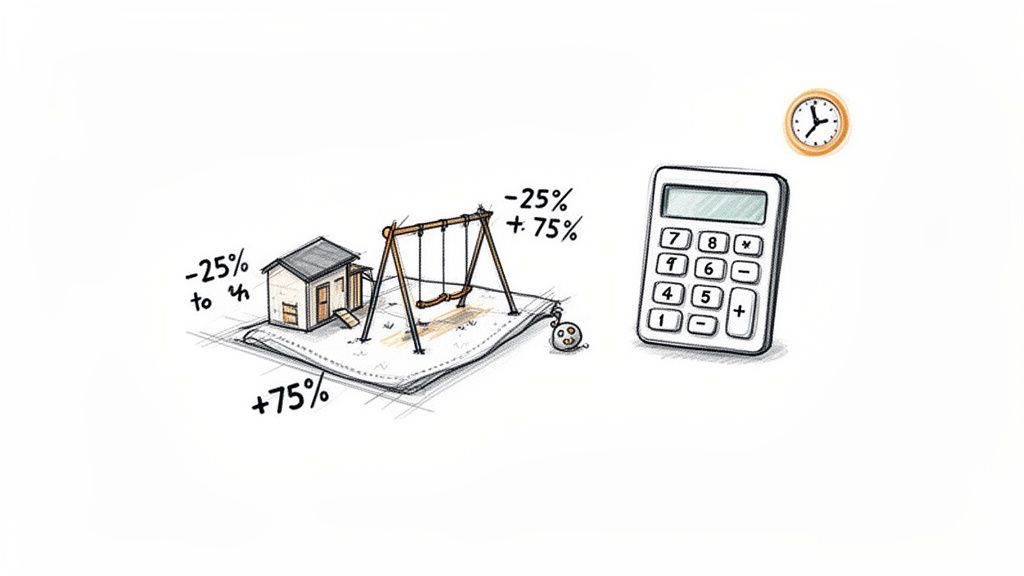
Ever heard the term “rough order of magnitude” thrown around in a planning meeting? Think of it as the financial equivalent of a quick sketch on a napkin. It’s not the detailed blueprint; it’s the initial, big-picture idea that tells you if building the house is even feasible.
Understanding the Rough Order of Magnitude Estimate
Let’s say a potential grant opportunity pops into your inbox. It looks great on the surface, but your team's time is incredibly valuable. Before anyone sinks hours into crafting a detailed proposal, you need a fast answer to a simple question: "Is this project even in our financial ballpark?"
This is the exact moment a ROM estimate becomes your best friend. It’s not a formal quote or a detailed budget. It's a strategic tool for making quick, early-stage decisions. It helps your nonprofit get a feel for the potential financial scope of an idea, so you can decide if it's worth the effort to explore further.
Why the Accuracy Range Is So Wide
One thing that often surprises people about a ROM estimate is how broad its accuracy range is. According to the Project Management Institute’s PMBOK Guide (6th edition), a typical ROM has an accuracy of −25% to +75%.
What does that look like in practice? If your ROM estimate for a new community garden program is $100,000, the final cost could realistically fall anywhere between $75,000 and $175,000. You can find more details on the specifics of ROM estimation and its applications online.
This massive window isn't a mistake—it's the whole point. It’s a built-in acknowledgment of all the unknowns you face at the very start of a project.
A rough order of magnitude estimate is your first strategic filter. It’s not about getting the numbers perfect; it's about getting them just good enough to make a smart go/no-go decision without wasting valuable resources.
This initial number acts as a crucial guardrail. It stops your organization from chasing grants that are too small to make a real difference or, just as importantly, too large for you to manage with your current capacity.
To help you remember these core ideas, here’s a quick summary of what makes a ROM estimate unique.
Key Characteristics of a ROM Estimate
This table summarizes the core attributes of a Rough Order of Magnitude estimate, helping you quickly understand its purpose and limitations in nonprofit grant planning.
This table makes it clear: a ROM is a low-effort, high-level tool designed for early-stage screening, not detailed execution planning.
How Nonprofits Use ROM Estimates
For any mission-driven organization, a well-timed ROM is an invaluable tool. It plays a few critical roles in the early days of grant planning and project development:
- Feasibility Check: It’s a quick reality check. Does this great idea even remotely align with the potential funding or our internal resources?
- Strategic Filtering: It helps you sort through a pile of potential grant opportunities and focus your team’s energy only on the ones that make sense.
- Leadership Alignment: It gives you a preliminary number to take to your board or executive director to get conceptual buy-in before you invest heavily in the proposal process.
- Funder Conversations: It provides a solid starting point for those early, exploratory chats with program officers, showing them you’ve already done some thoughtful, proactive planning.
At the end of the day, a ROM estimate is the first domino in a solid financial planning process. It’s the quick math that helps turn a brilliant idea into a fully funded, real-world success story.
So, when does a Rough Order of Magnitude estimate actually come into play during your grant cycle? Think of it as your secret weapon for the earliest, most uncertain stages of planning. This isn't the number you'll submit in your final proposal. Its real value is in providing a compass when you're navigating a sea of questions and possibilities.
Using a ROM at just the right time can save your team from chasing dead ends and help you focus your precious energy on the most promising funding opportunities. It’s the first, most important filter you’ll use.
Go/No-Go Decisions and Stakeholder Alignment
The most powerful application of a ROM is for making those crucial internal go/no-go decisions. We’ve all been there—a new project idea sparks excitement, and the team is ready to dive in. But before anyone gets too attached, a quick ROM provides a much-needed dose of reality. Is the project's scope way too big for the potential funding? Or is the grant amount too small to even cover the basic costs?
This back-of-the-napkin math becomes an essential tool for talking with your stakeholders. Walking into a meeting with your board or leadership team and presenting a ROM is the perfect way to get their initial buy-in.
For instance, you could say, "Our very early estimate to get a mobile food pantry on the road is somewhere between $80,000 and $180,000." This simple statement immediately frames the conversation around feasibility and strategy, not nit-picky line items.
A ROM gives you a concrete, defensible number to start a conversation. It transforms a vague idea into a tangible concept that leadership can evaluate, discuss, and ultimately approve for further exploration.
It also helps you manage expectations right from the start. By being upfront about the wide accuracy range (like -25% to +75%), you’re being transparent about the current level of uncertainty. This builds trust and shows you're a fiscally responsible planner who understands the process.
From Initial Idea to Detailed Budget
A ROM isn't a one-and-done document. It's the first stepping stone in a path that leads to a detailed, accurate budget. As you move deeper into the grant planning process, your estimates will naturally get sharper and more refined. A well-thought-out ROM provides the solid foundation you'll build your final budget upon.
To see how this all fits together, it helps to compare the different types of estimates you'll create along the way.
Choosing the Right Estimate for Each Grant Stage
This table breaks down the three main types of estimates, showing when to use each one and what to expect in terms of accuracy.
As you can see, the ROM is where it all begins. It gives you the confidence to have those early, exploratory conversations with program officers, showing them you're thinking ahead without locking yourself into premature, rigid figures. It’s the tool that gets the ball rolling, ensuring that by the time you're sweating the details of a definitive budget, you’re doing it for a project that has been strategically vetted and approved from the get-go.
How to Create Your First ROM Estimate
You don’t need a finance degree to pull together a solid rough order of magnitude estimate. Honestly, it’s less about complicated math and more about structured thinking and using the information you already have. Let’s walk through three simple but powerful methods any nonprofit pro can master.
These aren't meant for final budgets; they're designed for speed and getting a quick read on a project's potential scale right at the beginning.
This visual shows exactly where a ROM fits into the bigger picture of project planning—it's the first sketch before you start filling in the details.
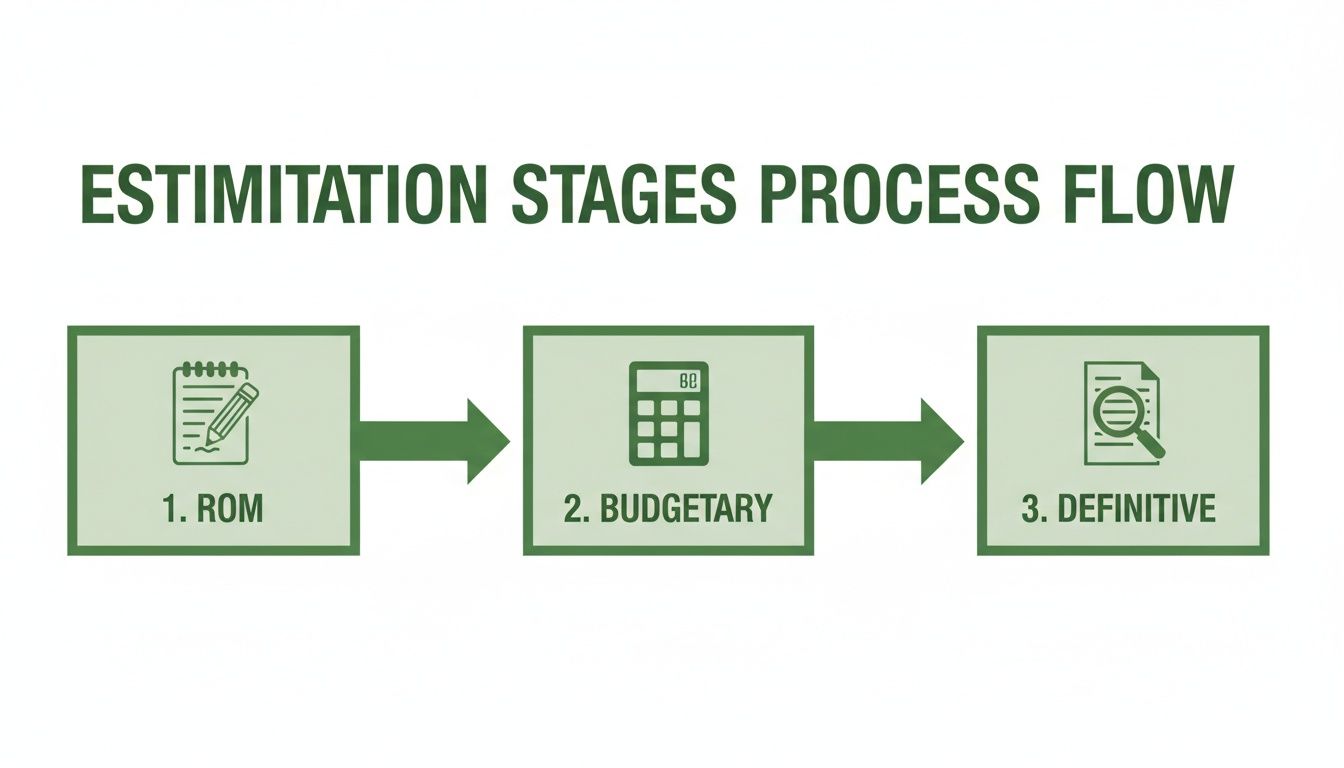
As you can see, the ROM is that crucial first step. It lays the groundwork for more detailed budgetary and definitive estimates once the project starts to take real shape.
The Analogous Estimating Method
Think of this as the "we've done something like this before" method. You're simply looking at the actual cost of a past project and using it as a starting point for a new, similar one. It’s a great way to answer the question, "What did it cost us last time?"
For instance, maybe your nonprofit ran a summer literacy camp last year for 50 children that cost $40,000. This year, you’re thinking about a similar camp, but for 60 children. Right away, you have a baseline. You know the cost will be a bit more than $40,000, giving you an instant rough estimate to start the conversation.
This method is incredibly fast. It's most reliable when you have good historical data and the new project is a very close match to the old one.
The Parametric Estimating Method
Parametric estimating takes things a step further. Instead of grabbing the total cost from a past project, you drill down to a specific unit cost—a parameter—to build your new estimate. You're basically figuring out a "per-person" or "per-item" rate.
Let's stick with our summer literacy camp example.
- Find Your Unit Cost: Last year’s $40,000 camp served 50 kids. That gives you a unit cost, or parameter, of $800 per child ($40,000 / 50).
- Apply It to the New Project: For this year’s camp with 60 children, you just multiply the new number by that unit cost: 60 children x $800/child = $48,000.
Just like that, you have a parametric ROM of $48,000. This approach is usually more accurate than the analogous method because it scales with the project’s specific size. When you're sifting through past data to find these parameters, tools for AI Data Analysis can be a huge help in spotting trends and pulling out the right numbers quickly.
The Top-Down Estimating Approach
Sometimes, you aren't starting with a project idea; you're starting with a grant amount. The top-down approach flips the script. You begin with the total funding available and work backward to figure out what kind of project you can realistically deliver.
A top-down estimate isn’t about figuring out what you think a project will cost. It's about figuring out what you can actually do with the money you have.
Imagine a foundation announces a $25,000 grant for community wellness initiatives. Instead of building a dream project and hoping it fits, you start with $25,000 as your firm ceiling. From there, your team can brainstorm what's possible:
- Could we run a series of 10 wellness workshops for that amount?
- Is that enough to buy new equipment for the community gym?
- Can we hire a part-time instructor for six months?
This approach is perfect for tailoring a project to a specific funding opportunity. It ensures your proposal is perfectly aligned with the funder’s budget right out of the gate. Once your ROM helps you define the scope, you can dive into the details with a formal budget. Our free grant budget template is a great resource for that next step.
Bringing ROM Estimates to Life in the Nonprofit World
Theory is one thing, but seeing a rough order of magnitude estimate in action is where it all starts to make sense. To really understand how this works, let's walk through three different scenarios from the nonprofit sector. These stories show how organizations use ROMs to make smart, early-stage decisions—long before they’ve even started a grant application.
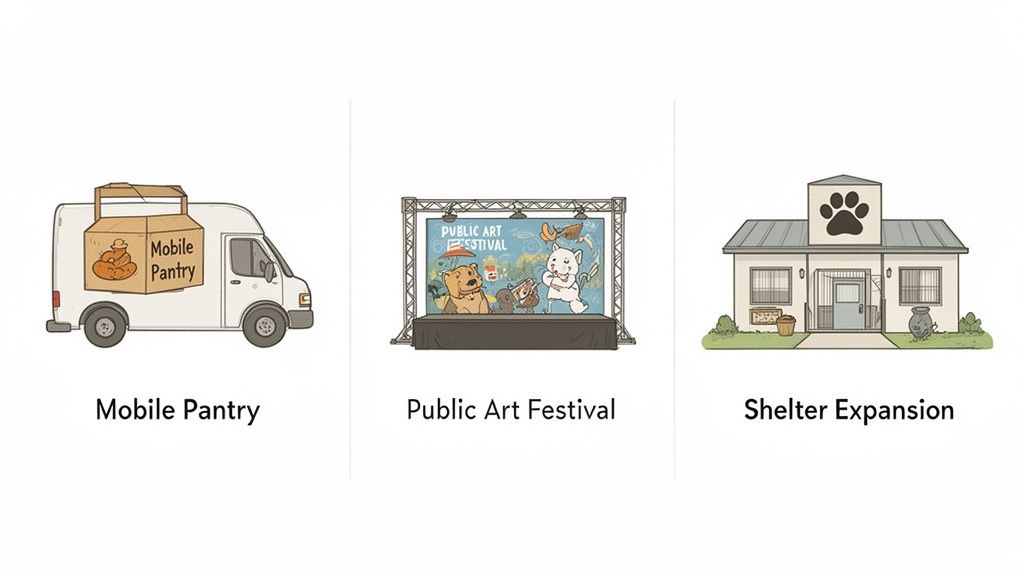
Each of these examples uses a slightly different estimation method, which will give you a feel for how to adapt these techniques to your own projects.
Story 1: The Food Bank's Mobile Pantry
A local food bank dreamed of launching a mobile pantry to serve families in remote rural areas. It was a brand-new idea for them, so trying to create a detailed line-item budget from scratch was impossible. They needed a starting point.
- Method Used: Analogous Estimating
- How They Did It: The director got resourceful. She started digging into the annual reports of three other food banks in neighboring states that were already running mobile pantries. From her research, she found their annual operating costs fell between $95,000 and $120,000.
- The ROM Calculation: By averaging those numbers, she arrived at a ROM of about $110,000 for the first year. She then applied the standard -25% to +75% accuracy range, giving her a working financial ballpark of $82,500 to $192,500.
- The Payoff: Armed with this ROM, the food bank felt confident enough to go after a $150,000 grant. The grant amount landed squarely within their estimated range, confirming the project was feasible enough to invest time in developing a full, detailed proposal.
Story 2: The Arts Council's Public Festival
An arts council was sketching out plans for a huge, city-wide art festival. The project’s size—and cost—all hinged on one key question: how many local artists could they commission? Their big goal was to fund at least 20 new public art installations.
- Method Used: Parametric Estimating
- How They Did It: The team dug into the numbers from their past events. They figured out that, on average, the total cost for each commissioned piece (including the artist’s stipend, materials, and insurance) came out to $7,500. This became their key data point.
- The ROM Calculation: The math was simple. They just multiplied their target by their cost-per-unit: 20 installations x $7,500 per installation = $150,000.
- The Payoff: With a $150,000 ROM in hand, the council started conversations with the city’s cultural affairs department. The figure was concrete enough to kickstart a real discussion about a partnership, anchoring the talk in a clear, scalable financial model. This initial step is perfect for laying the groundwork before you build out a more formal budget. For help with that next stage, these sample grant budgets are a great resource.
Story 3: The Animal Shelter's Expansion
An animal shelter desperately needed to add a new wing for a low-cost spay and neuter clinic. This was a major capital project, and the board needed a top-level cost estimate to even begin thinking about a fundraising campaign.
When it comes to construction, a ROM is essential for filtering out unfeasible ideas early. It transforms an architectural dream into a financial reality check, allowing leadership to prioritize projects with the best chance of success.
- Method Used: Parametric Estimating (Square-Foot Pricing)
- How They Did It: They reached out to a local contractor who had experience building nonprofit facilities. The contractor gave them a standard industry rate for a medical-grade animal care space: roughly $350 per square foot.
- The ROM Calculation: The initial sketches called for a 2,000-square-foot addition. Their calculation was straightforward: 2,000 sq ft x $350/sq ft = $700,000.
- The Payoff: That $700,000 figure became the initial goal for their capital campaign. It was the number they could share with major donors and the board to get everyone on the same page. This square-foot pricing method is a go-to in the construction world, helping teams make sense of the 1.5 million building permits issued annually in the U.S. and decide which projects to pursue.
Common Mistakes to Avoid with ROM Estimates
A rough order of magnitude estimate can be a fantastic tool for getting a project off the ground, but it’s packed with a few traps for the unwary. To use it well, you really need to understand what not to do.
Probably the biggest mistake is treating a ROM with the same seriousness as a finalized, line-item budget. That’s one of the fastest ways to lose trust with funders, your board, and other stakeholders.
Think of it like this: a ROM is the first grainy photo you get back from a satellite, not the detailed street-level map. Its only job is to confirm you’re looking at the right continent. If you present it as anything more, you’re setting expectations that are bound to be broken, which can really damage your credibility later on.
Overlooking Key Assumptions
It’s so easy to jot down a number and forget to document the "why" behind it. But a ROM is only as solid as the assumptions it's built on.
Let’s say you’re estimating the cost of a new van for a mobile food pantry. Did you assume you'd be buying new or used? Did your number include insurance, registration, and fuel for the first year? These details are everything. Without them, your estimate is just a number floating in space, making it nearly impossible to defend or adjust as you learn more.
Along those same lines, completely forgetting about indirect costs is a classic blunder that can blow a huge hole in your budget. It's absolutely vital to account for these operational expenses from the very beginning. If you're unsure how, take a look at our guide on how to calculate indirect costs to make sure they're baked into your early numbers.
A ROM without documented assumptions is just a guess. A ROM with clear, documented assumptions is a strategic planning tool.
Failing to Communicate the Range
This might be the most critical mistake of all: not being completely, upfront, and transparent about the -25% to +75% accuracy range. This isn't the fine print; it's the main headline.
When you share a ROM estimate, you have to be crystal clear that the final number could end up being very different. It’s not about being non-committal; it's about being honest and managing risk.
In fact, this kind of transparency is a powerful risk management strategy. A 2023 PMI survey found that 68% of projects using a ROM in the early stages successfully avoided scope creep down the road, saving an average of 15–20% on their final budgets. You can learn more about how effective estimation prevents project failure on Galorath.com.
By steering clear of these common pitfalls, you can turn your ROM from a potential liability into a genuinely valuable strategic asset for your nonprofit.
Got Questions About ROMs? We've Got Answers.
Even once you get the hang of it, putting a rough order of magnitude estimate into practice can feel a little tricky. Let's tackle some of the most common questions that pop up when you're in the trenches, trying to make these numbers work for you.
How Do I Explain That huge +/- Range to My Board?
This is a big one. When you show a range like -25% to +75%, it can raise some eyebrows. The key is to frame it correctly. Don't present it as a budget; present it as a "feasibility check."
I find an analogy works wonders here. Tell them it's like an architect's first napkin sketch, not the final detailed blueprint. Everyone understands that a quick concept drawing isn't the same as the engineering plans, and a ROM works the same way. It's a tool to see if the idea is even in the right ballpark.
Emphasize that the wide range isn't a bug—it's a feature. It’s an honest reflection of how much we still don't know at this very early stage. This kind of transparency actually builds trust and shows you’re a responsible planner managing expectations from the get-go.
Can I Create a ROM if I Have No Past Project Data?
Absolutely. It’s a common situation, especially for new programs. While having your own historical data for an Analogous Estimate is great, it's not the only way.
This is where you have to look outside your own four walls.
- Use industry benchmarks: Parametric Estimating is your friend here. Find out the average cost to serve one person in your field or the typical cost-per-square-foot for a facility renovation.
- Do some research: Dig into the annual reports or public grant filings (like IRS Form 990s) of nonprofits similar to yours. You can often see what they spent on projects like the one you're planning.
The secret isn't having perfect internal data. The secret is documenting your assumptions and showing your work. A well-reasoned estimate based on solid external research is a hundred times better than a wild guess pulled out of thin air.
What's the Difference Between a ROM and T-Shirt Sizing?
They're both early-stage estimation tools, but they answer different questions. The main difference is what you get at the end.
A ROM gives you a numerical cost range—say, $80,000 to $180,000. This is what you need for initial financial planning and making those critical go/no-go decisions. It’s about the money.
T-shirt sizing (S, M, L, XL), on the other hand, is all about relative effort or complexity. It’s a quick, non-numerical way to compare tasks. You might use it internally to help your team prioritize, deciding that writing a grant report is a "Small" task while launching a new community-wide program is an "XL" effort. You'd then use a ROM to put a starting dollar figure on that "XL" initiative.
At Fundsprout, we believe solid planning is the first step to grant success. Our AI-powered platform helps you move from initial estimates to fully-funded projects by finding the right opportunities and streamlining your proposal writing. Discover how at https://www.fundsprout.ai.
Try 14 days free
Get started with Fundsprout so you can focus on what really matters.