7 Downloadable Sample Grant Budgets To Secure Funding In 2025
Explore our 2025 guide to sample grant budgets with downloadable templates, strategic analysis, and pro tips to help your nonprofit craft a winning proposal.

Abdifatah Ali
Co-Founder
Crafting a grant budget can feel like the most daunting part of any proposal. It's more than just a spreadsheet of numbers; it’s the financial story of your project, translating your ambitious vision into a concrete, fundable plan. A well-constructed budget demonstrates credibility, foresight, and a deep understanding of the resources required to achieve your goals. Get it right, and you build immediate trust with funders. Get it wrong, and even the most compelling narrative can fall flat.
This is precisely why we've compiled this comprehensive collection of sample grant budgets. We’re moving beyond generic templates to provide a detailed, strategic breakdown of how to structure your financials for different types of funders and projects. This guide is designed for nonprofit leaders, program managers, and development teams who need to create persuasive and compliant budgets that win grants. We will dissect real-world examples, providing line-item analysis and actionable takeaways you can apply directly to your own proposals.
You will find detailed examples and downloadable templates for various scenarios, including:
- Complex federal grants from agencies like the NSF and NIH.
- Standard foundation and corporate grant applications.
- Common project-based and operational funding requests.
Each example includes a strategic analysis, highlights common funder expectations, and points out potential red flags to avoid. Our goal is to demystify the process, giving you the tools and confidence to transform a blank page into a powerful financial document that secures the funding your mission deserves. Let’s dive into the budgets.
1. NSF (National Science Foundation) Standard Grant Budget
The National Science Foundation (NSF) standard grant budget is a highly structured and detailed format required for research and education proposals seeking federal funding. It’s the gold standard for academic and scientific grant applications, demanding a meticulous breakdown of all anticipated costs. This template is less a suggestion and more a strict requirement, forcing applicants to justify every dollar in alignment with their project’s specific aims and timeline.
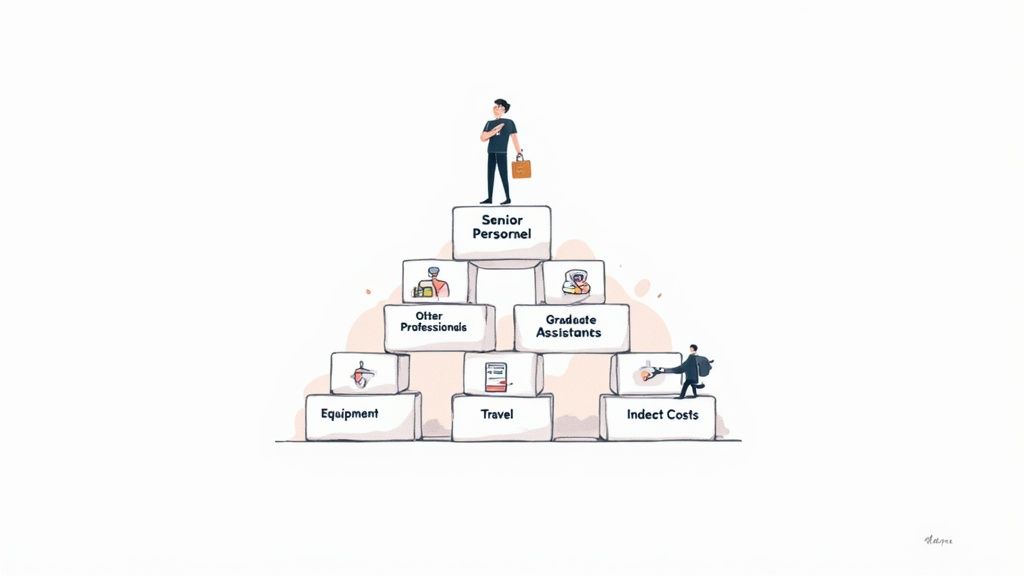
Unlike more flexible foundation grants, the NSF format is categorized into specific, non-negotiable line items from A to M. These include Senior Personnel, Other Personnel, Fringe Benefits, Equipment, Travel, Participant Support Costs, and other direct costs. Perhaps its most defining feature is the calculation and inclusion of Facilities & Administrative (F&A) costs, often called indirect costs. These are costs not directly tied to the project but necessary for the institution to function, such as utilities, administrative salaries, and building maintenance.
Strategic Breakdown and Analysis
The NSF budget's power lies in its rigor. It forces a level of detailed planning that strengthens the entire proposal. Funders see a well-prepared NSF-style budget and immediately recognize the organization's capacity for managing complex, federally funded projects. This makes it an excellent model even for non-federal grant proposals where you want to signal high levels of accountability and planning.
- Personnel Costs (Sections A, B, C): This is often the largest part of the budget. You must specify the name, role, and "person-months" dedicated to the project for each senior person. This level of detail ensures the staffing plan is realistic and directly tied to project activities.
- Equipment (Section D): Any item over $5,000 is typically defined as equipment. The justification must prove why existing equipment is insufficient and why the requested item is essential for achieving the project's goals.
- Indirect Costs (F&A): This is a critical component. Your institution must have a federally negotiated F&A rate. Miscalculating or misapplying this rate is a common reason for budget rejection.
Key Insight: The rigor of an NSF budget serves as a project management blueprint. Each line item corresponds to a specific task or resource needed to meet a milestone, making your proposal's narrative and financial plan perfectly synchronized.
Actionable Takeaways and Application
For organizations new to federal grants, adopting the structure of this sample grant budget can dramatically improve your grant readiness.
- Consult Your Grants Office: Before starting, connect with your institution's sponsored programs or grants office. They are the experts on your negotiated F&A rate and internal compliance rules.
- Justify Everything: For every line item, write a corresponding justification in the budget narrative. Explain why the cost is necessary and how you calculated the amount (e.g., "Travel for the Principal Investigator to present findings at the Annual Geosciences Conference, calculated as: $500 airfare + $200/night x 3 nights hotel + $75/day x 4 days per diem = $1400").
- Align with the Timeline: Your budget should reflect the project's lifecycle. If major equipment is needed in Year 1, ensure it's budgeted for in Year 1. If a postdoctoral researcher is only joining in Year 2, their salary should only appear in that year's budget.
This approach is best used when applying for any federal grant or large, complex foundation grants that value meticulous financial planning. The NSF provides detailed instructions and blank templates on its website, making it an accessible, though challenging, format to master.
2. NIH (National Institutes of Health) Modular Budget Format
The National Institutes of Health (NIH) modular budget is a simplified format designed for certain grant applications requesting up to $250,000 in direct costs per year. Instead of requiring a line-by-line detailed budget, this approach allows applicants to request funds in "modules" or increments of $25,000. This format streamlines the application process, reducing the administrative burden on both the applicant and the NIH reviewers, especially for smaller-scale or exploratory projects.
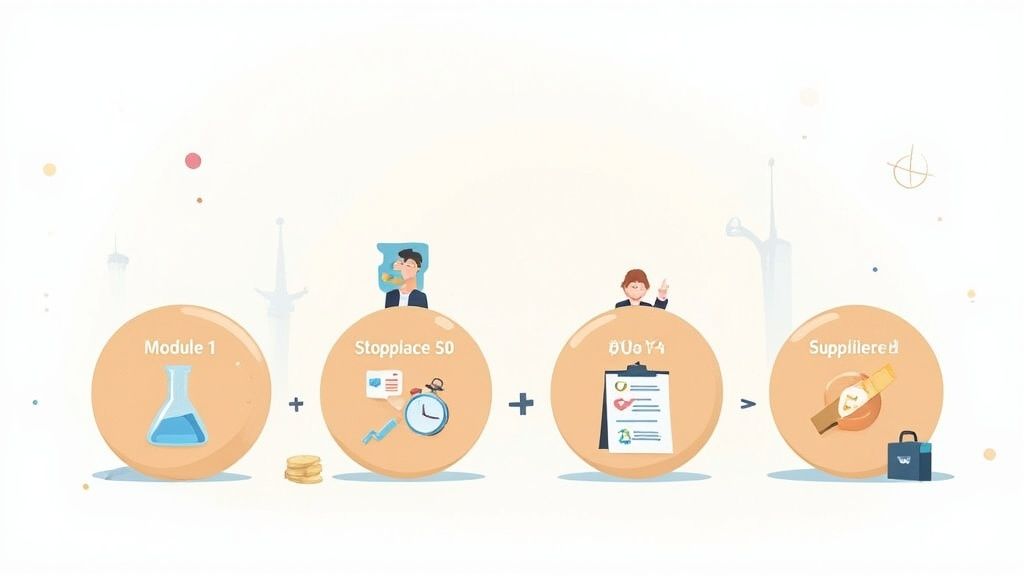
This approach is fundamentally different from the granular detail required by the standard NIH R&R budget. Applicants do not submit detailed categorical breakdowns in the main budget form. Instead, they provide a comprehensive budget justification that explains how the requested modules will be allocated across personnel, supplies, and other expenses. It is most commonly used for grant mechanisms like R03 (Small Grant Program), R21 (Exploratory/Developmental Research Grant), and certain R01 applications from early-career investigators.
Strategic Breakdown and Analysis
The modular budget's primary advantage is its simplicity, but this simplicity requires a robust and persuasive justification narrative. Since reviewers don't see a detailed spreadsheet of costs, the narrative must clearly and convincingly explain the allocation of resources. This shifts the emphasis from meticulous calculation in the form itself to clear, strategic storytelling in the justification. It is an excellent sample grant budget format for projects where the focus should be on the science, not the minutiae of accounting.
- Personnel Justification: You must still list all project personnel by name, role, and person-months. The narrative must justify their involvement and explain how their salaries fit within the requested modules.
- Consortium Justification: If your project includes subcontracts or consortium partners, you must provide a detailed categorical budget for each of them, even though your primary budget is modular. Their Facilities & Administrative (F&A) costs are not included in your direct cost base for the modular calculation.
- Budget Narrative: This is the core of the modular budget. It must explain why the number of modules is appropriate for the scope of the work. For example, if you request 10 modules ($250,000), you need to describe how those funds will cover specific aims, personnel effort, and necessary supplies.
Key Insight: The NIH modular budget is a test of your ability to summarize and justify complex financial needs concisely. Your justification narrative becomes the central financial document, requiring a clear link between the funds requested and the project's scientific goals.
Actionable Takeaways and Application
Using a modular budget format effectively requires a shift in mindset from line-item accounting to high-level resource planning. It is ideal for applicants who want to focus reviewer attention on the research plan rather than the budget details.
- Build a Detailed Internal Budget First: Before requesting modules, create a detailed categorical budget for your own planning purposes. Calculate personnel, supplies, travel, and other costs precisely. Then, round the total direct costs up to the nearest $25,000 to determine your module request.
- Verify Eligibility: Always check the specific Funding Opportunity Announcement (FOA). Not all NIH grants allow the modular format, even if they are under the $250,000 threshold. Using it when it's not permitted is a cause for administrative rejection.
- Craft a Compelling Justification: Don't just list what you will buy. Explain how the requested resources will directly enable you to complete the project's specific aims. For a multi-year project, provide a justification for each year, noting any significant changes in spending (e.g., a decrease in supply costs after a piece of equipment is purchased in Year 1).
This approach is best used when applying for specific NIH mechanisms that encourage or require it, particularly for exploratory projects, pilot studies, or grants for new investigators where the scope is well-defined but doesn't require the complexity of a full R&R budget. The NIH provides extensive guidance on its website to help determine when and how to use the modular format.
3. Foundation Grant Budget Template (Ford Foundation Model)
The Ford Foundation grant budget template represents a more narrative-driven and flexible approach favored by many large private foundations. Unlike the rigid, compliance-focused structure of federal grants, this model prioritizes alignment with programmatic goals and organizational sustainability. It’s designed to tell a financial story that connects every dollar spent to the mission and the communities being served, making it a powerful tool for social justice, arts, and community-based initiatives.
This format typically consolidates costs into broader categories like Personnel, Direct Program Expenses, and Administrative Overhead. The emphasis is less on minute line-item compliance and more on demonstrating how the requested funds will directly enable the proposed activities and lead to measurable outcomes. It’s a template built on trust and a shared vision between the funder and the grantee.
Strategic Breakdown and Analysis
The power of the foundation-style budget lies in its strategic storytelling. It shifts the conversation from "What will you buy?" to "What will you achieve?" A well-crafted budget in this format clearly illustrates the organization's theory of change, showing how financial resources are the engine for social impact. It’s an excellent model for proposals where the 'why' is just as important as the 'what'.
- Program-Centric Categories: Instead of generic line items, expenses are grouped by their function within the program. For example, rather than just "Supplies," you might have "Workshop Materials for Youth Leadership Program" or "Outreach and Communications."
- Narrative Justification: The budget narrative is paramount. It must clearly explain how the financial plan supports the project's goals, how costs were estimated, and why this investment is critical for success. This is where you connect the numbers to your mission.
- Sustainability and Capacity: Foundations often want to see how their grant will strengthen the organization long-term. This budget format encourages you to include costs related to professional development, technology upgrades, or strategic planning that build capacity beyond the grant period.
Key Insight: This sample grant budget format frames your request as a strategic investment in impact. It demonstrates that you have a clear, realistic plan to convert funding into tangible community benefits, aligning your financial needs with the foundation’s philanthropic goals.
Actionable Takeaways and Application
For nonprofits seeking funding from private or community foundations, mastering this narrative-driven format is essential for building strong funder relationships.
- Start with the Program, Not the Spreadsheet: Design your program activities and outcomes first. Then, build the budget by assigning costs to each activity. This ensures every expense has a clear and defensible purpose tied to your mission.
- Show Your Full Costs: Include a column for in-kind contributions (like volunteer hours or donated space) and other funding sources. This presents a complete financial picture and demonstrates that the foundation's investment is part of a broader, well-supported strategy.
- Align with Funder Priorities: Carefully read the foundation’s guidelines and strategic priorities. Use language in your budget narrative that mirrors their own, showing that you understand their goals and are a fitting partner to help achieve them. For example, if a funder prioritizes "equity," explicitly label and justify costs that advance this goal.
This approach is best used when applying to private, corporate, or community foundations like the Ford Foundation or MacArthur Foundation, where the focus is on shared mission and long-term impact rather than strict federal compliance.
4. Department of Education (ED) Standard Grant Budget
The Department of Education (ED) standard grant budget is a comprehensive format tailored for educational institutions and organizations seeking federal funding for K-12, higher education, and community-based learning programs. Similar to the NSF budget in its rigor, the ED format is structured around specific cost categories designed to ensure accountability and alignment with educational objectives. It requires applicants to provide a detailed breakdown of costs and a compelling narrative justifying how each expense supports the proposed project's goals.
This budget format is mandatory for most ED grant programs, from Title I school improvement grants to adult literacy initiatives. Its key features include a strong emphasis on personnel, detailed tracking of contractual services, and specific guidelines for indirect costs. The ED format ensures that federal funds are used efficiently to improve educational outcomes, making it a critical tool for schools, universities, and educational nonprofits.
Strategic Breakdown and Analysis
The ED budget’s strength lies in its direct connection between financial planning and programmatic impact. It forces organizations to think critically about the resources needed to execute educational programs successfully. A well-constructed ED budget demonstrates fiscal responsibility and a deep understanding of the project's operational needs, which builds significant trust with funders.
- Personnel and Fringe Benefits: This section often represents the largest portion of the budget. It requires a clear breakdown of salaries for teachers, aides, project coordinators, and other staff, along with precise calculations for fringe benefits like health insurance and retirement contributions. Accuracy here is paramount.
- Contractual Services: Unlike some other federal budgets, the ED format often has a significant section for contractual services. This includes costs for external evaluators, professional development providers, or curriculum consultants. Justifications must clearly state why these services cannot be performed by existing staff.
- Indirect Costs (F&A): As with other federal grants, institutions must use their federally negotiated indirect cost rate. However, some ED programs may have specific restrictions or caps on indirect costs, which requires careful reading of the grant solicitation.
Key Insight: A well-prepared ED budget serves as a detailed roadmap for program implementation. It connects every dollar to a specific educational activity or outcome, ensuring that financial planning and programmatic goals are perfectly aligned.
Actionable Takeaways and Application
For any organization pursuing federal grants for nonprofits in the education sector, mastering this sample grant budget format is non-negotiable.
- Collaborate with Your Fiscal Office: Engage your school or district's business or fiscal office early in the process. They are essential for verifying salary data, calculating accurate fringe benefit rates, and ensuring the correct indirect cost rate is applied.
- Provide Detailed Justifications: Every line item requires a clear and concise justification. For example, explain how a specific software purchase will support student learning objectives or why travel to a particular conference is necessary for professional development outlined in the project plan.
- Document All In-Kind Contributions: Clearly document any non-federal matching funds or in-kind contributions, such as volunteer time or donated space. This demonstrates community buy-in and leverages federal funds effectively, which is highly valued by the Department of Education.
This budget is essential when applying for any grant from the U.S. Department of Education or state education agencies that use federal pass-through funds. The ED provides detailed instructions and the SF-524 budget form on its website, offering the necessary tools to navigate this complex but crucial format.
5. Corporate/Corporate Foundation Grant Budget (Simplified Format)
The corporate grant budget is a streamlined and often simplified format favored by corporate foundations and private companies. Unlike the exhaustive detail required by federal grants, this budget style prioritizes clarity, impact, and direct alignment with the funder's business values and community engagement goals. It's less about bureaucratic compliance and more about demonstrating a clear return on investment (ROI) in terms of social good, brand visibility, or community impact.
This format typically uses broader categories and expects a concise narrative justification. Funders like the Wells Fargo Community Giving Program or the Coca-Cola Foundation look for budgets that are easy to understand and clearly link financial requests to measurable outcomes. The focus is on demonstrating efficiency and proving that the majority of funds will go directly to programmatic activities rather than significant administrative overhead.
Strategic Breakdown and Analysis
The power of a corporate grant budget lies in its directness. It tells a simple, compelling story: "Give us X dollars, and we will produce Y results for the community." This approach forces applicants to distill their project down to its most impactful components, making it an excellent exercise in program clarity. A well-crafted corporate budget signals that an organization is business-minded, outcome-oriented, and a responsible steward of investment.
- Direct vs. Indirect Costs: While indirect costs are expected, they are scrutinized heavily. Corporate funders often prefer to see a low overhead percentage (typically 10-15%). The budget must clearly show that the majority of funding supports direct project activities and services.
- Outcome-Focused Line Items: Instead of just listing "Supplies," a stronger budget might list "Educational Kits for 100 Students." This ties the cost directly to a deliverable, making the impact tangible and easy for a corporate review committee to grasp.
- Matching Funds and In-Kind Support: Corporate funders love to see leverage. Highlighting matching funds or in-kind donations (like volunteer hours or donated space) shows that their investment is multiplied, increasing the overall project value and demonstrating community buy-in.
Key Insight: A corporate grant budget is fundamentally a business case for social impact. It frames the funding request not as a donation but as a strategic investment in a shared community goal, aligning your mission with the corporation's brand values.
Actionable Takeaways and Application
For any nonprofit seeking funding from local businesses or large corporations, mastering this sample grant budget format is essential. It's about speaking their language: efficiency, results, and partnership.
- Research Corporate Priorities: Before creating the budget, thoroughly research the company's CSR (Corporate Social Responsibility) reports, recent press releases, and foundation guidelines. Align your budget categories and narrative with their stated values, whether it's STEM education, environmental sustainability, or workforce development.
- Quantify Your Impact: Every dollar should be tied to a metric. Frame your budget justification around numbers, such as "Funds for marketing will enable us to reach 5,000 community members through targeted social media" or "This salary supports a coordinator who will serve 200 at-risk youth."
- Create a "Menu of Options": Sometimes it's effective to present specific funding opportunities within the budget. For example, show them that $5,000 funds a summer camp for 10 children or $10,000 underwrites a specific community event. This gives them a concrete picture of what their investment will "buy."
This budget style is best used when applying to corporate giving programs, local business sponsorships, or private foundations with a strong corporate linkage. Its focus on ROI and clear, measurable outcomes makes it a powerful tool for building partnerships with the business community.
6. Grants.gov Standard Budget Format (SF-424 Series)
The Grants.gov SF-424 series is the universal application and budget format for most U.S. federal grant opportunities. Think of it as the common language for federal funding, used by agencies from the Department of Justice (DOJ) to the Environmental Protection Agency (EPA). The SF-424 Research & Related (R&R) budget form, in particular, is a comprehensive template that standardizes how applicants present their financial needs for research projects.
Unlike a foundation grant that may have a unique format, the SF-424 forces a consistent structure across disparate agencies, simplifying the process for organizations applying for multiple federal grants. It requires a detailed breakdown of costs over multi-year project periods, separating expenses into categories like Personnel, Equipment, Travel, and Contractual Costs. A mandatory and detailed budget justification must accompany the form, connecting every requested dollar directly to project activities.
Strategic Breakdown and Analysis
The SF-424's strength is its universality, but its challenge lies in the specific instructions layered on by each individual federal agency. While the form is standard, the rules for what can be included in each category can vary significantly. Mastering this format demonstrates an organization's readiness to manage complex federal compliance and reporting requirements. A well-executed SF-424 budget signals to reviewers that your organization is a low-risk, high-accountability partner for federal funds.
- Personnel & Fringe Benefits (Sections A, B): Similar to the NSF format, this requires a detailed breakdown of effort in person-months or percentage of time. Accuracy in calculating fringe benefits (e.g., health insurance, retirement contributions) is critical and often scrutinized during reviews.
- Travel (Section C): Budgets must distinguish between domestic and foreign travel. Justifications need to be highly specific, detailing the purpose of each trip, the destination, and the basis for cost estimates (e.g., GSA per diem rates).
- Indirect Costs (Section H): This section requires the application of your organization's federally negotiated F&A rate. You must specify the rate, the base it applies to (like Modified Total Direct Costs), and show the calculation. An incorrect F&A calculation is a frequent cause for budget revision requests.
Key Insight: The SF-424 budget is more than a financial document; it is a compliance tool. Successfully completing it proves you understand and can adhere to federal regulations, making your proposal more competitive.
Actionable Takeaways and Application
For any nonprofit seeking federal funding, proficiency with the SF-424 is non-negotiable. Using this sample grant budget as a model prepares you for the high stakes of federal applications.
- Register Early and Download Forms: The registration process for Grants.gov and SAM.gov can take weeks. Start immediately. Download the specific application package for your funding opportunity, as forms can vary slightly.
- Create a Detailed Budget Justification: Write a separate narrative that explains every single line item. For personnel, list each person's role and responsibilities. For supplies, itemize what you will buy and how it supports the project.
- Follow Agency-Specific Guidelines: Read the Notice of Funding Opportunity (NOFO) carefully. An agency might have specific cost caps, unallowable expenses, or unique justification requirements that supplement the standard SF-424 instructions.
This format is the required standard for a vast range of federal opportunities, including USDA grants, HHS social services programs, and EPA environmental projects. You can learn more about how to approach the Grants.gov Standard Budget Format (SF-424 Series) to strengthen your next application.
7. Nonprofit/501(c)(3) Project-Based Budget Template
The nonprofit project-based budget is the quintessential format for 501(c)(3) organizations seeking funding for a specific program or initiative. Unlike a general operating budget that covers the entire organization, this template isolates all revenues and expenses tied directly to a single project, such as a youth mentorship program or a community health initiative. Its primary purpose is to demonstrate to funders how their specific investment will be used to achieve measurable outcomes.
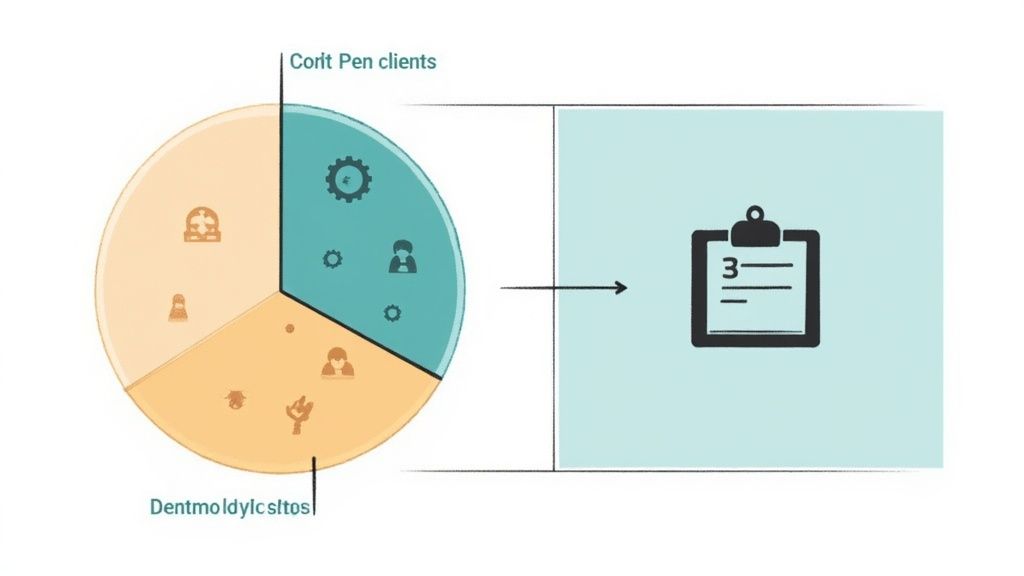
This format is favored by local and national foundations because it clearly distinguishes between direct program costs and administrative overhead. Funders can easily see what percentage of their grant will go toward service delivery versus back-office support. A strong project budget tells a compelling story of efficiency, transparency, and impact, assuring donors that their funds are being used effectively to advance the mission. It is a cornerstone document for demonstrating fiscal responsibility.
Strategic Breakdown and Analysis
The power of a project-based budget lies in its clarity and focus. It forces an organization to think critically about resource allocation for a specific set of activities, which sharpens the overall project design. For funders like Charity Navigator and local community foundations, this focused approach is a key indicator of a well-managed organization capable of executing its proposed work.
- Direct vs. Indirect Costs: This is the most critical distinction. Direct costs are expenses like program staff salaries, supplies for beneficiaries (e.g., food for a food bank), and direct travel. Indirect costs (overhead) are shared expenses like rent, utilities, and executive leadership salaries, often calculated as a percentage of direct costs.
- In-Kind Contributions: A key feature for nonprofits, this section documents the value of donated goods (like office space or supplies) and services (like volunteer hours). Including these demonstrates community support and leverages the funder's cash investment.
- Cost-Per-Beneficiary: This powerful metric (Total Project Cost / Number of People Served) translates your budget into a simple, compelling impact statement. For example, "Your $50 donation provides one week of meals for a family."
Key Insight: A well-structured project budget is more than a financial document; it is a tool for strategic communication. It proves your organization is a responsible steward of funds and links every dollar directly to a human outcome, making your proposal far more persuasive.
Actionable Takeaways and Application
For any nonprofit seeking programmatic funding, mastering this sample grant budget format is essential. It's the standard language spoken by most foundation program officers.
- Develop a Cost Allocation Plan: Before you even create the budget, have a clear, written policy for how you allocate shared costs like salaries or rent across different programs. This is crucial for audits and funder inquiries.
- Document In-Kind Value: Don't just list volunteer hours; assign a reasonable market value. Use resources like the Independent Sector's value of volunteer time to calculate and justify these figures. This shows the full scope of your project's resources.
- Align with Your Program Narrative: Every line item in your budget must correspond to an activity described in your grant proposal narrative. If you budget for a "Workshop Facilitator," your narrative must explain what that workshop is, who it serves, and why it's necessary.
This budget style is ideal for applications to private foundations, corporate giving programs, and community foundations. To get started, you can find a comprehensive nonprofit/501(c)(3) project-based budget template that breaks down these essential components.
Comparison of 7 Grant Budget Formats
Turn Your Budget Into Your Most Powerful Fundraising Tool
Navigating the world of grant funding can often feel like translating a different language, with each funder presenting its own unique set of rules, formats, and expectations. As we have explored through the diverse collection of sample grant budgets in this article, from the intricate requirements of the NSF and NIH to the streamlined simplicity of a corporate foundation request, the budget is far more than a financial document. It is the quantitative expression of your mission, a detailed roadmap of your strategy, and the most concrete evidence of your organization's ability to deliver on its promises.
Moving beyond mere compliance, the goal is to transform your budget from a required attachment into a compelling, persuasive fundraising asset. A well-crafted budget tells a story of impact, efficiency, and thoughtful planning. It demonstrates that you have not only a powerful vision but also the operational acumen to bring that vision to life. This is where your proposal gains its credibility.
Key Insights: From Numbers to Narrative
The examples provided, whether a federal SF-424 or a community foundation template, share a common thread: clarity and justification are paramount. Your budget must be a logical extension of your grant narrative. Every line item should correspond directly to a proposed activity, and every calculation should be defensible.
Think of your budget justification as the script that accompanies the numbers. It’s your opportunity to explain the "why" behind each cost, assuring the funder that every dollar will be used strategically to achieve the stated outcomes. This is where you build trust and preemptively answer the questions a grant reviewer will inevitably ask.
Strategic Takeaway: The strongest grant proposals are those where the narrative and budget are perfectly synchronized. A reviewer should be able to look at your budget and understand your project's core activities without even reading the full proposal narrative, and vice-versa.
Your Actionable Next Steps
Mastering the art of grant budgeting is an iterative process. It requires practice, attention to detail, and a commitment to continuous improvement. To turn the insights from these sample grant budgets into action, focus on these critical steps:
Build Your Internal Budget Library: Don't start from scratch every time. Use the templates and examples from this article to create a master folder of budget formats. When a new funding opportunity arises, you will have a solid starting point that you can quickly adapt.
Standardize Your Justifications: For recurring costs like staff time, standard supplies, or administrative overhead, develop pre-written, detailed justification language. This saves time and ensures consistency across all your applications, allowing you to focus on tailoring the project-specific details.
Conduct a "Red Flag" Review: Before any submission, perform a self-audit using the common red flags we discussed. Is your math correct? Are your personnel costs reasonable for your region? Have you included unallowable costs? Getting a second pair of eyes, even from a colleague unfamiliar with the grant, can be invaluable.
Align Budgeting with Program Design: Involve your program managers in the budget creation process from the very beginning. Their on-the-ground expertise is crucial for ensuring that the financial plan is realistic, comprehensive, and truly reflects the resources needed to succeed. This collaboration prevents the common pitfall of a budget that looks good on paper but fails in practice.
Ultimately, the confidence you project in your budget reflects the confidence you have in your mission. A clear, well-supported, and strategically aligned budget tells funders that you are a responsible steward of their investment and a capable agent of change. By embracing these principles and using the provided sample grant budgets as your guide, you are not just filling out a form; you are building a powerful case for support that can unlock the resources needed to make a meaningful difference in your community.
Ready to streamline your grant writing process and eliminate budget-building headaches? Fundsprout uses AI to help you draft compelling grant narratives, create tailored budgets, and manage your entire fundraising workflow in one place. Turn these sample grant budgets into winning proposals faster than ever by visiting Fundsprout to learn more.
Try 14 days free
Get started with Fundsprout so you can focus on what really matters.