Receipt for Non Profit Donation: Your 2026 Guide
Create a compliant receipt for non profit donation. Our guide covers IRS rules, templates, and best practices for cash, in-kind, and recurring gifts.

Abdifatah Ali
Co-Founder
A gift hits your account. It's large enough that the donor will care about the tax record, and important enough that your executive director wants a warm thank-you out the door today. Then the practical question lands on your desk: what exactly counts as the receipt for non profit donation, and what belongs in a separate thank-you note?
That moment matters more than many organizations realize. A sloppy acknowledgment creates tax problems for the donor, extra cleanup for finance, and avoidable doubt about whether your organization runs a tight operation. A clear, prompt receipt does the opposite. It confirms the gift, protects the donor's deduction when required, and signals that your stewardship is as professional as your mission.
New development directors often inherit a patchwork process. One template lives in a CRM. Another sits in someone's desktop folder. Event gifts are handled one way, stock gifts another, and multi-year pledges often get blurred with actual cash received. The fix isn't complicated, but it does require discipline. The strongest nonprofits treat receipting as part of the donor journey, not just year-end paperwork.
Beyond "Thank You" Why Your Donation Receipt Matters
If you've ever sent a heartfelt thank-you email and assumed you were done, you're not alone. Many nonprofits confuse gratitude with substantiation. Both matter, but they do different jobs.
A thank-you note says, “We appreciate your support.” A donation receipt says, “We received this contribution, on this date, under these terms.” When those documents are combined well, the donor feels seen and protected. When they're muddled, the donor may still feel appreciated, but their records may not hold up when needed.

In practice, the receipt is one of the first operational proofs that your organization keeps its promises. In 2022, total U.S. charitable giving reached $499.33 billion, with individuals contributing $319.04 billion. The IRS requires proper donation receipts for gifts of $250 or more to validate those deductions, which is why receipting sits inside a nearly half-trillion-dollar giving system, according to Giving USA figures summarized here.
The donor sees more than paperwork
Donors rarely separate compliance from trust. If your acknowledgment arrives quickly, uses the correct legal name, and clearly states whether anything was provided in return, they assume your back office is solid. That confidence helps future asks.
If the receipt is delayed, vague, or inconsistent with the payment record, donors notice that too. Major donors notice fastest, but small donors notice as well.
Practical rule: Every receipt should answer the donor's unspoken question: “If I need this later, will it hold up?”
That's why I advise teams to stop treating receipting as an afterthought delegated to whoever has time. It belongs in the same conversation as donor retention, campaign operations, and readiness for an audit for small organizations.
What works and what doesn't
A few patterns show up again and again:
- What works: Sending the legal receipt promptly, then adding a short mission-centered message.
- What works: Using one approved template per gift type so staff don't improvise key language.
- What doesn't: Calling every acknowledgment a “receipt” when some are really just thank-you notes.
- What doesn't: Waiting until year-end to sort out whether event benefits or non-cash language were handled correctly.
A good receipt closes the loop on the gift. A great one also makes the next conversation easier.
The Anatomy of a Compliant Donation Receipt
The core rule is simple. The IRS requires a written acknowledgment for charitable contributions of $250 or more, a requirement established under the Revenue Reconciliation Act of 1993. That rule matters because it helps substantiate the $319.04 billion in itemized charitable deductions claimed by Americans in 2022, as summarized in this IRS-focused compliance guide.
The hard part isn't understanding the rule. It's making sure every receipt includes the right information every single time.
The non-negotiables
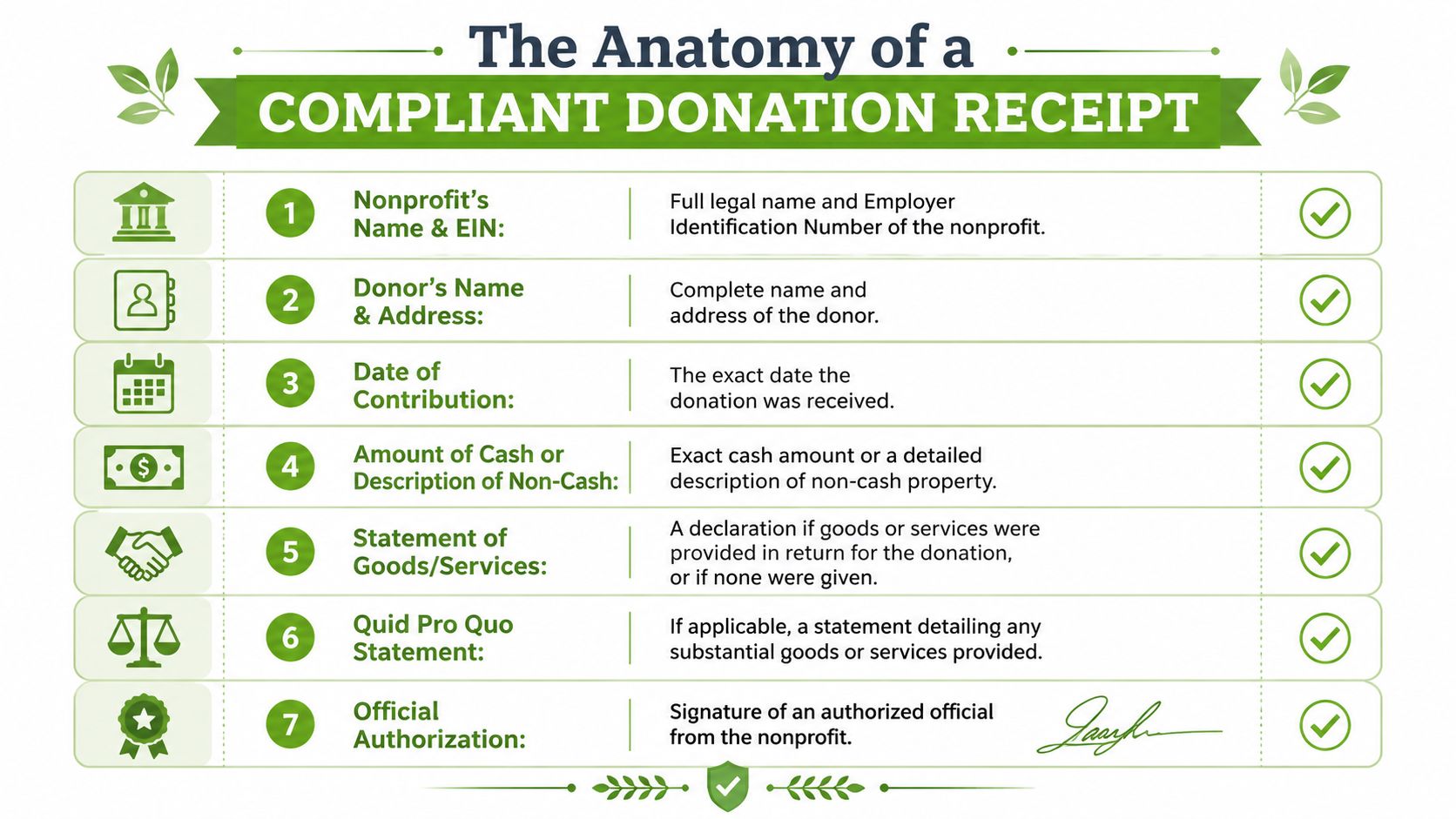
For a standard receipt for non profit donation, include these items:
- Organization name: Use the full legal name of the nonprofit.
- Contribution date: List the date the contribution was received.
- Cash amount or non-cash description: For cash, state the amount. For non-cash gifts, describe what was donated, but don't assign value.
- Goods or services statement: State whether the donor received anything in exchange.
- Quid pro quo disclosure when applicable: If goods or services were provided, include a good-faith estimate of their fair market value when required.
- Prompt delivery: The acknowledgment should be contemporaneous. In plain English, send it promptly.
- Consistent donor record: The legal donor on the receipt should match the actual giver of record.
A lot of organizations also include the donor's address, the organization's EIN, and an authorized signature. Some of those items may be best practice rather than the minimum legal floor in every scenario, but they make the document stronger and easier for donors and accountants to use.
If a donor, auditor, or tax preparer reads your receipt without calling you for clarification, your process is working.
For organizations that want a second set of eyes on edge cases, especially large gifts or complicated event transactions, outside review can help. A specialist such as Hire Tax Accountants can be useful when your internal team needs support on donor substantiation questions.
Here's a short explainer if your team needs a quick visual refresher:
The line that gets missed most often
The goods-and-services statement causes a surprising amount of trouble. Teams forget to include it, or they use loose language that doesn't answer the actual question.
Use direct wording. If the donor got nothing in return, say so plainly. If they attended an event dinner, received merchandise, or got another benefit, disclose that clearly and estimate the value in good faith when required. Don't bury that line deep in a footer.
What to standardize internally
Build your internal review around a short checklist:
- Gift type confirmed
- Legal donor confirmed
- Required language inserted
- Date and amount verified against payment record
- Copy stored in donor and finance records
That discipline prevents most receipting errors before they leave your office.
Sample Wording for Every Donation Type
Templates save time, but only if they reflect the gift that happened. The biggest mistake I see is using one generic receipt for every transaction. Cash gifts, non-cash donations, and quid pro quo contributions need different language.
Below are practical examples you can adapt. Keep the tone warm, but keep the legal facts precise.
Simple cash gift
Use this when a donor gives money and receives nothing in return.
Dear [Donor Name],
Thank you for your generous contribution to [Organization Name]. This letter acknowledges receipt of your cash contribution of [amount] received on [date]. No goods or services were provided in exchange for this contribution.Sincerely,
[Authorized Representative]
[Organization Name]
This version works because it does not overcomplicate a straightforward gift. It states the amount, date, and required no-benefit language in one place.
Non-cash gift
Use this for donated property, supplies, equipment, stock, or other non-cash items. The key rule is simple: describe the gift, but don't state its value.
Dear [Donor Name],
Thank you for your contribution to [Organization Name]. This letter acknowledges receipt of the following non-cash contribution received on [date]: [description of property]. No goods or services were provided in exchange for this contribution.Sincerely,
[Authorized Representative]
[Organization Name]
Good descriptions are specific enough to identify the item but stop short of valuation. “Laptop computer” is weak. “One used laptop computer, Dell Latitude model [identifier if relevant]” is better. For stock, list the security and share information descriptively without assigning dollar value.
Quid pro quo gift
Use this when the donor pays more than the value of something they receive, such as a gala ticket or sponsorship package with tangible benefits.
Dear [Donor Name],
Thank you for your support of [Organization Name]. This letter acknowledges receipt of your contribution on [date] in the amount of [amount]. In exchange for this contribution, you received [description of goods or services]. The organization's good-faith estimate of the fair market value of those goods or services was [value].Sincerely,
[Authorized Representative]
[Organization Name]
This wording helps the donor and your finance team distinguish the charitable portion from the benefit received. Don't use your event marketing copy here. Use plain accounting language.
Donation receipt requirements by gift type
| Gift Type | Key Requirement | Sample Wording Snippet |
|---|---|---|
| Cash gift | State amount, date, and whether goods or services were provided | “This letter acknowledges receipt of your cash contribution of [amount] received on [date]. No goods or services were provided in exchange for this contribution.” |
| Non-cash gift | Describe property without assigning value | “This letter acknowledges receipt of the following non-cash contribution received on [date]: [description of property].” |
| Quid pro quo contribution | Disclose goods or services provided and their good-faith estimated value when applicable | “In exchange for this contribution, you received [description]. The organization's good-faith estimate of the fair market value was [value].” |
| Pledge payment | Receipt the actual payment received, not the full pledge promise | “This letter acknowledges receipt of your payment of [amount] received on [date] toward your pledge.” |
Keep the thank-you separate in your mind
You can combine the thank-you and the legal acknowledgment in one document. Many organizations do. The trick is to draft it in layers.
Start with gratitude. Then insert the substantiation language exactly as needed. End with a brief impact sentence if appropriate. What you don't want is a beautifully written donor letter that leaves out the legal facts the donor needs.
A strong receipt sounds human, but it reads like a record.
If your team handles multiple channels such as checks, online gifts, stock transfers, event payments, and in-kind donations, keep a small library of approved templates. That reduces improvisation and helps new staff avoid accidental errors.
Handling Pledges Grants and Special Cases
Many otherwise solid development shops get into trouble. They understand ordinary gifts, but the moment a multi-year pledge, grant installment, donor-advised fund payment, or matching gift shows up, the paper trail gets fuzzy.
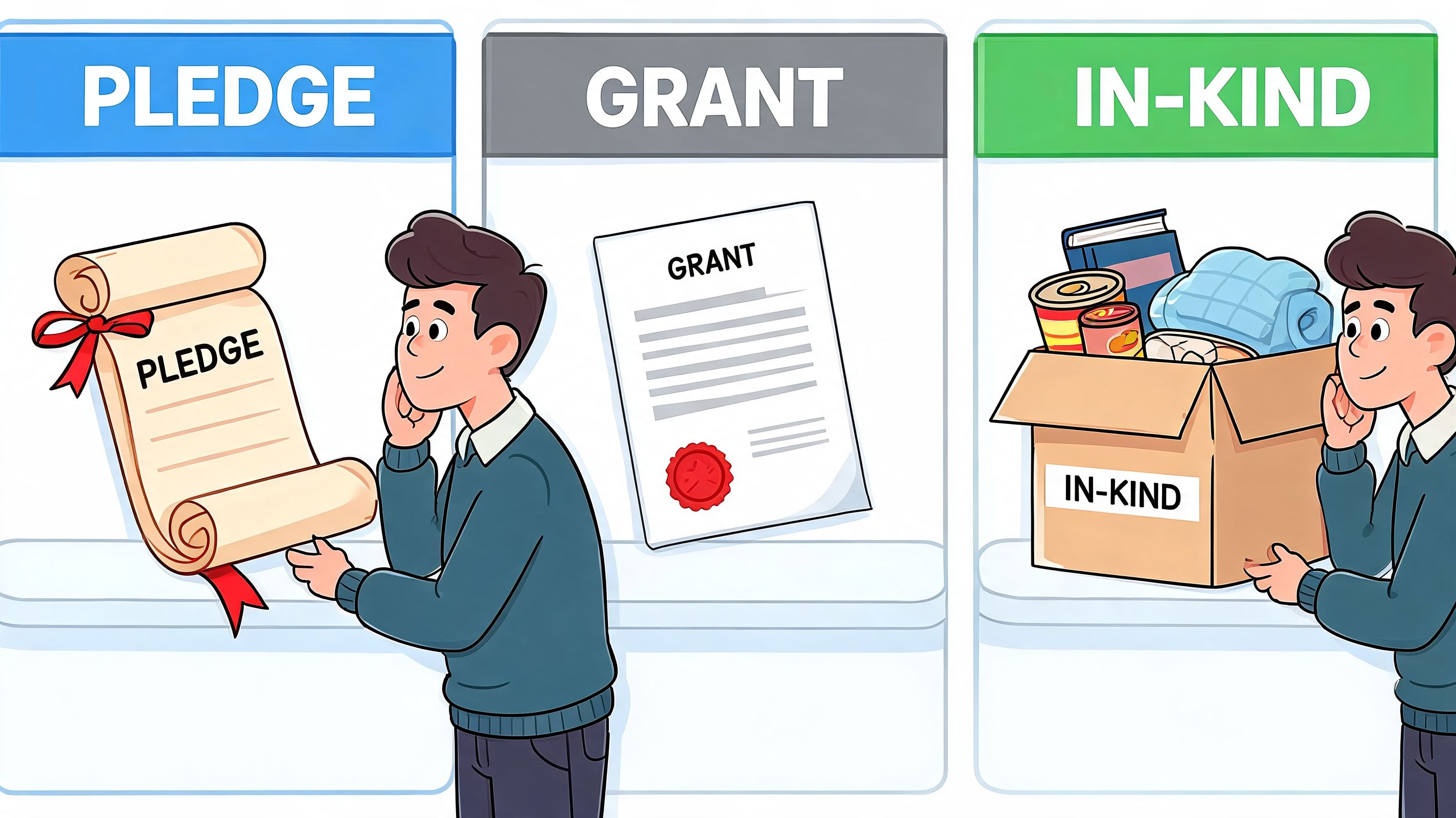
The biggest point to remember is this: a pledge is not the same thing as a received contribution. You can acknowledge a pledge as a commitment. But if payments come in over time, each actual payment needs to be handled based on what was received and when.
According to a 2025 summary of nonprofit receipting issues, 42% of small nonprofits reported compliance issues with multi-payment grants, often because they failed to separate a pledge acknowledgment from the requirement to issue compliant receipts for each payment of $250 or more as it is received.
Multi-year pledges and installment gifts
Here's the clean operational approach:
- Acknowledge the pledge: Thank the donor for the commitment and note the intended payment schedule.
- Receipt each payment: When each installment arrives, issue a receipt tied to that payment only.
- Keep the records linked: Your CRM or accounting system should connect the pledge record and the payment receipts.
Don't issue one receipt for the full pledge amount up front if the funds haven't been received. That creates problems for the donor and for your audit trail.
Grants, DAFs, and matching gifts
These scenarios need careful attention to the legal donor.
For grants, receipt the entity that made the payment if a receipt is appropriate for that funding relationship. For donor-advised fund gifts, the legal donor is generally the sponsoring organization that sends the payment, not the individual advisor who recommended it. For employer matching gifts, the company's payment should be documented to the company as donor of record, while stewardship can still recognize the employee who initiated the match.
Keep two lanes in your process. One lane is the legal receipt. The other is relationship stewardship.
That distinction matters because donor records often include hard credits, soft credits, household links, and tribute data. Those are useful for fundraising, but they should never muddy the legal receipt.
If your team manages complex restricted awards, installment disbursements, and grant reporting deadlines together, it helps to align receipting with the same controls you use for accounting for grants. The cleaner your internal handoff between development and finance, the fewer corrections you'll make later.
Delivery Recordkeeping and Automation Practices
A compliant receipt that sits in draft form for weeks doesn't help the donor much. Delivery matters. Recordkeeping matters just as much.
The IRS standard is that acknowledgments should be contemporaneous. In day-to-day operations, that means you should send them promptly and in a repeatable way. Email works well for many donors because it's fast, searchable, and easy to store. Physical mail still has a place, especially for donors who prefer paper or for certain major gift touchpoints.
Choose a method you can execute consistently
The strongest process is usually not the fanciest one. It's the one your team can follow every time.
- Email delivery works best when your online giving forms, CRM, and finance records are connected.
- Printed letters work best when gift volume is manageable and your team wants a more personal major donor cadence.
- Hybrid systems work best when you segment by donor preference and gift type rather than sending everything the same way.
What fails is split ownership with no source of truth. Development thinks finance sent the receipt. Finance assumes the CRM automated it. The donor gets nothing, or gets two versions with conflicting language.
Build the audit trail while you send
Every receipt should leave a durable record. That means a saved PDF or system-generated copy, a timestamp, the final text sent, and a connection to the underlying transaction. If your organization ever needs to answer donor questions, reconcile campaign records, or support internal controls, that history saves hours.
A sound setup usually includes:
- A central donor system with approved templates
- A finance reconciliation step for higher-risk gift types
- A document retention rule so receipts can be retrieved quickly
- A periodic template review to catch outdated language
Churches and faith-based nonprofits often face the same operational choices, especially when digital giving platforms feed directly into acknowledgments. If that's your environment, reviews of the best digital giving tools for churches can be useful for comparing workflows around payment intake and donor communication.
Good receipting systems don't just reduce mistakes. They reduce handoffs.
Automation helps most when it removes repetitive work without hiding exceptions. Let software send standard cash-gift acknowledgments. But set flags for event gifts, non-cash property, stock transfers, pledge installments, and anything with donor restrictions or unusual terms.
If you're tightening your financial operations at the same time, it's worth reviewing how your receipting process connects with your nonprofit bank accounts. The closer your deposit records, donor records, and acknowledgment records are to each other, the stronger your controls become.
Common Questions About Donation Receipts
Should we send receipts for gifts under $250
Yes, as a best practice. Donors giving under that threshold may be able to rely on bank records, but a receipt still reduces confusion and shows professionalism. It also keeps your process consistent.
What if a donor loses their receipt
Reissue it. Mark it clearly as a duplicate in your internal records, and make sure the replacement matches the original transaction details. Don't create a fresh version with revised dates or altered wording unless you are correcting an actual error and documenting that correction.
Can we receipt an anonymous donation
You can still document the gift internally, but public anonymity doesn't remove your need to maintain accurate donor records. Handle anonymity in stewardship and recognition settings, not by weakening the legal record.
Who gets the receipt when a third-party platform processes the donation
Follow the legal donor of record and the actual flow of funds. Some platforms act as processors for your organization's donation, while others may structure the transaction differently. Review the platform agreement and payment record before issuing the receipt.
Do year-end summaries replace individual receipts
They can be helpful for donor convenience, but they shouldn't become a substitute for handling each gift correctly when received. If your team sends annual summaries, make sure they align with the underlying records and don't gloss over event benefits or non-cash details.
What if we operate in Canada too
Treat Canadian receipting as its own compliance workflow. For nonprofits operating in or receiving funds from Canada, CRA-compliant receipts have 12 mandatory elements, including a unique serial number for each receipt, and automated software can reduce the 30% error rate seen in manual processing while preventing duplicate serial issues that the CRA rejects, as outlined in this Canadian donation receipt compliance guide.
Should development or finance own the process
Both. Development should own donor communication and gift coding accuracy. Finance should own control, reconciliation, and retention standards. One team alone usually misses something the other would catch.
What's the simplest way to improve fast
Start with approved templates, one owner for exceptions, and a weekly reconciliation habit. Most receipting problems come from inconsistency, not complexity.
Fundsprout helps nonprofits stay organized across the full funding lifecycle, from finding grants to tracking requirements, reporting, and renewals. If your team wants fewer compliance gaps and a cleaner operational trail around funding activity, explore Fundsprout.
Try 14 days free
Get started with Fundsprout so you can focus on what really matters.