NTEE Code List: The Complete Nonprofit Guide [2026]
Find any code with our complete, searchable NTEE code list. Learn how to choose the right code for your nonprofit and see how funders use it to find you.
![NTEE Code List: The Complete Nonprofit Guide [2026]](https://cdn.prod.website-files.com/68d218aac03c489c1296d334/6a0abeeb3ca33ac05fb94351_ntee-code-list-nonprofit-guide.jpeg)

Abdifatah Ali
Co-Founder
You're halfway through a grant application, moving quickly, and then you hit a field that stops the whole process: NTEE code.
You know your mission. You know your programs. You know who you serve. But “pick the right code from the ntee code list” can feel oddly hard, especially if your organization runs more than one program, has evolved over time, or never had anyone explain what the code does.
That confusion is normal. The ntee code list looks simple on the surface, but the choice attached to it can shape how databases classify your nonprofit, how funders filter for eligible organizations, and how peers compare your work to similar groups.
The good news is that this isn't mysterious once you see the logic. An NTEE code is a classification tool. It's not a judgment about your worth, and it isn't a complete description of your organization. It's a shorthand label that helps other systems understand your primary purpose.
A strong choice comes from knowing three things: how the system is built, how to narrow to the closest fit, and how to handle the messy real-world cases where your work crosses categories. That's where most list-style articles stop short. They show codes, but they don't help you think.
Your Guide to Nonprofit NTEE Codes
If you're a new executive director, this usually comes up in one of three moments. You're applying for exemption, cleaning up your records, or trying to understand why your organization isn't showing up where you expect in grant databases.
The NTEE classification system gives nonprofit organizations a common language. IRS and nonprofit data systems use it to describe what an organization primarily does. In plain English, the ntee code list helps answer a practical question: “What kind of nonprofit is this?”
That sounds straightforward until you run a tutoring program, a family resource center, and a youth leadership initiative under one roof. Which one counts most? The answer matters because your code often becomes part of how other people first encounter your organization in structured data.
What the code does in practice
Your NTEE code can affect how your organization is:
- Categorized in public records so researchers, grantmakers, and nonprofit platforms can sort organizations consistently
- Benchmarked against peers when people compare you to similar institutions
- Screened for fit when a funder starts with a mission category before reading full narratives
- Described internally when your board or staff needs one shared classification across forms and systems
Practical rule: Choose the code that best reflects your organization's primary purpose, not the program that sounds most appealing on a form.
Often, many nonprofits get tripped up. They treat the ntee code list like a branding exercise. It's better to treat it like a classification exercise. You're not picking the most impressive label. You're picking the most accurate one.
What helps most
A useful approach is to move in this order:
- Start with your current mission and main activities.
- Identify the broad category that fits.
- Narrow to the most precise activity code you can defend.
- Check whether your organization has secondary activities that also need to be documented elsewhere.
That last point matters for funding strategy. A carefully chosen code makes it easier for the right funders to find you, and it makes your own grant prospecting cleaner because your organization is being described more accurately from the start.
What Is the NTEE Classification System
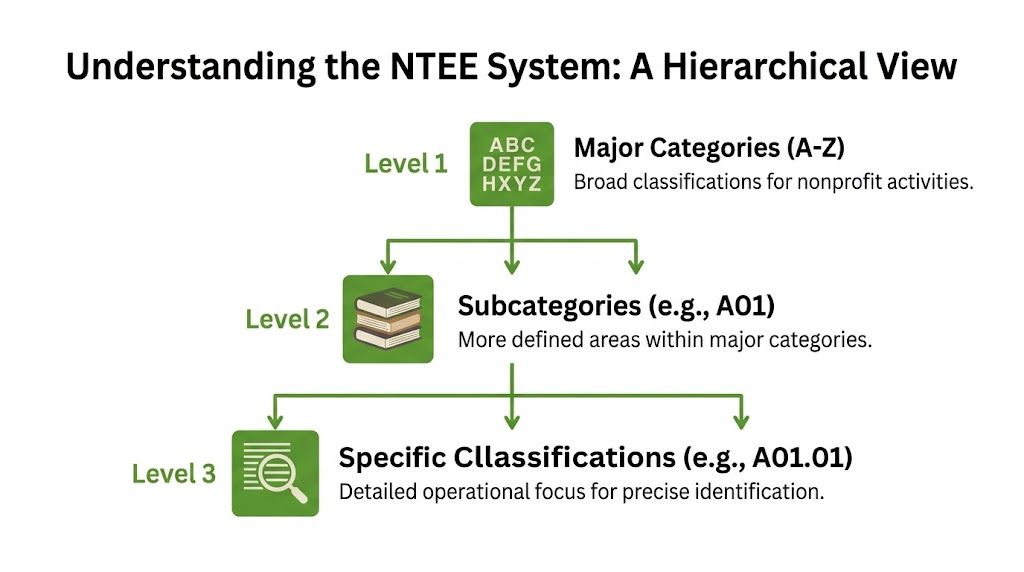
The National Taxonomy of Exempt Entities, usually shortened to NTEE, is a structured way to classify nonprofit organizations. Its structure resembles a library system for the sector. Instead of shelving books by subject, it groups nonprofits by their primary mission and activity.
The system was developed by the National Center for Charitable Statistics during the 1980s, and the historical overview from NCCS on the development of NTEE and NTEE-CC explains that the later NTEE-CC condensed the original 645 categories down to about 400 core categories for more practical classification and data linkage.
How the structure works
At its simplest, the code has two main parts:
- A major-group letter that places the organization in a broad field
- A two-digit activity code that gets more specific about what the organization does
So when you see a code like B03 or B05, the letter tells you the broad sector and the numbers tell you the activity type within that sector.
The system is hierarchical. Major groups sit at the top. Then the numeric layers narrow the classification. That structure was designed for statistical analysis, not for deciding legal status. That distinction matters because people sometimes assume the code defines what an organization is allowed to do. It doesn't. It describes the organization for data and comparison purposes.
Why the history matters
The history explains why the ntee code list can feel both useful and imperfect.
It was built to standardize nonprofit measurement across large datasets in the United States. That's excellent for research, public records, and funding databases. It also means the system sometimes compresses complex organizations into one primary label.
The code is a map, not the whole landscape.
That's also why NCCS later created simplified core codes. The original system was detailed. The core version made classification easier to use at scale. Easier, though, doesn't always mean simpler for a hybrid nonprofit deciding where it belongs.
A newer format for cleaner analysis
NCCS has also described a newer NTEE-V2 format that separates mission area and organizational type more cleanly. For nonprofit leaders, the main takeaway is practical: legacy codes still matter, but newer data structures are trying to make sector analysis less confusing.
If your team works with grant databases, CRM imports, prospect research tools, or benchmarking reports, this background helps. The ntee code list wasn't created as a marketing label. It was built so many different systems could describe nonprofits in a consistent way.
The Complete NTEE Code List Searchable and Filterable
When people say they want the “complete ntee code list,” they usually mean one of two things. They either want a literal list of codes, or they want a fast way to find the one that fits their organization. The second need is usually the more common one.
NCCS describes the traditional standard as a major-group letter plus a two-digit activity code, and notes that the newer NTEE-V2 reformats the taxonomy into a tidier structure for analytics in its NTEE resource overview. For daily nonprofit use, though, the familiar code style such as B03 or B05 remains common.
How to use a searchable ntee code list
When you search a list, don't start with abstract language like “impact” or “community transformation.” Start with operational words.
Use terms such as:
- Program nouns like tutoring, shelter, orchestra, clinic, mediation, advocacy
- Organization type words like association, research institute, foundation, support group
- Service setting terms like school, museum, food pantry, housing, recreation
If the result set is too broad, filter by major group first. Then compare nearby codes that look similar.
A simple workflow works well:
| Step | What to do | Why it helps |
|---|---|---|
| 1 | Search by your clearest program term | Gets you into the right neighborhood fast |
| 2 | Check the major group letter | Prevents you from comparing codes from unrelated sectors |
| 3 | Read adjacent codes | The best fit is often next to your first guess |
| 4 | Test the code against your mission statement | Confirms you're classifying the organization, not just one activity |
If your team also uses grant discovery software, keep your code choice aligned with your keyword strategy. A platform roundup like this guide to grant discovery platforms is useful because it shows how different systems organize opportunities and filters, even though the actual matching criteria vary by platform.
Major groups people search most often
A full ntee code list is long, so most nonprofits begin at the major-group level and narrow down from there. Common examples include:
- A for arts, culture, and humanities
- B for education
- C for environmental areas
- D for animal-related work
- E, F, G, H for different health and medical areas
- P for human services
- R for civil rights, social action, and advocacy
- S for community improvement and capacity building
- T for philanthropy and grantmaking
- X for religion-related organizations
That broad scan is often enough to eliminate the wrong half of the list quickly.
What a practical code table should show
A useful reference table should include four pieces of information:
| Field | What it tells you |
|---|---|
| NTEE code | The actual classification shorthand |
| Full name | The standard label attached to the code |
| Description | The operational meaning in plain language |
| Major group | The broader mission family it belongs to |
Without the description, teams often choose badly. The label alone can be misleading.
Sample entries that show how the list works
Here are a few examples using verified code patterns and functions discussed in NCCS guidance:
| NTEE code | Full name | Plain-language description | Major group |
|---|---|---|---|
| B03 | Professional Societies and Associations | Membership organizations for professionals in education | Education |
| B05 | Research Institutes and Public Policy Analysis | Research-focused organizations in education | Education |
Those examples matter because they show a common trap. A nonprofit connected to schools isn't automatically classified as a school. If its main function is professional membership or research, the activity code changes the answer.
Why “complete” can still feel incomplete
Most static list pages fail for one reason. They assume finding a code is just a lookup problem.
It usually isn't.
It's a classification decision. That means you often need to compare mission, organizational type, and primary activity at the same time. A youth-serving nonprofit may still belong in human services rather than education. A coalition may belong under advocacy or alliance work rather than direct service. A support organization may be classified by the kind of support it provides, not by the field of the groups it helps.
If two codes both seem plausible, ask which one best describes the organization on its busiest, most ordinary day.
That question tends to cut through aspirational language. It keeps your team focused on actual operations, which is what classification systems handle best.
A better way to work with the list internally
For team use, I recommend keeping a short internal note with three items:
- The code you use now
- The reason it fits your primary purpose
- The alternate codes you considered and rejected
That record helps when a board member, auditor, grant writer, or consultant asks why your classification looks the way it does. It also makes future updates easier if your programming shifts.
A searchable ntee code list is useful. A documented decision is better.
How to Choose the Right NTEE Code for Your Nonprofit
Choosing from the ntee code list gets easier when you stop asking, “What causes do we care about?” and start asking, “What is this organization primarily organized to do?”
That sounds subtle, but it changes everything.
Start with mission, then test against operations
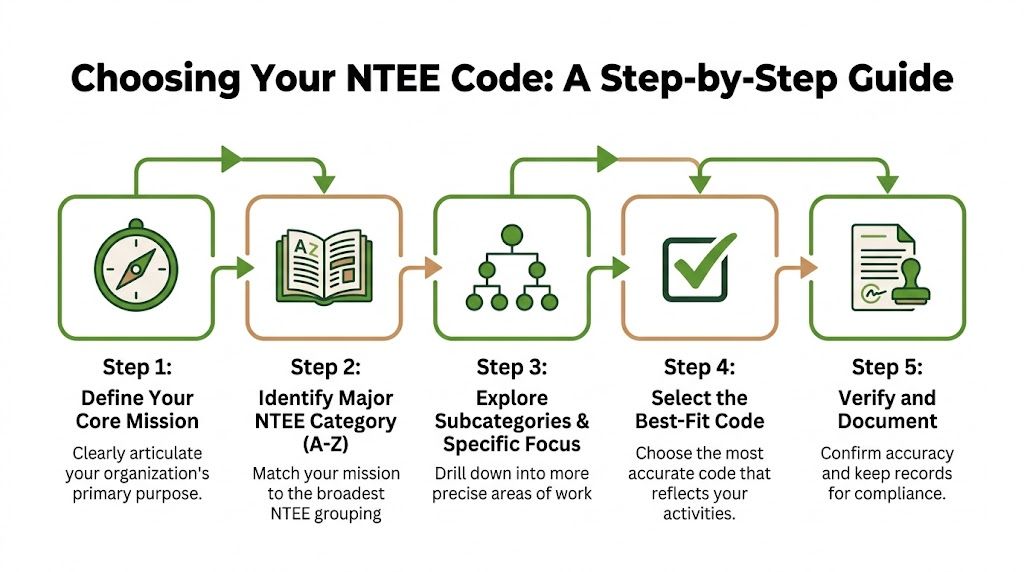
Use this sequence with your leadership team:
Pull your current mission statement.
Not the version from five years ago. Use the one that reflects what you do now.List your primary programs.
Identify the activities that take the most organizational attention and define your public identity.Identify the main organizational function.
Are you delivering services, conducting research, convening professionals, advocating, or regranting support?Match the broad major group first.
Only after that should you narrow to a more specific activity code.
A formation guide like this overview of starting a 501(c)(3) is useful for newer teams because many classification problems begin when organizations describe future plans more than current operations in early paperwork.
Watch for standardized activity codes
One of the most helpful nuances comes from NCCS guidance on recurring activity meanings across major groups. In the NCCS FAQ on code selection and recurring activity codes, 03 is identified as Professional Societies/Associations, and 05 as Research Institutes/Public Policy Analysis. That's why a professional society for secondary-school teachers belongs under B03, not B25.
This short training video can help if you want a visual walkthrough before making a final choice.
A simple decision check
Ask these three questions before you lock in a code:
- What do we do most consistently
- What function defines us if someone sees only one label
- Would an outside reviewer describe us this way after reading our programs
Choose the code that reflects your dominant function, even if another code better matches the population you serve.
That's where many organizations make a preventable error. They classify by audience instead of activity. Serving teachers doesn't necessarily make you a school. Serving artists doesn't necessarily make you a performing group. The organizational role matters.
Why Your NTEE Code Matters to Funders and Platforms
An NTEE code can feel administrative until you look at how funding systems operate. Funders and nonprofit data platforms have to sort large numbers of organizations quickly. They can't begin with a close reading of every website, annual report, and program brochure.
They start with structured fields.
Jitasa reports that, as of November 15, 2025, the IRS had 1,923,040 NTEE codes on file, which helps explain why major categories and subcategories are used to compare organizations consistently across very large datasets in its overview of nonprofit NTEE codes and IRS scale.
Why this matters in grant screening
Suppose a foundation wants organizations working in animal welfare. If your nonprofit is coded in arts because that was the closest fit someone chose years ago, you may never appear in that initial pool, even if one of your current programs clearly aligns.
That doesn't mean NTEE is the only thing funders use. It does mean that a wrong code can create friction before your narrative ever gets read.
How platforms use the signal
Grant databases, prospect research tools, and matching systems use classification fields to narrow opportunity sets. That's practical. Without some kind of mission standard, every search would depend on messy free-text interpretation.
If you want a sense of how matching logic works in practice, this explainer on nonprofit grant database matching shows how platforms combine mission fit, eligibility signals, and filtering criteria. Fundsprout is one example of a platform that uses structured nonprofit information alongside program, geography, and eligibility details to help teams identify aligned opportunities.
The strategic takeaway
A correct code helps in at least three ways:
- Visibility because the right organizations are more likely to appear in the right filtered sets
- Comparability because funders can place you alongside relevant peers
- Credibility because your classification and your story support each other instead of contradicting one another
A good code won't win a grant by itself. A bad code can make you harder to find.
For executive directors, that's the key shift. Treating the ntee code list as clerical data misses its funding impact. In many systems, classification is part of discovery.
Common NTEE Code Mistakes and How to Fix Them
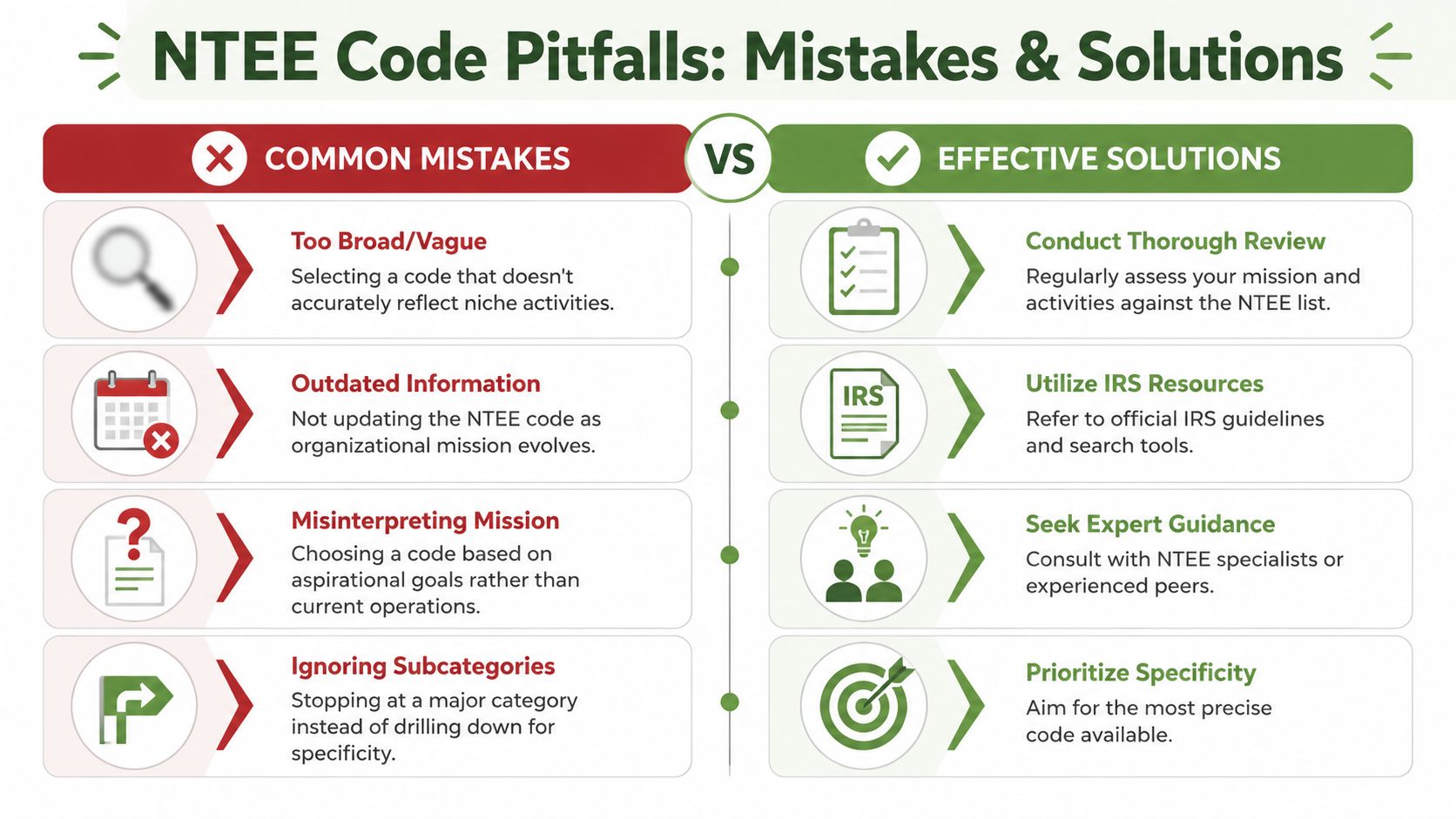
Most NTEE mistakes come from good intentions. A team wants to highlight an exciting program, broaden its appeal, or simplify a complicated mission. But the code works best when it stays grounded in present-day operations.
The IRS also allows up to three activity codes on Form 1023 or 1024, which is important for organizations with blended work, as noted in IRS Form 1023/1024 application materials. That flexibility helps, but many nonprofits still treat the ntee code list like a single permanent label and stop thinking after the first choice.
Mistake patterns I see often
| Symptom | Problem | Fix |
|---|---|---|
| You chose the broadest possible category | The code is technically related but not specific enough | Re-read nearby subcategories and choose the closest operational fit |
| You classified by who you serve | Audience replaced organizational function | Reframe around what the organization actually does |
| Your programs span multiple fields | Staff assume only one activity can be recognized | Identify the primary purpose, then document secondary activities separately |
| The code matched years ago but not now | Mission drift or growth changed the center of gravity | Review the classification whenever programs materially change |
A practical correction process
When a code feels off, don't jump straight to a replacement. Work through evidence.
- Review your current materials such as mission statement, website copy, board-approved program descriptions, and grant boilerplate.
- Identify the dominant activity that would still define you if you had to describe the organization in one sentence.
- List adjacent codes that also seem plausible, then explain why they are secondary.
- Document the decision so future staff don't have to guess why the current classification was chosen.
Hybrid organizations usually don't have a classification problem. They have a prioritization problem.
That's a better way to think about it. You're not trying to force all of your complexity into one word. You're deciding what sits at the center, then making sure the rest of your materials explain the full picture.
When to revisit your code
Revisit your code when:
- A major program becomes your primary line of work
- Your funding mix changes because your mission focus changed
- You merged with another organization
- Your public identity now differs from the code attached to your records
A code choice shouldn't be random, and it also shouldn't be frozen forever.
Downloadable NTEE Resources for Your Team
Once your organization has settled on a code, save the decision somewhere your whole team can use it. That sounds basic, but it prevents a lot of avoidable inconsistency across grant applications, donor databases, onboarding materials, and board packets.
What to keep on hand
Create a small internal NTEE reference folder with:
- A CSV version of your working ntee code list for quick sorting and filtering during grant research
- A one-page print view of major groups so staff can orient themselves fast
- An internal memo on your chosen code including why it fits and what alternatives were considered
- Examples of approved language your team can reuse in applications that ask about classification or mission area
This is especially helpful when development, programs, and finance all touch external reporting. One shared reference reduces the chance that each department describes the organization differently.
Who should have access
At minimum, give these materials to:
- Executive leadership
- Development and grant staff
- Program directors
- Anyone preparing IRS, compliance, or profile information
If your nonprofit is small, this may all live in one operations folder. If your nonprofit is larger, keep it wherever institutional records are maintained and easy to update.
A clean offline copy of the ntee code list is useful in strategy meetings because teams can compare categories side by side without relying on memory or scattered bookmarks.
Using Your NTEE Code as a Strategic Tool
The most useful way to think about your NTEE code is this: it's a compact signal about your organization's identity.
It won't replace your mission statement. It won't explain your outcomes, your geography, your community relationships, or your funding needs. But it does shape how structured systems first sort and understand you. That makes it more strategic than most nonprofits realize.
What strong organizations do differently
They don't treat the code as a box to check once and forget. They use it as part of a broader positioning discipline.
That means they:
- Align the code with actual operations
- Keep grant profiles, public descriptions, and internal records consistent
- Revisit the classification when the organization changes
- Use the code as one filter in prospecting, not the only filter
The real value of accuracy
An accurate code gives your team a cleaner starting point. It improves how you search, how you describe peer organizations, and how other systems classify your work. For multi-program nonprofits, the discipline of choosing carefully can also sharpen internal understanding about what the organization is fundamentally for.
That's valuable well beyond compliance.
Your code should support your story, not compete with it.
When the classification and the narrative line up, funders spend less time reconciling contradictions. Your records make more sense. Your staff answers profile questions more consistently. Your organization becomes easier to understand in the places where understanding begins with structured data.
The ntee code list is still a list. But used well, it becomes a decision tool. It helps you name your primary function clearly, defend that choice internally, and show up more accurately in the systems that influence funding discovery.
If you're leading a nonprofit with multiple programs, that clarity is worth the effort. You don't need the perfect label. You need the most defensible one.
If you want help turning classification clarity into a stronger grant pipeline, Fundsprout helps nonprofits identify relevant funding, organize requirements, and manage proposal work in one place so your team can spend less time untangling systems and more time pursuing aligned opportunities.
Try 14 days free
Get started with Fundsprout so you can focus on what really matters.