Effective Nonprofit Grant Management Training: 2026 Guide
Master nonprofit grant management training with our 2026 guide. Learn curriculum design, delivery methods, and tools to build long-term organizational capacity.

Abdifatah Ali
Co-Founder
You win the grant on Tuesday. By Friday, the celebration is over.
Now someone has to confirm the budget categories, translate the proposal into a work plan, set reporting dates, collect backup documentation, explain restrictions to program staff, and make sure finance is coding expenses correctly. In a small nonprofit, that “someone” is usually several people who are already overloaded.
That's why nonprofit grant management training matters so much. The issue isn't just compliance. It's whether your organization can turn a funded proposal into a clean, repeatable operating process without burning out staff or creating avoidable risk.
Why Ad-Hoc Grant Management Fails Nonprofits
A common pattern looks like this. The development lead submits the proposal. The executive director signs the award. Then the grant disappears into email, a shared drive, and a few calendar reminders. Three months later, program staff are delivering services, finance is closing the month, and nobody is fully sure which outcomes were promised, which costs were approved, or when the next report is due.
That's not a staffing failure. It's a systems failure.
A grant is easy to romanticize during the application stage. It feels like money coming in. In practice, it's also a contract, a reporting schedule, a set of restrictions, and a cross-functional workload that touches programs, finance, leadership, and often external partners.
A 2025 compilation by Instrumentl reports that a foundation grant may take 15 to 20 hours to complete, while federal grants can take more than 100 hours, and the average success rate across grant seeking is only about 10%. That combination of heavy labor and low odds means every grant your team pursues needs disciplined follow-through, not improvisation (Instrumentl grant statistics and trends).
The hidden cost of winging it
When teams manage grants informally, the first problems usually look small:
- Deadlines live in one person's inbox: If that person is out, the report slips.
- Budget assumptions stay in the proposal file: Program staff spend against the grant without seeing the original restrictions.
- Narrative and finance stay separate: A strong program update arrives late because nobody matched it to expense data.
- Renewal prep starts too late: The organization has activity, but not organized evidence.
Those issues compound. Not because people don't care, but because nobody was trained to run the grant lifecycle as a shared workflow.
Practical rule: If your grant process depends on memory, heroics, or “the one person who knows how this works,” you don't have a process yet.
Training changes the conversation. It gives staff a common language, clear responsibilities, and a predictable rhythm for intake, implementation, reporting, and closeout. It also helps leadership stop treating grant administration as an afterthought and start treating it as capacity.
If your current process feels reactive, it helps to ground your next steps in a tighter operating framework such as these grant management best practices for nonprofit teams. The point isn't to copy a perfect model. It's to replace chaos with a system your staff can sustain.
What trained teams do differently
Trained teams don't just submit more carefully. They manage differently after award:
- They run kickoff meetings so everyone sees the grant terms.
- They assign owners for budget tracking, deliverables, and reports.
- They document decisions instead of relying on hallway conversations.
- They keep evidence as they go rather than rebuilding records at report time.
That's what makes training a resilience tool, not an administrative extra.
Start with a Grant Management Needs Assessment
Before building a training calendar, diagnose how your organization handles grants today. Most nonprofits don't need an outside consultant for this first step. They need a blunt internal review.
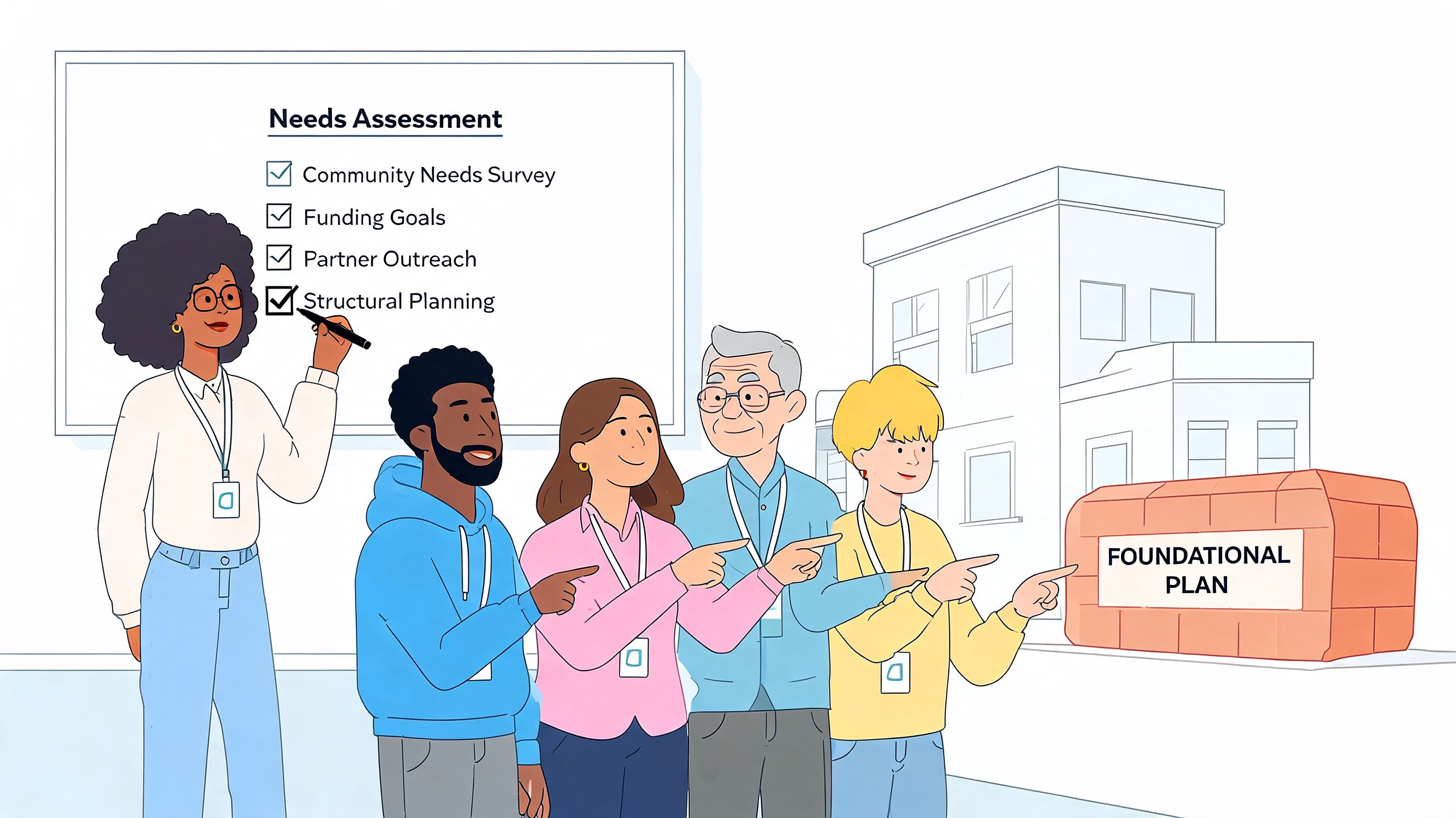
The mistake I see most often is copying a generic training agenda. Staff sit through a session on compliance, nod along, and then return to the same messy file structure, unclear handoffs, and last-minute reporting scramble. Training only sticks when it addresses the points where work breaks down.
Ask who touches the grant lifecycle
Start with a whiteboard or spreadsheet. List every stage from opportunity review through closeout. Then write down who touches each stage.
You're looking for three things:
- Unowned work
- Duplicated work
- Critical work done by people without enough context
In small nonprofits, the executive director, program lead, and finance manager often all touch the same grant at different moments without shared visibility. That creates friction even when everyone is competent.
Use prompts like these in your review:
- Pre-award decisions: Who decides whether an opportunity is worth pursuing?
- Proposal assembly: Who owns attachments, approvals, and final review?
- Post-award launch: Who communicates grant terms to the delivery team?
- Reporting: Who gathers metrics, who pulls financials, and who submits?
- Renewal readiness: Who stores evidence that will matter later?
A practical worksheet can help structure that conversation. If your grant work ties closely to community data and program planning, these community needs assessment tools for nonprofits can help teams connect grant readiness to program evidence, not just internal workflow.
Diagnose where the scramble starts
Once you know who is involved, identify where grants become stressful. Don't ask only whether a task gets done. Ask how it gets done.
Look for patterns such as:
- Deadline confusion: Dates tracked in multiple places or not updated after award
- Reporting bottlenecks: Program and finance data assembled at the last minute
- Version problems: Staff working from outdated narratives or forms
- Documentation gaps: Missing approvals, invoices, notes, or support files
- Tool misuse: A shared drive, CRM, or spreadsheet exists, but nobody uses it the same way
A useful needs assessment doesn't try to prove the team is capable. It tries to expose where capable people are being forced to work around a weak process.
Turn findings into training priorities
Don't train everyone on everything. Build the curriculum from the failures you found.
A simple way to sort priorities is by category:
| Training priority | What it usually signals |
|---|---|
| Missed or rushed deadlines | Weak calendar ownership and handoffs |
| Inconsistent financial reporting | Limited budget-to-actual discipline |
| Confusion after award | No kickoff process or role clarity |
| Poor file organization | No records standard or naming convention |
| Weak renewal prep | Evidence not collected during implementation |
When you finish the needs assessment, you should be able to say, in plain language, what staff need to learn, what process needs to change, and which tools are being underused. That's the foundation of a training program that solves real operating problems instead of adding another meeting to the calendar.
Designing Your Core Training Curriculum
Good nonprofit grant management training covers the full lifecycle. Not just reporting. Not just proposal writing. The team needs to know how grants are qualified, accepted, launched, monitored, documented, and closed.
Many organizations lack staff, experience, or technology for grant management, leading to errors, inefficiencies, and even loss of funding. A practical training goal is to create a workable operating model for lean teams, especially where an executive director, program lead, and finance person share responsibilities without a dedicated grants manager (NetSuite on grant management challenges).
Build around roles, not theory
The biggest curriculum mistake is teaching everyone the same material at the same level. Your program lead doesn't need the same training as your finance lead. Your executive director needs decision rules and oversight habits, not a long lecture on file naming.
A stronger curriculum answers three role-specific questions:
- What decisions does this person make
- What records must this person maintain
- What mistakes can this person prevent
That's also where smart instructional planning matters. If you need help structuring modules, sequencing content, and reducing overload, these instructional design tips for SaaS teams translate surprisingly well to internal nonprofit training because the same learning principles apply.
Sample Grant Management Training Curriculum
| Module | Key Topics | Primary Audience |
|---|---|---|
| Opportunity screening | Funder fit, eligibility review, go or no-go decisions, capacity check | Executive director, development lead |
| Proposal handoff | Final narrative storage, budget assumptions, commitments made in application | Development lead, program lead, finance lead |
| Award intake | Notice of award review, restrictions, reporting schedule, kickoff checklist | Executive director, finance lead, program lead |
| Roles and accountability | Responsibility map, approval workflow, escalation path, backup coverage | All grant-involved staff |
| Budget management | Allowable costs, internal coding, budget-to-actual review, spending controls | Finance lead, executive director |
| Program implementation tracking | Deliverables, milestone logs, participant data, evidence collection | Program lead, program staff |
| Reporting workflow | Narrative drafts, finance inputs, review deadlines, submission archive | Program lead, finance lead, development lead |
| Records management | Folder structure, naming conventions, version control, audit trail | All grant-involved staff |
| Funder communication | Progress updates, issue escalation, amendment requests, relationship notes | Executive director, development lead, program lead |
| Closeout and renewal prep | Final report checklist, lessons learned, renewal evidence, archive process | All grant-involved staff |
Teach the full grant arc
A lean curriculum still needs breadth. These are the modules that tend to matter most.
Pre-award discipline
Teams learn here not to chase every opportunity. Training should cover fit screening, basic eligibility review, internal capacity checks, and what must be true before you say yes to an application. A proposal that wins but overwhelms your staff wasn't a good fit.
Award launch habits
Many nonprofits skip this important step. The team needs a standard post-award kickoff. That includes reviewing grant terms, confirming deadlines, translating proposal promises into deliverables, and assigning owners before work starts.
Field note: The best kickoff meeting is short, documented, and specific. Staff should leave knowing what was funded, what is restricted, what must be tracked, and who owns the next deadline.
Post-award execution
This is the operational core. Training should include budget monitoring, deliverable tracking, evidence collection, records management, and reporting workflow. For small teams, a simple checklist often prevents more damage than a long policy manual.
Closeout and renewal
Strong teams don't treat closeout as paperwork at the end. They preserve final deliverables, compile lessons learned, and store proof points that make renewal easier. This habit also improves board reporting and internal planning.
Keep it lightweight enough to use
Your curriculum doesn't need to become a mini graduate program. It needs to create repeatable behavior.
For most small nonprofits, that means:
- Short modules: Staff can absorb them without leaving core work for a full day
- Shared artifacts: One kickoff template, one report checklist, one naming convention
- Role-based training: People learn the parts of the lifecycle they touch
- Refreshers: Brief follow-up sessions after the first live grant cycle
If training produces a binder nobody opens, it failed. If it produces a handful of habits the whole team follows, it worked.
Choosing the Right Training Delivery Method
Once the curriculum is clear, delivery becomes a practical decision. The best format depends less on trend and more on staffing reality, geographic spread, and how much discussion your team needs.
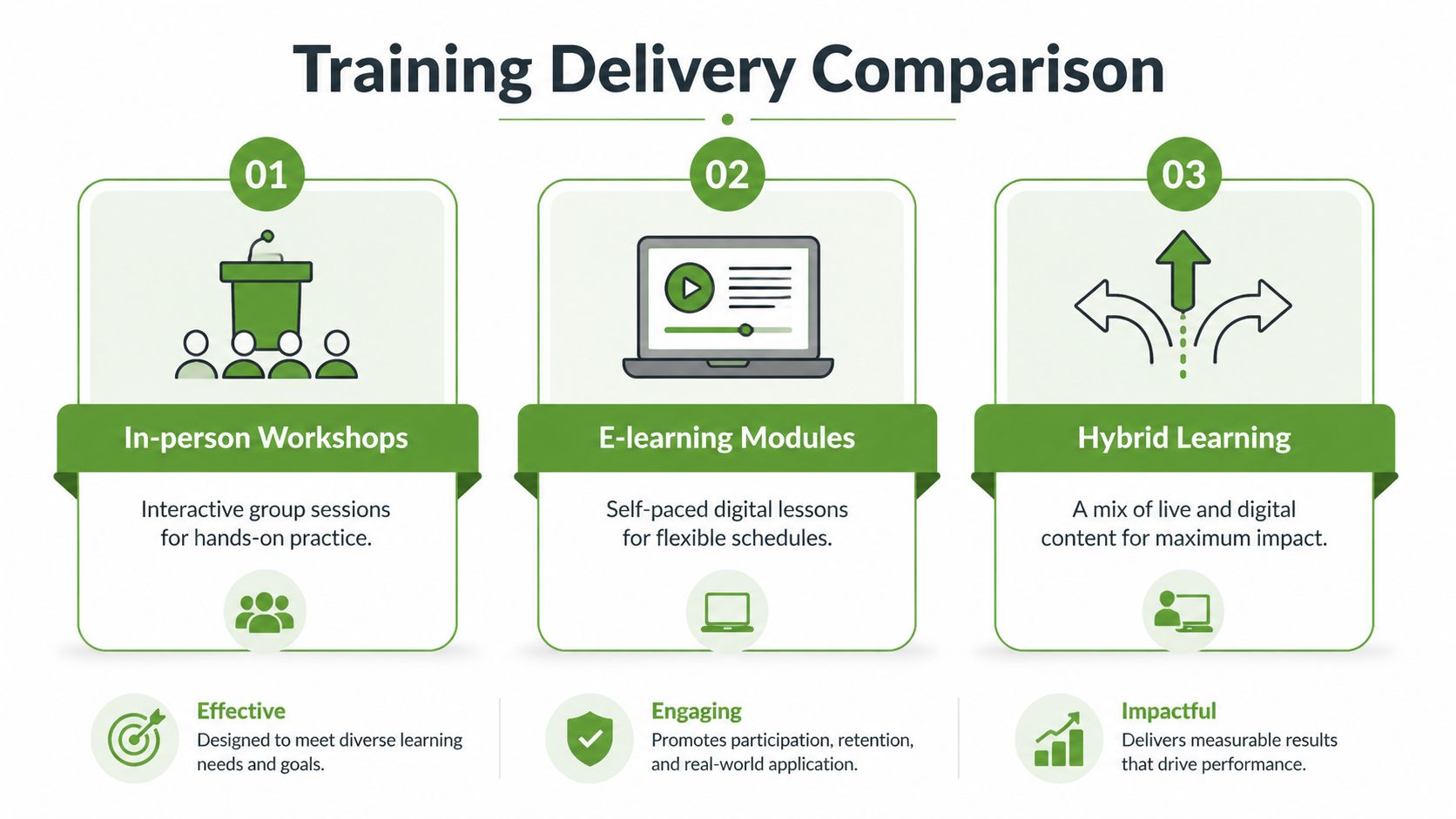
A team that needs to redesign roles and workflows usually benefits from live interaction. A team with turnover or uneven schedules often needs self-paced reinforcement. Most nonprofits end up needing both.
In-person workshops
In-person training works best when the organization needs alignment, not just information. If program, finance, and leadership are carrying different assumptions about grants, a room-based workshop can surface those differences quickly.
Best fit: Teams that need real-time discussion, shared process design, or role clarification.
Trade-offs:
- Strength: Easier to resolve confusion and build consensus
- Limitation: Harder to sustain if there's no follow-up material
- Resource demand: Requires scheduling discipline and protected staff time
Self-paced virtual modules
Self-paced training is useful when the issue is consistency. New hires can take the same baseline training. Existing staff can revisit narrow topics such as closeout, documentation, or report assembly without waiting for a live session.
Best fit: Distributed teams, lean teams with shifting schedules, and organizations with recurring onboarding needs.
Trade-offs:
- Strength: Flexible and easy to reuse
- Limitation: Completion doesn't guarantee behavior change
- Resource demand: Requires someone to maintain the content and connect it to actual workflows
Live virtual sessions
Live virtual sessions are a middle ground. They work well for office hours, Q&A, and scenario-based coaching. They're less effective when your team needs to build shared documents together from scratch.
Teams usually don't struggle because they lack information. They struggle because information is disconnected from the way work moves across staff.
Hybrid delivery
For most nonprofits, hybrid delivery is the strongest option. Use one live session to align on roles, one or two shorter virtual sessions for problem-solving, and a set of short on-demand materials for reinforcement.
A practical hybrid model often looks like this:
| Delivery method | Use it for | Avoid relying on it for |
|---|---|---|
| In-person workshop | Role design, kickoff process, team alignment | Ongoing refreshers only |
| Self-paced module | Onboarding, policies, repeatable basics | Sensitive cross-team conflict |
| Live webinar | Coaching, examples, Q&A | Deep process redesign |
| Hybrid model | Most small nonprofit training programs | None, if managed deliberately |
Choose the method your team will complete. A polished training series nobody attends is weaker than a modest hybrid program that staff can absorb and apply.
Reinforce Learning with Systems and Tools
Training falls apart when it lives only in notes. Staff leave a session with good intentions, then return to inboxes, deadlines, and old habits. If you want nonprofit grant management training to stick, you have to embed it into daily work.
Modern grant management failures are often tied to poor records management, while funders increasingly expect timely, accurate documentation. The training gap is teaching staff how to combine automation with internal controls, especially in hybrid workflows where AI drafts content but humans must verify compliance and citations (CommunityForce on grant management red flags and recordkeeping).
Build reinforcement into the workflow
Teams typically don't need more theory. They need small structures that make the right action easier than the wrong one.
Start with a few operational anchors:
- Kickoff checklist: Award terms, deliverables, budget restrictions, report dates, owner assignments
- Reporting checklist: Required attachments, finance review, narrative approvals, submission archive
- Folder standard: One naming convention and one place for final files
- Version rule: Staff know where the current narrative or report draft lives
- Calendar ownership: One person maintains the official due-date system, with backup visibility
These aren't glamorous. They work because they reduce avoidable decision-making.
Use tools to support behavior, not replace judgment
A grant platform should reinforce the process your training defined. It shouldn't become another place where information goes to die.
Useful tools typically help with:
- Deadline tracking
- Centralized grant records
- Task assignment
- Narrative and attachment version control
- Submission history
- Reporting reminders
- Audit trail preservation
If your team is also formalizing staff learning, a separate LMS can help organize role-based modules, short refreshers, and onboarding content. This roundup of top LMS platforms for businesses is useful for comparing practical training-delivery options when your nonprofit wants something more structured than a shared drive.
One example in the grant workflow category is nonprofit grant management software from Fundsprout, which is designed to centralize grant tracking, deadlines, proposals, reporting, and audit history. For small teams, the main value of a system like that isn't automation alone. It's shared visibility.
AI can help, but governance matters more
AI tools can speed up drafting, summarize RFP requirements, and pull from prior narratives. That can save real staff time. But the risk rises when teams mistake draft generation for compliance.
Use AI inside a governed workflow:
- Draft with AI: First-pass narrative language, checklist creation, or requirement summaries
- Verify with humans: Eligibility, citations, budget alignment, funder-specific restrictions
- Preserve the record: Keep approved versions, source files, and review history
- Control reuse: Don't let staff paste old language into new applications without fit review
This is a good point to show staff what a disciplined process looks like in practice:
The strongest training programs make tools part of the lesson. Staff don't just hear that records matter. They practice where to store them, how to name them, when to review them, and who signs off before anything goes out the door.
Operational test: If a staff member left tomorrow, could another person find the current grant status, next due date, latest approved narrative, and supporting documents within minutes? If not, the system needs reinforcement.
Measure the Impact of Your Training Program
If leadership can't see results, training gets treated as overhead. The answer isn't a satisfaction survey. It's a short set of operational measures that show whether staff are managing grants more reliably after training.
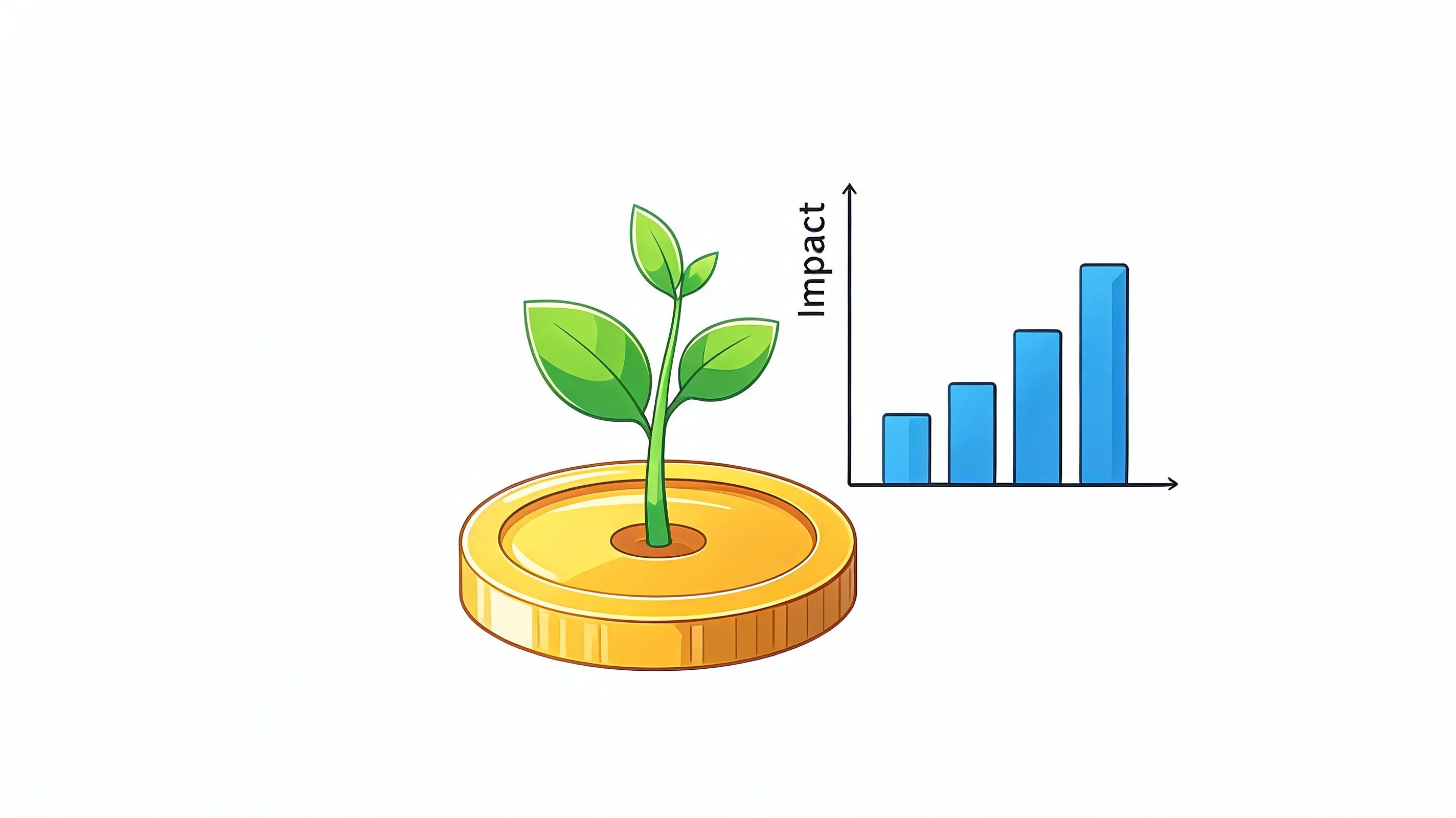
The first step is to track the basics consistently. Practitioner guidance recommends recording total grants submitted and awards received to calculate win ratio, then total dollars requested and awarded to calculate award ratio, and segmenting both by funder type, geography, and program type so teams can see where process or training gaps are affecting outcomes (Nonprofit Nomad on win ratio, award ratio, and grant tracking).
Use realistic benchmarks by funder type
One generic success-rate target won't help much. Effective training should teach teams to benchmark by funding source. Guidance cited in the field suggests private foundations average about 30% success, while state and local government funders average 52%. Tracking against source-specific benchmarks reveals where training is helping and where qualification, fit, or process still needs work (Funding for Good on grant writer success rates).
That matters because a weak foundation hit rate may signal poor prospect screening, while a weaker government performance pattern may point to compliance readiness, attachments, or cross-functional coordination.
Track behavior change before outcome change
Outcomes take time. Behavior changes show up first.
Look for signs such as:
- Reports submitted on time: The process is becoming reliable
- Fewer last-minute data requests: Program and finance are coordinating earlier
- Cleaner files: Staff can locate approved versions and support documents quickly
- Faster internal handoffs: Proposal promises are being translated into post-award action
- Stronger renewal preparation: Evidence is collected during implementation instead of reconstructed later
A simple dashboard can combine operational and funding indicators:
| Measure | What it tells you |
|---|---|
| On-time report submission | Whether workflow discipline is improving |
| Number of compliance corrections | Whether staff understand requirements |
| Win ratio by funder type | Whether opportunity selection and execution are improving |
| Award ratio by funder type | Whether proposals are winning meaningful funding, not just approvals |
| Renewal readiness notes | Whether records and evidence are being maintained well |
Review the story behind the numbers
Don't stop at the metric. Ask what changed operationally.
If the team submits reports on time but still scrambles for data, training may have improved urgency but not handoffs. If foundation performance improves while government results don't, your curriculum may need stronger instruction on documentation, approvals, or technical requirements.
Better grant results usually come from better qualification, cleaner handoffs, and steadier records. Training works when those habits become normal.
A good training program should make grant work feel less dramatic. Fewer surprises. Fewer email chases. Fewer “who has the latest version?” moments. That's what creates better compliance and, over time, better win rates.
If your team is trying to move from scattered spreadsheets and ad-hoc handoffs to a more disciplined grant workflow, Fundsprout is one option to evaluate. It supports grant discovery, proposal development, deadline planning, reporting, and audit tracking in a centralized system, which can make staff training easier to reinforce in day-to-day operations.
Try 14 days free
Get started with Fundsprout so you can focus on what really matters.