Letters of Inquiry for Grants That Actually Get Funded
Learn to write compelling letters of inquiry for grants. Our guide shares proven strategies, real-world examples, and expert advice to secure funding.


Abdifatah Ali
Co-Founder
A Letter of Inquiry, or LOI, is a short document—usually just 2-3 pages—that you send to a foundation to feel out their interest in your project. Think of it as a pre-proposal. It's your first chance to introduce your organization and your idea before you dive into writing a massive, time-consuming grant application.
This initial outreach helps a funder quickly see if your work fits with their mission. It’s a huge time-saver for everyone involved.
Why Your Letter of Inquiry Is Your Most Critical First Impression
Before you pour dozens of hours into a full-blown grant proposal, the LOI stands as the gatekeeper. It’s not a hurdle to clear; it’s a strategic move. This is your organization's elevator pitch on paper, crafted to make a powerful impact and determine whether you get an invitation to apply or a polite "no, thank you."
Program officers are swamped with requests. The LOI is their go-to tool for sifting through the noise efficiently. For you, it's a low-stakes way to test the waters with a funder without committing a ton of resources. A sharp, well-written letter shows you respect their time and know what you're doing.
The Rise of the LOI as a Screening Tool
Over the last few years, the letter of inquiry for grants has become standard practice. A lot of private and corporate foundations now require an LOI to screen requests before they’ll even look at a full proposal. In fact, research shows that somewhere between 60% and 75% of medium-to-large private foundations have an LOI stage to manage their application pipeline.
This one step can slash the number of full proposals they have to review by a staggering 50–90%. You can find more helpful insights about grant funding strategies on Instrumentl.com.
This trend means that getting the LOI right is more important than ever. It's not just a formality; it's the key that opens the door to a real conversation with a potential funder.
A strong Letter of Inquiry doesn’t just ask for money. It builds a compelling case for partnership by showing a clear alignment of mission, vision, and impact. It proves you understand the funder’s goals and have a viable plan to help achieve them.
At the end of the day, a solid LOI needs to nail three things:
- Introduce Your Organization: Who are you, what do you do, and why is it important?
- Present a Compelling Need: What’s the problem you're trying to solve? Make it feel urgent and clear.
- Propose a Clear Solution: Briefly explain your project and the real-world change it will create.
If you can't make a strong case here, your full proposal won't ever see the light of day. This short document carries a ton of weight. It sets the tone for your entire relationship with a funder and decides whether you get to move on.
So, how is an LOI different from the full grant proposal it precedes? Here’s a quick breakdown.
LOI vs Full Proposal At a Glance
This table highlights the key differences between the two documents, so you know exactly what to focus on at each stage.
As you can see, the LOI is all about being concise and compelling, while the full proposal is where you lay out all the details. Mastering the LOI is your ticket to getting the chance to write that proposal.
Anatomy of a Winning Letter of Inquiry
Think of your Letter of Inquiry (LOI) as the movie trailer for your full grant proposal. It’s not a miniature version of the main feature; it's a strategic, compelling summary designed to grab a program officer's attention and make them want to see more. If you get this right, you save everyone time and dramatically increase your odds of getting to the next stage.
A truly effective LOI weaves together a few critical elements to tell a powerful story. Every sentence has a job to do, building a case that aligns perfectly with what the funder cares about. You're aiming for a concise narrative that hooks them from the first line and ends with a clear, confident ask.
The Essential Components of an LOI
While you should always check a funder’s specific guidelines, most successful LOIs follow a proven structure. It’s a logical flow that makes your case easy to understand and hard to ignore.
Here’s the breakdown of what you need to include:
- A Punchy Introduction: Get straight to the point. Introduce your organization, state why you're writing, and immediately connect your work to the funder's mission. Don't bury the lede.
- The Statement of Need: This is where you paint a picture of the problem you’re solving. Use hard data to show the urgency and scale of the issue in the community you serve.
- Your Project Description: Give a quick, clear snapshot of your proposed solution. What will you do? Who will you help? What results do you expect?
- Organizational Credibility: Briefly touch on why your organization is the right one for the job. A key achievement, a unique approach, or a relevant piece of experience is all you need here.
- The Specific Funding Request: State the total project budget and the exact amount you are requesting. End with a clear call to action about the next steps.
This isn’t just a checklist; it’s a roadmap for a persuasive story.
Crafting a Data-Driven Statement of Need
Your Statement of Need is often the make-or-break section. Simply saying a problem exists isn’t enough—you have to prove it with solid evidence. This is your moment to frame the issue with facts and figures that create a real sense of urgency.
For instance, don’t just say, "many local youth lack job skills." Instead, make it concrete: "According to the County Workforce Board, youth unemployment in our service area has surged by 15% in the past two years, leaving over 3,000 young adults without stable work." See the difference? For a deeper dive, check out our guide on how to write a powerful statement of need.
A great statement of need connects the dots for the funder. It shows a deep understanding of the problem and subtly positions your organization as the expert ready to deliver a solution.
Remember, funders use the LOI as a screening tool. Your goal is to make it through the filter.
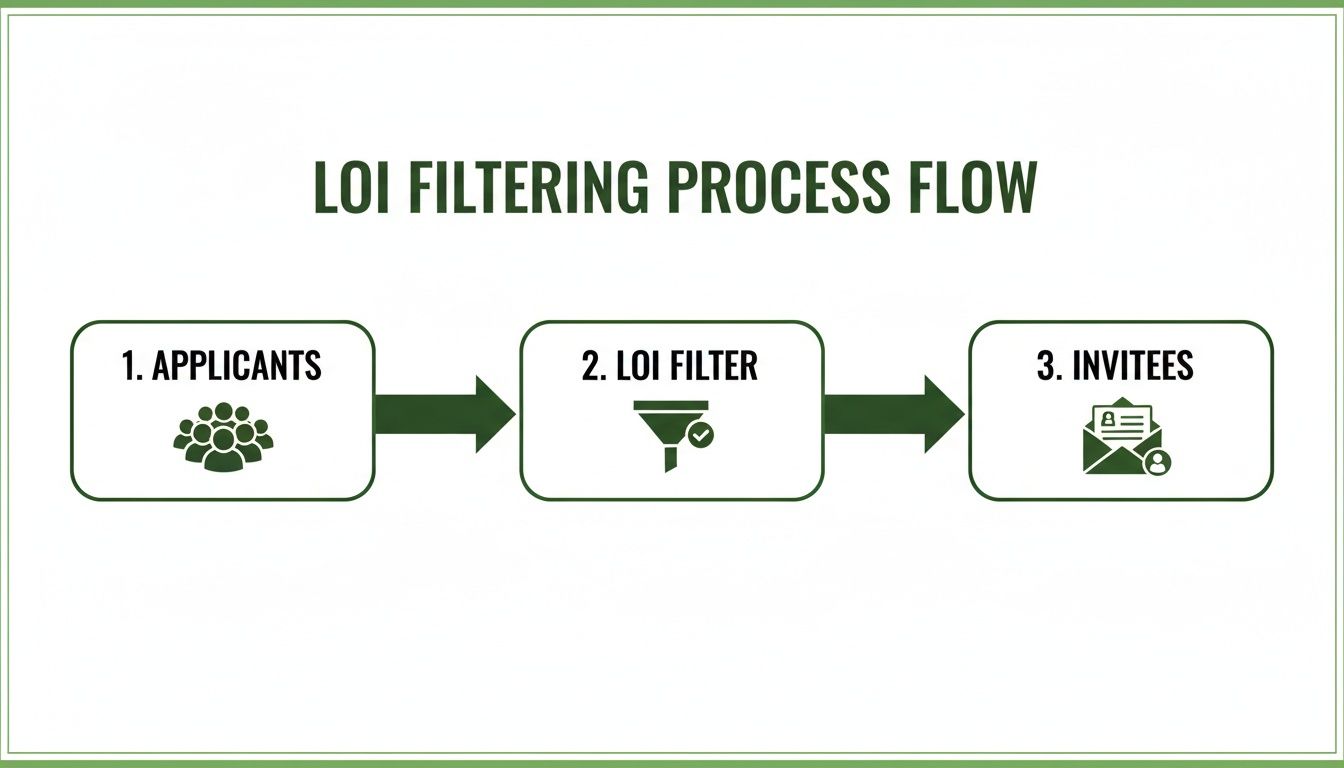
As you can see, only a select few applicants are invited to submit a full proposal. A strong LOI is what gets you on that shortlist.
The Project Description and Funding Request
When you describe your project, keep it tight. This is the elevator pitch of your solution. Focus on the "what, who, and how," and make sure you link your activities to the outcomes you expect to see. The full details can come later in the proposal; for now, you just want to spark their interest.
Finally, be direct and confident with your funding request. Clearly state the total project cost and the specific amount you are asking for from this foundation. Any vagueness here can look like poor planning and can quickly kill your credibility. A clear ask signals that you've done your homework and are ready to put their potential investment to work.
Using Data to Tell a Compelling Story
A powerful story can capture a funder's heart, but solid data is what truly convinces their head. Backing up your narrative with real numbers is what moves your letter of inquiry from the "maybe" pile to the "must-read" stack.
Data isn't just about spreadsheets and charts; it's about translating your mission into an evidence-based case for support. It’s the proof that the problem you’re solving is real, significant, and needs urgent attention. This is how you build immediate credibility with a program officer and show them you've done your homework.

Weaving in Your Organization's Metrics
While big-picture statistics set the stage, it’s your organization's own data that proves you’re the right team for the job. This is where you get to show off your track record and demonstrate tangible results, no matter the scale.
Here’s how you can weave your own metrics into the story:
- Pilot Program Outcomes: Instead of just saying a program worked, quantify it: "Our 12-week pilot program achieved an 85% job-placement rate for participants, proving our model is effective."
- Service Delivery Numbers: Show your reach: "In the last fiscal year, our clinic provided essential healthcare services to over 1,200 uninsured residents in our community."
- Client Success Stories (Quantified): Connect your work to real change: "After completing our financial literacy course, 70% of participants reported a measurable decrease in personal debt within six months."
These specific, measurable achievements make your impact impossible to ignore. They prove to a funder that you aren't just planning to do good work—you're already doing it successfully. If you want to dig deeper into this, our guide on how to write a needs assessment is a great place to start.
Finding Credible Data to Frame the Problem
The real magic happens when you combine your internal results with external data. Think of it as a powerful one-two punch. Credible statistics from government agencies, academic institutions, or respected research centers legitimize the problem on a much larger scale.
This approach shows funders that your project isn't just a local passion project; it’s a targeted solution to a significant community, regional, or even national issue.
The most compelling letters of inquiry balance the macro (the big-picture problem supported by public data) with the micro (your organization's proven ability to create change). This combination builds a rock-solid case for investment.
From my experience, including concrete numbers is directly tied to getting invited to submit a full proposal. In fact, many fundraising advisors recommend including at least 2–4 hard metrics. Reviewers often report that these simple data points make an LOI 30–50% more likely to advance in a competitive grant cycle. By strategically placing just a few key stats, you build an evidence-based story that funders can’t ignore.
How to Tailor Your LOI for Each Funder
Sending out a generic, one-size-fits-all Letter of Inquiry is probably the fastest way to get your proposal tossed. Trust me, funders can spot a copy-paste job from a mile away, and it sends a clear message: you haven't bothered to understand what they're all about.
Customizing your letters of inquiry for grants isn’t just a nice touch; it’s absolutely essential. It shows you’re looking for a partner, not just a piggy bank. It proves you’ve done your homework and genuinely see a connection between your work and their mission. The best part? This doesn't have to be a massive undertaking. A few hours of smart, focused research can make all the difference.
Become a Funder Detective
Before you even think about writing, it’s time to do some digging. Your mission is to get inside the funder's head—what are their priorities? What kind of language do they use? Who have they given money to in the past? This intel is your roadmap.
Here’s where I always start my research:
- The Funder’s Website: This is your home base. Scour their mission and vision statements. Pay close attention to the specific words they use in their program descriptions, news releases, and annual reports.
- Form 990s: These public tax filings are pure gold for grant seekers. They list every single grant the foundation has awarded, showing you who got the money, how much they got, and often a short description of the project. This is how you see where their money really goes.
- Past Grantee Lists: Who is already in their portfolio? Look for organizations that are similar to yours, whether in size, location, or focus. This gives you a much clearer picture of what a "fundable" project actually looks like to them.
As you go through these documents, you'll start to see patterns emerge. You'll get a feel for the kinds of projects that excite them and the buzzwords they tend to use.
Mirror Their Language and Mission
Once you have a solid grasp of the funder, you can start weaving that knowledge into your LOI. The trick is to subtly reflect their language and draw a bright, clear line from your project’s goals to their stated mission. You want to make it incredibly easy for the program officer to see the connection.
For instance, if a foundation’s website is filled with the phrase “community-led solutions,” you’d better believe your LOI should describe how your project is, in fact, a community-led solution. If their primary goal is to “improve early childhood literacy,” your letter needs to state exactly how your program will help them achieve that.
A tailored LOI speaks the funder’s language. It doesn’t just describe what you do; it frames your work as the ideal answer to a problem the funder is already committed to solving.
This isn't about pretending to be something you're not. It’s about strategically highlighting the parts of your work that will resonate most deeply with this specific funder. Think of it like adjusting the spotlight to illuminate the elements of your story they are most eager to see. Doing this makes your request feel less like a cold ask and more like the beginning of a powerful partnership.
Navigating Submission and Follow-Up Like a Pro
You can write the most compelling Letter of Inquiry in the world, but if you fumble the submission or drop the ball on follow-up, it might never get the attention it deserves. This final stretch is where so many otherwise great proposals go wrong. It’s about more than just hitting "send."
Think of this stage as the beginning of your professional relationship with the funder. The best way to start on the right foot is to follow their instructions to the letter. If they specify a PDF attachment submitted via their online portal, don’t be the one who emails a Word doc. It’s a small detail, but it shows you’re organized, respectful, and easy to work with.
The Art of the Follow-Up
So, you’ve sent your LOI. Now what? The follow-up is a delicate dance between persistence and patience.
First, check if the funder provided a timeline for their review process. If they did, honor it. Reaching out before that window closes can make you seem impatient or suggest you didn't read their guidelines carefully.
If their deadline passes and you haven't heard anything, a polite, professional check-in is perfectly fine.
Here’s a simple template I've used that works well:
"Dear [Program Officer Name],
I’m just following up on the Letter of Inquiry for our [Project Name], which we submitted on [Date]. We remain incredibly enthusiastic about the potential to partner with [Funder's Name] and wanted to gently confirm that you received everything.
Please let me know if you need anything else from our end. Thank you for your time and consideration."
This note is courteous and professional. It doesn't put them on the spot but serves as a gentle nudge, confirming receipt and reiterating your interest.
Handling the Funder's Decision
Whether the answer is a "yes" or a "not at this time," your response sets the tone for future interactions.
If you get an invitation to submit a full proposal, that’s fantastic news! But the real work is just beginning. Your first move should be a prompt and gracious thank-you email confirming you'll be moving forward. For a deeper dive into what comes next, check out our guide on how to apply for grants.
On the other hand, a rejection can feel like a setback, but it’s really a chance to learn. Some funders are open to providing feedback. It never hurts to send a brief, polite email asking if they’d be willing to share any insights. Not all foundations have the bandwidth for this, so don’t be discouraged if you don’t hear back.
Keep in mind that invitation rates for letters of inquiry for grants can be surprisingly low. Some foundations only invite 5–10% of LOIs to the full proposal stage. Funders often share their review process, and understanding it can help manage expectations. It’s a numbers game, and persistence is your greatest asset.
7. Common LOI Mistakes That Get Your Grant Request Tossed
Even the most brilliant project idea can get sidelined by a few simple, avoidable mistakes in a letter of inquiry. I've seen it happen time and time again. Program officers are often swimming in submissions, and small errors can become big red flags that send your LOI straight to the "no" pile.
Let's walk through the most common pitfalls so you can steer clear of them.

Not Doing Your Homework
This is the cardinal sin of grant seeking. Pitching a senior services program to a foundation focused on youth literacy is an immediate disqualifier. It tells the funder one thing loud and clear: you didn't bother to read their guidelines or understand their mission. This is the fastest way to show disrespect for their time and work.
Another classic mistake is being vague about the money. Just saying you need "financial support" won't cut it. You have to state the exact amount you're requesting from this specific funder. A clear, confident ask shows you've done your budgeting and you know precisely what you need to make your project happen.
Ignoring the Simple Rules
Funders provide guidelines for a reason—it makes their review process manageable. Ignoring their instructions is a surefire way to annoy the person reading your proposal.
Keep an eye out for these common slip-ups:
- Blowing past word or page limits. This signals that you can't follow directions and don't respect the reviewer's time. Be concise.
- Submitting in the wrong format. If they ask for a PDF, don't send a Word doc. Simple formatting rules, like font size or line spacing, matter too.
- Using too much jargon. Avoid insider acronyms and overly technical language. The program officer might not be an expert in your niche, so write for clarity, not complexity.
A polished, error-free LOI isn't just about good grammar. It communicates professionalism, credibility, and respect for the funder's process, making it much easier for them to trust you with their investment.
Fumbling the Story and Strategy
Beyond the basics, some mistakes cut to the heart of your request and undermine its power. A weak or unsupported problem statement is a fatal flaw. If you can't paint a vivid picture of the need—backed by data or compelling stories—your solution will feel irrelevant.
Just as important is answering the "Why you?" question. Failing to explain what makes your organization uniquely qualified to solve this problem is a huge missed opportunity. You have to connect the dots for the funder. Briefly touch on your track record, your team's expertise, or deep community roots. This is what builds the confidence they need to invest in your vision and trust that you can deliver real results.
To help you double-check your work, I've put together a quick checklist of the most common red flags I see and how to fix them.
LOI Red Flag Checklist
Before you hit "send," run your letter through this checklist. Catching these common issues can make all the difference between getting an invitation to apply and a swift rejection.
Think of this table as your final quality check. A clean, strategic, and well-researched LOI is your best shot at getting a funder's attention and securing the resources you need to make a difference.
Clearing Up the Confusion: Your LOI Questions, Answered
When you're deep in the grant writing process, a few key questions about Letters of Inquiry always seem to pop up. Let's tackle some of the most common ones I hear from nonprofits all the time.
How Long Should a Letter of Inquiry Be?
Think short and powerful. Most funders want to see something between one and three pages. In my experience, the two-page LOI is often the sweet spot. It gives you enough room to build a compelling case without overwhelming a busy program officer.
Of course, this is just a rule of thumb. The funder's guidelines are the ultimate authority, so always double-check what they ask for.
Who Should Sign the Letter?
This is an easy one: the person at the very top. Your Executive Director or CEO should be the one signing the letter.
Why? A signature from leadership sends a clear message. It shows the funder that this project has the full support and backing of your entire organization, which instantly adds weight and credibility to your request.
Can I Send an LOI Without Being Asked?
This is a big one, and the answer is a firm "it depends." Some foundations are open to hearing from new organizations and welcome unsolicited LOIs. For example, the ECMC Foundation has an online portal and accepts inquiries on a rolling basis.
However, many other funders operate on an "invitation-only" basis. Sending an unsolicited letter to them is one of the fastest ways to get your proposal ignored. It signals you haven't done your homework.
Pro Tip: Never, ever assume a funder is open to unsolicited letters. A quick check of the "How to Apply" or "Grants" section of their website is an essential first step before you write a single word.
Ready to stop guessing and start winning? Fundsprout uses AI to match your nonprofit with the right funders, analyze requirements, and help you write compelling grant narratives in a fraction of the time. Discover your next funding opportunity at https://www.fundsprout.ai.
Try 14 days free
Get started with Fundsprout so you can focus on what really matters.