Letters of Agreement for Nonprofits: Essential 2026 Guide
Master letters of agreement for nonprofits. Get practical guidance on use cases, key inclusions, and how to protect your organization affordably in 2026.

Abdifatah Ali
Co-Founder
Your gala is six weeks away. A restaurant owner offers to provide catering in exchange for sponsorship recognition. A volunteer designer agrees to refresh your event materials. A local business promises a raffle package, but only if your team confirms the logo placement quickly.
Those are good problems to have, until someone asks, “Can you send that in writing?”
For many nonprofits, that's the moment where things stall. A verbal agreement feels too loose. A full legal contract feels too heavy for a modest partnership or short-term project. What usually works in that middle ground is a letter of agreement. It gives both sides a written record, sets expectations, and protects the organization without turning a straightforward arrangement into a legal production.
The key is using it in the right situations and drafting it with enough precision to prevent avoidable disputes. Nonprofits deal with a specific mix of relationships that generic business articles rarely address. Sponsorship benefits, in-kind support, volunteer expertise, community partnerships, and short contractor engagements all carry risks that are easy to miss if you rely on handshake deals or recycled templates.
Formalizing Partnerships Without Formal Contracts
A nonprofit executive director gets a call on Tuesday afternoon. A local catering company wants to support the annual fundraiser. The owner will provide food for the event, and in return the nonprofit will place the company logo on the event banner, mention the business in promotional materials, and thank them from the stage.
Everyone is pleased. The event manager starts updating the run-of-show. The development director adds the sponsor to a draft flyer. Then the practical questions hit. Who is responsible for setup? What exactly is being donated? What happens if the headcount changes? Is the recognition limited to the event, or does it include social posts and email mentions too?
That's where nonprofits often get exposed. Goodwill is present, but the terms are fuzzy.

A letter of agreement solves this without forcing either side into a long contract review. In practical use, it works as a short written agreement that captures who is doing what, when performance starts, what each party receives, and how either side can exit if plans change. For nonprofits, that matters because staffing is lean, event timelines are compressed, and institutional memory is often weaker than anyone wants to admit.
Why nonprofits need this middle ground
Small organizations routinely juggle relationships that are too important to leave undocumented and too modest to justify custom legal drafting every time. A sponsorship exchange, an in-kind gift with delivery obligations, or a short consulting engagement all fit that pattern.
A good letter of agreement helps your team do three things:
- Lock down expectations early: Staff, volunteers, and partners stop working from different assumptions.
- Reduce avoidable conflict: If a disagreement comes up, you have a written reference point.
- Keep momentum: You can move quickly without waiting for a full contract process.
Practical rule: If the arrangement is simple, time-sensitive, and still important enough that failure would create stress, document it.
Nonprofit leaders often hesitate because they think any written agreement has to sound like it came from a law firm. It doesn't. The best letters of agreement are usually plain, direct, and specific. They protect the relationship by reducing confusion. That's often more valuable than legal complexity.
What Exactly Is a Letter of Agreement
A letter of agreement is best understood as a business-grade handshake on paper. It's more formal than a verbal promise and usually much shorter than a full contract. It records the core terms of a deal so both sides can move forward with fewer assumptions.
That simple description matters because the term gets used loosely. In some contexts, people use it for operational coordination. In others, they use it as a short-form legal agreement. Even basic legal guidance notes that an LOA can be a formal legally binding document, but whether it functions that way depends on context and jurisdiction, as discussed in Law365's overview of common LOA questions. For nonprofit leaders, the practical takeaway is straightforward. Don't assume the label alone determines enforceability. The actual wording, signatures, and surrounding circumstances matter.
What makes it different from an MOU
Teams often confuse letters of agreement with memoranda of understanding. They're not the same tool.
An MOU is often used when parties want to express shared intent, collaboration goals, or a framework for working together. It can be useful when the relationship is exploratory or when the parties want to document alignment without locking every operational detail into enforceable terms.
A letter of agreement is more concrete. It's usually the better fit when your nonprofit needs the other side to deliver something specific, or when your organization is giving defined benefits in return.
LOA vs MOU vs Contract at a glance
| Characteristic | Letter of Agreement (LOA) | Memorandum of Understanding (MOU) | Formal Contract |
|---|---|---|---|
| Primary use | Short written agreement for a specific arrangement | Statement of shared intent or framework for collaboration | Detailed agreement for more complex or higher-risk matters |
| Typical tone | Direct and operational | Collaborative and broad | Comprehensive and legal |
| Level of detail | Moderate | Usually lighter | High |
| Best for nonprofits when | You need clear terms without a long document | You're outlining cooperation or future intent | The stakes, risk, or complexity are high |
| Common examples | Sponsorships, in-kind support, short consulting work | Coalition partnerships, joint planning, referral relationships | Major vendor deals, real estate, significant services |
Why the format is credible
Letters of agreement are not a casual invention used only by small organizations. Related forms are embedded in formal systems. In federal procurement, FAR 16.603 defines a letter contract as a written preliminary contractual instrument that allows work to begin before a definitive contract is negotiated. The Bureau of Labor Statistics also uses a formal Letter of Agreement for restricted research data access, which shows that these documents are established tools in government and administrative settings, as reflected in the BLS Letter of Agreement materials and related federal context.
A letter of agreement works best when the relationship is real, the expectations are specific, and the document matches the scope of the deal.
For nonprofit use, that means this document isn't “less serious” than a contract. It's narrower and more efficient when the situation calls for that.
Key Scenarios for Nonprofits to Use an LOA
Nonprofits run on a steady stream of small but meaningful arrangements. That's exactly where letters of agreement earn their keep. They aren't reserved for legal departments. They're useful in day-to-day operations where a missed deadline, vague deliverable, or disputed benefit can create friction your team doesn't have time to absorb.
Commercial guidance often suggests letters of agreement for lower-value work, with one guide recommending them for engagements at approximately £25,000 or below in the context of smaller, less complex deals, as noted in Cloud Contracts 365's discussion of when to use a letter of agreement. That isn't a universal threshold for every nonprofit, but it's a helpful rule of thumb. If the project is relatively contained and the risks are manageable, an LOA often fits.
Sponsorships and in-kind support
This is one of the most common nonprofit uses. A business offers food, printing, venue space, prizes, transportation, or media promotion. Your organization offers recognition, tickets, signage, speaking acknowledgment, or digital visibility.
The trouble starts when nobody writes down the exchange.
Use an LOA when you need clarity on:
- What the sponsor is providing: goods, services, timing, quantities, or event-day support
- What the nonprofit is providing back: logo placement, mentions, booths, tickets, naming rights, or acknowledgments
- How brand use works: approved logo files, review rights, and any restrictions
If you're building packages for this kind of relationship, it helps to review concrete examples of sponsorship levels before drafting the LOA so the benefits section doesn't stay vague.
Short contractor and consultant engagements
Nonprofits often hire people for narrow assignments such as:
- grant editing
- event photography
- board training facilitation
- database cleanup
- website updates
- program evaluation support
These are classic LOA scenarios when the assignment is limited in scope. You need clear deliverables, timeline, payment terms, and ownership expectations. You probably don't need a long services contract if the work is narrow and the risk profile is modest.
Volunteer professionals and community partners
The hardest relationships to document are often the friendliest ones. A volunteer attorney offers policy review. A retired HR director agrees to help with hiring procedures. Another nonprofit agrees to co-host a workshop. A school lets you use a room for a family event.
Because these arrangements feel mission-aligned, teams skip paperwork. That's a mistake.
When an LOA is usually a fit
A letter of agreement tends to work well when:
- The arrangement has one clear purpose: one event, one project, one contribution, one defined service
- The timeline is limited: there's a start point and an endpoint
- The exchange is understandable: money, services, recognition, access, or specific deliverables
- The consequences of confusion are real: missed work, disappointed partners, reputational tension, or accounting headaches
Nonprofits don't need formal contracts for every routine collaboration. They do need a written record whenever assumptions could drift.
If the relationship starts expanding into multiple phases, layered obligations, sensitive data handling, or significant liability issues, move up to a fuller contract instead of stretching an LOA beyond its useful limits.
Essential Elements Your Nonprofit LOA Must Include
A usable letter of agreement isn't long. It is complete. The strongest versions identify the parties, state when the agreement takes effect, and spell out obligations, payment, confidentiality, termination, and governing law. That basic structure aligns with practical legal guidance on business use, and it also reflects the FAA's insistence that an LOA define responsibilities clearly when used for a single purpose in operational settings, as described in the FAA's LOA guidance.

The clauses that do the real work
Here's the checklist I'd want any nonprofit team to use before sending an LOA for signature.
Parties and contact details: Name the nonprofit's legal entity and the other party correctly. Include addresses and the main contact person for implementation. If your board-approved name differs from your public-facing brand, use the legal name in the agreement.
Effective date: State when the agreement starts. The signing date matters because it marks the point at which the written agreement becomes effective in many practical business contexts. If performance begins later, include that operational start date too.
Purpose and scope: Describe the single transaction or project in plain English. If this section is weak, the rest of the document won't save you. “Marketing support” is weak. “Design and deliver one event flyer, one sponsor slide, and three social media graphics for the annual luncheon” is usable.
Responsibilities of each party: Put obligations under separate headings if needed. Don't bury them in one paragraph. Nonprofits especially need this when staff, volunteers, and external partners all touch the same project.
Payment or consideration: If money is changing hands, state the amount, invoice process, and due date. If no money is involved, describe the exchange just as clearly. Sponsorship recognition, donated goods, venue access, and consulting hours are all consideration and should be spelled out.
A short governance check belongs here as well. If the arrangement involves a board member, major donor, or related party, review your organization's conflict of interest policy for nonprofits before finalizing the agreement.
This walkthrough is also useful if your team wants a visual refresher before drafting:
The terms teams skip and later regret
Some clauses don't feel urgent when everyone is aligned. Those are often the ones that matter most later.
| Element | Why it matters for nonprofits |
|---|---|
| Deadlines and milestones | Helps staff coordinate event prep, reporting, approvals, and deliverables |
| Confidentiality | Protects donor lists, financial details, participant information, and internal plans |
| Termination | Gives both sides a clear exit path if circumstances change |
| Governing law | Reduces uncertainty if a dispute escalates |
| Signature blocks | Confirms that the people signing actually have authority |
Board-level caution: If your nonprofit would struggle to explain the arrangement to an auditor, funder, or future executive director, the LOA isn't detailed enough yet.
For sponsorships, include communication approvals. For consultant work, include draft and final delivery dates. For in-kind donations, include condition, quantity, delivery timing, and who bears setup or transport responsibility. The document doesn't need to be elegant. It needs to be unmistakable.
Drafting Tips and Sample Language for Nonprofits
Most weak letters of agreement fail for one reason. The writer tries to cover too much in too little space. The better approach is tighter. Keep the document focused on one arrangement, define the exchange clearly, and remove language that sounds official but doesn't commit anyone to anything.
The FAA's guidance offers a useful discipline here. It requires an LOA to be confined to a single subject or purpose so responsibilities and coordination requirements stay clear. That same principle works extremely well for nonprofits handling event support, contractor projects, or a discrete partnership.
Drafting habits that make LOAs easier to enforce
Use these habits when you draft:
- Write for the person implementing the work: If an event manager or program coordinator can't use the document to run the arrangement, it's too abstract.
- Replace broad words with specifics: Don't write “promotion.” Write “one logo on the printed program, one logo on the event webpage, and one verbal thank-you at the event.”
- Use dates, not vague timing: “By October 1” is stronger than “ahead of the event.”
- Separate obligations by party: That prevents each side from reading only the part they like.
- Define approval rights: This matters for logos, messaging, speaker mentions, and public statements.
If you want a drafting head start, it can help to download legal document templates and adapt the structure to nonprofit use instead of writing every clause from scratch. Templates are useful for format. They are not a substitute for tailoring the details.
Sample language for common nonprofit situations
Use these as starting points, not as final legal advice.
In-kind contribution acknowledgment
“[Business Name] agrees to provide the following in-kind contribution to [Nonprofit Legal Name]: [describe goods or services in specific terms]. Delivery or performance will occur no later than [date]. [Nonprofit Legal Name] agrees to acknowledge the contribution as follows: [describe recognition clearly]. No additional benefits are included unless stated in this Agreement.”
That clause works because it identifies the contribution and limits assumptions about extra recognition.
Sponsorship benefits and recognition
“In consideration of Sponsor's contribution described in this Agreement, [Nonprofit Legal Name] will provide the following sponsorship benefits: [list each benefit]. Sponsor will provide logo files and any required brand guidelines by [date]. All public-facing materials are subject to [Nonprofit Legal Name] production schedules and format limitations.”
This language helps when a sponsor assumes a premium placement that your team never promised.
Volunteer consultant deliverables
“Volunteer Consultant agrees to provide the following services on a volunteer basis: [describe services]. Deliverables will include [list outputs]. The parties acknowledge that Volunteer Consultant is not an employee of [Nonprofit Legal Name]. Any confidential information shared for the purpose of this work must not be disclosed outside the project.”
That keeps a generous offer from turning into a role confusion problem.
Short clauses worth borrowing
A few simple lines can prevent a lot of back-and-forth later:
This Agreement may be terminated by either party upon written notice if the other party fails to perform a material obligation described in this Agreement.
Any changes to this Agreement must be made in writing and signed by both parties.
Each signer represents that they are authorized to sign on behalf of the party named below.
Those aren't flashy clauses. They are practical ones. Nonprofits rarely need elegant LOAs. They need usable ones.
Common LOA Mistakes and Red Flags to Avoid
The most dangerous letters of agreement are the ones that look finished but leave key issues unresolved. They create false confidence. Staff assume the paperwork is handled, then discover too late that the document never addressed the point everyone is arguing about.
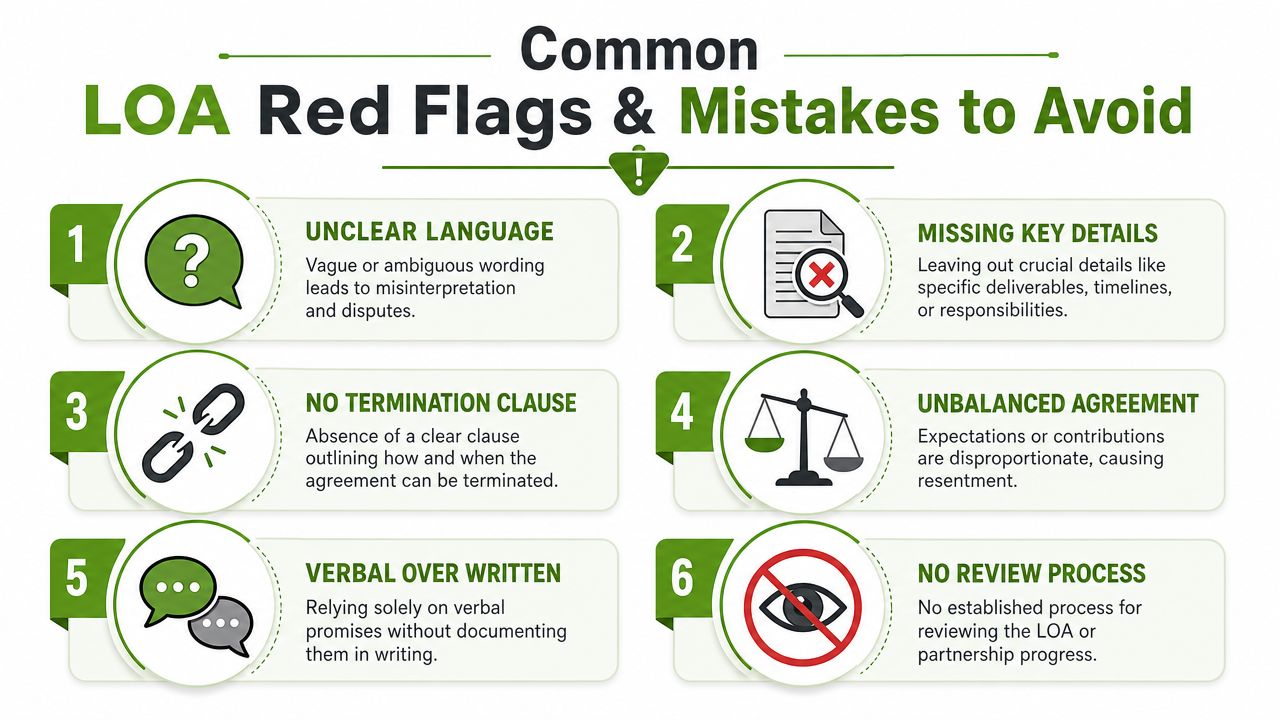
Red flags that should stop you before signing
- Vague deliverables: If the LOA says a sponsor will receive “marketing exposure” or a consultant will provide “support,” expect conflicting interpretations later.
- No termination language: If the partnership goes sideways, your team needs a clean off-ramp.
- Missing dates: Event work without deadlines almost always creates avoidable scramble.
- Unsigned drafts in circulation: Staff often start performing under a document that nobody formally approved.
- Using an LOA for the wrong job: If the arrangement involves substantial risk, layered compliance obligations, or a long-term operational commitment, a fuller contract is the safer tool.
What can happen when details stay fuzzy
A sponsor expects premier placement on every sign because the LOA promised “prominent recognition.” The nonprofit only planned a logo on the event program. Nobody is technically lying, but both sides feel let down.
A volunteer consultant delivers strategic advice over several months, then starts directing staff because the original agreement never defined role boundaries. The issue isn't bad intent. It's poor drafting.
A community partner withdraws from a joint event days before launch. Your team realizes the LOA never said who owned the registration list, who would notify attendees, or who would absorb nonrefundable costs.
If a sentence can support two reasonable interpretations, someone will eventually choose the one that favors them.
That's why diligence matters even for friendly relationships. Most nonprofit disputes around small agreements don't come from hostility. They come from assumptions that were never tested in writing.
Signing Storage and Compliance Best Practices
A letter of agreement only helps if your organization can prove it was signed, find it quickly, and connect it to the work that followed. That sounds basic, but it's where many nonprofits fall short.
A simple closeout workflow
Use a consistent process every time:
- Confirm signer authority: Make sure each person signing has authority to bind the organization or business.
- Capture final signed copies: E-signatures are often the practical choice because they speed turnaround and reduce version confusion.
- Store the file centrally: Save the fully signed PDF in one shared location using a standard naming format.
- Attach supporting records: Keep invoices, deliverables, event proofs, logo approvals, and correspondence with the LOA.
- Set a retention habit: Document preservation matters for audits, reporting, disputes, and staff turnover. This ultimate guide to document preservation is a helpful reference for building a cleaner storage practice.
Make retrieval part of compliance
Your grants team, program staff, and finance lead should all know where these documents live. That matters when a funder asks for support records, when an auditor reviews related-party transactions, or when a new staff member inherits an event file.
If your organization is already trying to connect agreements, deadlines, and funder documentation in one workflow, tools such as grant compliance tracking software can help teams keep records tied to obligations and reporting timelines instead of scattered across inboxes and shared drives.
A stored agreement is not the end of the process. It's part of your nonprofit's operating memory.
Fundsprout helps nonprofits stay organized from funding research through reporting and renewal. If your team wants one place to manage grant requirements, deadlines, source documents, and compliance records, take a look at Fundsprout.
Try 14 days free
Get started with Fundsprout so you can focus on what really matters.