Kellogg Foundation Grant: 2026 Application Success
Get an overview of the Kellogg Foundation grant process for nonprofits. Learn WKKF's mission, eligibility, and how to write a successful proposal for 2026.

Abdifatah Ali
Co-Founder
Your team has a strong program, clear community trust, and a funding gap that smaller local grants won't close. That's usually when the kellogg foundation grant enters the conversation. Someone on the board mentions Kellogg. A program director says your work aligns. Development starts wondering whether this is a smart bet or a prestige chase that will consume weeks of staff time.
That tension is healthy. W.K. Kellogg Foundation is large, respected, and mission-driven, but it's also selective in ways that aren't obvious if you only skim the website. The right move isn't “apply because the grants are big.” The right move is to decide whether your organization fits Kellogg's worldview, operating style, and place-based focus well enough to justify the effort.
For nonprofits building a serious grants plan, it helps to compare this opportunity against a broader pipeline of foundation grants for nonprofit organizations. Kellogg should usually sit in the “high-value, high-alignment, high-effort” category. If that category makes sense for your organization, the opportunity is worth real attention.
Is a Kellogg Foundation Grant Right for Your Nonprofit?
A Kellogg application makes sense when your organization is trying to move more than a single program. WKKF tends to reward work that changes conditions for children, families, and communities over time. If your plan is narrowly transactional, the fit gets weaker fast.
The first filter is honesty. Not “can we wordsmith our project to sound like Kellogg?” but “does our work already reflect the values Kellogg funds?” That means community leadership, equity-centered outcomes, and a willingness to talk about systems, not just services. Many nonprofits miss this point and submit a polished request that still feels off-strategy.
Signs you may be a strong fit
- Your work serves children and families through broader community change. Kellogg isn't just looking for activity. It's looking for conditions that help people thrive.
- Community voice shapes the design. If residents, parents, workers, or local partners influence the strategy, that matters.
- You can explain why the problem persists. Strong applicants name structural barriers, not just immediate needs.
- Your leadership can handle a major foundation relationship. This includes follow-up, refinement, reporting, and thoughtful communication.
Signs you should pause
Some organizations apply too early. Others apply because the foundation is famous.
Practical rule: If your proposal depends on Kellogg to define the strategy for you, you're not ready yet.
You should probably wait if your project is geographically disconnected from Kellogg's place-based work, if your outcomes are vague, or if your plan is essentially “fund our current program because demand is high.” Need alone rarely wins at this level. Strategic alignment does.
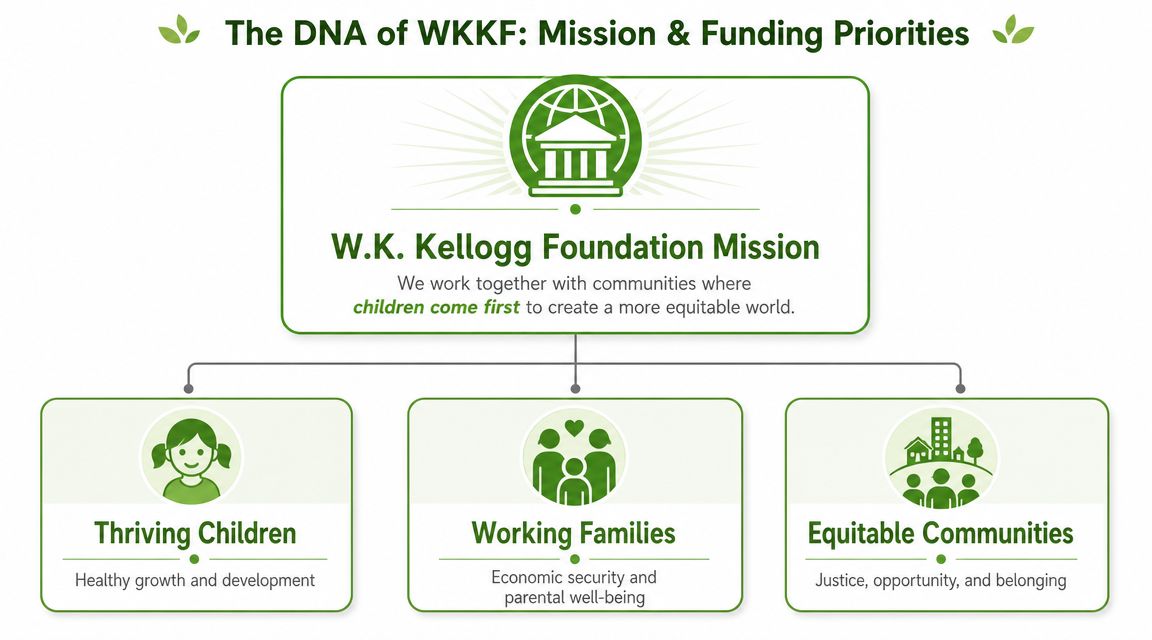
The DNA of WKKF Mission and Funding Priorities
W.K. Kellogg Foundation has scale, but scale alone doesn't explain its funding behavior. The more important point is that WKKF has spent decades backing work that operates at the level of systems, institutions, and community conditions. In its first 60 years, the foundation awarded over $1.4 billion in grants, and its assets grew from nearly $1.3 billion to about $4 billion between 1984 and 1991, according to a Health Affairs profile of the foundation's historical growth. That history matters because it shows Kellogg didn't just become influential recently. Large-scale grantmaking is part of its institutional identity.
Here's the big strategic takeaway. WKKF is not a generalist foundation that happens to fund children and families. It approaches those issues through a specific lens: racial equity, long-horizon change, and community-rooted solutions.
What the public priorities mean in practice
Many applicants stop at the familiar themes: thriving children, working families, equitable communities. Those themes are real, but they're too broad to guide a proposal by themselves. The better question is how Kellogg interprets them.
A “children” proposal that only describes direct service may be less compelling than one that shows how families, schools, community institutions, and local policy interact. A “working families” proposal that only requests workforce program support may underperform compared with one that addresses barriers like access, equity, or economic mobility conditions. An “equitable communities” proposal usually needs to show who holds power now, who should hold more of it, and how your project changes that balance.
The unwritten rule behind alignment
Kellogg often makes more sense if you think like a strategist, not a grant writer. The proposal has to answer an implicit question: why will this work matter beyond the grant term?
That's why community-led design matters so much. WKKF's orientation is less about funding a standalone intervention and more about strengthening the ecosystem around it. If residents are advisory only, your fit is weaker. If they shape priorities, implementation, and accountability, your fit improves.
A strong Kellogg narrative doesn't say, “We have a program that helps people.” It says, “This community is driving a change in the conditions that affect children and families, and our organization has the trust and capacity to help deliver it.”
How to read your own program through the WKKF lens
Ask three questions before you draft anything:
| Strategic question | Weak answer | Stronger answer |
|---|---|---|
| Who defines the problem? | Staff defined it internally | Community members and partners shaped it |
| What changes? | Service volume | Systems, access, conditions, or equity outcomes |
| Why this organization? | We need support | We have relationships, credibility, and a role in long-term change |
If you can't answer those well, the issue usually isn't writing quality. It's strategic fit.
Who Kellogg Funds Geographic and Eligibility Filters
Before you spend serious time in Fluxx, screen your organization hard. The most common mistake I see is teams investing in narrative development before they've answered the basic eligibility and fit questions. With Kellogg, geography matters more than many applicants assume.
For the fiscal year ending in 2024, WKKF distributed an estimated $408 million for charitable purposes, and of $262 million in new grant commitments, 58% was directed to benefit its priority places in the U.S., Mexico, and Haiti, according to WKKF's 2024 by-the-numbers update. That figure tells you something operationally important. Place-based strategy is not a side feature. It is a major funding filter.
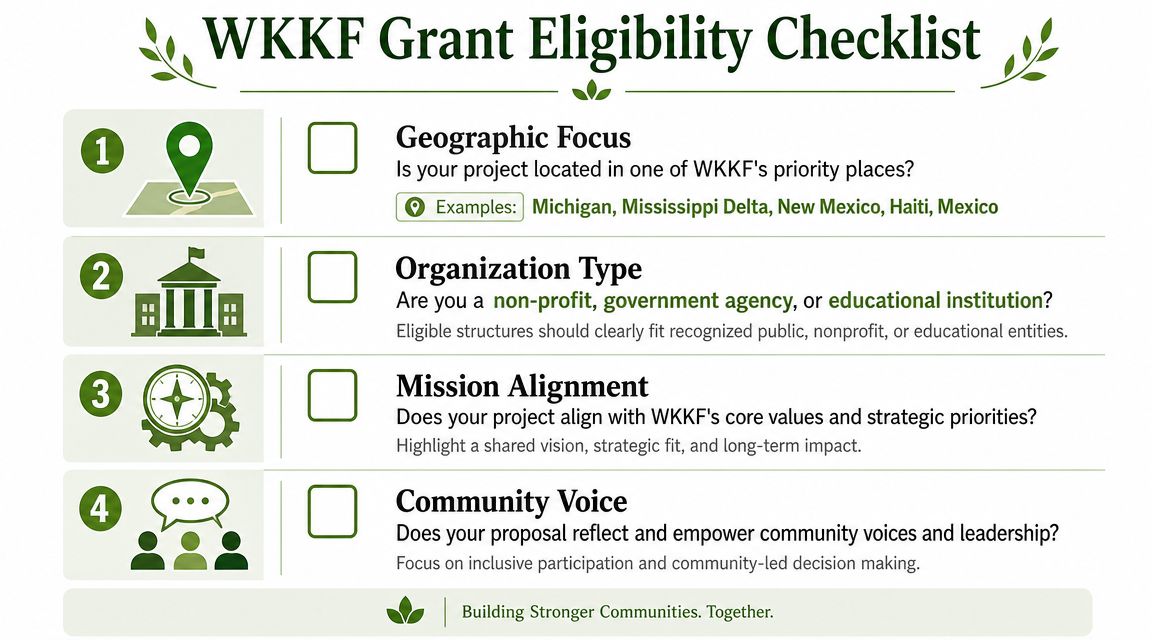
The first screen is location
WKKF identifies priority places in the United States and abroad. The places named publicly include Michigan, Mississippi, New Mexico, and New Orleans, plus work in central and southwest Haiti and the highlands of Chiapas and the Yucatán Peninsula in Mexico in the same by-the-numbers material referenced above.
If your work is rooted in one of those places, that doesn't guarantee funding. It does mean you're operating closer to where Kellogg has explicitly concentrated resources. If your organization is outside those areas, you need a sharper rationale for relevance.
Outside a priority place does not always mean impossible
Some nonprofits read Kellogg's geography and disqualify themselves too quickly. Others ignore it and apply anyway. Both reactions can be wrong.
Use this practical screen:
- Direct place-based fit: Your program operates in a priority place and serves communities Kellogg already emphasizes.
- Adjacent fit: You're part of a coalition, network, or field-building effort that supports outcomes in those places.
- Weak fit: Your work is valuable but disconnected from Kellogg's named communities and strategy.
If you're in that third category, I'd usually advise redirecting effort to another foundation unless you have a compelling, documented reason WKKF should care about your specific intervention.
Organization type and baseline readiness
The pre-uploaded checklist image reflects the broad categories often associated with applicants, and in practice organizations pursuing Kellogg funding are usually nonprofit, public, or educational entities with a mission fit. But legal eligibility alone won't carry the application.
What matters more is whether your organization can show these basics:
- Mission match: Your work advances equity, health, education, family well-being, or community conditions in a way that fits Kellogg's philosophy.
- Community legitimacy: People affected by the issue aren't just beneficiaries. They have voice and influence.
- Institutional readiness: Finance, leadership, and program staff can support a major funder relationship.
- Clear role: You can explain why your organization is the right vehicle for this work, not just an eligible one.
If your strongest argument is “we are a 501(c)(3),” you haven't started the real qualification process yet.
The WKKF Application Process from LOI to Decision
The mechanics of a kellogg foundation grant are straightforward. The strategy behind each stage is where teams either gain momentum or waste it. WKKF uses a two-stage online process through Fluxx. Applicants submit a Letter of Inquiry first, then a full proposal only if invited. WKKF states on its grantseeker page that it typically responds to LOIs within 30 business days, and 80% of final funding decisions are made within 60 business days after a formal proposal is received, as outlined on the WKKF grantseekers application process page.
That timeline is useful because it forces internal discipline. You can't treat the LOI as a casual first draft and hope to fix the strategy later.
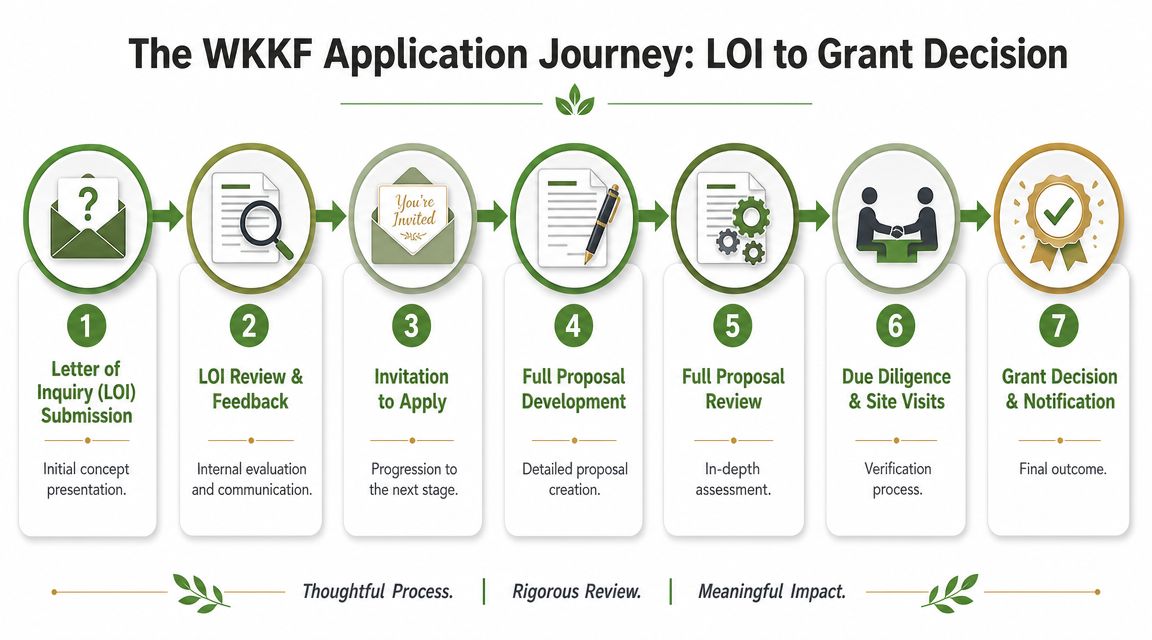
The LOI is the real first test
A lot of organizations think the LOI is just a door opener. In practice, it's your first judgment point on fit, clarity, and maturity. If the logic is muddy there, an invitation is unlikely.
Your LOI should do four things well:
- Name the problem clearly. Not just the symptom, but the condition underneath it.
- Show why your organization is positioned to act. Trust, partnerships, and track record matter.
- Demonstrate alignment without parroting website language. Reviewers can spot copy-paste framing.
- Signal what kind of change you're pursuing. Immediate outputs are fine, but long-term relevance matters more.
If your team needs a refresher on framing this stage well, a practical letter of intent for a grant guide can help sharpen the concept before you enter Fluxx.
What happens after an invitation
Once invited, the full proposal phase becomes less about introducing the idea and more about proving the organization can execute it. During this phase, internal coordination often breaks down. Program has one version of the outcomes. Finance has another view of the budget. Leadership wants the request bigger. None of that helps.
Build the full proposal around one disciplined narrative:
| Stage | What WKKF is likely assessing | Common mistake |
|---|---|---|
| LOI | Fit, clarity, relevance | Writing too broadly |
| Full proposal | Execution, evidence of readiness, coherence | Adding complexity that weakens the core case |
| Follow-up | Responsiveness and organizational maturity | Slow internal turnaround |
What works: Treat the invitation as a sign of interest, not a sign that the grant is nearly won.
Practical planning for your team
Because the process is staged, your internal calendar should be staged too. Don't draft the full proposal in full before the LOI decision, but do prepare the ingredients. Have budget assumptions, partner roles, and outcome logic in working form so you can move quickly if invited.
The strongest teams use the waiting period to clean up attachments, align leadership, and pressure-test the case. The weakest teams go silent after submission, then scramble when the invitation arrives.
How to Write a Compelling Kellogg Foundation Proposal
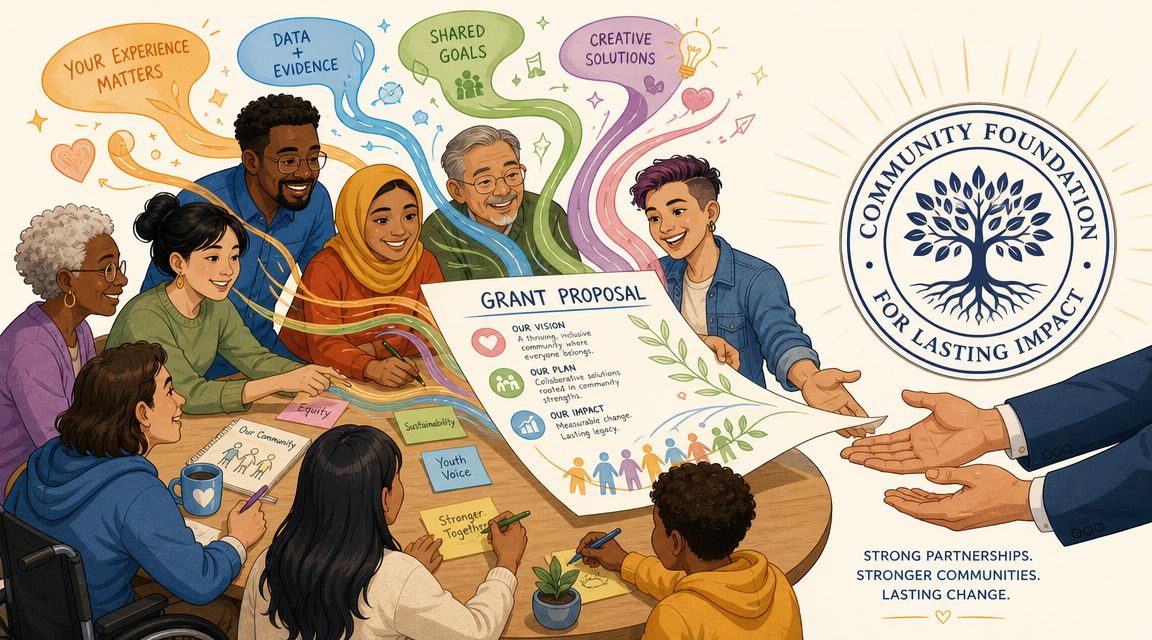
A compelling Kellogg proposal does not read like a generic foundation narrative with “equity” added to the executive summary. It shows that your organization understands how WKKF thinks about change. That means the proposal needs to connect community voice, racial equity, and measurable structural progress in a way that feels native to your work.
One useful lens comes from how WKKF-related health funding is described in recent third-party analysis. That coverage notes that WKKF's health funding increasingly centers racial equity, food systems, and upstream community conditions rather than just clinical care, and that the strongest proposals are often systems-change strategies with measurable equity outcomes, not narrow program-budget requests, as discussed in this analysis of WKKF community health center funding trends. Even if your organization isn't a health provider, that tells you a lot about how Kellogg reads problems.
Write for fit, not for applause
Many proposals sound impressive and still miss. Why? Because they describe effort instead of strategy.
A weak version says: we provide valuable services to underserved families and need support to expand.
A stronger version says: families in this community face barriers that are reinforced by policy, access, and institutional practices; residents shaped this approach; our project changes those conditions while producing accountable outcomes.
That second version doesn't abandon direct service. It situates service inside a broader theory of change. That's much closer to how Kellogg-funded work is often framed.
Use evidence with discipline
Reviewers don't need a literature dump. They need confidence that your logic is grounded. If your team struggles to distinguish evidence gathering from storytelling, this guide to research methodology for content creators is a useful primer for tightening how you justify your approach and explain why your methods make sense.
Then make your own proposal answer these practical questions:
- Who helped shape the intervention?
- What inequity is being addressed?
- What changes in systems, access, or decision-making if this succeeds?
- How will you know the change is happening?
The proposal components that matter most
Below is a simple working table I use with clients when pressure-testing fit.
| Proposal Component | What WKKF Looks For | Pro Tip |
|---|---|---|
| Problem statement | A root-cause understanding of the issue, not just demand for services | Name the barrier beneath the barrier |
| Community role | Evidence that residents or affected groups shaped the work | Show decision-making, not just participation |
| Equity frame | Clear explanation of who is excluded and how the project changes that | Be specific about the inequity |
| Strategy | A pathway toward systems or condition-level change | Don't present isolated activities as transformation |
| Outcomes | Measurable progress tied to equity and community impact | Separate outputs from actual change |
| Organizational role | Credibility, partnerships, and execution capacity | Explain why your organization is the right lead or backbone |
| Budget narrative | Resources that match the strategy | Keep the request coherent with the scope |
The best Kellogg proposals sound like they were written after listening to the community for a long time, not after studying a funder website for a weekend.
What usually doesn't work
Three patterns consistently hurt otherwise capable applicants.
First, foundation mimicry. This happens when teams copy Kellogg's language without proving that the values show up in operations, governance, partnerships, or program design.
Second, service-only framing. If your proposal treats community conditions as background context but positions the grant as support for program volume, the case often feels too narrow.
Third, measurement without meaning. A list of outputs is not the same as a theory of equitable change. Count what matters. Don't just count what is easy.
If you're building the draft across departments, a structured writing workflow helps. One practical option is the grant proposal writing resource for nonprofits, which can support teams that need to organize narrative sections, evidence, and review cycles before submission.
Beyond the Application Grant Reporting and Renewals
Winning a Kellogg grant is the start of a relationship, not the finish line. The organizations that manage it well don't disappear after the award notice. They communicate clearly, document progress accurately, and surface challenges before those challenges become surprises.
That matters because major foundations usually pay attention to how grantees operate after approval, not just how they write before it. If your team promises community leadership, your reporting should show how community voice continued to shape the work. If your proposal promised systems change, your updates should explain movement at that level, even when progress is uneven.
If you're funded
Focus on consistency over performance theater.
- Keep internal records clean. Program, finance, and development should be working from the same version of outcomes and spending assumptions.
- Report what changed and what didn't. Foundations can work with complexity. They struggle with vagueness.
- Treat the program officer relationship professionally. Ask useful questions, respond on time, and avoid unnecessary over-contact.
Good reporting builds renewal potential because it shows the funder your organization can learn, adjust, and stay accountable.
If you're declined
A decline is not automatic evidence of a weak organization. It may reflect fit, timing, geography, portfolio balance, or strategy mismatch. The useful response is to review the application with discipline.
Ask internally:
| Question after a decline | Why it matters |
|---|---|
| Was the fit real or aspirational? | Prevents repeated misfires |
| Did the proposal show systems relevance? | Reveals whether the case was too narrow |
| Did community voice appear concrete enough? | Tests authenticity of the narrative |
Reapplying makes sense when the core fit is strong and the next version will be materially sharper. It does not make sense when the original application was built on weak alignment from the start.
Next Steps and Alternative Funding Sources
The decision on a kellogg foundation grant should come down to a short list of strategic answers. Is your work aligned with equity-centered, community-led systems change? Is your geography relevant? Can your organization handle a major foundation relationship without distorting its program strategy to chase money?
If the answer is yes, prepare deliberately. Tighten the theory of change, align leadership before submission, and build an LOI that sounds like your organization at its strongest. Don't write toward prestige. Write toward fit.
If the answer is no, that's still useful. You've clarified what kind of funder you need. Look for foundations that support one or more of the same broad characteristics: place-based work, racial equity, upstream health or education conditions, family economic security, public policy change, or community-led implementation. The discipline you used to assess Kellogg will make your broader pipeline better.
A practical next step is to sort prospects into three buckets:
- High alignment and high effort. Reserve these for major opportunities with real mission fit.
- Strong alignment and moderate effort. These often become the healthiest part of a foundation portfolio.
- Low alignment, even if prestigious. Remove them early.
That kind of filtering saves more grant time than better prose ever will. Good strategy shrinks wasted effort. Then good writing can do its job.
If your team wants help turning funder research into a usable grant pipeline, Fundsprout helps nonprofits screen opportunities by program, geography, and capacity, organize proposal work, and manage reporting from application through renewal.
Try 14 days free
Get started with Fundsprout so you can focus on what really matters.