Mastering the Letter of Intent for a Grant to Secure Funding
Craft a winning letter of intent for a grant with this guide. Learn proven strategies, see real examples, and avoid common mistakes to get funded.

Abdifatah Ali
Co-Founder
Before you pour countless hours into a full-blown grant proposal, you need a way to test the waters. That's exactly what a letter of intent (LOI) for a grant does. Think of it as a professional handshake—a brief, powerful document that introduces your project to a funder to see if it’s a good fit.
Its whole purpose is to save everyone time. You get an early read on a funder's interest, and they get a snapshot of your work without having to sift through a 20-page proposal.
Why Your Grant LOI Is the Most Critical First Step

The LOI is the ultimate gatekeeper in the grant-seeking world. It's often the very first impression you’ll make on a potential funder, and honestly, it might be the only one you get. A compelling LOI can be your ticket to a full application, while a weak or misaligned one gets you a polite "no" before you’ve even started.
For grantmakers, the LOI is a lifesaver. It’s a practical tool for managing the huge number of requests they receive. It allows their team to efficiently screen dozens, sometimes hundreds, of projects and quickly spot the ones that truly line up with their mission, priorities, and geographic focus.
The Funder's Perspective: A Strategic Filter
Funders depend on the LOI as a screening tool. It helps them filter out proposals that are clearly not a match and zero in on the partnerships with the most promise. This first-pass review is all about efficiency.
Think about the sheer volume of applications. Some grant programs are flooded with inquiries for just a handful of awards. A well-designed LOI process can cut down the initial applicant pool significantly—often by as much as 30%—weeding out projects that are vague or just don't fit. This frees up program officers to give their full attention to the applications that genuinely deserve a closer look.
From a funder's view, a well-written LOI demonstrates that an organization has done its homework. It shows respect for their time and a clear understanding of their strategic goals.
The Nonprofit's Perspective: A Smart Investment
For your organization, the LOI is just as valuable. Instead of sinking weeks of staff time into a detailed proposal that might be dead on arrival, you can gauge a funder’s interest with a much smaller investment.
- It Saves Your Resources: Let's be real, your time is precious. Writing a full grant proposal is a heavy lift. An LOI stops you from wasting that effort on funders who were never the right fit to begin with.
- It Sharpens Your Message: The exercise of condensing your entire project into a 1–3 page letter is incredibly clarifying. It forces you to get to the heart of your mission and articulate your goals in the most persuasive way possible.
- It Opens a Dialogue: A strong LOI can be the start of a conversation with a program officer. Even if it doesn't lead to an invitation this time, it can open the door for valuable feedback and start building a relationship for the future.
The competition out there is fierce. For example, some federal programs have incredibly low success rates. Back in 2020, only about 21% of NIH grant proposals received funding, which really highlights why that first impression has to be rock-solid.
Learning to write a great letter of intent for a grant isn’t just about checking a box. It’s a strategic move that shows you're a serious, well-prepared organization ready to make a difference. And that’s exactly the kind of partner funders are looking for as they find grants for nonprofits to support.
Anatomy of a Winning Letter of Intent
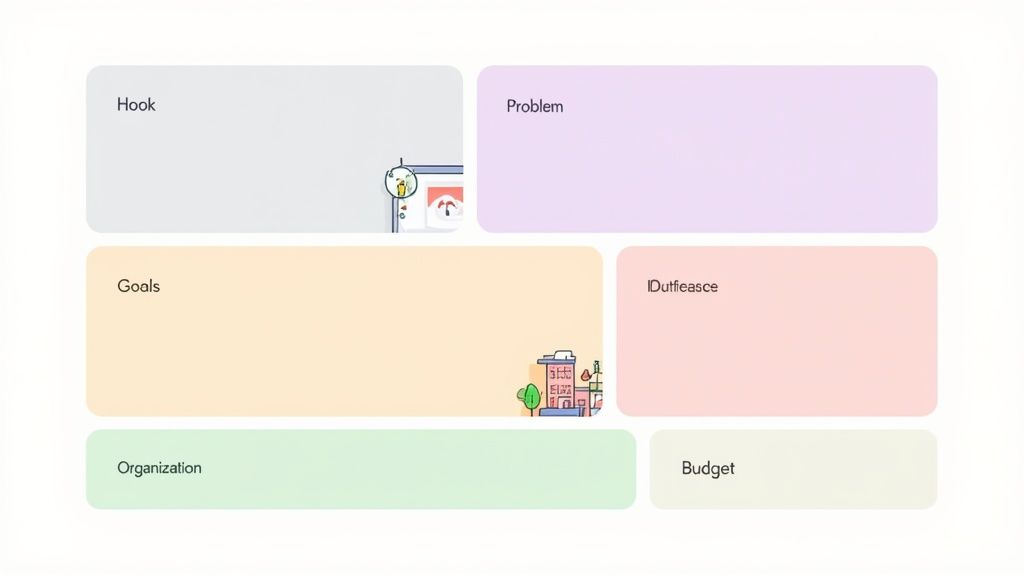
Think of a strong grant Letter of Intent less like a summary and more like a compelling story. It’s your job to guide the reviewer on a journey, starting with a problem that demands their attention and ending with your organization as the clear, credible solution.
Every piece should build on the last, creating a persuasive case that answers the funder's unspoken questions: Why this project? Why your team? Why right now? It's not about a rigid formula, but about strategic storytelling. Let’s walk through the essential building blocks that make an LOI impossible to ignore.
The Introduction and Hook
You get one paragraph to make a first impression. This is your only shot to grab a busy reviewer’s attention, so forget the long-winded warm-ups and generic greetings. You have to connect your project to the funder’s mission right away—ideally in the first couple of sentences.
Start with a punchy statement that frames the issue and gets straight to the point. Be sure to mention the funder by name and the specific grant you're applying for. This simple step shows you’ve done your homework and aren’t just blasting out a generic request.
For example: "In line with the [Funder Name]'s commitment to youth development, [Your Organization] seeks a $40,000 grant for our 'Digital Navigators' program, designed to bridge the digital literacy gap for 500 at-risk teens in our community." It's direct, it's specific, and it immediately aligns your mission with theirs.
The Problem Statement or Statement of Need
Okay, you’ve got their attention. Now you have to convince them that your work is urgently needed. This is the heart of your LOI. Vague claims about a problem just won't cut it; you need to back it up with hard evidence.
Use specific, local data to paint a clear picture of the need. Don't just say, "many seniors in our area are lonely." Instead, try something like, "68% of local residents over age 65 report feeling isolated due to a lack of digital connection." See the difference? You’ve just turned a general issue into a concrete, measurable problem right in the funder's backyard. This section is so critical that it's worth spending extra time crafting a powerful statement of need to anchor your entire letter.
A great problem statement does more than list facts. It creates a sense of urgency and makes the reviewer feel that ignoring this issue is simply not an option.
Project Goals and Proposed Solution
After clearly defining the problem, it's time to introduce your solution. This section needs to be a crisp, clear overview of your project. What are you actually going to do? Who will you serve? What results do you expect?
Try to avoid jargon or overly technical language. The goal here is to project clarity and confidence.
- Introduce your project: Give it a memorable name and briefly explain its core activities.
- Define your objectives: List 2-3 primary goals. Make sure they are specific, measurable, achievable, relevant, and time-bound (SMART).
- Connect the dots: Explicitly show how your project activities directly address the problem you just laid out.
Following our senior loneliness example, you could propose a project that provides tablets, one-on-one training, and a virtual community hub to 200 seniors over 12 months. The goal? To reduce self-reported isolation by 40%.
Organizational Capacity and Credibility
At this point, you have to answer the big question brewing in the reviewer’s mind: why should we trust you to do this? This is where you build credibility. Briefly highlight your track record, your team's expertise, and what makes your organization uniquely positioned to succeed.
Mention a key success from a past project or a statistic that proves your impact. Something like, "For over a decade, our organization has delivered technology training to more than 3,000 community members, maintaining a 95% program completion rate."
This isn't about bragging; it's about building the funder’s confidence. You need to show them their money will be in capable, experienced hands. Don't forget to mention strong community partnerships or special qualifications of key staff—those details can be powerful proof.
The Budget Summary and Request
Finally, it's time to talk money. You don't need a super-detailed, line-item budget in an LOI, but you do need to state your request clearly. The reviewer needs to see the total project cost and the specific amount you’re asking for from them.
Breaking the request down into major expense categories shows you've thought through the financials. A simple table or a bulleted list is perfect for this.
This kind of transparency shows you’re a responsible planner and helps the funder see exactly how their grant would be put to work. Wrap up your letter with a professional closing, reiterate your excitement about a potential partnership, and make sure your contact information is easy to find. This logical flow ensures your letter is persuasive, professional, and ready for a serious review.
Bringing Your Grant LOI to Life
Alright, you've got your structure mapped out. Now for the real work: turning that blueprint into a story that grabs a reviewer's attention. This is where you move beyond just listing facts and start building a narrative that connects on a human level.
Your goal is to make the funder feel the importance of your work, not just understand it. A winning letter of intent for a grant isn’t a dry report; it’s a confident, compelling pitch. Let's dig into the writing techniques that will make your LOI stand out.
Write with a Powerful, Active Voice
The tone you set is everything. Passive language makes your project sound timid and can suggest your organization is just a bystander. You want to sound like a leader, a changemaker.
Just look at the difference:
- Passive: "It is hoped that the program will be attended by 50 students."
- Active: "Our program will serve 50 students."
See? The second one is direct, confident, and leaves no room for doubt. Using an active voice puts your organization in the driver's seat. Go through every sentence you write and hunt down passive phrases. Swap them out for strong, action-oriented verbs. It’s a simple change that instantly adds authority.
Tell a Story with Your Data
Numbers give your LOI credibility, but they're useless on their own. The trick is to weave your data into a narrative that shows the real-world impact of your work.
Instead of just dropping a statistic, give it context. For example, don’t just say, "Our city has a 20% high school dropout rate."
Try this instead: "Every year, one in five students in our city walks away from their education, facing a future of limited opportunities. Our mentorship program is designed to rewrite that story for 100 of these students."
When you connect data to real people and consequences, a dry fact becomes an urgent reason to act. This is what makes your project's mission stick in a reviewer's mind.
Get Crystal Clear on Your Project
When you're describing your goals and activities, vagueness is your enemy. Ambiguous language makes a reviewer question your plan, while sharp, specific details build their confidence. You need to paint a picture so they can see exactly what you’re going to do.
Use these prompts to get specific:
- What’s the core activity? Instead of "provide support," try "deliver one-on-one weekly tutoring sessions."
- Who are you helping? Don't just say "at-risk youth." Define them as "high school freshmen from low-income households reading below grade level."
- What does success look like? Swap "improve literacy skills" for "increase participants' average reading comprehension scores by one grade level within the academic year."
This kind of detail proves your project is more than just a good idea—it’s a well-thought-out, practical plan.
Build a Justifiable Budget Summary
Your budget summary has to be two things: clear and believable. You don’t need an exhaustive line-item breakdown in the LOI, but you absolutely have to justify the total amount you’re asking for. This is a common stumbling block.
Think of your budget as another part of your story; it needs to align perfectly with the activities you've described. For example, if you're launching a tech skills workshop, a decent chunk of the budget should logically go toward equipment. For a better sense of how to lay this out, you can check out a professional grant budget template to see how the pros organize these numbers.
In fact, over 70% of foundation and government grant programs now use the LOI as their first major filter. And in most requests, personnel costs are the biggest piece of the pie. A typical $40,000 grant might see 55% go to staff salaries, 20% to equipment, 15% for key partnerships, and 10% for indirect costs. If you want to dive deeper, you can discover more insights about these grant LOI trends on opengrants.io.
Quick Edits for a Stronger Impact
Once you have a solid draft, a final polish can make all the difference. Read through your letter one last time, looking for these four things:
- Cut the Jargon: Get rid of any insider acronyms or technical terms. Write it so your neighbor could understand it and get excited about it.
- Chop Up Long Sentences: If a sentence runs on and on, it’s going to exhaust the reader. Break it into shorter, punchier statements. The flow will be much better.
- Check for Consistency: Do the numbers in your narrative (like the number of people you'll serve) make sense with the budget you're requesting? A mismatch here is a major red flag.
- Read It Out Loud: This is my favorite trick. If you stumble over a sentence while reading it, it’s too clunky. Rewrite it until it sounds natural.
By focusing on these writing details, you can transform your letter of intent for a grant from a simple form into a powerful tool that builds trust and gets you invited to submit a full proposal.
Customizing Your LOI to Align with Funders
Submitting a generic, one-size-fits-all letter of intent for a grant is the fastest way to get a "no." Believe me, funders can spot a copy-paste job from a mile away, and it tells them you haven't bothered to learn what they're all about. The real magic happens when you tailor your pitch.
This goes way beyond just changing the foundation's name. You need to frame your entire project through the lens of what that specific funder cares about most. Think of yourself as a detective, digging into their priorities, past grantees, and even the specific words they use to prove you're the partner they've been looking for.
Research Funder Priorities Like a Pro
Before you type a single word, you need to do your homework. Don't just skim the mission statement on their homepage and call it a day. You need to get a real sense of their current strategic direction and what they're trying to accomplish right now.
Start by digging up their annual reports, strategic plans, or recent press releases. These documents are absolute goldmines. They often spell out the funder’s goals for the next few years. You might discover a new initiative focused on "advancing health equity" or a targeted push for "improving local water quality."
Once you've identified these priorities, start connecting the dots. How does your work directly help them achieve their goals? If they're all about community-based solutions, you'd better be highlighting your local partnerships and grassroots engagement.
Mirror Their Language and Terminology
Every foundation has its own internal vocabulary. Some talk about "capacity building," while others prefer "organizational strengthening." It might seem small, but picking up on these nuances and using their language in your LOI is a subtle but incredibly powerful way to signal you're a good fit.
Go through their grant guidelines, website, and publications and look for recurring keywords and phrases.
- Do they lean on terms like "evidence-based," "scalable," or "innovative approaches"?
- Is their focus on "at-risk youth" or "underserved populations"?
- Are they looking for projects that are "community-led" or "data-driven"?
When you incorporate their language, you're not just speaking their dialect; you're showing that you share their understanding of the issues. It makes your letter feel familiar and immediately frames your project as something they'll recognize and value.
Use Local Data to Make a Compelling Case
Broad statistics about national problems are fine, but local data is what creates urgency. Community and regional foundations, in particular, need to see that you have a deep understanding of the specific challenges in the area they serve.
For instance, instead of a vague statement about seniors being lonely, hit them with a targeted statistic like, "68% of local residents over age 65 report loneliness due to lack of digital connection." This makes the problem real, personal, and much more compelling. This kind of narrative—problem, supporting data, your solution—is what makes an LOI pop. You can read more about making your grant LOI compelling on fundsprout.ai.
Funders invest in outcomes. By presenting a problem using local, specific data, you’re not just asking for money—you’re showing them a tangible opportunity to make a measurable difference in a community they care about.
Connect Your Outcomes to Their Goals
The final piece of the puzzle is to explicitly connect your project's outcomes to the funder's strategic goals. Don't leave it up to the reviewer to figure out how you fit into their plans—draw a straight line for them.
Let’s say a funder’s goal is to "foster a sense of belonging within inter-professional groups." You wouldn't just describe your mentorship program. You would frame it like this:
"Our mentorship program directly supports your goal of fostering belonging by pairing junior and senior staff from diverse backgrounds. We will measure success through pre- and post-program surveys, with a target of a 30% increase in participants reporting a stronger sense of connection and inclusion at our organization."
This simple shift changes your LOI from a mere request for cash into a powerful partnership proposal. It shows the funder that you see them as a strategic ally in a shared mission, not just as a bank.
Common LOI Mistakes That Guarantee Rejection
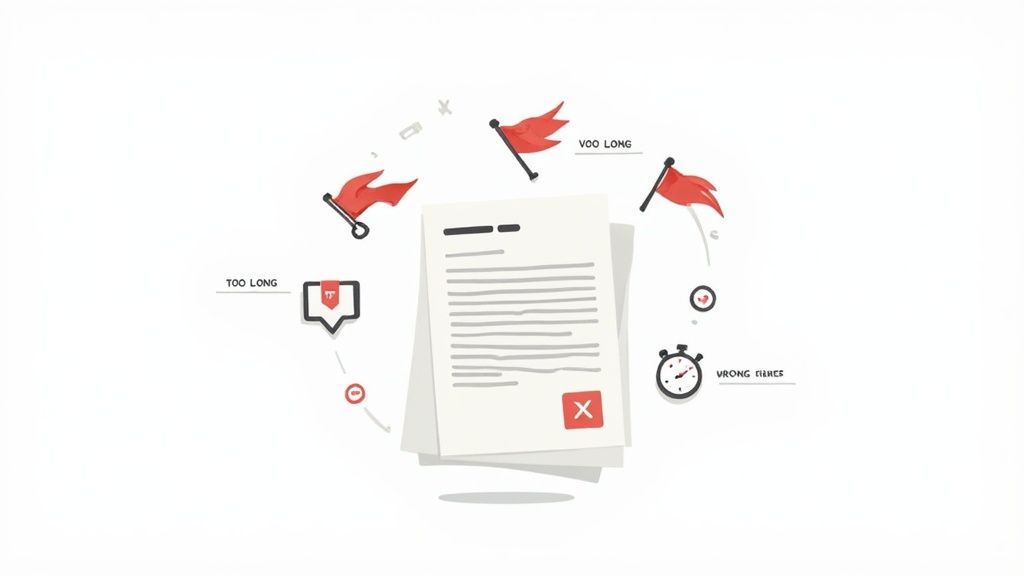
After pouring all that effort into planning your project and writing a powerful story, the last thing you want is for a simple mistake to send your letter of intent for a grant straight to the "no" pile. But it happens all the time. Grant reviewers are often swamped, and they have to use specific criteria to quickly weed out applications that don't make the cut.
Knowing what these common tripwires are is your best defense against an early exit. When you avoid these errors, you give your project’s real strengths a chance to shine. Think of this as your final check to catch the easy-to-miss flaws that trip up other applicants.
Disregarding Funder Guidelines
This is, without a doubt, the number one unforced error in grant writing. Every funder provides specific instructions for a reason, and ignoring them comes across as disrespectful to their process. It’s the fastest way to get disqualified—often before a program officer even reads a single word about your project.
Pay obsessive attention to the technical stuff:
- Page or word limits: If they ask for two pages, don't send three. They're testing your ability to be concise.
- Formatting specifics: Follow every rule on font size, margins, and document type (like PDF only). No exceptions.
- Submission method: If the instructions say to use an online portal, sending an email attachment is a non-starter.
These details might seem minor, but they show you can follow directions—a non-negotiable trait for any potential grantee.
Writing a Vague or Unfocused Narrative
In an LOI, clarity is everything. Funders need to know exactly what you plan to do, who benefits, and what you expect to achieve. Filling your letter with jargon or ambiguous language just creates confusion and raises doubts.
A reviewer should never have to guess what your project is about. Vague statements like "improving community wellness" or "providing support to vulnerable populations" don't paint a clear picture. Get specific. Instead, try: "launching a weekly nutrition workshop for 50 low-income seniors to reduce food insecurity." Now they know what you're doing.
A muddled LOI suggests a muddled project. If you can't explain your plan clearly in two pages, a funder will have little faith that you can actually execute it.
Submitting a Disconnected Budget
Your budget summary isn't just a spreadsheet; it's the financial version of your project story. It has to perfectly match your narrative. A huge red flag for reviewers is a budget that seems totally random or disconnected from the activities you just described.
For instance, if your project is all about community outreach events, but the biggest line item is administrative overhead, something’s off. The budget must logically support the work. If you're asking for $40,000 for a mentorship program, the costs for mentors, training materials, and your evaluation plan should be obvious and proportional. An illogical budget completely undermines your credibility and screams poor planning.
Failing to Proofread Meticulously
A letter full of typos, grammatical mistakes, and sloppy formatting sends a very clear message: you don't pay attention to detail. This immediately makes a funder wonder what other important details you might miss when you're managing their money. Even a few small errors can chip away at your professional image.
Once you’re done writing, step away from it for at least a few hours, then come back for a final polish. I recommend a three-step process:
- Read it backward. Start with the last sentence and work your way to the top. This trick forces your brain to see individual words and catch errors it would normally skim over.
- Read it out loud. This is the best way to catch awkward phrasing, run-on sentences, and clunky paragraphs.
- Get a fresh pair of eyes. Ask a colleague who knows nothing about the project to read it. They'll instantly spot confusing language or gaps in logic that you're too close to see.
By sidestepping these common blunders, your letter of intent for a grant will stand out for all the right reasons—its professionalism, clarity, and compelling vision. That’s how you earn the invitation for a full proposal.
Your Top Questions About Grant LOIs, Answered
If you’re new to the grant world, the Letter of Intent can seem a little mysterious. That's totally normal. Most of us have been there. To clear things up, here are some straight-up answers to the questions I hear most often from organizations just like yours.
What’s the Magic Number for an LOI’s Length?
First and foremost, the funder's guidelines are law. If they say two pages, you give them two pages—no more.
But if they don't specify, the unwritten rule is one to three pages. Honestly, leaning toward brevity is always a smart move. A grant reviewer's time is incredibly valuable, and they appreciate a pitch that gets straight to the point. If you can make a powerful case on a single, well-crafted page, you’re in a great position.
Your goal is to be thorough but tight. You want to paint a complete picture of your project without drowning them in detail. Trust me, going over a page limit is one of the quickest tickets to the "no" pile.
How Is an LOI Different From a Full Proposal?
Think of the LOI as the movie trailer and the full proposal as the feature film. The LOI is a condensed, high-level pitch designed to see if a funder is even interested in your project's concept. The full proposal is the deep-dive you get invited to submit if they like what they see.
Here's the breakdown:
- The LOI is your highlight reel. It introduces the core problem, your innovative solution, a quick snapshot of your organization's credibility, and a ballpark budget number.
- The Full Proposal is the exhaustive blueprint. This is where you bring out the detailed line-item budgets, the full bios of your key staff, your comprehensive evaluation plan, and all those glowing letters of support from your community partners.
The LOI has one job: to pique their interest enough to earn that coveted invitation to submit the real deal.
Can I Just Send the Same LOI to a Bunch of Different Funders?
In a word: no. Program officers can spot a copy-and-paste job from a mile away, and it instantly signals that you haven’t put in the work. It’s a major red flag.
While the core of your project won't change, every single letter of intent for a grant needs to be carefully tailored to the funder you're sending it to.
Before you even type a single word, dig into the foundation's website. Look at their mission, check out who they've funded recently, and get a feel for their strategic priorities. Use their language. Connect the dots for them, showing how your work directly advances their specific goals. This proves you see them as a potential partner, not just an ATM.
I’ve Hit "Submit." Now What?
First, breathe! Then, make sure you received a confirmation that your LOI went through successfully, especially if it was via an online portal. Glitches happen.
Next, find the funder’s response timeline and put it on your calendar. This is critical. Respect their process and resist the urge to follow up before that date. They’ll get back to you.
Don’t just sit on your hands while you wait. Start outlining your full proposal. If you get the green light, you’ll be ready to hit the ground running and won't have to scramble to meet a tight deadline. And if it's a "no" this time? Send a brief, professional thank you. Then, take a hard look at your LOI and see how you can make it even stronger for the next opportunity.
Finding the right grants and writing winning proposals takes serious time and expertise. Fundsprout uses AI to help you discover perfectly matched funding opportunities, analyze RFP requirements, and generate compelling narratives in your organization's voice. Take the guesswork out of grant seeking at https://www.fundsprout.ai.
Try 14 days free
Get started with Fundsprout so you can focus on what really matters.