Howard Gilman Foundation: A Guide to Getting Funded
Get a step-by-step guide to the Howard Gilman Foundation. Learn about their mission, funding priorities, eligibility, and how to write a competitive proposal.

Abdifatah Ali
Co-Founder
You’re probably in one of two places right now.
Either your organization has heard that the howard gilman foundation is a major force in New York City performing arts funding, and someone on your team said, “We should really get in front of them.” Or you’ve already looked them up, realized they’re relationship-driven, and felt the usual frustration. Strong fit on paper. Unclear path in practice.
That tension is real. Gilman is big enough to matter and selective enough to feel hard to access. The foundation operates with an annual grantmaking budget of approximately $32 million, holds total assets over $624 million, and awards around 250 grants per year, making it one of the largest private funders dedicated to New York City’s performing arts sector, according to the Howard Gilman Foundation grants assistant job description.
For a development director, that combination creates a familiar problem. You can see the upside. You can also see the risk of wasting time on a cold approach that never turns into a real conversation.
The good news is that Gilman is not impossible to understand. It’s just not a volume funder in the way many grant databases make it seem. This is a foundation where fit, clarity, and organizational credibility matter more than polished grant language. It’s also a foundation where a generic proposal tends to be unsuccessful.
What works is different. You need to show that your organization belongs in their field of vision. You need to understand what they mean by trust. And you need to present your work in a way that makes staff confident they should spend time getting to know you.
Introduction Navigating Your Path to Gilman Funding
A common scenario looks like this. A small or mid-sized performing arts nonprofit in Queens, Brooklyn, the Bronx, or Manhattan has a solid track record, a loyal audience, and a program mix that serves artists and community well. The executive director opens a prospect list and sees the howard gilman foundation near the top. The reaction is immediate. Strong potential. Little idea how to break in.
That uncertainty gets worse because Gilman’s reputation is built less on flashy open calls and more on relationships, alignment, and long-term support. For some organizations, that reads as “closed network.” For others, it reads as “invitation only unless you know someone.”
Neither interpretation is fully useful.
Why this funder matters
Gilman isn’t just another New York arts foundation. It sits near the center of the city’s performing arts funding ecosystem. When a funder with a roughly $32 million annual grantmaking budget and assets above $624 million chooses where to place support, those choices shape who has breathing room to plan, hire, present work, and survive difficult cycles.
For newer applicants, that scale can feel intimidating. It can also create a false assumption that only major institutions have a shot.
In practice, the better question is simpler: Does your organization align with how Gilman thinks about the performing arts sector in New York City?
What new applicants usually get wrong
Most first attempts fail before the proposal stage.
Not because the work is weak. Because the positioning is weak.
Teams often:
- Lead with need instead of fit. Financial pressure is real, but Gilman is not looking for a rescue narrative.
- Describe programs without describing institutional role. Staff need to understand why your organization matters in the local performing arts ecology.
- Sound generic. If your narrative could be sent to ten other foundations unchanged, it won’t help here.
- Treat relationship-building as networking theater. Staff don’t need flattery. They need evidence that you understand your own work and theirs.
Practical rule: A new applicant’s first job is not to impress Gilman. It’s to reduce uncertainty.
That means showing artistic seriousness, organizational self-knowledge, and a genuine understanding of where you fit within New York City’s performing arts field.
The Gilman Legacy and Core Mission
A first-time applicant can lose this funder before the inquiry is even read closely.
It happens when an organization describes itself as a broad arts nonprofit, a community program hub, or a civic equity initiative with some performances mixed in. Gilman’s current mission asks for a tighter fit than that. The foundation is centered on New York City’s performing arts field, and applicants need to present themselves accordingly.

The mission shift that still shapes every application
Howard Gilman’s philanthropy once touched multiple areas, including science and medicine. The foundation’s current direction is much narrower. Its own history and mission materials make clear that the organization now concentrates on supporting New York City performing arts organizations.
For applicants, that history matters because it explains the difference between legacy and present-day strategy.
Gilman is not operating from an old family-foundation habit of saying yes to a wide range of worthy causes. It chose a specific role in one sector and one city. That choice affects how staff read every new organization that comes through the door, especially one without a prior relationship.
A practical implication follows. If your case for support depends on broad cultural value, generalized community benefit, or arts education language without a clear performing arts identity, staff still have to do interpretive work. Relationship-based funders rarely reward that. They tend to back groups that can explain who they are, where they sit in the field, and why their presence matters.
What the mission means in practice
The strongest Gilman-aligned positioning answers three basic questions fast.
- What artistic discipline or performing arts function defines the organization?
- How does the organization contribute to New York City’s performing arts ecology?
- Why is the institution itself worth knowing over time, not just the program being pitched?
That last point matters for new applicants. Gilman’s trust-based style is often misunderstood as informal or intuitive. In practice, it raises the standard for institutional clarity. Staff need enough confidence in the organization to picture an ongoing relationship, and that is harder to earn if your materials read like they were built for a one-off project grant.
How to translate your mission into Gilman language
I usually tell clients to remove every sentence that could apply equally to a museum, an after-school provider, and a social services nonprofit. What remains is often much closer to what Gilman needs to see.
A stronger framing looks like this:
- name the performing arts work plainly
- show whether you produce, present, commission, develop artists, or support the field
- locate the work in New York City with specificity
- explain the institutional role you play for artists, audiences, or the local ecology
There is a trade-off here. Narrower positioning can feel risky because it leaves out worthy parts of the organization’s story. But with Gilman, disciplined framing usually helps more than expansive framing. New applicants are not trying to prove they do everything. They are trying to prove they belong in this portfolio.
The practical takeaway
Before drafting an inquiry, test your narrative against the foundation’s actual mission.
- State your artistic identity in one sentence. If it takes a paragraph, the positioning is still muddy.
- Define your NYC role concretely. Name the borough, audience, artistic community, or presenting function.
- Separate core work from adjacent work. Education, advocacy, and community programs can strengthen the case, but they should not blur the performing arts center of gravity.
- Check whether your request reflects institutional alignment. Gilman is more likely to respond to a clear organizational case than to a loosely attached special initiative.
Organizations that do this well make it easier for program staff to trust what they are seeing. For a new applicant without a warm introduction, that is one of the few advantages you can create on your own.
Decoding Gilman's Funding Priorities
If mission tells you where Gilman stands, funding priorities tell you what kind of applicant gets traction.
Many organizations often overcomplicate things. They assume the key is to invent a special initiative for the foundation. Usually, that’s the wrong move. Gilman appears much more interested in whether the organization itself belongs in its portfolio.
The core artistic lanes
The howard gilman foundation is centered on New York City performing arts organizations. In practical terms, that means applicants should think in terms of dance, music, theater, presenters, and closely related performing arts support structures.
That doesn’t mean every discipline has equal weight in every cycle. It means your organization should fit clearly enough that staff don’t have to decode what you really are.
When I review draft narratives for arts clients, the strongest Gilman-aligned materials usually do three things well:
- They define the artistic work plainly. No inflated theory language.
- They connect art and community without reducing art to a service wrapper.
- They show institutional steadiness. Not perfection. Steadiness.
Why general support framing matters
Gilman is widely understood as a relationship-based funder that values long-term partnerships and organizational understanding. That should influence how you frame your request.
A weak approach is to pitch a one-off project as though the project itself is the only thing that matters.
A stronger approach is to show how your programming, artist support, audience development, and operational judgment fit together. Even if the foundation asks for specific information about activity, the underlying case is about the health and role of the whole organization.
That’s especially important for nonprofits that have outgrown project-only language.
Equity is not a side note
A 2020 study by the foundation found that 60% of performing arts organizations already identified racial equity, justice, diversity, and inclusion as a primary focus before the pandemic, according to The Crisis Was There and Waiting to Happen. For applicants, the takeaway is straightforward. Gilman’s attention to equity is not a trend add-on. It’s connected to how the foundation understands the sector itself.
That changes what “alignment” looks like.
What strong alignment sounds like
Strong framing often includes:
- A clear artistic thesis. What work do you put into the world, and why does it matter now?
- Credible community connection. Not vague claims about impact. Real description of who participates, attends, collaborates, or benefits.
- Leadership awareness. Evidence that your team knows the pressures facing the organization and has made choices intentionally.
- Equity embedded in operations and programming. Not a single paragraph added near the end.
If you need a broader map of how institutional funders evaluate alignment, this guide to foundation grants for nonprofit organizations is useful for pressure-testing your framing before you approach a relationship-heavy funder.
What doesn’t work
Here’s the kind of language that tends to weaken an application:
“We seek support for an innovative program that will empower diverse communities through transformative arts experiences.”
That sentence says almost nothing. It could belong to hundreds of organizations.
A better version sounds like an actual organization:
“We produce contemporary dance performances rooted in immigrant neighborhood histories, commission local artists, and present work in venues where our audience already gathers.”
That second version gives staff something to evaluate. It signals identity, place, and intent.
A practical test
Before you submit anything, ask this question:
If the organization name were removed, would the narrative still sound uniquely like us?
If the answer is no, keep revising.
Confirming Your Eligibility A Clear Checklist
Before you spend time on relationship-building, confirm whether your organization belongs in the howard gilman foundation’s lane at all.
This sounds obvious, but plenty of teams skip the hard filter because they like the foundation’s values. Liking the values isn’t enough. If your work falls outside Gilman’s stated scope, a well-written outreach note won’t change that.
The biggest eligibility issue
The foundation explicitly prioritizes performing arts organizations of color and organizations located in underserved NYC neighborhoods like Staten Island, the Bronx, and parts of Brooklyn and Queens, while excluding categories such as visual arts museums, in-school arts education, and film/TV projects, according to the Foundation Directory profile.
That one statement does a lot of work.
It tells you that geography matters. It tells you that community and representation matter. It also tells you that “arts organization” is too broad a label to be useful here.
Howard Gilman Foundation Eligibility At-a-Glance
| What They Fund | What They Do Not Fund |
|---|---|
| NYC-based performing arts organizations with a clear connection to dance, music, theater, presenting, or closely related field support | Visual arts museums |
| Organizations of color within the performing arts ecosystem | Botanical gardens |
| Groups in underserved neighborhoods including Staten Island, the Bronx, and parts of Brooklyn and Queens | Tuition-based schools |
| Organizations seeking relationship-based support with strong mission fit | In-school arts education |
| Performing arts organizations serving New York City’s five boroughs | Youth productions |
| Applicants whose work is squarely in the performing arts rather than adjacent categories | Literary arts |
| Film and TV projects | |
| Social service programming in hospitals, senior centers, prisons, and shelters |
A practical checklist before you reach out
Use this as an internal go or no-go screen.
- Check organizational identity. Are you unmistakably a performing arts organization, presenter, or service organization tied to performing arts?
- Check geography. Is your work based in New York City, and can you explain your borough and neighborhood relevance clearly?
- Check exclusions. If your strongest work is in film, visual arts, school-day education, or social service settings, this probably isn’t your best prospect.
- Check program emphasis. If your organization does many things, can you present the performing arts work as the core rather than a side program?
- Check equity and place. If you serve an underserved neighborhood or operate as an organization of color, that shouldn’t be buried deep in your materials.
The trade-off that catches mixed-model nonprofits
Many cultural nonprofits now have blended models. They may present performances, run education programs, offer community services, and host visual or interdisciplinary work. That complexity isn’t a problem by itself.
The problem comes when the performing arts identity gets diluted.
If your website leads with youth development, wellness, or community services and only later mentions performances, Gilman staff may reasonably conclude that you are not a primary fit. You don’t fix that with grant prose. You fix it with organizational positioning.
Screening rule: If a funder has clear exclusions, respect them early. Chasing a maybe-fit prospect usually costs more than it returns.
When to proceed
Proceed if your organization can say, with confidence, “We are a New York City performing arts organization, our artistic work is central to who we are, and our geography and community role are easy to see.”
If that sentence feels hard to say, pause before drafting anything.
The Application Journey From Inquiry to Grant
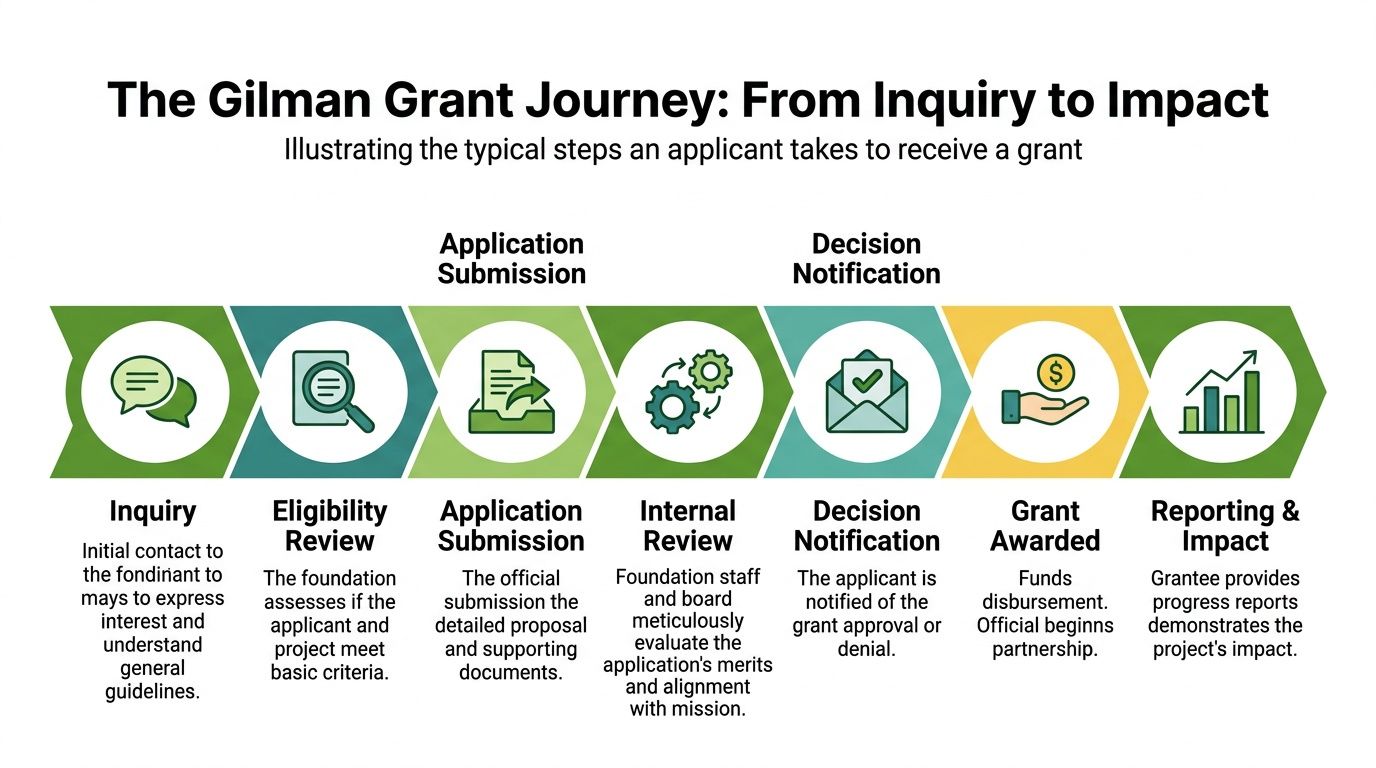
The howard gilman foundation can feel opaque if you expect a simple public RFP process. It’s better to think of the path as a sequence of decisions that starts before any formal submission.
The foundation processes approximately 250 grants annually through three distinct cycles and uses the Fluxx grants management system to handle due diligence, recommendations, payment, and contract issuance, according to this Howard Gilman Foundation profile and operational summary.
That gives you two useful signals. First, the workflow is structured even if the relationship side feels informal. Second, staff are managing a lot of movement, so your materials need to be easy to assess.
A simple process view helps.
Step one starts before the form
For a new applicant, the first hurdle isn’t the proposal. It’s visibility with credibility.
That usually means a concise inquiry, a sharp organizational overview, and evidence that your team understands why Gilman might care about your work. In many cases, inviting staff to a performance or sharing a meaningful upcoming program can help. The key is relevance, not volume.
Don’t send repeated generic updates. Send communication that helps a program officer answer one question: Should I learn more about this organization?
If you need help tightening your first outreach, this guide to a grant inquiry letter is a useful reference point.
What staff are likely assessing early
Early review usually isn’t about literary style. It’s about signal quality.
Look at what your first contact conveys:
- Mission fit
- Artistic seriousness
- Organizational maturity
- Geographic relevance
- Whether your work belongs in the performing arts portfolio
If your note leads with urgency, a long origin story, or abstract language, staff still won’t know whether your group is a fit.
A sharper opening is usually shorter than teams expect.
The formal side still matters
Once a conversation advances, the process becomes more structured. Even relationship-driven funders need records, internal memos, recommendation materials, payment systems, and grant agreements.
That’s where platforms like Fluxx matter. Applicants don’t need technical expertise in the system, but they do need to submit clean materials.
Prepare for operational scrutiny
Expect requests that help staff assess whether the organization can manage funds and deliver on what it claims.
That often includes:
- Clear organizational documents
- Recent financial information
- Board and leadership details
- Program descriptions that match reality
- A budget that reflects how the organization operates
Sloppy inconsistencies are more damaging with trust-based funders because they raise doubts about judgment.
Here’s a short explainer that gives a helpful overview of the broader grants process and funder decision-making context:
What works best during the journey
The strongest applicants tend to act like future partners, not salespeople.
They:
- Answer the question asked. No padded narratives.
- Acknowledge limits candidly. If a system is still developing, say so clearly.
- Make staff’s job easier. Clean files, consistent language, and straightforward budgets matter.
- Stay responsive without hovering. Follow up professionally, then give space.
What to avoid
Avoid these habits:
- Submitting before your materials are aligned
- Overstating audience reach or organizational capacity
- Treating the inquiry as a mini annual report
- Assuming invitation language means relationship is all that matters
Relationship opens the door. Execution keeps it open.
Crafting a Proposal That Builds Trust
A howard gilman foundation proposal should read like a real organization speaking clearly about its work. That sounds simple. It isn’t.
Many nonprofits know how to produce polished language. Fewer know how to produce language that creates confidence.
Trust-based funders are not asking for less rigor. They are asking for a different kind of rigor. They want to see whether your narrative, finances, programming, and leadership judgment line up.
Write for recognition, not decoration
The best proposal strategy is usually narrative-driven, but not in the sentimental sense. Staff need to recognize your organization as it operates.
That means your proposal should answer questions like these:
- What artistic work do you make or present?
- Who is it for?
- Why are you positioned to do it?
- What choices have you made as an organization?
- Where are you strong, and where are you still building?
A decorative proposal avoids those questions by hiding behind broad impact language. A strong proposal answers them directly.
Strong framing versus weak framing
Weak framing:
- “We provide impactful arts experiences for underserved communities.”
- “Our distinctive programming builds equity and access through creative expression.”
Those lines aren’t false. They’re just unusable. They don’t tell a program officer what you do.
Stronger framing:
- “We commission and present new theater led by artists of color from our neighborhood, pair those productions with public conversations, and maintain low-barrier ticket access so local audiences can attend consistently.”
Now the reader can assess the work.
Trust is built through consistency
Your proposal narrative should match your attachments.
If the narrative says your organization is stable, the budget should not suggest uncontrolled volatility. If the narrative says your board is engaged, your governance materials should not look neglected. If the narrative says the organization values transparency, the numbers should reconcile cleanly.
For many applicants, the fastest way to improve this is to standardize internal financial presentation before drafting. If your finance materials are messy or inconsistent, these essential financial statement templates can help your team present statements more clearly before they ever reach a funder.
Show judgment, not just aspiration
A strong Gilman proposal usually includes evidence of judgment.
What that looks like
- Program choices with rationale. Explain why certain artistic directions or audience strategies make sense for your organization.
- Operational realism. Show that leadership understands staffing, space, scheduling, and cash flow constraints.
- Community knowledge. Describe relationships and audiences specifically, not symbolically.
- Governance integrity. Your policies and disclosures should support your trust-based pitch. If your team needs to review governance basics, a practical model for a conflict of interest policy for nonprofits is a good place to start.
The proposal should make staff feel that your team sees the organization clearly, including the messy parts.
Common pitfalls
Mistaking abstraction for sophistication
Some arts organizations write as if being vague sounds strategic. It doesn’t. It sounds evasive.
Overloading the proposal with every program
Gilman doesn’t need your entire archive. Select what best demonstrates identity, track record, and role.
Treating equity as a standalone paragraph
If equity matters to your organization, it should show up in artistic leadership, staffing choices, partnerships, audience access, and programming logic.
Hiding operational weakness
You don’t need to present a flawless organization. You do need to present an honest one. If a challenge exists, frame it with context and response, not spin.
A working standard for your final draft
Before submission, test the proposal against this standard:
- Could a reader describe our organization accurately after one pass?
- Do our numbers and narrative agree?
- Have we shown why we matter in New York City’s performing arts sector?
- Does the proposal sound like us, or like a consultant template?
If the draft sounds polished but generic, keep revising. Trust is easier to build with specificity than with elegance.
Recent Grantees and Emerging Trends
A common mistake with Gilman prospect research is treating the public record like a complete map. It isn’t. New applicants still can learn a lot from who appears in the foundation’s orbit, how those organizations describe their role in the city, and what kinds of institutions seem to receive ongoing confidence.
The useful question is not, “Who got funded most recently?” The better question is, “What made these organizations legible and fundable to Gilman in the first place?”
What recent grantee patterns actually show
Publicly available information points to a consistent preference for New York City performing arts organizations with a clear civic role, not just a good season plan. Gilman appears interested in institutions that contribute to the city’s cultural infrastructure over time. That usually means artistic identity, audience relevance, and organizational staying power all need to be visible at once.
For a new applicant, that is an important distinction.
An exciting production calendar can help staff understand the work. It usually will not carry the case by itself. The stronger signal is institutional significance. Can your organization show that it matters to a neighborhood, an artistic community, a specific population, or a part of the city’s ecology that would be weaker without you?
How to study grantees without guessing
A practical review of recent and known grantees usually surfaces a handful of recurring traits:
- They are clearly rooted in the performing arts
- They have a real New York City footprint
- They read as institutions, not temporary projects
- They can point to leadership, partnerships, or programming choices that support equitable access
- They occupy a recognizable place in the field
That last point deserves more attention than it usually gets. Gilman is relationship-driven, and relationship-driven funders tend to back organizations that other credible people in the field can place quickly. New applicants should work on becoming easy to place. That may mean sharpening how you describe your artistic niche, your community role, and your peers.
A trend newer applicants should pay close attention to
Organizations serving communities that have historically received less benefit from New York’s major arts funding networks appear to have a stronger opening here than they do with some legacy funders. That does not mean “underserved” is a substitute for artistic quality or financial discipline. It means the case for support can be stronger when community relevance and artistic purpose are tightly connected.
This is one of the clearest openings for a nonprofit without a long Gilman relationship.
If your organization is not part of the usual Manhattan-centered conversation, do not treat that as a weakness you need to hide. Present it as evidence of why your work adds value to the city’s performing arts field. The trade-off is that you need sharper proof. Staff will need to see that your local importance is real, durable, and artistically credible.
What new applicants should avoid reading into the pattern
Do not build a strategy around simplistic rules. Size alone does not make an organization attractive. Newness alone does not disqualify one. A social impact frame will not compensate for weak artistic positioning, and artistic prestige by itself does not guarantee fit.
A better approach is to test your organization against a harder standard: would an informed reader understand why your institution belongs in New York City’s performing arts future, and why Gilman is a logical funding partner for that role?
That is the threshold worth aiming for.
Frequently Asked Questions About Gilman Funding
Can individual artists apply directly?
The howard gilman foundation is best approached as an institutional funder. If you’re an individual artist without an eligible nonprofit structure or without a clear organizational home that fits their guidelines, this is usually not the right direct prospect.
Is it possible to get funded without an existing relationship?
Yes, but you should be realistic. A cold submission with generic language is weak. A new approach built around clear fit, a sharp inquiry, and meaningful visibility in the field is much stronger.
What’s the best first contact?
Lead with a concise, customized note. Explain who you are, what artistic work you do, where in New York City you operate, and why your organization appears aligned. If there’s a strong upcoming performance or presentation, mention it only if it helps staff understand the work.
Should we ask for a meeting right away?
Usually, no. Ask for consideration, not access for its own sake. Give staff enough substance to decide whether a conversation makes sense.
Are deadlines fixed?
Gilman processes grants in cycles, but relationship-based foundations don’t always function like open-call funders with a single public deadline mentality. Track timing carefully and confirm current practices before planning internal work backward from assumptions.
Can a newer organization compete?
Possibly, but newness by itself won’t carry the case. A younger organization needs especially strong clarity about artistic identity, community role, and operational readiness.
What is the biggest mistake first-time applicants make?
They submit too early. They confuse admiration for alignment, and they send materials before the organization’s identity, financials, and message are fully coherent.
If your team wants a faster way to research fit, organize materials, and turn messy grant prep into a workable pipeline, Fundsprout is built for exactly that. It helps nonprofits find relevant opportunities, screen eligibility, draft stronger narratives from real organizational documents, and keep every requirement, deadline, and reporting task in one place.
Try 14 days free
Get started with Fundsprout so you can focus on what really matters.