How to write nonprofit press release: Get media attention fast
How to write nonprofit press release: a concise guide with tips, examples, and proven strategies to tell your nonprofit story and attract media.

Abdifatah Ali
Co-Founder
When you’re writing a nonprofit press release, you need to think like a journalist. That means using the inverted pyramid format—getting the most important information right at the top. The who, what, where, when, and why of your story should be the very first thing a reporter reads.
This approach is crucial because it guarantees your core message gets across instantly, even if someone only skims the first paragraph. A truly effective release is a blend of a hook-worthy headline, a strong opening, genuine quotes, and a clear purpose.
The Blueprint of a Compelling Nonprofit Press Release
Before a single word hits the page, you need a plan. A well-structured press release isn’t just about sharing news; it’s about making that news incredibly easy for a busy journalist to understand and, hopefully, use. The gold standard for this is the inverted pyramid.
Think of a pyramid flipped upside down. The widest part, right at the top, holds all the mission-critical information. As you read down, the details become more supportive and less essential. This structure is a sign of respect for a reporter’s time—it delivers the story's core on a silver platter.
Understanding the Inverted Pyramid Structure
The very top of your release, your first paragraph, must answer the five essential questions of journalism, often called the 5 Ws:
- Who: Your organization and any key people involved.
- What: The actual announcement or news.
- When: The date of the event or announcement.
- Where: The location or community you’re impacting.
- Why: The reason this news matters right now.
Get all of that into your lead paragraph. From there, the rest of the release can flesh out the story with supporting details, powerful quotes, and background context. This methodical approach is also practical—if an editor needs to trim your story to fit a specific word count, they can cut from the bottom up without losing the main point.
Key Components Every Release Must Have
Beyond the structure, every professional press release includes a few standard elements. These are the non-negotiable building blocks that signal to journalists that you know what you're doing. A solid grasp of the fundamentals of how to fundraise for charity often provides the context for the "why" in your announcement, making your story much more compelling.
A press release is your formal pitch to the media. Forgetting something like a boilerplate or contact info is like sending a resume without your name—it tells them you’re not a serious source.
To help you get it right every time, here’s a quick-reference checklist of the core elements your nonprofit press release needs to include.
Essential Components of a Nonprofit Press Release
Nailing these components ensures you're creating a professional and effective document that journalists will actually take seriously.
Finding Your Story and Crafting an Irresistible Headline
Before a single word of your press release gets read, your headline has to do all the heavy lifting. It's the gatekeeper. It’s what stands between your story getting noticed or getting instantly deleted from a busy journalist’s inbox.
The real trick isn't just announcing something new; it's framing that news as a story someone needs to read.
A weak headline just states a fact, like "Local Nonprofit Receives Grant." A truly powerful headline, on the other hand, shows the impact: "New Grant Allows Local Nonprofit to Provide 10,000 Meals to Food-Insecure Families." One is a transaction, the other is a story of real change. That distinction makes all the difference.
Identifying Your Newsworthy Angle
Let’s be honest: not every internal update is "news." To find an angle that will actually land with the media, you need to step outside your organization and think like a reporter. What makes your announcement timely, relevant, surprising, or just plain moving?
Here are a few places to look for your strongest story:
- Human Impact: Don't just announce a new program—tell the story of the first person whose life it will change. People connect with people, not programs.
- Surprising Data: Did your annual report uncover a shocking statistic about your community? A headline like "75% of Local Seniors Face Isolation, New Report Reveals" creates immediate urgency and gives a reporter a hard number to build a story around.
- Community Connection: How does your news fit into a larger local conversation? If your city is debating the lack of green spaces, a release about your new community garden suddenly becomes incredibly relevant.
Nailing down your angle doesn't just make for a better press release. This kind of thinking also strengthens your overall messaging, which is invaluable when you're crafting a compelling statement of need for grant proposals.
The Art of Writing a Magnetic Headline
A great headline is a masterclass in concise, powerful writing. It needs to be clear, compelling, and accurate, all in about ten words. Its only job is to make a promise that the rest of the press release will deliver on.
Think of it as the subject line of an email to a very important, very busy person. If it’s boring or vague, it’s getting ignored. Journalists see hundreds of pitches a day; yours has to jump out.
Your headline must answer the reader's unspoken question: "Why should I care about this right now?" If it doesn't provide a compelling reason within seconds, you've already lost.
To get your headlines working harder, use strong, active verbs and concrete numbers. Don't say your program "is helping"; say it "feeds," "shelters," or "trains." The more specific and active, the better.
This is especially true when announcing events. A recent Fundraising Outlook Report found that 75% of nonprofits hosting in-person events met or beat their goals, and 80% are planning more. Announcing your own milestone or event 2-4 weeks in advance with a powerful headline helps you get on media calendars and ride this wave of success. You can dive into more fundraising trends by checking out the full report on INN.org.
Real-World Headline Examples Dissected
Let's break down the difference between a headline that falls flat and one that grabs attention.
Weak Headline: Community Center Launches New After-School Program
- Why it's weak: It's a statement of fact, but it has no soul. It doesn't tell a journalist why this matters to their readers.
Strong Headline: New After-School Program to Provide Safe Haven for 200 At-Risk Youth in Downtown
- Why it works: It's packed with specifics. We see the impact (safe haven), the scale (200 at-risk youth), and the location, making it a tangible, local story a reporter can sink their teeth into.
Weak Headline: Animal Shelter Receives Donation
- Why it's weak: This feels like an internal memo, not public news. It lacks scale, drama, and a compelling reason for anyone outside the organization to care.
Strong Headline: Record-Breaking $50,000 Donation Saves Local Animal Shelter from Closure
- Why it works: Now we have a story! It’s got high stakes (saves from closure), dramatic language (record-breaking), and a big number that immediately signals significance. This isn't just a donation; it's a community coming together to prevent a tragedy.
Adding Depth with Quotes, Data, and Multimedia
So you’ve grabbed a journalist’s attention with a great headline and a solid lead. Fantastic. Now you have to give them the substance to actually build a story. This is where you move past just making an announcement and start painting a picture with real emotional weight and hard facts.
The best way to do this is by weaving together authentic quotes, solid data, and engaging multimedia. Think of these as the ingredients that turn a bland announcement into a story-ready package a reporter can run with.
Crafting Quotes That Actually Resonate
A quote is your chance to inject a real human voice into your press release. But too often, this is where things go wrong. Nonprofits default to generic, jargon-filled statements from an executive director that sound like they were written by a committee. Journalists see right through these and almost never use them.
What you want are quotes that feel genuine and add a new layer of emotion or perspective. A great quote doesn't just repeat information from the press release; it explains the why behind the news.
Think about whose voice would be most powerful:
- A Program Beneficiary: Hearing directly from someone whose life you've changed is pure gold. It provides an authentic, ground-level view of your impact that no one else can.
- A Lead Volunteer: Quoting a dedicated volunteer shines a light on the community passion that fuels your mission.
- Your Executive Director: This is still a strong choice, but the quote needs to be full of genuine passion and vision, not just a dry summary of the project.
For example, don't use a flat quote like, "We are pleased to launch this new initiative." Instead, try something that hits an emotional chord: "Seeing a child's face light up when they receive their first book from this program—that's the moment we work for. It's about more than literacy; it's about unlocking a future."
Using Data to Show Your Tangible Impact
Stories create an emotional connection, but data gives your claims credibility. Hard numbers show a journalist that your work is more than a feel-good story; it’s a measurable force for change.
As you write, sprinkle in key statistics that put your announcement in context. Don’t just say your food pantry helps people. State that you provided over 50,000 meals last year, which was a 20% increase from the year before. See the difference? A vague claim just became a concrete, newsworthy fact.
Often, the best data comes from your own internal tracking. This is why having a solid reporting framework, similar to what you'd prepare for a nonprofit annual report format, is so critical. It gives you a well of credible stats to draw from whenever you need them.
A journalist’s job is to verify everything. When you provide clear, verifiable data, you're not just making your story stronger—you're making their job easier. That makes them much more likely to cover you.
It also helps to connect your work to bigger trends. For instance, you could mention that while total U.S. charitable giving recently hit $592.50 billion, donations to education saw a significant 13.2% jump, reaching $88.32 billion. Tying your local work to national figures like these, which you can explore in more detail on PR Newswire, adds another layer of relevance to your story.
The Power of Multimedia
In today's digital news world, visuals aren't a nice-to-have; they're essential. A press release that includes high-quality multimedia is far more likely to get picked up and shared. You’re handing journalists ready-to-use content that makes their story better and grabs their audience’s attention.
In fact, leveraging multimedia and data visualization can boost engagement by a staggering 85%. A few good visual assets can turn your pitch from just another email into a complete story package.
Make sure to include a few of these:
- High-Resolution Photos: Offer professional shots of your program in action, your event, or key people. Action shots are always better than posed group photos.
- A Short Video: A one- or two-minute video with a powerful interview or B-roll of your work can be incredibly effective.
- An Infographic: If your release is heavy on data, pull out the key stats and create a simple, shareable infographic.
And here’s a pro tip: make it incredibly easy for them. Provide a direct link to a cloud folder (using Google Drive or Dropbox) where they can instantly download all your high-res assets. That little step removes a barrier and makes it a no-brainer for them to use your visuals.
Finalizing Your Press Release: The Boilerplate and Call to Action
How you wrap up your press release is just as important as how you kick it off. Those last few paragraphs are your final shot to frame the narrative and steer your audience toward a specific next step. This is where two critical pieces come in: the boilerplate and the call to action (CTA).
Think of them as the finishing touches that complete the picture. A sharp, well-crafted boilerplate gives your story the context it needs, while a powerful CTA turns your news from a simple announcement into something people can actually act on. Getting these right is the key to making sure your message doesn't just land, but inspires.
Your Boilerplate: The "About Us" That Matters
Your boilerplate is your organization's official, standardized "About Us" blurb that sits at the very end of your press release. It's a quick, punchy summary of your nonprofit's mission, vision, and what you do every day. It might seem like a small detail, but a good boilerplate is a hallmark of professionalism.
For a busy journalist, this little paragraph is incredibly useful. If they aren't familiar with your organization, it gives them instant, accurate context without making them dig around your website. It quickly answers: Who are you? What do you do? Who do you serve?
Your boilerplate is your nonprofit's elevator pitch, set in stone. It needs to be consistent across every single communication and strong enough to explain your entire mission in under 100 words.
A great boilerplate isn’t just a dry description; it's a tiny piece of persuasion. It should communicate the scale and impact of your work. For instance, instead of vaguely saying you "help the community," get specific: "We provide shelter, meals, and job training for over 500 individuals experiencing homelessness each year in the greater metropolitan area." That's a story in itself.
The Call to Action: Guiding Readers to What's Next
A press release that only informs has done just half its job. A truly effective one inspires a response. That’s the entire purpose of your call to action (CTA)—it tells the reader exactly what you want them to do next.
Your CTA needs to be direct, clear, and focused on a single action. Don't muddy the waters by asking people to donate, volunteer, and follow you on social media all at once. Pick the single most important action tied to your announcement and make the ask impossible to misunderstand. A weak CTA like "Visit our website for more information" is a huge missed opportunity.
Think about the goal of this specific press release and tailor your CTA to match.
- Launching a fundraiser? "Join us in reaching our goal. A gift of $25 can provide a week of warm meals for a family in need. Donate today at [YourDonationLink.com]."
- Announcing an event? "Tickets are limited. Reserve your spot today and celebrate our community’s progress at [YourEventLink.com]."
- Kicking off a volunteer drive? "Be a part of the change. Sign up for our next volunteer orientation and start making a difference at [YourVolunteerLink.com]."
Here’s a pro tip: connecting your CTA to funder priorities can seriously boost media attention. Research shows that including funder-aligned calls to action can increase media pickups by 60%. This is more critical than ever, especially when 33% of nonprofits have recently faced funding disruptions. With 85% of organizations prioritizing recurring gifts, closing with a strong, partnership-focused CTA can make all the difference. You can discover more insights about nonprofit stability on Nonprofit PRO.
Effective Call to Action Examples
It's one thing to have a CTA, but it's another to have one that actually works. A generic request often gets ignored, while a specific, emotionally resonant one can move people to act.
Here’s a look at how to transform a standard CTA into something much more impactful.
By closing with a powerful boilerplate and a clear, compelling call to action, you ensure your nonprofit press release doesn't just fade out—it leaves a lasting impression and gives your readers a clear path to get involved.
Getting Your Story into the Right Hands
Even the most powerful, perfectly worded press release won't do you any good if it just sits on your desktop. Once you’ve polished your story, the real work begins: getting it to the right people. This isn't about shouting your news from the rooftops; it's about strategically placing it in front of the journalists, bloggers, and influencers who will actually care about your cause.
You essentially have two ways to go: broad distribution or a targeted approach. Both can work, but knowing which one to use—and when—is the secret sauce.
Understanding Your Distribution Options
The "broad" approach usually means using a press release wire service. These platforms are built to send your announcement to hundreds, sometimes thousands, of newsrooms and media outlets all at once. It’s a fast way to get your news indexed by search engines and can be a solid choice for huge announcements with wide appeal. The downside? It can get expensive, and it completely lacks the personal touch that often convinces a journalist to cover a story.
The alternative is a much more surgical, targeted pitching strategy. This is where you roll up your sleeves and build a custom list of specific journalists who cover your nonprofit’s world. It takes more time, absolutely, but the payoff can be huge. A personal email to a reporter who has a track record of writing about your niche is infinitely more effective than a generic blast from a wire service.
A wire service can guarantee reach, but a personalized pitch is how you build relationships. For most nonprofits, creating a trusted network of media contacts is the far more valuable long-term play.
Honestly, the best strategy is often a mix of both. You might use a wire service to get the word out about a major national campaign while also sending personal, tailored pitches to your A-list of local reporters and industry bloggers.
Building a High-Impact Media List
Think of your media list as your most valuable PR tool. A generic, purchased list is basically worthless. You have to put in the time to build a list of real people who cover stories like yours.
Start by mapping out the right kinds of outlets:
- Your Own Backyard: Don't underestimate the power of local. Think city newspapers, regional magazines, the 6 o'clock news affiliates, and community blogs. They are constantly searching for stories with a direct local angle.
- Niche Publications: Are there trade journals, specific blogs, or newsletters dedicated to your field? Whether it's environmental action, education reform, or animal welfare, find the publications that live and breathe your topic.
- Digital Influencers: Look for bloggers and podcasters who have an engaged audience that overlaps with your own. A single mention on a popular podcast can sometimes drive more action than a traditional newspaper article.
Once you know where to look, you need to find who to contact. Never, ever send your pitch to a generic "news@" or "info@" email address. It’s a black hole. Instead, dig for the names of specific reporters, editors, or producers. Use the publication's own website, LinkedIn, or even X (formerly Twitter) to find the person who actually covers your beat. A pitch sent to the "Community Features" editor has a fighting chance; one sent to the sports desk is just digital trash.
To get more ideas on making your story stand out, it's worth checking out other guides on crafting an impactful press release.
Perfecting Your Pitch
Journalists are drowning in emails. I’m not exaggerating—they get hundreds every single day. Your pitch needs to be a life raft, not another drop in the ocean. The best pitches are short, personal, and get straight to the point.
Always start with a personal touch. A simple line mentioning a recent article they wrote shows you’ve actually done your homework. It proves you’re not a spammer.
Then, immediately connect the dots for them. Don't just attach your press release and hope they figure it out. Explicitly tell them why your story is a perfect fit for their audience. Pull the most compelling hook from your release and put it right in the first sentence of your email.
For example:
"Hi Jane, I really enjoyed your piece last week on rising food insecurity in our city. I'm reaching out because my nonprofit is launching a mobile pantry that will bring fresh produce directly to the three neighborhoods you highlighted in your article."
See the difference? You’ve turned your pitch from a cold ask into a hot, relevant tip. This kind of strategic thinking is a hallmark of successful outreach, and you can get more of it by exploring nonprofit fundraising best practices.
This simple infographic breaks down the final polishing steps before you hit "send."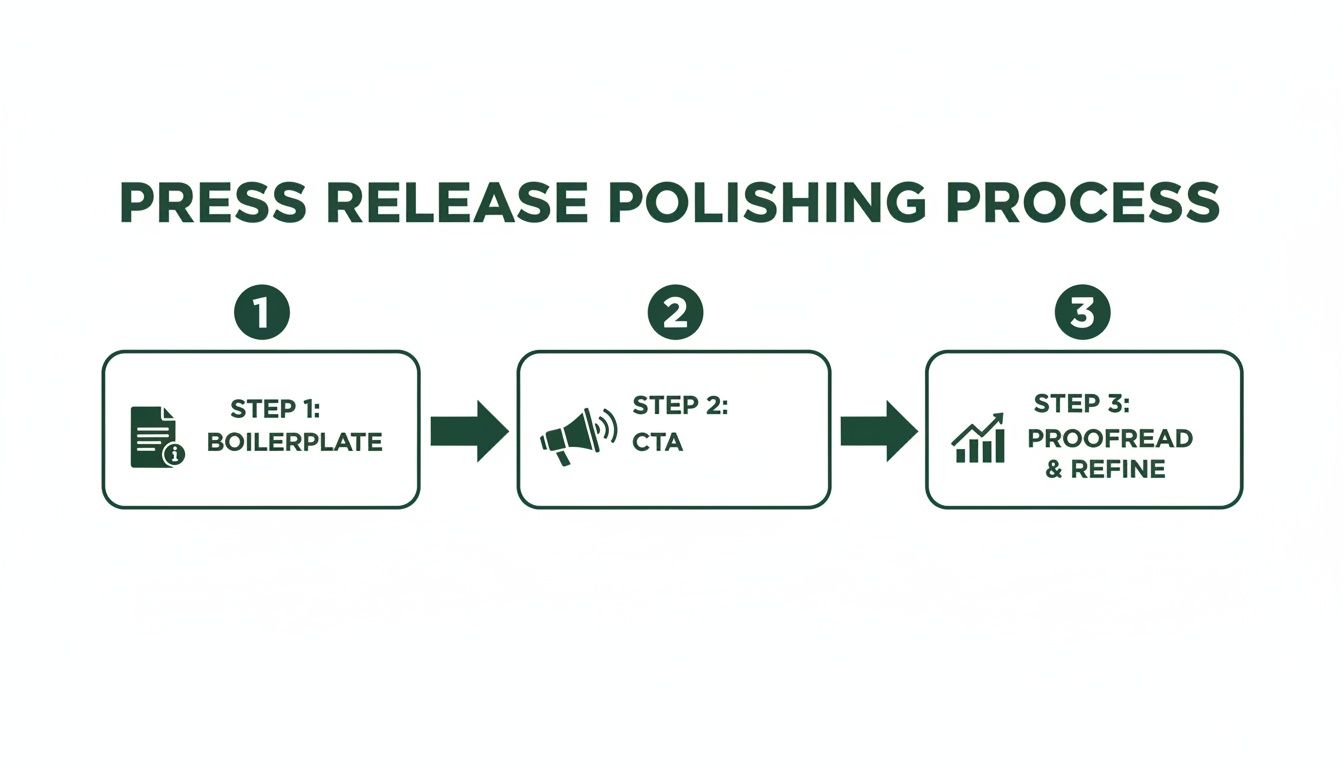
Moving from a solid boilerplate to a clear call to action, and finishing with a final proofread, is what makes your document professional and ready for the media.
Answering Your Top Questions About Nonprofit Press Releases
Even with the best templates and a solid plan, you're bound to have questions pop up as you get into the thick of it. Let's walk through some of the most common hurdles nonprofit pros run into, so you can handle them like a seasoned pro.
What’s the Ideal Length for a Nonprofit Press Release?
Keep it tight. You should aim for a sweet spot between 400 and 500 words.
Think of it this way: a journalist is sifting through dozens, if not hundreds, of emails a day. A release that fits neatly onto one page gets your point across quickly and respects their time. This word count also forces you to be disciplined, sticking to the inverted pyramid style and putting your most important news right at the top.
A release of this length has enough room for a punchy headline, a solid lead paragraph, a couple of body paragraphs with a great quote and some data, your boilerplate, and your contact info. Anything more, and you risk it getting tossed in the "read later" pile—which often means "never."
How Do I Actually Find the Right Media Contacts?
This is where the real work begins, and it’s less about a huge list and more about a smart one. Sending your story to the right person is half the battle.
Forget the shotgun approach. Start by making a list of local news outlets, industry-specific blogs, and even podcasts that cover your nonprofit's niche. Then, dig deeper. Who are the actual reporters covering community stories, social issues, or whatever your focus is? Look for their bylines on past articles that feel similar to your news.
Tools like LinkedIn and X (formerly Twitter) are your best friends here. You can often find a reporter's direct email or at least learn what they're interested in.
Pitching "Jane Doe, Community Reporter" is a world away from sending your email to a generic
news@publication.comaddress. It shows you’ve done your homework and you value what they do. That alone can make your email stand out.
Should I Follow Up with a Journalist After Sending My Release?
Yes, but there's a right way and a very wrong way to do it. A single, polite follow-up can be the nudge that gets your story noticed. Bombarding a journalist’s inbox is the fastest way to get blocked.
Give it a day or two. If you haven't heard back, send one—and only one—brief follow-up email. The key is to add value, not just ask, "Did you see my press release?"
Try offering something new.
- An exclusive interview: "I'd be happy to connect you with one of our lead volunteers for a fantastic conversation."
- Better visuals: "I also have some high-res photos of the new community garden in action if that would be helpful for your story."
- A timely news hook: "With the city council discussing food deserts next week, this story is especially relevant right now."
A thoughtful follow-up is helpful. A pushy one is just noise.
What Are the Most Common Mistakes to Avoid?
So many press releases land with a thud because of a few simple, avoidable slip-ups. If you can sidestep these, you’re already ahead of the game.
The number one mistake is a boring, non-newsworthy headline. If it doesn't grab attention in five seconds, it's failed. A close second is burying the lede—hiding the most exciting part of your story in the third paragraph. Journalists don't have time for a treasure hunt.
Another killer is using too much jargon or including stiff, corporate-sounding quotes that sound like they were written by a committee. And for goodness sake, don’t forget to include a clear call to action and easy-to-find media contact info. Finally, stop sending generic email blasts. A targeted pitch to a handful of relevant reporters will always beat a mass email to a list you bought online.
Fundsprout is the AI-powered grant success platform designed to help your nonprofit find the right funding, craft winning proposals, and manage compliance with ease. Discover your next grant opportunity and streamline your writing process at https://www.fundsprout.ai.
Try 14 days free
Get started with Fundsprout so you can focus on what really matters.