How to Write Measurable Goals for Grant Proposals
Learn how to write measurable goals that win grants. Our step-by-step guide for nonprofits covers SMART goals, outcomes vs. outputs, and funder alignment.

Abdifatah Ali
Co-Founder
You spent days pulling program data, aligning your budget, and writing a compelling need statement. Then the rejection lands, and the weakness isn't your mission. It's your goals.
This happens constantly in nonprofit grant work. Strong programs get framed with soft language like “increase awareness,” “support families,” or “improve outcomes.” Funders read that and see risk. They don't know what success looks like, how you'll verify it, or whether your team can report progress without scrambling later.
If you're trying to learn how to write measurable goals for grant proposals, the fix isn't more inspiring language. It's tighter design. A fundable goal tells a reviewer what will change, for whom, by when, how you'll know, and where the data will come from. The strongest proposals also do two things most generic SMART guides miss. They measure the right skill, not just the headline outcome, and they name an auditable data source up front.
Why Vague Goals Get Your Grant Application Rejected
Most rejected objectives fail for one simple reason. They describe intention, not evidence.
A funder isn't paying for passion alone. They're backing a plan that can be implemented, monitored, and defended in a report. If your proposal says you will “uplift youth,” “strengthen the community,” or “expand access,” a reviewer still has basic unanswered questions. Who exactly is being served? What change should happen? How will your team measure it? What counts as success?
What funders see when a goal is vague
Vague goals create operational problems long before reporting season. They make staffing harder, data collection inconsistent, and evaluation weak. Program staff start interpreting the same objective in different ways, and the development team ends up trying to retrofit metrics after the grant is awarded.
That usually shows up in wording like this:
- Unclear action: “Participants will gain valuable skills.”
- No metric: “Families will be better prepared.”
- No deadline: “The program will improve health outcomes.”
- No method: “Students will show growth.”
None of those statements tells a funder what to expect.
Practical rule: If two staff members could read your goal and track it in two different ways, the goal isn't measurable yet.
Why measurable goals change the funding conversation
Measurable goals aren't a compliance exercise. They're a trust signal.
When a reviewer sees a concrete objective, they can connect your budget to your activities, your activities to your outcomes, and your outcomes to a reporting plan. That lowers perceived risk. It also shows that your team understands implementation, not just aspiration.
Evidence-based guidance from MSU Extension on achieving your goals says writing down goals with concrete steps, resources, and timeframes is essential for success, and it notes that people who report progress weekly are 40% more likely to succeed.
That matters in grant writing because funders are looking for organizations that can manage progress, not just announce ambition.
A fast test for your current goals
Take one objective from your proposal draft and ask:
- Can a reviewer picture the exact change?
- Can staff collect the data without guessing?
- Can you report progress before the grant period ends?
- Can an auditor or program officer trace the result back to a real data source?
If the answer is no on any of those, the goal needs work. Most nonprofits don't lose funding because the mission is weak. They lose it because the mission isn't translated into measurable terms.
Build Your Foundation with the SMART Framework
The SMART framework still works because it forces discipline. It was first described in print in 1981 by George T. Doran, and the core idea remains useful in grants: a goal must be specific, measurable, achievable, realistic, and time-bound. Research summarized by Tableau also notes that people who set time-bound goals and report progress are 40% more likely to succeed in this overview of SMART goals criteria.
Use it as a drafting filter, not a buzzword.
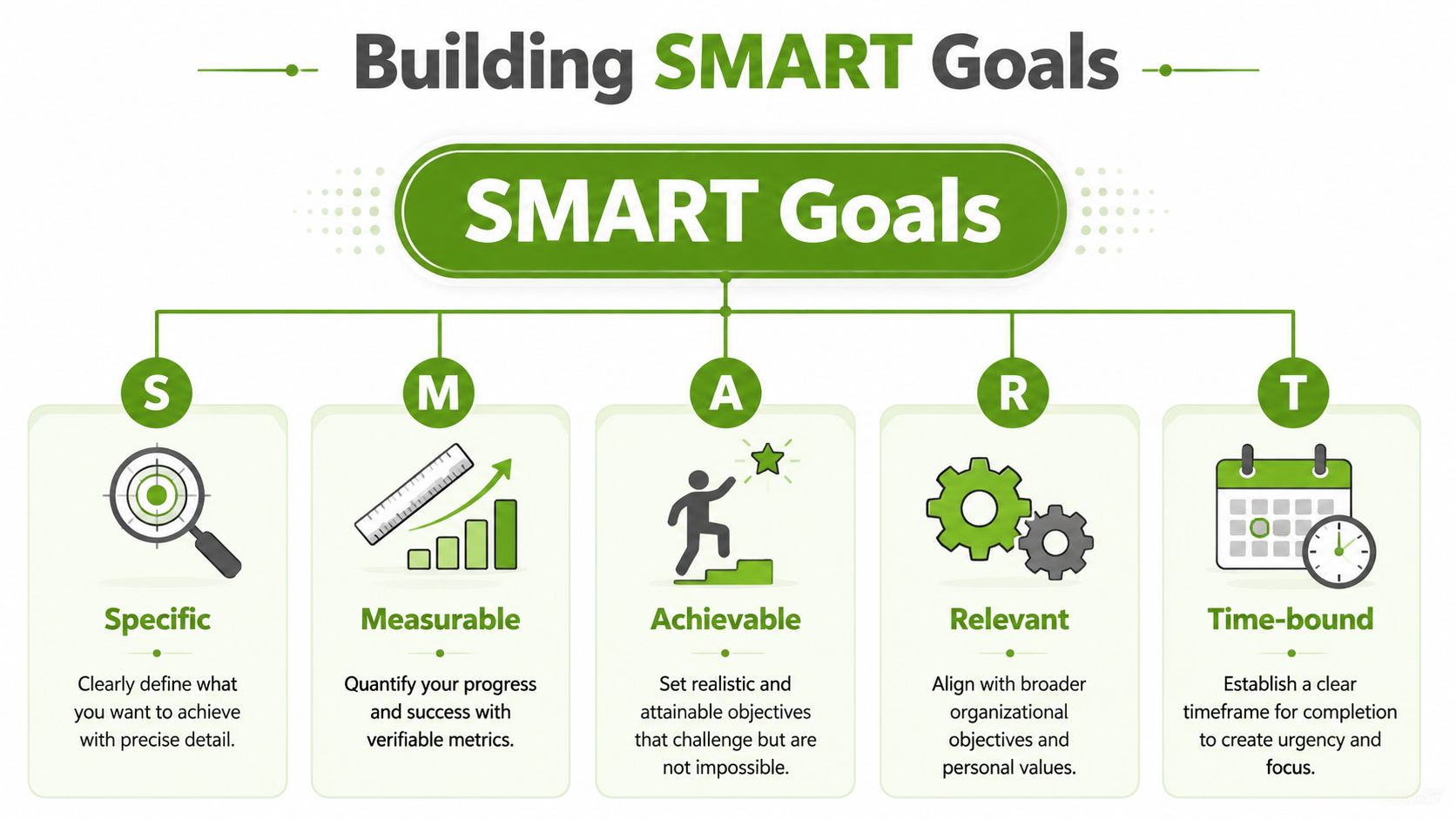
Specific means a reviewer can picture the work
“Support local youth” is not specific. It hides the population, service, and setting.
A stronger version is: provide after-school math tutoring to high school students attending two partner schools.
Specificity answers the who, what, and where. If you're trying to understand OKRs and SMART goals, SMART is especially useful in grants. Funders need clear operating detail, not just directional intent.
Measurable means success has a score
The measurable part is where many proposals collapse. “Improve attendance” sounds fine until someone asks, “By how much, for whom, and based on what data?”
A measurable version names the indicator and target. For example: increase average student attendance in tutoring sessions over the grant period. If you don't yet know the right number, don't invent one in drafting. Go get the baseline first, then set the target.
Achievable and realistic mean you can defend the target
An ambitious objective can still be weak if your staffing, timeline, and delivery model don't support it. Reviewers can tell when a target was chosen for drama rather than feasibility.
Check your proposed goal against:
- Staff capacity: Who is delivering the service?
- Program reach: How many participants can you realistically enroll and retain?
- Data capacity: Can your team track the metric?
- Grant period: Is the timeline long enough to observe change?
Time-bound means the clock is visible
Deadlines create accountability. “Participants will improve financial literacy” is loose. “Participants will demonstrate improvement by the end of the program cycle” is better because it gives the evaluator a reporting window.
Here is a short explainer if you want a visual walkthrough before drafting your own objectives:
A SMART goal should leave very little room for interpretation. If the wording still depends on someone's opinion, it's not ready for a grant application.
Focus on Outcomes Not Just Outputs
Nonprofits often confuse activity with change. Funders don't.
An output is what your team does. An outcome is what changes because of that work. If you hosted workshops, distributed materials, or enrolled participants, those are outputs. They matter, but they don't answer the reviewer's real question, which is: so what?
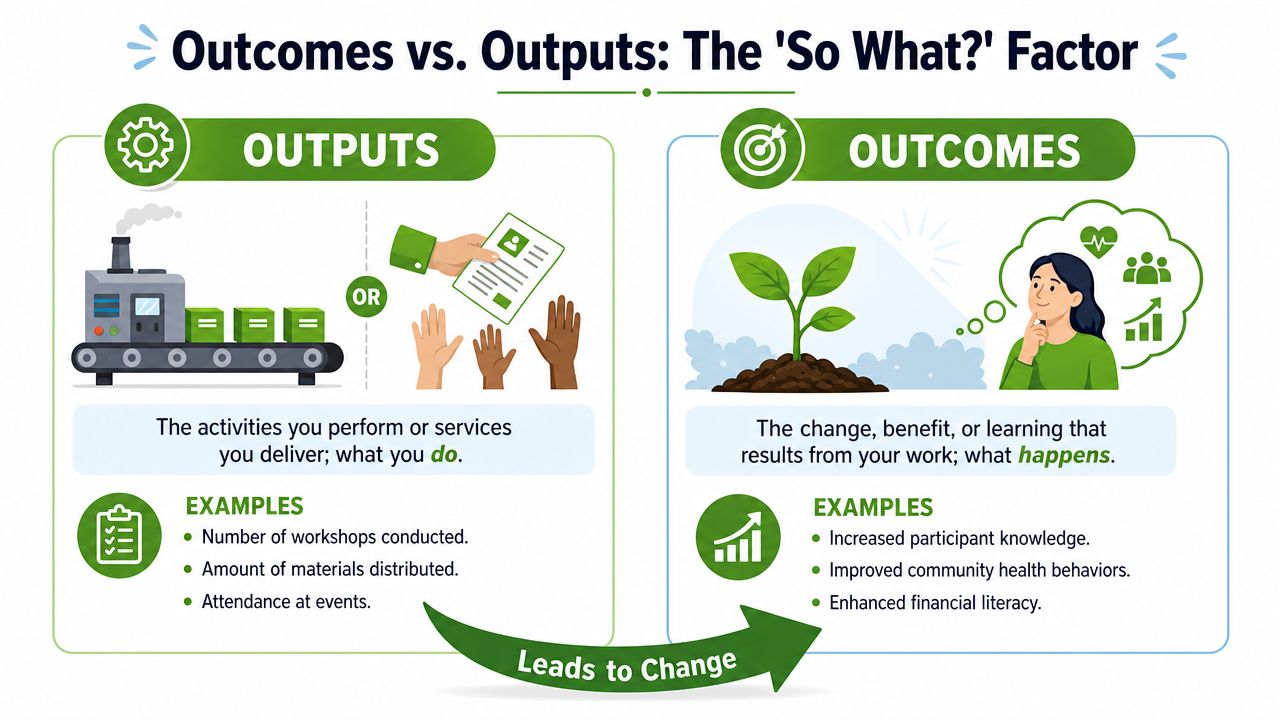
The side-by-side test
Here is the distinction in plain terms:
| Output | Outcome |
|---|---|
| Held job-readiness workshops | Participants improved interview skills |
| Distributed food boxes | Households reported improved food access |
| Taught arts classes | Students demonstrated stronger artistic technique or confidence |
| Delivered literacy tutoring | Students improved a defined reading-related skill |
Outputs tell the funder you were busy. Outcomes tell the funder the work mattered.
Why outputs alone weaken a proposal
I see this problem in otherwise solid applications. The narrative is strong, the community need is clear, and the budget is reasonable. Then the objectives section says things like “serve 200 residents through training sessions.” That's an implementation metric, not an impact claim.
You still need outputs in a grant proposal because they prove service delivery. But they should support an outcome, not replace it.
A better structure looks like this:
- Output statement: Deliver weekly financial literacy workshops to enrolled participants.
- Outcome statement: Participants demonstrate increased ability to complete a household budget under program conditions.
That second line gives the reviewer something to evaluate.
Use lead and lag measures together
One of the most common mistakes is tracking only the end result and ignoring the predictors. The SME Strategy guidance on SMART goals warns against relying only on lag measures and notes that 72% of failed grant proposals stem from vague objectives lacking specific, quantifiable constraints in its article on setting SMART goals.
In practice:
- Lag measures show the final result. Think end-of-program assessment results or post-program status.
- Lead measures show whether you're moving in the right direction while the grant is active. Think attendance consistency, assignment completion, or interim skill checks.
If you're building staff development plans or coaching internal teams on clearer performance metrics, examples outside the grant world can help sharpen your thinking. This guide on SMART goals for career growth is useful because it shows how the same logic applies when you're defining progress in professional settings.
For nonprofits, the strongest reporting systems usually include both types of measures. If you need a planning structure that connects activities, outputs, and outcomes before you write the objective itself, a simple logic model for program evaluation can keep your team from mixing them up.
Outputs tell you the program happened. Outcomes tell the funder the program worked.
Set Your Baselines Indicators and Targets
Once you stop writing vague outcomes, the next problem appears fast. You need to quantify them without making up numbers.
That means building every measurable goal from three parts: baseline, indicator, and target. The proper construction of these elements often determines whether proposals succeed or fail.
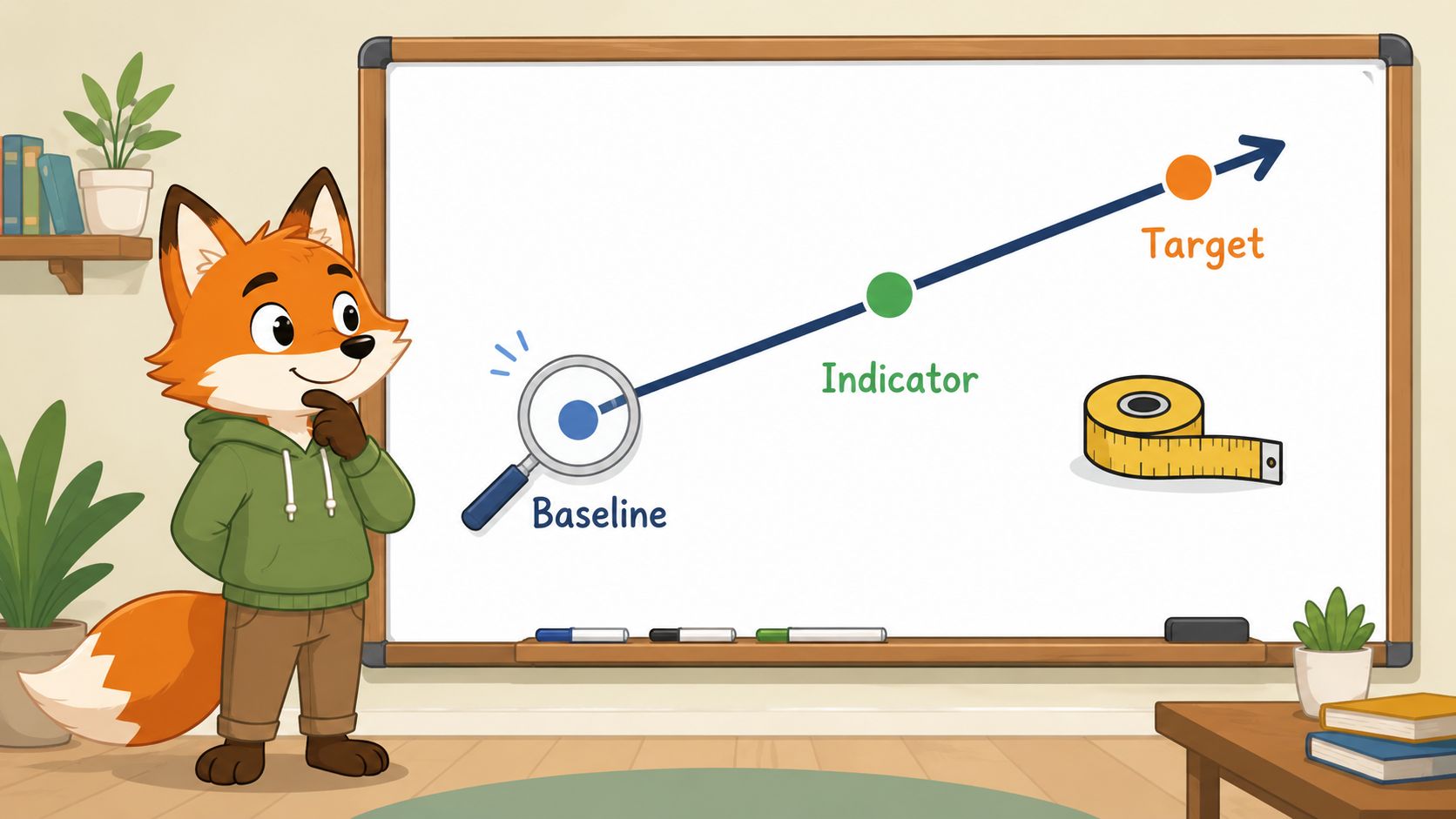
Start with the baseline
A baseline is your starting point. Without it, you can't show improvement because you don't know where participants began.
For a tutoring program, the baseline might come from intake assessments, school records, or a pre-test. For a workforce program, it might come from enrollment forms, skills screenings, or supervisor observations documented at intake.
Bad baseline language sounds like this: participants have limited knowledge.
Useful baseline language sounds like this: intake assessments show where each participant currently performs on the selected skill or indicator.
If you don't have baseline data yet, don't bluff. Write the data collection step into your launch plan and avoid over-committing in the proposal.
Choose one indicator that actually reflects the goal
An indicator is the data point you'll track. The best indicator is close to the change you want to prove.
If your goal is stronger reading performance, the indicator should not be “number of tutoring sessions delivered.” That's an activity count. The indicator should reflect demonstrated reading-related skill. If your goal is improved financial capability, an indicator might be whether participants can complete a budgeting task under defined conditions.
Use this filter when choosing indicators:
- Directness: Does it measure the change itself, not just participation?
- Reliability: Can staff collect it the same way each time?
- Practicality: Can your team track it without a research department?
- Usefulness: Will a funder accept it as evidence of progress?
Set a target your staff can defend
Targets should be informed by actual capacity, baseline data, and program design. The biggest drafting mistake here is choosing a number first and reverse-engineering the plan later.
When I review proposals, weak targets usually have one of two problems. They're either timid enough to sound meaningless, or inflated enough to sound fictional. The right target is one your program staff can explain with a straight face.
A useful internal question is: if a reviewer asks why this target is reasonable, can the program manager answer in one minute?
Add ABCD to remove ambiguity
The ABCD framework sharpens a goal by naming Audience, Behavior, Condition, and Degree of Mastery. According to Bob Pike Group, explicitly labeling those parts reduces ambiguity by over 40%, and failing to label them leads to a 65% higher rate of goal misinterpretation in this article on clear and measurable learning objectives.
Here is how that looks in practice:
| ABCD part | Question it answers | Example |
|---|---|---|
| Audience | Who is expected to change? | Enrolled adult learners |
| Behavior | What observable action shows progress? | Complete a budgeting exercise correctly |
| Condition | Under what circumstances? | During the final workshop assessment |
| Degree of Mastery | What level counts as success? | Meet the defined scoring threshold |
Working rule: If the “degree of mastery” isn't quantifiable, the goal still has holes.
Drafting Funder-Ready Goals with Sample Templates
A funder-ready goal usually needs more than SMART language. It needs a complete measurement spine: outcome, indicator, baseline, target, timeframe, and data source. That last piece gets skipped constantly, and it's one of the clearest signals that a proposal was drafted by someone who understands reporting.
The Minnesota Department of Health says measures and targets should be tied to a specific data source such as a regular survey, publication, or agency report in its guidance on writing objectives. That's not bureaucracy for its own sake. It's what makes your metric auditable.
A template you can actually use
Use this table when you're drafting or revising objectives.
| Component | Description | Example |
|---|---|---|
| Outcome | The change you expect to produce | Participants improve a defined job-readiness skill |
| Indicator | The metric that shows change | Performance on a mock interview rubric |
| Baseline | Starting point before services begin | Intake assessment results collected at enrollment |
| Target | The level of improvement you aim to reach | Defined by program design and baseline review |
| Timeframe | When progress will be measured | By the end of the program cycle |
| Data source | Where the evidence will come from | Program assessment records and attendance logs |
If your team struggles to turn raw results into funder language after the goal is drafted, it helps to study examples of how to write impact statements so your reporting language matches the rigor of your objectives.
Three sample goal formats
Here are examples that avoid the usual traps.
Education program
By the end of the tutoring cycle, enrolled students will demonstrate improvement in the specific reading-related skill identified in their intake assessment, as measured by the program's pre/post skill assessment. Baseline data will come from intake screening records, and progress will be verified through tutor-administered assessment files.
This works because it measures a skill, not just a broad outcome like “read at grade level.”
Environmental program
By the end of the community stewardship initiative, participating households will demonstrate the targeted environmental behavior identified by the program, as measured through follow-up survey responses and program participation records. Baseline data will come from enrollment surveys, and the data source will be the organization's documented survey tool and attendance records.
This works because the behavior is observable and the source is named.
Workforce development program
By the end of the training period, enrolled participants will demonstrate improvement in the interview competency taught in the curriculum, as measured by a standardized mock interview rubric completed by trained staff. Baseline data will come from intake performance assessments, and the reporting file will use stored rubric scores as the data source.
This works because the indicator is close to the service delivered.
Skill-based goals beat vague outcome goals
Such an approach significantly strengthens many proposals. If a student isn't reading at the expected level, the right goal may not be “student will read at grade level.” It may be improvement in the underlying skill that is blocking that outcome.
The same applies outside education. If job seekers aren't securing employment, the measurable goal may need to focus on interviewing, resume quality, or application completion accuracy. If a health program wants better long-term outcomes, it may need to measure the behavior or skill participants must master first.
For teams looking to tighten internal workflows while drafting proposals, lightweight automation can help organize source material and draft inputs. If you're evaluating support systems more broadly, this roundup to discover AI tools for business growth offers a useful look at how teams structure repetitive work without losing oversight.
Tracking Progress and Reporting Your Success
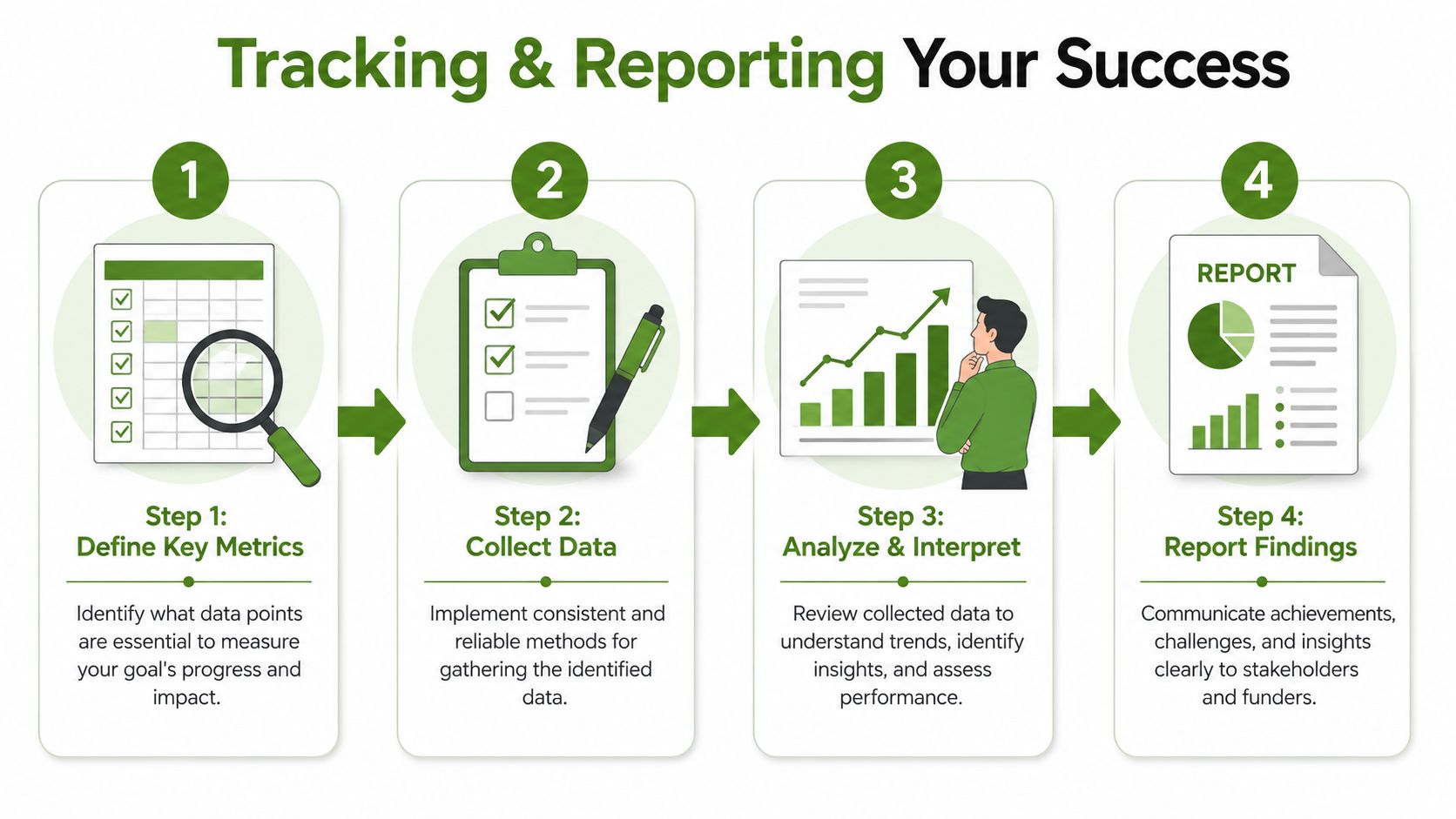
A measurable goal is only credible if your team can track it without chaos.
Many nonprofits frequently backslide. They write a decent objective in the proposal, then collect data inconsistently, wait too long to review it, and send funders a report filled with activity counts because the outcome data isn't ready. That's avoidable if you build a simple reporting rhythm from the start.
Build a tracking system your staff will actually use
You do not need a complicated evaluation department to track grant goals well. You need consistency.
A workable setup often includes:
- One owner per metric: Someone is responsible for each indicator.
- One collection method: Staff use the same form, rubric, or spreadsheet every time.
- One review cadence: Check progress on a recurring schedule, not only at report deadlines.
- One storage location: Keep evidence where it can be retrieved for audits or renewals.
For many small teams, a spreadsheet is enough if it's maintained well. If you need a starting point, a dedicated grant tracking spreadsheet template can help centralize deadlines, metrics, and reporting notes.
Report progress like a steward, not a marketer
Funders don't need spin. They need evidence, interpretation, and candor.
A useful mini impact report has four parts:
- The goal you committed to
- The indicator you tracked
- What the data currently shows
- What you changed or learned
That last point matters. If progress is slower than expected, don't hide it behind general language. Explain what the team observed and what adjustment you're making. Honest interpretation builds more trust than glossy overstatement.
Strong reporting says, “Here is the change we measured, here is how we measured it, and here is what we're doing next.”
Know when to report skill growth instead of only headline outcomes
Special education professionals regularly warn against writing goals around broad outcomes or age-level expectations alone. In this discussion on data-driven goal writing, the advice is clear: don't write goals around outcomes when the underlying skill deficit is what needs intervention.
That lesson carries into nonprofit reporting more broadly.
If your literacy program only reports whether students reached a final reading benchmark, you may miss the most persuasive evidence of progress. If your workforce program only reports placement outcomes, you may overlook measurable gains in interview performance or application readiness that show the program is working before the lagging outcome fully appears.
When your report includes both, funders can see the deeper story:
- Outcome data shows whether the larger change occurred.
- Skill data shows whether the program is addressing the mechanism that drives that change.
That combination often makes renewals easier because it proves your team understands causality, not just compliance.
The nonprofits that retain funding year after year usually aren't the ones with the prettiest narrative. They're the ones that can show a clean chain from goal to data to learning to action.
Fundsprout helps nonprofits turn messy grant work into a tighter system. Teams use Fundsprout to find aligned funding opportunities, structure proposal requirements, draft stronger narratives, track deadlines, and maintain the audit trail funders expect from application through renewal. If your organization is tired of rebuilding the same grant process every cycle, it's worth a look.
Try 14 days free
Get started with Fundsprout so you can focus on what really matters.