How to Write a Program Evaluation Report: A Nonprofit Guide
Learn how to write a program evaluation report that secures funding. Our guide for nonprofits covers planning, analysis, drafting, and grant compliance.

Abdifatah Ali
Co-Founder
You ran the program. Staff delivered the workshops, participants showed up, surveys came back, and now a grant deadline is staring at you from the calendar. On your desk or in your shared drive, you’ve got attendance logs, notes from staff debriefs, a spreadsheet that almost makes sense, and a vague sense that you should be able to turn all of it into a report.
That moment feels familiar in a lot of nonprofits.
The mistake is treating the evaluation report like the last administrative chore before you can move on. A good report does much more than satisfy a funder. It gives your board a clearer view of what to keep, what to fix, and what to stop. It gives your development team language for proposals and donor updates. It gives your program staff a record of what they learned while the details are still fresh.
If you’re learning how to write a program evaluation report, start with that mindset. You are not producing paperwork. You are building an asset your organization can reuse for fundraising, planning, and storytelling.
Your Program Is Done Now What
The first draft usually starts in the wrong place. New managers often open a blank document and try to write the story from memory. That leads to vague claims, missing evidence, and a report that sounds polished but doesn’t help anyone make decisions.
Start somewhere more concrete. Gather the materials that already exist.
- Program records: attendance sheets, sign-in forms, service logs, referral data, and staff notes
- Participant feedback: surveys, testimonials, open-ended comments, and emails
- Planning documents: proposal narrative, logic model, work plan, and stated outcomes
- Internal reflections: what staff saw, what changed during delivery, and what surprised the team
Those materials tell you what happened. Your job is to turn them into an honest interpretation of what the program achieved, where it struggled, and what should happen next.
Practical rule: If a sentence in your report can’t be supported by something your team documented, rewrite it more carefully.
That shift matters because nonprofits often write evaluation reports for one audience while ignoring everyone else who’ll read them later. A funder may want evidence of performance. Your executive director may want to know whether the model is worth expanding. Your development team may need one sharp paragraph they can lift into a proposal next month.
A report that only checks boxes gets submitted and forgotten. A report built for reuse becomes part of your organization’s operating system.
The strongest reports do three things at once:
- Prove credibility by showing how you gathered and interpreted evidence
- Support decisions by naming what worked and what needs adjustment
- Create language you can reuse in grant applications, annual reports, board materials, and donor conversations
When you see the report that way, the work changes. You stop writing to defend the program. You start writing to help the organization learn from it.
Plan Your Evaluation Before You Write a Word
Most weak reports were doomed before anyone typed the first sentence. The problem isn’t usually bad writing. The problem is bad evaluation design.
If your team didn’t decide what it wanted to learn before collecting data, you’ll end up sorting through information that doesn’t answer the questions your board or funder cares about. The CDC evaluation reporting guidance makes this point clearly: evaluation design must precede evidence gathering to ensure feasibility and prevent resource waste, and organizations that fail to define evaluation questions aligned to their logic model report significantly higher rates of unusable or misaligned findings.
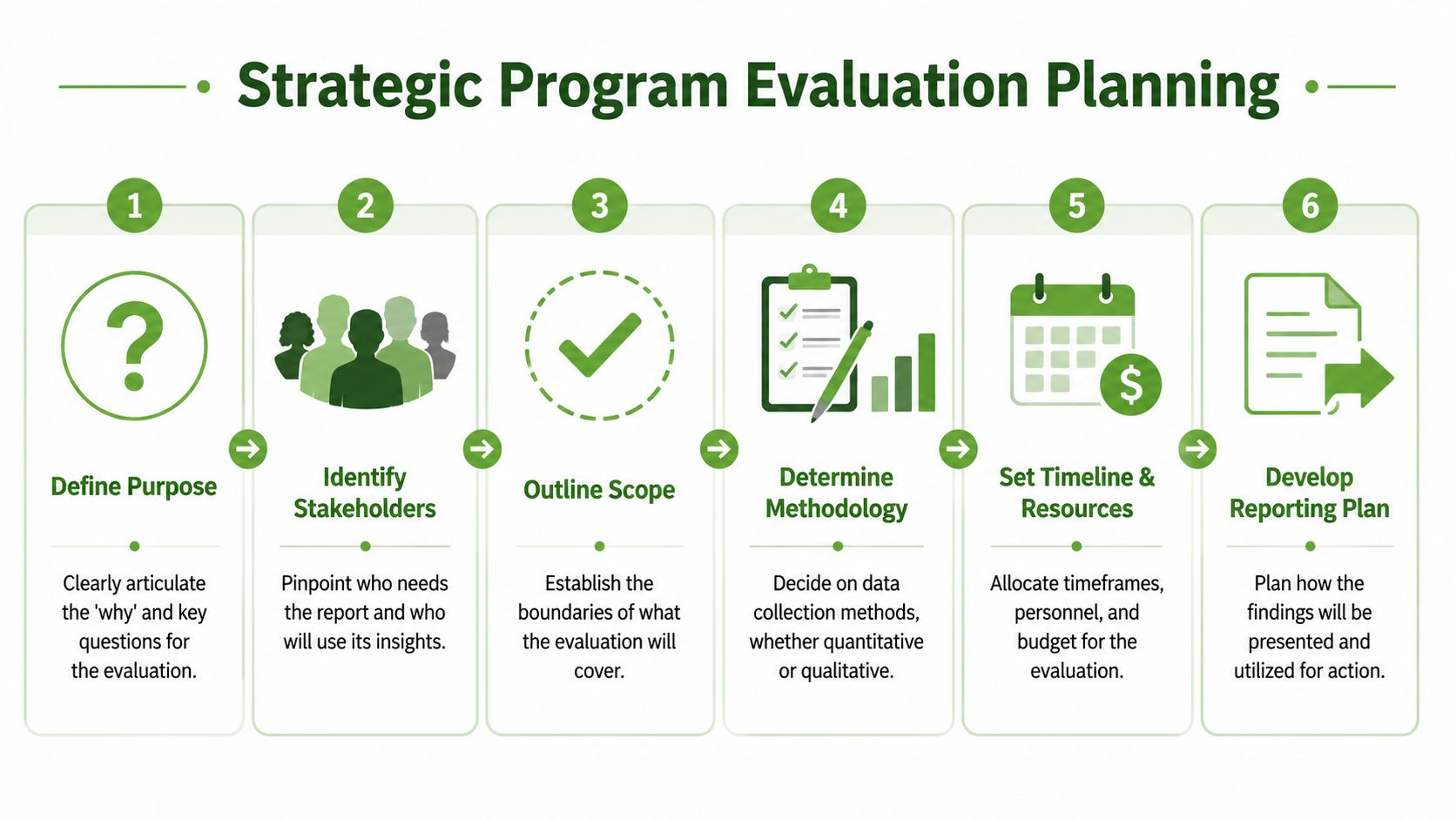
Start with purpose, not format
Before you think about charts, templates, or report length, answer a harder question: Why are we evaluating this program?
The answer changes the report.
If your primary audience is a foundation officer, the report needs clear alignment between goals, methods, and findings. If your primary audience is your board, they may care more about whether the program should continue, scale, or change. If your audience is internal staff, they need practical lessons that improve delivery.
Write down the purpose in one sentence. Then list the decisions the report should inform.
For example, your report might need to help the organization decide:
- Whether to renew the program in its current form
- How to improve implementation for the next cycle
- What evidence to use in future grant proposals
- Which outcomes are realistic to promise going forward
That exercise prevents a common problem. Teams often collect “interesting” data that doesn’t connect to a real decision.
Build your questions from the logic model
A report gets stronger when evaluation questions grow out of the program’s actual design. If your logic model shows inputs, activities, outputs, and intended outcomes, your evaluation questions should follow that same chain.
A simple structure works well:
- Implementation question: Did we deliver the program as intended?
- Participation question: Who did we reach, and who didn’t engage?
- Outcome question: What changed for participants?
- Improvement question: What barriers or adjustments matter for the next round?
If your organization needs help tightening that foundation, a logic model for program evaluation can help staff connect activities to outcomes before they start reporting.
A report is easier to write when the questions were settled before the program ended.
Scope protects small teams
Small and mid-sized nonprofits get into trouble when they try to evaluate everything. You don’t need to answer every possible question. You need to answer the most useful ones with evidence you can realistically collect and interpret.
Set boundaries early:
| Planning area | What to decide |
|---|---|
| Purpose | Why this report exists and what decision it should support |
| Audience | Who will read it first and what they need from it |
| Scope | Which outcomes, time period, and participant groups are included |
| Methods | What evidence you’ll collect and how |
| Capacity | Who will gather data, analyze it, and draft the report |
| Use | How findings will be shared and applied |
Trade-offs are real. A narrower report with credible evidence is better than an ambitious one built on thin data. If your team has limited staff time, choose fewer questions and answer them well.
Gathering and Analyzing Credible Evidence
Two weeks before a board meeting, many nonprofit managers realize they have attendance logs in one file, survey results in another, staff notes in email, and no clear picture of what belongs in the report. Credible evidence fixes that problem. It gives you something stronger than a stack of documents. It gives you findings you can stand behind with funders, staff, and the board.

Combine numbers with explanation
Small and mid-sized nonprofits rarely need complex analysis. They need evidence that is believable, relevant, and practical to collect.
Use quantitative evidence to show scale and direction. Use qualitative evidence to explain what those patterns mean in real life. A completion rate may show that participation dropped in month two. Interview notes or staff observations may show that transportation, scheduling, or childcare made attendance harder than expected.
That combination turns an evaluation report into something more useful than compliance paperwork. It becomes a record of what worked, what got in the way, and what should change before the next cycle or the next grant proposal.
A workable mix often includes:
- Attendance and enrollment records to show reach and retention
- Pre/post surveys or short outcome surveys to show reported change
- Case notes, interviews, or open-ended responses to explain participant experience
- Staff debriefs to document delivery challenges and implementation choices
Strength comes from consistent collection
Credibility usually rises or falls long before anyone starts writing. It comes from how the team collects, stores, and cleans information.
Start with definitions. Decide what counts as enrolled, active, completed, referred, or successful before staff enter data. If one staff member counts a participant as completed after one workshop and another requires all sessions, your report will carry that inconsistency all the way to the final draft.
Then test your tools. I have seen short surveys fail because one question meant two different things to participants and staff. A quick pilot with a handful of users can catch confusing wording, missing response options, and data you will not be able to interpret later.
For day-to-day practice, keep the discipline simple:
- Pilot surveys and forms with a small group before full use
- Use the same definitions across staff and systems
- Record where each figure or quote came from
- Review for missing entries, duplicates, and date errors
- Break out results by group when that matters to program decisions
If your team manages digital information across several platforms, this guide to preventing unreliable analytics is useful because many reporting problems start with inconsistent collection, naming, and tracking rules.
Analyze what matters to decisions
Analysis should answer a management question. Should this program keep the same model, adjust delivery, target a different group, or make a stronger case for renewal funding?
For quantitative information, begin with a few comparisons tied to your evaluation questions. Look at participation over time, changes from pre to post when you have them, and differences across participant groups if those differences affect access or outcomes. Keep the math readable. For many reports, clear counts, percentages, and simple comparisons are enough.
For qualitative information, read everything before pulling quotes. Group comments into themes, then note which themes appeared often, which came from only a few participants, and which ones point to a fix the team can make. The goal is not to collect the most positive testimonial. The goal is to explain patterns accurately.
This is also the point where many teams discover they are missing context. A program can appear underused or less effective when the underlying issue is a poor fit between services and current community demand. A practical needs assessment guide for nonprofits can help staff reconnect findings to the original need the program was meant to address.
Report limits clearly
Every evaluation has limits. Small samples, missing follow-up data, uneven staff documentation, and participant self-report all affect how strongly you can interpret findings. Say that plainly.
That honesty does not weaken the report. It improves it. Funders and board members are more likely to trust a nonprofit that shows care with evidence, admits where the data is thin, and still makes reasonable recommendations based on what the team learned.
Good analysis gives your organization material you can use again. The same clear evidence base can support a board discussion, a grant renewal, a case for program adjustments, and stronger stories about community impact.
Drafting Each Section of Your Report
The draft stage is where many nonprofit teams lose momentum.
You finally have the data sorted, your notes are spread across three documents, and someone asks for "a quick summary for the board by Friday." Without a clear structure, the report turns into a pile of findings, caveats, and half-finished recommendations. With one, it becomes a document you can use more than once. A solid evaluation report should help a program manager improve delivery, help an executive director explain impact, and give a grant writer language they can reuse in proposals and renewals.
Good reports are built section by section. Each part has a job. If a section does not help a reader understand what the program did, what changed, what the evidence supports, or what should happen next, tighten it or cut it.
Write in the order that makes drafting easier
Start with the sections that rely most on facts already in front of you. Draft the methodology and findings first. Then write the recommendations and conclusion. Save the executive summary for the end.
That sequence helps in two ways. It keeps the summary honest, because you already know what the report states. It also keeps recommendations tied to evidence instead of personal opinions, staff frustrations, or funder wish lists that never showed up in the data.
For small to mid-sized nonprofits, that discipline matters. Staff often need one report to serve several audiences at once. If the core draft is clear, you can adapt it for a board packet, grant attachment, donor update, or strategy discussion without rewriting the whole thing.
Give each section one clear job
A useful report structure can be simple.
| Report Section | What it needs to do |
|---|---|
| Executive Summary | Give leaders the short version of the program, the strongest findings, and the main decisions or actions |
| Introduction | Explain the program, the need it addresses, and the purpose of the evaluation |
| Methodology | Show how information was gathered, who was included, and what limits affect interpretation |
| Findings and Discussion | Present the strongest evidence and explain what it means in practice |
| Recommendations | Turn findings into specific next steps that staff or leadership can act on |
| Conclusion | State the overall judgment about program performance and the main takeaway |
| Limitations | Clarify where evidence is thin, incomplete, or not generalizable |
| Lessons Learned | Capture what the team learned about program delivery and measurement |
You do not need a long report to cover these well. You need a report where each section earns its space.
Draft the executive summary last
This section gets read first and judged fast.
Keep it short. Name the program, who it served, the period reviewed, the strongest findings, the main recommendation, and the overall conclusion. A busy board member or funder should be able to read this section and understand the report without flipping back and forth.
The common mistake is stuffing the summary with every interesting detail. Resist that. The summary is not a miniature copy of the report. It is a decision tool.
In practice, I look for one sentence that answers each of these questions: What did the program set out to do. What evidence shows progress or gaps. What should the organization do next.
Use the introduction to set context, not to market
The introduction should explain why the program exists and why this evaluation was conducted. Describe the community need, the program model, the population served, and the timeframe reviewed.
Keep the language grounded in operations. Avoid broad mission language that could apply to any program in the organization. Readers need enough context to interpret the findings, not a general case for why your nonprofit matters.
This is also a good place to remind readers what the evaluation was designed to assess. That keeps expectations realistic. If the report examines short-term outcomes and service delivery, say that plainly. Do not let readers assume it proves long-term community change if the evaluation was never built to show that.
Make the methodology plain and readable
A strong methodology section is straightforward. It explains what information you collected, where it came from, who participated, over what period, and how you analyzed it.
Plain writing helps here. Technical language often creates distance instead of trust. A program manager, board member, or funder should be able to follow your process without a glossary.
Include enough detail to answer practical questions such as:
- What data sources were used
- How participants or records were selected
- Whether both quantitative and qualitative information were included
- What time period the evaluation covers
- What important gaps or constraints affected the data
Short reports often fold limitations into the methodology section. That works well if the report is concise and the limits are easy to understand.
Organize findings around the questions that matter
For smaller nonprofits, findings and discussion often work best as one combined section. Present the finding, show the evidence behind it, and explain what it means for the program.
Organize this section around the evaluation questions or major themes, not around every instrument you used. Readers rarely need a subsection for surveys, another for interviews, and another for attendance logs if all three are answering the same question. Grouping evidence by question makes the report easier to follow and more useful for decision-making.
A simple pattern works well:
- State the finding clearly.
- Cite the evidence that supports it.
- Explain the practical meaning.
- Note any caution that affects interpretation.
That fourth step matters. A finding can be promising and still need context. If participant satisfaction was high but follow-up data was limited, say so. If attendance improved after a staffing change, note that timing. Specific context makes the report more credible and more useful.
Write recommendations that someone can assign
Recommendations should lead to action, not nodding.
A weak recommendation says, "improve outreach." A usable recommendation says who should do what, where, and with what focus. For example: revise referral materials, simplify enrollment instructions, and test outreach earlier in the program cycle for first-time participants.
That level of detail is especially useful in smaller organizations where the same report may guide next year's work plan and support a funding request. If a recommendation points to a staffing gap, a training need, or a data system problem, say that directly. Those are often the details a development director needs when turning evaluation findings into a grant narrative.
Keep the list focused. A report with twelve recommendations usually has three that matter and nine that dilute them.
Separate conclusions, limitations, and lessons learned
These sections are related, but they do different work.
The conclusion gives your overall assessment of the program's performance against its goals and context. It should answer the big question the reader carried through the report. Did the program produce the intended results, partly produce them, or show mixed results that require changes?
Limitations explain what the report cannot claim. Name issues such as incomplete baseline data, low response rates, inconsistent staff documentation, or a participant group that was not well represented. Clear limits increase trust because they show care with evidence.
Lessons learned are more operational. They capture what the team now understands about implementation, participant engagement, data collection, timing, staffing, or program design. These are often gold for internal planning, even when they are less useful in a public-facing summary.
That distinction is worth protecting. Conclusions judge performance. Limitations set boundaries. Lessons learned improve the next round of work.
Keep the tone steady and usable
Strong evaluation writing is calm, specific, and direct. It does not oversell. It does not hide behind vague language either.
A report written this way is easier to reuse. Development staff can pull sentences for proposals. Leadership can lift findings into a strategy memo. Program staff can turn recommendations into an action plan. That is the standard to aim for, especially when time is tight and every major document needs to do more than one job.
Write for that reality.
Presenting Findings That Inspire Action
A report can be accurate and still fail.
It fails when readers can’t tell what matters, what changed, or what they’re supposed to do with the information. That’s why presentation matters so much. The Better Evaluation framework recommends a message-based approach where evaluators identify the main messages before writing and structure the report around a small set of key findings. That approach matters because, as noted in the same discussion, “numbers don't speak for themselves” and need context to mean anything in practice, as described in Better Evaluation’s guidance on writing for utilisation.

Lead with the message, not the spreadsheet
Most readers do not want every table first. They want the answer first.
Instead of dumping survey results into a long appendix-style section, identify the handful of findings that carry the most weight. Then organize the story around those.
That usually means asking three questions:
- What is the strongest finding in the report
- What does that finding mean for the program
- What action should the reader take because of it
When teams skip that step, the report becomes a document people skim politely and then ignore.
Context turns data into meaning
A number without context leaves too much work to the reader. They have to decide whether the result signals strong performance, mixed progress, or a serious challenge.
Context can come from several places:
- Program goals: Did the result align with what the program was designed to achieve?
- Implementation realities: Were there staffing, timing, or access barriers that shaped the outcome?
- Group comparisons: Did different participants experience the program differently?
- Qualitative evidence: Do participant comments or staff observations explain the pattern?
A simple bar chart is often more useful than a dense table. A short pull quote from a participant can help a board member understand the human side of the result. A concise caption under a figure can keep a funder from misreading the trend.
Here’s a useful primer for teams that need help thinking about presentation and dissemination in a more engaging format.
Match the format to the audience
A formal written report is still important, but it shouldn’t be the only output. Evaluation guidance increasingly recognizes multiple valid dissemination formats, including dashboards, slide decks, one-page summaries, and formal reports.
That matters for nonprofits because the same findings need different packaging.
- Board members often need a short summary with implications for strategy
- Program staff need operational detail and lessons learned
- Funders need credible methods, findings, and accountability
- Donors and community partners respond to plain language and mission-connected stories
Use one core report as the source document, then adapt it into shorter formats for different readers.
What doesn’t work is trying to make one version satisfy everyone equally. That usually produces a report that’s too long for board members, too abstract for staff, and too dry for external communications.
Leverage Your Report for Funding and Growth
Once the report is finished, don’t let it disappear into a grant folder. The work can now start paying dividends.
A strong evaluation report becomes a reusable source document for funding, communications, and planning. If you’ve written it well, you already have language your team can adapt rather than reinvent.
Turn one report into many useful assets
Use the report as a content bank.
- Grant proposals: Pull key findings, concise program descriptions, and evidence-backed lessons into renewal applications and new proposals.
- Board materials: Turn conclusions and recommendations into a discussion memo for strategic planning.
- Annual reports: Adapt your strongest findings and participant stories into a public-facing impact summary. If your team needs a structure, this nonprofit annual report format guide can help translate evaluation content into donor-friendly reporting.
- Donor communication: Use one or two clearly supported findings in stewardship emails, campaign materials, or meeting leave-behinds.
- Program improvement plans: Convert recommendations into assigned tasks with owners and timelines.
Keep the report alive internally
The most valuable thing you can do after submission is revisit the report with staff. Ask what the organization learned, what it will change, and what evidence it wants to collect differently next time.
That conversation builds an evidence-based culture. It also makes the next report easier because staff stop seeing evaluation as something imposed from outside. They start seeing it as part of better program management.
A few practical habits help:
- Archive the source files so future staff can trace the evidence.
- Save reusable language from the executive summary and findings.
- Track which recommendations were implemented and which were delayed.
- Review the report before writing the next proposal so your organization stays consistent.
A report should not be a snapshot you file away. It should be a working document that helps your nonprofit raise money, improve programs, and speak more clearly about impact.
Fundsprout helps nonprofits turn scattered grant requirements, program documents, and reporting data into structured workflows for proposals and compliance. If your team wants a more organized way to connect program design, evidence, and reporting, explore Fundsprout.
Try 14 days free
Get started with Fundsprout so you can focus on what really matters.