How to Start a Charity A Founder's Guide to Real Impact
Learn how to start a charity with this practical guide. We cover mission development, legal requirements, fundraising, and launching for lasting impact.

Abdifatah Ali
Co-Founder
Starting a charity isn't just about filing paperwork; it's about turning a deep-seated passion into a real, functioning organization that makes a difference. This journey involves a few critical first steps: defining your mission, proving the need for your work, building a solid board, getting incorporated and securing your 501(c)(3) tax-exempt status, and figuring out how you’ll get those first crucial dollars in the door.
Defining Your Mission Beyond a Vague Idea
Every great nonprofit I've ever worked with started with an undeniable sense of purpose. This first phase is all about taking a big, heartfelt idea—like "helping homeless animals" or "supporting local arts"—and honing it into a razor-sharp mission that will guide every decision you make for years to come. Getting this right is what separates organizations that create lasting change from those that fizzle out.
It all boils down to one fundamental question: What specific problem are you uniquely positioned to solve?
From Passion to Precision: A Needs Assessment
Before you even think about a name or a logo, you have to prove that the need you feel so strongly is real and not just your perception. A needs assessment is how you do that. Don't worry, this doesn't have to be some massive academic study. Think of it as practical, on-the-ground research.
- Talk to People: The best insights come from the people you want to help. Sit down with them. Ask about their biggest challenges, what they've already tried, and what's still missing.
- Connect with Peers: Find other nonprofit leaders in your area and take them out for coffee. What gaps do they see? Where are services stretched thin? This is invaluable for avoiding duplicated efforts and might even spark future collaborations.
- Dig Up the Data: Look for local government reports, studies from community foundations, or census data that puts numbers to the problem. If you're starting a youth literacy program, find the actual third-grade reading proficiency rates for your city.
This kind of research is your proof. It shows future funders that you're building a solution for a documented need, not just a hunch. For a great starting point, you can explore some effective community needs assessment tools.
Crafting Your Guiding Statements
Once you've done your homework, you're ready to put your purpose into words. This usually takes the form of two key statements. Your vision statement is your big, audacious dream—the ideal future you're working toward. Think "a world where every child has access to quality education."
Your mission statement, on the other hand, is all about the here and now. It clearly and simply states what your organization does, who it serves, and how you do it. Keep it concise, memorable, and free of jargon. A great mission for a food pantry might sound like: "To alleviate hunger in our community by providing nutritious food, education, and resources to our neighbors in need."
A compelling mission statement does more than just describe your work; it becomes the emotional and strategic anchor for every decision you make, from program design to donor appeals. It's the core message that will resonate with supporters and keep your team aligned.
Choosing a Name and Setting First Goals
Your organization's name should be professional, easy to remember, and hint at your mission. Do a quick search of your state's business registry and Google to make sure the name you want isn't already taken. Something direct like "The Springfield Literacy Project" is far more compelling and fundable than a vague name like "Brighter Futures Initiative."
Finally, set some realistic goals for your first year. Instead of a massive goal like "end homelessness," aim for something you can actually achieve, like "provide 50 individuals with stable housing resources and job placement support." Hitting these specific, measurable targets is how you build credibility and momentum.
To help structure your thinking, here's a look at the core components you should have clearly defined before you even think about filing legal paperwork.
Core Components of Your Nonprofit Launch Plan
Nailing down these fundamentals gives you a solid foundation and a clear story to tell potential supporters.
The good news is you're launching into an incredibly generous philanthropic environment. With a record $592.5 billion in U.S. charitable giving recently reported—and individuals contributing a massive 66% of that total—the opportunity is huge. A well-defined mission has an incredible power to attract support from a public that is eager to fund work that truly matters.
Getting Legal: How to Make Your Charity Official
Once your mission is set in stone, it's time to tackle the legal side of things. This is where your idea transforms from a passionate vision into a real, recognized organization. It can feel like a mountain of paperwork and legalese, but think of it as building the sturdy foundation your charity will stand on for years to come. Getting this part right is what allows you to accept tax-deductible donations and operate with the credibility your cause deserves.
The first move is to incorporate your nonprofit in your state. You'll do this by filing a document, usually called the "Articles of Incorporation," with the Secretary of State's office. This step officially creates your charity as a legal entity, completely separate from you and the other founders.
It's like giving your charity its own birth certificate. This document locks in its name, its purpose, and who's on the initial board of directors. Every state has slightly different rules and fees, so your first stop should be your state's official website to get the specifics.
This is the point where all your initial planning—assessing the need, defining your mission, and choosing a name—gets formalized.
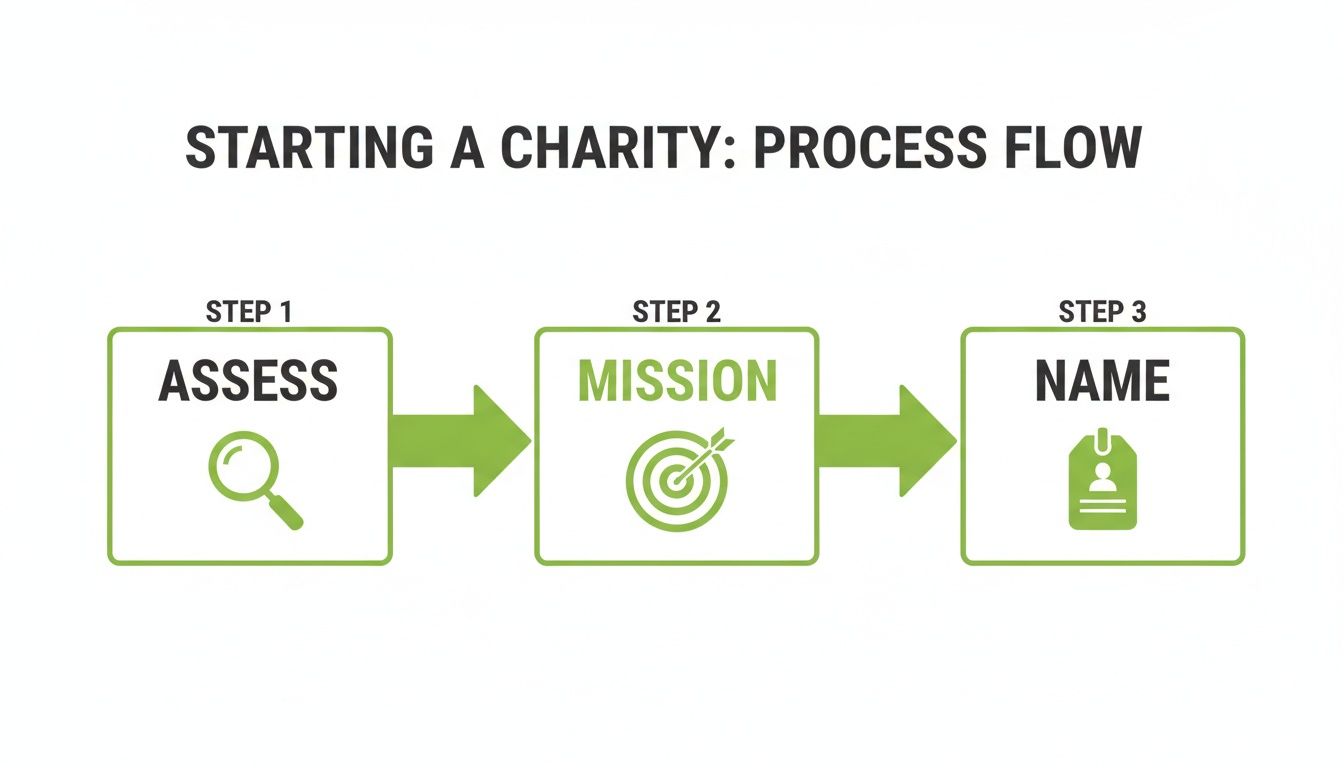
As you can see, the legal stuff doesn't happen in a vacuum. It’s the natural next step after you've done the critical strategic work upfront.
Securing Your 501(c)(3) Tax-Exempt Status
After you're incorporated at the state level, the next big hurdle is getting tax-exempt status from the IRS. For almost every charity, this means becoming a 501(c)(3) organization. This is the golden ticket—the federal designation that makes contributions to your cause tax-deductible for donors. Frankly, it's a must-have for serious fundraising.
To get it, you have to file Form 1023 with the IRS. Be prepared; this is a beast of an application. It digs into every corner of your organization, from your mission and programs to your board governance and detailed financial projections. The IRS uses this to confirm you're genuinely operating for the public good and not for private gain.
The IRS reviewers are trained to spot inconsistencies. They look closely at Form 1023 to ensure an organization is set up and run exclusively for exempt purposes. Vague mission statements or budgets that don't add up are common red flags that will get your application sidelined for months, or even rejected.
Early on, you'll need to decide how to classify your organization. The two main options are:
- Public Charity: This is the most common path. A public charity gets its funding from a wide base—the general public, government grants, or other charities.
- Private Foundation: This is usually funded and controlled by a single family, individual, or corporation, often from a large endowment or investment income.
For the vast majority of new founders, the public charity route is the goal. It comes with more favorable tax treatment and fewer operational restrictions.
Avoiding Common Application Pitfalls
That Form 1023 application is notoriously tricky, and simple mistakes can create massive delays. A classic error is writing a purpose statement that's too broad or fluffy. Just saying you want to "do good in the community" won't cut it. You have to be specific about your charitable, educational, or scientific activities.
Another place people stumble is the financial data. The IRS requires a realistic three-year budget, projecting your income and expenses. If you project $500,000 in grant funding but have no concrete fundraising plan to back it up, they're going to have questions. Your numbers need to tell a believable story that matches your operational plans. Our guide on understanding nonprofit organizational structure can help you think through how these pieces fit together.
Your best bet is to submit a flawless, meticulously prepared application. Triple-check every section, make sure your bylaws are attached, and read your narrative to ensure it clearly and convincingly meets the legal test for a 501(c)(3). The wait for IRS approval can feel long—often several months—but a well-crafted application is your best investment in a smooth start.
Assembling Your Board and Governance Framework
Once the legal paperwork is filed, your attention needs to turn to the people who will guide your charity’s future. An engaged, skilled board of directors isn't just a legal checkbox—it’s the strategic brain and ethical compass of your entire operation. This group provides critical oversight, helps bring in funding, and acts as your champion in the community. Honestly, who you pick for your board is one of the most important decisions you'll make.

Think of your founding board as your ultimate startup team. You're not just looking for people who are passionate about the cause; you need a diverse group with specific, practical skills. A great board is where passion meets profession.
Recruiting Your Founding Board Members
Keep your initial board small and focused. A dedicated group of three to seven members is usually perfect for a new nonprofit. Your goal here is to build a "working board," meaning everyone is ready to roll up their sleeves and get things done. Avoid the temptation to just recruit friends; instead, strategically seek out expertise that fills the gaps in your own skill set.
Look for people who can bring these key skills to the table:
- Financial Acumen: You absolutely need someone who is comfortable with numbers. This could be an accountant, a banker, or a small business owner who can help you build your first budget and keep your finances transparent.
- Legal Guidance: A lawyer willing to provide pro-bono or low-cost advice is worth their weight in gold. They can guide you on compliance, contracts, and managing risk.
- Community Connection: Find a respected community leader or an advocate who truly understands the people you want to serve. Their credibility can open doors and build trust faster than anything else.
- Fundraising and Marketing Skills: Look for someone with a background in sales, marketing, or development. They'll be key in shaping your message and making those crucial connections with early donors.
When you approach potential board members, be upfront about what you expect. Clearly explain the time commitment, their fundraising responsibilities, and the specific skills you hope they'll contribute. Being transparent right from the start builds a solid foundation of trust.
Crafting Your Bylaws and Governance Policies
Your bylaws are the official rulebook for your charity. This isn't just paperwork; it’s a legal document that dictates how your board will function, how decisions get made, and how the organization will operate fairly and consistently. You can find templates online, but I always recommend having an attorney review your final draft.
Your bylaws need to clearly define a few key areas:
- Board Roles and Responsibilities: This section should spell out the duties of officers like the President, Treasurer, and Secretary.
- Terms and Elections: How long will a board member serve (e.g., a three-year term)? What's the process for electing new members and officers? Get this in writing.
- Meeting Procedures: Be specific about how often the board will meet (say, quarterly) and what constitutes a quorum—the minimum number of members needed to vote.
- Conflict of Interest Policy: This is a huge one. This policy dictates how your board will handle any situation where a member's personal interests might clash with the charity’s best interests.
A solid conflict of interest policy is non-negotiable for maintaining public trust and staying compliant with the IRS. For a closer look, check out our guide on creating a conflict of interest policy sample for a non-profit. This framework isn't just about avoiding trouble; it’s about building an ethical culture from the ground up.
Strong governance is your charity's immune system. It protects your mission, ensures financial integrity, and gives donors the confidence that their contributions are being managed responsibly. Don't treat it as an afterthought.
It helps to understand what motivates donors. For instance, Giving USA reports consistently show that religion is the largest recipient of charitable dollars, capturing 23% or $146.54 billion. This proves how missions built on deep community trust and shared values can create lasting support. Your new charity can learn from this by focusing on building that same level of trust and connection.
By carefully assembling a skilled board and setting up clear, ethical governance from day one, you create the stable leadership your charity needs to not just survive, but thrive.
Building Your Initial Fundraising Engine
You’ve navigated the legal maze and assembled a passionate board. Now comes the moment of truth: fueling your mission with actual funding. Let’s be clear—your initial fundraising plan isn't about landing a million-dollar check on day one. It's about methodically building a sustainable engine that can power your first year, prove your concept, and show the world you mean business.
This is where your mission transforms from a beautiful idea into a compelling case for support. You need a clear, emotional, and data-backed answer to the one question every single potential supporter has: "Why should I give to you?"
Diversifying Your First Funding Streams
Putting all your eggs in one basket is a recipe for disaster. A healthy, resilient fundraising engine draws from multiple streams, creating a crucial safety net as you get started. Think of your first year's funding like a balanced portfolio.
Your initial strategy should really zero in on three key areas:
- Individual Donors: These are the people who believe in you from the very beginning—friends, family, board members, and local leaders who are personally invested in seeing you succeed.
- Foundation Grants: These are formal awards from charitable foundations whose missions align with yours. Landing even a small grant in your first year isn't just about the money; it’s a massive credibility boost.
- Corporate Support: This could be a sponsorship for your launch event, an in-kind donation of office furniture, or a small gift from a local business that wants to make a difference in its own backyard.
This multi-pronged approach means that a "no" from a grant application won't derail your entire launch. It also proves to larger funders down the road that you have genuine, broad-based community support.
Launching a Founding Donor Campaign
Your very first fundraising effort should be a founding donor campaign. This is a focused, time-bound push to secure that first, absolutely critical group of supporters. These people aren't just donors; they are your partners, your earliest champions who get to be part of your story right from the start.
Frame the "ask" around tangible, first-year goals. Instead of just asking for money, show them exactly what their contribution will accomplish. For instance, a new animal shelter might say, "Become a Founder and Help Us Fund Our First 50 Rescues." This makes the impact concrete, urgent, and easy to visualize.
To ensure you can track every dollar with integrity, getting a handle on a double-entry bookkeeping system is essential from day one. This builds the trust you need to turn initial curiosity into lasting support.
A sobering reality for new charities is that donor retention for first-time givers is just 19%. Your launch strategy must be obsessed with immediate, personal engagement to turn that first gift into a second, and a third.
The data backs this up. With individuals powering an incredible 66% of all charitable giving in the U.S., building authentic relationships with your first supporters is the single most important investment you can make.
Building Your Case for Support
Your "case for support" is the core narrative you'll use in every grant proposal, donor email, and coffee meeting. It's your story, backed by cold, hard facts. It needs to be clear, concise, and hit people right in the heart.
A powerful case for support always answers these four questions:
- The Problem: What urgent community need have you identified? Use the data from your needs assessment to make it real.
- Your Solution: How will your specific programs tackle this problem in a unique or more effective way?
- The Impact: What measurable change will a donor's contribution make possible? Be specific (e.g., "$50 provides a week of nutritious meals for a family").
- Your Team: Why is your organization the right one to solve this? Highlight the unique expertise and passion of your board and staff.
This narrative is the bedrock of all your fundraising materials, from a simple one-page handout for a local business to a full-blown grant proposal. By starting with a diverse strategy and a powerful story, you're not just launching a charity—you're building an engine for long-term financial health and real-world impact.
Launching Operations with Smart Technology
The planning phase is exciting, but this is where the real work begins. With your legal paperwork filed and initial fundraising efforts in motion, it’s time to build the operational engine that will actually deliver on your mission. This means translating your big ideas into the day-to-day nuts and bolts of running an organization.
For a brand-new charity, the administrative to-do list can feel overwhelming. The secret is to view technology not as an overhead cost but as your first, most valuable team member. The right tools act as a force multiplier, giving a small founding team the reach and efficiency of a much larger organization. By embedding smart systems from day one, you free up your most precious resource—your time—to focus on making an impact, not pushing paper.
Your Operational Launch Checklist
Before you can officially open your doors, there are a few non-negotiable operational steps to check off. Think of these as the foundation of your charity's credibility. Getting them right from the start shows donors, funders, and your community that you’re serious and professional.
Here are the absolute must-dos:
- Open a Dedicated Business Bank Account: This is non-negotiable. Never, ever mix personal and nonprofit funds. You’ll need your Employer Identification Number (EIN) and Articles of Incorporation to open a checking account exclusively for the charity. It's step one for financial accountability.
- Set Up Your Accounting System: You need a clear way to track every dollar coming in and going out. Whether it's a dedicated tool like QuickBooks for Nonprofits or a spreadsheet system managed by an accountant, this is crucial for board reports, grant applications, and staying sane during tax season.
- Establish a Professional Online Presence: Grab a domain name for your organization and put up a simple, clean website. It doesn't need to be fancy, but it must clearly explain your mission, introduce your team, and—most importantly—have a secure and obvious donation button.
- Secure Necessary Insurance: Don’t skip this. Depending on what you do, you'll likely need General Liability Insurance. It’s also wise to get Directors & Officers (D&O) insurance to protect your board members. Chat with an insurance broker who specializes in the nonprofit sector.
Supercharging Your Grant Strategy with AI
For most startups in the nonprofit world, grants are the lifeblood of early-stage funding. But let’s be honest: the grant lifecycle is a notorious time-sink. Finding the right opportunities, writing compelling proposals, and then managing the reporting is a full-time job in itself. This is exactly where specialized technology can give you a massive leg up.
AI-powered platforms are built to take the grunt work out of grants, freeing you up to focus on building relationships with funders.
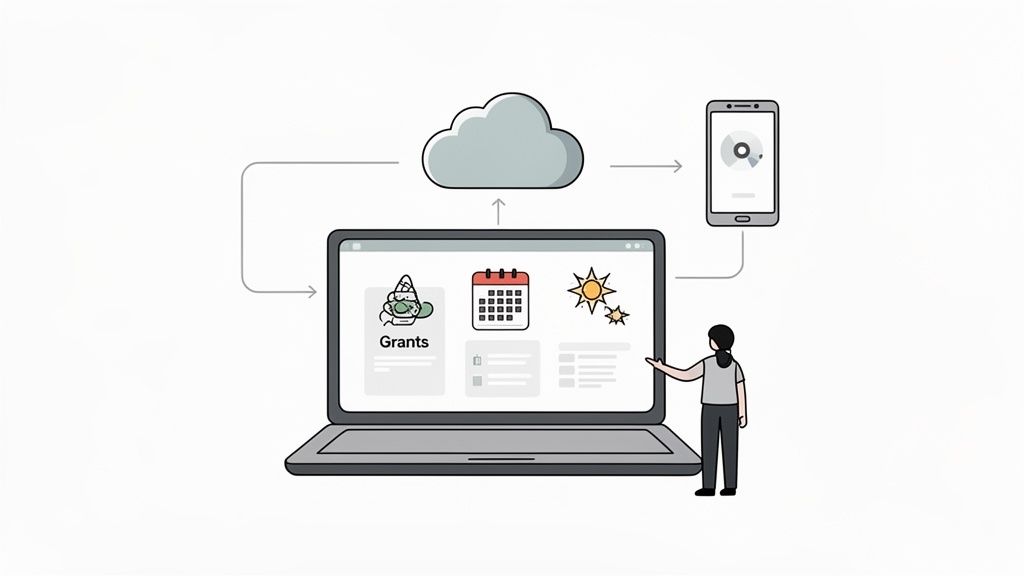
Instead of spending days sifting through databases, tools like this serve up a curated list of potential funders who are actually a good fit for your mission. You get deadlines, eligibility requirements, and contact information all in one place. This flips the grant-seeking process from a reactive scramble into a proactive, organized strategy. You can immediately zero in on foundations that align with your work, which saves an incredible amount of time and points your efforts where they’ll have the biggest payoff.
Adopting smart technology early is the single best way to prevent founder burnout. It automates the administrative drag that pulls so many new leaders away from their core mission, allowing you to stay focused on the work that truly matters.
Modern platforms like Fundsprout take it even further. They can use AI to help you draft sections of your grant proposals, pulling from your own documents to keep the voice consistent. They also build out project management timelines for each application so you never get surprised by a deadline again.
This isn’t about replacing the human touch; it’s about amplifying it. These tools level the playing field, allowing a small, scrappy nonprofit to compete for funding with the sophistication of a long-established institution. By building these efficient, tech-forward workflows from the beginning, you’ll be punching well above your weight class.
Common Questions About Starting a Charity
You've got the passion, the mission is taking shape, and the legal paperwork is piling up. It's completely normal for a flood of practical questions to surface right about now. As you move from the big vision to the day-to-day realities of running a charity, a few common hurdles always seem to pop up.
Let's walk through the questions I hear most often from founders. Getting these sorted out early on will save you from some major headaches down the road.
How Much Money Do You Need to Start a Charity?
There’s no one-size-fits-all answer, but you definitely need a realistic budget for the administrative and legal legwork to get started. Don't let this part surprise you.
You'll have state incorporation filing fees, which vary, plus the IRS application fee for your 501(c)(3) status. A safe starting point for these essential legal costs is somewhere between $1,000 and $3,000. Of course, the much bigger financial challenge is lining up your first year of operating funds—a number you should have clearly mapped out in your business plan.
Can I Pay Myself a Salary When I Start a Nonprofit?
Yes, you absolutely can and often should. The key term the IRS cares about is "reasonable compensation." This isn't about taking a vow of poverty; it's about paying a fair wage for the real work you're doing.
Your salary can't be excessive. It needs to be benchmarked against what similar roles earn at comparable organizations in your area. This decision must be approved by your board of directors (and you'll abstain from that vote, of course). Document everything meticulously to maintain transparency and protect your nonprofit status.
As you grow and bring on a team, knowing how to choose retirement plan options for your nonprofit will also become a critical piece of the puzzle for retaining great people.
Your salary isn't a reward; it's a legitimate operational expense. Documenting the decision process and benchmarking the amount against industry standards protects both you and the organization's tax-exempt status.
How Long Does It Take to Get 501c3 Status?
This is where you'll need to practice some patience. The timeline for getting that official 501(c)(3) determination letter from the IRS can really vary. The biggest factor is which application form you’re eligible to file.
- Form 1023-EZ: If you’re a smaller organization that qualifies for this streamlined version, you could see an approval in as little as 2-4 months.
- Standard Form 1023: For most organizations filing the full, comprehensive form, the wait is typically longer—think 6 to 12 months.
Honestly, the timeline often comes down to the IRS's current workload and the quality of your application. The best way to speed things up is to not give them any reason for delays. Submit a flawless, complete, and well-organized application from the get-go.
Do I Need a Lawyer to Start a Charity?
While the law doesn't technically require you to hire an attorney, I strongly recommend it. Starting a charity means wading through a sea of complex legal documents and regulations at both the state and federal levels. It’s incredibly easy to make a costly misstep.
A lawyer who specializes in nonprofit law is worth their weight in gold. They'll ensure your state incorporation is structured correctly, your bylaws are compliant, and your Form 1023 is filled out perfectly to avoid the common traps that lead to rejections or long delays. For very simple startups, an online legal service might be a more budget-friendly route, but nothing beats the peace of mind you get from an expert.
Ready to stop scrambling for grants and start building a predictable funding pipeline? Fundsprout is your AI-powered grant success platform. We help you find the perfect funding opportunities, draft winning proposals in a fraction of the time, and manage every deadline with ease. Discover how our tools can give your new charity the power of a full development team at https://www.fundsprout.ai.
Try 14 days free
Get started with Fundsprout so you can focus on what really matters.