Your Guide to Securing Grants for Autism in 2026
Master the grant-seeking process. Our guide covers finding and winning grants for autism, from federal funding to writing compelling proposals that get results.

Abdifatah Ali
Co-Founder
Trying to secure grants for autism programs can feel like a daunting, full-time job on its own. If you're running a nonprofit, you're driven by a passion to serve your community—but turning that passion into a fully-funded reality is often the biggest hurdle.
This guide is designed to feel like you're getting advice from a seasoned grant professional, someone who has been in your shoes and understands the unique challenges of funding autism-related services.
A Practical Roadmap to Winning Autism Grants
We’re going to skip the dense jargon and abstract theories. Instead, this is a step-by-step playbook that covers the entire grant lifecycle. The goal is simple: to give you the confidence and practical skills to build a reliable funding pipeline. This is what allows your vital programs to not just survive, but to grow and deepen their impact on individuals and families.
Finding and winning grants is a clear, repeatable process. From getting a lay of the land to hitting ‘submit’ on a polished proposal, every step logically builds on the one before it. This simple three-part journey is the core of what we'll cover.
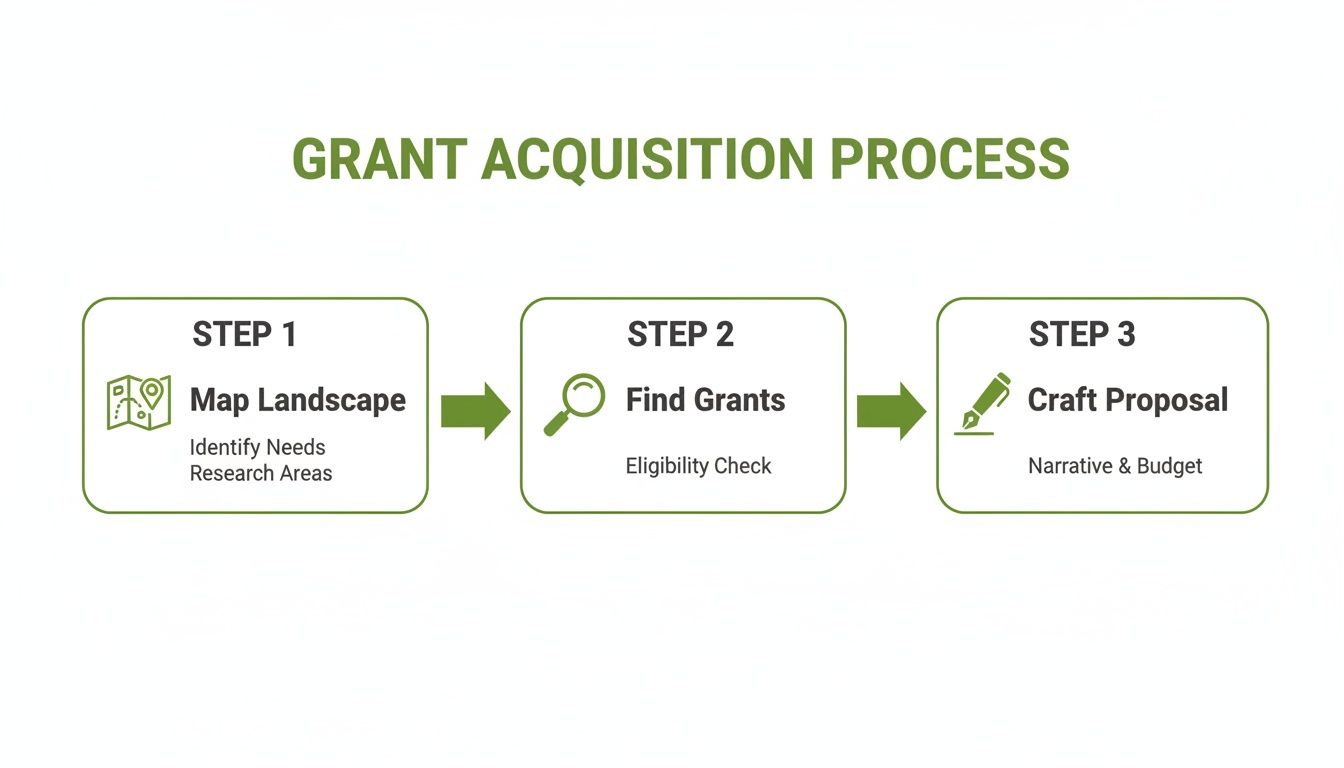
As you can see, success starts long before you ever write a single word of a proposal. The prep work—understanding the funding world and finding the right opportunities—is just as important as the application itself.
The Grant-Seeking Cycle
Think of grant seeking not as a one-and-done task, but as a continuous cycle. It all begins with a crystal-clear understanding of your organization's mission and the specific needs you're trying to meet. That clarity is your north star, guiding every decision from here on out.
Mapping the Funding Landscape: The first step is to figure out who is giving out the money. This means researching federal agencies, state-level programs, and private foundations to see where your mission and their priorities overlap.
Finding and Qualifying Opportunities: Once you know who the players are, you have to find specific, open grants and determine if they're a good fit. This is a critical filter that saves you from wasting precious time on long-shot applications.
Crafting a Compelling Proposal: This is where you bring your story to life. A winning proposal is a powerful blend of hard data and human impact—a compelling case that a funder can’t ignore.
The most successful grant seekers are storytellers who back their narratives with solid proof. They don't just ask for money; they present a clear, credible vision for change and invite the funder to become a partner in that vision.
Ultimately, this guide is here to help you at every stage. We’ll start by mapping the funding landscape, then move on to finding the right grants, and finally, dive deep into how to write a proposal that truly connects with funders.
Understanding the Autism Funding Landscape
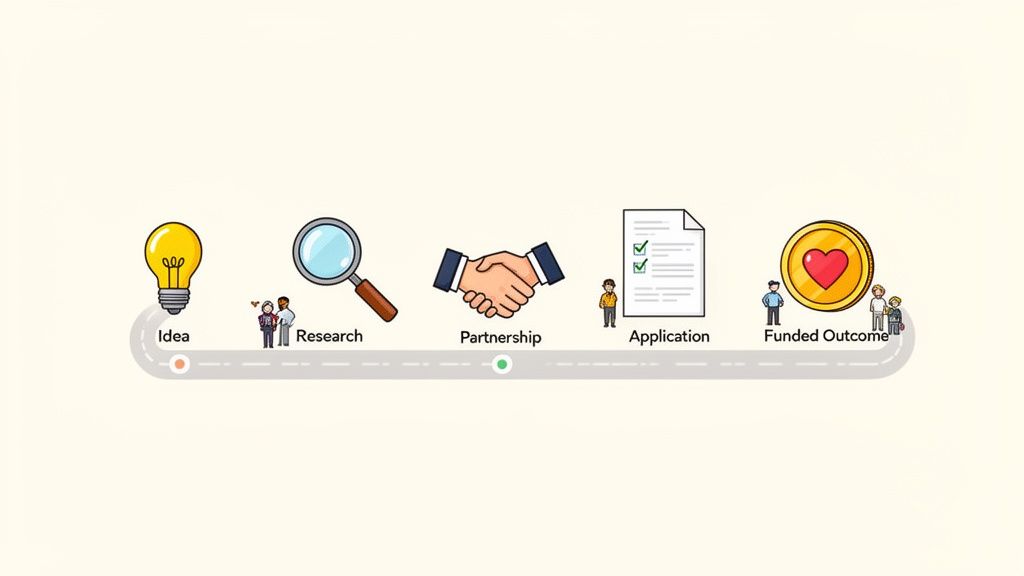
Before you even think about writing a proposal, you need a solid grasp of the playing field. The world of grants for autism isn't one-size-fits-all. It’s made up of different kinds of funders, each with their own unique goals, passions, and rulebooks. The secret to getting funded is finding the right match for your program.
Think of it this way: you wouldn't pitch a small, local startup idea to a Wall Street investment bank. In the same way, you need to find a funder whose mission aligns with yours. Understanding what makes each one tick is the first step toward a successful application.
The Three Main Sources of Autism Funding
Grant funding for autism programs generally flows from three main channels: the federal government, state agencies, and private foundations. Each one operates differently and is looking for a specific kind of impact.
Federal Grants: These are the heavy hitters. They’re large, data-driven, and focused on programs that are backed by solid evidence and can be scaled up. They want to fund research and services that have a broad, even national, reach.
State-Level Grants: Think of these funders as being deeply invested in their own backyard. They concentrate on meeting the specific needs of their state or community, often funding direct services and local programs that fill critical gaps.
Private Foundations: This group is the most diverse. You’ll find everything from small family foundations to massive national organizations. They are often more flexible and willing to take a chance on a new, innovative idea or a pilot project that tests a fresh approach.
A brilliant idea can fall flat if it's pitched to the wrong audience. An innovative pilot program might get a "no" from a conservative federal agency, but that same idea could get an enthusiastic "yes" from a forward-thinking foundation. It's all about alignment.
What Federal Funders Are Looking For
Federal money for autism initiatives is significant but also highly structured. A great example is the Autism CARES Act, through which the U.S. Congress allocated nearly $400 million in Fiscal Year 2026 for autism research and support.
This money flows to major agencies like the NIH, CDC, and the Health Resources and Services Administration (HRSA), which itself received $57.344 million to improve how healthcare professionals are trained in autism care. These grants are incredibly competitive and require rock-solid data and a clear plan for measuring your results. Federal funders want to see that your program is built on a proven model that can deliver a real return on public investment.
How to Approach State and Foundation Grants
State grants tend to be more focused on local impact. To succeed here, you need to show that you have a deep understanding of your community’s challenges and that your program is the right solution to a specific, documented need.
Private foundations, on the other hand, run the gamut. Some are narrowly focused on a single issue, like employment for autistic adults, while others have much broader interests. With foundations, building relationships and researching their past grants is key.
Of course, grants aren't the only way to raise money. Many organizations find success by combining grant funding with other sources, like creative nonprofit fundraising event ideas.
To help you figure out where your program fits best, the table below breaks down the key differences between these funding sources. And for a more detailed guide on the search process, check out our resource on how to find grants for nonprofits.
Comparing Sources for Autism Grant Funding
Here’s a quick breakdown of the three primary grant sources for autism programs. This can help you decide where to focus your energy based on your organization's needs and the type of program you want to fund.
| Grant Type | Typical Funder | Focus Area | Funding Level | Best For |
|---|---|---|---|---|
| Federal | NIH, HRSA, CDC | Research, large-scale service delivery, training programs | High ($100k - $Millions) | Established organizations with strong data and scalable models |
| State | State Health/Education Depts. | Community-based services, filling local service gaps | Medium ($25k - $250k) | Nonprofits with strong community ties and a focus on direct service |
| Foundation | Family or Corporate Foundations | Innovative pilots, specific niches, advocacy, capacity building | Varies ($5k - $500k+) | New programs, innovative ideas, and targeted, specific projects |
Ultimately, choosing the right target is a strategic decision. Understanding these distinctions will save you time and dramatically increase your chances of securing the funding your program deserves.
How to Find and Qualify for the Right Grants
Let's be honest: finding the right grant for your autism program isn't like discovering a hidden treasure. It’s a methodical hunt, and the first step is to move beyond a simple Google search. The real goal is to stop wasting precious hours on opportunities that were never a good fit in the first place and channel that energy toward grants you can actually win.
Think of it as building a smart filter. A good search process weeds out the thousands of potential grants, delivering only the most promising leads right to you. It turns a frustrating, time-sucking task into a focused, manageable part of your work.
Going Beyond Google to Strategic Grant Discovery
Your search should always start with dedicated grant databases. These are powerful tools built specifically for nonprofits, allowing you to slice and dice opportunities by focus area (like autism services), where you're located, and how much funding you need. They save you an incredible amount of time.
Here are the places I always start:
- Grants.gov: This is the official hub for every single federal grant. It can feel a bit clunky to navigate, but it’s an absolutely essential resource if you're looking for significant funding to scale your programs.
- Foundation Directories: Tools like Candid's Foundation Directory Online give you a behind-the-scenes look at private foundations. You can see who they’ve funded before and what they truly care about, which is gold when you're trying to figure out if you're a good match.
- Specialized Search Tools: Newer platforms are using technology to play matchmaker between nonprofits and grants. For a full rundown, our guide on the best grant discovery platforms can help you find one that fits your budget and needs.
A classic mistake is to apply for any grant that has "autism" in the description. A winning strategy means focusing on a small handful of opportunities where your mission and the funder's goals are perfectly aligned. It’s all about quality over quantity.
This targeted approach is the difference between finding any grant and finding the right grant.
Why You Must Vet Every Opportunity
Once you’ve found a promising grant, the real work begins. This isn't just about checking a few eligibility boxes; it's about doing a deep dive to confirm that your program truly fits the funder's mission. I can't tell you how many times I've seen fantastic proposals get rejected simply because of a bad fit.
Think of it like preparing for a job interview. You wouldn't just walk in cold. You'd research the company's values, culture, and recent projects. The same goes for funders. You need to understand their history, their priorities, and the kinds of organizations they like to support. This homework is what allows you to write a proposal that speaks their language.
A thorough vetting process will save you from sinking dozens of hours into an application that was dead on arrival.
Your Quick-Evaluation Checklist
Before you even think about writing a single sentence of a proposal, run the opportunity through this quick checklist. This is your "go" or "no-go" decision point.
- Mission and Priority Alignment: Does their mission statement sound like something you could have written? Look for keywords that match what you do, like "community integration," "early intervention," or "adult life skills." If the connection is a stretch, move on.
- Geographic Focus: This is a simple one. Does the funder only support work in a specific city, state, or region? If they’re laser-focused on Washington State and you’re in Florida, it's an immediate "no-go." Don't waste your time.
- Past Grantee Profile: Look at who they've funded recently. Do these organizations look like yours in terms of budget, size, and the work they do? If they only give to massive university research projects and you're a small community-based provider, it’s probably not a good fit.
- Funding Amount and Type: Does the award size make sense for you? Applying for a $500,000 grant when your entire annual budget is $75,000 can be a red flag for funders. On the flip side, a $5,000 grant might not be worth the application effort for a large-scale project.
By using this filter on every potential grant, you can focus your energy where it has the best chance of paying off. That discipline is what gets you one step closer to securing the funding your vital programs need.
How to Write a Proposal That Actually Gets Funded
A grant proposal is much more than a simple request for money. It's your chance to tell a compelling story—one that connects with a funder on both an emotional and a logical level. To win grants for autism, your proposal has to convince them of three things: a serious problem exists, your organization is perfectly positioned to solve it, and your plan will produce real, measurable results.
Think of yourself as a storyteller. You need to hook the reader from the very beginning, introduce the stakes, and then present a believable path to a successful conclusion. Every piece of your proposal works together to make your case undeniable.
The Foundation of Your Story: The Needs Statement
Every great story starts with a clear problem. In the world of grant writing, this is your Needs Statement. Its job is to create a sense of urgency, proving to the funder that the issue you're tackling is significant and can’t wait.
A weak needs statement says, "We need money for our autism program." A powerful one paints a vivid picture of a specific gap your work will fill. The magic happens when you blend hard data with a human touch, showing not just what the problem is, but who it hurts.
To build a truly convincing Needs Statement, try this:
- Weave Together Data: Start with broad statistics on autism, then zoom in. Use local data to show how this national issue impacts your specific community. For instance, you could cite national employment figures for autistic adults, then follow up with data showing a lack of vocational training programs in your own city.
- Tell a Human Story: Numbers create context, but stories create connection. Include a brief, anonymized anecdote that brings the problem to life. Describing a family’s struggle to find social skills groups for their teen is far more memorable than a statistic on its own.
- Define the Consequences: Clearly state what happens if this need goes unmet. Will families be left without support? Will autistic adults face even greater barriers to independence? Make the stakes clear.
Getting this section right is crucial. For a deeper dive into this first, critical step, you can check out our guide on building a powerful Statement of Need. A strong opening sets the stage for everything that follows.
Presenting Your Solution: Program Goals and Outcomes
Once you’ve established the problem, it’s time to present your clear, credible solution. This is where you lay out your program’s goals, objectives, and—most importantly—its measurable outcomes. You’re shifting from talking about the problem to proving you can fix it.
A goal is the big-picture vision (e.g., "Improve social skills for autistic teens"). An objective is a specific, measurable step you'll take to get there (e.g., "75% of program participants will demonstrate an increase in initiating peer interactions over a six-month period").
Grant funders don't fund activities; they fund outcomes. They want to know the tangible difference their investment will make. Clearly articulating measurable results is non-negotiable for a competitive proposal.
Make sure your outcomes are SMART:
- Specific: What, exactly, will you measure?
- Measurable: How will you track progress with numbers or clear indicators?
- Achievable: Are your targets realistic given your timeline and budget?
- Relevant: Does every outcome tie directly back to the need you described?
- Time-bound: When will you achieve these results?
This level of detail shows funders you’ve thought through your plan and are serious about accountability. The competition is fierce, so a data-driven approach is essential. Just look at the Eagles Autism Foundation: for its 2025 cycle, it received 267 letters of intent and awarded $10.8 million to 54 projects. That 27% surge in applications shows just how competitive the field of grants for autism is, especially as services for adults struggle to keep up.
Learning from Major Autism Funders and Programs
Knowing the theory behind grant seeking is one thing, but to really succeed, you need to understand the players. Getting familiar with what major funders actually care about is like getting insider intelligence for your next proposal.
This isn't about twisting your mission to fit a funder’s mold. It’s about finding the organizations whose mission is already in sync with the incredible work you do every day. Let’s look at a few real-world examples to see what this looks like in practice.
Federal Initiatives: The Autism CARES Act
At the federal level, the Autism CARES Act is a massive force, channeling significant money into research, training, and large-scale service systems. Most of this funding isn’t meant for individual community programs but for building capacity across the board.
A perfect example is the Health Resources and Services Administration’s (HRSA) Leadership Education in Neurodevelopmental and Related Disabilities (LEND) program. LEND grants are huge, highly competitive, and almost always go to university-based initiatives.
The goal here is to train the next generation of professionals—doctors, psychologists, speech pathologists, you name it. LEND programs work to improve the entire system of care by creating a workforce that truly gets the needs of autistic individuals and their families. This focus on training and systems-level change is a classic feature of many federal grants for autism.
When looking at federal funders, pay close attention to their high-level goals. They are often less interested in funding a single new playground and more interested in a project that trains all park staff across a city in inclusive recreation practices.
Private Foundations: NEXT for AUTISM
On the other side of the coin, private foundations offer a different—and often more direct—path to funding. These groups tend to zero in on specific gaps in services, and one of the biggest right now is support for autistic adults. NEXT for AUTISM has established itself as a leader in this space.
This foundation focuses on programs that help adults build independent lives and become part of their communities. Their grants typically back fresh ideas in four critical areas:
- Home: Supporting independent living and various supported housing models.
- Work: Funding job training programs and initiatives for inclusive employment.
- Social: Backing programs that create social connections and community engagement.
- Health: Promoting better access to quality healthcare for autistic adults.
If you look at their recent grant cycle, a clear trend emerges. For its 2025-26 cycle, NEXT for AUTISM awarded $856,572 across 52 organizations, with a heavy emphasis on autistic-led projects and community-based adult services. The fact that they received a record 522 applications—a 27% jump from the year before—shouts a clear message about the massive, unmet need in this area. You can see the full breakdown of their latest grant awards on their site.
This data offers a crucial insight: foundations like NEXT for AUTISM are increasingly putting their money behind programs designed by and for the autistic community, particularly those focused on the transition to adulthood.
What We Can Learn from These Examples
Looking at these two funders side-by-side reveals two very different, but equally important, paths for securing grants for autism. Federal grants often demand a big-picture focus on systems change, professional development, or research. They want to fund models that can be scaled up and replicated across the country.
In contrast, private foundations like NEXT for AUTISM can be a much better fit for community-based nonprofits. They're often eager to fund direct services, pilot new concepts, and tackle specific, under-resourced needs like adult employment or social clubs.
The takeaway is simple: understand these different priorities. It will help you strategically target the funders who are already out there looking for a program exactly like yours.
Managing Your Grant and Building Funder Relationships
You got the grant. The email landed in your inbox, and your team celebrated a hard-won victory. It’s a fantastic feeling, but it’s not the finish line. In reality, that award notice is the starting gun for the most important part of the process: building a real, lasting relationship with your funder.
What happens after you get the money is what separates a one-time grant recipient from an organization with a truly sustainable funding pipeline. Your proposal was the promise you made; now it's time to show them you can deliver. This takes more than just running your program well—it demands careful management, open communication, and a focus on proving your impact.
Stewardship: The Secret to Getting Funded Again
The whole post-award phase can be summed up in one word: stewardship. It's a simple idea that means you’re taking incredible care of the resources someone has entrusted to you. Good stewardship isn't a passive, check-the-box activity. It's an active strategy for building trust that will make funders want to support you again.
- Acknowledge with Genuine Gratitude: The very first thing you should do is send a heartfelt thank you. Ditch the generic email template. A personal letter that expresses your team's excitement and reinforces your commitment to your shared goals goes a long way.
- Track Every Penny, Meticulously: You need to be able to show exactly where every dollar went. This is non-negotiable for compliance, but it also signals to the funder that you're organized and responsible. Having a solid financial system in place is critical; understanding the principles of fund accounting for nonprofits is a great place to start to ensure you’re transparent and audit-ready.
- Communicate Consistently and Honestly: Don't go silent until a report is due. Send quick, positive updates when you have them—a great photo from an event, a short success story, or a note that you’ve hit a key milestone. And if you run into a problem? Tell them. Being upfront about a challenge, along with your plan to solve it, builds far more trust than pretending everything is perfect.
Think of your funders as partners, not just ATMs. These relationships flourish on the same things any partnership does: trust, transparency, and mutual respect. I’ve seen a single, compelling success story shared mid-year do more to secure the next grant for autism than the original proposal ever did.
Turning Reports into Relationship-Builders
We all know grant reporting can feel like a chore. But if you shift your mindset, you’ll see it’s your single best chance to show off your work and make a strong case for continued investment. A great report tells a story; it doesn't just list data points.
So instead of just writing that "80% of participants completed the program," bring that number to life. Tell the anonymized story of one of those participants—someone who gained the confidence to land their first job because of your work. That’s how you connect the data directly to the human impact you promised.
When you manage your grant with this kind of diligence and share your successes with passion, you turn a transaction into a partnership. You're not just fulfilling an obligation; you're making your funders feel like a crucial part of your mission. This is what makes them eager to reinvest, turning that one grant into the reliable support your vital work deserves.
Common Questions About Autism Grants
Jumping into the world of grants for autism can bring up a lot of questions, especially when you're just getting started. It's a complex field, no doubt about it. Here are some straightforward answers to the questions we hear most often from nonprofit leaders, designed to give you the clarity and confidence to take the next step.
My Small Nonprofit Has Never Won a Grant. Where Should We Start?
Think local, and start small. Your best first move is to look right in your own backyard. Research community foundations, local family foundations, and even the regional chapters of national organizations. These funders are often much more accessible, and their entire focus is on making a tangible impact close to home.
When you're starting out, set your sights on grants under $10,000. Winning one of these is more than just getting funds; it's about building your grant-winning muscle. Each small victory gives you performance data and powerful stories you can use to build a compelling case for those larger state and federal grants down the road.
What Is the Biggest Mistake to Avoid in a Grant Application?
Hands down, the most common—and heartbreaking—mistake is not following the funder's directions to the letter. Grantors are incredibly specific about their priorities and application rules for a reason. So many fantastic projects get rejected for simple, avoidable errors like ignoring page limits, not answering a question directly, or pitching an idea that just doesn't align with the funder's mission.
Your program could be brilliant, but it won't be funded if it's not what the funder wants to support. Reading the Request for Proposal (RFP) multiple times and tailoring every single application is non-negotiable.
How Can We Compete if We Are a New Organization with Limited Data?
This is a classic chicken-and-egg problem, but it’s solvable. If you don't have your own program data yet, lean on high-quality, external data to paint the picture of need. Use census figures, academic research, and government health reports from respected sources like the CDC or your local health department. This third-party data is crucial for building a powerful Needs Statement that proves the problem you're solving is real and urgent.
Then, shift the focus to the future. You may not have past results, but you can present a rock-solid evaluation plan. Clearly outline what data you will collect, what outcomes you plan to measure, and how you'll track your progress. Funders get that new organizations are starting from scratch; what they need to see is that you have a concrete plan to measure your impact from day one.
Ready to stop chasing dead-end grants and start building a winning funding strategy? Fundsprout is an AI-powered platform that finds perfectly matched opportunities and helps you write compelling proposals faster. Explore how Fundsprout can grow your nonprofit's impact.
Try 14 days free
Get started with Fundsprout so you can focus on what really matters.