Foreign Military Sales: A Nonprofit's Guide to the Program
Understand the U.S. Foreign Military Sales (FMS) program from a nonprofit perspective. Learn how it works, its implications, and how to monitor its impact.

Abdifatah Ali
Co-Founder
Your team is running a nutrition program, a protection hotline, and a local partner training series in a fragile state. Then a field officer messages from the capital: new armored vehicles have appeared near a ministry compound, local officials are talking about expanded security cooperation, and communities are suddenly asking whether aid operations will be affected.
For many nonprofits, that moment feels political, military, and far outside the day job. In practice, it often lands squarely inside it.
Those new systems may be connected to Foreign Military Sales, usually shortened to FMS. This is the U.S. government's state-run channel for selling defense equipment and related support to foreign governments. It is large enough that nonprofit leaders can't treat it as background noise. The Department of Defense's historical sales record shows cumulative FMS sales of $1,196,995,020,549 from FY1950 through FY2024 in the DoD Historical Sales Book.
That scale matters because security decisions reshape civic space, partner access, transport routes, local perceptions, and advocacy risk. If your organization works in humanitarian response, development, peacebuilding, or human rights, foreign military sales can affect the environment you operate in even when your own work has nothing to do with defense.
Many nonprofit teams already track grants, sanctions, and procurement rules. FMS belongs in that same mental map. It helps explain why security forces suddenly receive new equipment, why a host government's priorities shift, and why a donor conversation can start sounding more like strategic competition than community resilience. If your board is also thinking more broadly about public funding environments, this overview of federal funding opportunities for nonprofits is useful context for how government priorities shape operational reality.
Introduction A New Reality on the Ground
A lot of confusion starts with a simple assumption: if a foreign country buys U.S. military equipment, people picture a direct transaction between that country and a defense company.
That's not how FMS works.
Under FMS, the sale is government-to-government. The legal and operational structure runs through the U.S. government, not just through a private vendor. The Defense Security Cooperation Agency explains that the central transaction document is the Letter of Offer and Acceptance, or LOA. Once the LOA is signed, the Department of Defense executes the case using the DoD acquisition system, and the Department of State approves cases individually through a case-by-case process described on the DSCA Foreign Military Sales page.
A simple way to think about it
A helpful analogy is a government-run personal shopper.
The foreign government says what it wants. The U.S. government checks whether the request is allowed, builds the terms, manages the procurement machinery, and oversees execution. U.S. defense companies still manufacture the equipment, but they aren't the party running the international sale in the same way they would in a standard commercial export.
That distinction matters for nonprofits because the process reflects policy, diplomacy, and institutional priorities, not only market demand.
Practical rule: If you hear that a country is “buying from the U.S.,” ask whether it's an FMS case or a direct commercial sale. The policy implications can be very different.
The document that makes it real
The LOA is the hinge point. Before it is signed, there may be discussions, estimates, and political signaling. After it is signed, there is a binding government-to-government instrument that the U.S. defense system can execute.
For non-specialists, that sounds technical. But it's useful. It means FMS is less like browsing a catalog and more like entering a managed public procurement channel with diplomatic review built in.
If you work with advocacy staff, policy interns, or country analysts who need a broader grounding in how states use coercion and influence, this guide for international relations students helps place FMS in the larger discussion of hard power.
What FMS is not
It isn't just a press release.
It isn't just a contractor announcement.
It isn't just a signal that equipment will appear immediately in the field.
And it isn't only about hardware. In practice, the program can involve training, services, and support tied to the equipment package.
For nonprofit leaders, the key takeaway is simple: FMS is a state-managed security cooperation mechanism. That makes it relevant to anyone tracking how government capacity, alliance politics, and force posture affect communities and civic space.
The Lifecycle of a Foreign Military Sale
Most nonprofit leaders don't need a legal manual. They do need a reliable mental model.
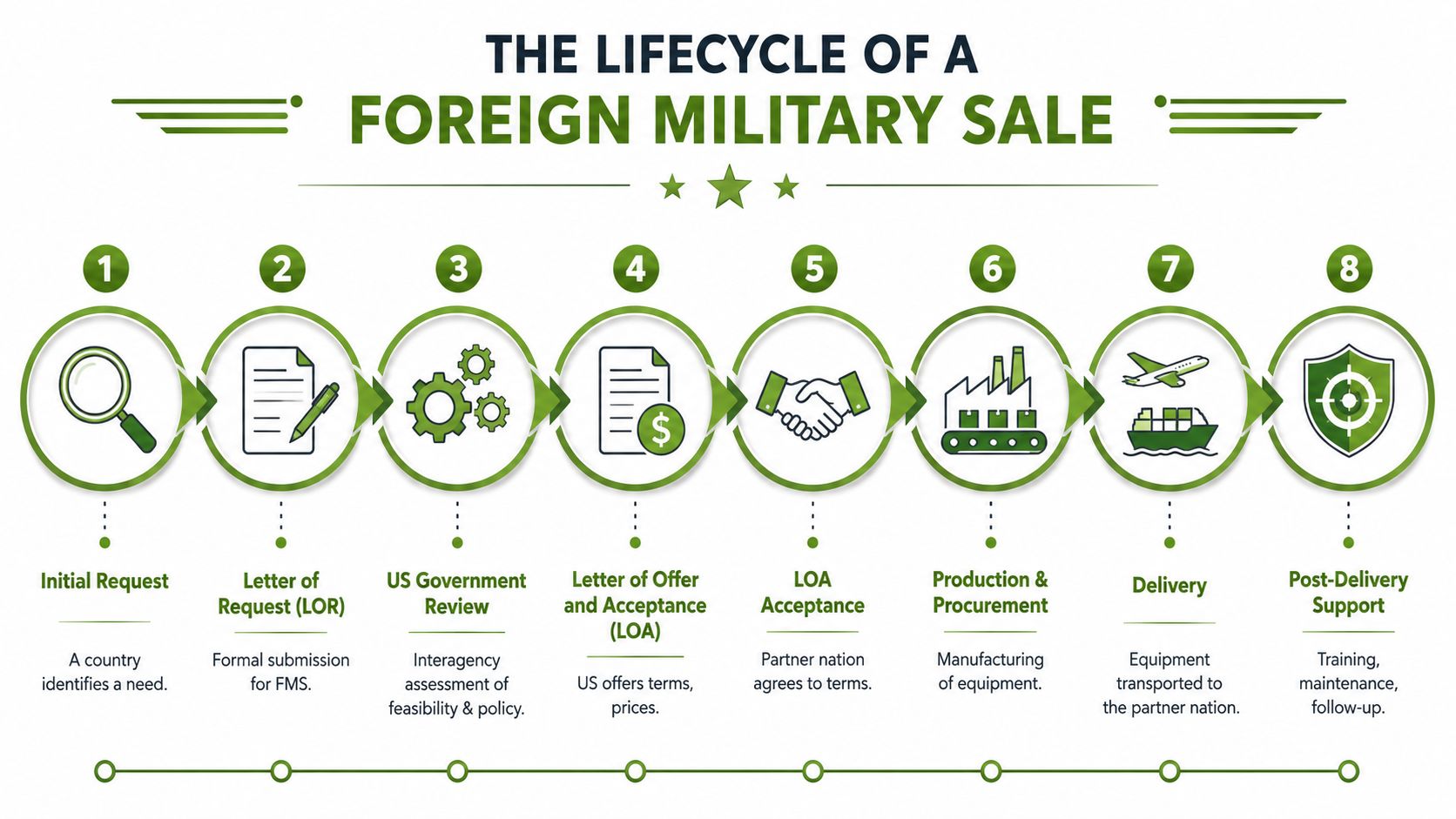
A foreign military sale usually moves in stages, and each stage answers a different question. Has a government expressed demand? Has Washington approved the idea? Has a binding instrument been signed? Has money been committed? Has production started? Has anything arrived?
Here's the high-level flow.
From request to offer
The process begins when a partner government identifies a need and sends a request. In practice, that request can follow consultations with U.S. officials about feasibility, policy concerns, or what the partner can realistically sustain.
Then U.S. agencies review the request. They assess whether the proposed sale fits U.S. policy, whether the equipment can be provided, and how the terms should be structured. If the case moves forward, the U.S. side prepares the LOA.
At this point, outsiders often assume the sale is done. It isn't.
From offer to execution
Once the partner signs the LOA, the case becomes binding. Then the U.S. defense system executes it through procurement, contracting, logistics, and follow-on support. That phase can include manufacturing, shipping, training, sustainment, and administrative changes along the way.
A short explainer can help visualize the sequence before you read field signals too directly.
Why the timeline matters on the ground
For an NGO, the most important lesson is that announcement, approval, contracting, and delivery are not the same event.
That's why a local rumor, a congressional notice, and a confirmed field delivery may all describe different moments in the same case. If your security team hears about a proposed sale, that doesn't mean equipment will appear next week. If your country director sees equipment in service, the policy debate that enabled it may have started much earlier.
A simple way to track the lifecycle is to ask these questions in order:
- Need identified: What capability does the partner government say it wants?
- Request submitted: Has there been a formal request to the U.S. side?
- Policy review: Did U.S. agencies decide the case is acceptable?
- Offer issued: Has an LOA been prepared?
- Offer accepted: Did the partner sign the LOA?
- Procurement underway: Are contracts and orders being placed?
- Delivery occurring: Has equipment, training, or support arrived?
- Post-delivery support: Who is maintaining, monitoring, and sustaining the capability?
Treat FMS like a pipeline, not a headline. The policy meaning of a case often appears early. The operational effect usually appears later.
That simple discipline prevents one of the most common analytical mistakes in nonprofit reporting: treating a public announcement as if it were immediate field reality.
Key Players in the FMS Ecosystem
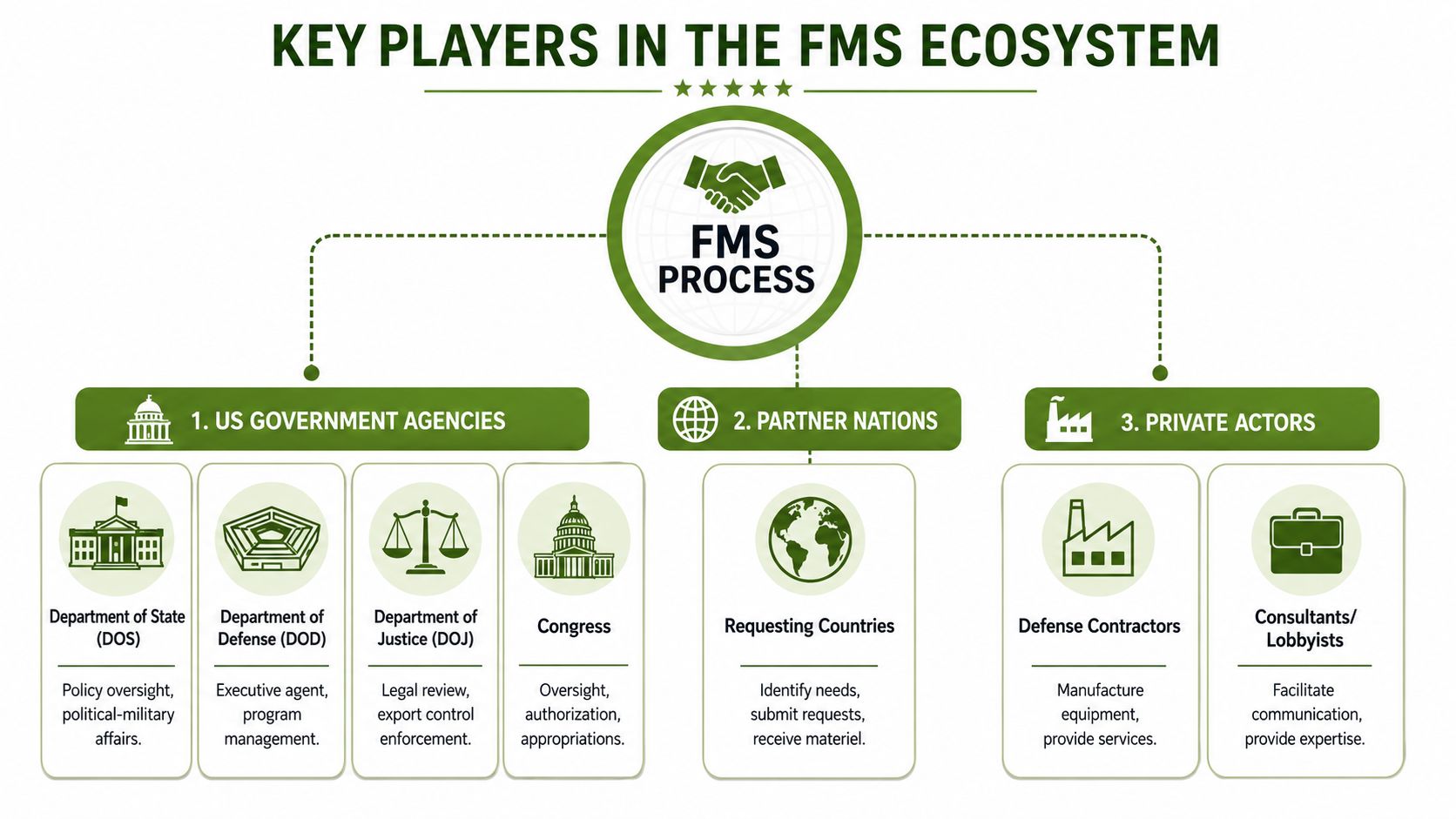
FMS looks opaque until you separate the actors by function. Some players decide whether a sale should happen. Others manage the machinery. Others build the equipment. A nonprofit that can distinguish those roles will ask better questions and target advocacy more effectively.
Who does what
| Actor | Core role in the process | Why nonprofits should care |
|---|---|---|
| Partner government | Defines need, requests the case, accepts terms | Signals national security priorities and likely future force posture |
| Department of State | Approves cases on a case-by-case basis | Connects the sale to foreign policy and diplomatic priorities |
| Department of Defense and DSCA | Manages and executes the case | Determines how the sale moves through procurement and delivery |
| Congress | Reviews major proposed sales and exercises oversight | Creates an advocacy window before some cases advance |
| Defense contractors | Manufacture equipment and provide related services | Shape timelines, supply realities, and sustainment burdens |
The policy side and the execution side
The State Department is the policy gatekeeper. It decides whether a case aligns with U.S. foreign policy and whether the transfer should be approved.
The Department of Defense, working through DSCA and related implementing bodies, runs the execution system. That means procurement, contracting, logistics, and case management.
Congress sits in a different lane. It doesn't execute the sale, but it can review and contest major proposed transfers. For advocacy groups, that review role matters because it creates moments when concerns about civilian risk, governance, or regional escalation can be raised with specificity.
Private firms are important, but they are not the whole story
Contractors make the products. That often leads observers to focus almost entirely on industry announcements. But in FMS, the public policy architecture matters just as much as the manufacturer.
That distinction is useful when comparing different national defense debates. For example, nonprofits tracking European rearmament and industrial policy may find this analysis of policy insights on Germany's defence revival helpful because it shows how procurement, politics, and production interact beyond a single contract.
When your advocacy memo says “the U.S. sold weapons,” the next question should be “which institution approved, managed, and reviewed that decision?”
That wording keeps your analysis grounded in real decision points rather than vague blame.
Why FMS Matters for Nonprofits and NGOs
For many organizations, foreign military sales sound far removed from service delivery. On the ground, they can alter risk, access, and public perception faster than a strategy document does.
The strategic context is shifting too. The U.S. government has increasingly framed FMS as a tool of strategic competition and industrial readiness, not merely an export channel. That framing is described in the State Department's discussion of retooling foreign military sales for an age of strategic competition. For nonprofits, that means FMS can influence the security environment even where your organization never touches a defense issue directly.
Compliance risk is often indirect
Most NGOs aren't parties to an FMS case. But they may still encounter downstream compliance issues.
A local partner might be asked to coordinate access near military facilities. A humanitarian team might receive inquiries from officials operating newly delivered systems. A governance project might work alongside ministries whose reporting and monitoring obligations become more sensitive as security cooperation expands.
This doesn't mean every nonprofit needs export lawyers on speed dial. It does mean your organization should know when a changing security environment may trigger extra review by legal, compliance, or safeguarding teams.
Program context can change quickly
Foreign military sales can signal a host government's priorities. If security modernization accelerates, that may affect budget politics, internal power balances, civil-military relations, and how authorities respond to dissent or unrest.
For a nonprofit country office, that changes basic operating assumptions:
- Access planning: Roads, checkpoints, and movement permissions may tighten around strategic sites.
- Community trust: Residents may associate outside actors with broader geopolitical shifts, fairly or unfairly.
- Partner mapping: New security relationships can strengthen some ministries and sideline others.
- Advocacy posture: Public messaging may need more care when civic space is narrowing.
If your team often has to explain organizational form and accountability to partners or donors, this primer on the difference between an NGO and a nonprofit can help sharpen internal language before you engage on sensitive public policy issues.
Monitoring civilian impact requires better questions
The humanitarian and human rights relevance is straightforward. If security forces receive new capabilities, watchdog groups need to watch how those capabilities are used, not just whether they were announced.
That includes asking:
- What type of equipment is involved?
- Which units are likely to receive it?
- What operating patterns might change after delivery?
- How could communities experience those changes?
The nonprofit question isn't “Are we a defense organization?” It's “Will this security shift affect civilians, partners, or our operating space?”
Advocacy gets stronger when it is specific
General concern rarely moves policy. Specific concern sometimes does.
FMS gives advocacy groups a structured issue to examine: who requested the capability, what it is meant to do, where review happens, and what on-the-ground risks deserve attention. That's more actionable than broad statements about militarization because it ties concerns to an actual process.
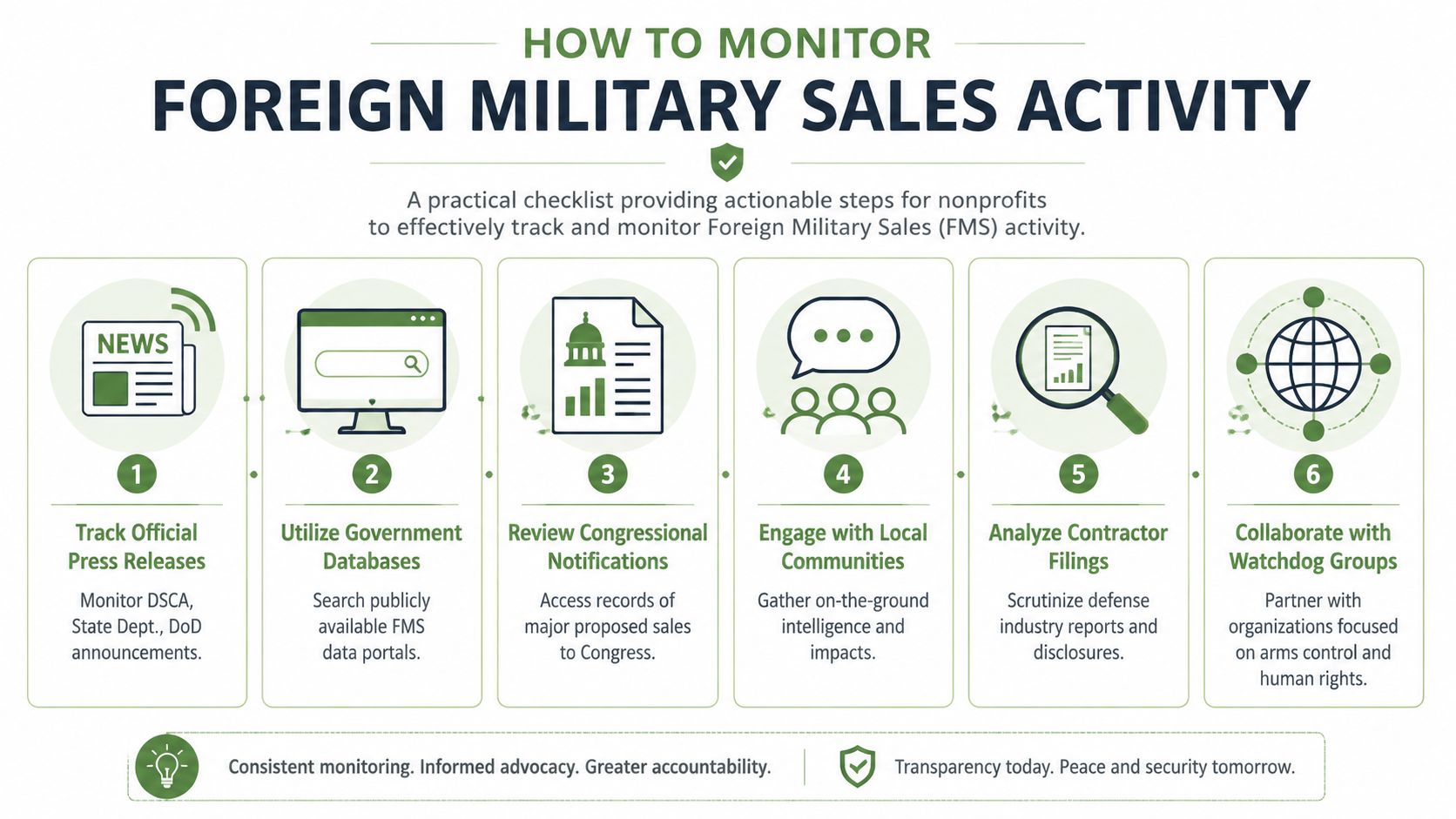
How to Monitor Foreign Military Sales Activity
The fastest way to get FMS wrong is to confuse a public notice with a completed delivery.
That mistake is common because the public record is uneven. Big numbers attract headlines, but execution happens over time and across multiple systems. Bruegel's work on FMS notes a major challenge: the gap between public notifications and the actual value and timing of deliveries. It also notes that public attention often centers on announced totals, including the record $80.9 billion in 2023, rather than on the long pipeline from approval to fielding, as discussed in Bruegel's paper on understanding U.S. foreign military sales through a new dataset.
Start with a monitoring routine
A practical monitoring system for nonprofits doesn't need to be fancy. It needs to be consistent.
- Track official announcements: Follow DSCA, State Department, and DoD public releases related to proposed sales and security cooperation.
- Log the basics: Record the purchasing country, equipment type, announced value if given, and the date of the notice.
- Separate stages: Mark whether the item you found is a notification, a signed case, a delivery report, or field observation.
- Add local reporting: Pair official information with partner feedback, media monitoring, and community observations.
- Review regularly: Security context changes are easier to understand when you compare notes over time instead of reacting to isolated headlines.
Notifications and deliveries are different things
This distinction deserves a simple comparison.
| Public signal | What it usually tells you | What it does not tell you |
|---|---|---|
| Notification | The U.S. government has publicly identified a proposed sale for review | That equipment has been built, shipped, or fielded |
| LOA-related reporting | A case may be moving into binding execution territory | That all items will arrive quickly or exactly as first described |
| Field observation | Some capability is present in-country | The full legal and procurement history behind the case |
A good analyst keeps all three categories separate.
Use datasets carefully
Bruegel's dataset is especially useful because it captures the purchasing country, equipment type, quantities when available, contractors, and sale value across notifications from April 2008 to May 2026, as described on the Bruegel FMS dataset page. That kind of structure helps with pattern spotting across time.
For nonprofit teams, the value isn't just academic. It helps answer practical questions such as whether a country is repeatedly seeking certain capabilities, whether announced demand is shifting, and whether your local observations match the public record.
If your staff already build simple tracking workflows for procurement notices or grant bids, the same discipline applies here. This overview of RFPs and RFQs is a useful parallel because both fields reward teams that can tell the difference between an announcement, a formal instrument, and actual execution.
Good monitoring starts with humility. “We saw a notification” and “we confirmed delivery” are different claims, and they should never appear as if they mean the same thing.
Conclusion Your Actionable Next Steps
Foreign military sales matter to nonprofits because they shape the environment in which nonprofit work happens. They can affect access, civilian risk, governance dynamics, donor language, and the practical choices your staff make in the field.
The key points are straightforward. FMS is a government-to-government process. It runs through formal approval and execution channels. Public announcements often describe proposed activity, not completed delivery. And the program's strategic role means it belongs in the situational awareness toolkit of humanitarian, development, and advocacy organizations.
A useful next-step checklist looks like this:
- Map your countries of operation: Identify where foreign military sales activity may intersect with your programs, partners, or movement plans.
- Create a watchlist: Monitor official U.S. announcements and keep a basic internal log of relevant cases.
- Separate rumor from evidence: Label each item clearly as a notification, policy signal, signed case, delivery report, or field observation.
- Review internal policies: Ask legal, security, and compliance staff whether changing security relationships create new operational questions.
- Brief program teams: Country directors and field managers should understand why new military capabilities may alter community perception or access.
- Use the information: Fold FMS awareness into advocacy strategy, conflict sensitivity reviews, and scenario planning.
You don't need to become a defense specialist. You do need enough fluency to recognize when a military procurement story is also a humanitarian access story, a civic space story, or a partner risk story.
That awareness can keep your organization from being surprised by changes that were visible long before they reached the road outside your office.
Fundsprout helps mission-driven organizations turn complex public funding and compliance work into a manageable system. If your team is juggling grant discovery, proposal writing, deadline tracking, and renewal reporting, Fundsprout gives you one place to find relevant opportunities, organize requirements, and keep an audit trail that supports stronger submissions and smoother follow-through.
Try 14 days free
Get started with Fundsprout so you can focus on what really matters.