NGO vs Nonprofit Choosing the Right Structure for Your Mission
Unsure about NGO vs nonprofit? Our guide details the key differences in funding, legal structure, and scope to help you make the best choice for your cause.

Abdifatah Ali
Co-Founder
It’s easy to get tangled up in the terms "nonprofit" and "NGO." While they seem interchangeable, the key difference really boils down to scope. Think of it this way: all NGOs are nonprofits, but not every nonprofit is an NGO. A nonprofit generally works within a single country, tackling domestic issues, whereas an NGO (Non-Governmental Organization) typically operates on an international stage to address global challenges.
NGO vs. Nonprofit: Understanding the Core Differences
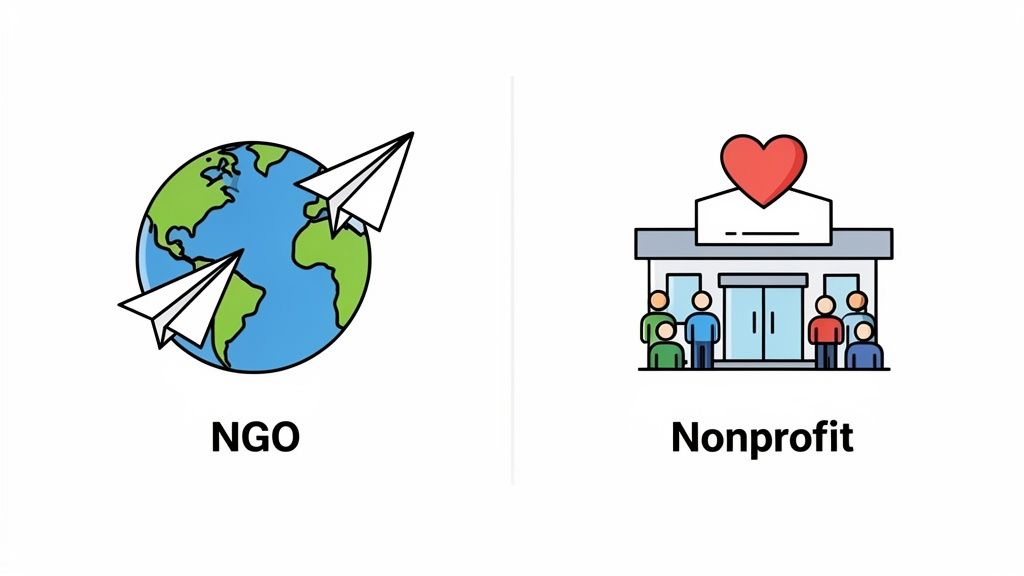
So, let's break that down. A nonprofit is a legal entity created to serve a public or social good rather than to generate profit for owners or shareholders. Its work is almost always focused within the legal and geographical borders of one country. For example, a local animal shelter or a community arts center in the United States is a classic nonprofit.
An NGO, on the other hand, is a specific kind of nonprofit that functions independently of any government and often has an international reach. The term actually came from the United Nations back in 1945 as a way to differentiate between official governmental bodies and private organizations at the table.
Getting the distinction right isn't just about semantics; it has real-world consequences for your organization.
- Legal & Compliance: The two structures navigate entirely different registration processes and regulatory hurdles, especially when multiple countries are involved.
- Funding Strategy: Their funding streams are often different. A local nonprofit might rely on community grants, while an international NGO often seeks aid from global foundations or government bodies.
- Mission & Branding: The term you choose signals your operational focus, helping you attract the right donors, volunteers, and partners who are aligned with your goals.
The real dividing line is geography and operational scale. If your mission is rooted in serving a community within your own country, 'nonprofit' is the right fit. If you're working across borders on issues like human rights or global health, 'NGO' is a much more accurate description.
This guide will unpack these differences in more detail to help you position your organization effectively. But first, here's a quick look at the fundamental distinctions.
At a Glance Comparison: NGOs vs. Domestic Nonprofits
For a quick reference, this table highlights the fundamental characteristics that set international NGOs and domestic nonprofit organizations apart.
While both are driven by mission over profit, their operational worlds—from fundraising to legal compliance—are shaped by whether their focus is local or global.
What Is a Nonprofit Organization
A nonprofit organization is, at its heart, a legal entity created to serve a public or social cause, not to make money for owners or shareholders. The key defining feature here is its domestic focus. A nonprofit is chartered and operates under the laws of a specific country, concentrating its mission and work within those borders.
It’s a structure built entirely around serving a community. Any money the organization brings in—whether from donations, grants, or services—gets plowed right back into its mission. Nothing is distributed to private owners, which is the fundamental line separating it from a for-profit business.
Because of this unique model, nonprofits often have very specific operational needs. They have to manage donations, track grants, and stay compliant, which is why many seek out specific solutions for the Non Profit industry designed for their distinct financial workflows.
The Legal and Tax Framework
In the United States, when people say "nonprofit," they're usually talking about a 501(c)(3) organization. This is a specific designation from the Internal Revenue Service (IRS) that grants federal tax exemption and, crucially, allows donors to make tax-deductible contributions. That last part is a massive incentive for fundraising.
Getting that 501(c)(3) status isn't automatic; it comes with some pretty strict rules. The organization has to prove its purpose is charitable, religious, educational, scientific, or literary. Governance is also heavily regulated. If you want to get into the weeds, our guide on designing a solid nonprofit organizational structure is a great place to start.
The sheer scale of this sector is staggering. In the U.S. alone, there are over 1.5 million nonprofit organizations. Together, they employ more than 12 million people and pump over $1 trillion into the economy every year. They fill vital gaps in society, with 56% focused on healthcare, 25% on education, and 50% on human services—from small, volunteer-run food banks to sprawling hospital systems.
A nonprofit’s legal identity is tied to its home country. Its tax-exempt status, governance rules, and fundraising capabilities are all defined by national and state laws, anchoring its operations firmly within domestic borders.
This domestic framework really shapes everything a nonprofit does. It dictates who can be on the board, how the books are kept, and where the money comes from. Funding strategies tend to rely on in-country sources like government grants, individual donors, and local foundations, a localized approach that stands in stark contrast to the global nature of many NGOs.
What Is a Non-Governmental Organization?
While a nonprofit's identity is tied to its home country, a Non-Governmental Organization (NGO) is defined by its international reach and its separation from direct government control. The term itself really took off after the United Nations was formed in 1945, creating a way to differentiate between official intergovernmental bodies and private organizations working on the world stage.
An NGO operates across borders, tackling problems that don't respect national boundaries. Think human rights, environmental conservation, disaster relief, and global health crises. Their work is, by its very nature, transnational.
This international scope introduces a whole new level of operational and legal complexity that most domestic nonprofits never have to think about. An NGO has to navigate the laws, regulations, and cultural nuances of every single country it works in—a far cry from simply complying with one nation's legal framework.
Global Reach and Legal Identity
The true mark of an NGO is how it carries out its mission across borders. It's not just about having a global mindset; it's about taking action on a global scale. This often means setting up a physical or programmatic presence in multiple countries, which is a major logistical and legal puzzle.
Instead of just securing a single 501(c)(3) status, an NGO might need to register as a distinct legal entity in several different nations, each with its own set of rules for governance and financial reporting. On top of that, they must follow international laws and treaties relevant to their field.
An NGO's identity is less about a single, fixed legal status and more about its international mission. Its structure is built to manage cross-border logistics, multi-currency funding, and diverse cultural contexts, which fundamentally separates it from a domestically-focused nonprofit.
The world of international NGOs is massive. Today, there are over 40,000 of them working to solve some of our planet's biggest challenges. A great example is Doctors Without Borders. Founded back in 1971, it now has over 35,000 staff providing urgent medical care in dozens of countries, work that even earned it a Nobel Peace Prize. To get a better sense of their scale and impact, check out this detailed Wikipedia article on non-governmental organizations.
Distinct Funding and Operations
This global focus has a huge impact on how NGOs raise money. A local nonprofit might get by with community fundraisers and grants from local foundations, but an NGO's funding is usually more institutional and international. Their primary sources often include:
- International Bodies: Grants from major players like the United Nations or the World Bank.
- Foreign Governments: Development aid from agencies like USAID.
- Multinational Foundations: Large-scale funding from global philanthropic organizations.
This type of funding demands a highly professional approach to grant management and compliance, as each source comes with its own strict reporting rules. The core difference in the NGO vs. nonprofit conversation often boils down to this: raising money at home versus navigating the complex, high-stakes world of international aid.
Comparing Key Operational and Legal Frameworks
When you start peeling back the layers of the NGO vs. nonprofit debate, the real differences surface in their operational and legal structures. These are the nuts and bolts that dictate everything from how an organization is legally formed to where its money comes from. While both are driven by a mission for social good, their day-to-day realities are worlds apart, largely defined by their geographic footprint.
We can really zero in on these differences by looking at four key areas: legal registration, funding streams, governance models, and operational scope. Getting a handle on these will make it much clearer which structure—or even just which term—is the right fit for a mission.
Legal and Registration Requirements
The legal path for a domestic nonprofit is, relatively speaking, pretty straightforward. In the U.S., this usually means incorporating in a single state and then going through the process of applying for 501(c)(3) tax-exempt status from the IRS. It's an intensive process, no doubt, but it's all contained within one country's legal system.
An international NGO, on the other hand, has to navigate a much more tangled web of compliance. It must play by the rules not just of its home country but of every single nation where it sets up shop. This often means establishing separate legal entities in multiple jurisdictions, each with its own unique registration rules, tax laws, and reporting standards.
This infographic really captures the essence of an NGO's international nature.
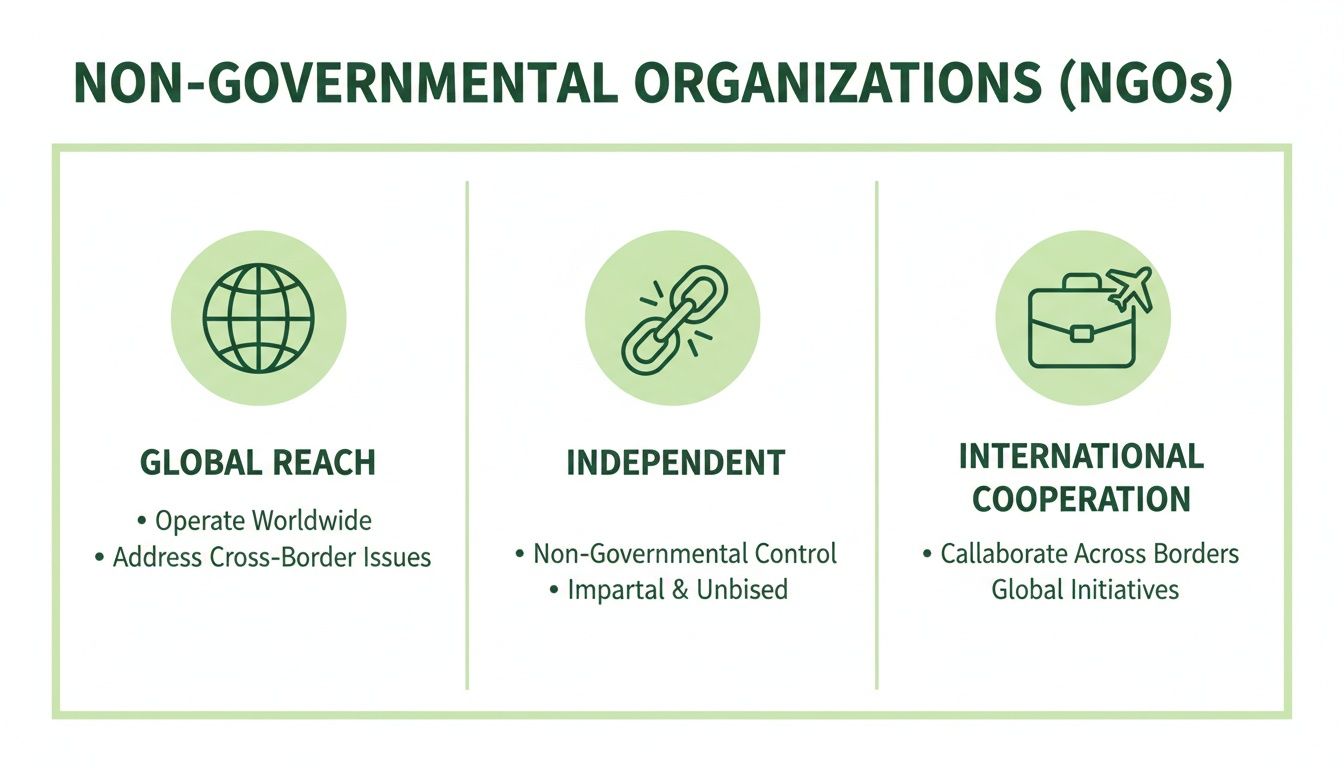
The big takeaway here is that NGOs are built from the ground up to operate in a multi-jurisdictional world, and that requires a seriously sophisticated legal and operational machine.
Funding and Revenue Streams
Where the money comes from is another huge point of divergence. Domestic nonprofits primarily raise funds from within their own country. Think about it:
- Individual Donations: Contributions from people in the local community and supporters across the nation.
- Community Foundations: Grants from philanthropic groups that are laser-focused on specific cities or regions.
- Government Grants: Funding from local, state, and federal agencies. In the U.S., for instance, at least 30% of nonprofits report getting some form of government grant.
NGOs, in contrast, tap into a global funding ecosystem. Their revenue often flows from international bodies like the United Nations, foreign aid agencies like USAID, and massive multinational foundations. This type of funding is almost always project-based, much larger in scale, and comes with incredibly strict international reporting requirements.
Governance and Accountability
The governance structure also mirrors the operational scope. A domestic nonprofit is typically governed by a board of directors whose main job is to comply with national and state laws. Their accountability is primarily to their local stakeholders, their donor base, and national regulators like the IRS. A well-crafted conflict of interest policy for your nonprofit is a cornerstone of this kind of domestic governance.
An NGO's governance is far more layered. You might have an international board overseeing the global strategy, with separate national or regional boards managing operations on the ground. Accountability becomes a much broader concept, extending to a wide array of international stakeholders—including foreign governments, international donors, and the diverse communities they serve all over the world.
The core operational difference in the NGO vs nonprofit debate boils down to scale. A nonprofit solves problems within a single, defined legal system, while an NGO has to build a framework that can function effectively across many.
Scope of Operations and Economic Impact
Finally, their operational scope is what truly defines their impact. A domestic nonprofit, like a local food bank, concentrates its programs on serving a specific community. You measure its success by its direct, tangible impact within that city or state.
An NGO, like the World Food Programme, operates on a global stage. Its mission involves mind-boggling cross-border logistics, international advocacy, and complex programs designed to tackle systemic issues that affect multiple countries. This global focus is also reflected in their economic contributions. For example, the economic role of nonprofits is massive in developed nations like Canada, where they contributed 8.1% of GDP back in 2008, and the U.S. at 6.6% in 2009. This often outpaces the domestic economic footprint of internationally-focused NGOs in those same countries. If you're curious, you can read the full research on how the nonprofit sector contributes to global economies for a deeper dive.
How to Choose the Right Term for Your Organization
Deciding whether to call your organization a "nonprofit" or an "NGO" isn't just about semantics—it's a strategic choice. The term you pick sends a clear signal to donors, partners, and grantmakers about who you are and where you work. The right decision really boils down to three things: your mission's geography, your main funding sources, and who you're talking to.
If your work is entirely focused within a single country, "nonprofit" is almost always the term you want to use. It's the standard language for domestic funders, whether you're dealing with federal and state agencies, community foundations, or local donors. Using "nonprofit" tells them you’re focused on national or community issues, which is precisely what they’re set up to support.
On the other hand, if your operations span multiple countries, "NGO" is the globally recognized standard. This is the language of international development, humanitarian aid, and global advocacy. It immediately frames your work in an international context.
A Practical Decision Framework
Let’s walk through a couple of real-world scenarios to see how this plays out:
You run a local food bank in Ohio. Your legal status is a 501(c)(3), and your funding comes from local donations and state grants. You're a nonprofit. Calling yourself an NGO would just confuse the people you need to reach.
Your organization champions clean water initiatives in several East African countries. You're applying for grants from the United Nations and USAID. In this arena, you're an NGO. That term instantly signals your international scope and mission to global funders.
This distinction is especially critical for fundraising. Grant applications aimed at domestic funders will almost always use the term "nonprofit," while proposals sent to international bodies like the UN will expect to see "NGO."
The bottom line is to align with your audience. Speak the language that your funders and partners speak. A U.S.-based 501(c)(3) working abroad is still technically a nonprofit, but its partners on the ground will almost certainly call it an NGO. It's best to embrace that duality.
Navigating the Overlap
What about organizations that operate in both spheres? It's a common scenario. A U.S. nonprofit might launch a project overseas, effectively taking on the role of an NGO in that specific context.
In these situations, adaptability is your best friend.
On your website and in your U.S. grant proposals, stick with nonprofit. It’s what domestic funders expect. But when you’re writing proposals for global foundations or communicating with international partners, switch to using NGO. This situational approach ensures you're always speaking the right language to the right audience, which is the most practical way to handle the NGO vs. nonprofit distinction.
Tailoring Your Grant Strategy for Maximum Impact
The way you label your organization—as an NGO or a nonprofit—has a massive impact on your fundraising, especially when you're hunting for grants. These two paths lead to very different funding worlds, and knowing which one you're on is critical. It determines where you look for money, who you ask, and how you frame your requests.
Domestic nonprofits typically have their sights set on local, state, and federal grants. The name of the game is building relationships with community foundations and getting really good at navigating government grant portals. For some, learning how to bid for government contracts can also open up significant revenue from the public sector.
International NGOs are playing in a totally different league. They’re chasing huge grants from global bodies like the United Nations and development agencies like USAID. The competition is fierce, the reporting requirements are intense, and you often need a whole team just to manage the compliance and paperwork.
A Smarter Way for US Nonprofits to Find Grants
Let's be realistic. Most U.S.-based nonprofits just don't have the resources to compete for those complex international grants. And that's perfectly fine—they don't need to. The vast majority of grant money available to them is right here at home, and new tools are making it easier than ever to tap into it.
AI-powered platforms can take the most tedious parts of the grant cycle off your plate, from finding the right opportunities to helping draft proposals. This shift means leaders can spend more time on the mission itself instead of getting buried in administrative tasks.
For instance, modern grant-seeking tools can automatically sift through thousands of opportunities to find the perfect match for your organization's work.
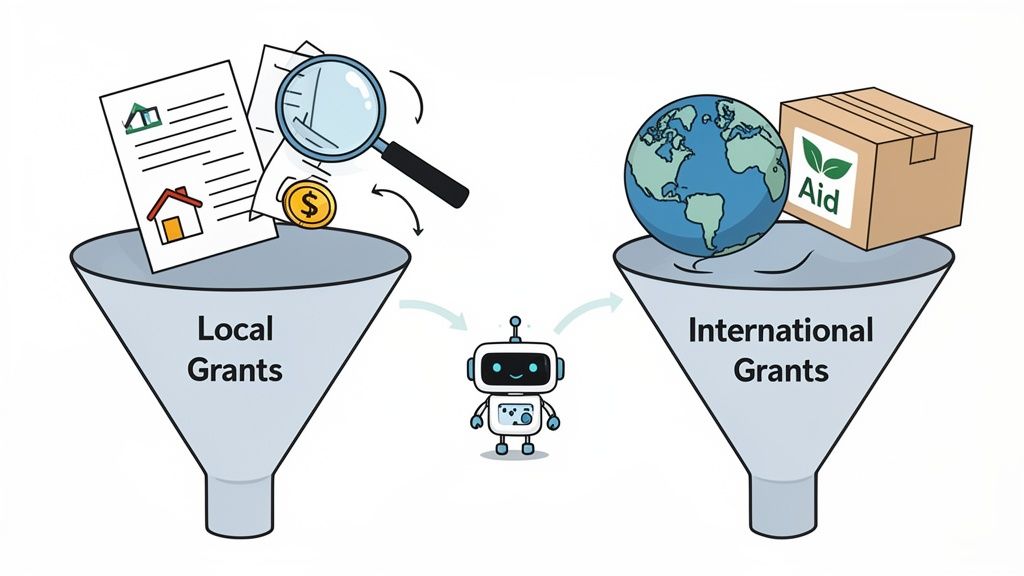
By filtering grants based on your specific programs and mission, these systems give you a ready-made pipeline of funders who are already interested in what you do. It saves an incredible amount of time. We dive much deeper into these methods in our guide on how to find grants for nonprofits.
For a domestic nonprofit, the real strategic win isn't chasing massive international grants. It's about efficiently dominating the local and national funding scene. This is where AI offers a huge advantage, automating the search, eligibility checks, and even writing for the grants you actually have a shot at winning.
In the end, it all comes down to a strategy that fits your reality. An NGO needs a global fundraising machine. A domestic nonprofit needs a smart, efficient system to consistently win the thousands of federal, state, and foundation grants available right here in its own backyard.
Frequently Asked Questions About NGOs and Nonprofits
It's easy to get tangled up in the terminology. Let's clear up some of the most common questions people have when trying to understand the difference between an NGO and a nonprofit.
Can a Nonprofit Organization Also Be an NGO?
Yes, and this is where most of the confusion comes from. At its heart, every NGO is a nonprofit because its primary goal isn't to generate profit for private shareholders. The real difference is all about scope and perception.
Think of it this way: "nonprofit" is often the legal, domestic term. For instance, an organization with 501(c)(3) status in the U.S. is legally a nonprofit. But once that same organization starts working on projects in other countries, the international community will almost always refer to it as an NGO.
Do NGOs and Nonprofits Face Different Tax Implications?
Absolutely. The tax situation is a perfect example of their core difference in action. A domestic nonprofit typically answers to one primary tax authority, like the IRS in the United States, along with state-level regulations.
An NGO, on the other hand, wades into much deeper water. It has to navigate the unique tax laws of every single country it operates in. This means dealing with multiple sets of rules for everything from local staff payroll to the complexities of transferring funds across international borders. The compliance burden is significantly higher.
The core difference is singular versus multiple tax jurisdictions. A nonprofit answers to one country's tax authority, while an NGO must satisfy the financial and legal requirements of many.
Is It Better to Start a Nonprofit or an NGO?
There’s no "better" choice—only the right choice for your mission. It all comes down to the geographic scale of your work.
- Start a nonprofit if your work is focused on a community within a single country. This structure keeps things simpler and aligns perfectly with local and national funding opportunities.
- Start an NGO if your vision is international from day one. If you're tackling issues like global health crises, cross-border environmental protection, or international human rights, the NGO framework is built for that kind of operation.
Getting this right from the beginning sets up your entire legal and operational structure for success. It ensures your foundation matches your ambition.
At Fundsprout, we empower U.S. nonprofits to master their domestic funding strategy. Our AI-powered platform automates grant discovery, eligibility screening, and proposal writing, helping you secure the funding you need to focus on your mission. Discover how we can help at https://www.fundsprout.ai.
Try 14 days free
Get started with Fundsprout so you can focus on what really matters.