Engineering Change Order for Nonprofit Success
Learn how an engineering change order (ECO) helps nonprofits manage project scope, stay compliant, and protect grant funding. Essential guide for leaders.


Abdifatah Ali
Co-Founder
Your project is moving well until one detail changes everything.
A contractor tells you the specified flooring for your grant-funded community health site is no longer available. Your IT lead says the tablets approved for field intake will not support the software your program promised. A funder-approved budget assumed one type of equipment, but your team now needs another to meet safety or accessibility requirements.
Many nonprofit teams treat moments like this as one-off problems. They email a few people, make a quick call, update a spreadsheet, and keep going. That feels efficient. It often is not.
When a funded project changes, you are not just swapping one item for another. You may be changing scope, budget assumptions, timelines, procurement records, staff training plans, reporting obligations, or promised outcomes. That is where an engineering change order becomes useful, even outside manufacturing.
Think of it as a formal detour map. You still want to reach the same destination. You just need a documented route that shows what changed, why it changed, who approved it, and how the project will stay compliant.
For nonprofits, this matters in capital projects, technology implementations, fleet purchases, facility upgrades, and any grant-supported initiative with specific deliverables. If your team has ever wondered whether a change is “big enough” to document, that question alone is a sign you need a clearer process. Good nonprofit project teams do not avoid change. They control it.
If your organization is still building its project discipline, this practical guide to nonprofit project management is a helpful companion. It gives broader structure around planning, roles, and execution, which makes change control much easier.
The Unexpected Detour in Your Grant Project
A neighborhood nonprofit receives a grant to renovate part of its building into a youth wellness hub. The proposal is strong. The budget is approved. The timeline is tight, but manageable.
Then three issues hit at once.
The originally specified HVAC unit is backordered. The architect says a substitute model could work, but it needs a different mounting layout. The program team adds that the room will now host more evening use than first planned, which may change ventilation needs. Finance asks the obvious question. Does this still fit the grant budget and procurement rules?
This is the point where many teams drift into confusion.
When a simple substitution is not simple
On paper, the change looks minor. Replace one unit with another. In practice, the ripple effects spread fast:
- Facilities: The installation details may change.
- Finance: The vendor quote may change.
- Programs: Room usage assumptions may change.
- Compliance: The grant file may need updated approvals.
- Leadership: Someone must decide whether the project is still aligned with what the funder approved.
A nonprofit does not need factory language to face a factory-style problem. It still needs a disciplined way to evaluate change before acting on it.
The nonprofit version of an engineering change order
In industrial settings, an engineering change order is a formal method for changing a design, component, or process. For nonprofits, the same idea applies when a funded project needs a documented adjustment to a planned deliverable.
That could include:
- A capital project change such as substituting materials, equipment, or site layout
- A technology change such as replacing a database platform or altering system requirements
- A program delivery change such as revising how services are delivered because approved tools or partners changed
- A compliance-driven change such as updating procedures after a policy or regulatory shift
Tip: If a change affects what you promised, what you will spend, when you will deliver, or how you will prove compliance, treat it as a formal change request.
This is why an engineering change order is not just an engineering document. It is a governance tool. It protects your mission by protecting your execution.
What an Engineering Change Order Really Is
An engineering change order is the formal record that says, “We are proposing a change to an approved plan, and we will not rely on memory or hallway conversations to manage it.”
The easiest analogy is a contract amendment. The original project plan is your signed agreement with reality. An engineering change order is the official amendment when reality shifts.
Think amendment, not suggestion
A casual note says a team wants to change something. An engineering change order says the organization has documented the proposed change, reviewed its effects, and decided what happens next.
That matters because projects collect assumptions. A drawing assumes a material. A budget assumes a vendor. A timeline assumes a sequence. When one assumption moves, others move with it.
A proper engineering change order creates an auditable trail with items like:
- What is changing
- Why the change is needed
- Which deliverables, items, or requirements are affected
- Who reviewed the impact
- Who approved or rejected the change
- What actions must happen after approval
For a nonprofit, this may apply to a building plan, software configuration, vehicle spec, classroom equipment package, or even a revised service model tied to a grant commitment.
The key distinction that confuses people
Not every change deserves the same level of scrutiny.
A Class I, or Major, engineering change order affects form, fit, or function, making the changed part non-interchangeable with the original. That definition comes from Tractian’s glossary on Class I engineering change orders. In regulated environments, these changes require broader review because they can create compatibility, safety, or performance problems if handled poorly.
For nonprofit readers, translate that language this way:
| Change type | What it means in nonprofit terms | Example |
|---|---|
| Major change | The change alters what the project is, how it works, or whether it still matches the approved design | Replacing planned medical intake equipment with a different system that changes workflow, training, and data capture |
| Minor change | The change does not materially alter function and can be swapped without wider consequences | Changing cabinet finish or paint color in a facility project |
Form, fit, and function in plain language
These three words sound technical, so they trip people up.
Form
This is the physical or structural nature of the thing.
If your grant funded a mobile clinic with a specific equipment layout and the substitute equipment takes more space, the form changed.
Fit
This asks whether the new item works with the surrounding system.
If a replacement server does not fit your current setup, vendor contract, or cybersecurity requirements, the fit changed.
Function
This asks what the item or process does.
If your original software supported multilingual intake and the substitute tool does not, the function changed.
Key takeaway: If the change affects form, fit, or function, stop treating it like routine purchasing. It likely needs formal review.
When to trigger an engineering change order
Many teams wait too long. They think they need certainty before documenting a change. They do not.
Trigger the process when any of these appear:
- A material or equipment substitution may alter cost, schedule, or deliverables
- A design revision changes how a facility, system, or program component will work
- A compliance issue forces a revision to approved plans
- A vendor limitation creates a mismatch between what was proposed and what can be delivered
- A safety or quality concern requires redesign or rework
A good rule is simple. If the project cannot continue responsibly without answering “What changes downstream if we approve this?”, you need an engineering change order.
The Anatomy of an Effective ECO Process
Most failed change control does not fail because the team lacks good intentions. It fails because nobody knows the sequence, the decision rights, or the documentation standard.
A workable engineering change order process is not mysterious. It is a chain of small, disciplined actions.
Early in the process, it helps to orient everyone around the same workflow.
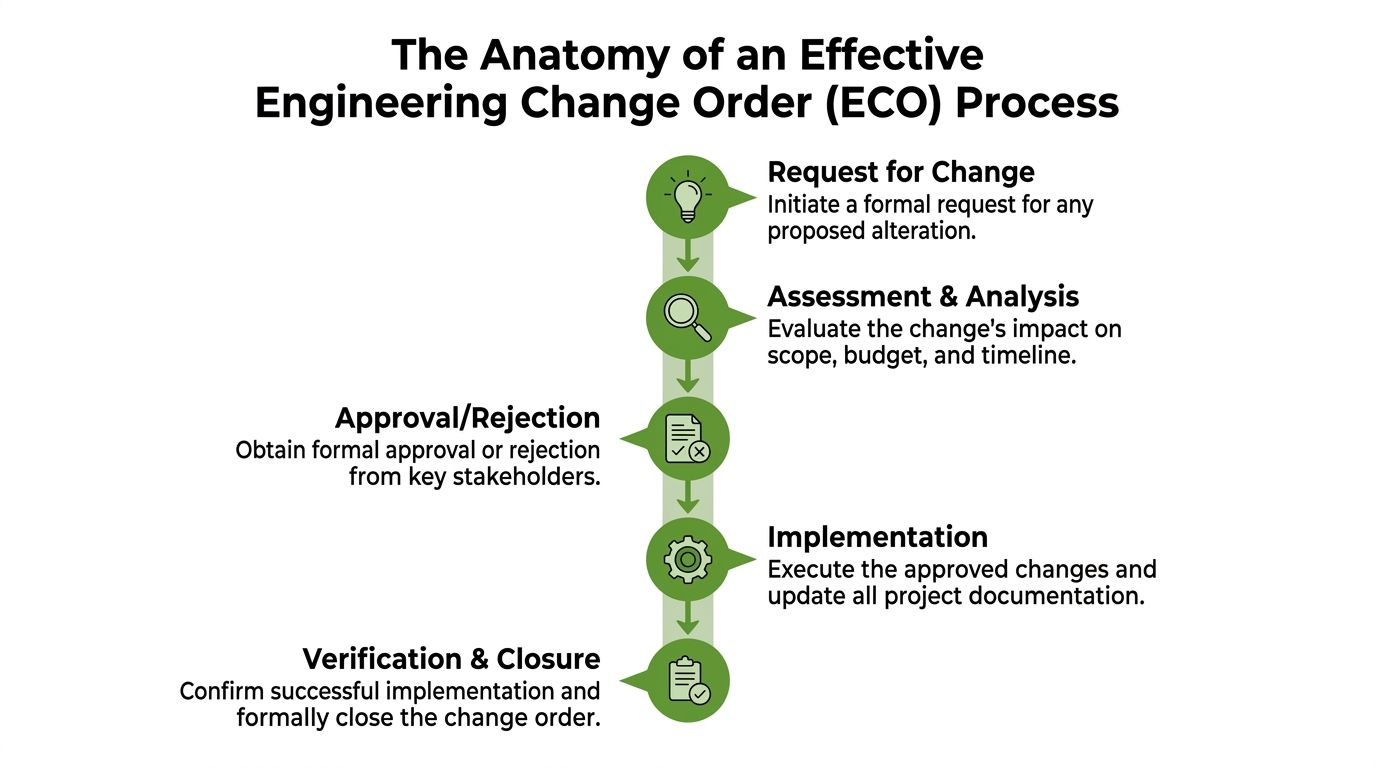
Step one starts with a formal request
Somebody has to raise the flag.
That person may be a project manager, site supervisor, IT lead, program director, or finance manager. The request should not wait until every answer is known. It should capture the issue while facts are still fresh.
A solid request includes:
- The problem statement
- The item, system, or deliverable affected
- The reason the change is being proposed
- The urgency
- Any immediate risk if the team does nothing
For nonprofits, this can be as simple as a standardized form in Google Forms, Microsoft Forms, Airtable, or a shared document template.
Impact analysis is where serious teams slow down
This is the heart of the process.
A thorough impact and risk analysis should assess quality, compliance, cost, and supply chain effects. The verified guidance in eLeaP’s engineering change order in QMS guide notes that weak analysis can create cascading failures, including tooling updates costing 20-50% of the ECO budget, schedule slips averaging 2-4 weeks, and that PLM-integrated systems have been shown to cut ECO cycle times by 30-50% when the analytical process is standardized.
Nonprofits may not use factory tooling, but the lesson transfers directly. A change that looks local often creates secondary work in procurement, training, reporting, configuration, and recordkeeping.
Questions your team should answer
- Scope: Does this change alter what we promised to deliver?
- Budget: Does it affect grant-allowed costs, match requirements, or vendor pricing?
- Schedule: Will this change delay procurement, installation, launch, or reporting?
- Compliance: Does the grantor need notice or approval first?
- Operations: Will staff need retraining, new SOPs, or new support arrangements?
- Stakeholders: Who must know before the change is implemented?
Tip: Ask finance and compliance to review before leadership approves. That order prevents “approved in principle” changes that later become impossible to charge correctly.
Approval needs a real decision body
Every organization needs a right-sized version of a Change Control Board, often shortened to CCB.
In a nonprofit, that board may include:
| Role | What they review |
|---|---|
| Executive Director or COO | Mission fit, authority, external risk |
| Program Manager | Service delivery impact |
| Finance Lead | Budget, allowability, vendor implications |
| Operations or Facilities Lead | Practical implementation |
| Compliance or Grants Lead | Funder terms, documentation, approvals |
| IT Lead or Technical Lead | System compatibility and support |
| Funder representative when required | Formal approval for material changes |
The board does not need to be large. It does need to be clear. Confusion about who can approve a change is one of the fastest ways to create rework.
A short explainer can also help new team members understand the flow before they join a review meeting.
Implementation is controlled, not casual
Approval is not the finish line. It is the starting signal.
Once approved, someone must update the documents that drive execution. That can include purchase orders, statements of work, floor plans, inventory lists, project schedules, grant files, training materials, and board or funder communications.
Three controls matter here:
- Version control so staff use the current plan.
- Effectivity so everyone knows when the new change takes effect.
- Assignment so each action has an owner and due date.
Closure means proving the change worked
The final step is easy to skip. Do not skip it.
Closure should confirm that the approved change was implemented, supporting documents were updated, stakeholders were informed, and the project record now tells a complete story. If you ever face a funder question, audit request, staff transition, or project dispute, that closure record becomes gold.
Why Formal Change Control Matters for Nonprofits
Nonprofit teams often resist formal change control for understandable reasons. They are lean. Staff wear multiple hats. Deadlines are real. A documented engineering change order can look like a luxury process built for giant manufacturers.
It is not.
It is a budget protection tool, a compliance tool, and a communication tool. For grant-funded work, it is often the difference between a manageable adjustment and a messy explanation later.
Change still costs money, even when nobody budgets for it
Large contract environments treat change as an expected expense, not a surprise. The Air Force Institute of Technology recommends budgeting 13.25% of contract value during Development and 5.5% during Production for changes in complex projects, based on historical analysis in its thesis on engineering change proposal estimating factors.
A small nonprofit should not copy defense budgeting formulas into every grant application. That is not the lesson.
The lesson is simpler. Experienced project environments assume change will happen and plan for it. In nonprofit work, leaders often do the opposite. They treat change as exceptional, then scramble when it appears.
Informal change is expensive in quieter ways
When teams do not use formal change control, they usually pay through confusion rather than a single dramatic invoice.
You see it when:
- Procurement orders the old item because nobody sent the approved revision
- Program staff train on the wrong process because the updated workflow lives in one person’s inbox
- Finance codes costs inconsistently because the budget narrative was never revised
- The funder hears about the change late and asks why it was not disclosed earlier
That is why it helps to distinguish change management and change control in practical terms. Change management is about helping people adopt a new reality. Change control is about deciding, documenting, and governing the change itself. Nonprofits need both.
Audit readiness is not optional
A grant file should tell a clean story.
If the approved project changed, an auditor, grant manager, or board member should be able to answer these questions quickly:
| Question | What your documentation should show |
|---|---|
| What changed? | The original plan and the approved revision |
| Why did it change? | A documented reason and supporting context |
| Who approved it? | Named decision-makers and dates |
| What did it affect? | Budget, schedule, scope, compliance, or operations |
| Was the funder informed? | Communication record, if required |
If your current records cannot do that, your process is too informal.
For teams trying to strengthen documentation across the grant lifecycle, a structured approach to grant compliance tracking software can help connect budgets, deadlines, approvals, and reporting records in one place.
Key takeaway: A formal engineering change order process is not bureaucracy added to the project. It is the record that keeps the project defensible when plans shift.
Practical ECO Workflows for Grant-Funded Projects
A realistic nonprofit example makes this easier.
A community health organization wins a grant to launch a mobile health clinic. The approved project includes onboard refrigeration for vaccines, patient intake tablets, a compact exam station, and a specific power setup inside the vehicle.
Midway through procurement, the operations lead learns that the originally selected refrigeration unit is unavailable. A substitute is available, but it draws power differently and requires a revised interior layout. That means the electrical plan, equipment placement, vendor quote, and staff workflow may all shift.
This is a classic engineering change order situation.
How the workflow unfolds
The operations lead opens a change request. The request states the original unit is unavailable, identifies the proposed substitute, and flags possible impacts on layout and electrical load.
The project manager then gathers the review group. Program staff want to know whether patient flow will change. Finance checks whether the substitute remains an allowable cost under the grant. The vehicle outfitter reviews space and installation effects. The compliance lead checks whether the grantor must approve the revision before purchase.
No one asks only, “Can we buy this instead?” They ask, “What else changes if we do?”
That is the shift in mindset.
A sample ECO form you can adapt
You do not need expensive software to start. You need consistency. A simple template can live in Google Sheets, Airtable, Asana, Trello, Microsoft Lists, or your grants folder.
Sample Nonprofit ECO Form Template
| Field | Description | Example |
|---|---|
| ECO Number | Unique identifier for the change record | ECO-2026-004 |
| Project Name | Name of the grant-funded project | Mobile Health Clinic Launch |
| Request Date | Date the change was submitted | May 12, 2026 |
| Requested By | Person initiating the change | Operations Manager |
| Change Summary | Short plain-language description | Replace specified vaccine refrigerator with approved alternative model |
| Reason for Change | Why the original plan no longer works | Original unit unavailable from vendor |
| Affected Deliverables | Which project items or outputs are touched | Vehicle layout, electrical setup, procurement package |
| Budget Impact | Expected cost change or note if under review | Under finance review |
| Schedule Impact | Expected timeline effect | Installation sequence may shift |
| Compliance Impact | Funder approval or internal policy implications | Grants lead reviewing sponsor approval requirement |
| Alternatives Considered | Other options and why they were rejected | Delay purchase, source used unit, revise equipment package |
| Review Team | Functions involved in analysis | Programs, Finance, Operations, Compliance, Vendor |
| Decision | Approved, rejected, or deferred | Approved pending funder notice |
| Decision Date | Date of final decision | May 19, 2026 |
| Implementation Owner | Person responsible for execution | Project Manager |
| Documentation Updated | Files that must be revised | Budget file, equipment list, vendor scope, grant record |
| Closure Date | Date implementation was verified | May 30, 2026 |
What happens in the approval meeting
A useful approval meeting is short and specific.
The project manager walks through five questions:
- What exactly is changing?
- Why is the change necessary now?
- What are the effects on budget, schedule, and deliverables?
- Does the funder need notice or approval?
- What must be updated if the change is approved?
The finance lead may approve the cost treatment but request a revised coding note. The compliance lead may say the grantor must be informed before purchase. The program director may confirm the service model remains intact. Leadership then approves the change with conditions.
That is a healthy decision. It is neither rushed nor overbuilt.
Tip: Record conditional approvals clearly. “Approved pending funder notification” is very different from “approved for immediate purchase.”
Tools nonprofits can use without overcomplicating things
A small organization can run a strong engineering change order process with common tools:
- Google Sheets or Microsoft Excel: Good for a change log and status tracking
- Asana or Trello: Good for assigning implementation tasks after approval
- Google Drive or SharePoint: Good for version-controlled supporting documents
- Email plus a standard subject line convention: Good for keeping approvals searchable
- A grants platform: Useful when the change touches reporting, deadlines, and sponsor communication
Teams that want a single record for project and grant materials often look for clearer workflows around grant management for nonprofits, especially when one project touches budgets, funder correspondence, internal approvals, and reporting schedules at the same time.
The final step that is often forgotten
After the substitute refrigerator is installed, the project manager closes the ECO only after confirming the updated equipment list is saved, procurement records match the final purchase, staff know the revised layout, and the grant file includes the sponsor communication.
That last part matters.
If a board member, auditor, or new staff lead asks six months later why the mobile clinic differs from the original proposal, the answer is not buried in memory. It is documented.
Best Practices and Common Pitfalls
The best engineering change order systems feel boring in the best sense. People know when to use them, who decides, and how long decisions usually take.
The worst systems create two opposite failures at once. Small changes get trapped in unnecessary review, while urgent major changes skip review entirely.
Best practices that keep the process usable
A change process only works when staff trust it enough to use it early.
Define thresholds in plain language
Write down what kinds of changes require an engineering change order.
Examples might include changes to approved equipment, facility specifications, software functionality, major vendors, timeline commitments, or budget categories tied to funder approval. If the threshold lives only in leadership’s head, staff will guess.
Keep the review group right-sized
Not every issue needs the full leadership team.
A simple change can route to program, finance, and operations. A larger change can go to the full decision group. This keeps the process moving without lowering standards.
Protect capacity at the bottleneck
Loch and Terwiesch showed that ECO queues become dangerous when utilization gets very high. Their queueing model shows the ratio u/(1-u) jumps from 9 at 90% utilization to 19 at 95% utilization, and they observed a bottleneck station at 92.5% utilization in their study of ECO processing, underscoring how delays escalate sharply as teams approach full capacity in their research on engineering change orders and project delays.
For nonprofits, the lesson is practical. If every change waits on one overbooked executive, approvals will pile up. Build backup reviewers, scheduled review windows, or delegated authority for lower-risk items.
Tip: A slow approval lane creates project delay even when the change itself is simple. Protect reviewer capacity like you protect budget.
Pitfalls that create chaos fast
Some errors are more common than others.
- Rubber-stamping requests: Approval without real impact analysis turns the ECO into paperwork theater.
- Allowing “urgent” bypasses: Teams remember the shortcut and reuse it later.
- Forgetting downstream documents: The change gets approved, but the budget, schedule, or SOP never gets updated.
- Treating all changes alike: One size fits none. Major changes need more scrutiny than cosmetic ones.
- Waiting for perfect information: Teams delay opening a request because they want complete certainty first.
A healthy process is lean, not loose
The right goal is not maximum control. It is reliable control.
That means:
| If your process feels like this | Adjust by doing this |
|---|---|
| Every request becomes a leadership meeting | Set approval tiers |
| Approvals sit in inboxes | Create review deadlines or weekly review blocks |
| Staff avoid the process | Simplify the form and define triggers clearly |
| Records are scattered | Store decisions and attachments in one system |
| Changes keep reappearing as surprises | Encourage early flagging, not late rescue |
An engineering change order process should help staff act sooner, not scare them into silence.
ECOs and Grant Compliance in 2026
Many nonprofit leaders still think of an engineering change order as a technical device for builders, manufacturers, or IT teams. That view is too narrow for grant-funded work.
A formal change process is also a compliance discipline.
A January 2025 Executive Order revoked EO 11246 and changed the compliance environment for federal contractors and grant recipients, while other non-discrimination obligations still remain in place. The verified guidance provided for this article notes that nonprofits may now need to certify they are not engaging in certain DEI programs while still complying with other statutory requirements, which creates a need for formal documentation of program changes made in response to that evolving environment, as reflected in the referenced summary at Wikipedia’s engineering change order page.
That matters because regulatory shifts do not always arrive as neat grant amendments. Sometimes they force internal policy review, revised program language, adjusted training, changed partner expectations, or updated proposal and reporting practices. Those are controlled changes, even if nobody calls them engineering.
The compliance question nonprofits should ask
When a rule changes, ask this immediately:
What in our funded work must now change, and where will we document that decision?
That question belongs in the same discipline as an engineering change order.
A nonprofit may need to revise:
- Program procedures
- Training materials
- Vendor or partner requirements
- Grant narratives or certifications
- Internal review and sign-off records
For organizations tightening governance around regulatory documentation, a practical external reference like this small business compliance checklist can help teams think through how policy shifts translate into operational records and responsibilities.
The larger point is simple. In 2026, grant compliance is not just about submitting reports on time. It is about showing how your organization responded, documented, approved, and implemented change when the rules moved under your feet.
Fundsprout helps nonprofits handle the full grant lifecycle, from finding aligned funding to managing proposal requirements, reporting, and compliance records in one place. If your team wants a clearer way to track changes, deadlines, approvals, and documentation across grant-funded projects, explore Fundsprout.
Try 14 days free
Get started with Fundsprout so you can focus on what really matters.