Winning Dr Scholl Foundation Grants in 2026
Get Dr Scholl Foundation grants for your nonprofit. Discover funding areas, application process, and tips to secure $5k-$25k in 2026. Apply now!

Abdifatah Ali
Co-Founder
You’re probably staring at the Dr. Scholl Foundation guidelines with the same question most nonprofit teams ask: is this one of those foundations that funds almost everything a little, or one that only funds a very specific kind of project and leaves everyone else guessing?
That uncertainty is normal. The public information gives you the basics, but it doesn’t tell you much about the board’s taste, what makes one LOI rise above another, or why some perfectly eligible proposals never move forward. That’s where most organizations lose time. They submit something technically correct, but strategically flat.
For dr scholl foundation grants, the difference usually comes down to fit, framing, and restraint. This funder appears to like organizations that can describe a real problem clearly, ask for a sensible amount, and show that the grant will support work with visible community value. Big language, inflated promises, and fuzzy budgets tend to work against you.
Understanding the Dr Scholl Foundation Mission and Scale
The Dr. Scholl Foundation matters because it’s not a small family fund handing out occasional checks. It was established in 1947 by William M. Scholl, M.D., and by 2024 its assets exceeded $207 million. In the same year, it made 365 grants totaling $8,110,000, with an average grant of about $22,200, according to the Dr. Scholl Foundation’s published information. That tells you two useful things immediately.
First, this is a real institutional prospect, not a vanity lead. Second, the foundation’s activity level suggests it supports many organizations, but usually at practical grant sizes rather than headline-making awards.
What their scale means for applicants
A lot of nonprofits misread mid-sized foundation grants. They see strong assets and assume they should build an ambitious ask around expansion, staffing growth, or a broad new initiative. That’s often the wrong move.
The better interpretation is this: the foundation has the capacity to fund consistently, but its pattern points toward disciplined, usable philanthropy. It appears more interested in supporting concrete work than in underwriting vague institutional aspiration.
That matters when you decide what project to put forward. A focused request for a clearly bounded program usually feels more in step with this kind of funder than a sweeping pitch built around organizational transformation.
Practical rule: Treat the foundation like a serious, values-driven grantmaker that rewards clarity and grounded execution, not theatrical need statements.
The worldview behind the funding
The foundation is commonly associated with values such as innovation, practicality, hard work, and compassion in third-party descriptions of its program. Those words are broad, but they still reveal a lot.
“Innovation” here probably doesn’t mean novelty for its own sake. It usually works better to present innovation as a better delivery method, stronger access model, or more effective program design. “Practicality” matters just as much. If your proposal reads like a theory paper, it will likely feel weak. If it reads like a plan a board can picture being carried out well, you’re closer.
Use that lens when you assess your fit:
- Mission fit: Your work should sit naturally inside a recognized charitable area rather than forcing a connection.
- Operational credibility: The proposal should show that your team can execute what it promises.
- Human benefit: The foundation’s pattern suggests interest in work that produces direct public value.
- Reasonable scope: A contained, believable request is often more persuasive than a sprawling one.
Some nonprofits should walk away early. If your program is hard to explain in plain language, if your outcomes are mostly conceptual, or if the ask depends on several uncertain moving parts, this may not be your best lead.
That’s why I usually tell clients to start with fit before they start writing. A useful grounding resource is this guide to foundation grants for nonprofit organizations, because it helps teams separate broad interest from true funder alignment.
Who should take this funder seriously
Three kinds of organizations tend to have the strongest starting position.
One is the nonprofit with a mature program and a specific funding need. Another is the community-based organization that can show a direct link between the grant and public benefit. The third is the institution with a well-defined initiative that fits the foundation’s established categories without requiring the board to stretch.
The weakest applicants are usually not underqualified. They’re under-disciplined. They ask the foundation to infer too much.
Decoding Their Funding Priorities and Programs
The quickest way to understand dr scholl foundation grants is to ignore the broad language for a moment and look at where the money has gone. Over the past decade, 28% of grants went to education, 28% to social services, 22% to hospitals and healthcare, and 17% to civic and cultural projects, according to Duke Research Funding’s summary of the foundation’s grant distribution.
That pattern is useful because it’s consistent enough to help you self-screen. It doesn’t guarantee funding in those categories, but it does tell you where the board has repeatedly shown comfort.
Dr. Scholl Foundation granting areas at a glance 2026
| Funding Category | Historical Allocation | Typical Grant Range | Example Funded Projects |
|---|---|---|---|
| Education | 28% | $5,000 to $25,000 | Leadership development, student support, educational access initiatives |
| Social Services | 28% | $5,000 to $25,000 | Community service programs, direct assistance, local support initiatives |
| Hospitals and Healthcare | 22% | $5,000 to $25,000 | Palliative care education, diabetes-related work, pediatric psycho-oncology training |
| Civic and Cultural | 17% | $5,000 to $25,000 | Democracy initiatives, civic participation, cultural and public-interest programs |
What strong alignment looks like
If you’re in education, the foundation’s history suggests it likes projects that solve an identifiable access, training, or leadership problem. A proposal tied to a specific student population or practical educational intervention usually reads better than one centered on general institutional support with no program edge.
If you’re in social services, direct benefit matters. The strongest concepts usually involve clear service delivery, not abstract systems language. Boards often respond better to “here is the service, here is who receives it, here is why the grant matters now” than to long descriptions of cross-sector theory.
Healthcare applicants need to pay attention to form. The healthcare category is significant, but not dominant. That means hospitals, clinics, and health nonprofits should avoid assuming category strength will do the work for them. The proposal still has to feel concrete, bounded, and useful.
The hidden screen most applicants miss
The percentages tell you more than category preference. They also reveal an implicit review habit. The foundation seems to favor broad social utility within familiar charitable lanes.
That creates a practical screen:
Is the problem easy to understand?
If your first paragraph requires field-specific vocabulary, simplify it.Does the project produce visible public value?
Reviewers should be able to explain your program to another board member in plain speech.Is the grant request proportional to the project?
If the request feels oversized for the work described, credibility drops.Would this still look compelling without jargon?
If not, the idea may be weaker than the writing suggests.
A common mistake is assuming “innovative” means unusual. For many foundations, it means useful, timely, and well-designed.
Examples of fit by category
Here’s how I’d pressure-test common proposal types.
Strong education fit
A program that equips students, teachers, or emerging leaders through a defined intervention and a clear delivery plan.
Strong social services fit
A direct service model that addresses a practical community need with an understandable path from funding to service.
Stronger healthcare fit than basic equipment requests
Training, care access, and patient-support initiatives often make a cleaner case than requests that read like routine operating replacement.
Stronger civic and cultural fit
Projects that connect culture or civic engagement to public benefit tend to make a better case than programming that feels inward-facing or prestige-oriented.
What doesn’t work as well? Proposals that sit on the margins of these categories and rely on clever wording to appear aligned. Reviewers can spot category-stretching. If your project needs a long explanation for why it belongs, it probably doesn’t belong.
How to use the categories strategically
Don’t just identify your category. Build your narrative around the category logic.
For example, if you’re a youth arts organization, you may be tempted to frame yourself as cultural because that’s your identity. But if student development and access are central to the proposal, the education frame may be stronger. If you’re a hospital-affiliated nonprofit requesting support for patient navigation, the healthcare lane may be right, but only if the proposal keeps the emphasis on service and outcomes rather than institutional prestige.
Many first-time applicants waste a cycle. They describe their organization accurately but frame the project weakly. Accuracy matters. Strategic framing matters just as much.
Navigating Eligibility and Application Cycles
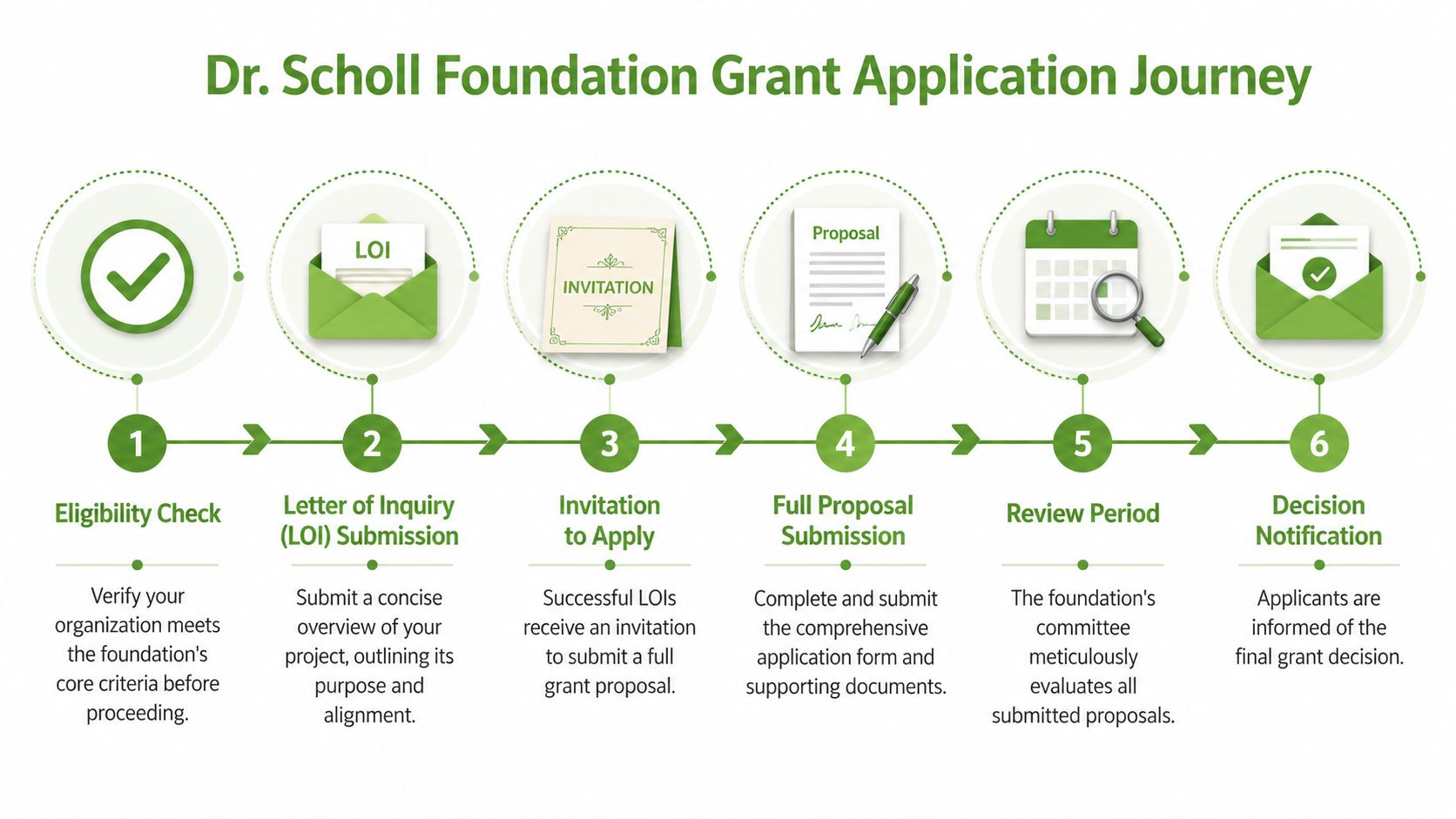
A strong fit won’t save a sloppy process. Dr scholl foundation grants use a structured application path, and teams that ignore the mechanics often knock themselves out before the board ever weighs the substance.
The process is a mandatory two-stage cycle. A Letter of Inquiry opens October 1 and is reviewed within five business days, invited applicants submit a full proposal by March 1, and final decisions are communicated in October, creating a nine-month cycle, according to this Dr. Scholl Foundation application overview.
The rules that deserve your attention
The public guidance makes a few constraints clear, and these aren’t the kind you can finesse later.
- Two-stage entry is mandatory: You don’t skip to the full proposal. The LOI is the gate.
- One organization, one shot each year: If your team submits the wrong project, you can’t usually fix it with a second attempt in the same cycle.
- Timing discipline matters: The review window on the LOI is fast, but the overall cycle is long.
- U.S.-based work is the core focus: Some international support exists, but most nonprofits should treat this as primarily a U.S. funder unless they have an unusually clear reason otherwise.
That one-application rule changes strategy. Don’t send the most exciting idea on your whiteboard. Send the project with the cleanest fit, clearest case, and strongest internal readiness.
A practical calendar for your team
Most organizations get into trouble because they treat March 1 as the main deadline. It isn’t. Your real deadline is the date by which your internal team has chosen the right project and shaped a sharp LOI.
Use a working sequence like this:
Before October 1
Confirm eligibility, pick one project, and settle the funding rationale.When the LOI window opens
Submit only after the draft has been reviewed by someone who can spot category drift, jargon, and ask-size mismatch.After invitation
Build the full proposal early. Don’t assume you can repurpose a general case statement and budget narrative.Before March 1
Review attachments, numbers, naming consistency, and board-facing readability.During the long review period
Keep internal records organized. If funded, you’ll want the same materials ready for stewardship and reporting.
What works: a prepared team that treats the LOI as a strategic document.
What fails: a rushed LOI built from a generic grant summary and submitted because “we can explain more later.”
Where eligibility questions usually go wrong
The biggest issue isn’t formal ineligibility. It’s practical misalignment disguised as eligibility.
A nonprofit might technically qualify, but still be a weak candidate because:
- The project isn’t distinct enough from general operations.
- The benefit is too diffuse to explain cleanly.
- The request depends on future contingencies the board can’t evaluate.
- The team hasn’t chosen a single priority and tries to blend multiple initiatives into one ask.
That last one is common with executive directors who need funding in several areas. They try to roll staffing, program supplies, outreach, and evaluation into one narrative. The result feels blurred.
Treat the LOI like a board memo
The five-business-day review window should tell you something important. The LOI probably needs to work quickly. Reviewers won’t have patience for throat-clearing.
Write it so someone can answer four questions fast:
- What does the organization do?
- What specific project needs funding?
- Why does this matter now?
- Why is this a sensible request for this foundation?
If your LOI can’t do that in a short read, it probably isn’t ready.
Crafting a Proposal That Gets Noticed
Most dr scholl foundation grants are probably won or lost before the board reaches any internal scoring conversation. Public sources don’t disclose the foundation’s exact rubric or LOI-to-invite rate, and a Vanderbilt limited-submission notice discussing the program notes that this lack of specificity makes proposal framing critical. That same source says third-party analysis suggests typical foundation success rates are often under 10%.
That doesn’t mean you should write defensively. It means you should write precisely.
The four qualities your narrative should project
The foundation’s public-facing language points repeatedly toward innovation, practicality, hard work, and compassion. If you want your proposal to feel right for this funder, those ideas should appear in substance, not just as labels.
Innovation that feels usable
Don’t write, “Our model is unique because no one else is doing this exact work.”
That’s weak. It invites skepticism.
Instead, show innovation through design choices. Maybe you’re reaching a population in a way that removes barriers. Maybe you’re improving service delivery. Maybe you’re adapting a proven model for a setting that needs it. The point is to make the improvement visible.
Practicality that lowers doubt
Practicality is often what separates a shortlist proposal from an admired rejection. A practical proposal answers obvious board questions before they’re asked.
Use plain language to show:
- what the grant pays for
- who receives the benefit
- how the work will happen
- why your organization can carry it out now
If your budget and narrative don’t line up tightly, the proposal stops feeling practical.
Hard work without self-congratulation
Boards don’t need a speech about how dedicated your staff is. They need evidence that your organization has done the hard work of planning.
That comes through in disciplined choices. A defined scope. A realistic timeline. A budget that doesn’t hide behind broad categories. A project lead who makes sense. A request that matches your capacity.
Compassion with edges
Compassion works best when it’s specific. Avoid generic claims about caring profoundly for the community. Describe the actual burden your participants face and the actual relief the program creates.
The strongest need statements are human, not sentimental. They respect the people served and explain the problem without turning the organization into the hero.
What a board-friendly proposal sounds like
I often rewrite draft language in one of two directions: less inflated or less internal.
Here are examples of stronger framing.
- Instead of saying your program is “transformational,” explain what changes for participants in concrete terms.
- Instead of saying demand is “overwhelming,” describe the gap your organization is positioned to address.
- Instead of saying the grant will “expand impact,” explain what activity will become possible because the grant is awarded.
This short resource on proposal writing steps is useful for teams that need a clean process for drafting and review, especially when different staff members own different sections.
Build the case in this order
A persuasive proposal for this foundation usually reads best when built from the ground up.
Start with the problem
Keep it concrete and local to your work.Name the intervention
Describe the program or initiative in operational terms.Show why your organization is the right vehicle
Focus on credibility, not biography.Tie the ask to action
Make the use of funds easy to picture.Close with benefit
End with what the grant will enable for people or community, not with internal organizational language.
A lot of teams do the opposite. They spend half the proposal describing the organization, then rush through the project. For this kind of funder, the project should carry the weight.
Here’s a useful checkpoint before submission.
Budget choices that help instead of hurt
Budgets tell reviewers whether your judgment is sound. An overcomplicated budget can undermine a clear narrative. So can a vague one.
What tends to help:
- Use direct categories: Keep line items understandable to a general reviewer.
- Match budget to narrative: If the proposal emphasizes direct service, the budget should reflect that.
- Avoid padded contingency language: It makes the request feel less disciplined.
- Keep the ask proportional: The foundation funds both modest and larger awards, but your request should feel normal for your program, not aspirational for your organization.
What usually weakens an otherwise good application
Some proposals fail for reasons that aren’t obvious to the writers.
Common problems include:
- Category confusion: The project could fit several areas, but the application never chooses a clear lane.
- Institution-first writing: The proposal sounds like the organization needs support, but never makes the program case strongly enough.
- Unclear success picture: Reviewers finish reading and still can’t tell what a funded year would look like.
- Too much abstraction: The need is real, but the writing hides it under strategy language.
If your team needs a starting point for structure, a nonprofit grant proposal template can help you organize the case before you tailor it to this foundation’s tone and preferences.
Managing Post-Award Reporting and Renewals
If you receive a Dr. Scholl Foundation grant, the work changes shape. You’re no longer persuading. You’re proving that your organization does what it said it would do, and that it’s a reliable steward of foundation money.
That matters for more than compliance. Good post-award management influences whether a funder remembers your organization as disciplined, easy to trust, and worth considering again.
Treat reporting like stewardship
Many nonprofits make a mistake after award. They treat reporting as a deadline problem instead of a relationship tool.
A stronger approach is to document the grant from the start. Save the materials you’ll wish you had later. Keep notes on program adjustments, implementation wins, obstacles, and examples of participant benefit. When reporting season arrives, you won’t be forced to reconstruct the story from old emails and partial spreadsheets.
Stewardship lens: A report shouldn’t just say the money was spent correctly. It should help the foundation see that its grant supported work that was thoughtful, responsive, and well-managed.
What to include in your internal reporting file
Even when a foundation doesn’t publish detailed public reporting standards, I advise clients to maintain a standard grant file with four buckets.
- Program delivery records: What happened, what changed, and what was completed.
- Use-of-funds documentation: A clean record connecting the grant to approved activities or expenses.
- Narrative evidence: Short stories, examples, and observations that show the work in human terms.
- Lessons learned: Not every adjustment is a failure. Smart mid-course decisions often strengthen credibility if explained clearly.
Many small teams often encounter a specific difficulty. Different staff members hold different pieces of the story, and no one consolidates them until the last minute.
Renewal readiness starts early
Some organizations think about renewal only after the grant period ends. That’s too late. Renewal potential begins with how well you execute and communicate during the funded period.
To improve your position for future support:
- Keep promises narrow and visible: It’s easier to demonstrate follow-through on a focused commitment.
- Flag changes early internally: If the program shifts, document why.
- Preserve consistency: The story you tell in reports should line up with the story you told in the application.
- End with a forward-looking but restrained case: Show what remains important without assuming continuation.
Relationship management principles from broader fundraising still apply here. This guide to nonprofit donor retention strategies is useful because it reinforces habits that translate well to foundation stewardship, especially around communication cadence and trust.
Don’t turn the final report into a victory lap
Foundations usually prefer candor over polish. If something didn’t go according to plan, say so plainly and explain the adjustment. A report that sounds too perfect can create doubt, especially if the original project involved real-world service delivery.
For teams juggling multiple grants, it helps to centralize templates, deadlines, and evidence collection in one place. A resource on managing multiple grant reporting requirements can help you build that reporting discipline before renewal season gets messy.
Streamline Your Grant Seeking with Fundsprout
Winning dr scholl foundation grants usually comes down to a few disciplined decisions. Choose the right project. Frame it inside the foundation’s actual funding habits. Write an LOI that gets to the point fast. Build a proposal that sounds practical, compassionate, and credible. Then manage the award carefully enough that future funding stays possible.
None of that is conceptually hard. The main problem is workload.
Executive directors are choosing among multiple funding opportunities at once. Development staff are rewriting similar narratives for different funders. Program leaders are asked for budgets, outcomes, and implementation details on short notice. Reporting requirements pile up while new deadlines keep coming. Many organizations don’t fail because they lack mission clarity. They fail because the grant workflow is fragmented.
That’s where Fundsprout becomes useful as an operating system, not just a writing aid.
Where it helps before you apply
Fundsprout scans foundation, federal, state, and local opportunities daily and ranks them against your programs, geography, and organizational capacity. That matters because a tool should help you eliminate poor-fit opportunities, not just collect more of them.
For a prospect like the Dr. Scholl Foundation, that means your team can evaluate fit earlier and with more structure. Instead of asking whether you could apply, you can ask whether this is the right use of your one annual submission.
Where it helps during writing
The platform’s RFP analyzer breaks requirements into a usable outline, which is especially valuable when a team is moving from LOI strategy to full proposal development. The writing assistant can draft narrative sections in your organization’s voice using uploaded documents, prior language, and impact information, while preserving citations and version control.
That reduces two common problems in foundation work:
- Reinventing every draft from scratch
- Losing consistency across narrative, budget, and attachments
It also helps smaller nonprofits that don’t have a dedicated grant writer. Instead of one person carrying the whole application in their head, the system organizes the moving parts.
Where it helps with timing and team coordination
Fundsprout also gives teams planning tools that map tasks and deadlines visually. That sounds simple, but it solves a very real problem. Grant applications break down when nobody knows what still needs to be gathered, drafted, approved, or reviewed.
For a long-cycle foundation process, that kind of visibility helps your team avoid the familiar pattern of submitting a decent LOI, receiving an invitation, and then scrambling through the full proposal phase.
Where it helps after award
Post-award work is where many teams become reactive. Fundsprout’s reporting features help auto-populate funder templates, track submissions, and maintain an audit trail. That supports stronger compliance and better renewal preparation because the record of what was promised, submitted, and reported stays organized.
That’s especially important for foundations where continued trust matters as much as the initial application.
The practical takeaway
The best grant strategy still requires judgment. No platform can decide your strongest project for you or invent alignment that isn’t there. But the right system can make sure your team spends time on the decisions that matter instead of losing hours to scattered files, duplicated drafts, and avoidable deadline pressure.
If your organization is pursuing selective foundations and wants a more reliable way to research, write, track, and report across the full grant lifecycle, Fundsprout gives you that structure.
If you want a simpler way to find strong-fit opportunities, draft better proposals, and stay on top of reporting without building the whole system manually, take a look at Fundsprout.
Try 14 days free
Get started with Fundsprout so you can focus on what really matters.