Unlock Your Community Grants Fund Potential 2026
Navigate the community grants fund landscape for 2026. Find opportunities, write winning proposals, and secure vital local funding for your nonprofit.

Abdifatah Ali
Co-Founder
Your week probably looks familiar. A program deadline is coming up. A board member wants a funding update. Staff need supplies, rent is due, and someone just forwarded another grant opportunity with the note, “Could we apply for this?” You care about the mission, but the funding side can feel like a second full-time job.
That’s where a community grants fund becomes easier to understand when you stop treating it like a mystery and start treating it like a system. The strongest nonprofits don’t just chase random opportunities. They learn how local funding works, choose grants that fit their capacity, write applications that sound grounded and credible, and then manage awards well enough to earn trust for the next round.
A lot of leaders assume community grants are small, informal, or too relationship-driven to crack. In practice, they’re often one of the most practical funding paths for under-resourced organizations, especially when your work is rooted in a place, a population, or a clear local need.
The Hidden Power of Local Funding
To visualize a community grants fund, consider it a neighborhood investment pool. Different donors, institutions, or public partners put money into a shared funding stream, and that money gets distributed to improve local life. One grant might support after-school mentoring. Another might help a pantry buy equipment. Another could fund planning, outreach, or operating support.
That local focus matters. Funders in this space often care less about polished jargon and more about whether you understand the community, can deliver the work, and can explain why your organization is the right vehicle for it.
The scale surprises many nonprofit leaders. In fiscal year 2023, community foundations in the United States collectively awarded $18.7 billion in grants, surpassing $16.2 billion in fundraising for the first time since 2008, according to Candid’s reporting on community foundation grantmaking. That tells you something important. Local and community-based grantmaking isn’t a side channel. It’s a major part of the funding environment.
Practical rule: If your work clearly improves life in a defined community, you likely have a community grant story already. You may just not be naming it that way yet.
Many leaders get stuck because they imagine grants as all-or-nothing contests with national foundations or federal agencies. Community funding often works differently. The funder may be looking for trusted local implementers, credible partners, and organizations that can show need in plain language.
That doesn’t mean easy. It means legible.
A youth program can explain school-based demand. A housing nonprofit can point to neighborhood conditions. A food organization can describe gaps in access and distribution. When the fit is strong, your proposal doesn’t need to sound grand. It needs to sound real.
If your work touches neighborhood revitalization, local services, or place-based outcomes, this guide on funding community development projects is a useful next step for mapping that fit.
Decoding the Types of Community Grants
If community funding feels confusing, it’s usually because people mix up two separate questions. First, who is giving the money. Second, what the money is meant to do.
A simple way to sort it out is to think of grants like tools in a toolbox. A wrench and a hammer are both tools, but they’re built for different jobs. Grants work the same way.
Where community grants usually come from
Most nonprofits encounter community grants through a few common sources.
Community foundations are often the clearest example. They pool charitable funds and redistribute them to organizations serving local priorities. These funders usually care about geography, community trust, and practical impact.
Corporate giving programs often show up when a business wants to support the places where it operates. These grants may align with workforce development, education, neighborhood improvement, or employee volunteer interests.
United Way affiliates often prioritize direct service, community stability, and partnerships. They can be a good fit for organizations with strong local service delivery and measurable outputs.
Public-local hybrids can also matter. Sometimes local government, civic collaboratives, or regional initiatives administer funds that look and feel like grants even when they come with more compliance requirements.
One reason these sources deserve attention is that projections for 2026 place foundation and United Way affiliate grant success rates between 35% and 60%, which the Council on Foundations-linked data summary highlights as stronger than many highly competitive federal programs.
What the funding is actually for
Once you know the source, ask the more important question. What job is this money supposed to do?
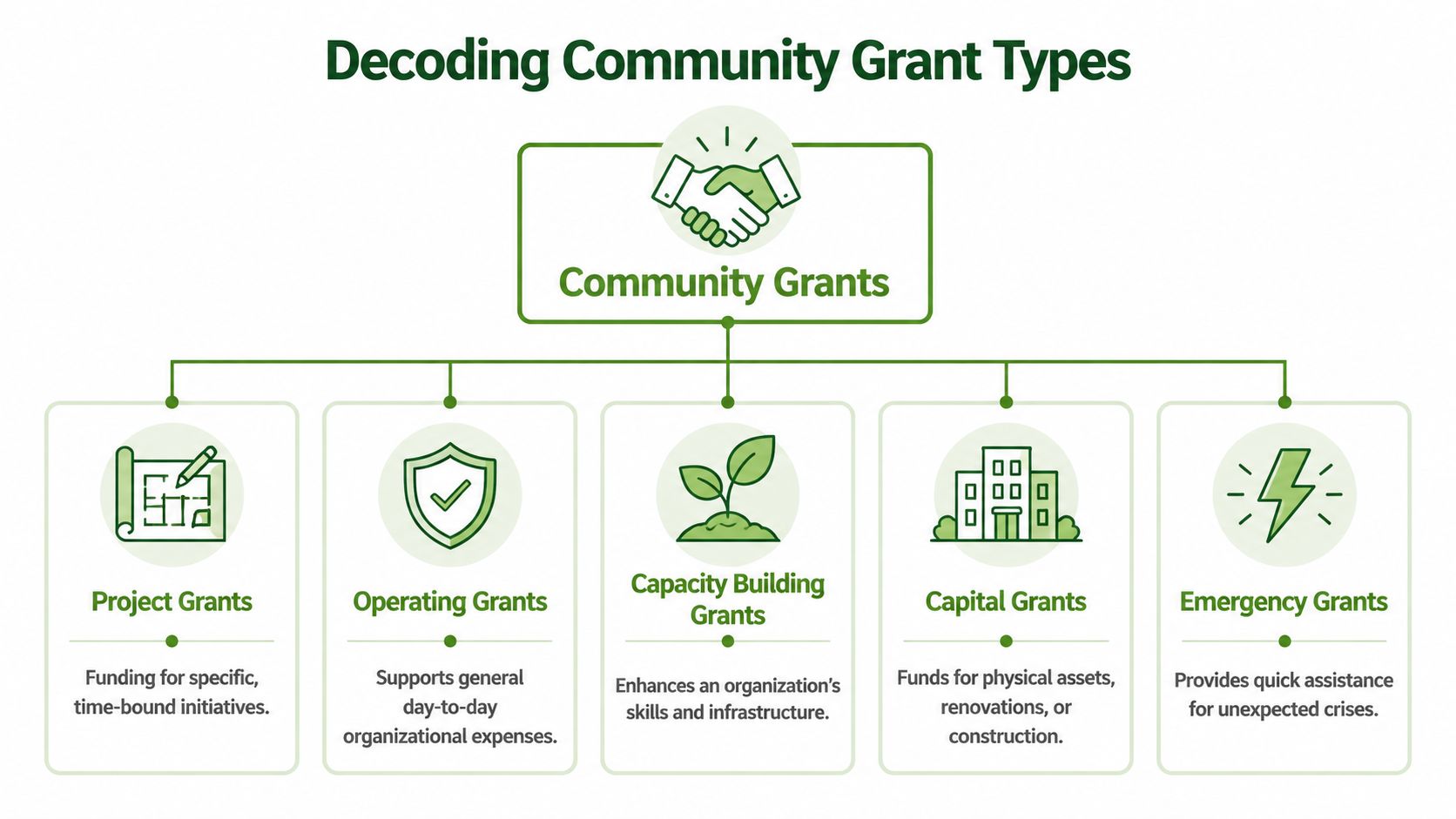
Here’s a quick sorting table.
| Grant type | What it supports | Plain-language example |
|---|---|---|
| Operating grant | General organizational expenses | Paying staff time, rent, insurance, utilities |
| Program grant | A specific service or initiative | Running a summer youth program at one site |
| Capital grant | Buildings, equipment, renovations | Buying a van or upgrading a community kitchen |
| Capacity building grant | Organizational strength | Staff training, technology, evaluation systems |
| Emergency grant | Crisis response or sudden disruption | Replacing damaged supplies after an unexpected event |
The confusion usually starts when a nonprofit needs one thing but applies for another. If you need breathing room for payroll and admin, a tightly restricted project grant may create stress instead of solving it. If you need a facility upgrade, an operating grant won’t cover the core problem.
Match the ask to the real need
Many executive directors understate what they need because they assume funders only want shiny new programs. That’s not always true.
A few examples make this easier:
- Operating support fits stability problems. If your organization is growing but cash flow is uneven, general support can protect service delivery.
- Program funding fits expansion problems. If you already run a strong mentoring model and want to add a school site, project funding may be the cleanest ask.
- Capital support fits infrastructure problems. If your pantry can’t store enough food safely, the issue isn’t outreach. It’s equipment.
- Capacity funding fits management problems. If reporting, data collection, or staff systems are weak, building internal capacity may be the highest-value grant you can pursue.
The best grant strategy starts with honesty. Name the real bottleneck first. Then look for the grant type built to relieve it.
When leaders do this well, they stop applying vaguely and start applying precisely. That alone makes every later step easier.
Finding the Right Funding Opportunities
Most nonprofits don’t lose time because there are no grants. They lose time because they’re screening the wrong ones.
That’s why grant discovery can feel so draining. You search databases, skim newsletters, open long guidelines, and realize halfway down the page that the funder wants a different geography, a different applicant type, or a much larger administrative setup than your team can handle.
For many small organizations, the central problem isn’t access to information. It’s capacity mismatch. A verified industry summary notes that many small nonprofits, especially those focused on BIPOC and low-income communities, struggle to screen opportunity volume against limited staffing, risking a mismatch on over 70% of potential fits, as discussed in this grant opportunity analysis for communities in need.
Stop searching broadly and start filtering sharply
Old-school grant hunting often looks like this:
- broad keyword searches
- generic grant directories
- spreadsheets with dozens of weak prospects
- last-minute decisions driven by deadlines instead of fit
That method rewards stamina, not judgment.
A better approach starts with a short internal profile of your organization. Before you search, define the filters that matter most.
Ask:
- What are we trying to fund? Operations, a defined project, equipment, planning, or capacity.
- Where do we work? City, county, state, neighborhood, or a specific service area.
- Who do we serve? Youth, older adults, immigrants, families, artists, residents of a defined place.
- What kind of application can we realistically complete? Short form, standard proposal, collaborative application, government-style submission.
- What can we manage if we win? Reporting load matters as much as award appeal.
That final question is where leaders often hesitate. A grant you can’t administer well is not a good grant.
Use an opportunity scorecard
You don’t need complex software to make better decisions, though software can help. Start with a simple scorecard and review each opportunity against the same criteria.
| Question | Strong fit looks like |
|---|---|
| Mission fit | The funder’s purpose closely matches your work |
| Geographic fit | Your service area falls squarely within their focus |
| Eligibility fit | Your entity type and program model qualify clearly |
| Capacity fit | Your team can complete the application and manage compliance |
| Relationship fit | You can explain why your organization belongs in this portfolio |
If a grant scores low on two or three of these, it’s usually a distraction.
Decision shortcut: Don’t ask only, “Can we apply?” Ask, “Can we apply well, deliver well, and report well?”
Include readiness checks early
Eligibility details can eliminate an otherwise promising lead. Entity type, tax status, geography, documentation, and partnership requirements all matter.
For organizations outside the United States, local eligibility frameworks matter too. For example, if you’re evaluating philanthropic readiness in Australia, understanding Deductible Gift Recipient status can help clarify which funding pathways and donor incentives may apply to your organization.
For U.S.-based nonprofits, the same principle holds. Before you spend writing time, confirm whether the grant requires fiscal sponsorship, audited statements, government registrations, collaborative partners, or prior-year operating history.
One practical way to reduce this manual screening burden is to use tools that rank opportunities by match, geography, and organizational readiness. Grant discovery platforms can help teams shift from endless searching to structured evaluation. Fundsprout, for example, scans funding sources daily, screens for eligibility, and ranks opportunities based on programs, geography, and capacity. That kind of workflow is most useful when it narrows choices, not when it floods your team with more leads.
Build a pipeline, not a pile
A strong grants pipeline usually includes three categories:
- Ready now opportunities. Clear fit, current deadline, manageable requirements.
- Near-future prospects. Good fit, but you need partner conversations, board approval, or stronger data first.
- Relationship opportunities. Funders worth watching because your work aligns, even if timing isn’t right yet.
That pipeline mindset changes everything. Instead of reacting to whatever arrives in your inbox, you start making intentional choices. The result is less scramble, fewer weak applications, and a much more sustainable use of staff time.
Crafting a Winning Grant Application
A grant application is not a paperwork exercise. It’s a decision document.
The reviewer is asking a quiet set of questions as they read. Is this problem real? Is this organization credible? Is the plan specific? Can this team manage the money? Will the proposed work produce visible value in the community?
If your proposal answers those questions clearly, you’re doing more than filling out forms. You’re helping a funder say yes with confidence.
Start with a need statement that sounds lived-in
Many proposals lose force in the first page because the need statement sounds generic. The organization says the issue matters, but it doesn’t show how it appears in the community they serve.
A strong need statement does three things at once:
- it defines the problem in concrete terms
- it explains who is affected
- it connects that problem to what your organization already sees firsthand
Good writing here is specific without becoming inflated. If your staff are seeing increased demand, describe the pattern. If families face barriers that make participation difficult, explain those barriers plainly. If your program exists because a neighborhood lacks something essential, make that gap easy to picture.
Build the application like a chain of logic
Reviewers trust proposals that hold together. Every section should connect to the next.
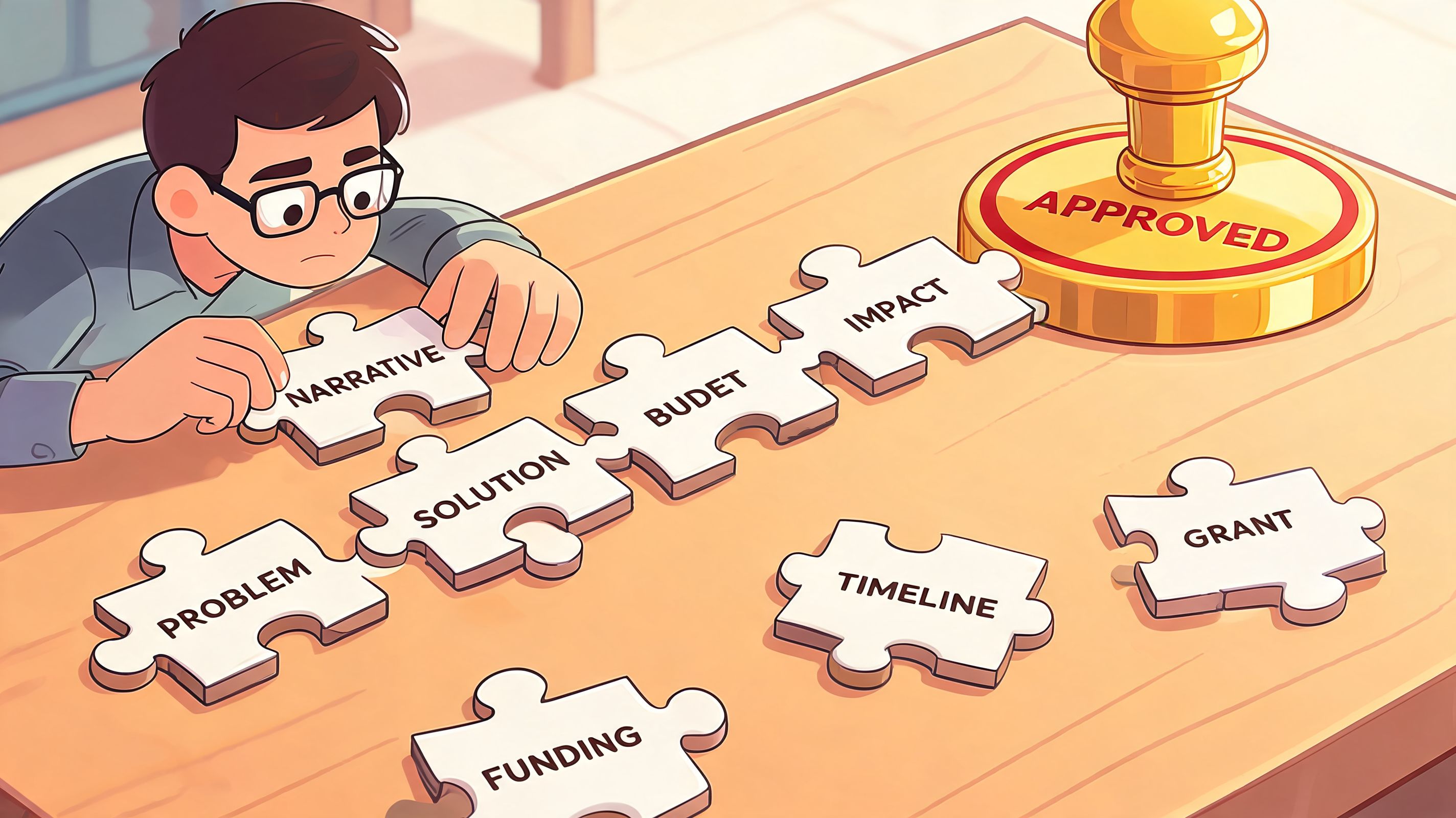
Use this simple sequence:
Need
What problem exists, and for whom?Approach
What will you do about it?Capacity
Why is your team able to deliver this?Outcomes
What changes will result?Budget
What resources are required to do it realistically?
If one link is weak, the whole application wobbles. A strong program idea with a confusing budget creates doubt. A compelling need statement with vague outcomes creates doubt. A solid budget without a clear implementation plan creates doubt.
Reviewers don’t fund effort alone. They fund a believable path from resources to results.
Let data support the story
Data doesn’t replace narrative. It sharpens it.
This is especially clear in competitive federal programs. In the Community Change Grants process, organizations that complete automated eligibility screenings 45 days before deadlines achieve 25% higher submission completion rates, and proposals that integrate GIS-layered data to show need are benchmarked as 15% to 20% stronger, according to technical guidance collected in the Community Change TA resource library.
Even if you’re not applying for that program, the lesson carries over. When a funder asks why this work matters here, support your answer with grounded evidence. That might include maps, local service patterns, client intake trends, waitlist data, school partner observations, or neighborhood-level indicators that help the reviewer see the context more clearly.
A useful mindset is this: tell the human story first, then prove you understand the context.
Treat the budget as part of the argument
Some nonprofits treat the budget like an appendix. Funders don’t.
A realistic budget shows that you understand what it takes to deliver the work. It should match the narrative. If your proposal centers outreach, staffing should reflect that. If it depends on equipment, that cost should appear clearly. If evaluation is required, don’t hide it or bolt it on late.
Here’s a quick review table you can use before submission:
| Proposal element | What reviewers want to see |
|---|---|
| Need statement | Specific local problem, clear affected population |
| Program design | Activities that logically address the need |
| Organizational capacity | Staff, partners, and systems that make delivery credible |
| Outcomes | Measurable changes tied to the work proposed |
| Budget | Reasonable costs that align with the plan |
This short walkthrough can help if you want a visual reset before drafting the next proposal.
Use tools as a co-pilot, not a substitute for judgment
AI tools are most helpful when they reduce friction around structure and compliance. They can summarize a request for proposals, flag missing attachments, organize narrative sections, and help your team maintain a consistent voice across drafts.
What they can’t do is decide what your strongest case is. Your leadership team still has to make the strategic choices. Which need matters most. Which activities are feasible. Which outcomes are honest and meaningful. Which budget assumptions are defensible.
That’s why templates and analyzers work best when paired with internal clarity. If your team needs a starting point, a nonprofit grant proposal template can help structure the draft so you’re not inventing the format from scratch.
The strongest proposals don’t sound robotic or overloaded. They sound like a capable organization explaining a clear problem, a focused response, and a realistic path to impact.
The Grant Lifecycle Beyond the Application
Many nonprofits act as if the finish line is submission. Then, if they win, they move straight back into chasing the next deadline.
That habit is expensive.
A critical post-award gap persists for small organizations. Data suggests that only 40% to 60% of grants are renewed, often because milestones and reporting deadlines aren’t tracked well, according to this grant management and renewal discussion. The hidden opportunity isn’t only in finding new grants. It’s in keeping the funders you already earned.
Compliance is relationship work
It helps to stop thinking about reporting as admin cleanup. Reporting is how a funder learns whether you’re dependable.
When you submit reports on time, explain changes early, and document results clearly, you’re sending a message. You’re telling the funder your organization can be trusted with another investment.
That matters because renewal decisions often depend on confidence as much as enthusiasm. A funder may like your mission and still hesitate if communication is uneven or required documentation arrives late.
A grant award is the start of a working relationship, not the end of a contest.
What to do right after award
The most effective teams create a post-award routine immediately, while the application details are still fresh.
A simple checklist helps:
- Save the governing documents. Keep the award letter, scope, approved budget, reporting instructions, and deadlines in one place.
- Translate the grant into tasks. Put reporting dates, data collection needs, and spending checkpoints on the calendar.
- Assign owners. Someone should own program delivery, someone should own finance tracking, and someone should own funder communication.
- Track deviations early. If staffing changes, timelines slip, or expenses shift, note it before the report is due.
- Collect proof as you go. Don’t wait until the final week to find participant stories, outputs, or internal notes.
Many small nonprofits often struggle. The same staff member who wrote the proposal may also run the program, manage partners, and answer board questions. Without a simple system, reporting becomes reactive.
Think in renewal terms from day one
A smart question to ask at kickoff is, “What would this funder need to see to fund us again?”
That question changes how you manage the award. You start documenting not only what you did, but what the funder values. Did the grant improve access? Strengthen delivery? Reach a specific group? Build something lasting in the community?
If you capture that evidence consistently, renewal writing becomes much easier. You’re no longer trying to reconstruct impact from memory. You’re building a track record in real time.
For under-resourced organizations, automated reminders, shared reporting calendars, and audit trails can make a major difference. The point isn’t to create bureaucracy. The point is to protect hard-won funding relationships and make the next ask more credible.
Real-World Examples of Community Grant Success
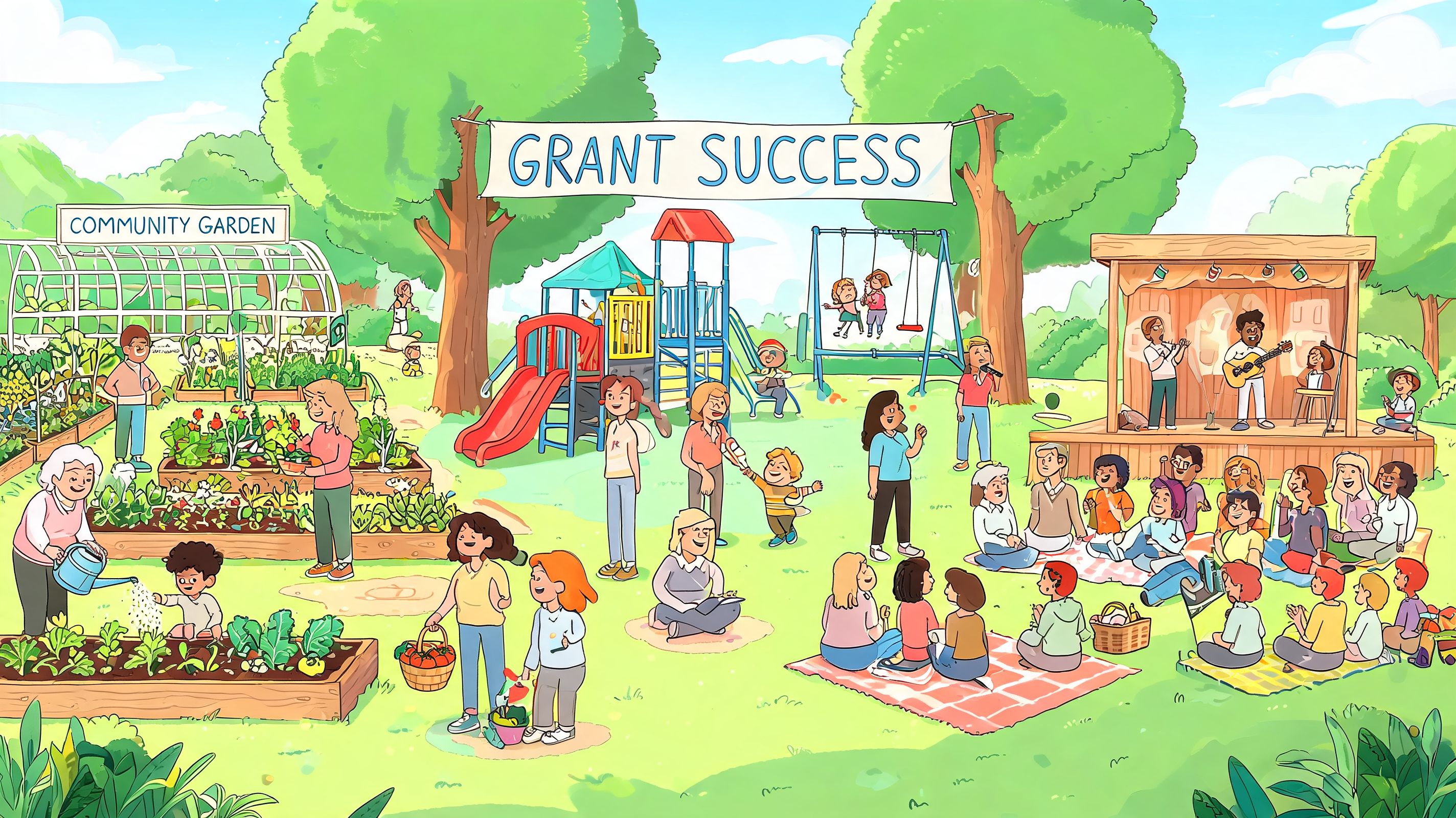
The process gets easier to trust when you can see how different kinds of organizations use a community grants fund in practice. Not every win looks the same. The grant type depends on the bottleneck.
The neighborhood theater that needed breathing room
A small community theater had strong attendance, deep volunteer support, and a loyal local audience. What it didn’t have was flexibility. Every donated dollar was tied to performances, while rent, insurance, and admin work kept getting squeezed.
The organization stopped pitching itself only as an arts presenter and started framing its role more broadly. It was creating local access, youth engagement, and community gathering space. That shift helped it pursue a general operating request through a community-focused funder.
The grant didn’t launch a flashy new program. It stabilized the organization. Staff could plan a season earlier, keep the lights on without panic, and spend less time patching budget holes.
The food pantry that had outgrown its equipment
A neighborhood pantry served more families each month, but distribution had become inefficient because storage space and refrigeration were limited. The team initially considered applying for another food access program grant, but the main barrier wasn’t outreach. It was infrastructure.
Once the pantry reframed the need, the case became much clearer. A capital-focused request for equipment and facility improvement matched the problem directly. The application centered on service reliability, food safety, and the ability to handle higher-volume deliveries.
After the grant, the pantry wasn’t just busier. It was better organized. Volunteers worked faster, food quality improved, and the team could accept items they had previously turned away.
Sometimes the strongest application isn’t for more programming. It’s for the tool or asset that makes the programming possible.
The youth mentorship program that expanded carefully
A mentoring nonprofit had solid results at one school and growing interest from another campus nearby. The temptation was to promise a rapid scale-up. Instead, the organization proposed a focused expansion with a clear staffing plan, partner roles, and defined student supports.
That made the ask feel controlled rather than aspirational. The funder could see exactly how the additional site would operate and why the team could manage it.
The result was a program grant that supported measured growth. Students at the second school gained access to mentoring, and the nonprofit expanded without overextending itself.
These examples share one pattern. Each organization got traction when it named the core problem, matched that problem to the right type of grant, and made the post-funding outcome easy to picture.
Building Your Sustainable Funding Strategy
A healthy grants strategy isn’t a string of isolated applications. It’s a loop.
You identify the right opportunities. You screen for fit before you write. You build proposals around real needs, credible plans, and realistic budgets. Then you manage the award in a way that makes renewal possible. After that, you return to discovery with sharper positioning, better data, and stronger funder credibility.
That’s how a community grants fund becomes part of a sustainable engine instead of a periodic scramble.
It also helps to remember that grants work best inside a broader revenue mix. Events, donor giving, partnerships, and grants can reinforce one another when they’re planned together. If your team is balancing grants with community-based earned attention and donor cultivation, this roundup of nonprofit fundraising event ideas can help spark complementary strategies that fit your audience.
The important shift is mental. Stop asking whether your organization is “grant-ready” in some abstract sense. Ask whether you can build repeatable habits around fit, writing, compliance, and renewal.
You don’t need a huge development department to do that. You need a clear process, honest prioritization, and tools that reduce avoidable manual work. When those pieces are in place, funding starts to feel less like chaos and more like stewardship.
If you want help turning grant work into a repeatable system, Fundsprout supports the full cycle from funding discovery to proposal drafting to compliance tracking and renewal preparation for mission-driven nonprofits.
Try 14 days free
Get started with Fundsprout so you can focus on what really matters.