Funding Community Development Projects: How to Secure Grants
Discover funding community development projects with proven strategies to attract funders, craft winning proposals, and manage grants effectively.

Abdifatah Ali
Co-Founder
Bringing a community development project to life is a huge undertaking, and finding the money to do it can feel like the biggest hurdle of all. But it doesn't have to be an impossible climb. I've spent years in this field, and I can tell you that the most successful nonprofit leaders follow a clear, repeatable process. This playbook is designed to give you that same process.
We're going to break down the entire funding lifecycle, from figuring out who to ask for money to writing a proposal that actually gets read and, most importantly, approved. This is your roadmap to turning that community vision into a funded reality.
Your Playbook for Community Development Funding
Forget abstract theories. This guide is all about practical, real-world steps you can take right now. We'll cover everything from sifting through the crowded funding landscape to find the right partners to building a powerful case for support that blends hard data with compelling human stories. You'll also learn the ropes of grant management, which is key to keeping your projects sustainable long after the initial check is cashed.
Think of this as your go-to field manual—a collection of advice and tactics that work. My goal is to equip you with the confidence and the skills to secure the resources your community truly deserves.
From Vision to Funded Reality
It all starts with a rock-solid plan. Great fundraising isn't just about writing a beautiful proposal; it's about the strategic prep work that happens long before you type a single word. This groundwork ensures your mission is perfectly aligned with a funder's goals. For a broader look at the financial landscape, these strategies to get sponsorship and secure funding offer great insights that can complement your grant-seeking efforts.
The core of your strategy will boil down to a few key activities:
- Finding the Right Funders: The first step is always knowing where to look. Learning to pinpoint the foundations, government agencies, and corporate partners whose priorities genuinely match your project is half the battle. You can learn more about how to find grants for nonprofits at https://www.fundsprout.ai/resources/find-grants-for-nonprofits.
- Telling a Powerful Story: A winning proposal isn't just a dry report. It’s a narrative that weaves together data and personal stories, connecting with reviewers on both a logical and an emotional level.
- Building Smart Partnerships: Don't go it alone. Teaming up with other local organizations shows funders that you have broad community support, which instantly boosts your project's credibility and perceived impact.
A well-structured plan is your single most critical asset in the funding process. It transforms a good idea into a fundable project by demonstrating foresight, capacity, and a clear path to measurable outcomes.
Keeping all your potential opportunities straight can get chaotic fast. This is where having a system makes a world of difference.
A tool like Fundsprout, for example, can give you a centralized dashboard to track everything. This kind of organized view ensures deadlines aren't missed and every potential funder is properly vetted—details that can make or break your success.
Navigating the Modern Funder Landscape
The world of community development funding isn't what it used to be. To succeed, you need a modern map that goes far beyond the usual suspects in philanthropy. Thinking about your funding as a diverse portfolio is the smartest way to build resilience. Relying on a single source is risky; a blended approach ensures your project can weather any storm.
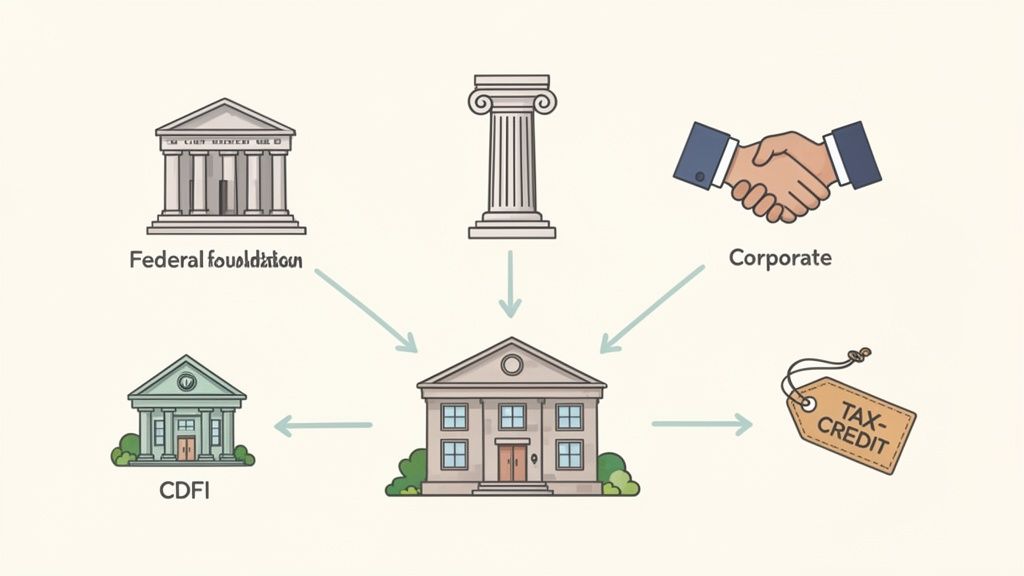
We're seeing some major shifts right now. Some traditional donors are pulling back, while new players are stepping up. For fundraising teams, this is a clear signal to focus on quality over quantity, targeting emerging donors and even diaspora remittances.
Even philanthropies are changing their tune, with more conversations about activating more than the standard 5% endowment payout through impact investing. Keeping a finger on the pulse of these trends is crucial for staying ahead.
The Big Three: Government, Foundations, and Corporations
Your funding journey really starts with understanding who the key players are and what makes them tick. Each type of funder has its own rulebook, its own priorities, and its own process. Getting this right from the beginning saves you countless wasted hours.
For example, if you're working on an affordable housing project, a federal HUD grant might be a perfect fit. But for a local after-school arts program? You’re probably better off looking at a community foundation or a corporation’s local giving initiative.
A game-changing piece of advice I always give is to see your project through the funder's eyes. Stop and ask, "How does my work help this specific funder achieve their mission?" When you can answer that, you’re on the right track.
To help you get started, here's a quick breakdown of the primary funding sources you'll encounter. Think of this table as your cheat sheet for identifying the best-fit partners for your project.
Key Funder Types for Community Development
Understanding these differences is the first step toward building a strategic and diversified funding plan that truly supports your mission.
Looking Beyond Traditional Grants
Don't stop at the big three. Beyond government agencies, foundations, and corporations, there's a whole world of specialized funding sources. These alternatives can be incredibly powerful, especially for projects that don't fit neatly into a conventional grant category. Learning to navigate these different avenues, including the key differences between donor-advised funds and private foundations, can unlock major opportunities.
These specialized funders are often looking for a very specific type of impact, and if you fit their niche, you've got a great shot.
Community Development Financial Institutions (CDFIs)
I’m a huge advocate for CDFIs. These are private financial institutions 100% dedicated to delivering responsible, affordable lending where it's needed most. They offer flexible financing that traditional banks often can't or won't.
CDFIs are great for things like:
- Low-interest loans for affordable housing developments.
- Working capital to get a local social enterprise off the ground.
- Financing for community facilities like health clinics or charter schools.
Tax Credit Programs
Tax credit programs like the New Markets Tax Credit (NMTC) and the Low-Income Housing Tax Credit (LIHTC) are designed to pull private investment into distressed communities. They work by giving investors a dollar-for-dollar tax credit in exchange for making equity investments in community projects.
I'll be honest—they are complex. But the payoff can be huge, unlocking millions in capital for large-scale projects that wouldn't be possible otherwise.
Ultimately, successful funding requires a multi-faceted strategy. When you understand the unique motivations of each funder type—from a federal agency's public mandate to a local business's connection to its community—you can tailor your story perfectly. This transforms your search for capital from a simple ask for money into a compelling invitation for a true partnership.
Building a Bulletproof Case for Support
A great idea for changing your community is where it all starts, but passion alone won’t get the grant. Funders, whether they're a local family foundation or a huge federal agency, need to see a compelling, data-driven case that spells out the problem and presents a smart, logical solution. This is how you transform a good idea into a fundable project.
The bedrock of any winning proposal is a solid needs assessment. It’s not enough to just say a problem exists; you have to prove it with cold, hard facts. Your story has to be anchored in evidence that makes a grant reviewer sit up and take notice.
This means you’ve got to move beyond anecdotes. Personal stories are incredibly powerful for painting a picture, but they need data to back them up. So, instead of saying "a lot of families in our area can't get healthy food," you’d say, "28% of households in the Jackson County East District lack consistent access to fresh, affordable produce, according to the latest regional health survey." See the difference? One is a claim, the other is a fact.
Grounding Your Project in Data
To build this data-driven foundation, you'll need to pull information from several places. Casting a wide net not only shows you've done your homework but also gives you a much richer understanding of the community's real challenges. The best needs assessments mix both quantitative (the numbers) and qualitative (the stories) data.
- Community Surveys: Go straight to the source. Ask residents directly about the hurdles they face, what they think needs to change, and what solutions they’d support.
- Census Data: This is your go-to for the basics. You can quickly establish demographic information, poverty rates, and other key socioeconomic indicators that set the stage.
- Stakeholder Interviews: Talk to people on the front lines. Community leaders, city officials, and staff from other organizations have invaluable insights that can confirm what you're seeing in the data.
If you want to go deeper, exploring different community needs assessment tools can give your team a structured way to gather and make sense of all this crucial information. Honestly, this step is non-negotiable if you want to be seen as credible.
From Problem to Plan with SMART Objectives
Once you’ve clearly defined the need, you have to spell out exactly what you’re going to do about it. This is where SMART objectives are your best friend. They take your big, ambitious goals and break them down into a concrete action plan that funders can easily grasp and measure.
The SMART Objectives Framework
- Specific: What, exactly, will you accomplish?
- Measurable: How will you track progress and know you've succeeded?
- Achievable: Is this goal realistic with your current resources?
- Relevant: Does it directly tackle the community need you identified?
- Time-bound: When will you get this done?
For instance, a fuzzy goal like "improve local literacy" becomes a sharp, fundable objective: "Provide one-on-one tutoring to 50 elementary school students from low-income households for one academic year, resulting in a 15% average increase in standardized reading scores by June 2025." That level of detail shows a funder you're not just hoping for results—you have a plan to achieve them.
Another fantastic tool is a logic model. Think of it as a one-page roadmap that visually connects your project's resources (staff, funding) and activities to the outcomes you expect to see. It’s a powerful way to show a funder, in a single glance, that you’ve thought through every single step.
Crafting a Realistic and Justifiable Budget
Your budget isn’t just a list of numbers; it's the financial version of your project's story. Every single line item must connect directly to an activity you described in your proposal. If a reviewer can't see how a budget item supports the work, it’s an immediate red flag.
Make sure your budget includes:
- Direct Costs: These are the expenses tied directly to your project—things like staff salaries, program supplies, and specific equipment.
- Indirect Costs: This is the overhead required to keep the lights on—rent, utilities, and administrative support that make the project possible.
- In-Kind Contributions: Don't forget to include the value of donated goods, services, or volunteer hours. This shows community buy-in and demonstrates how you’re stretching the funder’s dollars.
Finally, remember that you don't have to go it alone. Building strategic partnerships with other local nonprofits, schools, or public agencies is the final piece of the puzzle. Collaboration shows funders you have a broad base of support and aren't working in a silo. It makes your project stronger, your impact wider, and your case for support that much more convincing.
Crafting a Proposal That Resonates With Funders
All the hard work is done. You've done the deep-dive needs assessment, forged strong community partnerships, and meticulously planned out every detail. Now, it all comes together in the grant proposal.
This document is so much more than a simple request for money. It's the story of your project, your community, and the future you’re fighting to build. A winning proposal takes your solid, data-driven case and turns it into a compelling narrative that connects with a funder's mission on a deeply human level.
Think of your proposal less like a technical manual and more like a persuasive argument you’d make to a trusted partner. It needs to be logical, absolutely clear, and hit an emotional chord. Grant reviewers are often slogging through dozens, sometimes hundreds, of applications. Yours has to pop by being both completely credible and genuinely memorable.
The Anatomy of a Winning Proposal
While every funder puts their own spin on the application, most successful proposals are built on the same foundational structure. Each section has a specific job to do, building on the last to paint a complete and convincing picture of what’s possible if they invest in your work. Getting these core components right is non-negotiable.
- Executive Summary: This is your one-page elevator pitch. You'll actually write it last, but it sits right at the front. It needs to nail the entire proposal in a nutshell: the problem, your solution, the ask, and the expected impact.
- Statement of Need: Here's where you unleash the data from your needs assessment. You’re not just listing numbers; you’re explaining the real-world challenge your community faces, using both powerful statistics and personal stories to show why it matters right now.
- Project Description: This is the "how" section. You'll detail your project’s goals, lay out your SMART objectives, and walk them through the specific activities and timeline. A reviewer should be able to close their eyes and clearly visualize your project in action.
- Evaluation Plan: How will you prove you’re making a difference? This section is critical. It outlines the specific metrics you’ll track to show your project is hitting its goals and creating tangible change.
This simple flow shows how these core pieces fit together. Your needs assessment informs your goals, and your goals dictate the budget you need to achieve them.
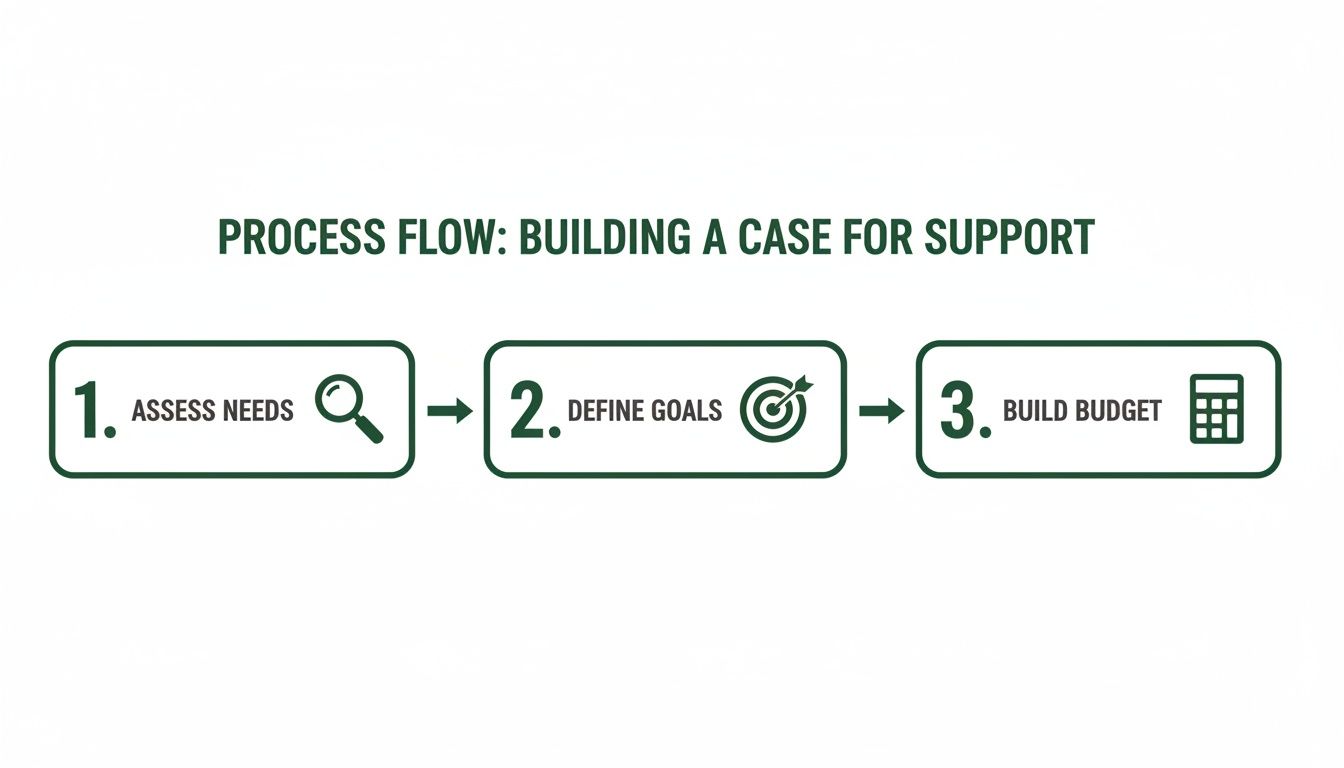
It’s this logical, data-backed progression that gives funders the confidence they need to invest.
Weaving Data into a Compelling Narrative
Data gives you credibility, but stories create the connection. A proposal that just rattles off statistics feels cold and disconnected from the real world. Your job is to make those numbers breathe by showing what they mean for the people you serve.
For instance, don’t just state that "40% of local third-graders are reading below grade level." Immediately follow that up with a short, anonymized story about a student in your tutoring program who is now reading to their younger siblings. This mix of hard data and human impact makes the problem urgent and your solution feel essential.
A grant reviewer once told me, "Your numbers convinced my head, but your story convinced my heart. We fund projects that do both." This is the secret sauce of effective proposal writing—making a logical case that also sparks an emotional investment.
This approach is more important than ever. As traditional funding sources fluctuate, nonprofits have to get smarter. Official development assistance from major sources like the United States and EU Institutions is constantly shifting. To stay resilient, you have to diversify your funding by going after emerging philanthropies and development finance institutions. These funders are often moved by powerful, evidence-backed stories. You can read more about these global funding trends on OECD.org.
Customizing Your Proposal for Each Funder
One of the most frequent and fatal mistakes I see is the "copy-paste" proposal. Sending the same generic application to a dozen different funders is a fast track to the rejection pile. Reviewers can spot a one-size-fits-all submission a mile away, and it tells them you haven’t bothered to do your homework.
Instead, you have to tailor every single proposal to the funder you're approaching. This doesn't mean starting from scratch each time. It means making strategic tweaks to align your project perfectly with their specific mission, language, and priorities.
Your Quick Customization Checklist
- Mirror Their Language: Do they talk about "economic empowerment" or "workforce development"? Scan their website and annual reports, then use their preferred terms.
- Align with Their Mission: Don't make them guess. Explicitly connect your project's outcomes to the goals they’ve stated in their mission statement.
- Reference Their Priorities: If a foundation just launched a new strategic plan focused on youth engagement, make sure you highlight exactly how your project advances that specific goal.
- Follow Instructions to the Letter: This seems small, but it's huge. Stick to their formatting guidelines, page limits, and submission rules without fail. Ignoring these details can get you disqualified before a human even reads your first sentence.
This level of customization shows a funder that you see them as a genuine partner, not just a piggy bank. It shows you respect their work and truly believe your project is the perfect fit for their investment. With a tool like Fundsprout, you can use the RFP analyzer to instantly break down a funder's requirements into a structured outline, making this tailoring process faster and far more accurate. It helps ensure every proposal you send is perfectly tuned to its audience.
Managing Your Grant from Award to Renewal
That email finally lands in your inbox—"Congratulations, you've been funded!" It's a moment of pure excitement, and you and your team absolutely deserve to celebrate. But once the confetti settles, the real work begins.
Winning the grant is just the first step. How you manage that funding is what truly matters. It's your chance to prove your impact, build trust, and turn this one-time award into a lasting partnership that can fuel your mission for years to come. Think of it less as spending money and more as stewarding a crucial investment in your community.
Your Post-Award Action Plan
The moment you get that award notification, it's time to put a clear plan into motion. Getting organized right from the start is the secret to avoiding those late-night, deadline-induced headaches later on.
Don't let the initial excitement cause you to skip these foundational tasks:
- Dissect the Grant Agreement: This is your rulebook. Read every single line, paying extra attention to reporting deadlines, how you can (and can't) spend the money, and any other special conditions.
- Set Up a Dedicated Bank Account or Code: Make financial tracking a breeze by creating a separate budget code or chart of accounts just for this grant. This keeps every dollar transparent and accounted for.
- Get Those Deadlines on the Calendar: Immediately plug all reporting due dates—both for your narrative updates and financial reports—into a shared team calendar. Set up multiple reminders. Nothing sours a funder relationship faster than a late report.
A little diligence now saves a world of panic later. It shows your funder that you're a professional, responsible steward of their investment.
Nurturing a Partnership with Your Program Officer
Here's a piece of advice I give to every nonprofit leader: your program officer isn't an auditor; they're your most important ally. They are genuinely invested in seeing you succeed. The key to unlocking this relationship is proactive, honest communication.
Keep them in the loop. Did you hit a major milestone? Send a quick, celebratory email. Did you run into an unexpected roadblock? Let them know before it spirals into a crisis. A simple heads-up demonstrates foresight and respect for their role.
Don’t be afraid to ask for advice. Your program officer often has a bird's-eye view of what’s working for other grantees. They can be an invaluable source of guidance and connections, but only if you cultivate an open line of communication.
When renewal season rolls around, a program officer who feels like a true partner is much more likely to go to bat for you.
Mastering Compliance and Reporting
Grant compliance can feel overwhelming, especially with complex federal awards. Take the State and Local Fiscal Recovery Funds (SLFRF), for example. These come with notoriously strict deadlines and intense oversight from the U.S. Treasury, which monitors every obligation.
The secret to painless reporting? Treat it as a daily habit, not a last-minute scramble. Document everything as you go. For a deeper dive on this, our guide on grant management best practices can help you build sustainable systems from the ground up.
Start building these habits today:
- Collect data continuously. Don't wait until the week a report is due to start hunting for your metrics. Track them in real-time.
- Gather stories and photos. The human impact of your work is just as powerful as the numbers. Capture testimonials and images along the way.
- Maintain a clean audit trail. Keep every receipt, invoice, timesheet, and important email organized in a dedicated folder.
When you manage your grant with this level of care, the final report practically writes itself. Better yet, all the data and stories you've gathered become the backbone of a powerful renewal proposal. You'll have a clear track record of success and fiscal responsibility, making the case for continued funding almost effortless.
Tools like Fundsprout are designed for this, helping you auto-populate funder templates and maintain a clear audit trail. It turns what was once a chore into a real strategic advantage.
Got Questions? We’ve Got Answers on Funding Community Projects
Even the most experienced nonprofit pros hit a wall sometimes when it comes to funding community development. Let's be honest, this world has its own language, unwritten rules, and plenty of hurdles that can trip you up. Getting a straight answer can be the difference between a great idea that fizzles out and a project that truly changes lives.
Here, we're tackling some of the most common and urgent questions we hear from organizations doing the real work on the ground. Think of this as practical, no-fluff advice you can start using today.
How Can a Small Nonprofit Realistically Compete for Big Federal Grants?
It can definitely feel like a David vs. Goliath situation, but I've seen smaller organizations win major federal funding time and again. The secret isn't about having a bigger team or a fancier office; it's about being smarter and more strategic. Don't try to out-muscle the big guys—out-think them.
First, you have to lean into what makes you unique. Zero in on opportunities where your specific, on-the-ground expertise is a massive advantage. Federal agencies often look for organizations with deep, authentic connections to the community. Your agility and genuine relationship with the people you serve is a powerful asset that a big, bureaucratic national organization just can't fake.
Then, it’s all about collaboration.
- Partner Up: Find a larger, more established organization and submit a joint application. This immediately shows you have the capacity and broad support to pull off the project.
- Be a Sub-Awardee: This is one of the best ways to get your foot in the door. It lets you build a solid track record of managing federal funds, which makes you a much stronger candidate for your own prime awards down the road.
- Build Your Resume: Start with smaller state or local grants. Successfully managing a state-level project gives federal reviewers hard proof that you know how to deliver results.
What Are the Most Common Mistakes You See in Grant Proposals?
After reading more grant proposals than I can count, I can tell you the most frequent errors almost always boil down to one thing: a fundamental disconnect with the funder. It’s rarely about bad grammar; it’s about failing to build a convincing, well-researched case for support.
The top three mistakes I see over and over are:
- A Weak Needs Statement: Relying on stories and assumptions instead of hard data is a killer. You have to ground your project's "why" in recent, relevant statistics that make the problem impossible to ignore.
- The "Copy-Paste" Proposal: Funders can spot a generic, one-size-fits-all application from a mile away. It shows you haven't done your homework on their mission or specific priorities.
- An Unrealistic Budget or Timeline: This is a red flag for poor planning and instantly sinks your credibility. Every number in your budget should be detailed, justified, and tied directly to your project activities.
A great proposal is a conversation with the funder. A generic one is a monologue. Always adapt your language, data, and story to show you understand and align with their specific goals. That simple shift in mindset can change everything.
How Do We Actually Measure Long-Term Impact for Funders?
Measuring long-term impact means looking beyond simple outputs like "how many people we served." Funders, especially foundations, are more interested in outcomes—the real, lasting changes your work creates in people's lives and the broader community.
The best way to do this is to build a logic model right from the very beginning, before you've even launched the project. This simple tool helps you map out your intended long-term goals and the shorter-term wins that will get you there.
For your measurement strategy, you’ll want a mix of data:
- Quantitative Metrics: These are the hard numbers. Think increased household income, improved test scores, or reduced recidivism rates.
- Qualitative Data: This is where you tell the story behind the numbers. Collect success stories, powerful testimonials, and case studies that put a human face on your data.
You also have to plan for follow-up. Build surveys or interviews into your process at key intervals—maybe six months or a year after someone finishes your program. Showing funders you’re committed to tracking that lasting change proves you’re serious about making a real, sustainable difference.
This is exactly the kind of complexity Fundsprout was built to handle. Our platform helps you sidestep these common pitfalls by structuring your proposals around what funders want to see, making it easy to track impact metrics, and ensuring every application is perfectly tailored. See how you can build a stronger case for funding at https://www.fundsprout.ai.
Try 14 days free
Get started with Fundsprout so you can focus on what really matters.