Win More Community Foundation Grants in 2026
Unlock local funding with our guide to community foundation grants. Learn to find opportunities, build relationships, and write winning nonprofit proposals.

Abdifatah Ali
Co-Founder
If you’re a nonprofit leader, you know that finding the right funding partner is about more than just money. You’re looking for an ally who truly understands your work and the community you serve. This is where community foundation grants shine.
Think of them as the philanthropic heart of a specific city, county, or region. They’re public charities that pool money from local families, businesses, and individuals, then strategically invest it back into the community through grants. For a small or mid-sized nonprofit, they can be one of your most accessible and powerful funding partners.
The Power of Local Giving and Community Foundation Grants
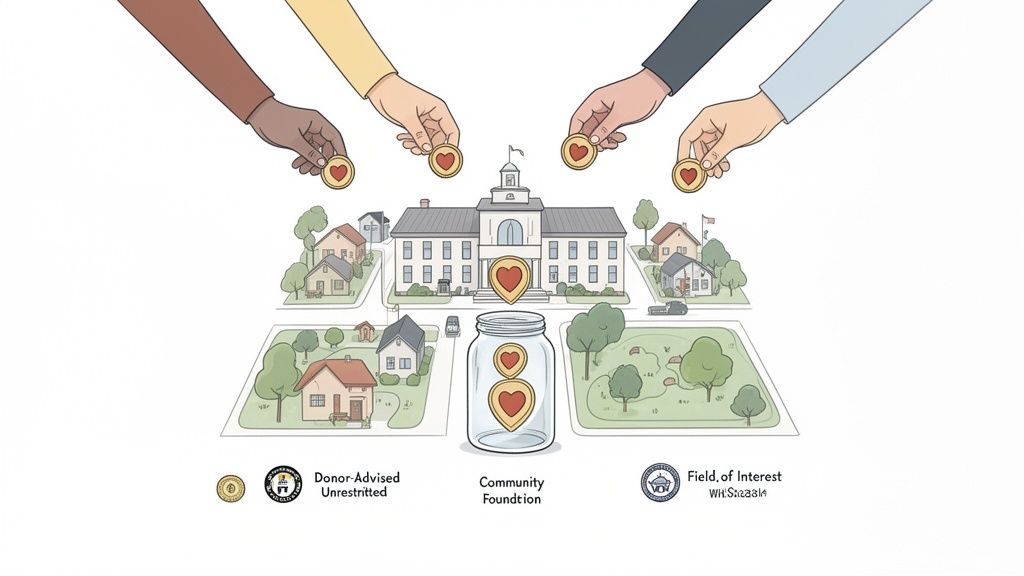
Unlike a massive national foundation that might see you as just one of thousands of applicants, a community foundation is your neighbor. Their staff and board members live and work where you do. They see the same challenges and opportunities firsthand. This shared ground is what makes them such critical players in the nonprofit sector.
But here’s the key: they aren't a single pot of money. Most community foundations manage hundreds of distinct charitable funds, each with its own purpose. Getting a handle on how these different funding streams work is the first step to successfully navigating their grantmaking process.
To help you get started, here’s a quick overview of what makes these grants unique.
Community Foundation Grants at a Glance
| Characteristic | What It Means for Your Nonprofit |
|---|---|
| Geographic Focus | They are laser-focused on a specific city, county, or region. If you operate there, you're already on their radar. |
| Relationship-Driven | Success often comes from building real connections with foundation staff and donors. They value partnership over paperwork. |
| Diverse Funding Pools | They manage multiple fund types, from unrestricted dollars to donor-advised funds, creating several potential avenues for support. |
| Deep Community Knowledge | They understand local needs intimately, making them more receptive to projects that address real-time community issues. |
This structure means there are multiple "doors" you can knock on within a single foundation, which is a huge advantage once you know how to find them.
Understanding the Different Funding Streams
To find the right door, you need to know what’s behind each one. Community foundations generally operate four main types of funds, and your strategy will change depending on which one you’re targeting.
- Unrestricted Funds: This is the foundation's most flexible money. The program officers and board decide where it can do the most good, responding to the community's most urgent needs. These are often the grants you see advertised in a competitive, open application cycle.
- Field-of-Interest Funds: Here, a donor has dedicated money to a broad cause—like environmental conservation, youth arts programs, or senior services—without picking a specific organization. The foundation staff then identifies the most impactful nonprofits working in that field to receive the grants.
- Donor-Advised Funds (DAFs): A DAF is a charitable giving account set up by an individual or family. They "advise" the foundation on where to direct the money. While the foundation has the final say, they almost always follow the donor's wishes. This means building relationships with local philanthropists who hold DAFs can be a very direct route to funding.
- Designated Funds: This is a long-term gift a donor makes to support one or more specific nonprofits, year after year. If you're lucky enough to be a designated recipient, it’s a stable source of income you can count on.
Knowing these differences helps you think more strategically. Is your appeal a perfect fit for a competitive grant cycle, or should you be networking to connect with local DAF holders?
The Scale and Local Impact of Community Giving
Don't mistake "local" for "small." Community foundations pack a serious financial punch. In 2024, foundations across the U.S. managed nearly $159 billion in assets. They took in over $18 billion in new gifts and distributed an incredible $16.5 billion in grants to organizations just like yours.
What’s more, with many foundations signaling plans to increase their grantmaking, the opportunity is only growing.
The real game-changer with community foundation grants is proximity. These funders aren't just reading your proposal; they're seeing the impact of your work every day. That shared experience makes for a much stronger, more authentic partnership.
This is a fundamental difference compared to other types of foundation grants for nonprofit organizations. While national funders might know you only through an online portal, community foundations offer a chance to have a real conversation. They are invested in your success because your success means a stronger community for everyone—including them.
How to Find the Right Community Foundations for Your Nonprofit
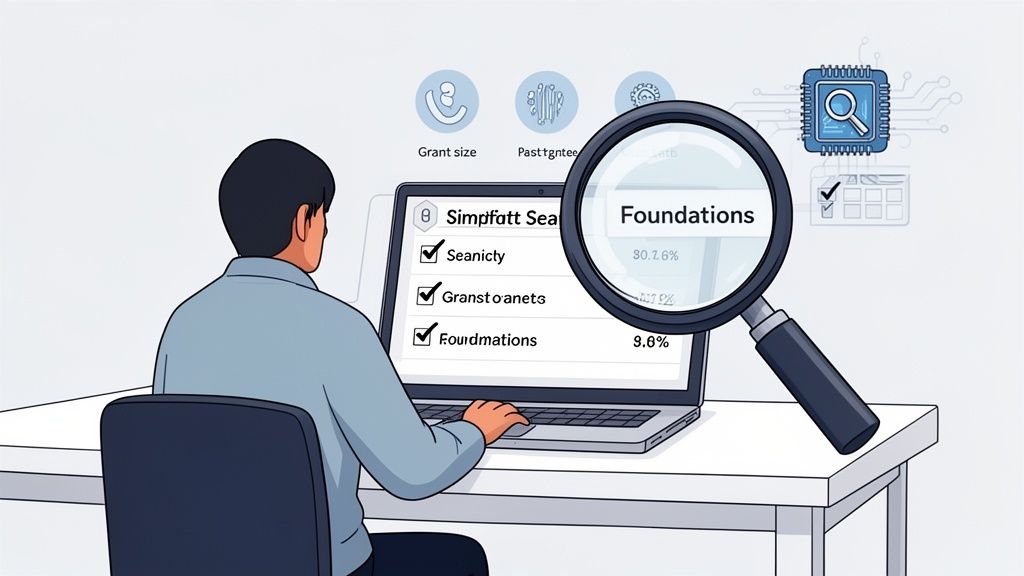
Alright, you understand the power of community foundation grants. But where do you actually find them? The truth is, effective grant prospecting is much more than a few Google searches. It’s a targeted hunt to find funders whose mission genuinely aligns with yours, so you can focus your precious time where it matters most.
Your first move is always to zero in on foundations that serve your specific geographic area. Casting too wide a net is overwhelming and inefficient. Thankfully, there are tools built to help you slice through the noise and build a solid list of local prospects.
Start with Specialized Directories
Forget about sifting through endless, irrelevant search results. The smart move is to go straight to the directories built for this exact purpose.
A fantastic—and free—place to begin is the Council on Foundations' Community Foundation Locator. This interactive map lets you find verified community foundations by state. In just a few clicks, you have a high-quality starting list of organizations operating in your backyard.
This simple tool handles the most basic, yet critical, piece of eligibility screening: geography. It instantly narrows your focus.
Once you have that initial list, it's time to dig deeper. This is where paid platforms like Candid’s Foundation Directory really shine. These tools let you filter by funding interests, typical grant size, and keywords, turning a long list of names into a pipeline of qualified leads. Yes, they require an investment, but the hours you save and the quality of the matches can deliver a serious return.
For a deeper dive into these platforms, check out our guide on the top grant discovery platforms for nonprofits in 2026.
Put on Your Detective Hat: Dig into Form 990-PF
Once you’ve identified a promising foundation, it's time to do some real vetting. Your most powerful tool for this is the foundation's Form 990-PF. This public tax document is a goldmine of information, showing you exactly where their money has gone in previous years.
A Form 990-PF is more than a tax document; it's a foundation's giving story. It tells you who they funded, how much they gave, and whether they are a realistic prospect for your organization. Reading it is non-negotiable for serious grant seekers.
By analyzing this form, you get answers to crucial questions that a foundation’s website might not make obvious:
- Who have they funded in the past? Look for nonprofits with missions or programs similar to yours. If they consistently give to the local animal shelter and you run an after-school arts program, it might not be a strong match.
- What's their typical grant size? The 990-PF lists every single grant awarded. This is your reality check. It’s a common rookie mistake to ask for $50,000 from a foundation whose average award is only $5,000. The 990 tells you what a realistic ask looks like.
- Are there application restrictions? The form might note whether the foundation only accepts applications by invitation or if they have specific exclusions (e.g., no funding for capital campaigns).
Use Modern Tools for Faster Vetting
Let's be honest: manually combing through directories and 990s for every potential funder is a massive time sink. This is where modern grant platforms can be a game-changer.
AI-powered tools like Fundsprout can automate a huge chunk of this work. They scan thousands of opportunities and cross-reference them against your nonprofit's unique profile—your location, programs, and funding needs.
Instead of you spending hours searching, the best-fit community foundation grants land right in your lap in a prioritized pipeline. These systems can screen for eligibility, analyze past giving patterns, and even highlight potential connections, saving you countless hours so you can focus on what really matters: building relationships and writing a killer proposal.
It’s All About Relationships (Long Before You Ask for Money)
I can’t stress this enough: one of the biggest mistakes a nonprofit can make is treating a grant application like a cold, one-off transaction. Just submitting a proposal when a grant cycle opens tosses you into a massive, anonymous pile.
The grant seekers who consistently win funding know the real secret: securing community foundation grants is about partnership, not paperwork. It all starts long before a request for proposals is ever posted.
The whole point is to shift from being just another name in a stack of applications to becoming a familiar, trusted partner. Think of program officers as more than just gatekeepers—they are your potential champions. When they know you, believe in your work, and understand your impact, they're the ones who will go to bat for you when the review committee is making its final decisions.
Making that First Connection
So, how do you get on their radar? A generic "Dear Sir or Madam" email is a one-way ticket to the trash folder. You have to be thoughtful and do a little digging first.
Your first move is to find the right person. Pinpoint the program officer who handles the funding area that matches your mission. Go read their bio on the foundation’s website, see if they’ve written any articles, or check if they've spoken on recent panels. Find a real connection point.
When you write that first introductory email, keep it short and personal:
- Show you’ve done your homework. Start by mentioning something specific, like, "I was really impressed by the recent report your foundation published on youth literacy..." or "I saw you spoke on the panel about food insecurity last month..."
- Introduce yourself—briefly. In just a couple of sentences, explain who you are and the community need you’re tackling.
- Ask for a small piece of their time. The goal isn't money yet. Simply request a brief, 15-minute "get-to-know-you" call to introduce your work and learn more about their current funding priorities.
This isn't a pitch. It's an invitation to a conversation. You’re just planting a seed. For a deeper dive, we have a complete guide on how to write a compelling letter of inquiry that can help you nail this first step.
Nurture the Relationship
Once you’ve had that first call or email exchange, the real work begins. Now you need to stay on their radar without being annoying. Think of it as developing a professional friendship. Your goal is to provide value and show you're engaged without constantly asking for something.
Here’s how this plays out: A small after-school arts program identified the right program officer at their local community foundation. After a great 15-minute intro call, the nonprofit’s director simply added the officer to their quarterly email update. Six months later, the foundation announced a new youth arts initiative. Because the program officer was already familiar with the program's impact, she personally called the director to encourage them to apply. What would have been a cold application became a warm, invited one.
It's all about being a consistent, positive presence. This gentle, sustained contact means that when a grant opportunity finally does pop up, you aren't a stranger. They already know your name and your value to the community.
Engage in Their World
A great way to stay connected is to interact with the foundation in its own space. It shows you’re invested in the same community conversations they are.
Community foundations are deeply embedded in their local areas. With over $15 billion in annual grantmaking, they are incredibly responsive to local needs. For example, the Connecticut Community Foundation's 2025 grants included $10,000 for a local Puerto Rican festival—a perfect example of their hyper-local focus. You can discover more insights about these charitable giving trends on Candid.org.
As a fundraiser, your job is to tap into that alignment. When you build these genuine connections, you completely change the dynamic. You’re no longer just another organization asking for money; you’re a partner working with the foundation to build a stronger community together. Platforms like Fundsprout can even analyze RFPs to help you generate tailored narratives that speak directly to that alignment, which is a huge advantage as competition for these funds grows.
Craft a Winning Grant Application That Stands Out
When you’re applying for community foundation grants, you’re not just filling out a form—you’re solidifying a partnership. A disorganized or generic proposal can instantly undermine all the hard work you’ve put into building that relationship.
The secret to avoiding the last-minute scramble isn't working harder; it's working smarter. I've seen countless nonprofits transform their grant-seeking by adopting a modular approach. This just means you build your application from a set of pre-written, polished pieces you can quickly tailor for each new opportunity. It saves an incredible amount of time, cuts down on stress, and leads to a much stronger proposal.
Get Your “Grant-Ready” Folder in Order
Before you even glance at a new grant opportunity, you should have a "grant-ready" folder on your server. Think of it as your go-to toolkit, with all the essential documents and stories ready to be deployed. Having this organized is a massive competitive advantage.
First, gather the non-negotiable paperwork that nearly every funder asks for:
- Proof of Status: Your 501(c)(3) determination letter.
- Who’s in Charge: A current list of your board of directors, complete with their professional affiliations.
- Financial Health: Your most recent Form 990, your annual operating budget, and your latest audited financial statements.
- Core Identity: Your mission and vision statements, a brief organizational history, and a one-page summary of your strategic plan.
With the administrative files handled, you can focus on drafting the narrative components. These are the building blocks you’ll mix and match for every proposal you write.
By getting these core pieces ready ahead of time, you stop scrambling for documents and start focusing on strategy. You'll spend less time on tedious tasks and more on what actually wins grants—telling a powerful story of your impact.
This system ensures your messaging is consistent and frees you up to nail the most important part: the narrative.
Tell a Story That Moves People to Act
With your library of documents ready, you can pour your energy into the heart of the application—the story. Your grant proposal can’t just describe your project; it has to make a compelling emotional and logical case for why your work deserves funding.
From my experience, the most persuasive proposals do three things exceptionally well:
- Frame the Problem. This is where you paint a vivid picture of the challenge your community is up against. Don’t just state facts; bring them to life. Use a mix of hard data (e.g., "35% of local students lack access to after-school programs") and a short, powerful anecdote about a single person affected by the issue. You need to show the grant committee why this problem matters right now.
- Present Your Solution. Explain exactly how your program tackles the problem you just described. Detail the activities, who you’ll serve, and what makes your approach different or better. This is your chance to really showcase your organization's expertise and unique methods.
- Define Success. How will you—and the foundation—know you’re making a difference? Lay out the specific outcomes you’ll track, whether it’s the number of people served, improvements in test scores, or feedback from participant surveys. This proves you’re accountable and shows the foundation that their investment will deliver a measurable return.
For instance, a youth literacy program wouldn't just say "we help kids read." It would use local reading proficiency data to frame the problem, describe its weekly one-on-one tutoring model as the solution, and propose tracking each student's reading level quarterly to measure success.
Map Out Your Timeline to Avoid the Rush
A well-managed timeline is the backbone of a stress-free—and successful—grant application. Procrastination is the enemy of a quality proposal. I always recommend an 8-week timeline, which gives you plenty of breathing room for thoughtful writing, team collaboration, and a thorough review.
Here’s a look at how you can break down the work week by week.
Grant Application Timeline Example
This sample timeline shows how an 8-week schedule allows for a methodical, high-quality process from start to finish.
| Week | Key Tasks & Milestones |
|---|---|
| Week 1-2 | Deconstruct the RFP & Outline: Read the grant guidelines multiple times. Create a detailed outline and a checklist of every single required document and question. |
| Week 3-4 | Draft Narrative Sections: Write the first drafts of the need, the program, and the evaluation plan. This is when you pull in relevant data and stories. |
| Week 5 | Build the Budget & Gather Attachments: Finalize your project budget. Pull all the required attachments from your "Grant-Ready" folder. |
| Week 6 | Internal Review & Feedback: Share the complete draft with your team (and maybe a trusted outsider) for feedback. Ask them to focus on clarity, tone, and alignment with the guidelines. |
| Week 7 | Final Polish & Proofreading: Incorporate all the feedback and do one last, careful proofread. Check for grammar, spelling, and formatting errors. Read it aloud to catch awkward phrasing. |
| Week 8 | Submit Early & Confirm: Submit the application at least one day before the deadline to avoid technical glitches. Follow up with a brief email to confirm it was received. |
Following a timeline like this isn't just about hitting a deadline; it's a quality control system. Rushing at the end is how critical mistakes get made, and you want to give your proposal the best possible chance of success.
This simple diagram brings it all together, showing how you move from making a connection to landing the grant.
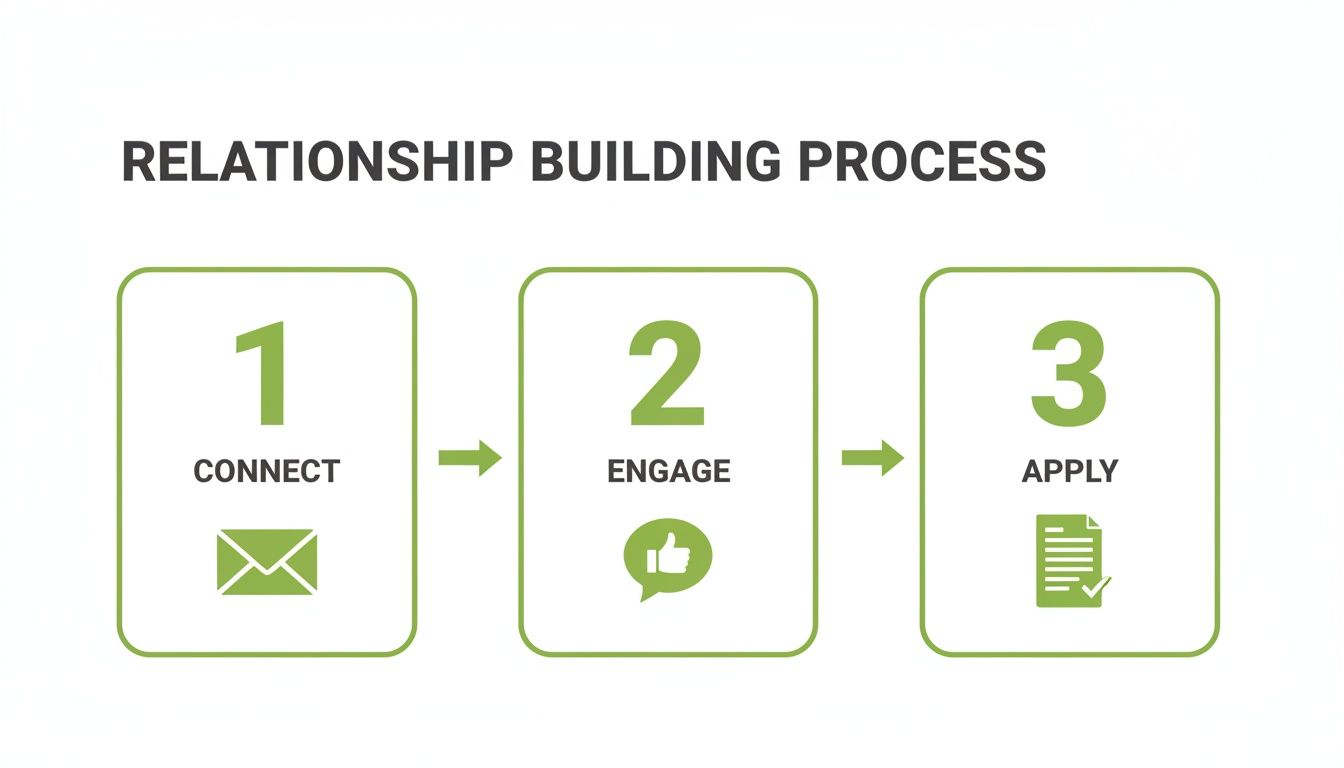
The "Apply" stage is where all your earlier work connecting with and engaging the foundation pays off in a powerful, persuasive proposal.
Modern tools like Fundsprout can make this process even more efficient. Their platform can analyze a funder's guidelines to automatically create a structured outline and help generate first drafts of your narrative in your organization's voice. This is a great way to assemble a winning application for community foundation grants faster, giving you a serious edge.
Manage Your Grant After You Click Submit
You’ve poured weeks of effort into a compelling proposal and finally clicked submit. It’s so tempting to sit back, breathe a huge sigh of relief, and just wait for the news. But don't. The work of building a genuine partnership with a community foundation is just getting started.
How you handle this post-submission quiet period says a lot about your organization’s professionalism and dependability. This is your chance to show them you’re a fantastic partner to work with, whether you get the grant or not.
The Art of the Follow-Up
The golden rule of following up is simple: respect the foundation's process. They'll almost always spell out their decision timeline and communication preferences in the guidelines. Follow these instructions to the letter.
But what if the decision date comes and goes, and all you hear is crickets? It’s perfectly fine to send a brief, polite email. The key is to avoid asking, "Have you made a decision yet?" Instead, frame your check-in as an offer to help.
Here's a sample email you can adapt:
Subject: Following up on Our Proposal - [Your Organization Name]
Dear [Program Officer Name],
I hope you're having a great week. We were so grateful for the opportunity to submit our proposal for the [Program Name] last month and remain really excited about what it could mean for our community.
As your team moves through the review process, please don't hesitate to reach out if any questions come up. We're happy to provide any additional information you might need.
Thank you again for your time and consideration.
All the best,
[Your Name]
See the difference? This approach is helpful, not pushy. It reinforces your role as a collaborator and keeps your organization on their radar in a positive way.
Responding to the Decision With Grace
Whether the email brings a "yes" or a "no," your response is a critical moment. It sets the tone for your entire future relationship with the foundation. I’ve seen both scenarios become powerful opportunities to strengthen that connection.
Turning a grant rejection into a learning opportunity is one of the most important skills a fundraiser can develop. The feedback you gain can be the key to unlocking a "yes" on your next attempt, either with this funder or another.
How you handle the news shows them you’re in this for the long haul.
When You Get the "Yes"
Congratulations! Pop the sparkling cider and celebrate with your team—you've earned it. Then, it's time to immediately pivot into stewardship mode.
- Acknowledge it, fast: Send a personal, heartfelt thank-you email to your program officer right away. Follow that up within a week with a formal, signed acknowledgment letter from your Executive Director or Board Chair.
- Share the good news (with permission!): Once you have the green light, shout it from the rooftops. Announce the grant on social media and in your newsletter, making sure to tag and thank the community foundation. This shows their investment is already making an impact. For example, the Latino Community Foundation regularly amplifies its partners' work by highlighting major grant awards, like the $2.2 million they distributed for leadership and disaster recovery.
- Deliver on your promises: This is the most important part. Execute your project flawlessly. Meet every single reporting deadline, and don't just send numbers—be proactive in sharing success stories and photos that bring their investment to life. This is how you build the trust that leads to the next grant.
When It's a "No"
A rejection stings, there's no way around it. But it's far from the end of the road. Your goal now is to learn everything you can and keep the door open for next time.
Take a day or two to process the news. Then, send a gracious email thanking the program officer for their time and consideration. The most important part? Ask for feedback.
Here’s a simple way to ask:
“Thank you again for the opportunity to apply. We know you had many worthy applications and appreciate your team’s careful review. If your time permits, would you be open to a brief 15-minute call in the coming weeks? We would be grateful for any feedback you could share to help strengthen our future proposals.”
This professional approach shows you value their expertise and are committed to improving. The insights you gather in that short conversation can be absolute gold, turning this "no" into a "yes" down the line.
Frequently Asked Questions About Community Foundation Grants
As you start exploring community foundation grants, you're bound to have some questions. It’s a common feeling, and we hear a lot of the same queries from nonprofit leaders just like you. Let's get them answered so you can feel confident in your next steps.
How Do I Know If My Nonprofit Is Eligible?
At its core, eligibility hinges on two non-negotiables: your legal status and where you do your work. First, you absolutely must be a registered 501(c)(3) organization in good standing. Community foundations almost exclusively give to other registered charities.
Just as important is your geographic service area. Your programs have to serve the foundation's specific territory, whether that's a single city, a county, or a broader region. Before you go any further, find the map or list of covered areas on their website. If you’re not there, you can’t apply.
But the real test of eligibility is mission alignment. A foundation might technically serve your county, but if they fund arts and culture and you run a food pantry, it’s not a match. You have to dig into their recent grantee list to see if they're actually funding organizations like yours.
That’s where the rubber meets the road. Your mission has to truly resonate with their giving priorities to have a shot.
What Is the Average Grant Size?
There's no magic number here. Grant sizes can swing wildly from a few hundred dollars for a neighborhood project to six-figure awards for a big capital campaign. The amount you can expect depends on the foundation’s assets, the specific fund you’re applying to, and what you’re trying to accomplish.
Many foundations offer "mini-grants" between $1,000 to $5,000 with a much simpler application, which is a fantastic way to get your foot in the door. For their larger, more competitive grant cycles, an average award might fall in the $25,000 to $50,000 range.
The only way to know what's realistic is to do your homework. Look for a list of recent grant awards on their website. For an even closer look, their public Form 990 tax documents will show you exactly who they funded and for how much. This simple research step keeps you from asking for an amount that’s completely out of sync with their giving patterns.
Can We Apply If We Are a New Nonprofit?
Yes, you can—but you have to be strategic about it. Some funders do want to see a few years of operational history, but many community foundations are genuinely excited to back new, local organizations. They're often more willing to take a risk on a fresh idea if you make a compelling case for support.
Without a long track record, you have to build credibility in other ways.
- Lean on Your Team: Showcase the deep community ties and professional experience of your staff and board members.
- Bring the Data: Use compelling statistics to prove the need you're meeting is real and urgent.
- Show You're a Collaborator: Provide strong letters of support or partnership from other established local organizations.
- Present a Rock-Solid Budget: Make sure every dollar is accounted for and clearly justified.
If you can, try to have a conversation with a program officer before you hit "submit." Putting a face to the application helps them understand your vision and gives them the confidence to advocate for a new organization like yours.
What Are the Most Common Mistakes to Avoid?
The biggest mistake I see is the "spray and pray" method—blasting a generic proposal to a dozen foundations and hoping something sticks. It never works. Every single application has to be thoughtfully tailored to that specific funder’s mission, priorities, and even the language they use.
Another classic error is skipping the relationship-building part entirely. Sending a "cold" application from an organization they've never heard of dramatically lowers your odds. Taking the time to introduce yourself makes a world of difference.
A few other common-sense slip-ups can sink an otherwise great proposal:
- Ignoring the Fine Print: Failing to follow exact formatting rules, word counts, or submission steps.
- A Sloppy Budget: Submitting a budget with math errors or costs the foundation doesn't allow.
- Fuzzy Metrics: Being vague about how you’ll actually measure the project's success and impact.
And of course, never miss a deadline. It sounds obvious, but last-minute scrambles are where mistakes happen. A good grant management tool can help you map out your timeline and keep you on track.
Fundsprout makes it easier to navigate the entire grant lifecycle. From finding the right community foundation grants with AI-powered prospect research to crafting tailored proposals with our writing assistant, our platform is designed to help your nonprofit secure the funding it needs to thrive. Learn how Fundsprout can help you win more grants.
Try 14 days free
Get started with Fundsprout so you can focus on what really matters.