7 Powerful Case for Support Examples to Secure More Funding in 2026
Discover 7 powerful case for support examples with detailed analysis and templates to help your nonprofit craft a winning narrative and secure more funding.

Abdifatah Ali
Co-Founder
Your organization's mission is powerful, but translating that passion into a document that convinces funders to invest can feel like a monumental task. A compelling case for support is the narrative backbone of all successful fundraising, from major grant proposals to annual donor appeals. It is more than just a plea for money; it's a strategic argument that clearly defines a community need, presents your unique solution, and proves you can deliver measurable results.
Yet, many nonprofits struggle to move beyond generic statements, leaving potential funding on the table. They describe their work without making a persuasive case for investment, failing to connect the dots for skeptical grant reviewers or discerning philanthropists. This guide will change that.
We're breaking down seven distinct and effective case for support examples, moving beyond surface-level descriptions to offer deep strategic analysis. For each example, you will find:
- A breakdown of why the approach is effective.
- Actionable takeaways to apply to your own writing.
- Ready-to-use templates and checklist items.
You'll learn not just what works, but why it works and how to adapt these winning frameworks for your own organization, regardless of your size or mission. Get ready to transform your case for support from a simple document into your most powerful fundraising asset.
1. The Problem-Solution-Impact Framework Case for Support
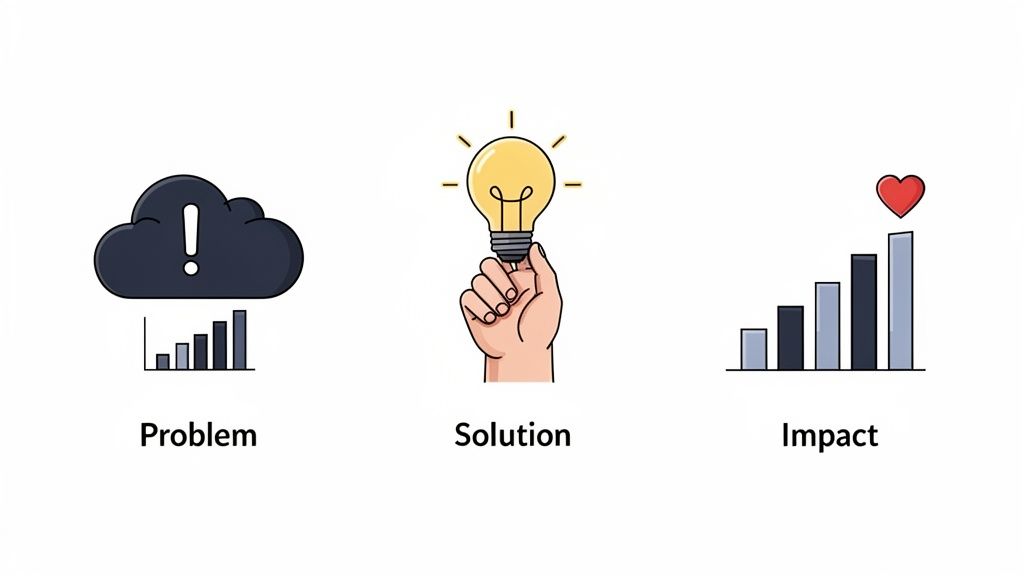
The Problem-Solution-Impact model is a foundational structure for building a persuasive case for support. This framework tells a clear and logical story that grantmakers and major donors find compelling because it directly answers their most fundamental questions: What is the issue? How are you fixing it? And how do we know your approach works? This classic narrative arc is one of the most effective case for support examples because it grounds your mission in real-world data and verifiable outcomes.
Why This Framework Works
The power of this model lies in its simplicity and logic. It systematically builds a case for investment by first establishing an urgent, validated need. Then, it positions your organization as the unique and capable agent of change before finally offering concrete proof of your effectiveness.
- Problem: This section grabs the reader's attention by outlining the specific, urgent issue your organization addresses. Use current, relevant data (local, if possible) to establish credibility. This part of your case connects directly to a strong statement of need, which is the foundation of any grant proposal.
- Solution: Here, you detail your unique methodology, programs, and activities. Explain why your approach is the right one to solve the problem you've just presented.
- Impact: This is where you prove your value. Share specific, measurable outcomes that demonstrate your solution’s success. Quantifiable data, such as percentages, numbers of people served, or pre- and post-program metrics, are critical here.
Actionable Tips for Your Case
To apply this framework effectively, focus on precision and relevance. Vague statements will weaken your argument.
- Be Hyper-Specific: Instead of saying "we help homeless youth," say "We provide stable housing and career counseling to 150 youth aged 18-24 annually in the downtown corridor."
- Connect to Funder Priorities: Customize your problem statement to align with a specific funder's stated interests. If a foundation focuses on education, frame your youth homelessness problem through the lens of its effect on high school graduation rates.
- Keep Data Fresh: Use statistics and community data from the last two years. Outdated information can signal that your organization is out of touch with the current reality of the problem.
Key Insight: The Problem-Solution-Impact framework is not just a writing template; it's a strategic tool. It forces you to clarify your organization's core logic model, ensuring every part of your case for support is aligned and mutually reinforcing.
2. The Community Voice and Testimonial-Driven Case for Support
A testimonial-driven case for support centers its narrative on authentic stories and direct quotes from program participants, beneficiaries, or community members. This emotionally resonant approach moves beyond statistics to demonstrate impact through lived experience. It is a powerful method for building connection and is one of the most effective case for support examples for organizations whose work is deeply personal. By balancing powerful stories with credible data, this model makes your mission feel both urgent and tangible.
Why This Framework Works
This framework succeeds by translating abstract outcomes into human terms. While data shows what you achieved, stories show why it matters. This approach gives a voice to the very people a funder's investment is meant to help, creating a direct line of sight from donation to real-world change.
- Authenticity: Real stories from real people build trust and credibility. A quote from a program graduate describing how they secured a job is often more memorable than a simple employment rate statistic.
- Emotional Connection: Stories create empathy. A funder might not fully grasp the complexities of clinical mental health treatment, but they can understand the relief in a parent's voice when they say, "I finally have my child back."
- Illustrative Power: Testimonials act as mini case studies that illustrate your process in action. For example, a student’s story of moving from coding novice to hackathon winner showcases the entire arc of your STEM program's success.
Actionable Tips for Your Case
To use this framework effectively, you must be both a storyteller and a responsible steward of people's experiences. Ethical and strategic story collection is paramount.
- Get Proper Consent: Always secure written consent from participants. Clearly explain where and how their story, name, and image will be used. For sensitive topics, particularly in health or human services, be mindful of HIPAA or other privacy regulations.
- Pair Stories with Data: Don't let stories stand alone. Follow a powerful testimonial with a hard metric to ground the anecdote in broader impact. For example: "Marcus's story is not unique. Last year, 78% of participants in our housing program secured stable employment within six months."
- Systematize Collection: Make story collection a routine part of your program operations. Use intake forms, follow-up surveys, and regular check-ins to gather quotes and impact narratives. Keeping these organized makes them easy to pull for proposals.
- Ensure Diverse Representation: Actively collect and feature stories that reflect the full diversity of the community you serve, including different demographics, backgrounds, and program outcomes. This paints a more complete and honest picture of your work.
Key Insight: The Community Voice model transforms beneficiaries from passive recipients of aid into active partners in your mission. Their stories are not just evidence; they are the most powerful advocacy tool you have for proving your value and inspiring investment.
3. The Capacity and Readiness Demonstration Case for Support
While a compelling problem and solution are essential, some funders, especially those considering large or multi-year investments, have a more immediate question: "Can you actually handle this money?" The Capacity and Readiness Demonstration model directly addresses this concern by shifting the focus from the "what" to the "how." This structure is designed to prove your organization is a stable, well-managed, and low-risk partner ready to execute a project effectively. It is one of the most practical case for support examples for newer nonprofits, those scaling up, or any group seeking a significant funding increase.
Why This Framework Works
This model builds a funder’s confidence by showcasing your operational and administrative backbone. It assures them that their investment will be managed responsibly and that your programs are built on a solid foundation. Instead of just pitching an idea, you are demonstrating your readiness to deliver.
- Financial Stability: This section provides proof of fiscal health. Evidence like consecutive clean audits, a diversified funding base, and strong internal financial controls shows you are a responsible steward of funds.
- Qualified Personnel: Here, you highlight the expertise of your team. This includes staff credentials, board member qualifications, leadership experience, and high staff retention rates, which indicate a stable and positive work environment.
- Proven Systems and Infrastructure: This part details the operational tools and processes that enable your work. Documented systems for project management, data collection (like an EHR system), or client tracking prove you can manage complex tasks and report on outcomes efficiently.
Actionable Tips for Your Case
To build a convincing capacity case, you must gather and present concrete proof of your organization's strengths. It’s about showing, not just telling.
- Emphasize Credentials and Longevity: Don't just list staff; highlight their qualifications. For example: "Our early childhood center is guided by 12 staff members with early childhood credentials and has maintained NAEYC accreditation for a decade."
- Quantify Project Management Success: Show a track record of success. Instead of saying "we build housing," specify "We have completed 340 affordable housing units on time and on budget over the past eight years, managed through our proprietary tracking system."
- Address Gaps with a Plan: If you have weaknesses, address them head-on. Acknowledge a gap and present a clear, actionable plan to fix it, which can build more trust than ignoring the issue. This is a core part of receiving nonprofit capacity-building grants.
- Highlight Partnerships: For smaller organizations, external relationships can demonstrate capacity. Frame your partnerships as a strategic extension of your team, such as "While we do not have an in-house evaluator, we have a three-year partnership with the local university's social work department to conduct third-party program evaluation."
Key Insight: A capacity-focused case for support is an argument for your organization as much as it is for your project. By proving your stability, expertise, and operational maturity, you reduce the perceived risk for funders, making a "yes" a much easier decision.
4. The Collaborative Partnership and Ecosystem Case for Support
Complex community problems rarely have simple, siloed solutions. The Collaborative Partnership model builds a case for support that positions your organization as a vital hub within a broader ecosystem of change. This approach demonstrates to funders that you understand the interconnected nature of systemic issues and are actively working with others to create a more coordinated, efficient, and comprehensive response. This is one of the most sophisticated case for support examples because it highlights strategic thinking and collective impact over isolated efforts.
Why This Framework Works
Funders increasingly favor collaborative models because they reduce service duplication, braid resources, and lead to more durable outcomes. This framework moves beyond your organization's individual achievements to tell a story of shared vision and mutual reinforcement. It answers a key funder question: "How does your work fit into the bigger picture?"
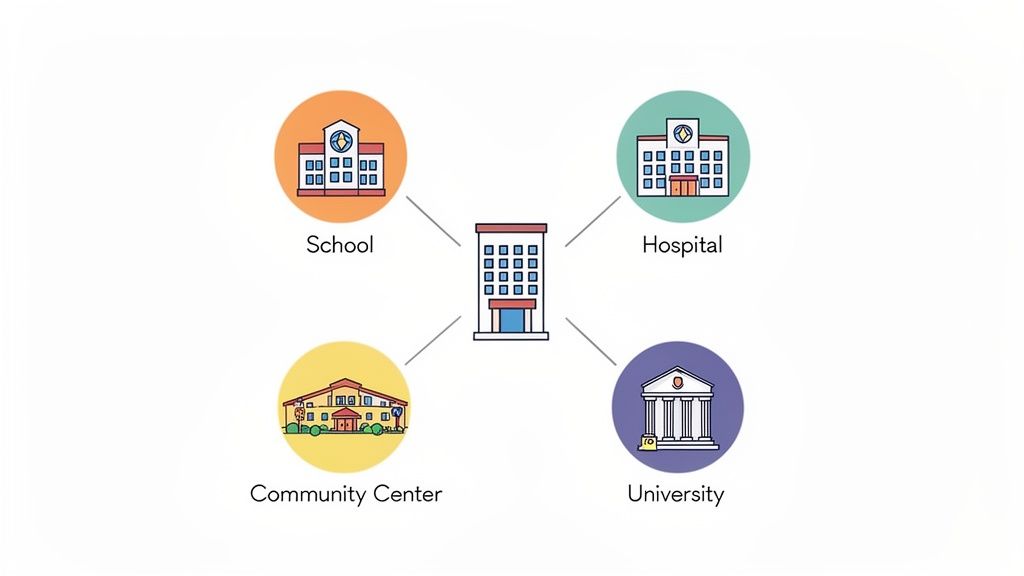
- Ecosystem: This section maps out the network of collaborators you work with. Clearly define the roles and responsibilities of each partner, such as government agencies, other nonprofits, school districts, or university research teams.
- Synergy: Explain why this partnership is greater than the sum of its parts. Detail how your combined efforts address a problem more effectively than any single organization could alone. For example, a housing nonprofit might partner with a mental health provider and a job training center to provide holistic support.
- Collective Impact: Present the shared goals and joint metrics you use to measure success across the entire partnership. This demonstrates a commitment to accountability and a unified strategy for achieving community-level change.
Actionable Tips for Your Case
To build a compelling partnership case, you must show genuine, well-documented collaboration, not just a list of names. Evidence is everything.
- Map It Out Visually: Create a clear partnership map or logic model that shows how each organization contributes to the overall goal. This visual aid makes a complex system easy for a funder to understand in seconds.
- Secure Letters of Commitment: Go beyond informal agreements. Include formal Memorandums of Understanding (MOUs) or strong letters of commitment that detail the specific resources, time, and expertise each partner brings to the table.
- Define Shared Metrics Early: Before seeking funding, work with your partners to establish joint metrics and a shared reporting framework. This shows funders you are already aligned and prepared to track your collective success.
Key Insight: A partnership-focused case for support shifts the narrative from "fund my organization" to "invest in a proven, coordinated community solution." It demonstrates maturity and a deep understanding of the problem's complexity, making your proposal a lower-risk, higher-impact investment for funders.
5. The Evidence-Based and Research-Supported Case for Support
The Evidence-Based and Research-Supported model anchors your case for support in objective, third-party validation. This approach moves beyond your organization’s internal data to demonstrate that your entire methodology is built on a foundation of peer-reviewed research and proven practices. For funders in sectors like health, education, and criminal justice, this structure is often a prerequisite, positioning your organization as a rigorous, reliable, and low-risk investment. This is one of the most powerful case for support examples for securing government grants and large institutional funding.
Why This Framework Works
This model's credibility comes from its scientific rigor. It tells funders not just that your program works, but that the model you've adopted has been proven effective under controlled conditions. It answers the question, "Why should we believe your solution will work?" with a body of external evidence.
- Evidence-Based Model: This section explicitly names the recognized, research-validated model your program implements (e.g., the Risk-Need-Responsivity model for reentry services, or Social-Emotional Learning frameworks in youth development).
- Supporting Research: Here, you cite the key studies, meta-analyses, or reports that prove the model's effectiveness. Referencing research from organizations like the RAND Corporation or findings published in academic journals builds immense trust.
- Implementation Fidelity: This component demonstrates that you are applying the model correctly. It explains how your operations align with the model's core principles and how you measure your adherence to its proven structure.
Actionable Tips for Your Case
To apply this framework, you must be meticulous in your research and documentation. Your goal is to show a clear, unbroken line from established science to your day-to-day work.
- Be Precise with Terminology: Instead of saying you run a "home visiting program," state that you implement the "Nurse-Family Partnership model," a specific, evidence-based intervention with decades of research behind it.
- Build a Research Library: Create a centralized document or repository of key citations, studies, and statistics relevant to your program models. This makes it easy to pull validated evidence for different proposals.
- Partner with Academics: Collaborate with local universities or research organizations to evaluate your programs. This can strengthen your evidence-based claims and even contribute new findings to the field.
Key Insight: An evidence-based case for support shifts the conversation from "We believe our program works" to "Independent, scientific research shows that this model, which we faithfully implement, achieves these specific outcomes." This is the gold standard for credibility.
6. The Geographic or Population-Specific Focus Case for Support
This highly targeted case for support moves away from broad statements to concentrate on a specific geographic area, demographic group, or distinct need. This approach positions your organization as the definitive expert within a defined niche, which is extremely compelling to funders interested in place-based or equity-focused initiatives. For community-based nonprofits, this model is one of the most powerful case for support examples because it demonstrates authentic connection and deep contextual understanding.
Why This Framework Works
The strength of this approach is its demonstration of specialized expertise and credibility. By narrowing your focus, you aren't limiting your impact; you are concentrating it. This tells funders that your strategies are not generic but are specifically designed for the unique cultural, economic, and social realities of the community you serve.
- Geographic Focus: This section details the specific region, city, or neighborhood you serve. It goes beyond naming the area to describe its unique challenges and assets, such as a rural tri-county area with limited public transportation or a specific urban district with a high concentration of recent immigrants.
- Population Focus: Here, you define the specific demographic you serve, such as LGBTQ+ youth in states without protective laws or Somali refugees in Minneapolis. The key is to explain why this group requires specialized services and how your organization is uniquely equipped to provide them.
- Expertise and Trust: This part proves your deep connection to the community. It includes details like staff or board members who are representative of the population, long-standing local partnerships, and culturally specific program designs that have earned community trust.
Actionable Tips for Your Case
To make this framework successful, your case must be rooted in authentic relationships and detailed, localized data.
- Demonstrate Deep Understanding: Instead of saying "we serve low-income families," describe the specific barriers they face in your community: "We provide financial literacy coaching in Spanish to agricultural workers in the Central Valley, addressing the challenges of seasonal income fluctuations and remittance practices."
- Show Community Representation: Highlight how your organization reflects the community it serves. Mention the percentage of staff who speak the community's primary language or board members who live in the target neighborhood.
- Use Hyper-Local Data: Support your claims with specific local statistics. Use census tract data, local public health reports, or school district statistics to paint a precise picture of the need in your defined area.
Key Insight: A population-specific case for support turns what some might see as a "niche" into a strategic advantage. It tells funders that their investment will be guided by true community expertise, leading to more effective and sustainable outcomes.
7. The Financial Sustainability and Long-Term Vision Case for Support
This forward-thinking model addresses not just the immediate need but the organization's long-term financial health. It demonstrates to funders that your organization thinks strategically beyond individual grant cycles and has a realistic plan for financial stability. This approach signals maturity and reduces funder concerns about what happens when their grant funding ends, making it one of the most reassuring case for support examples for sophisticated grantmakers.

Why This Framework Works
The power of this case for support lies in its transparency and foresight. It builds trust by showing that you are a responsible steward of funds with a viable plan to continue your mission indefinitely. Instead of just asking for money, you are inviting funders to invest in a durable, well-managed organization poised for lasting impact.
- Diverse Revenue Streams: This section outlines your plan to move away from over-reliance on a single funding source. For example, an arts nonprofit might show a mix of 40% grants, 30% individual donors, and 30% earned revenue from classes.
- Long-Term Vision: Here, you articulate where the organization is headed over the next 3-5 years. This includes plans for building operating reserves, launching a social enterprise, or securing government contracts to stabilize your financial base.
- Board and Leadership Buy-In: Demonstrating that your board has approved the financial plan and established strong oversight policies proves that sustainability is an organization-wide priority, not just a fundraising talking point.
Actionable Tips for Your Case
To apply this framework, focus on realistic projections and clear, documented planning. Honesty and credibility are paramount.
- Show Your Math: Present a clear, conservative financial projection. For an employment services nonprofit, this could mean showing how a new staffing cooperative will self-fund 10% of operations in year one, growing to 30% by year three.
- Be Honest About Gaps: If full revenue diversification isn't feasible for your model, explain why. Acknowledge the challenges and present a realistic path forward, showing funders you understand your operational context.
- Document Board Commitment: Include a sentence in your case for support noting that the board has formally adopted financial policies and regularly reviews progress toward sustainability goals. This adds a powerful layer of credibility. Learn more about how to structure a formal sustainability plan to guide this process.
Key Insight: This framework shifts the conversation from a one-time transaction to a long-term partnership. By showing a clear vision for financial health, you position your organization as a low-risk, high-impact investment for any funder concerned with lasting change.
7-Point Case for Support Comparison
Build Your Winning Case with the Right Tools
Throughout this guide, we've explored a variety of powerful case for support examples, each revealing a distinct strategy for building a compelling funding narrative. From the emotional power of testimonial-driven appeals to the undeniable logic of evidence-based models, it’s clear that a one-size-fits-all approach simply doesn’t work. The most successful nonprofits don't just tell their story; they select the right framework to make that story resonate with a specific audience.
We've seen how organizations effectively frame the problem, articulate a clear solution, and prove their impact. We also examined how demonstrating community buy-in, showcasing strategic partnerships, and presenting a solid vision for long-term financial health can be the deciding factor for many funders. Each example serves as a blueprint, not just a template, offering a strategic lens through which you can view your own organization's strengths and opportunities.
Your Strategic Takeaways and Next Steps
The journey from a good idea to a fully funded program is paved with intentional documentation. The examples provided highlight that a strong case for support is a living document, not a static file saved on a shared drive. It must be adaptable, data-informed, and consistently refined.
As you move forward, consider these actionable steps:
- Audit Your Assets: Review your existing materials. What do you have? Strong client testimonials? Compelling program data? A detailed strategic plan? Identify your strongest assets and match them to one of the case for support models we've discussed. For instance, an abundance of positive feedback from community members is a perfect foundation for a Community Voice and Testimonial-Driven Case for Support.
- Mix and Match Models: Don't feel confined to a single framework. The most sophisticated cases often blend elements from multiple approaches. You might combine the rigorous data from an Evidence-Based and Research-Supported Case with the narrative pull of a Problem-Solution-Impact Framework to appeal to both the head and the heart of a grantmaker.
- Create a Central "Story Bank": Begin compiling your core components in one accessible place. This includes key statistics, powerful quotes, project outcomes, high-resolution photos, and budget justifications. Having this information ready streamlines the creation of customized proposals, saving you from last-minute scrambles for critical data.
- Draft a "Master Case" Document: Use the insights and checklists from this article to build a comprehensive master case for support. This internal-facing document will serve as your single source of truth, from which you can pull and adapt content for specific grant applications, donor appeals, and marketing materials.
Turning Frameworks into Funded Realities
Mastering the art of the case for support is about more than just good writing; it's about strategic positioning. It's about showing funders not only that your work is important, but that your organization is the best possible steward for their investment. A well-constructed case demonstrates competence, foresight, and a deep connection to the community you serve.
By thoughtfully selecting and adapting these frameworks, you move beyond simply asking for money. You begin building genuine partnerships with funders who share your vision. You present an undeniable argument that investing in your organization yields measurable, meaningful returns. This strategic approach turns your mission from a hopeful aspiration into a well-funded, high-impact reality, ensuring your vital work can continue and grow for years to come.
Ready to move from scattered documents to a streamlined, powerful fundraising engine? Fundsprout provides the tools you need to build, manage, and optimize your case for support. With a central repository for your data, an AI-powered writing assistant to help draft compelling narratives, and integrated impact tracking, Fundsprout helps you craft winning proposals faster, so you can focus on what matters most: your mission.
Try 14 days free
Get started with Fundsprout so you can focus on what really matters.