Basic Ordering Agreement: Unlock Nonprofit Potential
Learn how a Basic Ordering Agreement (BOA) can unlock new opportunities for your nonprofit. This guide details the complete process to help you succeed.

Abdifatah Ali
Co-Founder
You may be hearing from a city agency, a state office, or a federal prime contractor that wants your nonprofit available on short notice. The need is real. Your team can deliver meals, outreach, counseling, housing navigation, training, or recovery support. The hard part is the paperwork.
For many nonprofit leaders, that's the frustrating gap. Government partners need flexibility because future needs aren't fully known. Your organization needs clarity because staff time, cash flow, and compliance risk are very real. A basic ordering agreement sits in that gap. It can create a path to future work without locking either side into a full contract on day one.
If you run a 501(c)(3), this matters more than it first appears. A basic ordering agreement can help your organization show up as a ready provider, a specialized subcontractor, or a mission partner to a larger prime. But it only helps if you understand what it is, what it isn't, and where nonprofits get tripped up.
Streamlining Your Mission with Strategic Agreements
A nonprofit disaster response team gets a call after a severe storm. Local officials need temporary shelter support, case management, and distribution logistics. The nonprofit can mobilize. Staff know the community. Volunteers are lined up. Vendors are on standby.
Then the bottleneck hits. Each purchase, staffing arrangement, and service scope needs separate approvals. Terms that could have been discussed earlier now have to be negotiated while families are waiting. The problem isn't willingness. The problem is that one-off contracting is slow when needs are urgent and not fully defined in advance.
That same pattern shows up outside emergencies. A behavioral health nonprofit may be asked to provide surge counseling during a public incident. A workforce group may be needed for rapid re-employment support after a plant closure. A food access organization may be called when a school district needs temporary community meal distribution. In each case, the demand arrives before the paperwork feels ready.
Why nonprofits feel this pain more acutely
For-profit government contractors often have dedicated contract staff, legal support, and cash reserves. Many nonprofits don't. An executive director may be reviewing scopes at night. A program director may be juggling service delivery and compliance. Delay costs more than time. It can mean missed service windows, staff burnout, and uncertain reimbursement.
That's one reason more nonprofit leaders are trying to broaden how they fund programs. If your team is thinking beyond traditional grants, this guide on increasing nonprofit revenue streams is a useful companion to procurement planning.
A strong government relationship often breaks down at the same place. Everyone agrees on the mission, but nobody has a fast, compliant way to order the work.
A basic ordering agreement is designed for this kind of environment. It gives an agency and a provider a framework for future orders when exact needs aren't known yet. That can reduce repeated setup work later, which is why BOAs attract attention from nonprofits that deliver recurring community services.
There's also a practical workflow issue. When agreements and orders move quickly, teams need signatures, approvals, and records to keep up. If your staff is still chasing PDFs by email, this primer on how to e-sign documents can help you tighten that part of the process before opportunities start arriving.
What Exactly Is a Basic Ordering Agreement
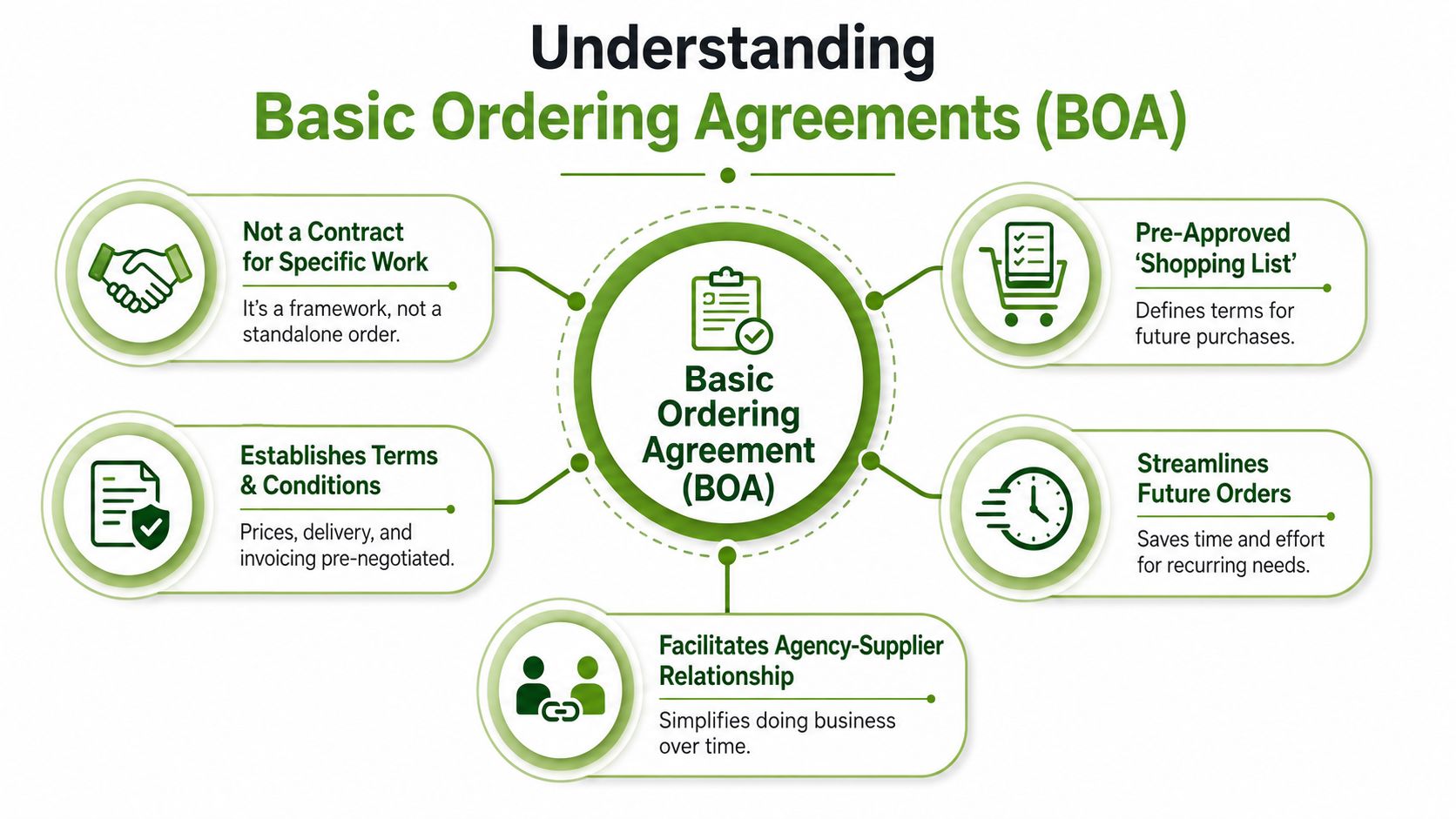
A basic ordering agreement, or BOA, is easiest to understand if you stop thinking of it as a contract for a specific project.
Think of it more like a pre-negotiated playbook. The government and your organization agree in advance on the ground rules for possible future orders. Those rules can cover general terms, methods for pricing, and how orders will be placed. Then, when a real need arises, the agency can issue an order under that framework instead of starting from scratch every time.
The official definition in plain English
The Federal Acquisition Regulation defines a BOA at 48 CFR § 16.703 as a written instrument of understanding, negotiated between an agency and a contractor, and explicitly says it is not a contract. The same rule says BOAs may be used when specific items, quantities, and prices are not known when the agreement is executed, but a substantial number of requirements is expected for the supplies or services involved, according to the Federal Acquisition Regulation definition of a BOA.
That single phrase, not a contract, is where many nonprofit leaders get confused.
A BOA does not mean funding has been awarded.
A BOA does not guarantee work.
A BOA does not let you book revenue as if a signed program contract already exists.
If you want an analogy, a BOA is closer to a library card than a bookstore purchase. The card gives you access to a system and a way to check things out under established rules. It doesn't mean you already have the books in hand.
What a BOA does for a nonprofit
For a nonprofit, the practical value is preparation. If your organization delivers services that agencies may need repeatedly, but not on a fixed schedule, a BOA can make you easier to work with.
Common nonprofit-friendly examples include:
- Emergency support services: Temporary shelter operations, distribution support, crisis case management.
- Community health activities: Outreach, screenings, health education, mobile service support.
- Workforce and training support: Rapid-response enrollment, coaching, employer coordination.
- Specialized community engagement: Language access, neighborhood outreach, culturally specific services.
The BOA sets the stage. Future orders are the actual performance opportunities.
What a BOA is not
This is the part to say clearly to your board and finance staff.
Practical rule: Treat a BOA as pipeline access, not booked income.
A nonprofit can spend a lot of energy celebrating the agreement and miss the operational reality. The binding commitment happens later, when an order is issued and accepted under the BOA framework. Until then, your organization has positioning, not guaranteed revenue.
That distinction matters for staffing. It matters for reserves. It matters for how aggressively you scale.
Here's the simplest way to explain it internally:
| Question | BOA answer |
|---|---|
| Do we have a contract for actual work yet? | No |
| Do we have guaranteed funding? | No |
| Do we have a defined framework for possible future orders? | Yes |
| Can this make future ordering faster? | Yes |
BOA vs BPA vs IDIQ Key Differences
Government acronyms make smart people feel lost. For nonprofits, the confusion usually starts when someone says, “We should pursue a BOA,” but the opportunity is a BPA or an IDIQ. Those are not interchangeable.
The fast version is this. A BOA is a framework for future orders when requirements are uncertain. A BPA often functions more like a repeat-purchase arrangement. An IDIQ is a formal contract vehicle for recurring needs over time.
If you want a plain-language glossary before diving deeper, SamSearch has a short overview to explore government contracting BOAs.
The comparison nonprofits actually need
| Attribute | Basic Ordering Agreement (BOA) | Blanket Purchase Agreement (BPA) | IDIQ Contract |
|---|---|---|---|
| Core idea | Framework for possible future orders | Repeat-purchase arrangement for recurring buys | Formal contract vehicle for future task or delivery orders |
| Is it itself a contract? | No | It depends on the underlying structure and ordering setup | Yes |
| Best when | Future needs are hard to define in advance | The buyer expects recurring, more routine purchases | The agency wants an established contract vehicle for ongoing requirements |
| Work guaranteed at award | No | Not necessarily | There is more formal commitment structure than a BOA |
| Good fit for nonprofits | On-call or surge services with uncertain timing | Frequently purchased support items or repeat services | Larger organizations with contract administration capacity |
| Internal planning posture | Treat as relationship and readiness infrastructure | Treat as recurring purchasing access | Treat as a contract vehicle requiring stronger back-office controls |
A nonprofit-friendly way to remember each one
Use these mental shortcuts:
- BOA: A pre-approved vendor relationship for future unknown needs.
- BPA: A charge-account style arrangement for repeated buying.
- IDIQ: A contract umbrella with future orders underneath it.
Those shortcuts aren't legal definitions. They're practical memory aids.
Which one fits your organization
A small community nonprofit often overreaches when it chases the biggest-sounding vehicle. That's usually the wrong instinct. The better question is whether your team can support the administrative burden that comes after award.
A BOA may fit when your value is speed, trust, and specialized local delivery. A BPA may fit if you provide routine support an agency buys regularly. An IDIQ may fit if your nonprofit already has experience with formal federal procurement and can manage order flow, invoicing, and compliance at a higher level.
If your team still struggles to tell solicitations apart, reviewing examples of RFPs and RFQs for nonprofits can sharpen your pattern recognition before you invest time in the wrong opportunity.
The biggest mistake is assuming “agreement” means the same thing across all three. It doesn't. Before pursuing any vehicle, ask two plain questions. Is this a contract right now? And what, if anything, is obligated today? Those answers shape cash planning, staffing, and board expectations.
How Your Nonprofit Can Leverage BOAs
Nonprofits often assume BOAs are mainly for defense firms, IT vendors, or large professional services companies. That view is too narrow. Many nonprofit capabilities line up with the exact kinds of uncertain, recurring needs that government agencies struggle to staff internally.
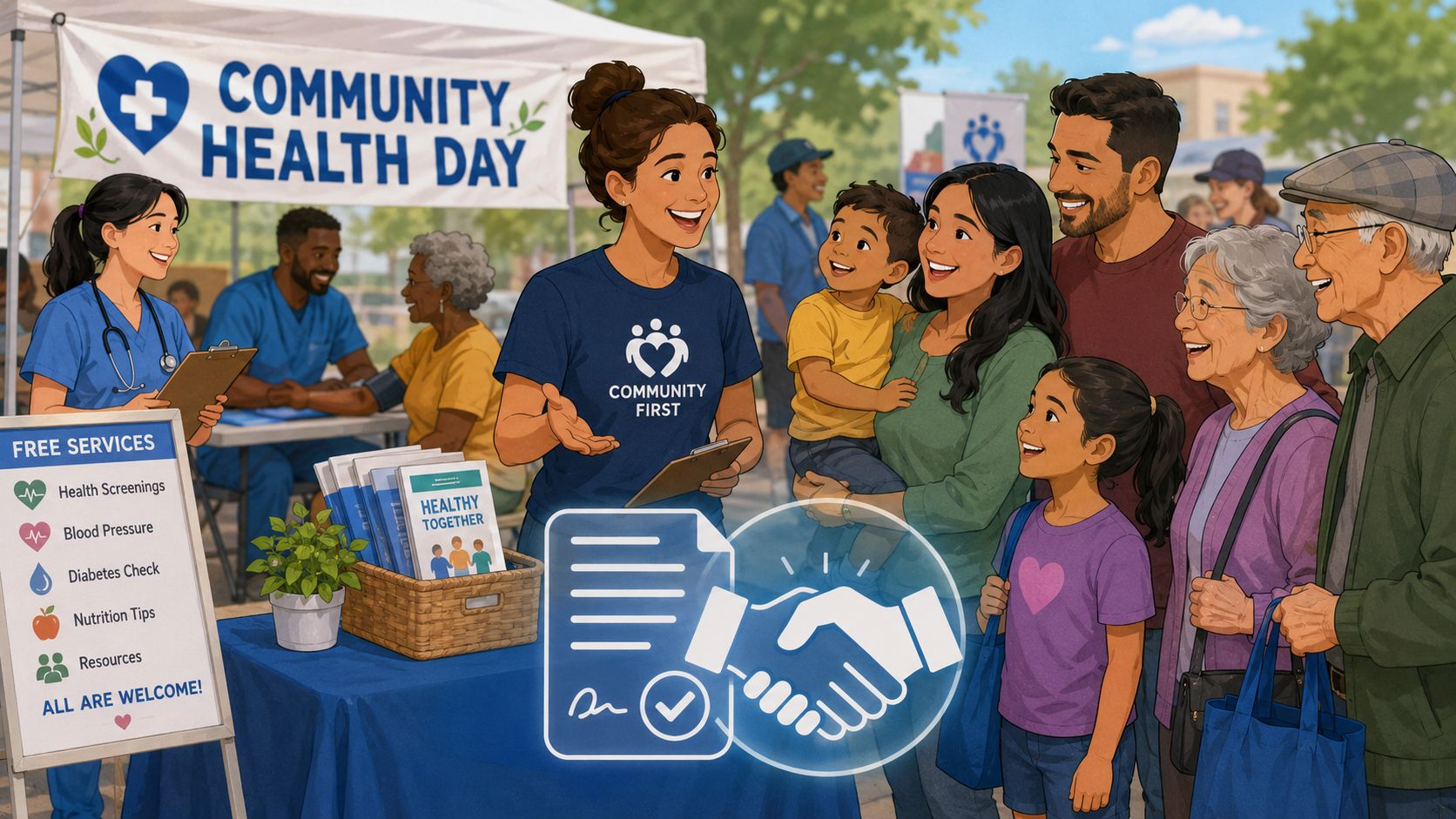
A nonprofit can engage with a BOA in three realistic ways. It can hold the BOA itself. It can work under another organization's BOA as a subcontractor. Or it can join a broader teaming arrangement where its mission expertise makes the whole offer stronger.
As the prime holder
This works best when your nonprofit has a clearly defined service area, operational controls, and leadership comfort with government terms.
A community health nonprofit, for example, may be well positioned if an agency needs recurring outreach, education, or service navigation support but can't predict exactly when or where each need will arise. A housing-focused nonprofit might fit where local government expects periodic surges in relocation support, intake, or landlord coordination.
Prime status gives you the strongest relationship with the agency. It also puts the most pressure on your systems. You'll need contract review discipline, order tracking, invoicing capacity, and a staff member who understands when an opportunity is real versus when it's still just preliminary discussion.
As a subcontractor
For many 501(c)(3)s, this is the smartest entry point.
A larger contractor may hold the BOA and need a trusted community partner to perform outreach, provide culturally competent service delivery, support participant recruitment, or manage local implementation. That lets your nonprofit contribute what it does best without carrying the full contract administration burden.
Subcontracting can be especially strong when your nonprofit brings one of these assets:
- Community trust: Residents respond to your organization in ways they won't respond to a national firm.
- Specialized populations: You serve veterans, immigrants, youth, older adults, or a local language community.
- Place-based reach: You already have facilities, volunteers, or referral pathways in the target area.
As a partner in a team
Sometimes the opportunity isn't a clean prime-sub arrangement. A nonprofit may join a team because the agency wants technical capacity and lived community connection in the same solution.
That can happen when public health, workforce, or disaster response work needs both backend management and frontline delivery. In those settings, the nonprofit may shape service design, equity strategy, or field operations while another partner manages procurement-heavy functions.
Some nonprofits don't need to “become government contractors” in the full traditional sense. They need to become indispensable mission partners inside a contracting ecosystem.
Mission areas where BOAs can make sense
Rather than thinking in legal categories, think in recurring public needs:
- Disaster and emergency relief where agencies need surge capacity
- Behavioral health and crisis response where timing is unpredictable
- Workforce transitions after closures or disruptions
- Public health outreach tied to changing local conditions
- Human services navigation when caseloads spike
What ties these together is uncertainty. The agency expects repeated needs, but not enough precision upfront to write one neat, fully defined contract for all future work.
The nonprofit test before you pursue one
Before saying yes to any BOA pathway, ask:
- Can we perform repeatedly, not just once? A BOA rewards organizations that can respond over time.
- Can we carry compliance without derailing programs? Mission strength doesn't replace back-office discipline.
- Do we know our role? Prime, sub, and partner each come with different risk.
- Can we wait for actual orders? The agreement itself won't pay payroll.
That last question is often the deciding one. If your organization treats a BOA as guaranteed future activity, it can overhire, overspend, or promise too much to the board. The strongest nonprofits use BOAs as strategic positioning tools, not as wishful revenue forecasts.
Navigating Key Clauses and Compliance
Once a BOA is signed, many nonprofit teams exhale too early. The hard part often starts after that.
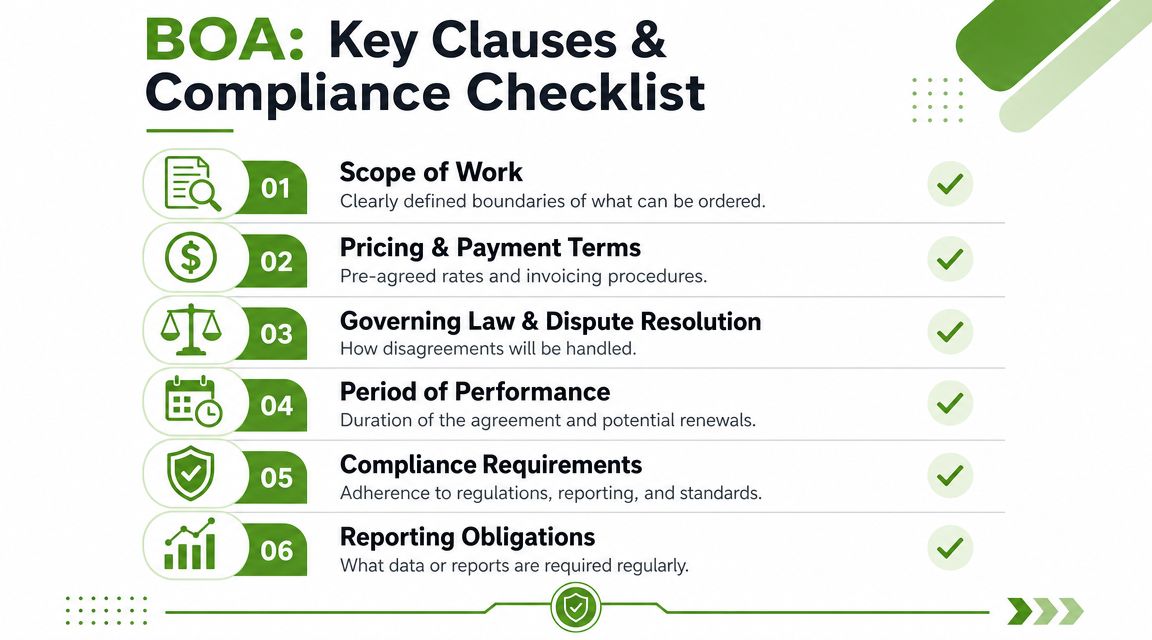
A BOA gives structure, but it doesn't erase procurement rules. Federal training guidance highlights an important operational gap. Contracting officers must obtain competition before issuing an order under a BOA and must establish prices before making a final commitment or authorizing work, according to federal acquisition training material on BOA ordering procedures. In plain language, your nonprofit usually can't start work just because the BOA exists.
Scope is your guardrail
The scope tells everyone what kinds of supplies or services may be ordered under the agreement. Nonprofits should read this with discipline, not optimism.
If your organization delivers trauma-informed counseling, but the BOA scope is written broadly around support services, don't assume every related activity is fair game. Scope creep creates two kinds of trouble. Program staff may promise services that don't fit the agreement, and finance staff may invoice work the government didn't properly order.
A simple internal rule helps: if the service isn't plainly inside the BOA's scope, ask before staffing it.
Ordering procedures control the real opportunity
BOAs diverge sharply from many nonprofit leaders' expectations. The BOA may already define general terms, but each order still has to follow the ordering process. Depending on the setup, that can include a request for quotes, order-specific details, and price establishment before work begins.
That means your team needs a repeatable workflow.
- Review the request quickly: Is this a real order opportunity or just market checking?
- Confirm scope fit: Does the requested work match the BOA language?
- Price carefully: Don't rely on assumptions from past conversations.
- Wait for proper authorization: Program urgency is not the same as legal authority to start.
Common mistake: Staff hear “you're on the BOA” and begin mobilizing before the order is competed, priced, and authorized.
Pricing needs more attention than many nonprofits give it
Because a BOA can be used when exact quantities and prices weren't known upfront, your nonprofit needs a method for building order-specific pricing that is both responsive and defensible.
That doesn't require complexity for its own sake. It requires consistency. Your organization should know how it calculates labor, travel, materials, overhead treatment, and any partner costs before the order arrives. If your pricing logic changes each time based on pressure or guesswork, you create audit risk and internal confusion.
A useful practice is to create a short internal pricing memo template for every BOA-related order. Keep it in the file with approvals and communications.
Agreement changes and order changes are not the same thing
Federal guidance also notes that if the BOA itself needs revision, the change should be made to the agreement, not by informally altering individual orders. That matters because nonprofits often patch process problems in email and assume everyone shares the same interpretation.
Don't rely on that.
If terms in the BOA need updating, route that through formal agreement modification. If a specific order changes within the authority provided, document that at the order level as required. Keep those tracks separate.
A practical compliance checklist for nonprofit teams
Use a short internal checklist before accepting work under any BOA-related order:
- Authority check: Confirm that the person sending instructions has authority to issue or confirm the order.
- Written documentation: Keep the order, modifications, and communications in one organized file.
- Program alignment: Match staff, budget, and deliverables to the actual authorized work.
- Pricing backup: Retain the basis for the price you proposed and accepted.
- Start trigger: Define the exact event that allows work to begin.
- Reporting readiness: Know what performance or invoicing documentation will be required.
For nonprofits, compliance isn't just about avoiding trouble. It protects cash flow. It protects staff from doing unfunded work. And it protects relationships with agencies that may want to order again.
Finding and Pursuing BOA Opportunities
Most nonprofits won't stumble into a BOA by accident. They find one because they start treating procurement visibility as a routine business development task, not a side project.
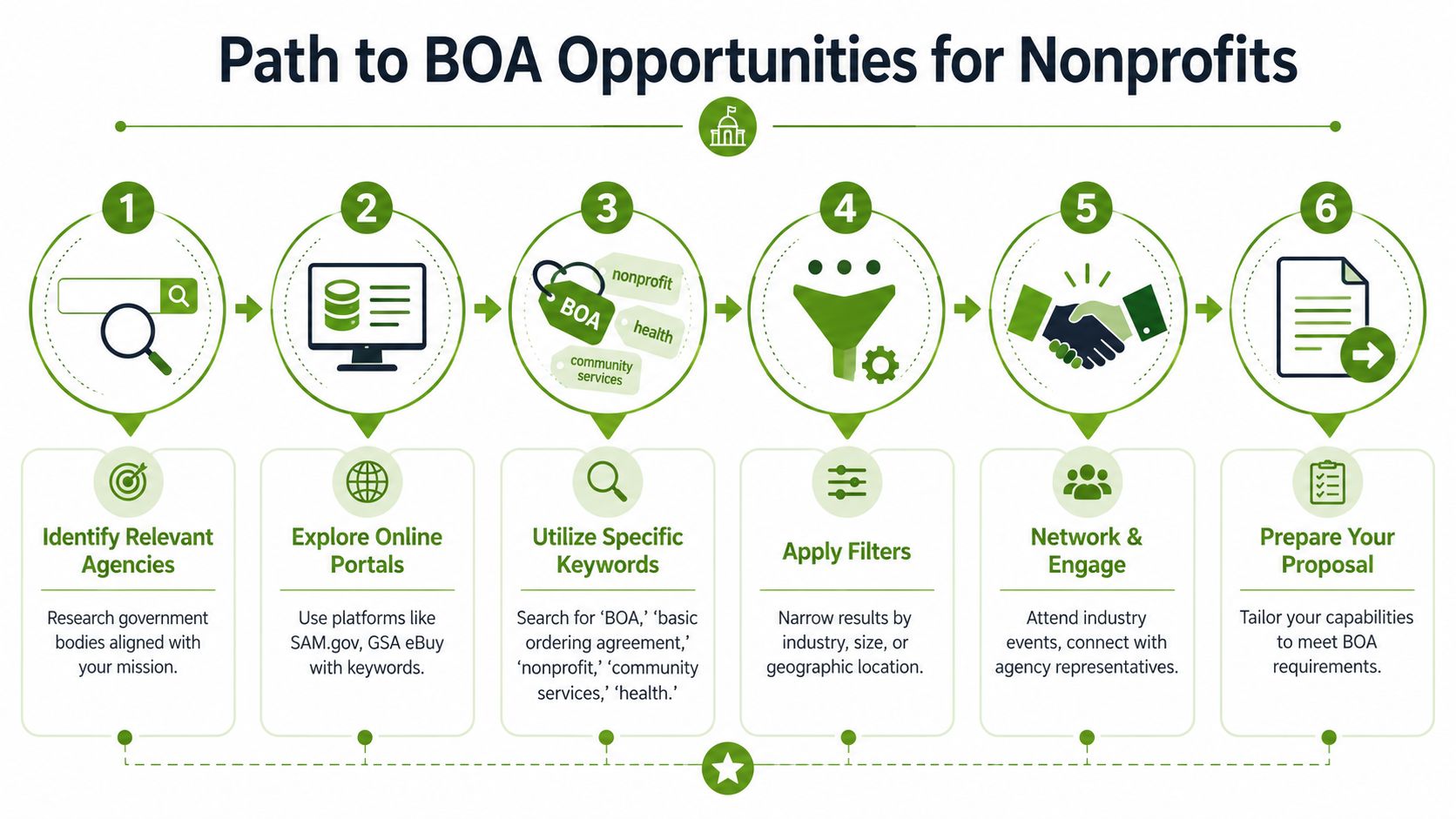
The first step is to identify agencies whose mission overlaps with your actual service model. Don't begin with procurement jargon. Begin with program reality. If your nonprofit runs reentry support, behavioral health outreach, nutrition services, youth development, or housing stabilization, list the government offices that buy those services.
Where to look
Search procurement portals and agency forecast tools using practical keywords tied to your work. Include terms like basic ordering agreement, community services, outreach, case management, disaster support, health education, and workforce services. Broaden and narrow from there.
For nonprofits tracking public funding more broadly, this directory of federal funding opportunities for nonprofits can help you map where agency demand shows up across grants and contracts.
How to improve your odds
A better BOA pursuit strategy usually looks like this:
- Build an agency list: Focus on agencies that already buy services close to yours.
- Watch recurring needs: BOAs make more sense where demand repeats but details vary.
- Attend industry events: Procurement staff and program staff often reveal future needs before formal notices appear.
- Talk to primes: Large contractors regularly need nonprofit partners with local trust and service credibility.
- Prepare a capability statement: Keep it short, concrete, and focused on outcomes, populations served, geography, and operational readiness.
Agencies don't buy your mission statement. They buy your ability to deliver a defined service compliantly when the order arrives.
What to say when you reach out
Lead with fit, not need. Don't open with “we're a nonprofit and need funding.” Open with the service problem you solve.
For example: your organization provides multilingual outreach in neighborhoods with low response rates, or your team can stand up case management capacity quickly in a specific region, or you already coordinate referral networks that reduce implementation lag. That language lands better because it sounds like procurement, not fundraising.
Then ask a grounded question: whether the agency uses BOAs or related vehicles for those services, and whether they work with nonprofit subs or local mission partners.
Fundsprout helps nonprofits find relevant public and private funding, organize proposal work, and stay on top of compliance without losing the thread between opportunity, submission, and reporting. If your team wants a more structured way to track grants, contracts, and renewal-ready documentation, take a look at Fundsprout.
Try 14 days free
Get started with Fundsprout so you can focus on what really matters.