A Strategic Guide to Increase Nonprofit Revenue Streams
Discover how to increase nonprofit revenue streams with our step-by-step guide on grants, individual giving, earned income, and strategic planning.

Abdifatah Ali
Co-Founder
If you want to build a truly resilient nonprofit, you have to stop putting all your eggs in one basket. The real key to long-term sustainability isn't just finding one big funding source; it's building a healthy mix of grants, individual donations, earned income, and corporate partnerships.
Beyond Bake Sales: Why Your Nonprofit Needs Diverse Revenue Streams
Let's be honest: relying on a single annual gala or that one major foundation grant is a gamble. It's a high-stakes game where a sudden economic downturn, a shift in funder priorities, or any number of unforeseen crises can pull the rug out from under your entire operation. The world changes fast, and that uncertainty means nonprofits have to be smarter and more adaptable to survive—and ultimately, to thrive.
Diversifying your income is more than just a smart defensive move. It's a powerful strategy for growth. When you create a stable financial foundation, you give your organization the freedom to innovate, expand its programs, and make an even bigger impact without being tied to a single, precarious funding cycle. A solid digital presence is the bedrock for this, and a good guide to nonprofit website development can show you how to build the online platform you need for modern fundraising and community engagement.
Building a Resilient Financial Future
Think of this guide as your playbook for building that resilience. We’re going to walk through the essential pillars that hold up a modern, sustainable funding model. Your path to a more secure financial future means getting comfortable with a few key areas:
- Grants and Foundation Funding: How to find and win consistent support for your core programs and new projects.
- Individual Giving: The art of building a dedicated community of donors, from small-dollar supporters to major benefactors.
- Earned Income: Creating products or services that align with your mission and bring in unrestricted cash flow.
- Corporate Sponsorships: Forging genuine, mutually beneficial partnerships with businesses that believe in your work.
- Planned Giving: Securing legacy gifts that will ensure your mission continues for generations to come.
I always tell people to think of diversification like a balanced investment portfolio. Some streams, like a monthly giving program, provide steady, predictable income. Others, like a blockbuster grant, can fuel massive growth. The goal is a healthy mix that can ride out any storm.
We’ll also look at how tools like Fundsprout can take the headache out of complex processes, especially when it comes to managing the grant acquisition pipeline. By the time you're done here, you won't just know how to increase your nonprofit's revenue; you'll have a clear roadmap to build an organization that’s strong, adaptable, and ready to make a lasting impact.
Time for a Nonprofit Revenue Health Check
Before you can build a more stable financial future for your nonprofit, you need to get brutally honest about where you stand right now. It's tempting to jump straight into chasing new funding, but trying to add new revenue streams without a clear picture of your current financial health is like building a new wing on a house without first checking the foundation. This internal audit is your chance to see what’s working, what isn't, and where your biggest risks and opportunities are hiding in plain sight.
First things first: map out your current revenue mix. Pull the numbers from your last fiscal year and figure out what percentage of your total income comes from each source. Are you one of those organizations where 80% of your budget is tied to a single, high-stakes federal grant? Or maybe a single annual gala is responsible for 60% of all your individual donations for the entire year?
This simple exercise instantly highlights your dependencies. Leaning too heavily on one source, no matter how reliable it seems, is a huge risk. A change in a foundation's priorities, a poorly attended event, or an economic downturn could put your entire operation in jeopardy. Seeing it laid out in black and white is often the wake-up call a team needs.
This decision tree shows the stark choice nonprofits face when they rely too heavily on one income source.
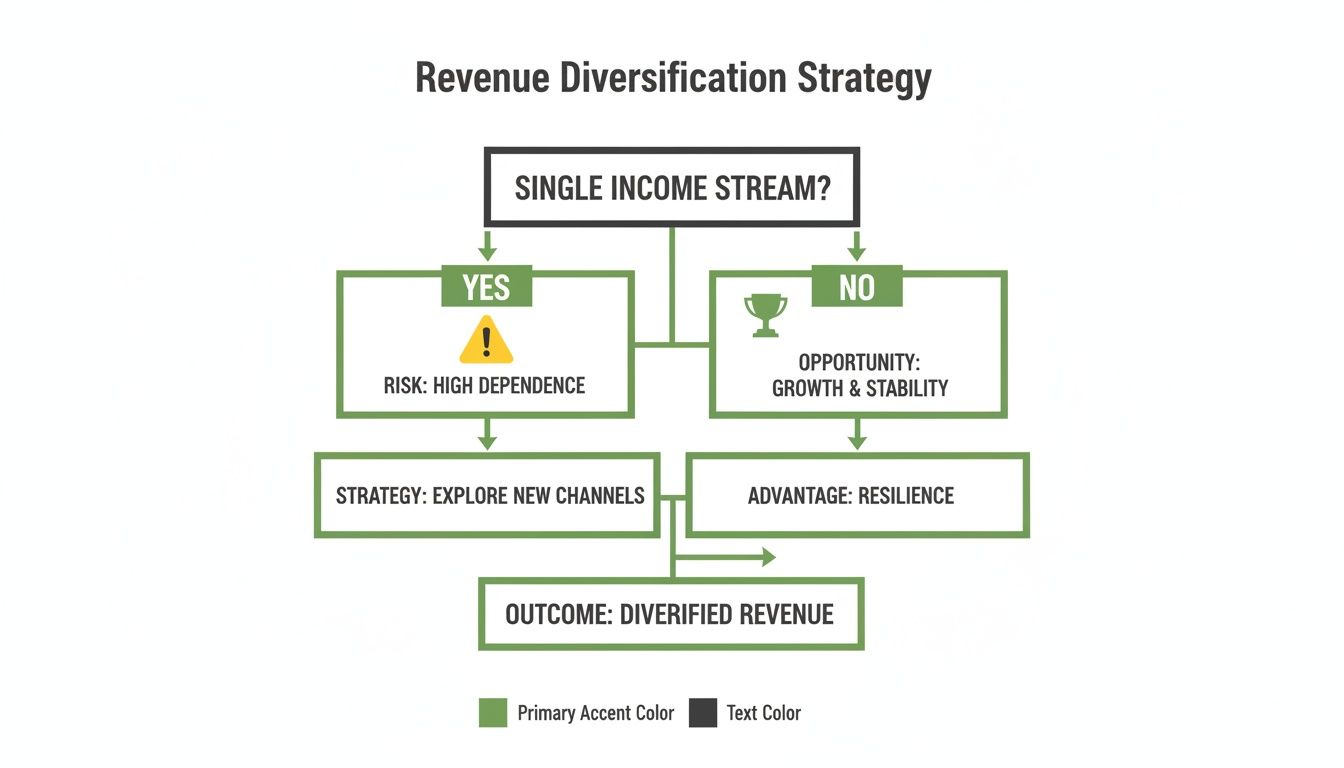
As you can see, putting all your eggs in one basket is a high-risk gamble. Spreading your bets across a few solid income streams is the only path to long-term stability and success.
How Much Does It Cost to Raise a Dollar?
Beyond just what you're raising, you have to dig into how you're raising it. For me, the most revealing metric is the cost-per-dollar-raised (CPDR). It’s a powerful tool that tells you exactly how efficient each of your fundraising efforts really is.
The math is simple: just divide the total expenses of a specific fundraising activity by the total revenue it brought in.
- Scenario A: The Annual Gala. You spent $50,000 on the venue, catering, marketing, and staff time. The event generated $200,000. Your CPDR is $0.25 ($50,000 ÷ $200,000). That means it cost you a quarter to raise every single dollar.
- Scenario B: The Digital Appeal. You spent $5,000 on platform fees and staff time for your year-end email campaign. It brought in $50,000. Here, your CPDR is just $0.10.
This data isn't about axing everything with a high CPDR. The gala might cost more, but it’s also where you connect with major donors and build community buzz. The goal is to create a healthy mix of high-efficiency, low-touch activities and higher-cost, high-engagement initiatives.
A low cost-per-dollar-raised isn't always the ultimate prize. Some of your most valuable, long-term donor relationships are forged through activities with higher upfront costs. The real key is understanding the true return on investment for each stream—not just in dollars, but in its impact on your mission.
A Quick Fundraising SWOT Analysis
With your revenue mix mapped out and your efficiency calculated, it’s time to pull it all together with a fundraising-focused SWOT analysis. This classic framework is perfect for organizing your thoughts and spotting the most promising ways forward.
Just ask yourself these four questions:
- Strengths: What are we already amazing at? (e.g., A super-engaged community on social media, a board full of connectors, killer grant writing skills).
- Weaknesses: Where are our blind spots or persistent struggles? (e.g., No recurring giving program, an ancient donor database, not enough staff to handle corporate outreach).
- Opportunities: What’s happening out there that we could jump on? (e.g., A big local company just launched a major CSR program, a new community foundation is focusing on our cause, virtual events are getting popular).
- Threats: What external challenges could throw a wrench in our plans? (e.g., A major local employer is downsizing, another nonprofit is launching a similar program, we’re hearing whispers about government funding cuts).
This exercise turns your raw data into a clear-cut action plan. If a strength is your engaged community and a weakness is the lack of a monthly giving program, the path forward is obvious. This health check gives you the strategic clarity you need to confidently and successfully increase your nonprofit's revenue streams.
Revenue Stream Assessment Matrix
To help you get started, use this assessment matrix. It’s a simple tool to evaluate both your current and potential revenue streams based on the factors that matter most for sustainable growth. Go through each potential income source and rate it honestly.
Once you've filled this out, you'll have a much clearer, at-a-glance view of where your best opportunities lie. The streams with high growth potential, low resource intensity, and strong mission alignment are your green lights—that's where you should focus your energy first.
Mastering Grants and Foundation Funding
For so many nonprofits, grants are the engine that drives everything forward. They provide the fuel to launch new initiatives, scale up what's already working, and achieve that long-term stability we're all after. Getting good at the grant funding game isn't just about finding opportunities; it's about building a smart, repeatable system that keeps the funding flowing.
The money is definitely out there. Private foundations and donor-advised funds (DAFs) have become absolute powerhouses in philanthropy. Just look at the nonprofit news sector for a real-world example. The median annual revenue for these outlets recently topped $500,000 for the first time, and a huge chunk of that growth came from smart, diversified funding strategies where grants played a starring role. You can learn a lot from these trends in nonprofit funding and how they might apply to your own work.
This just goes to show that organizations blending multiple income sources, with a strong grants program at the core, are the ones pulling ahead.

Finding the Right Funder Fit
Winning grants starts way before you ever write a single word of a proposal. The biggest mistake I see organizations make is casting a ridiculously wide net, applying for anything that seems even remotely related to their mission. It’s a "spray and pray" approach that just wastes time and kills team morale.
You need to shift your focus to funder alignment. This means going way beyond simple keyword searches in grant databases. You have to dig deep. Read a foundation's mission statement, look at who they've funded in the past, and pay close attention to the language they use in their annual reports.
What do they care about? Are they backing innovative pilot programs or proven models they can help scale? Do they get excited by data-driven outcomes or are they moved by powerful human stories? Understanding these little nuances is what separates a quick "no" from a "tell me more."
The best grant proposals aren't cold applications; they're the result of a conversation. Your first goal, before you even think about applying, should be to connect with a program officer. Trust me, a 15-minute phone call can give you more insight than 15 hours of research.
Building Relationships Before the Ask
This relationship-building step is where a lot of nonprofits stumble. Program officers are your best allies in this process. They genuinely want to fund great projects and are often happy to give you pointers on what makes a proposal catch their eye.
Here are a few ways to start building those critical connections:
- Introduce Yourself Early: Shoot them a brief, concise letter of inquiry (LOI) or an email. Introduce your organization, float a specific project idea, and ask if it sounds like a good fit for their priorities. End by asking if they'd be open to a quick chat.
- Show Up: Many foundations host webinars or info sessions. Make the effort to attend, ask a smart question, and follow up with a thank you afterward. It gets you on their radar.
- Use Your Network: Your board members, top volunteers, and even your current donors might have a connection to the foundations you’re targeting. Never be afraid to ask for a warm introduction.
All this groundwork is invaluable. It makes sure you aren't wasting your energy on a bad fit and helps your proposal stand out from the pile when it finally arrives. For a more detailed breakdown, our guide on how to apply for grants walks you through the entire process.
Crafting a Proposal That Tells a Story
Okay, you've found an aligned funder and made a connection. Now it's time to write. A winning grant proposal does more than list facts—it tells a compelling story that’s backed by solid data. You need to clearly lay out the problem, your unique solution, and the real-world impact you're going to make.
Think of your proposal narrative as a three-act play:
- The Problem: Define the challenge your community is up against. Use both data and personal stories to make it feel real and urgent.
- Your Solution: This is where you detail your program. Explain how it works, who it helps, and why your organization is the absolute best one to get it done.
- The Impact: Paint a picture of what success looks like. What's going to change because of their investment? Get specific with measurable outcomes (e.g., "We will improve third-grade literacy scores by 15%" is much stronger than "We will help children read").
For busy teams, this is where tools can make a huge difference. Platforms like Fundsprout are built to help you execute this strategy without burning out your team. It can help you find highly relevant opportunities, break down complicated RFPs into structured outlines, and even help you draft persuasive narrative sections using your own program data. This empowers even a small shop to punch above its weight and produce top-tier proposals without a full-time grant writer.
Cultivating Sustainable Individual Giving
Grants are a fantastic engine for getting big projects off the ground, but let's be honest—it's the steady support from individual donors that keeps the lights on. This is the flexible, unrestricted funding every nonprofit needs to stay agile and keep the mission moving forward, day in and day out.
Building a strong individual giving program isn't about chasing one-off donations. It’s about building real, lasting relationships that create a predictable revenue stream you can actually count on. The best way I've seen this done is by shifting your mindset from transactional "asks" to what I call a "subscription model for social impact."

The Power of Recurring Giving Programs
Monthly giving programs are the bedrock of a healthy individual giving strategy. They transform occasional supporters into reliable partners, creating a steady cash flow that makes budgeting and planning so much easier. This predictability is the key to increasing your nonprofit's revenue in a way that truly lasts.
The trend here is impossible to ignore. We're seeing a huge shift toward subscription-based giving, with participation in recurring programs jumping from 46% to 57% in just one year. This lines up with broader industry growth, as the U.S. donations sector is projected to hit $245.9 billion by 2025, growing at 6.3% annually. People are already used to subscriptions for everything from Netflix to coffee, making this a natural and budget-friendly way for them to support causes they care about.
Ready to launch a monthly giving program that works? Here’s what matters most:
- Frame Tiers with Impact: Don't just ask for a monthly gift. Show what it accomplishes. For example, "$15 a month provides after-school tutoring for a child."
- Make Sign-Up Effortless: The process needs to be dead simple, taking two minutes or less on a mobile-friendly form. The fewer clicks, the more sign-ups you'll get. Period.
- Offer Insider Perks: Make your monthly donors feel special because they are! Give them exclusive updates, early-bird access to event tickets, or a special mention in your annual report.
Mapping the Donor Journey
A one-time donation should always be the beginning of a conversation, not the end. To turn that first-time donor into a lifelong champion for your cause, you need to intentionally map out their journey with your organization, creating meaningful touchpoints along the way.
This "journey map" becomes your guide for communication, ensuring every interaction deepens their connection to your mission.
The moment a donor gives, the clock starts ticking. Your first thank you should be immediate and personal. Your next communication shouldn't be another ask—it should be an impact report showing them exactly what their gift accomplished. That's how you build trust.
Think about the key stages of this relationship:
- Awareness: How did they find you? Was it a social media post, a friend's recommendation, or one of your events?
- First Gift: What prompted that initial donation? An urgent campaign? A compelling story?
- Appreciation: A prompt, personalized thank you is non-negotiable. I've seen a simple handwritten note or a quick thank-you video work wonders.
- Engagement: Show them their impact with powerful stories and clear data. Invite them to a volunteer day, a webinar, or a facility tour.
- Advocacy: This is the goal. They start sharing your posts, fundraising for you, and telling their friends why your work matters.
Tailoring Your Approach for Different Donors
It's a simple truth: not all individual donors are the same. A smart strategy means segmenting your audience and tailoring how you engage with each group. Getting this right is a core part of mastering fundraising. For a deeper dive, exploring these nonprofit fundraising best practices can provide some incredibly useful tips.
Here’s a quick breakdown of how to think about your donor segments:
- Grassroots Supporters: This is your broad base of donors giving smaller amounts. The name of the game here is smart automation, community building, and demonstrating collective impact. Think monthly giving programs and wide-reaching digital campaigns.
- Mid-Level Donors: These folks can give more and deserve a more personal touch. They might get a phone call from a staff member, receive more detailed program updates, and be invited to smaller, more intimate events where they can connect directly with your team.
- Major Gift Donors: This is a high-touch, highly personalized process. It involves one-on-one meetings with your executive director or board members, customized proposals tied to specific projects, and deep, long-term relationship building.
By cultivating each of these groups with the right strategy, you create a powerful, multi-layered individual giving program that delivers the reliable funding your mission truly depends on.
Dipping your toes into earned income and corporate sponsorships can feel like a huge step away from traditional donations, but trust me, these two areas are often where nonprofits unlock serious financial stability. It’s about more than just another revenue stream; it's about tapping into the marketplace and creating value that circles right back to your mission.
Earned income is simply selling a product or service that's deeply connected to what you do. We're not just talking about slapping a logo on a t-shirt here. This is a strategic play that uses your organization's unique skills and assets to generate real revenue.
Think about a workforce development nonprofit that starts a professional catering business. They're not only creating a source of unrestricted funds but also providing invaluable, real-world job training for their clients. Or imagine an environmental group offering paid, guided eco-tours—they're funding their conservation work by sharing their expertise directly with the public.
This shift turns your organization from a passive recipient of aid into an active creator of economic value. That change in perspective is powerful for your team, your board, and your supporters. As you brainstorm ideas or build out sponsorship packages, remember that tangible, branded items can play a huge role. The key is to choose truly effective promotional products that people actually want and that tell a piece of your story.
Getting Real About Earned Income
Let's be clear: launching an earned income venture means putting on your business hat. You have to do the groundwork. That starts with solid market research to make sure people will actually pay for what you're planning to offer. From there, you need a smart pricing strategy—one that not only covers your costs but also generates a healthy surplus while staying competitive.
You also can't ignore the legal stuff, especially the Unrelated Business Income Tax (UBIT). This tax can apply if you're running a business that isn't directly and substantially related to your core tax-exempt mission. Before you go too far down this road, have a conversation with a lawyer or accountant who specializes in nonprofit finance. It's a critical step to keep your organization compliant and out of trouble.
Building Real-Deal Corporate Partnerships
Great corporate sponsorships aren't about a one-time logo placement at your annual gala. They're about building genuine, long-term partnerships founded on shared values. It’s a completely different ballgame now—companies are laser-focused on their Corporate Social Responsibility (CSR) goals and are actively searching for nonprofit partners who can help them create a real impact.
The opportunity here is massive and it's only getting bigger. Corporate giving has been on a tear, growing by a staggering 9.1% in 2024 to hit a record $44.4 billion. That’s the fastest growth of any major giving source, which should tell you something. If you want to dive deeper, these charitable giving trends and insights paint a really clear picture of where the money is flowing.
A truly great corporate partnership is a two-way street. The nonprofit gets critical funding and visibility. The company gets a stronger brand, happier employees, and a tangible way to show its commitment to the community. When it works, everybody wins.
To land these kinds of partners, you need to think like they do. What's in it for them? What concrete value can you offer in exchange for their investment? Creating tiered sponsorship packages is a fantastic way to lay out clear, compelling options that make it easy for them to say yes.
Try to build your sponsorship tiers with a mix of tangible benefits:
- Brand Visibility: Logo placement on your website, at events, and in social media shout-outs is the classic starting point.
- Employee Engagement: This is a huge one. Offer exclusive volunteer days for their team. Companies love this because it boosts morale and helps with retention.
- Targeted Marketing: Give them access to your audience, maybe through a feature in your newsletter or by co-hosting a webinar.
- Impact Reporting: Don’t just send a thank-you note. Deliver a custom report that shows exactly how their investment moved the needle, complete with powerful stories and hard data.
When you approach a business with a well-researched proposal that screams "value," you're not just asking for a handout. You're inviting them into a powerful alliance that can become a steady, significant source of funding for years to come.
Building Your Diversification Roadmap and Measuring Success
Turning good ideas into real, sustainable funding is all about having a solid plan. Once you've pinpointed some promising new ways to bring in revenue, the real work begins: building a practical roadmap to get it done. This isn't about trying to do everything at once. It's about being strategic, phasing your efforts, and keeping everyone focused on building a more resilient organization.
My advice? Start small with a pilot. Let’s say you've decided to go after corporate sponsorships. Before you build out a massive campaign, try pitching just three local businesses that feel like a perfect fit. This is your test kitchen.
This low-stakes approach lets you see what messaging works, fine-tune your sponsorship packages, and learn from a small, manageable sample. You're minimizing risk while building momentum. A few early wins will give you the confidence—and the data—to justify a bigger rollout.
Defining Your Timeline and Team
A plan without a deadline is just a wish. For every new revenue idea, you need to map out a realistic timeline with clear milestones. Just as important is assigning ownership. When everyone is responsible, nobody is. Give each initiative a single point person who is accountable for seeing it through.
Here’s a simple way to frame it:
- Initiative: Launch a Monthly Giving Program
- Owner: Development Associate
- Timeline: 90 Days
- Milestone 1 (Day 30): Finalize giving tiers and donor benefits.
- Milestone 2 (Day 60): Launch marketing campaign and website updates.
- Milestone 3 (Day 90): Secure the first 25 monthly donors.
This kind of structure provides immediate clarity and makes it easy to track progress, turning a big goal into something you can actually manage. If you need more ideas on what to prioritize, our guide on the core sources of funding for nonprofits can help you brainstorm.
Measuring What Matters Most
Success is about more than just the total dollars you raise. To get a true picture of your financial health, you need to track Key Performance Indicators (KPIs) that tell the whole story. These are the metrics that give you the insights you need to make smart decisions down the road.
Your fundraising dashboard should be more than a bank statement. It should be a strategic tool that tells you where your relationships are strong and where they need attention. A rising donor retention rate is often a better indicator of future stability than a one-time revenue spike.
Think about tracking KPIs specific to each funding stream. For example:
- Individual Giving: Donor Retention Rate, Average Gift Size, Lifetime Donor Value
- Grants: Grant Win Rate, Average Grant Size, Number of New Funder Relationships
- Earned Income: Conversion Rate on Sales Page, Profit Margin, Customer Acquisition Cost
Ultimately, diversifying your nonprofit's funding isn't a one-and-done project. It’s an ongoing cycle of testing, learning, and adapting. By building a clear roadmap and keeping a close eye on your progress, you’re creating an organization that can weather any storm and continue to grow its impact for years to come.
Got Questions? Let's Talk About Growing Your Nonprofit's Revenue
Diving into revenue diversification can feel like a huge undertaking. I get it. Over the years, I've seen leaders hit the same roadblocks and ask the same questions. Let's tackle some of the most common ones head-on.
We're a Small Nonprofit. Where Do We Even Begin?
Before you start chasing shiny new funding ideas, take a deep breath and look inward. The very first thing you need to do is a quick "revenue health check."
Seriously, map out where your money comes from right now. What's your single biggest source of income? Now, ask yourself the tough question: what would happen if that source suddenly dropped by 50%? You also need to be honest about how much time and money you're really spending on each fundraising activity. Is that annual gala actually worth the staff hours?
This kind of honest assessment shows you where you're strong and, more importantly, where you're vulnerable. It helps you pick a new revenue stream that actually fits with what you're already doing, instead of stretching your small team to the breaking point.
Here's a pro tip: Often, the smartest first move isn't chasing something brand new. It's about strengthening what you've already got. A simple recurring giving campaign for your existing donors can often bring in more reliable money than a complex new venture.
We Don't Have a Grant Writer. How Can We Possibly Win Grants?
This is a big one, but you absolutely can win grants without a dedicated grant writer on staff. The trick is to be strategic, not exhaustive.
Start local. Your community foundation is your best friend—their applications are usually much simpler and they want to fund local work. Then, make it a team sport. Your program managers have the powerful stories and the hard data. Your executive director's job is to build real relationships with funders.
And lean on technology to fill the gaps. This is where modern tools really shine. Platforms built for nonprofits can pinpoint the best-fit grants for your mission and even help you draft the core of your proposal. This lets a small, scrappy team punch way above its weight.
Is Earned Income a Real Option for Us? We're a Service Organization.
Yes, 100%. Earned income isn't just for nonprofits that sell t-shirts or coffee mugs. It's about monetizing your expertise.
Think about what your organization knows how to do better than anyone else.
- Are you a counseling center? You could offer paid mental wellness workshops to local corporations. That's a huge need right now.
- An environmental advocacy group? You could get paid to consult with municipalities on their sustainability plans.
The key is to find a service you're already an expert in that an outside group would gladly pay for. When you do it right, your earned income doesn't just bring in money—it actively demonstrates the value of your mission.
Ready to take the guesswork out of grant funding and find new opportunities? Fundsprout is an AI-powered platform built to help you find the right grants, write winning proposals, and keep your funding pipeline organized. See what it can do for you at https://www.fundsprout.ai.
Try 14 days free
Get started with Fundsprout so you can focus on what really matters.