What Is Organizational Capacity: A Guide for Nonprofits
Discover what is organizational capacity for nonprofits, why it matters to funders, and how to assess, build, and demonstrate it to secure grants.

Abdifatah Ali
Co-Founder
A funder asks, “Tell us about your organizational capacity,” and the room goes quiet.
That question rattles a lot of nonprofit leaders, especially newer Executive Directors. Not because they don't know their organizations, but because organizational capacity often gets presented like insider jargon instead of what it really is: proof that your nonprofit can do what it says it will do.
Funders aren't only asking whether your mission matters. They're asking whether your team, systems, finances, leadership, and partnerships are strong enough to turn money into results without dropping the ball. If you're running lean, that can feel unfair. You may be delivering great work while patching together spreadsheets, sharing grant duties across multiple roles, and relying on a board that's still growing into its job.
That's normal. It's also workable.
The practical challenge is translating real-world competence into language funders trust. Sometimes that means showing board oversight. Sometimes it means documenting program workflows. Sometimes it means demonstrating that your staffing plan matches your commitments. And sometimes it means showing that you've built outside support through partnerships, volunteers, or impactful corporate giving programs that strengthen both revenue and community visibility.
Capacity is not a story about being perfect. It's a story about being prepared, realistic, and accountable.
If you've been wondering what is organizational capacity in plain English, the short answer is this: it's your nonprofit's ability to deliver on its mission in a reliable, sustainable way. The stronger your capacity, the easier it is for a funder to see you as a smart investment rather than a risky bet.
Introduction What Funders Mean by Organizational Capacity
When funders ask about capacity, they usually aren't looking for buzzwords. They want signs that your organization can manage money responsibly, lead people well, run programs consistently, learn from results, and adapt when conditions change.
That sounds broad because it is. Capacity touches almost every part of a nonprofit. It's leadership quality, but it's also the boring infrastructure that keeps leadership from becoming chaos. It's your board, your budget controls, your staff supervision, your community relationships, and your ability to explain how all of that supports your mission.
What they're really asking
A capacity question often hides several smaller questions:
- Can this team execute? Funders want to know whether responsibilities are clear and whether someone is accountable for delivery.
- Can this organization absorb funding well? A grant can strain a small nonprofit if reporting, staffing, and cash flow systems are weak.
- Will this work last? They look for signs of stability, learning, and realistic planning.
- Is this organization honest about limits? Strong nonprofits don't promise everything. They scope work to match resources.
New leaders sometimes answer capacity questions by listing problems they hope funding will solve. That's understandable, but it can backfire. Funders need to know your gaps, yet they also need evidence that you already have a functioning base.
A better way to answer
Start with the mission, then describe the structure that supports it. Keep it concrete. Name who leads, how decisions are made, how programs are monitored, how finances are reviewed, and how partnerships expand your reach.
Practical rule: Don't frame capacity as “what we lack.” Frame it as “how we currently deliver, where we're strengthening, and how this grant fits into that plan.”
That shift matters. It shows judgment. It tells a funder that you're building an organization, not chasing money one proposal at a time.
The Five Pillars of a Strong Nonprofit
A new Executive Director often sees this question in a grant application right after a long week of payroll, board prep, and program issues: “Describe your organizational capacity.” The hard part is not understanding the work. The hard part is turning daily operations into a clear funding case.
For small and mid-sized nonprofits, that usually helps to simplify the jargon. I group organizational capacity into five working pillars. They give funders a practical picture of whether your organization can carry the work you are proposing, and they help your team show strength without pretending you have unlimited staff or money.

Governance and leadership
This pillar shapes every other one. If governance is weak, problems spread quickly through finances, staffing, and programs.
Funders look for a board that understands oversight, reviews financial information, and supports strategy without interfering in daily management. They also want to see that the Executive Director is not carrying the whole organization alone. Clear committee work, documented approvals, and defined reporting lines matter more than a large board roster. If you need sharper role clarity, this guide to the duties of nonprofit board of directors is a useful reference.
Leadership capacity also includes supervision, decision-making, and succession planning. In a smaller nonprofit, a simple cross-training plan and a short written backup procedure can reassure funders more than polished language about leadership philosophy.
Financial management
At this point, many grant decisions get cautious.
Funders want evidence that the organization can budget accurately, track restricted funds, review actuals against plan, and catch problems early. A capacity statement gets stronger when it names the routine. Monthly financial review by the board treasurer. Budget-to-actual reports. Two-person approval for payments. Basic cash flow tracking. None of those systems need to be expensive, but they do need to exist.
Resource-constrained nonprofits sometimes assume funders expect complex finance software or a full accounting team. Usually, they are looking for discipline and consistency. A clean spreadsheet, current policies, and timely reconciliations can tell a stronger story than a vague claim about fiscal strength.
Human resources and internal operations
Capacity often breaks down here first.
Staffing structure, volunteer management, file organization, technology, internal communication, and written procedures determine whether the work survives staff turnover and busy seasons. If grant reporting deadlines, client intake steps, and partner contact lists live in one person's memory, the organization is operating on risk.
Low-cost fixes go a long way. A shared drive with naming rules. A simple annual compliance calendar. Written job responsibilities. A basic onboarding checklist. For many nonprofits, improvements in leadership development and people intelligence show up in better supervision, clearer expectations, and fewer dropped tasks.
Programs and services
Program capacity is the ability to deliver services consistently, track what happens, and adjust when results are off.
Funders do not only ask whether a program is needed. They ask whether the program is designed well enough to run with the staff, partners, timeline, and reporting burden proposed in the application. A smaller nonprofit with a focused program model and reliable participant tracking often looks more credible than an organization promising broad impact across too many activities.
This is also where trade-offs matter. Adding a new site, service, or target population may sound ambitious, but it can weaken quality if staffing and systems are thin. Strong nonprofits show judgment by matching program scope to current capacity.
External relations and resource development
No nonprofit operates well in isolation. Community trust, referral partnerships, donor relationships, volunteer support, and institutional connections all affect whether programs can continue when conditions change.
Funders pay attention to this pillar because relationships reduce execution risk. A referral partner can stabilize enrollment. A reliable donor base can cover indirect costs a grant will not fund. A respected community presence can make outreach faster and more credible.
For smaller organizations, this pillar is often easier to prove than expected. A short partner list, current MOUs, referral data, donor retention notes, and letters of support can demonstrate traction without a large communications budget. The goal is not to look big. The goal is to show that your organization is connected, trusted, and realistic about how it gets results.
Why Funders Care So Much About Your Capacity
Funders care about capacity because grants fail in predictable ways.
Sometimes the proposal is strong, but the organization can't staff the work. Sometimes the program team is capable, but financial controls are weak. Sometimes leadership is committed, but timelines are unrealistic and partnerships aren't ready. From the funder's side, capacity is risk management.
They're screening for execution risk
One useful way to understand this comes from the concept of mission overreach. Evidence shows that capacity failures occur when project demand exceeds potential capacity, creating a gap that signals the organization has committed beyond what its people can carry, as discussed in Arthur Phidd's piece on improving organizational capacity.
Funders may not use that exact phrase in a meeting, but they think this way all the time. If your application proposes multiple sites, heavy reporting, community outreach, hiring, evaluation, and partnership coordination, they will ask themselves whether your current infrastructure can support that load.
That's one reason many nonprofits look for nonprofit capacity building grants before or alongside program funding. The strongest organizations know that backend strength and program success are tied together.
They want durability, not just enthusiasm
Passion matters. It just doesn't replace systems.
A funder wants confidence that if a key staff member leaves, the work won't disappear. They want to know whether your board can govern through stress, whether your finance process can withstand scrutiny, and whether your program model is repeatable rather than personality-driven.
Here's what usually reassures them:
- Clear ownership: Specific staff or board members are responsible for key functions.
- Documented processes: Important work lives in shared systems, not in one person's memory.
- Realistic scope: The proposal fits the organization you are now, not the organization you hope to become next year.
- Evidence of learning: You review results, adjust, and communicate changes transparently.
Funders rarely expect a small nonprofit to look large. They do expect it to know its limits and manage within them.
Capacity signals trustworthiness
When an organization can explain how it plans, staffs, tracks, and reviews its work, it sounds lower-risk. That matters even when a grantmaker is fully mission-aligned.
Strong capacity also changes the tone of the relationship. Instead of sounding like an applicant asking for rescue, you sound like a partner who understands execution. That's often the difference between “interesting idea” and “credible investment.”
How to Assess and Document Your Capacity
A familiar grant scramble goes like this. The deadline is two weeks away, the program plan is strong, and the Executive Director realizes half the “capacity” section lives in old board packets, one finance folder, and a staff member's memory. The organization may be capable, but it cannot prove it yet.
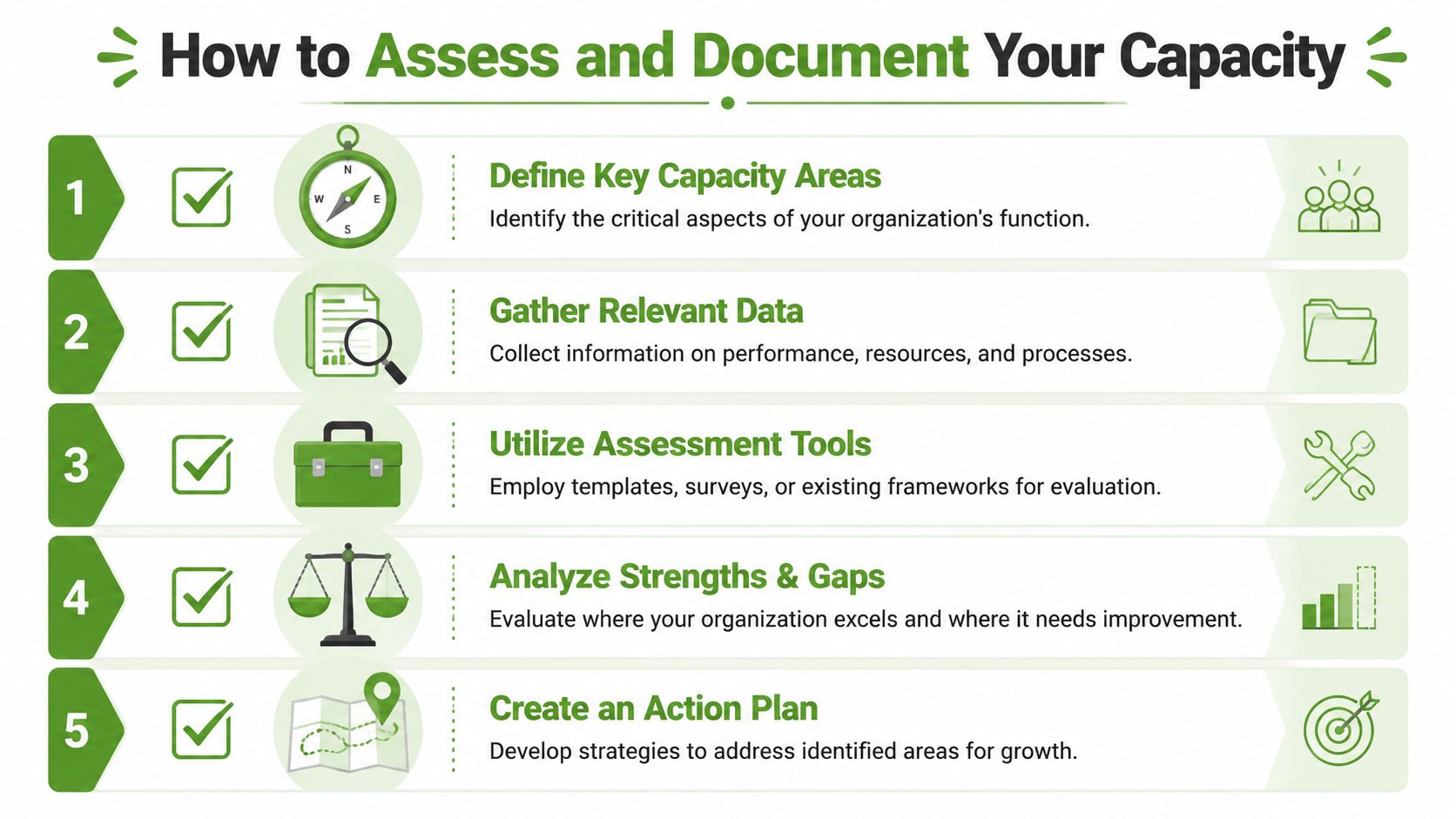
That is the core job here. Assessing capacity means gathering credible evidence that shows your nonprofit can deliver the work it is proposing, with the people, systems, and controls it already has.
Begin with existing records. Pull your board roster, job descriptions, current budget, recent financial statements, program reports, partner list, core policies, and grant calendar. Small nonprofits usually have more capacity evidence than they think. The gap is usually organization, not total absence.
Start with your actual working capacity
Start with time and role coverage.
A practical assessment asks how much work your team can absorb without dropping quality, missing reports, or pushing basic operations onto nights and weekends. That answer is usually lower than the team's ideal estimate. Staff time gets eaten by meetings, email, supervision, troubleshooting, and routine administrative work.
Use a simple estimate. List the people who would touch the grant, note the hours they can realistically give, then reduce that total to reflect normal interruptions and internal duties. If the remaining time does not cover program delivery, data tracking, financial reporting, and grant administration, the issue is not motivation. The scope is too large for current capacity.
Here is a quick method:
- List each person who will work on the grant
- Estimate the hours each person can realistically contribute
- Reduce that total to account for regular administrative and unplanned work
- Compare the remaining hours to the actual work required
This exercise helps in two ways. It protects the team from overpromising, and it gives funders a more credible explanation of why the request is sized the way it is.
Review what a funder can actually verify
A capacity assessment should produce documents, not just opinions.
This short video gives a helpful overview before you build your own internal review process:
Then review each area with a simple question: what proof could you show tomorrow if a funder asked?
- Governance: Current board list, meeting minutes, committee structure, conflict of interest policy
- Finance: Approved budget, budget-to-actual reports, recent financial statements, check approval process
- Operations: Written procedures, shared file system, reporting calendar, vendor or contract management records
- Programs: Service model, participant tracking, outcome reports, quality review notes
- External support: MOUs, referral partners, letters of support, renewal history from existing funders
A resource-constrained nonprofit does not need polished binders or expensive software. It needs clear, current records stored in one place and easy to retrieve.
Build a low-cost capacity file
Create one shared folder called “Capacity Documentation” and keep it current. For many teams, Google Drive, SharePoint, or a well-maintained desktop folder is enough.
Set up subfolders for board, finance, HR, programs, policies, and partnerships. Add a one-page index that lists what is inside, the date each item was last updated, and who owns it. That simple step solves a common grant problem. Staff stop rebuilding the same capacity narrative from scratch every time a new application opens.
If your organization is very small, start with the documents funders ask for most often. Board list, current budget, latest financials, IRS letter, key policies, program metrics, and partner documentation will cover a large share of applications.
Capacity metrics starter kit
Track a short list of indicators you can update consistently. A spreadsheet works well if one person owns it and reviews it regularly.
| Capacity Area | Metric to Track | Why It Matters to Funders |
|---|---|---|
| Governance | Board meeting attendance and committee participation | Shows whether oversight is active or nominal |
| Governance | Board giving or fundraising participation | Indicates engagement and shared accountability |
| Financial Management | Budget-to-actual review cadence | Demonstrates financial monitoring discipline |
| Financial Management | Days to close monthly books | Signals whether reporting is timely enough for decisions |
| Human Resources | Staff vacancies and role coverage | Reveals operational strain and continuity risk |
| Internal Operations | Written procedures for core workflows | Shows that work can continue through turnover |
| Programs | Service delivery against plan | Confirms the organization can execute what it proposes |
| Programs | Outcome review schedule | Demonstrates learning, not just activity |
| External Relations | Active referral or implementation partners | Signals community integration and delivery support |
| Resource Development | Grant calendar and reporting readiness | Reassures funders that compliance work is manageable |
Turn assessment into grant language
Once the evidence is organized, convert it into short statements a reviewer can trust.
For example:
Instead of: “We need help with operations.”
Write: “We maintain documented program workflows, monthly budget review, and board oversight, and we are improving reporting systems to support growth.”
Instead of: “Our team is stretched.”
Write: “We scoped this request to current staffing and use a shared workplan to assign ownership for implementation and reporting.”
That shift matters. Funders do not expect a small nonprofit to sound big. They respond when a small nonprofit sounds disciplined, realistic, and ready to use limited resources well.
Using Grant Planning Tools to Build and Prove Capacity
Many nonprofits treat grant work as separate from organizational capacity. That's a mistake. The way you plan, assign, draft, review, and submit grants often reveals how your organization operates under pressure.
A rushed proposal process usually exposes deeper issues. Deadlines live in one person's inbox. Program staff send numbers at the last minute. Finance reviews the budget too late. Attachments are outdated. Nobody is sure who owns final approval. Those aren't just grant problems. They're capacity problems wearing grant clothes.
Good planning creates evidence
The best grant planning tools do more than save time. They create an auditable record of how your organization works.
If a system helps your team break down an RFP, assign tasks, track missing documents, coordinate drafts, and manage deadlines, it's also helping you demonstrate that your nonprofit can organize complex work. That's valuable long before a funder sees the final proposal.
A solid workflow should make these things visible:
- Who owns each deliverable
- What documents support each claim
- When internal reviews happen
- Where final versions are stored
- How reporting requirements connect to implementation
That's why many teams eventually move from loose files and email chains into dedicated nonprofit grant management software. The point isn't shiny software. The point is operational clarity.
What works and what doesn't
What works is boring in the best way. Shared calendars. Standard narrative libraries. A current document folder. Named owners for budgets, attachments, and approvals. A pre-submission checklist. A record of what changed and why.
What doesn't work is relying on heroic effort. If your grants process depends on one person staying late, remembering every rule, and chasing every attachment, your apparent capacity is fragile.
Here's the trade-off leaders need to see clearly:
| Approach | What It Looks Like | Likely Result |
|---|---|---|
| Reactive grant writing | Last-minute drafting, scattered files, unclear roles | Stress, missed details, weak internal confidence |
| Planned grant workflow | Structured tasks, shared source documents, staged reviews | Stronger submissions and stronger internal discipline |
Capacity becomes visible when your organization can repeat good practice without drama.
Use the grant process as an internal discipline
A grant calendar can double as a management tool. Proposal checklists can expose missing policies. Budget narratives can force program and finance teams into healthier alignment. Reporting templates can reveal which outcomes you aren't consistently tracking yet.
That's why I advise leaders to stop treating grants as isolated fundraising events. They are recurring tests of whether the organization can coordinate strategy, finances, programs, and administration at the same time.
Frequently Asked Questions About Organizational Capacity
Small nonprofits often assume capacity assessment is for larger organizations with consultants, operations teams, and dedicated grant staff. That assumption keeps a lot of good organizations from documenting strengths they already have.
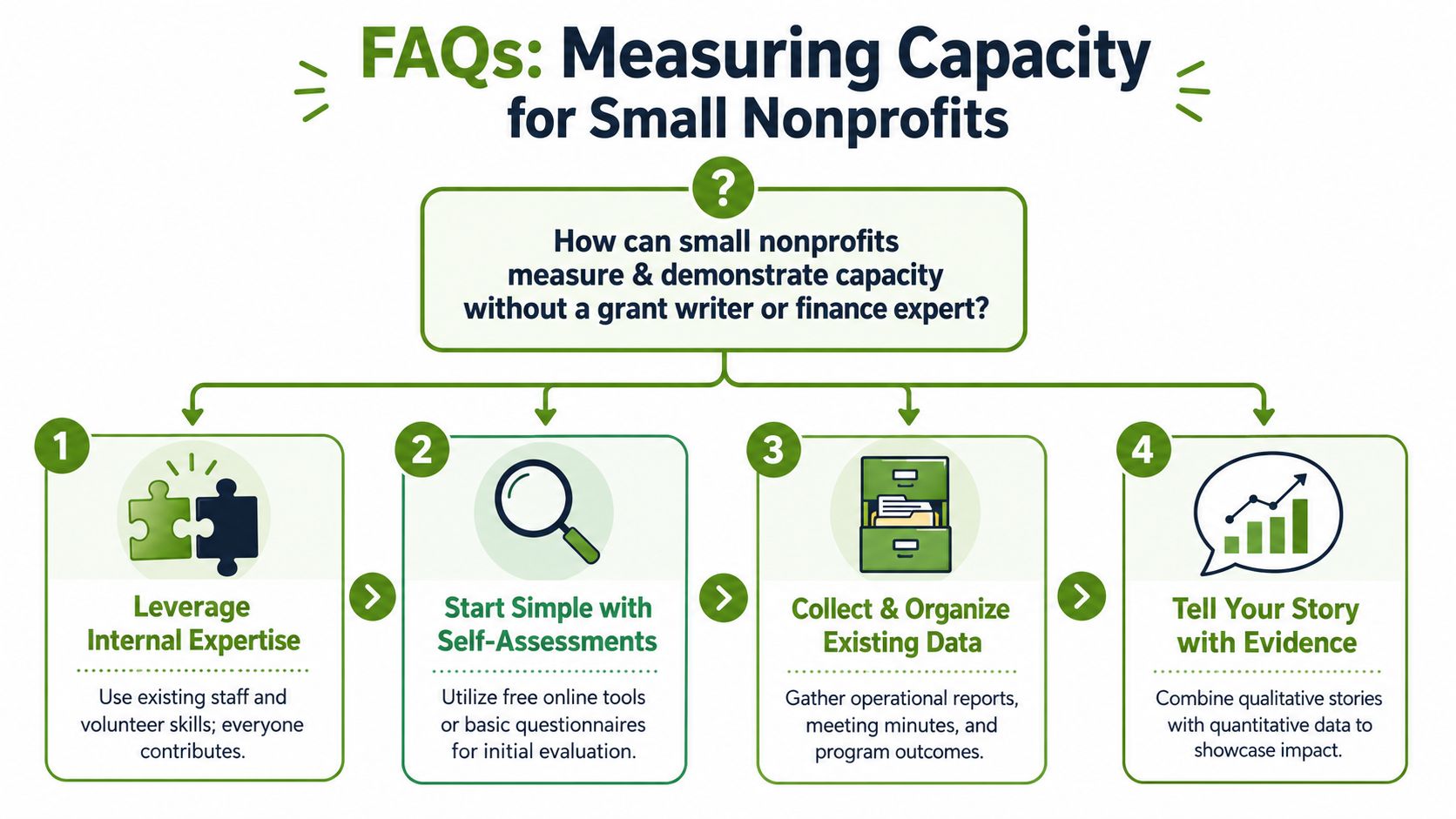
One source identified an unanswered practical question in the field: how small nonprofits without dedicated grant writers accurately measure and demonstrate organizational capacity to funders. It also noted that 65% of nonprofits under $500K annual revenue operate without grant writers or dedicated finance staff, and a pilot study found that 58% of small nonprofits using an improvised OKR-based capacity tracking system could credibly demonstrate infrastructure improvements to funders within 6 months, according to this nonprofit organizational capacity report.
Can a small nonprofit prove capacity without a grant writer
Yes. But it has to simplify the process.
The OKR approach works because it turns vague aspirations into short operating commitments. You choose one objective, define a few observable results, review them regularly, and save the evidence. That creates a capacity record over time.
A practical version looks like this:
Objective: Strengthen board governance
Key results: Improve attendance, finalize committee roles, document board review of financesObjective: Improve program consistency
Key results: Standardize intake, centralize participant tracking, schedule regular program reviewObjective: Tighten grant readiness
Key results: Build a shared document folder, assign proposal roles, maintain a reporting calendar
You don't need perfect metrics to begin. You need consistency.
What should we show funders first
Start with existing evidence that shows discipline.
Use items you likely already have:
- Board records: Meeting minutes, committee rosters, conflict policy, financial review notes
- Financial records: Approved budget, recent statements, budget monitoring routine
- Program records: Service descriptions, logic models, calendars, outcome summaries
- Operational records: Job descriptions, workflow checklists, partner MOUs, reporting schedules
If the documents exist but look rough, clean them up. Don't wait for ideal conditions.
Small organizations often have more capacity than they think. The gap is usually documentation, not substance.
What if our capacity is still developing
That's fine. Most funders know capacity is built over time.
The strongest answer is honest and specific: “Here is what we already do reliably. Here is where we are strengthening systems. Here is how this grant fits that progression.” That communicates maturity better than pretending every backend function is fully developed.
Do we need a formal framework
Only if your team will use it.
For many small nonprofits, a lightweight quarterly review works better than a complicated model borrowed from a larger institution. If your board chair, Executive Director, and a program lead can review objectives, note progress, and save evidence every quarter, you already have a meaningful capacity practice.
If your team wants a simpler way to organize grant requirements, track deadlines, store evidence, and turn internal capacity into funder-ready proposals, Fundsprout can help you build a cleaner grant workflow without adding more administrative chaos.
Try 14 days free
Get started with Fundsprout so you can focus on what really matters.