What Is an IDIQ: Unlock Nonprofit Funding in 2026
Curious what is an idiq? Discover how Indefinite Delivery, Indefinite Quantity (IDIQ) contracts work & help your nonprofit find opportunities.


Abdifatah Ali
Co-Founder
Your development director is juggling renewals. Your program team is trying to protect services that people already count on. And you're staring at the same problem many nonprofit leaders face: grants keep the lights on, but they rarely create a calm, durable revenue base.
That's usually when government contracts enter the conversation and immediately make everyone uneasy.
The language sounds built for procurement lawyers, not community organizations. Terms like “task order,” “ceiling,” and “IDIQ” can make a strong executive director feel like they've wandered into someone else's profession. But if your nonprofit delivers training, outreach, case management, technical assistance, research, evaluation, facilities support, or specialized services, this world may matter more to your mission than you think.
An IDIQ isn't a grant. It's a contracting vehicle. That distinction matters. Yet for nonprofits trying to move beyond one-off funding, it can become a practical strategy, especially if you begin as a subcontractor rather than trying to win everything as a prime on day one.
Beyond the Grant Cycle An Introduction for Nonprofits
A familiar nonprofit budget story goes like this. You win a grant for a promising program. The team hires carefully, launches services, builds trust in the community, and finally gets traction. Then the funding period ends, the renewal is uncertain, and leadership has to decide whether to scale back, bridge with reserves, or start another sprint for replacement dollars.
That cycle doesn't just drain staff. It distorts planning.
Government contracting offers a different frame. Instead of asking a funder to support a mission-aligned idea, you're offering the government a defined service it needs delivered. For some nonprofits, that shift feels uncomfortable at first. It can also be liberating because it treats your organization not only as a charitable actor, but as a capable service provider.
From grant seeker to mission service provider
Many nonprofit leaders already operate this way without naming it. A workforce nonprofit may run training programs that a public agency needs. A housing organization may provide outreach or navigation services that fit into a public contract. A research or policy nonprofit may support evaluation, technical assistance, or stakeholder engagement.
The actual change is mental.
You stop asking only, “What grants can support our work?” and start asking, “What public problems are we already equipped to solve under contract?”
Nonprofits often underestimate how contract-ready they already are. If you can define a service, staff it, document it, and report on it, you're closer than you think.
An IDIQ can help create more continuity around that service delivery. It won't remove competition. It won't guarantee easy money. But it can create a structure where work is ordered over time instead of funded as a single stand-alone award.
Why this matters for mission stability
For a busy executive director, the “so what” is simple. Contracts can diversify revenue, deepen agency relationships, and create a more operational funding model for programs that are already delivering measurable public value.
That's especially useful when your nonprofit has moved beyond pilot stage and needs a steadier way to support recurring work. Grants are still vital. They often fund innovation, expansion, and community-rooted initiatives. But contracts can complement them by paying for ongoing service delivery.
Decoding IDIQ Contracts and Key Terms
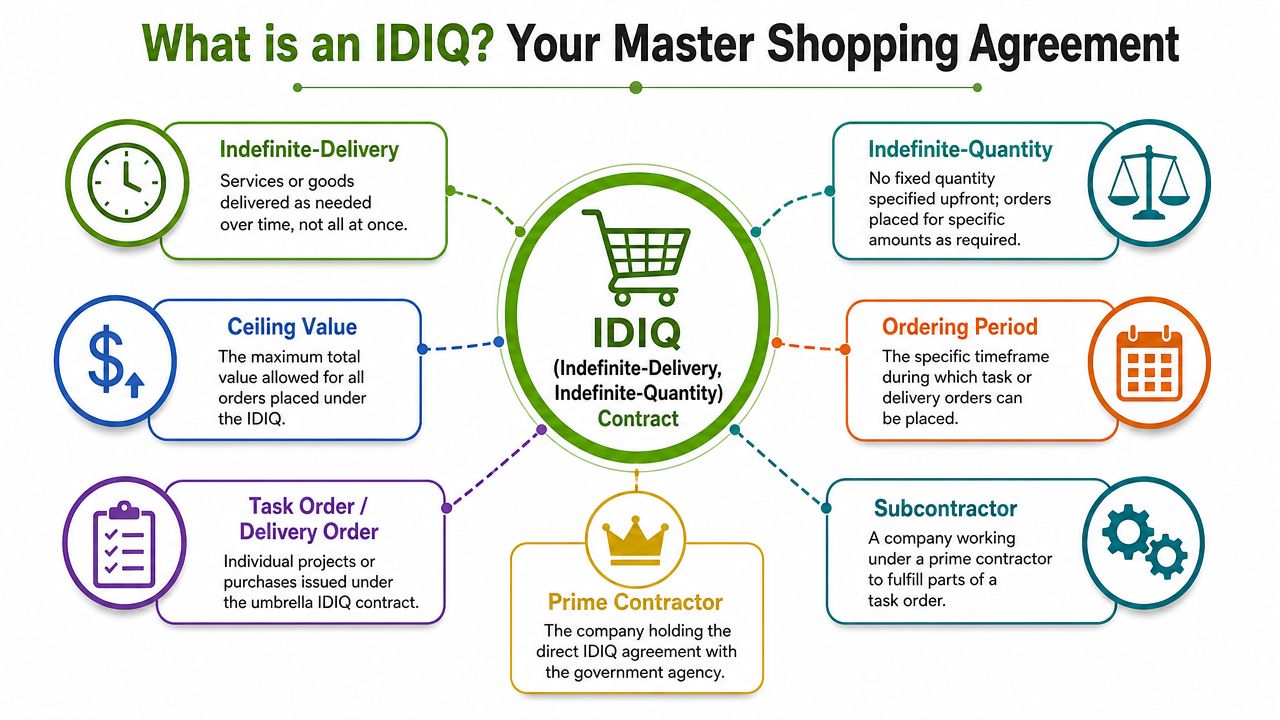
If you've searched “what is an IDIQ,” the fastest plain-English answer is this: it's a master shopping agreement between the government and one or more vendors.
The government knows it will need certain services or supplies over time. What it doesn't know yet is the exact amount, exact timing, or exact mix. So instead of running a full competition every single time a need appears, it creates an umbrella contract first and places individual orders later.
The official definition comes from FAR Subpart 16.5, which says an IDIQ contract provides for an indefinite quantity, within stated limits, of supplies or services during a fixed period, with orders placed as needs arise through task or delivery orders, and with quantity limits stated as units or dollar values in the contract text (Federal Acquisition Regulation Subpart 16.5).
The easiest analogy
Think of an IDIQ as a pre-approved house account.
A city agency, federal department, or large public buyer sets up the account with one vendor or a small pool of vendors. The account says, in effect: “For this period of time, if we need these services, we can place orders with you under these rules.” The buyer doesn't have to decide the full shopping list on day one. But it does have to set boundaries.
That's the part many people miss. “Indefinite” does not mean unlimited or forever.
The terms that usually trip people up
Here are the words nonprofit leaders need to know:
- IDIQ means indefinite delivery, indefinite quantity. Delivery is spread over time. Quantity is not fully fixed up front.
- Task order usually refers to an order for services under the umbrella contract.
- Delivery order usually refers to an order for supplies under the umbrella contract.
- Ordering period is the fixed period during which the government can place orders.
- Ceiling is the maximum amount of work or value allowed under the contract.
- Guaranteed minimum is the minimum amount the government commits to order. This is what keeps the contract from being meaningless.
Practical rule: If you remember only one thing, remember this. An IDIQ is not the job itself. It is the framework that makes future jobs easier to issue.
What this means for a nonprofit
If your nonprofit joins work under an IDIQ, the big prize may not be the umbrella agreement alone. The actual work usually comes later through the individual orders.
That's why nonprofits often get confused when they hear an organization “won an IDIQ.” Winning the umbrella vehicle can be important, but it doesn't automatically mean all the revenue is flowing at once. It means the organization now has access to compete for or receive work issued under that vehicle.
For mission-driven organizations, that distinction matters because it affects hiring, cash planning, and expectations. An IDIQ can open a door. It is not the same thing as guaranteed full-scale program funding.
How an IDIQ Contract Actually Works
The mechanics make more sense once you think in two phases. First, an organization wins access to the umbrella contract. Then specific work gets awarded underneath it.
That split is one reason IDIQs can feel foreign to nonprofit teams used to one proposal leading to one award.
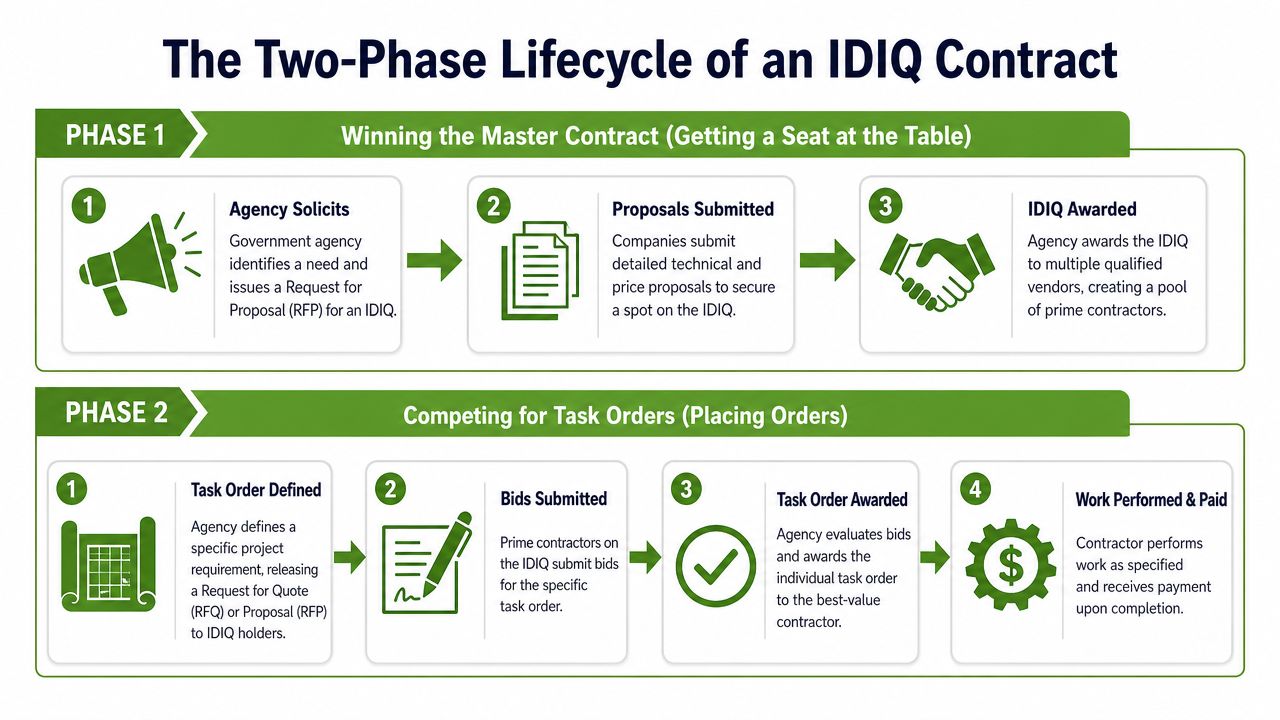
Phase one gets you a seat at the table
The base contract creates the overall terms. According to Deltek's explanation of IDIQ structure, the base agreement sets pricing, terms, and the ordering framework, while later task or delivery orders define specific requirements as the agency's needs become clearer. Deltek also notes that this structure reduces the need to recompete every requirement and is used across fixed-price, cost-reimbursement, and time-and-materials arrangements (Deltek guide to IDIQ contract types).
In plain language, the first competition is about qualification and readiness. Can your organization do this class of work? Do you have the systems, people, pricing logic, and compliance discipline to be trusted on the vehicle?
If yes, you get access. But access isn't the same as an assigned project.
Phase two is where actual work gets issued
Once the umbrella contract exists, the agency can issue a specific requirement as a task order or delivery order. That order spells out the actual work to perform.
This short explainer helps visualize the flow from the umbrella award to the downstream work:
A nonprofit executive should pay attention to the operational implications:
- The pipeline is layered. You may celebrate an IDIQ award and still need to compete again for the actual assignment.
- The pool is narrower. On many vehicles, only the awarded contract holders can bid on later task orders.
- The pace can be faster. Since the umbrella terms are already set, the agency doesn't start from scratch each time.
Single award and multiple award
There are two broad patterns:
- Single-award IDIQ means one organization holds the umbrella contract. Orders flow to that one holder, subject to the contract terms.
- Multiple-award IDIQ means several organizations hold the umbrella contract. They then compete for individual orders within that smaller pool.
For nonprofits, multiple-award environments are often where subcontracting becomes the most practical entry point. A prime contractor needs partners with subject matter expertise, community credibility, lived-experience access, service delivery infrastructure, or local presence. That's where many nonprofits bring real value.
If your team needs a plain-language refresher on the legal basics behind scopes, obligations, and terms, this essential business contract guide is a useful companion read before you start reviewing teaming agreements or subcontract terms.
IDIQ vs Grants and Other Funding Vehicles
The hardest shift for nonprofit leaders is not vocabulary. It's relationship type.
A grant usually supports work that advances a public purpose aligned with the funder's priorities. An IDIQ contract supports procurement. The government is buying something it needs. That changes how you write, budget, staff, report, and negotiate.
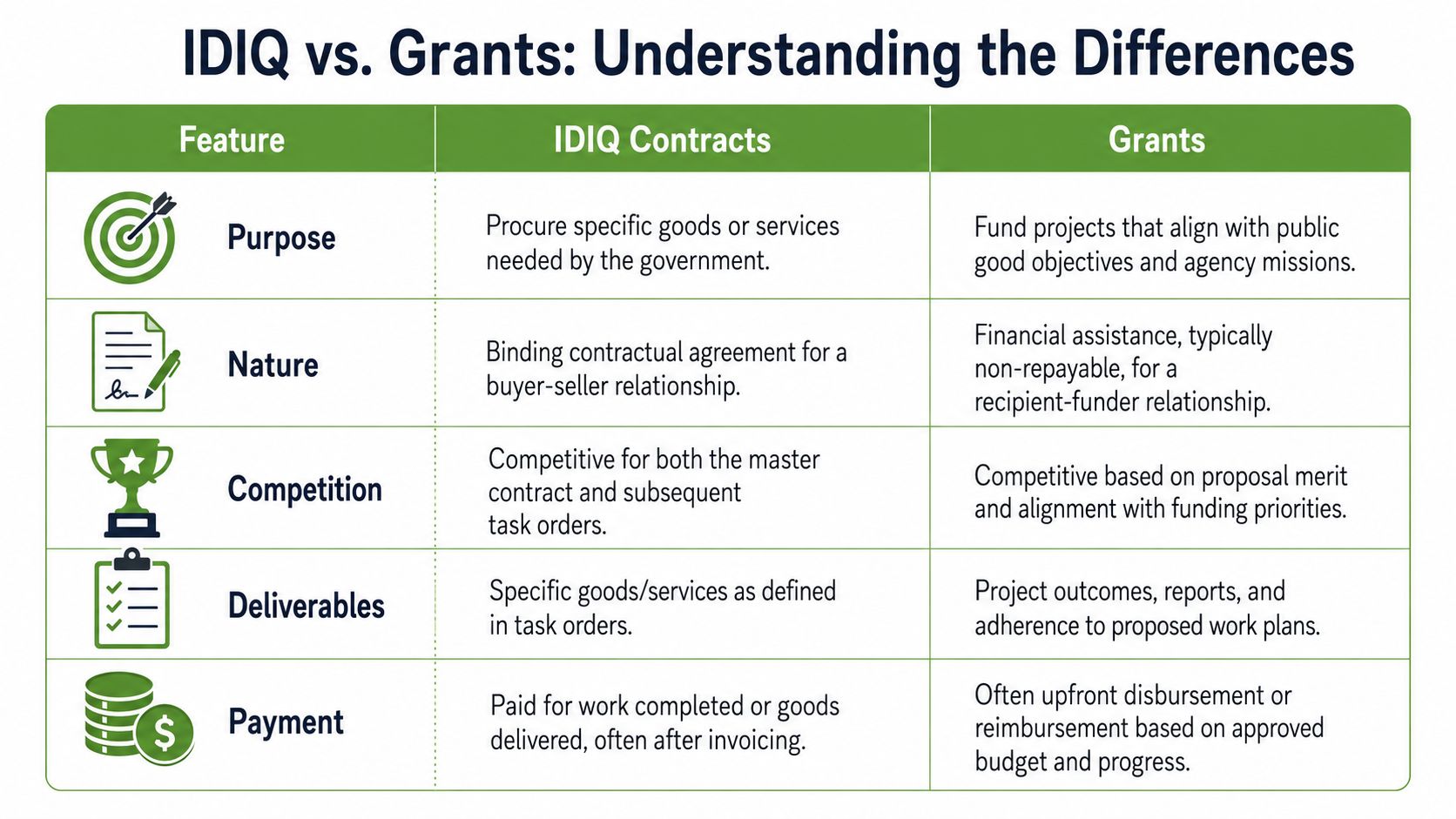
The clearest side by side view
| Feature | IDIQ contracts | Grants |
|---|---|---|
| Core purpose | Government buys defined goods or services | Funder supports mission-aligned public benefit work |
| Relationship | Buyer and seller | Funder and grantee |
| Work structure | Work is ordered through task or delivery orders | Work follows an approved project plan or program design |
| Payment logic | Payment is tied to contractual performance and invoicing | Funding may be advanced or reimbursed according to grant rules |
| Operational mindset | Compliance with contract terms and order-specific scope | Compliance with grant conditions, outcomes, and budget rules |
A nonprofit can succeed in both worlds, but the internal muscle is different.
Grant writing emphasizes need, approach, outcomes, and stewardship. Contracting emphasizes scope, staffing, performance, pricing, risk control, and execution discipline. Both require trust. They ask different questions.
What changes for your leadership team
Under a grant, your organization often has more room to shape programming within the approved proposal and budget framework. Under an IDIQ task order, the government's requirement is usually more tightly defined.
That can be a benefit if your nonprofit has strong operations. It can be frustrating if your culture is built around flexible program design.
When an agency buys services under contract, it isn't primarily funding your idea. It is hiring your organization to deliver against its requirement.
That doesn't make contracts less mission-aligned. It means alignment shows up differently. You're advancing mission by performing a needed public service well.
Where IDIQ fits among other vehicles
Nonprofits also hear terms like BPA, schedule, or general services contract. You don't need to master every vehicle at once. The important point is that an IDIQ is designed for recurring or uncertain needs over time, not a one-time standalone purchase.
A commonly cited rule of thumb is that IDIQs often use a base period plus renewal options and typically do not exceed five years in total duration, which helps explain why agencies use them for recurring needs and why vendors view them as a potential pipeline rather than a one-off transaction (Wikipedia overview of IDIQ contracts).
If your team is still heavily grant-centered, keep that strategy. Just broaden it. A useful companion resource on the assistance side is this guide to federal grants for nonprofits, especially for understanding where grants remain the better fit.
A simple decision lens
An IDIQ may be a better strategic fit when:
- Your service is repeatable. You can define it, standardize it, and deliver it under clear scopes.
- A public agency already buys similar work. You're not inventing a new category. You're entering an existing procurement pattern.
- Your team can handle tighter compliance. Contract performance usually demands disciplined invoicing, documentation, and service tracking.
A grant may be a better fit when:
- You're piloting or innovating. The work still needs testing or adaptation.
- Outcomes matter more than unitized service delivery. The funder is supporting a broader initiative, not buying a discrete service package.
- Your organization needs more design freedom. The program model is still evolving.
Why Your Nonprofit Should Pursue IDIQ Opportunities
Nonprofits often hesitate because “contractor” sounds commercial, even transactional. But there's nothing unmissioned about being paid to deliver a public service your organization already does well.
In fact, for some organizations, refusing to explore contracting leaves impact on the table.
Revenue diversification that supports stability
A healthy nonprofit rarely relies on one source of money. Grants remain important, but contract revenue can reduce the pressure that comes from living renewal to renewal.
That matters for staffing. It matters for cash flow planning. It matters for whether you can keep skilled program leaders instead of losing them every time a short-term award nears expiration.
Stronger institutional relationships
Contracts often create a more operational relationship with government agencies. Instead of interacting mainly during proposal review and reporting cycles, your organization becomes part of how an agency gets work done.
That can deepen trust over time. It can also sharpen your understanding of agency needs, procurement timing, performance expectations, and partnership patterns.
A path to scale without losing mission focus
Many nonprofits already deliver services that public agencies need but struggle to scale them because philanthropic support alone won't carry recurring operational growth. Contracting can fund execution, not just experimentation.
That's especially true when your organization brings something primes and agencies often need:
- Community credibility
- Specialized populations expertise
- Culturally competent service delivery
- Regional or neighborhood presence
- Program models with strong field experience
The strongest nonprofit case for IDIQ work is not “we need money.” It's “we can reliably deliver a public service that government already needs.”
Why subcontracting fits many nonprofits
Subcontracting gives you a lower-friction entry point. You can contribute meaningful work under a prime's umbrella while building internal systems and past performance.
That approach lets your organization learn the cadence of task orders, compliance expectations, and teaming dynamics before taking on the full burden of being prime. For most nonprofits entering this market, that's a smart strategic sequence, not a compromise.
Finding Your First IDIQ Opportunity as a Prime or Subcontractor
The first move is not writing a proposal. The first move is deciding where your nonprofit fits in the contracting ecosystem.
If your organization is new to federal procurement, subcontracting is often the best entry point. You can still win meaningful work, but you won't need to carry every legal, pricing, and administrative burden alone.
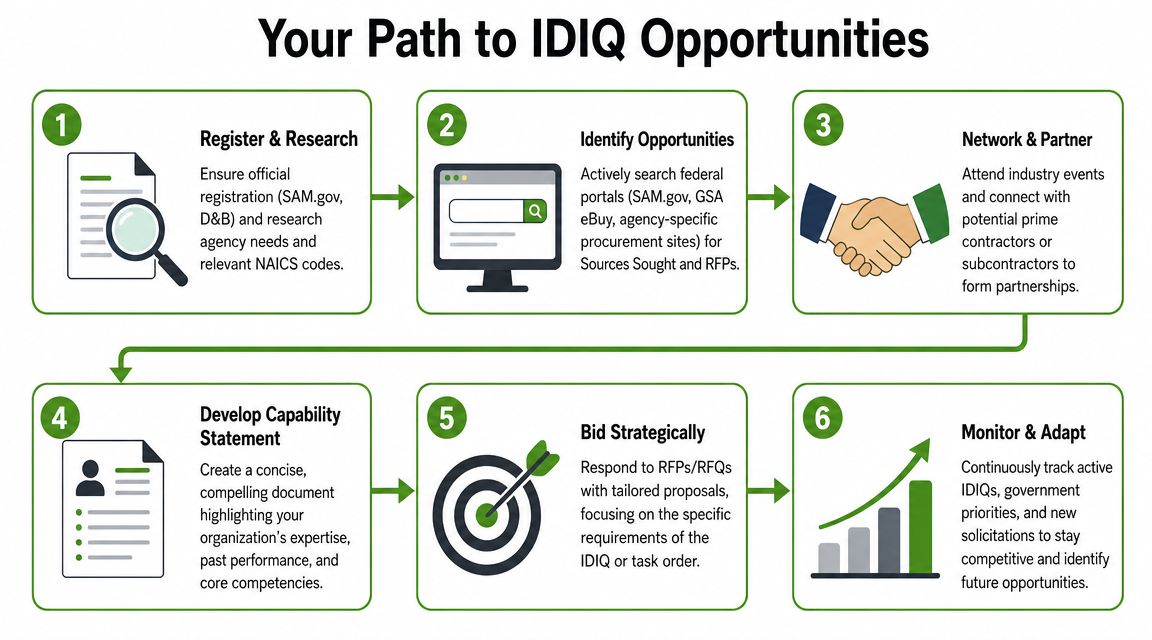
Start with fit, not volume
Don't search for every IDIQ under the sun. Search for work categories that match your real capabilities.
A nonprofit that provides behavioral health outreach shouldn't chase facilities support vehicles just because the contract looks large. A workforce intermediary shouldn't pursue technical engineering scopes unless it has that operating capacity.
Three questions help narrow the field:
- What service do we already deliver well enough to contract for?
- Which agencies buy that service?
- Would we be stronger as a prime or as a specialist partner?
Where to look
Federal opportunity discovery usually starts with public procurement tools and agency market research materials.
Use a simple tracking workflow:
- Monitor solicitation channels. Watch SAM.gov and relevant agency procurement pages.
- Study procurement forecasts. These help you see what may be coming before a formal release.
- Track Sources Sought notices. They reveal demand early and show how agencies are framing the need.
- Follow incumbent and prime contractors. They often become the partners you'll want to approach.
If your team needs a grounding in solicitation formats and how to read them, this overview of RFPs and RFQs is worth reviewing before you build a pipeline.
Prime versus subcontractor
Here's the practical distinction:
| Role | What it means for your nonprofit | Best fit when |
|---|---|---|
| Prime contractor | You hold the direct relationship, lead the proposal, manage compliance, and oversee delivery | You have strong contract infrastructure and direct past performance |
| Subcontractor | You perform a defined part of the work under a prime's contract | You're entering the market, offering niche expertise, or building experience |
For many nonprofits, subcontracting is attractive because it lets you prove contract performance without carrying the full administrative load of the umbrella vehicle.
What primes want from nonprofit partners
Prime contractors don't partner with nonprofits as charity. They partner when the nonprofit fills a real performance gap.
That usually means your organization can offer one or more of these:
- Trusted access to communities that larger firms can't reach easily
- Technical or program expertise in a specific service line
- Past performance in analogous work, even if it came through grants or local contracts
- Credibility with stakeholders such as schools, housing providers, clinics, or grassroots networks
A crisp capability statement helps. So does speaking the agency's language without abandoning your mission language.
If you're mapping your services to procurement categories, a tool like a NAICS classification API can help your team organize industry codes and identify where your offerings fit in procurement taxonomies.
Outreach that actually works
Don't send generic “we'd love to partner” emails.
Instead:
- Name the scope you fit. Refer to the actual service area or domain.
- Show operating evidence. Mention the programs you run, populations served, and delivery model.
- Translate grant experience into contract language. Say “case management at scale,” “stakeholder engagement,” “technical assistance,” or “training delivery” when those are accurate.
- Offer a defined role. Primes respond better to “we can lead outreach in these counties” than to vague partnership interest.
A nonprofit that approaches subcontracting this way stops looking like a nice community add-on and starts looking like a serious delivery partner.
Preparing for the Long Haul A Strategic Approach
IDIQ work rewards patience. The organizations that succeed usually start building relationships, tracking vehicles, and tightening internal systems long before an opportunity is live.
For nonprofits, that's good news. You don't need to become a major federal prime overnight. You need a disciplined entry strategy.
Focus on three moves. Clarify the services your organization can sell under contract. Build the operational habits that contracting requires. Pursue partnerships where your mission expertise solves a real delivery problem.
Keep your grants strategy. Add a contracts strategy next to it.
That combination can create a more resilient funding model, especially when your nonprofit already delivers repeatable, high-value services that government buyers need. If you want your team to sustain programs instead of rebuilding them every cycle, this is worth serious attention. And once that work grows, strong internal systems for grant management for nonprofits can help your organization manage the broader funding mix with less chaos.
Fundsprout helps nonprofits build a stronger funding pipeline across grants and public opportunities. If your team wants a clearer way to find relevant funding, organize proposal work, and stay compliant from application through renewal, explore Fundsprout.
Try 14 days free
Get started with Fundsprout so you can focus on what really matters.