Unrestricted Grants for Nonprofits A Guide to Flexible Funding
Unlock your nonprofit's potential with this guide to unrestricted grants for nonprofits. Learn how to find, apply for, and secure flexible funding in 2026.

Abdifatah Ali
Co-Founder
For any nonprofit leader, funding with no strings attached is the holy grail. That's exactly what unrestricted grants for nonprofits deliver—a form of capital designed to back your entire mission, not just one specific project. It’s the most flexible and empowering support a nonprofit can get.
So, What Are Unrestricted Grants Really?
At its core, an unrestricted grant is an investment in your organization's vision and long-term health. It shows a funder believes in not just what you do, but how you do it.
Think of it this way: a typical restricted grant is like a gift card for a specific store. It’s valuable, but you can only use it for pre-approved items on a very specific shopping list.

In contrast, unrestricted grants for nonprofits are like cash. You have the autonomy to direct the funds wherever your organization needs them most to truly thrive. This might mean covering essential—but often unglamorous—costs like rent, upgrading ancient technology, or offering competitive salaries to keep your best people from leaving. It’s all about trusting that you know where resources will make the biggest impact.
The Power of Trust-Based Philanthropy
This funding approach is a cornerstone of trust-based philanthropy, a movement gaining serious momentum. The idea is to shift power to the organizations on the ground doing the actual work, turning the funder-grantee dynamic from a top-down transaction into a genuine partnership.
Funders are increasingly offering multi-year, unrestricted grants to give organizations the stability they need to think and act strategically. This shift allows nonprofits to finally address nagging internal priorities, from staff burnout to long-term planning, without being tethered to rigid project deliverables.
This flexibility means your organization can be incredibly nimble. When a crisis hits or a sudden opportunity appears, you have the resources to pivot immediately without having to scramble for a new grant. For a deeper dive into this funding type, our guide on operating grants for nonprofit organizations offers even more detail.
Unrestricted Grants vs Restricted Grants At a Glance
Seeing the two funding types side-by-side makes it clear why unrestricted support is such a game-changer. While both are crucial for the nonprofit sector, they serve very different functions and foster very different relationships with funders.
Here’s a quick breakdown of the fundamental differences.
| Feature | Unrestricted Grants (General Operating Support) | Restricted Grants (Project-Based Funding) |
|---|---|---|
| Fund Use | Can be used for any mission-related expense, including salaries, rent, utilities, and technology. | Must be used for specific, pre-approved project activities and budget line items. |
| Flexibility | High. Allows organizations to adapt to changing needs and seize new opportunities. | Low. Funds are tied to a specific project timeline and scope, limiting adaptability. |
| Reporting | Focuses on overall organizational health, mission impact, and financial stability. | Requires detailed reports on project-specific metrics, outputs, and financial expenditures. |
| Funder Relationship | Tends to be a collaborative partnership built on mutual trust and shared goals. | Often transactional, focusing on compliance and adherence to the grant agreement. |
Ultimately, winning unrestricted grants for nonprofits isn’t just about getting a check. It’s about gaining a partner who truly believes in your mission and trusts you to get the job done right.
The True Impact of Unrestricted Funding
While a restricted grant pays for a specific program, unrestricted grants for nonprofits keep the entire organization running. Think of it as the difference between funding a single project and investing in the people, systems, and stability that make all projects possible. This isn't just about covering costs; it's about building a stronger, more adaptive nonprofit that can deliver on its mission for the long haul.

Let’s look at a community food bank. A restricted grant might buy 1,000 cans of soup—a great, measurable result. An unrestricted grant, however, gives the director the freedom to not only buy that soup but also repair the delivery truck that’s on its last legs, finally invest in inventory software to cut down on waste, and give a raise to the volunteer coordinator who keeps the whole operation from falling apart.
That's the core difference. Unrestricted funding covers the foundational needs that make everything else work.
Building a Resilient Organization
In the nonprofit world, resilience is everything. It’s your ability to handle unexpected challenges and adapt on the fly. Unrestricted funds are the bedrock of that resilience because they provide critical stability, covering the unglamorous but essential costs that most project-based grants won’t touch.
These operational pillars are the lifeblood of your organization:
- Talent Retention: Paying competitive salaries and benefits to keep your skilled, passionate staff from leaving. High turnover is incredibly disruptive and expensive.
- Infrastructure: Keeping the lights on. This is your rent, utilities, and insurance—the basic cost of having a place to do your work.
- Technology & Tools: Moving on from ancient computers, getting a real donor management system, or adopting tools that make your outreach more effective.
When these foundations are secure, a nonprofit can operate from a position of strength, not desperation. This is a huge part of what funders refer to as capacity building. You can dive deeper into this topic with our guide on nonprofit capacity building grants.
Sparking Innovation and Agility
The real magic of unrestricted funding is the freedom it gives leaders to think on their feet and innovate. When a new community need suddenly appears—or a staff member has a brilliant idea for a new program—flexible money means you can act now. You don't have to wait six months for the next grant cycle or twist a new idea to fit into an old, restrictive proposal.
Unrestricted funding allows nonprofits to be proactive, not just reactive. It’s the difference between plugging leaks in a boat and being able to build a faster, more weather-resistant vessel designed for the journey ahead.
This agility empowers organizations to:
- Pilot new programs: Test a creative idea on a small scale without the pressure of a dedicated grant.
- Respond to crises: Quickly shift resources to deal with an unforeseen event, like a natural disaster or a sudden economic downturn.
- Invest in professional development: Send a key team member to a game-changing training that will elevate the work of the entire organization.
Creating Long-Term Sustainability
Maybe the most profound impact of unrestricted support—especially when it's multi-year—is the path it creates to long-term sustainability. The constant cycle of single-year, project-based grants forces leaders into a short-term mindset, lurching from one grant application to the next just to stay afloat.
Multi-year unrestricted grants shatter that cycle. They provide the breathing room for real strategic planning, setting ambitious goals, and building up a financial reserve. This stability allows leaders to make smarter, forward-thinking decisions, whether that means expanding a successful program or investing in systems that will pay dividends for years.
At the end of the day, unrestricted grants for nonprofits are an investment in an organization's mission, not just its projects. It is a funder’s way of saying, "We trust your vision and your leadership." That trust is what empowers nonprofits to move beyond just surviving and start truly thriving.
Getting to Know the Funders Who Give Unrestricted Grants
If you want to land an unrestricted grant, you first need to understand who you're talking to. Project funding is a pretty clear-cut exchange of money for a specific outcome. Unrestricted funding is different. It’s a vote of confidence, a sign that a funder believes in your mission, your team, and your vision for the future.
The world of philanthropy isn't a monolith. It’s filled with different types of funders, each with their own philosophy and goals. Your job is to find the ones whose worldview aligns with yours, so you can focus your energy where it has the best chance of paying off.
Foundations That Lead with Trust
The biggest advocates for unrestricted funding are foundations that have embraced what’s known as trust-based philanthropy. This isn't just a buzzword; it's a fundamental shift in how they view their role. They see grantees as partners, not just projects to be managed from afar.
For these funders, the whole process is flipped on its head. They believe the experts are the people doing the work on the ground, so they aim to shift power back to the nonprofit leaders.
- They do their own research. Instead of making you jump through endless hoops with a lengthy application, they take the initiative to learn about your work beforehand.
- They focus on relationships. It’s all about open conversation and learning from each other, rather than just a series of transactional emails.
- They offer more than money. You’ll often find they provide access to networks, expert advice, and other resources to help your organization get stronger.
What really sets them apart is their long-game mentality. They know real, lasting change takes time, which is why they often provide multi-year, general operating support. They're investing in your organization's health, because a resilient nonprofit is one that can make a bigger difference.
Corporate Funders and Shared Missions
You might think of corporate giving as just sponsoring a local event, but companies are becoming a surprisingly good source of unrestricted grants. This usually happens when your nonprofit’s entire mission clicks with a company’s Corporate Social Responsibility (CSR) goals. When there's a perfect match, funding your core operations becomes a powerful statement of their commitment.
Even though they made up only 3% of total grant funding, corporate unrestricted grants played a major role in stabilizing nonprofits in the run-up to 2025. For example, The Coca-Cola Foundation has given out $1.6 billion through more than 200 annual grants, many of which are unrestricted when they support broader community goals. The Walmart Foundation also offers grants between $250 and $5,000 all year long to U.S. nonprofits that align with their priorities. If you want to dig deeper into how corporate giving works, you can find a lot of great nonprofit grant information from CallHub.
The trick to approaching a corporate funder is to position your entire organization as the solution to a problem they care about. It’s not just about one program; it’s about the whole engine—your staff, your systems, your expertise—that drives the change.
Community Foundations and Individual Donors
Don't overlook the funders in your own backyard. Community foundations are dedicated to improving life in a specific city or region. They have a finger on the pulse of local needs and are often more inclined to give flexible funding to organizations with a proven track record in the community. Building a strong local reputation is your key to unlocking this support.
Finally, there’s the incredible power of high-net-worth individual donors. These philanthropists can often move faster and more flexibly than large institutions. For them, giving is often a deeply personal decision sparked by a powerful story or a compelling vision. The best way to connect with them is by building genuine, one-on-one relationships where you can share the heart behind your work.
How to Find and Secure Unrestricted Grants
Winning unrestricted grants isn't about writing a better project proposal. It’s about learning to sell your entire organization—your vision, your stability, and your impact. This is a whole different ballgame, so let's walk through the playbook for landing the flexible funding that builds a truly resilient nonprofit.
The search starts with smart prospecting. Finding funders who actually offer unrestricted grants for nonprofits means you’re looking for a different philosophy, not just a different program area. You'll need to adjust your search tactics in grant databases to uncover these specific, high-value opportunities.
Mastering the Art of Prospect Research
Most grant searches revolve around program-specific keywords like "youth literacy" or "environmental conservation." That’s still important, but to find unrestricted funds, you need to add another layer to your search. Think of it as looking for a long-term partner, not just a one-time transaction.
Get comfortable with these key phrases in your searches:
- "General operating support" or "GOS": This is your North Star. It's the most common and direct term for unrestricted funding.
- "Capacity building": While sometimes restricted, these grants often support core infrastructure and staffing—exactly what flexible dollars are for.
- "Core support": This is another way funders signal they're focused on your organization's foundational needs.
- "Trust-based philanthropy": Searching for foundations that publicly embrace this movement is a direct line to funders who are philosophically aligned with flexible, relationship-driven giving.
Go beyond the keywords, too. Look for clues in a funder's behavior. Do they talk about multi-year grants? Is their application simple and focused on getting to know you? These are huge green flags.
Building Relationships Before You Apply
With unrestricted funding, the relationship often matters more than the proposal. Program officers at trust-based foundations see themselves as partners, not just gatekeepers. Your goal is to build a genuine connection long before you ever hit "submit."
Start by doing your homework. Read their annual reports and follow their team on professional networks to get a real feel for their priorities. Then, reach out for a brief introductory call—and this is not a sales pitch.
The goal of that first conversation is to learn and share. Come prepared with thoughtful questions about their work. Listen more than you talk. Then, briefly connect the dots between your organization's mission and their goals. This simple dialogue is how trust begins to form.
This simple shift transforms the entire dynamic. Instead of a cold application landing on a desk, it becomes a warm collaboration. By the time you apply, the program officer already knows who you are, what you do, and why it matters.
Crafting a Compelling Organizational Narrative
Writing a proposal for unrestricted grants for nonprofits is fundamentally different from what you're used to. You have to pivot from the "what" (a single program) to the "why" and "how" (your organization’s mission, its impact, and its operational strength).
Your proposal needs to tell a complete story about your organization.
- Lead with Your Vision: Start with the big picture. Why does your organization exist? What change are you fighting for?
- Demonstrate Impact with Data: Use high-level metrics that showcase your track record. Instead of "we served 50 kids," think bigger: "Our programs reached over 500 children last year, with 85% showing marked improvement in academic performance."
- Showcase Financial Health: Don't be shy about your numbers. Provide a clear, concise organizational budget that shows how these funds will support your core operations and strengthen your stability. This transparency builds a funder’s confidence in you.
- Connect Funds to Mission: Draw a straight line from their dollars to your impact. Explain how this flexibility will help you retain top talent, invest in critical infrastructure, or respond more quickly to your community's needs.
This narrative proves you're a stable, effective, and trustworthy steward of their investment. Recent crises have underscored this need. While nearly two-thirds of foundations provided emergency aid and over 40% increased unrestricted support, nonprofits felt the squeeze. Almost a third of U.S. nonprofits faced federal funding cuts averaging $150,000, which in turn pushed 76.5% to ramp up their private grant submissions. You can see more of the data in this analysis of foundation funding responses from Nonprofit PRO.
Using Technology to Your Advantage
Manually sifting through thousands of funders and trying to manage all these relationships is a massive time sink. This is where modern tools like Fundsprout come in, helping you work smarter, not harder. An AI-powered platform can dramatically accelerate the entire discovery process.
Here is a glimpse of how Fundsprout's dashboard helps you organize your funding pipeline.
The platform takes your organization’s profile and instantly delivers a ranked list of relevant funders, including those offering general operating support. It saves hundreds of hours of manual research, freeing your team up to focus on what really moves the needle: building relationships and telling your story. You can learn more by exploring our guide on choosing the right grant discovery platforms for your nonprofit.
Build Your Grant Workflow with Modern Tools
Winning unrestricted grants for nonprofits means shifting your focus from individual projects to the big picture—telling the story of your entire organization. But let's be honest, pulling that off can stretch a small team to its breaking point. This is where the right technology can make all the difference, helping you move from a frantic, reactive grant cycle to a smart, well-oiled machine.
Think of it like this: you could build a house using just a handsaw and a measuring tape. You'd get there eventually, but it would be slow, exhausting, and prone to mistakes. Or, you could use power tools and digital blueprints to work faster and with more precision. For grant seekers, modern platforms are your power tools.
From Manual Searches to Intelligent Discovery
First things first, you have to find the right funders. This can feel like searching for a needle in a haystack, spending countless hours sifting through databases. A platform like Fundsprout, however, works more like a trusted colleague. It automates that initial heavy lifting, delivering a curated list of funders who are already interested in general operating support and aligned with your mission.
This frees up your team from the drudgery of research and gives them back precious time to focus on what truly matters: building relationships with foundation staff. That's often the key to unlocking unrestricted funds.
The process, when streamlined with the right tools, becomes much more manageable.
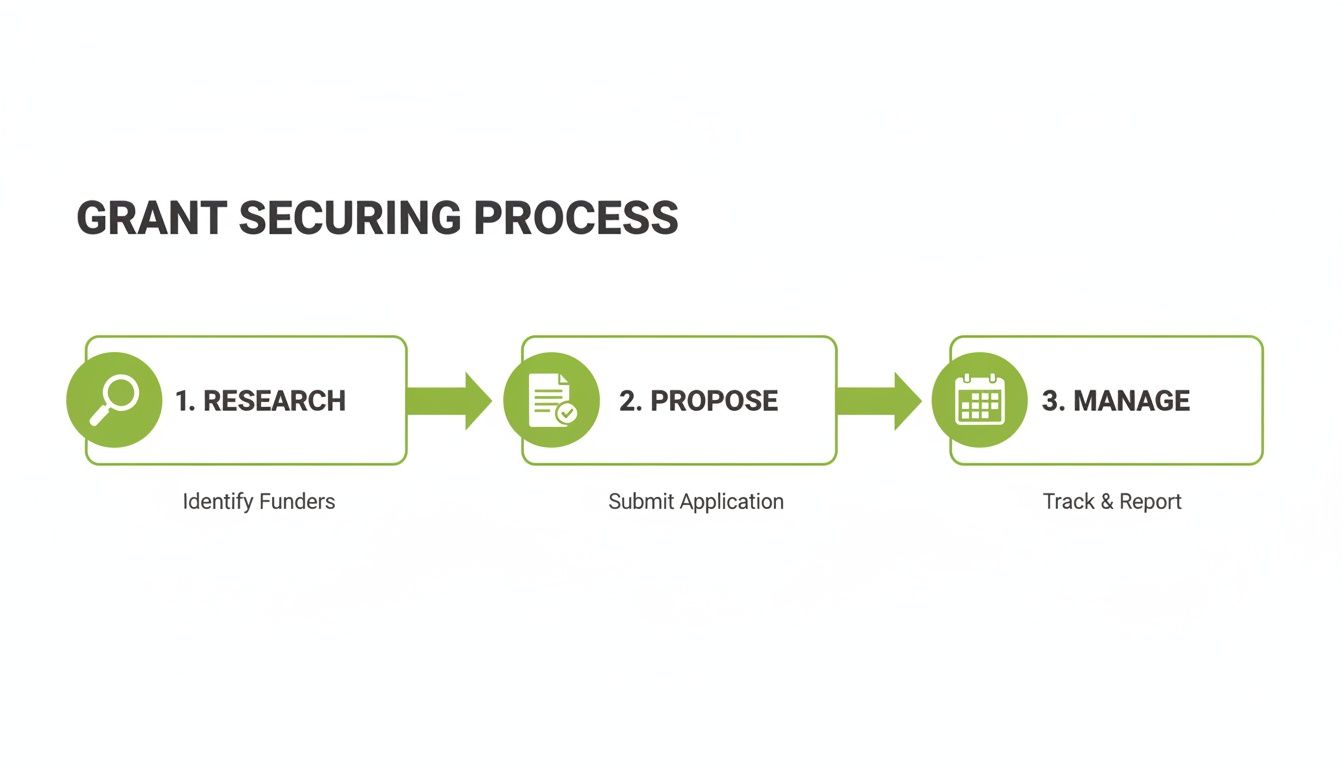
As you can see, what were once disconnected tasks—research, writing, and management—can become a single, connected workflow.
Deconstructing RFPs and Crafting Compelling Narratives
Once you’ve identified a promising funder, the real work begins. An unrestricted proposal needs a powerful story about your organization’s stability, impact, and vision. This is where AI-assisted features can be a game-changer. For example, some tools can break down a dense Request for Proposals (RFP) into a simple checklist, making sure you don't miss a single requirement.
A smart writing assistant can take it a step further. By analyzing your past grants, impact reports, and strategic plans, it learns your organization's voice. It then helps you draft new narratives, pulling your best stats and success stories to paint a vivid picture of your overall value—not just the results of one program.
This isn't about letting a robot write your proposal. It's about amplifying your own expertise. The technology ensures your core message comes through with consistency and punch, which is essential for earning a funder's trust.
Managing Deadlines and Building Funder Trust
Winning the grant is a huge milestone, but it’s not the finish line. The ultimate goal is to secure multi-year support, and that requires flawless follow-through. This is where integrated planners and reporting templates become your best friends.
These systems help you track every deadline and deliverable, creating a perfect audit trail. You can ensure reports go out on time and clearly communicate your progress, which shows funders you’re a reliable partner. If your internal processes are a bit dated, learning how to modernize legacy systems can give you a major boost, making your back-office operations as strong as your grant proposals.
This level of organization isn’t just about avoiding late reports. It builds a deep sense of trust that is absolutely critical for renewing and growing your base of unrestricted grants for nonprofits. When a funder sees that you are transparent, effective, and on top of your game, they are far more likely to invest in your mission for the long haul.
Common Questions About Unrestricted Funding
When you start exploring unrestricted grants for nonprofits, you're bound to have some questions. It’s a totally different ballgame than project-based funding, and it’s smart to wonder about the real-world challenges around competition, reporting, and even who gets a fair shot. Let's dig into what nonprofit leaders ask most often.
Is It Harder to Get Unrestricted Grants?
It can certainly feel more competitive, but maybe not for the reasons you'd expect. The difference isn't necessarily more people applying for the same pot of money; it's that the funders are looking at you through a completely different lens.
With unrestricted grants, a funder isn't just buying a specific outcome or program. They're making a long-term investment in your entire organization—your mission, your leadership, and your stability. They're betting on you.
This means the conversation shifts. Instead of scrutinizing a single project budget, they’re looking for evidence of a healthy, resilient organization with a clear vision. A strong track record, sound financial health, and authentic relationships with your program officers often carry more weight than a slick, polished proposal.
How Do We Report on Impact Without Specific Project Metrics?
This is where you get to change the conversation from accounting to storytelling. Reporting on flexible funding isn’t about checking off boxes on a project plan. It’s about showing how that trust-based investment strengthened your organization as a whole.
The core idea is to move from transactional reporting to trust-based learning. It's a dialogue about organizational progress, not a test of project deliverables. Funders want to know how their investment strengthened your entire mission.
Think bigger picture. Instead of reporting on a single program's outputs, you can share a much more compelling story of holistic progress. Consider highlighting things like:
- Organizational Health Metrics: Were you able to improve staff retention? Did you finally build up your operating reserve? Maybe you upgraded ancient technology that made your whole team more effective. That’s impact.
- Mission-Level Impact: Connect the dots for them. Show how having stable funding allowed you to serve 20% more clients, launch an innovative pilot program, or deepen your advocacy work in the community.
- Qualitative Stories: Never underestimate the power of a good story. An anecdote from a staff member or a powerful testimonial from someone you served can illustrate the real-world difference your work makes far better than a spreadsheet ever could.
Can a Smaller or Newer Nonprofit Get Unrestricted Funding?
Yes, absolutely. While it’s true that large, legacy institutions have years of data to back them up, smaller and newer organizations can—and do—earn this kind of trust-based funding.
For a younger nonprofit, funders simply look for different indicators of stability and potential. They’ll put a lot of stock in the experience and vision of your leadership team. They’ll want to see a thoughtful, realistic strategic plan and evidence of deep roots in the community you serve.
You might start with a smaller, project-restricted grant from a foundation that offers general support. Use it as an opportunity to build a relationship, deliver on your promises, and prove you’re a reliable partner. Once you've built that foundation of trust, the conversation about flexible funding becomes much, much easier.
Making the Shift to Sustainable Funding
Securing unrestricted grants for nonprofits is more than just another fundraising win. It's a fundamental shift in how you build a healthy, resilient organization. This is your chance to step off the exhausting project-funding treadmill and build a stable foundation that allows you to focus on what truly matters: your mission.
Getting there does require a different approach. You have to start thinking less like a project manager and more like a visionary leader. It's about finding funders who want to invest in your organization's overall health and impact, not just a single, neatly packaged program.
This journey really boils down to a few key actions:
- Tell your whole story. Your proposal needs to be about your mission, your stability, and your vision for the future—not just one program's outputs.
- Build real relationships. Don't let your first contact with a foundation be a grant application. Connect with program officers and build trust long before you make an ask.
- Be transparent about your needs. Show funders exactly how flexible support will strengthen your core operations and, in turn, amplify your impact across the board.
Winning unrestricted funding isn't a fantasy; it's a very achievable goal for organizations willing to change their approach. When you learn to articulate your full value and use the right tools to find aligned partners, you can secure the kind of funding that lets you plan, adapt, and grow. You have the map. Now it's time to take the first step.
Ready to find funders who believe in your mission as much as you do? Fundsprout helps you pinpoint the best grant opportunities and craft the compelling narrative you need to win them. Start building a more sustainable future for your nonprofit.
Try 14 days free
Get started with Fundsprout so you can focus on what really matters.