Guide to State of Georgia Procurement for Nonprofits
Your nonprofit's guide to the State of Georgia procurement system. Learn how to find bids, navigate the process, and win state contracts in 2026.

Abdifatah Ali
Co-Founder
State contracting probably feels like a strange middle ground right now. It looks too bureaucratic to be approachable, but too important to ignore if your nonprofit wants stable revenue beyond grants and donations.
That instinct is right. Georgia's procurement system has rules, acronyms, portals, and paperwork. It also has a clear structure. Once you understand where opportunities appear, how bids are evaluated, and which compliance mistakes knock out smaller organizations, the process becomes much less mysterious.
For nonprofit leaders, the challenge usually isn't mission fit. State agencies often need services nonprofits already provide well, especially training, outreach, case management, community engagement, and specialized local support. The challenge is translating that mission work into procurement language and building an internal process that can survive audit-level scrutiny.
Introduction Decoding Georgia Procurement
A nonprofit executive director gets a call from a state program manager who likes the organization's work and wants a proposal fast. The opportunity looks promising until the team realizes it is not a grant application. It is a procurement process with formal rules, pricing expectations, and documentation standards that can disqualify an otherwise strong mission fit.
That is the right place to start. Georgia procurement is the system state agencies use to buy goods and services under defined procedures, review criteria, and contract terms. For nonprofits, the opportunity is real, but so is the discipline required to compete.
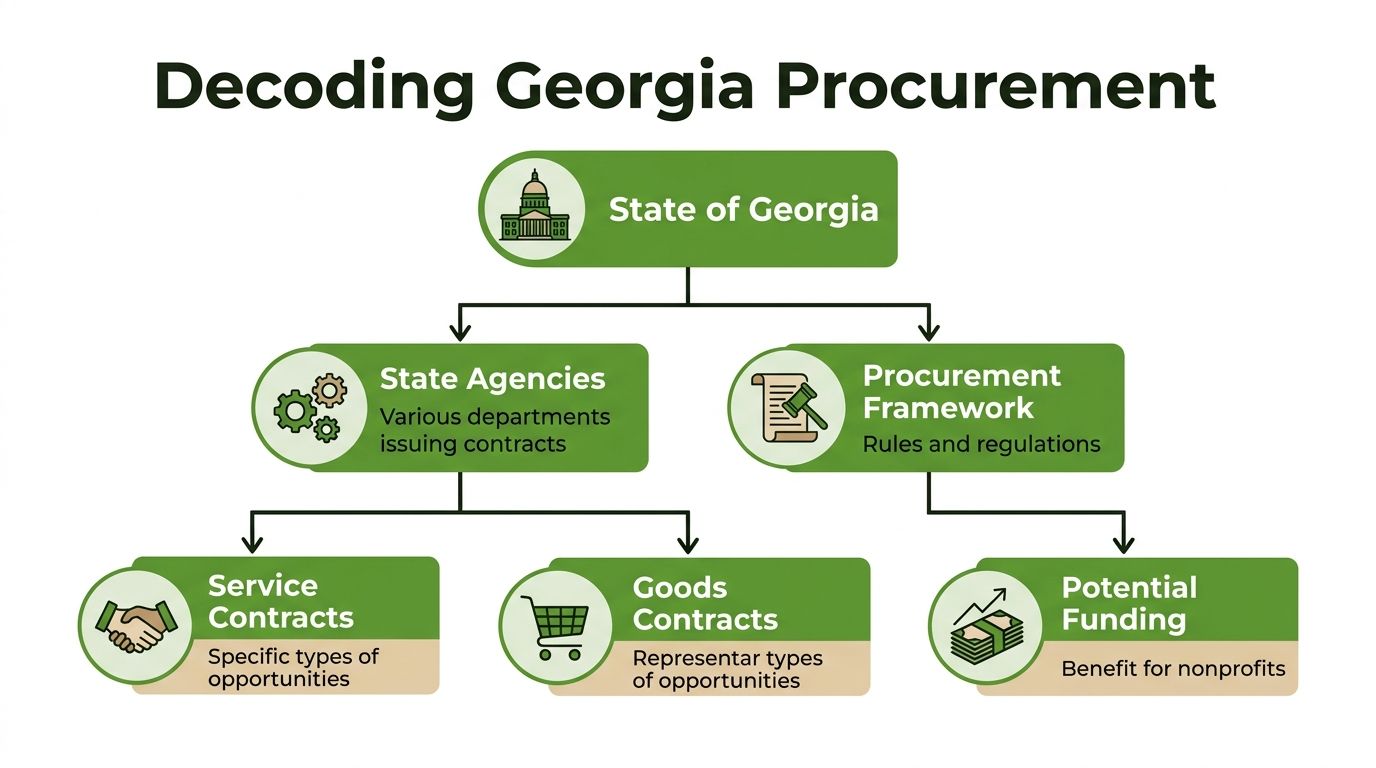
Who runs the system
The two names to learn first are DOAS and SPD.
- DOAS is the Georgia Department of Administrative Services.
- SPD is the State Purchasing Division within DOAS.
- State agencies identify many of the services they need, while SPD sets the purchasing rules and oversight framework those agencies must follow.
That distinction affects how nonprofits should read an opportunity. A program office may care most about service design, outcomes, and community credibility. The procurement office checks whether your response follows instructions, meets vendor requirements, and supports the price you quoted. Both sides matter.
Practical rule: In State of Georgia procurement, a strong mission case will not fix a weak compliance response.
Smaller nonprofits often miss another point. Not every purchase starts with a large formal bid. Some agency buys happen under informal quote thresholds, and some unusual purchases involve sole-source justifications. Those paths can create openings for specialized community-based organizations, but they also create risk. If your pricing is inconsistent, your scope is vague, or your justification materials are thin, the agency may decide your organization is too hard to buy from.
What procurement means in plain language
Procurement means the state is purchasing a defined product, service, or result. The state's support for your organization is not driven by the mission's worth alone. It is entering a buyer-vendor relationship that has public accountability, payment terms, and audit expectations attached.
Many nonprofits stumble by submitting language built for donors, foundations, or community partners, then wonder why the response scores poorly. State evaluators usually need something different. They look for scope, staffing, unit costs, timelines, past performance, and clear evidence that your organization can deliver consistently.
For a nonprofit, the trade-off is straightforward. State contracts can bring steadier revenue than private fundraising in some service lines, but they often require tighter internal controls, more disciplined pricing, and better documentation than grant-funded work. Before you pursue this channel seriously, make sure your organizational records are current, including the documents that prove tax-exempt status. If your files need cleanup, these tips for keeping your nonprofit determination letter organized and accessible will save time later.
For nonprofits that also handle equipment refreshes or public-sector electronics, it helps to understand adjacent state-facing operational requirements too. This guide to Beyond Surplus for Georgia government is a useful example of how specialized vendors position services for public entities while staying aligned with government process expectations.
Becoming a State Vendor Registration and Certification
Registration is the first gate. If your organization isn't set up correctly as a vendor, you'll miss notices, choose the wrong opportunity types, or create delays when an agency wants to move quickly.
What to gather before you start
Before anyone logs into a portal, assemble a vendor file. At minimum, have these items organized in one shared folder:
- Legal entity records such as your exact registered name, mailing address, and tax identification details
- IRS paperwork including your W-9 and the nonprofit records your finance team already uses
- Banking and remittance details for payment setup and invoice matching
- Primary contacts for procurement, program, and finance, so notices don't sit in one person's inbox
- Capability summary written in plain procurement language, not donor language
Your nonprofit status helps with credibility in some service areas, but it doesn't substitute for clean vendor records. If your legal name on tax documents doesn't match what you enter during registration, expect delays.
A related issue is contractor readiness more broadly. If your team needs a plain-English checklist on baseline business expectations, essential contractor requirements for businesses gives a practical outside perspective that many nonprofit leaders find useful before pursuing public work.
Commodity codes decide what you see
One of the most important setup choices is selecting the right commodity codes, often called NIGP codes. Many nonprofits inadvertently undermine themselves at this stage.
If you choose codes that are too broad, your inbox fills with irrelevant notices. If you choose codes that are too narrow, you won't see opportunities that fit your work. A workforce nonprofit, for example, might need codes connected to training, consulting, case management support, outreach, or program operations, depending on how agencies classify the service.
Use this test when choosing codes:
- Look at how agencies buy the work, not how your board describes it.
- Match to deliverables, such as training sessions, technical assistance, staffing support, or data collection.
- Review and revise quarterly after you start monitoring actual bid notices.
Register once, but expect to refine your vendor profile as you learn the state's vocabulary.
Nonprofit records that strengthen registration
Procurement teams don't always know nonprofit documentation the way grantmakers do. That means your internal records should be easy to produce and easy to read. Your IRS determination letter is a common example. If yours is outdated in your internal files, hard to locate, or inconsistent with your operating name, fix that now. This guide on determination letter tips for nonprofits is worth reviewing before you start vendor onboarding.
Certifications and positioning
Some nonprofits also qualify for certifications through ownership structure or related business entities. If that applies, treat certification as an advantage, not a substitute for proposal quality.
What works is pairing certification with a tight capability statement, accurate commodity codes, and an internal owner for procurement notices. What doesn't work is assuming registration alone will generate awards.
Finding and Monitoring State Contracts
A nonprofit ED gets a call on Tuesday about a state opportunity due the following week. Program staff are interested. Finance has not priced the service for a government buyer. No one knows whether the agency buys this work as outreach, case management, training, or administrative support. That is how small organizations end up forcing a decision with weak information.
The fix is simple, but it takes discipline. Treat contract discovery as a standing function, not a last-minute scramble when revenue gets tight.
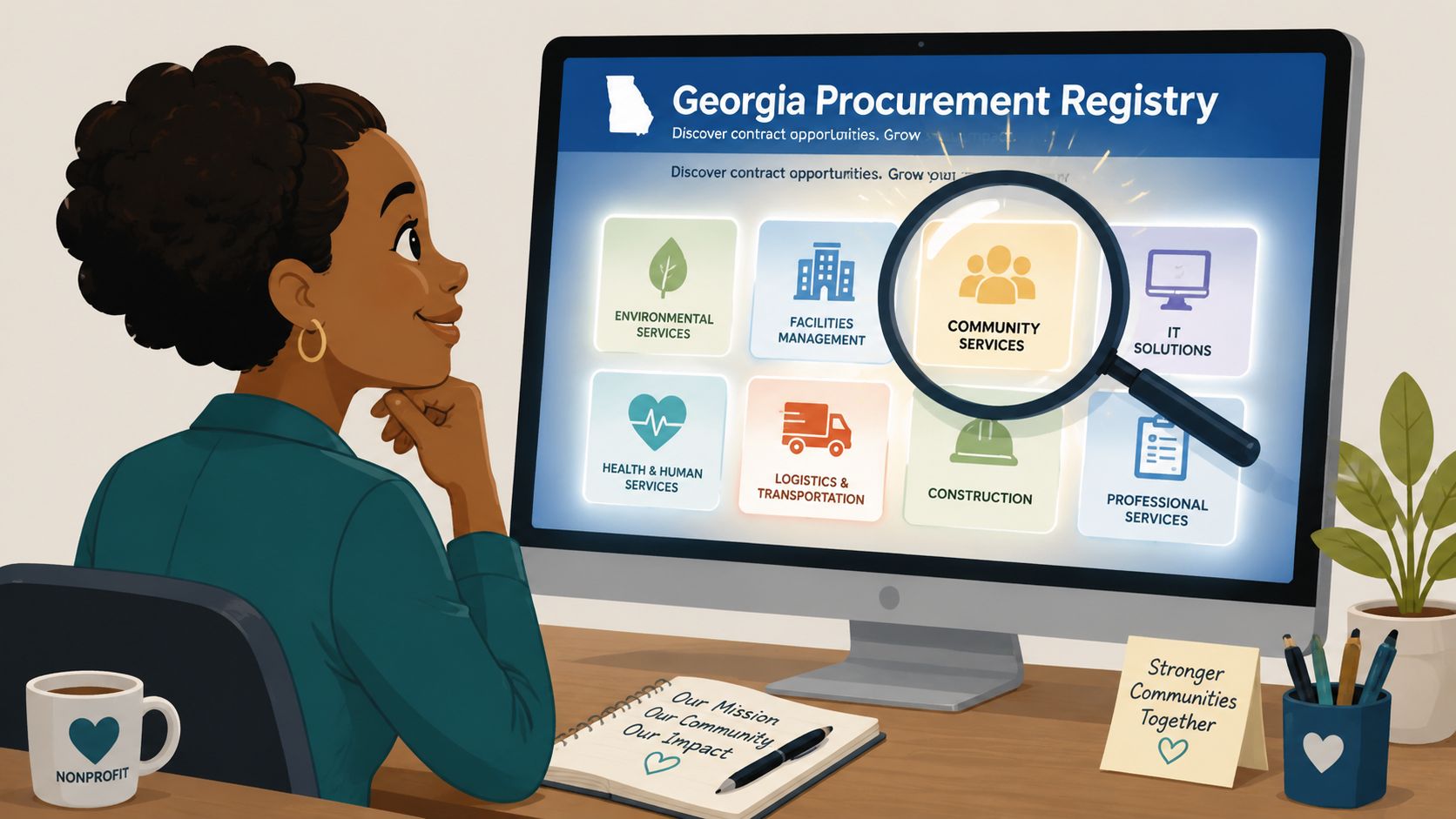
Use the Georgia Procurement Registry as your daily board
The Georgia Procurement Registry, or GPR, is the main public posting site for state opportunities. For nonprofits, consistency beats intensity. Fifteen focused minutes each business day will usually produce better results than a frantic search once a quarter.
Search beyond your program language. State buyers may describe work in operational terms instead of mission terms. A youth-serving nonprofit might find relevant notices under training, support services, community outreach, evaluation, staffing, or administrative services. A health-focused nonprofit may need to monitor behavioral health, prevention, education, or care coordination terms depending on how the agency frames the purchase.
A workable monitoring routine includes:
- Saved searches tied to your commodity codes, service lines, and likely agency terminology
- Manual agency checks for departments whose missions align with your work
- Archived closed solicitations for studying scope, attachments, amendments, and vendor questions
- A no-bid log that records why you passed, including timing, pricing, staffing, insurance, or compliance barriers
That no-bid log is more useful than many teams expect. It shows patterns. If you keep passing on opportunities because of turnaround time, informal quote thresholds, or required past performance, you can decide whether to build capacity, find a partner, or stop chasing a poor-fit market.
Study buying patterns before you price
Before you respond, look for evidence of how agencies buy services like yours. Review closed solicitations, award notices, and any public purchasing history you can access through Georgia procurement tools.
This data is valuable because nonprofits often price in a vacuum. They know their program budget, but they have not yet translated that budget into a state-friendly cost structure. Historical purchasing records help answer practical questions:
| Question | Why it matters |
|---|---|
| Which agencies buy services like ours? | You can focus outreach and bid review time where there is real demand |
| How often does this need come up? | Recurring demand may justify building a repeatable proposal process |
| Who usually wins? | You can decide whether to prime, subcontract, or wait for a better fit |
| How is the work described? | You can mirror procurement language instead of grant language |
For a small nonprofit, this step protects limited staff time. It also helps with one of the hardest judgment calls in Georgia procurement: deciding whether an opportunity is large enough, formal enough, and aligned enough to justify the effort. If an agency appears to buy the service repeatedly through smaller quotes or highly specific scopes, your strategy may be to build relationships and prepare a concise response package rather than waiting for a perfect RFP. If the work tends to go to larger incumbents, a subcontracting approach may be smarter.
If your team is still sorting out bid formats, this primer on RFPs and RFQs for nonprofits can help you interpret what you are seeing in the registry.
Build a lightweight tracking system
A shared spreadsheet, Airtable, or simple project board is enough if one person owns the process and updates it on schedule.
Track at least these fields:
- Opportunity title
- Agency
- Solicitation type
- Due date
- Question deadline
- Go or no-go decision
- Lead writer
- Pricing owner
- Required attachments
- Submission status
Add two more fields if your nonprofit is still building procurement muscle: fit with mission and capacity risk. Those columns help prevent a common mistake among mission-driven organizations. Staff see community need and want to bid, even when the reimbursement structure, reporting burden, or staffing model does not work for the organization.
The nonprofits that improve fastest review losses, withdrawals, and near-misses with honesty. They record whether the problem was pricing, attachments, turnaround time, unclear scope, missing registrations, or a weak sole-source justification for a proposed partnership path. Over time, that record becomes your playbook.
The best preparation for a state contract is a repeatable monitoring system you can run before the right opportunity appears.
Understanding the Three Main Solicitation Types
A Georgia agency posts an opportunity that looks short and straightforward. Your program team assumes it will be easier than a full proposal. Two days later, staff are scrambling over pricing, attachments, and whether the agency wants a quote, a bid, or a technical approach. That confusion is common for nonprofits, especially when capacity is thin and the wrong read can waste a week of staff time.
In Georgia, the three solicitation types you will see most often are IFB, RFP, and RFQ. They are not interchangeable. Each one tests a different part of your organization, and nonprofits usually perform better when they match the opportunity to their actual strengths instead of chasing every posting that fits the mission.
IFB when specifications are fixed
An Invitation for Bids works best when the state already knows exactly what it wants. The specifications are clear, the response format is tighter, and award decisions usually lean heavily on price once responsiveness is established.
For a nonprofit, an IFB can be a good fit if you are offering a standardized service, a repeatable unit cost, or a deliverable with very little design variation. The trade-off is simple. Mission alignment matters less here than operational discipline. If the solicitation asks for a specific service level, delivery schedule, insurance document, or bond requirement, your response has to match it cleanly. On bond-related requirements, Coverage Axis discusses bid and performance bonds in a way that helps smaller organizations sort out what each one covers.
Strong IFB responses usually include:
- Clear pricing with no hidden assumptions
- Direct confirmation that every specification is met
- Evidence that your team can deliver on schedule and at the quoted cost
RFP when the state is buying your approach
A Request for Proposals gives the agency more room to compare methods, staffing, experience, and implementation plans. This is often the format where nonprofits have the strongest position, especially in human services, community outreach, training, or specialized program delivery.
The catch is that a strong mission story does not win by itself. Evaluators are scoring against procurement criteria, not donor logic. A nonprofit that understands the community but cannot explain staffing coverage, subcontractor oversight, data reporting, or cost reasonableness will usually lose to an organization that can.
That is why RFPs reward translation. You are converting program knowledge into a response that shows feasibility, compliance, and measurable performance. If your team still mixes up the formats, this explainer on RFPs and RFQs for nonprofit teams is useful before you assign sections internally.
RFQ and the informal quote trap
An RFQ usually asks for a price quote on a narrower scope. Nonprofits often see RFQs as the easiest way into state contracting. Sometimes that is true. Just as often, smaller organizations get tripped up here because the process looks informal and staff treat it casually.
In Georgia, smaller-dollar purchases can move through quote-based processes with less narrative than a full RFP. That does not mean the file can be thin. Documentation still matters. Scope clarity still matters. Price support still matters. For nonprofits with limited back-office capacity, the primary risk is assuming a short solicitation requires less internal review.
The overlooked issue is fit. An RFQ may be quick to submit, but it can still be a bad opportunity if the reimbursement terms are tight, the deliverables are underpriced, or the agency expects a turnaround your team cannot sustain.
A practical way to read them
| Solicitation type | Best for | What the state is really testing |
|---|---|---|
| IFB | Standard goods or tightly defined services | Can you meet the exact specs at the lowest acceptable price? |
| RFP | Complex services, program delivery, or work needing judgment | Is your approach credible, compliant, staffed, and priced reasonably? |
| RFQ | Narrower purchases or lower-dollar quote requests | Can you submit a correct price and support it with clean documentation? |
For nonprofits, the lesson is to read the evaluation method before you get excited about the mission fit. A short RFQ can create more compliance exposure than a longer RFP. A well-aligned RFP can still be a poor target if you cannot support the pricing model or justify a sole-source partnership path when one is proposed. The right opportunity is the one your organization can price, document, and deliver without straining mission or capacity.
Navigating the Seven Stages of Bidding and Award
The Georgia procurement process feels less intimidating when you see it as a sequence instead of a black box. The state follows a formal lifecycle, and your timing needs to match it.
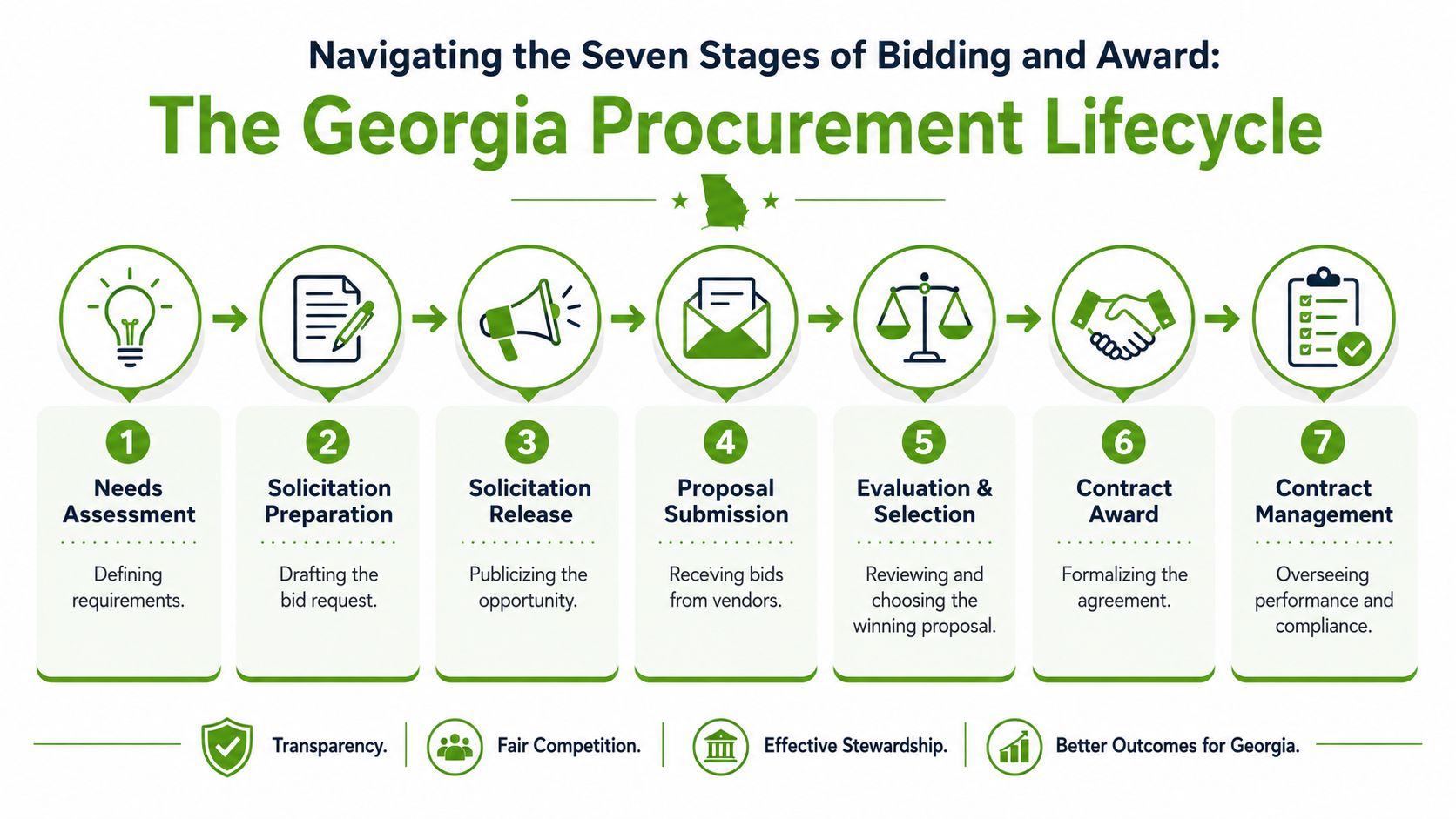
What the lifecycle means for your bid
Georgia's procurement framework is codified as a seven-stage lifecycle, and in Stage Five the evaluation method is triggered by the language in the solicitation document, according to the Georgia seven stages of procurement guidance. That means the rules for how the winner will be determined are not improvised after bids arrive. They are embedded in the solicitation itself.
For nonprofits, that changes how you read. You are not just scanning for scope, deadline, and attachments. You are looking for the evaluation logic.
Here's the practical sequence:
Need identification
An agency determines it needs a product or service.Pre-solicitation and preparation
The agency and procurement staff shape the scope, terms, and evaluation method.Solicitation release
The bid goes public. At this stage, your monitoring system proves its worth.Proposal submission
You respond exactly as instructed. Formatting, attachments, and signatures matter.Evaluation
The state scores or compares responses according to the solicitation language.Award and contract process
The apparent winner moves into final steps, negotiations if allowed, and formal award.Contract management
Performance begins. Reporting, invoicing, and compliance become part of your reputation.
Where nonprofits usually lose ground
The common failure point is not always bad programming. It's weak reading discipline in Stages Three through Five.
Use this review checklist before submission:
- What is the award basis? Lowest price, best value, pass/fail, or another defined method
- What is mandatory? Missing one required form can sink an otherwise strong response
- Are oral presentations possible? If yes, prepare program and operations staff together
- Is negotiation allowed? Don't assume there will be room to fix unclear pricing later
For construction-related or facilities-adjacent opportunities, bond requirements can also affect go/no-go decisions. If your nonprofit is unclear on the difference, Coverage Axis discusses bid and performance bonds in a way that helps non-specialists understand when each one matters.
Read the evaluation section before you write a single narrative paragraph. It tells you what the state will reward.
Winning Strategies for Small Nonprofits
A Georgia agency releases a service contract that fits your mission almost perfectly. Your team has the program experience, community relationships, and staff credibility to do the work well. Then the bid asks for pricing detail, reporting capacity, insurance, and response language that can stretch a small nonprofit thin. That is the point where many good organizations fall behind larger vendors.
Small nonprofits usually do better when they stop trying to look bigger and start presenting a tighter case. In Georgia procurement, that means choosing opportunities that match your actual bench strength, pricing the work so you can perform it well, and documenting any special market position in procurement terms instead of mission language.

Compete where your structure helps
A nonprofit should rarely chase every open opportunity in its service area. The stronger approach is to focus on contracts where your organization offers something a generalist vendor cannot easily reproduce, such as trusted access to a specific population, culturally competent service delivery, or proven outcomes in a narrow program model.
Your position is stronger when you can show:
- A defined niche instead of broad “we do everything” language
- Relevant delivery history that matches the scope closely
- Staff credibility in the exact service area
- An operating plan your current team can carry without strain
That last point deserves more attention than it usually gets. Agencies may like your mission, but they still need a contractor that can start on time, submit reports, and maintain staffing. Capacity wins trust.
Watch this for a practical overview before you refine your bidding approach:
Price without creating a delivery problem
Nonprofits often miss on price in two ways. Some carry over grant budgets without adjusting for a state contract's invoicing, supervision, data collection, and compliance load. Others cut too severely to look competitive, then discover halfway through the term that unrestricted funds are subsidizing the award.
A better approach is to price the actual work.
Include direct service time, supervision, reporting, finance review, travel, background checks if required, and contract administration. Georgia agencies do not always buy the lowest apparent hourly rate if the response raises concerns about feasibility. A realistic budget can be more persuasive than an artificially low one that leaves no room for performance.
Use this internal test:
| If your pricing does this | The likely result |
|---|---|
| Ignores reporting time | Staff burn out and margins vanish |
| Assumes unrestricted funds will cover gaps | Finance tension shows up mid-contract |
| Leaves no room for contract management | Performance quality drops |
| Reflects real delivery costs | You can sustain the work and protect renewal potential |
For nonprofit teams that already manage grants, many of the same budgeting and documentation habits carry over. These grant management best practices for nonprofit teams can help you tighten the internal controls that support contract pricing and delivery.
Handle sole-source carefully
Sole-source interest comes up often with smaller nonprofits because many serve a very specific geography or population. That can be real market differentiation. It is not, by itself, a procurement justification.
Georgia buyers need a written record showing why another vendor cannot reasonably provide the same requirement. The reason this is important is that the problem usually is not nonprofit capability. The problem is weak documentation. A mission statement, community reputation, or long local presence may support your case, but they do not replace proof of unique capability.
A stronger sole-source justification usually includes:
- Unique capability tied to the required service, not a broad statement of mission
- No practical alternative supplier described in terms of deliverables
- Geographic or population-specific fit if the contract depends on that access
- Operational readiness showing you can perform within the agency's timeline
Small nonprofits also need to pay attention to lower-dollar purchases. Informal quote thresholds can create opportunities to get in front of an agency without competing in a full formal solicitation, but they still require responsive pricing and clear scope alignment. Treat those requests seriously. A well-handled smaller engagement often becomes the reference point that helps on a later, larger procurement.
If you say your nonprofit is unique, prove why another vendor cannot reasonably meet the same requirement.
Partner when the scope exceeds your bench
Partnerships work best when they solve a real capacity gap. They work poorly when they exist only to make a team look larger on paper.
If the contract needs broader geographic coverage, deeper back-office support, or round-the-clock staffing, a subcontracting or consortium model may make sense. The trade-off is control. As the prime, you carry more visibility and more administrative burden. As a subcontractor, you may gain experience and past performance with less risk, but you give up direct agency relationship and some margin.
The best teams settle key questions early. Who owns reporting. Who carries which staff. How is pricing built. What happens if volumes rise or one partner underperforms. Clear answers protect both performance and relationships.
Post-Award Compliance and Reporting
The award notice feels like the finish line. It isn't. In State of Georgia procurement, post-award management is where your reputation is built.
A nonprofit that performs cleanly becomes easier for an agency to trust next time. A nonprofit that misses invoices, submits uneven reports, or lets insurance documents lapse becomes expensive to manage, even if the program work is good.
What to control immediately after award
Start with a contract kickoff file. It should include the executed agreement, scope, reporting deadlines, invoicing rules, insurance or license requirements, key agency contacts, and an internal responsibility chart.
Then assign ownership:
- Finance handles invoice timing and backup documentation
- Program staff track deliverables exactly as defined in the contract
- Leadership reviews changes, risks, and relationship management
- Operations or grants staff maintain the audit trail
Build a renewal mindset early
Don't wait until the final quarter to organize records. Good contract management means documenting work as it happens, keeping correspondence tidy, and resolving scope questions in writing.
If your team already manages grants, many of the same disciplines apply. These grant management best practices for nonprofit teams can help you adapt familiar controls to state contracts, especially around deadlines, reporting workflows, and documentation retention.
Strong compliance does more than avoid problems. It gives your nonprofit something every future procurement response needs. A credible performance history.
Fundsprout helps nonprofits do the work that usually breaks small teams during public funding pursuits: finding relevant opportunities, organizing proposal requirements, building responses from real organizational data, and keeping reporting records clean after award. If your team wants a simpler way to manage the path from application to renewal, explore Fundsprout.
Try 14 days free
Get started with Fundsprout so you can focus on what really matters.