Master Grant Funding With These Determination Letter Tips
Unlock funding with essential determination letter tips. Learn to secure, manage, and leverage your 501(c)(3) status to win more grants and build trust.

Abdifatah Ali
Co-Founder
Getting your determination letter might seem like just another piece of administrative hassle, but it’s the single most important document you have for unlocking serious grant funding. Think of it as the ultimate key—irrefutable proof of your 501(c)(3) status that instantly signals credibility to foundations and government agencies.
Why Your Determination Letter Is a Golden Ticket
Your IRS determination letter is far more than a simple piece of paper. It’s your nonprofit’s official passport into the world of legitimate fundraising. This one document is the definitive proof of your 501(c)(3) status, telling grantmakers that your organization is a trustworthy, mission-driven entity they can confidently support.
Without it, you’re practically invisible to the vast majority of institutional funders. The letter is the cornerstone of any solid development strategy. It’s an instant credibility booster that cuts through the noise, simplifies eligibility checks, and opens doors that would otherwise remain firmly shut. For any development team, big or small, understanding its power is the first step toward building a sustainable funding pipeline.
The Foundation of Funder Trust
Grantmakers don’t have time for guesswork; they operate under strict rules and need absolute certainty that their money is going to a qualified charitable organization. Your determination letter erases any doubt. It’s often the very first document they’ll ask to see.
Presenting your determination letter is the fastest way to pass the initial screening process. It tells funders, "We are a verified, IRS-approved nonprofit," allowing the conversation to shift from your eligibility to your impact.
For foundations, government agencies, and corporate givers, this letter is non-negotiable. It's the baseline check that qualifies you for specialized grants—whether in arts, healthcare, or education—that are a perfect fit for your programs.
Unlocking a World of Funding Opportunities
Having a valid determination letter doesn't just prove your status; it actively unlocks specific funding streams that are completely off-limits otherwise.
- Federal and State Grants: It's nearly impossible to secure government funding without it. Agencies must have this letter on file to ensure taxpayer money is distributed according to regulations.
- Foundation Grants: Nearly every private and community foundation lists a 501(c)(3) determination letter as a mandatory attachment in their grant applications. No letter, no consideration.
- Corporate Sponsorships: Companies offering grants or sponsorships need the letter for their own tax and compliance records, confirming their contributions go to a legitimate nonprofit.
Having your letter organized and ready to go ensures you never miss out on a perfect funding match just because of a paperwork scramble. This is especially true when pursuing federal grants for nonprofits, where compliance is everything. It solidifies your reputation as a professional, organized, and reliable partner ready to make a real difference.
How to Secure Your First Determination Letter
Trying to get your first IRS determination letter can feel like you're staring at a giant puzzle with a thousand tiny pieces. It’s easy to feel overwhelmed, but if you break it down into smaller, more manageable steps, the whole process becomes much clearer. The secret to success actually starts long before you ever type a single word into the application form.
This journey is all about building a solid foundation first. The IRS wants to see, in no uncertain terms, that your organization is set up for the public good, not for anyone's private benefit. That means getting your mission statement and organizational bylaws locked in isn't just a box to check—it’s the most critical first step you'll take.
Building Your Application Blueprint
Before you even think about visiting the IRS website, get all your core documents in one place. Think of it like a chef prepping all their ingredients before they even turn on the stove. A well-prepared application doesn't just look more professional; it dramatically cuts down the risk of the IRS coming back with questions, which can easily add months to your wait time.
Your mission statement needs to clearly connect to one of the IRS's recognized exempt purposes, like being charitable, educational, or religious. Any vague or fuzzy language is an immediate red flag. At the same time, your bylaws are the official rulebook for your nonprofit, so they need to cover everything from your board structure to how you'll handle conflicts of interest. Digging into what makes a strong nonprofit organizational structure can give you a major leg up here, both for your application and for your long-term health.
This is the key takeaway: getting that letter is the first domino to fall. It builds credibility, which in turn opens the doors to funding.
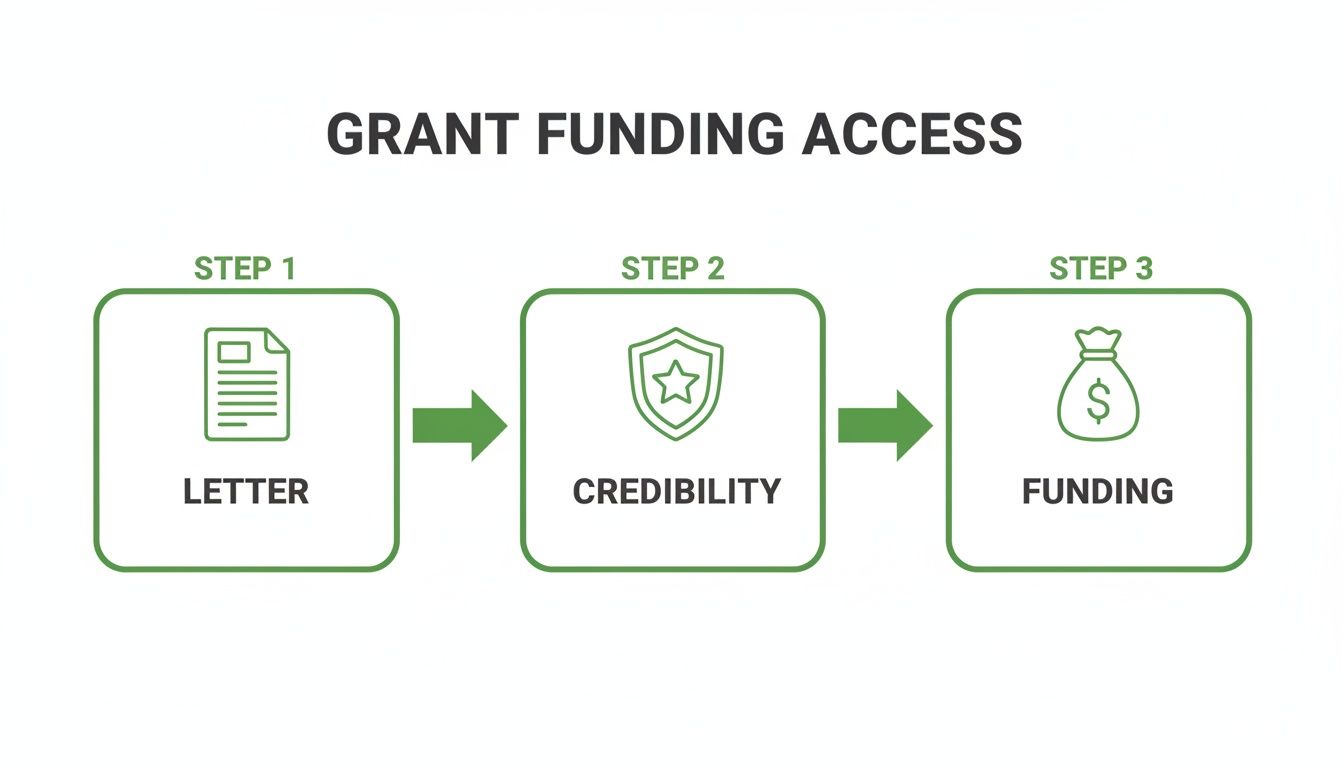
This simple flow from document to trust to funding is precisely why putting in the effort to create a flawless application is so essential for your nonprofit’s future.
Choosing the Right Form and Preparing Financials
Your next big decision is choosing between Form 1023 and the much shorter Form 1023-EZ. The "EZ" form is designed for smaller organizations. As a rule of thumb, you might be eligible if you expect your annual gross receipts to be $50,000 or less for the next three years and your total assets are under $250,000.
But don't just jump at the easier option. While tempting, the EZ form isn't always the best strategic move. Some foundations and even state charity officials prefer to see that an organization has gone through the more demanding full Form 1023. This longer form requires a much deeper dive into your programs and finances, signaling a higher level of transparency and seriousness right from the get-go.
No matter which form you choose, you absolutely must have your financial data buttoned up. This includes:
- Past Financials: If you’ve already been operating, you'll need income statements and balance sheets for any previous years.
- Projected Budgets: You have to submit a believable three-year budget that breaks down where you expect money to come from and how you plan to spend it. This proves to the IRS you've got a viable plan.
Submitting a Flawless Application
Once your documents are gathered and your financials are ready, it’s time to tackle the application itself. Think of it less as filling out a form and more as making your case. This is a time for precision—a single typo in your Employer Identification Number (EIN) or a half-answered question can get your application kicked to the back of the line.
To make sure you're not missing anything critical that could cause delays, here's a quick checklist of what the IRS is looking for.
Key Elements of a Successful Form 1023 Application
Getting these elements right from the start is the single best thing you can do to avoid headaches and long waits down the road.
The timeline for getting an approval can vary wildly. While the IRS aims for three to six months, it’s not unheard of for the process to take 12 months or even longer, especially if your application is complex or incomplete.
After you hit "submit," the waiting game begins. You can keep an eye on your application's status through the IRS website. If an agent has questions, they'll reach out in writing. Make sure you respond as quickly and thoroughly as possible to keep things moving. Securing this letter is definitely a marathon, not a sprint, but careful, meticulous preparation is what will get you across the finish line.
Reading and Understanding Your Determination Letter
When that official IRS envelope finally lands on your desk, it’s a huge moment. The first instinct is to celebrate, maybe even frame it, and then get right back to the mission-driven work you love. But hold on—that determination letter is more than just a trophy. It's the official rulebook for your nonprofit's tax-exempt status.
Learning to read it properly is one of the most critical skills you can have.
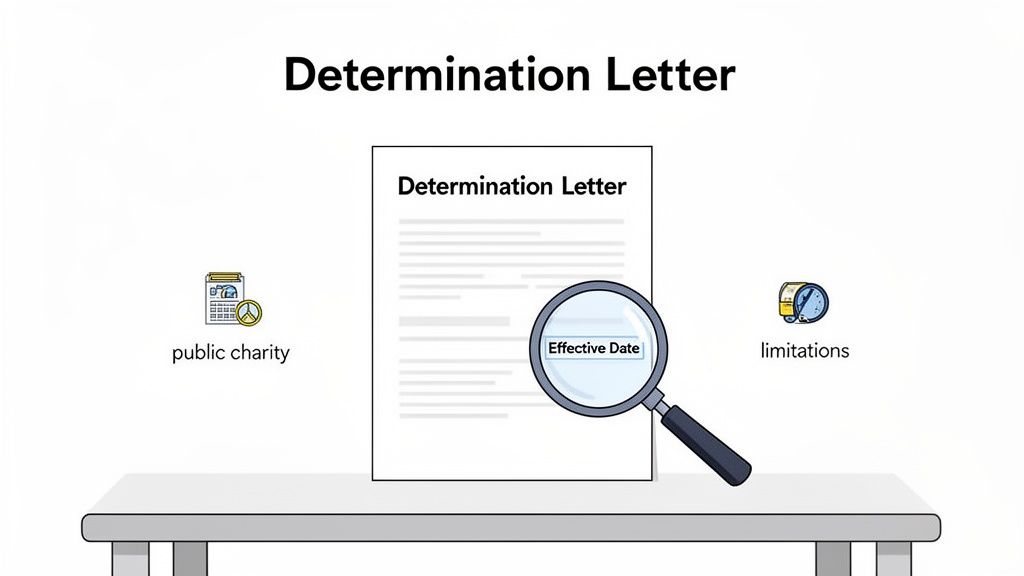
This document spells out exactly how you can operate, what you need to report to the government, and how your donors can treat their contributions. Taking 15 minutes to really digest it now can save you from massive headaches and compliance nightmares down the road. Let's walk through the key sections you absolutely need to know.
Pinpointing Your Critical Dates and Status
The most important information is usually right at the top, packed into the first few paragraphs. This is where the IRS gives its official stamp of approval and lays down the ground rules for your organization. Be on the lookout for these three things first.
- Effective Date of Exemption: This is a golden date. It's typically your date of incorporation, which means any donations you received since that day are tax-deductible—even if they were given months before the letter actually arrived.
- Public Charity Status: The letter will state your classification under Section 509(a). Most operating nonprofits are classified as 509(a)(1) or 509(a)(2), signaling to funders that you have broad public support. This is the status most grantmakers require.
- Foundation Classification: On the other hand, if you're a private foundation, the letter will explicitly say so. This classification comes with a whole different set of operational rules and tax laws, so it’s crucial to know which category you fall into.
Your effective date is key for thanking donors correctly, and your public charity status is your ticket to being eligible for the vast majority of grants.
Understanding Your Annual Filing Requirements
Your determination letter also acts as your official heads-up about ongoing duties. The IRS doesn't just grant you 501(c)(3) status and then disappear; they expect you to maintain it through consistent reporting.
The letter will clearly outline your annual information return requirement. This is your obligation to file a Form 990 every year (whether it's the Form 990, 990-EZ, or 990-N). This isn't optional. If you fail to file for three consecutive years, the IRS will automatically revoke your tax-exempt status. No questions asked.
Think of your determination letter as a living document, not a historical artifact. The rules and requirements it contains are in effect for the entire life of your organization. Following them is what keeps you in good standing with the IRS and with funders.
This section is essentially the IRS’s polite but firm warning: stay compliant, or you could lose the very status this letter grants.
Identifying Any Special Rules or Limitations
Finally, make sure you read every word of the letter. You're looking for any specific conditions or limitations the IRS might have placed on your organization. While most letters are pretty standard, some include unique clauses based on your specific activities or structure.
For example, your letter might contain language about:
- Advance Ruling Period: New organizations often get an "advance ruling" for their first five years. This is a probationary period where the IRS watches your funding sources to make sure you truly qualify as a public charity before making it permanent.
- Lobbying or Political Activities: The letter will remind you of the absolute ban on participating in political campaigns and the strict caps on lobbying.
- Unrelated Business Income (UBI): It may also mention that you have to report—and pay taxes on—any income you earn from activities that aren't directly tied to your mission.
Consider these sections the "fine print" of your agreement with the IRS. Ignoring them can lead to painful penalties or even the revocation of your 501(c)(3) status. By taking the time to truly understand your letter, you empower your team to operate with confidence, keeping your nonprofit safe and ready for every funding opportunity that comes your way.
Safeguarding Your Most Important Document
Your determination letter isn't just another piece of paper; it's the golden ticket for your nonprofit's fundraising and compliance efforts. Losing it can stall grant applications and kickstart a major administrative headache. It’s best to treat it like the deed to a house—you wouldn’t just leave it sitting on a desk.
That’s why every nonprofit needs a rock-solid system to protect this document. The smartest way to do this is with a two-pronged approach that combines physical security with digital backups. This ensures that no matter what—a server crash, an office flood, or just a simple filing mistake—you can always get your hands on that letter when you need it most.
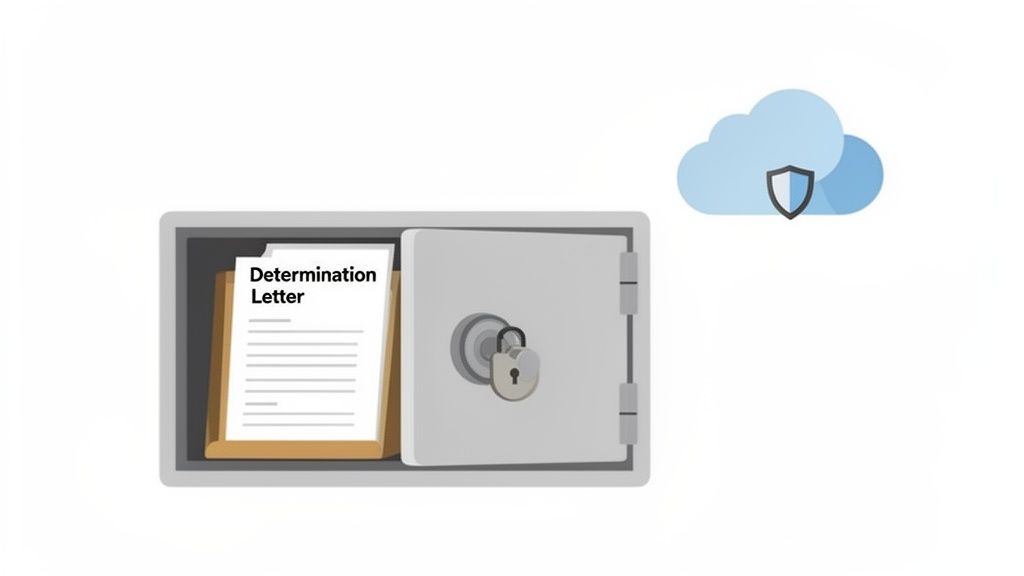
Taking this step doesn't just protect your organization. It also shows funders you’re organized, professional, and reliable—a great first impression to make.
Building Your Document Fortress
A truly dependable storage plan has two key parts: a secure physical spot and a backed-up digital location. If you only rely on one, you’re leaving your organization exposed. A fire could easily destroy your only paper copy, while a ransomware attack could lock you out of a single digital file forever.
For physical storage, the game plan is pretty straightforward.
- Get a Fireproof Safe: The original, hard-copy letter belongs in a high-quality safe that's both fireproof and waterproof. This is the single most effective way to protect it from a disaster at your office.
- Keep a Copy Off-Site: It's also a good idea to have a high-quality photocopy stored somewhere else entirely, like with a trusted board member or in a bank's safe deposit box. This gives you a crucial extra layer of redundancy.
Digital storage offers a lot more flexibility, but it demands careful planning. A scanned PDF saved to one person's desktop computer just doesn't cut it.
Implementing Smart Digital Storage
Your digital strategy should be all about security, easy access, and redundancy. Simply emailing the file around to your team is inefficient and insecure. A much better way is to use tools designed for the job.
Your digital storage system should be designed for both protection and ease of access. The goal is to make it simple for authorized personnel to retrieve the letter quickly while keeping it completely secure from unauthorized viewers.
Start by creating a dedicated folder in a secure cloud-based service like Google Drive or Dropbox. Make sure the folder is clearly named—something like "Critical Organizational Documents"—and that access is tightly restricted.
Establishing Clear Access Protocols
Not everyone on staff needs the ability to edit or delete the original digital file. Setting up clear rules from the start prevents accidental deletions and unauthorized sharing.
- Define User Permissions: Grant "view-only" access to most team members who need the letter for grant proposals. Limit "editor" or "owner" permissions to just one or two key people, like the Executive Director or Director of Development.
- Create a Sharing Policy: Train your team on the right way to share the letter with funders. Instead of attaching a PDF to an email, have them use a secure, shareable link from your cloud service. This gives you much more control and can even show you who has viewed the document.
- Watermark Copies for External Use: For an added layer of security, you can create a PDF version that’s watermarked with "COPY" or your nonprofit's name before sending it out.
Putting this system in place means your determination letter will always be safe, accounted for, and ready to go for your next big funding opportunity. It's a simple step that reinforces your image as a trustworthy and well-run organization.
What to Do If You Lose Your Determination Letter
It’s a moment that can send a wave of panic through any nonprofit leader. Maybe files got lost during an office move, a hard drive crashed, or vital records were misplaced in a leadership change. Suddenly, a huge grant deadline is on the horizon, and your determination letter is nowhere to be found.
First, take a deep breath. This happens more often than you'd think, and the IRS has a couple of clear pathways to get you a replacement. Acting quickly will get your grant applications back on track without missing a beat.
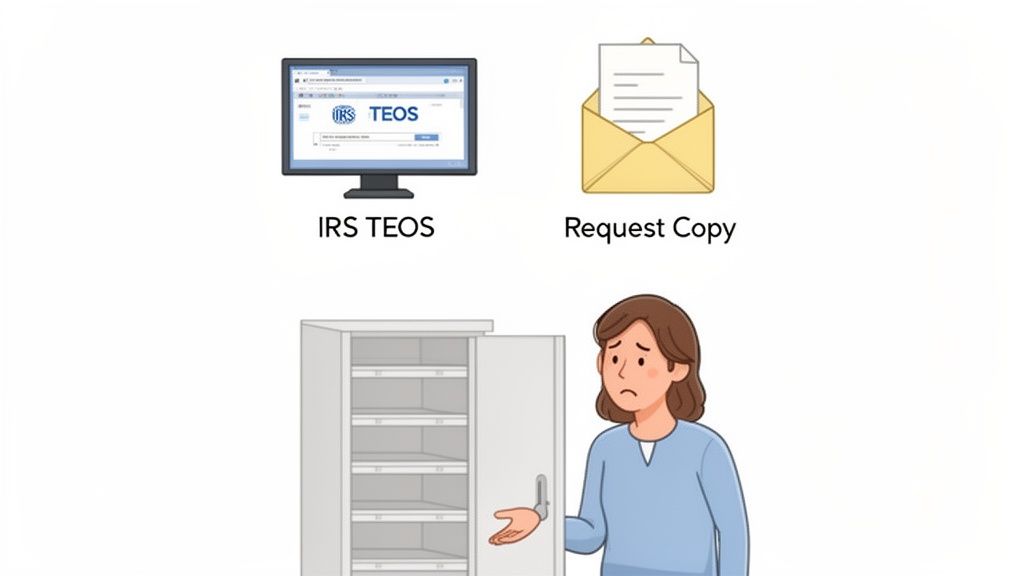
Your First and Fastest Option: The IRS TEOS Tool
Before you start digging through paperwork or filling out forms, your first stop should always be the IRS’s online Tax Exempt Organization Search (TEOS) tool. Think of it as the official digital filing cabinet for nonprofits.
This free database is, by far, the quickest way to find proof of your nonprofit's status. You can search by your organization’s name or Employer Identification Number (EIN).
The best part? For organizations approved after January 1, 2014, the IRS often uploads a digital copy of the actual determination letter right to the site. This digital version is an official IRS document and is perfectly acceptable to most grantmakers. Finding your letter here could solve your problem in just a few minutes.
How to Request an Official Copy from the IRS
What if your organization is older and got its status before 2014? Or what if your letter just isn't showing up in the TEOS tool? In that case, you'll need to go directly to the source and formally request a new copy from the IRS. This path takes a bit more time, so you’ll want to get started right away.
The form you need is Form 4506-B, Request for a Copy of Exempt Organization IRS Application or Letter. It’s specifically for getting copies of your exempt status documents, and thankfully, there’s no fee to file it.
When you fill it out, you'll need a few key pieces of information:
- Your organization's full legal name and mailing address.
- Your Employer Identification Number (EIN).
- The tax year and form number of your original application (for most, this will be Form 1023).
A word of caution: be prepared to wait. While processing times can vary, it often takes 60 days or more for the IRS to process your request and mail you a new hard copy. This is why it’s so important to act fast if you have funding deadlines on the calendar.
Gathering the Necessary Information
To make sure everything goes smoothly, precision is your best friend. Before you start searching or filling out forms, get your core details in order.
Make sure you have these three things confirmed and written down exactly right:
- Exact Legal Name: This must match the name on your original incorporation documents, letter for letter.
- Employer Identification Number (EIN): Double-check your nine-digit EIN. No typos!
- Mailing Address: Use the address the IRS has on file for your organization.
Getting these three pieces of information right is the single most important tip for recovering a lost letter. A simple typo or a mismatch in your legal name can cause the TEOS tool to come up empty or the IRS to reject your request, forcing you to start all over again.
Staying in Good Standing with the IRS
Getting that IRS determination letter is a huge moment. But it's not the end of the road—it’s the beginning. Think of it like getting the keys to a new car; you still have to do the oil changes and maintenance to keep it running. Maintaining your 501(c)(3) status is an ongoing job, and it’s what protects your credibility and keeps you eligible for grants.
This means you’ve got a few crucial, non-negotiable responsibilities. From filing your annual paperwork to making sure your board operates ethically, these actions prove to the IRS and to funders that you’re a responsible steward of the community's trust and money. If you let these things slide, you could face serious consequences, including losing the tax-exempt status you worked so hard to get.
The Yearly Must-Do: Filing Your Form 990
Your most important ongoing task is filing the Form 990 every single year. This isn't just a tax form; it's your nonprofit's annual report to the IRS and the public, showing exactly where your money comes from and how you spend it. It's not optional.
If you fail to file your Form 990 for three consecutive years, the IRS will automatically revoke your 501(c)(3) status. This is one of the most common—and most avoidable—reasons nonprofits get into hot water. A simple calendar reminder and a clear point person for this task can save you a world of trouble down the line.
Your annual Form 990 is more than just a compliance document; it's a public-facing report card. Grant funders absolutely look at it to check your financial health and see what your priorities are before they'll even consider a proposal. A timely, accurate filing tells them you're a well-run ship.
Keeping Your Activities on the Straight and Narrow
Beyond the paperwork, how you run your organization day-to-day really matters. There are a couple of big red lines you can't cross: private benefit and political activity. The whole reason you have tax-exempt status is that you serve a public good, and anything that pulls you away from that can put your status at risk.
- No Private Inurement: This is a fancy way of saying you can't let the organization's money or assets unfairly benefit an "insider," like a board member or the executive director. For example, paying your founder a salary that's wildly above the market rate could be flagged as private inurement.
- Absolute Ban on Political Campaigning: As a 501(c)(3), you are strictly forbidden from getting involved in political campaigns for or against a candidate. This means no financial donations, no public endorsements—nothing.
- Limits on Lobbying: While you can do some lobbying to advocate for your cause, it can't be a "substantial part" of what your organization does. There are clear limits, and crossing them can jeopardize your status.
Following these rules is fundamental to your survival. A solid conflict of interest policy is one of your best tools for navigating these issues safely. You can find guidance on how to create a conflict of interest policy sample for non-profits to make sure your team stays on the right side of the line.
What to Do When Your Organization Changes
Nonprofits grow and evolve—it's natural. You might move to a new office, tweak your mission statement, or update your bylaws. The key is to remember to report any significant changes to the IRS.
For instance, if you change your legal name or mailing address, you have to let the IRS know so you don't miss any important notices. Bigger changes, like a major shift in your programs, might also require notifying the IRS to confirm your new activities still fit within your charitable purpose.
Staying on top of compliance requires good internal systems. Adopting some basic contract management best practices can help you create reliable processes for tracking key documents and deadlines. A proactive approach here means you won't get caught off guard by a compliance issue that could bring your fundraising to a halt.
To help you stay on track, here's a quick look at the key tasks you should have on your radar every year.
Annual Compliance Checklist for 501(c)(3) Nonprofits
Keeping this checklist in mind will not only keep you in good standing with the IRS but will also build a foundation of trust with the funders you rely on to achieve your mission.
Common Questions About IRS Determination Letters
Once you get the basics down, a few specific questions about determination letters always seem to pop up. Getting these details right is key to keeping your organization compliant and your fundraising efforts on track. Let's tackle some of the most common ones we hear from development teams.
How Long Does a Determination Letter Last?
Here’s the good news: your determination letter does not expire. Think of it as your nonprofit's birth certificate—it's a one-time document that proves your status.
But there's a catch. While the letter itself is permanent, your 501(c)(3) status isn't guaranteed for life. The IRS can revoke it if you don't keep up with your obligations, like filing your annual Form 990 or staying out of prohibited political activities. So, the letter lasts forever, but only as long as you maintain the good standing it represents.
Is It the Same as a Tax-Exempt Certificate?
This is a really common point of confusion, but they are two very different documents serving different masters.
IRS Determination Letter: This is the big one from the federal government. It's the official document that grants your 501(c)(3) status, making you exempt from federal income tax and, crucially, allowing you to accept tax-deductible donations.
State Tax-Exempt Certificate: This document is all about state taxes, usually sales tax. To even apply for this state-level exemption, you'll almost always need to show them your federal determination letter first.
Think of it this way: federal approval comes first, and state-level perks often follow from that.
Can We Fundraise Before It Arrives?
Technically, yes, but it’s a risky move that most seasoned fundraisers will tell you to avoid. If you start soliciting donations while your Form 1023 application is still pending, you are legally required to tell donors their contributions are not yet guaranteed to be tax-deductible.
If you get approved, the IRS usually makes your tax-exempt status retroactive to your date of incorporation, which means those early donations do become deductible. But what if you're not approved? It gets messy.
The real barrier here is grant funding. You'll find that nearly every foundation or corporate funder won't even look at your grant proposal until you can provide a copy of your final, approved determination letter. It's a non-starter. Waiting is almost always the smarter, safer play.
It's also worth noting that the determination letter is just one of many important communications from the IRS. For example, knowing how to handle an IRS identity verification letter is vital for maintaining your organization's security and compliance.
Finding the right funding opportunities is just the first step. Fundsprout helps you build a ranked pipeline of perfectly matched grants and uses AI to help you write compelling proposals faster, so you can focus on your mission. See how it works at https://www.fundsprout.ai.
Try 14 days free
Get started with Fundsprout so you can focus on what really matters.