Sample Nonprofit Strategic Plan: A Step-by-Step Guide
Download our sample nonprofit strategic plan and follow our step-by-step guide to create a roadmap that drives impact and boosts fundraising success.

Abdifatah Ali
Co-Founder
You probably didn't search for a sample nonprofit strategic plan because you love planning documents.
You searched because a grant deadline is coming up, the board wants clarity, staff are stretched, and everyone keeps asking the same questions. What are we trying to accomplish this year? Which programs are priorities? How do we explain our direction to funders without rewriting the same narrative every month?
That's where a good strategic plan earns its keep. Not as a glossy PDF. Not as a retreat artifact. As the document that tells your team what to pursue, what to stop, what to fund, and how to prove your choices make sense.
A strong sample nonprofit strategic plan gives you structure. A usable strategic plan provides an advantage. It sharpens board conversations, makes staff accountability fairer, and turns fundraising from reactive scrambling into a disciplined case for support.
Why Your Strategic Plan Is Your Best Fundraising Tool
Most nonprofits have seen the bad version of strategic planning. A committee meets. A retreat happens. A polished document gets approved. Then it lands in a binder, a shared drive, or a board portal no one opens again.
That version doesn't help you raise money.
The useful version does something different. It gives funders a clear answer to five questions they always care about, whether they ask directly or not: Who are you? What problem are you solving? Why this approach? What will you do first? How will you know if it worked?
Funders trust direction, not just passion
A donor may give because they connect with your mission. A grantmaker usually funds because they see disciplined execution behind that mission. They want to know your organization can make choices, assign responsibility, and measure progress.
That's why strategic planning matters financially, not just operationally. Leaders who prioritize strategic planning experience 10% higher annual revenue growth than those who do not, according to Eide Bailly's nonprofit strategic planning guidance. For small nonprofits without a dedicated grant writer, that difference matters.
A strategic plan also makes your fundraising plan stronger. If you're building annual campaigns, grant calendars, or donor stewardship around vague priorities, your team will keep rewriting goals in slightly different language. If you want a practical companion to the planning process, a solid fundraising plan format helps translate strategic priorities into revenue activity.
A weak plan asks funders to trust your intentions. A strong plan shows them how decisions get made.
The plan becomes your case for support
When a nonprofit has a real strategy, fundraising gets easier for a simple reason. The core story stabilizes.
Your development director no longer has to guess which program deserves emphasis this quarter. Your executive director doesn't have to improvise a different future vision in every donor meeting. Your board chair can speak from the same set of priorities as your program team.
That consistency shows up in:
- Grant narratives that sound coherent because they come from agreed priorities
- Board fundraising conversations that focus on investment, not confusion
- Major donor meetings that connect gifts to defined goals rather than loose aspirations
- Budget decisions that support the strategy instead of reacting to the loudest request
What doesn't work
Some planning habits look responsible but weaken fundraising.
| Common habit | What it causes |
|---|---|
| Writing broad, aspirational goals | Donors can't see what will actually happen |
| Treating planning as a board-only exercise | Staff don't own implementation |
| Building the plan separately from development work | Fundraising stories drift away from operations |
| Focusing on document design over decision-making | The plan looks finished but isn't usable |
The best sample nonprofit strategic plan isn't the prettiest one. It's the one your staff can use on Monday morning and your grant writer can use on Tuesday afternoon.
Deconstructing Our Sample Nonprofit Strategic Plan
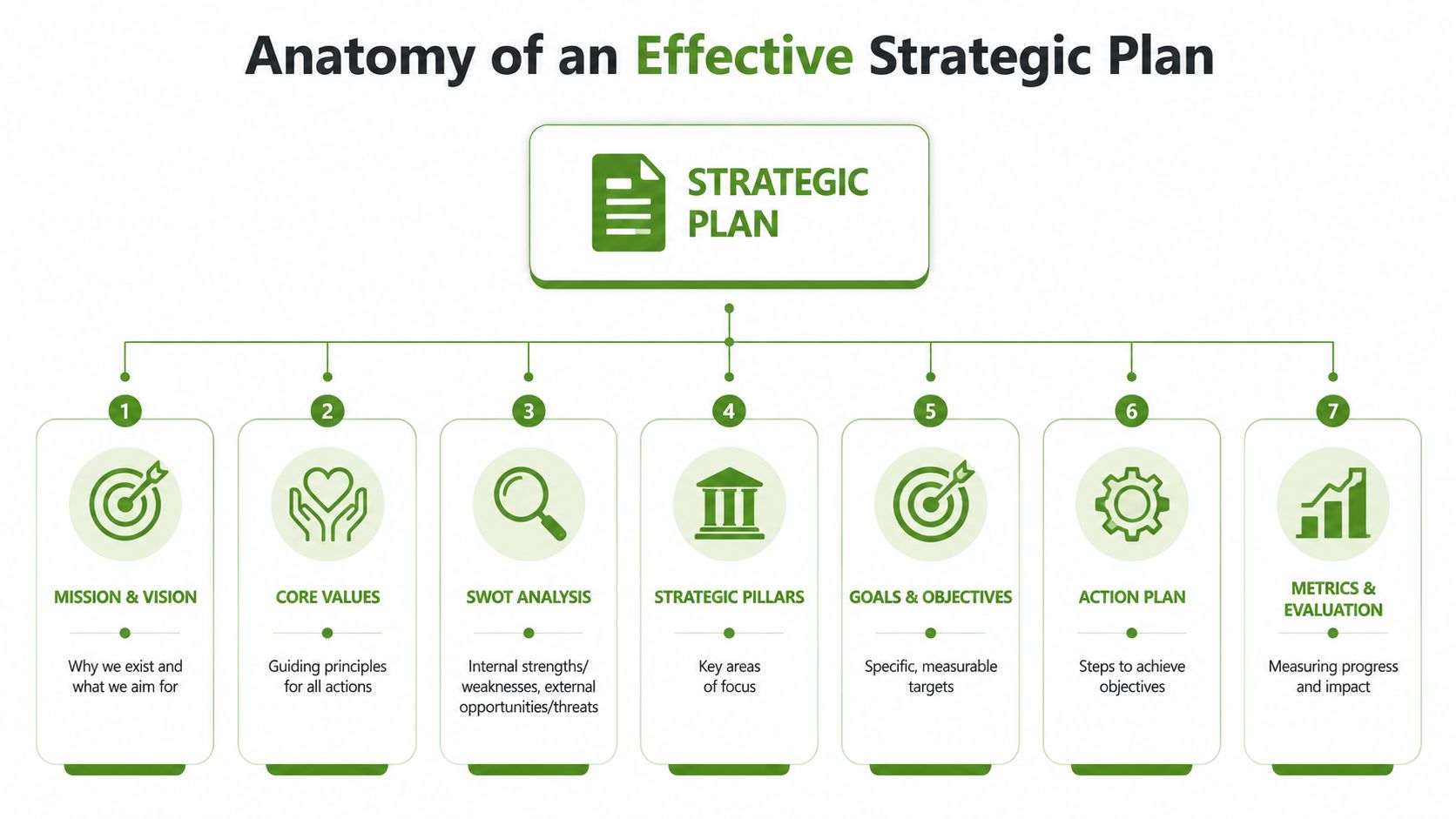
A sample nonprofit strategic plan should give you more than headings to fill in. It should show the logic of the document. Each section has a job, and if one is missing, the plan gets harder to execute and harder to use in fundraising.
Most nonprofit strategic planning efforts take approximately three to five months to complete, and a robust plan should include 8 to 10 specific sections, according to Social Impact Architects. That timeline is realistic for organizations that gather input, test assumptions, and draft something the board can govern from.
The core sections that belong in the plan
Here's the anatomy I'd expect in a working plan, not just a ceremonial one.
Leadership cover letter
This sets the tone. It tells staff, board, donors, and funders what changed, why this plan matters now, and what leadership is committing to.Executive summary
This is the shortest useful version of the plan. If a program officer reads only one page, this is often the page.Mission, vision, and values
These aren't filler statements. They are filters. If a new grant opportunity doesn't fit them, you have a reason to say no.Organizational history and current context
Briefly explain where the organization has been and what conditions shaped the planning process.Strategic analysis
Your SWOT or equivalent assessment belongs here. It connects reality to decision-making.Strategic priorities or pillars
These are the major areas of focus that will guide choices over the life of the plan.SMART objectives
These convert ambition into observable progress.Implementation framework
This names owners, timelines, and required resources.Progress measurement system
A plan without a tracking method becomes opinion-driven the moment pressure rises.Appendices or supporting materials
Use these for stakeholder summaries, definitions, and detailed workplans if needed.
Why each section matters to funders
A funder doesn't need your entire internal operating system, but they do need evidence that one exists.
| Plan section | What it signals externally |
|---|---|
| Executive summary | Leadership clarity |
| Mission and vision | Alignment with stated purpose |
| SWOT or situational analysis | Honest understanding of context |
| Strategic priorities | Ability to focus |
| SMART objectives | Measurable intent |
| Implementation plan | Feasibility |
| Progress measures | Accountability |
Practical rule: If a section doesn't help your team decide, prioritize, assign, or measure, it probably doesn't belong in the final plan.
What strong plans avoid
Strong plans don't confuse completeness with usefulness. They avoid long narrative sections that restate the obvious, padded environmental scans no one will revisit, and goals so broad they could apply to any nonprofit.
They also don't hide the hard choices. If your organization can't realistically expand programs, deepen advocacy, build infrastructure, and launch a capital effort at the same time, your sample nonprofit strategic plan should reflect that constraint clearly.
A good template gives you shape. A good final plan shows judgment.
From Template to Tailored A Step-by-Step Customization Guide
A template only helps if you force it to reflect your actual organization. That means your capacity, your community, your staffing reality, and your trade-offs.
The fastest way to ruin a plan is to borrow language from a larger nonprofit and paste it into a smaller one. The second-fastest way is to write goals that sound inspiring but don't match the people, time, and money you have available.
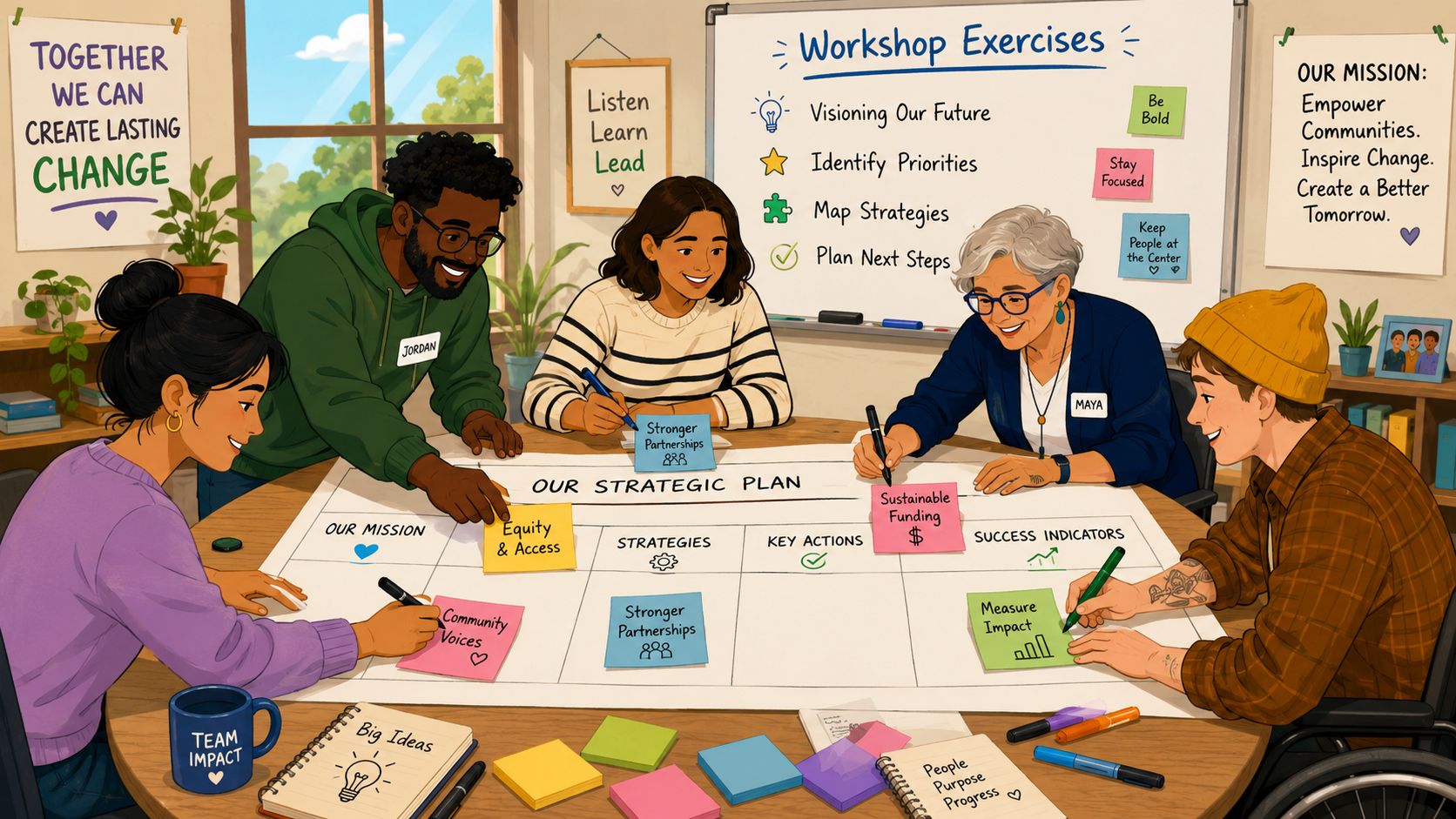
Start with a working planning group
Don't build the first draft alone and ask others to “react.” That produces polite edits, not real strategy.
Use a small planning group that includes board and senior staff. Then gather broader input before priorities are finalized. Laridae's nonprofit strategic planning guidance emphasizes continuous stakeholder engagement and the use of SMARTIE goals, meaning goals should be Specific, Measurable, Achievable, Realistic, Timebound, Inclusive, and Equitable.
A practical workshop sequence looks like this:
- Clarify mission first by asking, “What do we do that we would defend even under financial pressure?”
- Stress-test the vision by asking, “If we succeed, what changes for the people we serve?”
- Name values behaviorally instead of abstractly. “Collaboration” is vague. “Program and development staff review funding opportunities together before submission” is useful.
Make SWOT concrete
Most SWOT exercises fail because teams fill them with generic statements.
Weak SWOT entry: “Need more funding.”
Useful SWOT entry: “Revenue concentration limits flexibility when a single funding stream shifts.”
Weak SWOT entry: “Strong community relationships.”
Useful SWOT entry: “Program staff maintain trusted referral relationships that can support partnership-based grant proposals.”
Ask sharper questions:
Strengths
Where do clients, partners, or funders already trust us? What can we deliver consistently?Weaknesses
Where do decisions stall? Which functions depend too heavily on one person?Opportunities
Which partnerships, policy shifts, or community needs align with our mission and capacity?Threats
What could disrupt staffing, delivery, compliance, or donor confidence?
Your SWOT shouldn't read like a brainstorming wall. It should read like a set of strategic implications.
Turn broad goals into SMARTIE objectives
The template becomes usable at this stage.
A broad goal might be: “Strengthen community impact.”
That's a theme, not an objective.
A stronger SMARTIE version would specify the population served, the change sought, the time frame, and how inclusion and equity will shape implementation.
Here's how the language should change based on organizational size and complexity:
| Context | Vague wording | Better wording |
|---|---|---|
| Small volunteer-led nonprofit | Improve fundraising | Build a repeatable annual fundraising calendar with named owners, standard donor follow-up steps, and a board-approved case for support |
| Multi-program nonprofit | Expand services | Prioritize selected program growth areas, define lead owners for each, and track delivery and outcome measures through a shared review process |
| Small community organization | Increase outreach | Formalize outreach partnerships and define how referrals, follow-up, and community feedback will be documented |
| Mid-size regional nonprofit | Strengthen operations | Improve cross-team planning by linking program, development, and finance decisions to shared strategic priorities |
Customize for real capacity
A small nonprofit doesn't need a thinner version of a large nonprofit's plan. It needs a different plan.
For a lean team, keep the plan simple:
- Use fewer priorities so staff can hold them in working memory
- Assign one clear owner even when others contribute
- Write action steps plainly enough that a board member can understand them in one read
- Build around existing meetings instead of creating new administrative layers
For a more complex organization, add structure where coordination matters most. That may mean separate program-level workplans, formal dashboard reviews, or clearer sequencing between infrastructure and program expansion.
Good customization isn't about making the plan look impressive. It's about making it executable.
Turning Your Strategic Plan Into Grant-Winning Gold
Most grant proposals are harder than they need to be because the organization is trying to invent strategy while writing the application.
That's backwards.
A strategic plan should do the heavy lifting before the grant cycle starts. Your priorities, rationale, intended outcomes, internal responsibilities, and measurement approach should already exist. Then the grant proposal becomes an adaptation job, not a blank-page job.
To see the full planning-to-execution chain in one view, this visual is useful:
How plan sections map to proposal sections
Here's the practical crossover.
| Strategic plan component | Grant proposal component |
|---|---|
| Mission and vision | Organizational fit and case for alignment |
| SWOT or situational analysis | Needs statement |
| Strategic priorities | Program rationale |
| SMARTIE objectives | Outcomes and evaluation section |
| Implementation plan | Workplan and timeline |
| Resource allocation | Budget narrative |
| Measurement system | Reporting and learning approach |
Funders are not solely evaluating need. They're also evaluating readiness.
When your proposal pulls directly from a current strategic plan, your language is cleaner. Your timeline is more believable. Your outcomes make sense in context. Your budget looks tied to actual decisions, not retrofitted line items.
Why internal capacity matters to fundraising
A common mistake in nonprofits is treating fundraising as the solution to weak internal systems. In practice, weak systems often make fundraising harder to sustain.
That's one reason the long-term view matters. This research on NGO sustainability found that strategic planning and strong managerial capabilities are foundational for long-term NGO survival, more so than financial management alone. That's a useful corrective for organizations that keep chasing revenue without strengthening planning discipline.
If your board is debating whether to invest time in planning or in fundraising, that's usually a false choice. A disciplined plan improves fundraising quality.
For teams trying to connect strategic priorities to the organization's operating commitments, a plan of record mindset helps keep grants, staffing, and delivery aligned.
Use the plan before you need the grant
A smart development team doesn't wait for an RFP to open before organizing program logic.
Use your strategic plan to prepare in advance:
- Draft reusable language for organizational background and strategy
- Pre-approve priority initiatives that are grant-ready
- Document evidence of need from your analysis and stakeholder input
- Clarify ownership so no one is guessing who writes outcomes, budget notes, or implementation details
This video gives another perspective on aligning planning and grant readiness.
A plan that sits apart from fundraising creates more work. A plan that drives fundraising shortens drafting time and improves consistency across every proposal.
From Document to Daily Practice How to Execute Your Plan
Execution is where most nonprofit strategic plans break down. Not because the mission is weak, but because the operating habits don't change.
That's the main danger of a sample nonprofit strategic plan. It can make leaders think the document is the finish line. It isn't. The document only matters if it changes meeting agendas, staff ownership, board oversight, and decision-making routines.
ClearPoint Strategy reports that nonprofit organizations complete only 5.29% of their strategic projects annually, the widest gap between strategy and execution across all industries. The same guidance argues that nonprofits should focus on no more than three to five core strategic goals with named individual owners.
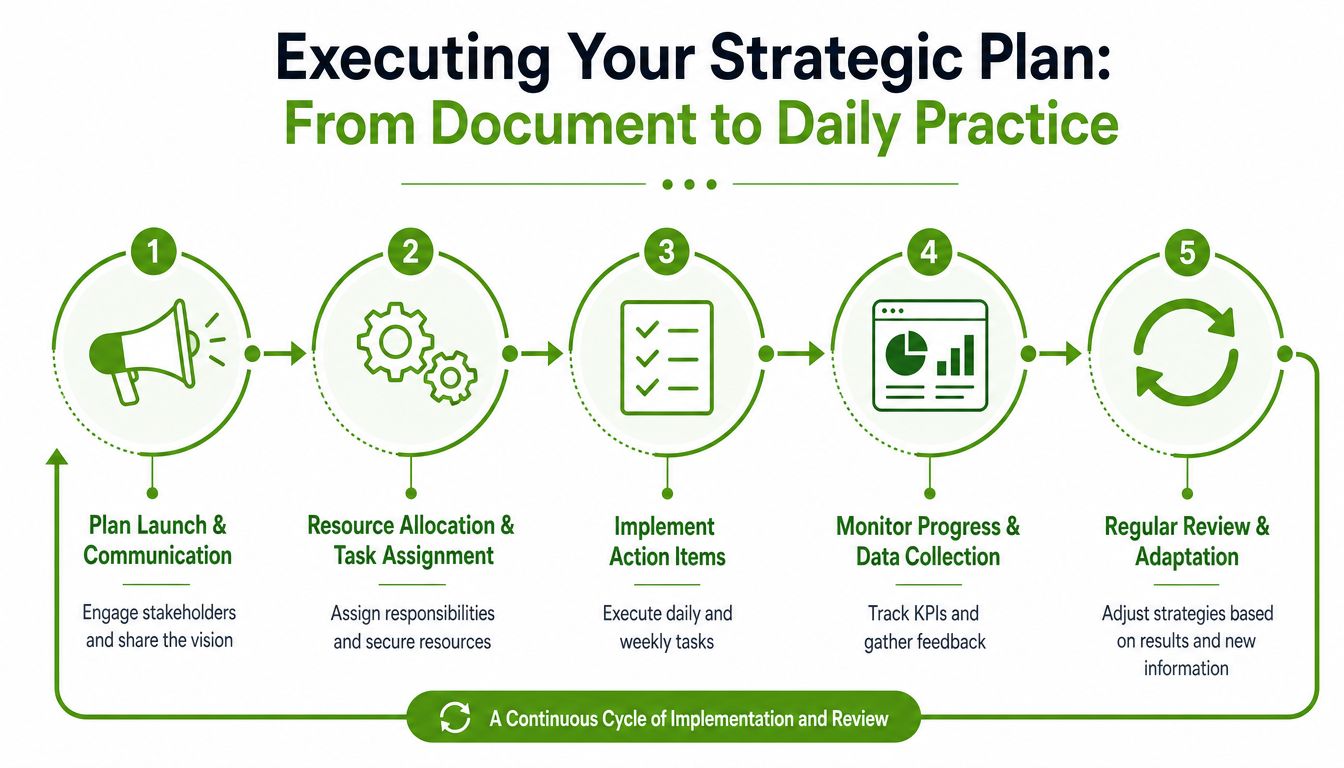
Build a real execution rhythm
If you want the plan to stay alive, put it inside existing management infrastructure.
A workable rhythm usually includes:
- Quarterly strategic reviews where owners report progress, barriers, and next decisions
- Monthly leadership checks that surface slippage early
- Board agenda alignment so strategic priorities appear regularly, not once a year
- Budget review linkage so funding decisions support stated goals
A quarterly review doesn't need fancy software. It needs discipline. Each owner should answer: What did we commit to? What happened? What changed? What needs a decision now?
Assign owners, not committees
Committees can advise. Owners execute.
If a goal says “Development and Programs will improve evaluation systems,” that usually means no one owns it. Name one person. Others can contribute, but one leader has to carry progress forward and report on it.
That same principle applies to donor stewardship. If a strategic goal includes deepening retention or community trust, assign responsibility for the relationship system itself. Small touches matter. Practical donor recognition ideas can help teams deepen philanthropic connections in ways that support the strategy rather than sit beside it.
Board members can support accountability. They should not become the substitute for it.
Put the plan into everyday tools
Plans fade when they live in separate documents no one uses during normal work.
Embed them into:
| Daily or recurring tool | What to include |
|---|---|
| Staff meeting agenda | Progress on one strategic priority |
| Board packet | Dashboard snapshot and decisions needed |
| Performance conversations | Individual ownership tied to strategic work |
| Annual budget draft | Spending mapped to strategic goals |
| Grant calendar | Opportunities matched to priority initiatives |
This is the essential part. If the strategic plan never appears in huddles, budget talks, supervision, board packets, or fundraising review, staff will treat it as optional.
And when pressure rises, optional work disappears first.
Your Strategic Blueprint for Sustainable Impact
A sample nonprofit strategic plan is useful because it gives you a starting point. But its true value comes when that sample becomes your organization's working blueprint.
The strongest plans do four jobs at once. They clarify direction, force trade-offs, support fundraising, and create accountability. That's why they matter so much for lean nonprofits. When staff time is limited, a good plan protects attention from drift.
The biggest mistake isn't writing an imperfect plan. It's writing one that never enters daily operations. As Candid's analysis of nonprofit strategic planning failure points notes, the most common problem is the failure to translate the plan into day-to-day decision-making.
That's also why strategic planning now intersects with other leadership disciplines. If your team is rethinking communications, outreach, or donor engagement, it helps to study how organizations are developing AI marketing strategies without losing strategic focus. The tool changes may be new. The need for clarity and alignment isn't.
A durable plan should also connect to long-term resilience. If you're thinking beyond the next grant cycle, this guide to what a sustainability plan is is a practical next step.
Start small if you need to. Schedule the first planning conversation. Review your current priorities. Identify what belongs in the plan and what doesn't. Then build a document your staff can use, your board can govern from, and your funders can trust.
If your team wants help turning strategy into a stronger grant pipeline, Fundsprout helps nonprofits find relevant funding, analyze RFPs, organize proposal requirements, and draft stronger applications using your real program documents and impact data. It's built for mission-driven teams that need a practical system, not more guesswork.
Try 14 days free
Get started with Fundsprout so you can focus on what really matters.