Your Guide to a Winning Sample Grant Letter of Support
Secure your next grant with this guide. Get expert tips and a powerful sample grant letter of support to make your application stand out.

Abdifatah Ali
Co-Founder
A powerful letter of support can be the secret ingredient that turns a good grant application into a funded one. It’s far more than a simple formality—it's a strategic endorsement that provides concrete, third-party proof that your project has real community buy-in and is built to last.
Why a Great Support Letter Is Non-Negotiable
Let's be real. After you've poured countless hours into a massive grant proposal, chasing down a letter of support can feel like one more chore on a never-ending to-do list. But in today's competitive funding world, it's often the single element that makes your application stand out from a sea of others.
Put yourself in the grant reviewer's shoes for a moment. They're sifting through stacks of applications, many of which start to look the same. A compelling letter from a respected community leader, a key partner organization, or a government official instantly cuts through the noise. It’s an impartial signal that your project isn’t just an idea—it's a collaborative effort with genuine community backing.
The Strategic Value of Endorsement
Think of this endorsement as a powerful strategic tool, not just a nice-to-have. It proves you have the collaborative muscle and established relationships needed to actually deliver on your promises, which dramatically lowers the funder's perceived risk. When another credible entity is willing to put their name on the line for you, it builds a level of trust that your application alone just can't achieve.
A well-written letter of support accomplishes several critical things:
- Validates the Need: It confirms that other key players agree the problem you’re tackling is urgent and your approach is the right one.
- Shows Collaborative Strength: Funders want to see that you aren’t working in a vacuum. Strong partnerships signal a more sustainable project with a broader, more lasting impact.
- Offers Concrete Proof: The best letters go beyond generic praise. They offer specific examples of past successes, shared goals, or a partner's tangible commitment of resources (like time, space, or staff) to this project.
In my experience, a persuasive letter of support can boost an application's perceived strength by as much as 20-30% in the eyes of an evaluator. It’s the kind of third-party validation that busy funders are desperate for. With 93% of nonprofit leaders seeking new funding sources, letters from aligned partners are an essential differentiator that can absolutely tip the scales. You can find more about what's coming in the grant world by exploring 2025 grant funding trends.
A letter of support is the difference between telling a funder you have community backing and showing them. It transforms your proposal from "good" to "fundable" by providing tangible proof of your project's value and your ability to succeed.
Ultimately, these endorsements are your secret weapon. In a grant-seeking environment where every single advantage matters, having a chorus of strong voices championing your proposal can be the deciding factor. It’s a small investment of time that can pay off in a big way, turning a hopeful application into a funded reality.
The Anatomy of a Support Letter That Gets Noticed
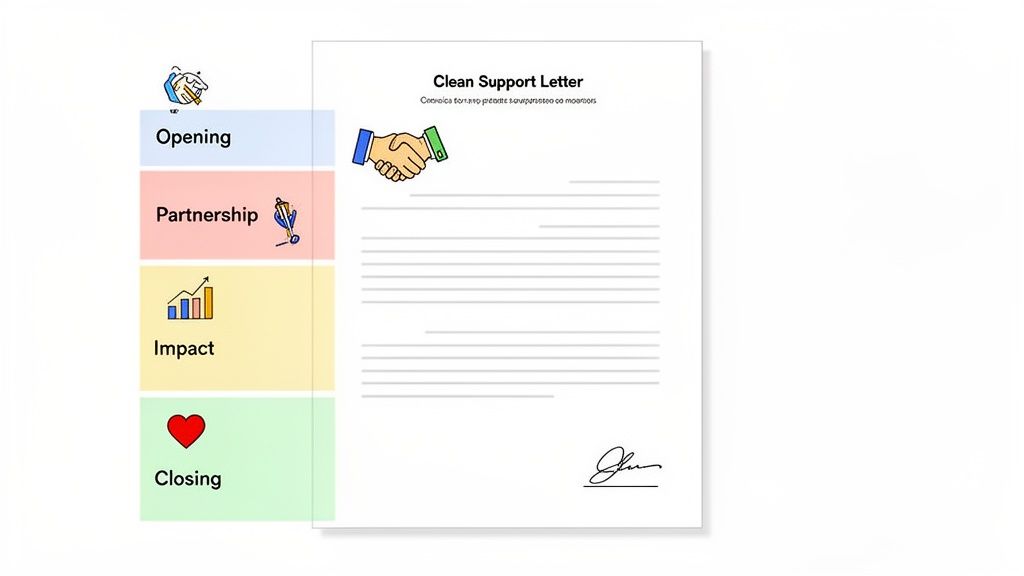
An exceptional letter of support does more than just offer praise; it tells a compelling story. Let's be honest, grant reviewers are swimming in paperwork. A letter that simply says "we support this project" is forgettable background noise. The ones that truly make a difference are built with a clear, persuasive structure that paints a vivid picture of partnership and impact.
Think of it like you're building a legal case. You start with a solid, professional foundation. Then, you layer on concrete evidence, establish your credibility, and inject genuine enthusiasm. Each part of the letter has a distinct role, and when they harmonize, you create a document that doesn't just get filed—it gets remembered and discussed by the review committee.
The Professional Framework: First Impressions Matter
Before a grant reviewer reads a single word, the letter’s appearance has already spoken volumes. Using your organization's official letterhead is non-negotiable. It instantly signals legitimacy and confirms this is an official endorsement from your organization, not just a casual note from an individual.
Keep the formatting clean, professional, and scannable. A standard business letter format is your best friend here. Make sure it includes:
- The current date.
- The grantmaker's name, title, and address.
- A clear, respectful salutation (e.g., "Dear [Funder Name] Grant Review Committee,").
This basic structure shows you respect the funder's time and take their process seriously. It’s a simple but powerful way to frame your letter with authority right from the start.
The Narrative Core: Building Your Case in the Body
This is where you make your argument. A powerful letter body doesn't just state support; it demonstrates why the project is so vital and deserving of funds. You’re moving from a simple statement to tangible proof.
First, briefly introduce your organization and its mission. Then, immediately clarify your relationship with the applicant. How long have you known them? What’s the history of your collaboration? This context is crucial for building credibility.
Next, get specific. Vague praise is the enemy of a great support letter. Instead of saying, "We have worked together successfully," provide specific, quantifiable examples. Try something like this: "Our joint pilot program last year served over 250 families, leading to a 40% increase in access to fresh produce for a food-insecure community." Numbers cut through the noise and demonstrate real-world results.
Interestingly, many of the strategies for crafting a standout support letter echo the advice you'd find in guides on how to write a cover letter that gets you hired. At their core, both documents are about using evidence to persuade a reader to take a specific, desired action.
The Strong Closing and Authoritative Signature
End your letter with the same confidence you started with. Reiterate your enthusiastic support for the project and briefly restate the single most important reason you believe it will succeed. This reinforces your core message and leaves a final, lasting impression.
Don't forget to provide clear contact information. Your name, title, email, and phone number show you’re open to follow-up questions. This transparency proves you are confident in your endorsement and willing to stand behind it.
Key Takeaway: The signature must come from someone with authority. A letter signed by an Executive Director, Board Chair, or CEO carries significantly more weight than one from a program manager. It signifies a full organizational commitment, not just the support of one department.
To help you ensure you've covered all the critical bases, we’ve put together a quick-reference table.
Key Elements of an Effective Grant Letter of Support
This table breaks down the essential components that every powerful letter of support should include. Use it as a checklist to make sure your letter is credible, persuasive, and professional from top to bottom.
By methodically including each of these elements, you move your letter from a simple formality to a powerful tool of persuasion.
Ultimately, a truly compelling letter tells a complete story. It starts with a professional presentation, builds a powerful case with specific evidence, and closes with an authoritative and heartfelt endorsement. For a deeper dive into crafting the perfect language, check out our detailed guide on how to write letters of support.
Real-World Examples from Winning Grant Applications
Theory is one thing, but seeing what works in the real world is another entirely. Let's move from simply talking about what to do and instead look at what successful letters of support actually look like. I've pulled together a couple of examples tailored to situations you'll almost certainly run into—like getting a letter from a key partner or a government official.
We're not just going to show you the text. We’ll break each one down piece by piece, pointing out the exact phrases that build credibility, showing you how to weave in data naturally, and highlighting where the tone creates a genuine sense of partnership. Think of it as a playbook you can use to turn abstract advice into a concrete strategy.
From a Key Programmatic Partner
Let's imagine your nonprofit, "Youth Forward," is applying for a grant to expand its after-school STEM program. You absolutely need a strong letter from your main partner, the "Innovate & Educate Foundation," which supplies volunteer tutors. This letter has one job: to prove your partnership is deep and delivers real results.
[Innovate & Educate Foundation Letterhead]
[Date]
[Grantmaker Name, Title, and Address]
Re: Letter of Support for Youth Forward's STEM Expansion Grant
Dear Grant Review Committee,
It is with immense enthusiasm that I write to express the Innovate & Educate Foundation's strongest possible support for Youth Forward’s proposal to expand their After-School STEM Excellence program.
Why this works: The opening is direct and powerful. Phrases like "immense enthusiasm" and "strongest possible support" immediately set a positive, confident tone. It signals to the funder that this isn't a lukewarm, obligatory endorsement.
For the past three years, our two organizations have been deeply collaborative partners, united by a shared mission to provide equitable access to high-quality STEM education for underserved students in our community. Our foundation has provided over 2,000 hours of volunteer tutoring from our network of tech professionals to support Youth Forward's existing program.
Why this works: This quickly establishes the history and credibility of the partnership. Instead of just saying they "provided volunteers," it uses a hard number—2,000 hours—to quantify the commitment. Specifics always carry more weight.
The results of our joint efforts speak for themselves. Participants in the After-School STEM Excellence program have shown a 45% improvement in standardized math and science scores, and 90% of high school seniors in the program have gone on to pursue post-secondary education in a STEM field. Youth Forward has created a program that doesn't just teach—it inspires.
Why this works: This is the heart of the letter—the proof. It presents impressive, specific impact data (45% improvement, 90% of seniors). This transforms a simple opinion into a data-backed validation of the program's effectiveness.
We are fully committed to supporting this expansion. Should the grant be awarded, the Innovate & Educate Foundation pledges to increase our volunteer tutor commitment by 50%, ensuring that every new student has access to the same high-quality mentorship that has defined this program's success.
Why this works: This is the clincher. The partner isn't just praising past work; they are making a tangible, future-facing commitment. By pledging specific resources, they are sharing the risk and showing the funder they have real skin in the game.
Youth Forward is a cornerstone of educational opportunity in our community. We are confident this expansion will deepen their impact, and we are proud to continue our partnership with them. Please do not hesitate to contact me for any further information.
Sincerely,
[Signature]
Dr. Alisha Chen
Executive Director, Innovate & Educate Foundation
[Contact Information]
From a Government Official
Okay, new scenario. Your organization, "Green Spaces Initiative," is seeking funds to turn a vacant city lot into a community garden. A letter from a city council member can be incredibly powerful, showing the project aligns with the city's own priorities.
[City Council Official Letterhead]
[Date]
[Grantmaker Name, Title, and Address]
Re: Strong Support for the Green Spaces Initiative's Community Park Project
Dear Members of the Grant Committee,
As the City Council representative for District 5, I am writing to offer my wholehearted endorsement of the Green Spaces Initiative's proposal to create a community park at the corner of Elm Street and 12th Avenue. This project directly aligns with the city's strategic goals for urban revitalization and increasing public access to green space.
Why this works: The letter immediately establishes the writer’s authority and why their opinion matters (as the local City Council member). Crucially, it connects the project to official city goals, telling the funder this isn't just a nice-to-have project but a strategic community priority.
The proposed site has been vacant for over a decade and has been a source of concern for residents. The Green Spaces Initiative has a proven track record, having successfully launched three similar community gardens in neighboring districts. Their community-led approach ensures that projects are not just built for residents, but with them.
Why this works: This provides essential context. It explains the need (a vacant, problematic lot) while also building the applicant's credibility ("proven track record"). Citing past successes is a simple, effective way to build a funder's confidence.
We believe this project will have a significant positive impact on community health, safety, and social cohesion. I am confident in the Green Spaces Initiative’s ability to execute this project successfully and urge you to give their proposal the strongest consideration. My office is prepared to assist with navigating city permits to ensure the project can proceed smoothly upon funding.
Why this works: The closing is more than just a polite sign-off. It offers a specific, valuable action: "assist with navigating city permits." For any grantmaker, seeing a government official offer to clear bureaucratic hurdles is a massive plus, adding significant weight to the endorsement.
Sincerely,
[Signature]
Maria Flores
City Council Member, District 5
[Contact Information]
As you can see, a well-written letter of support does more than just give a thumbs-up. It tells a story of collaboration, proves impact with data, and shows a shared commitment to what comes next.
These letters are just one type of formal document you'll handle. For a broader look at other agreements and contracts you might encounter, these examples of essential legal documents for nonprofit leaders offer some helpful context. And if you’re at the very beginning of the grant process, our guide on crafting a sample grant letter of inquiry is the perfect place to start.
Ready-to-Go Templates to Get You Started
Staring at a blank page is the worst. Especially when a crucial funding decision hangs in the balance. To help you get past that initial hurdle, I’ve put together a few fill-in-the-blank templates.
Think of these less as rigid formulas and more as a strong starting point. They provide a professional structure that you can easily customize to reflect your specific project and the unique relationship you have with your supporter. My goal is to give any organization, no matter how small your team, a practical tool to craft a genuine and compelling sample grant letter of support.
Each template uses clear placeholders, like [Partner Organization Name] and [Quantifiable Impact Metric], to show you exactly where to plug in the powerful details that make a grant reviewer sit up and take notice.
Not sure which letter to use? This decision tree can help you figure out which format fits your situation, whether you're working with a hands-on program partner or an official government entity.
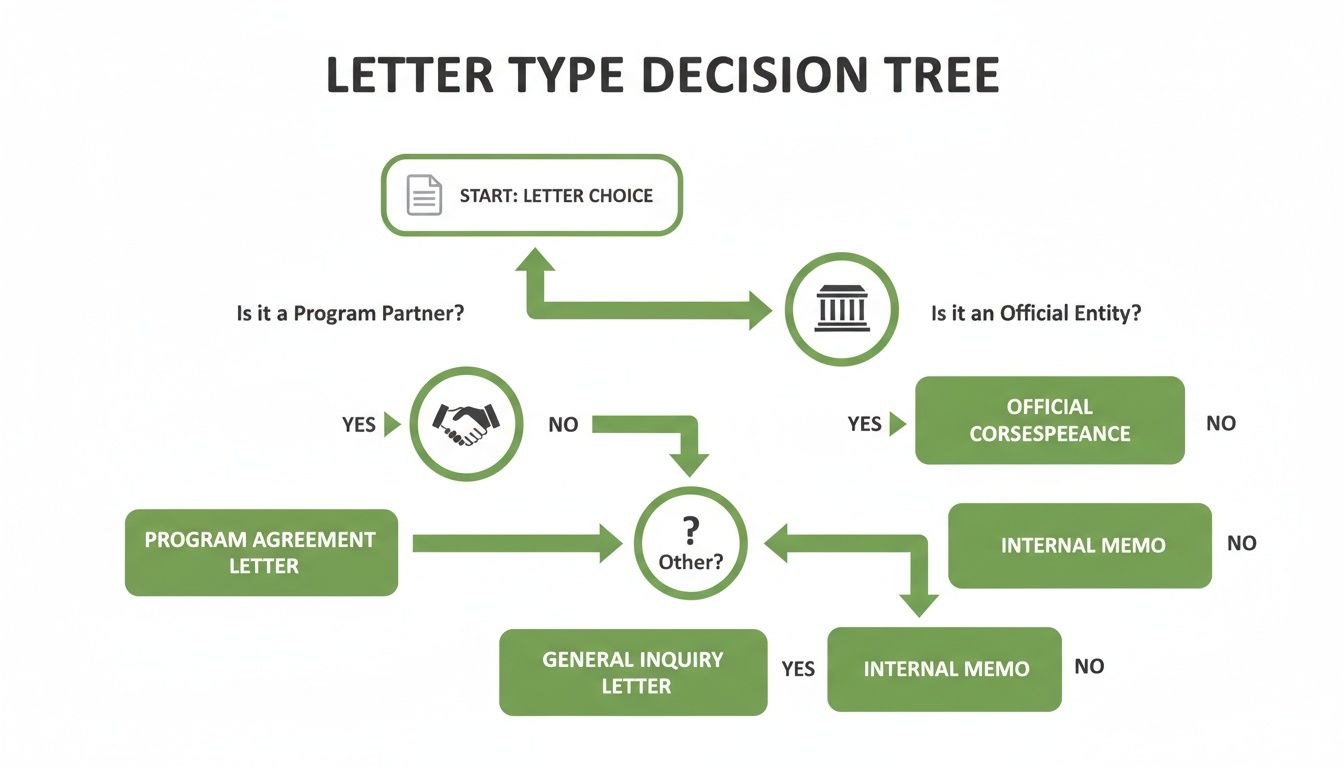
As you can see, choosing the right template based on the supporter's role is key. It ensures the letter's tone and content are perfectly aligned with their connection to your project.
Comprehensive Letter from a Strategic Partner
This one is for your closest allies—the partners who are in the trenches with you. It’s built to be comprehensive, packed with data, and designed to tell a story of shared wins and future commitment. Use this when you really need to show off a long-standing, impactful relationship.
[Partner Organization Letterhead]
[Date]
[Grantmaker Name, Title, and Address]
Re: Enthusiastic Support for [Applicant Organization Name]'s [Project Name]
Dear [Funder Name or Grant Review Committee],
I’m writing on behalf of [Partner Organization Name] to give our strongest possible support to [Applicant Organization Name]’s proposal for the [Project Name]. Our organizations have worked side-by-side for [Number] years, driven by a shared mission to [Briefly Describe Shared Goal, e.g., improve youth literacy rates].
Our partnership has a track record of real, measurable results. For instance, our joint [Name of Past Initiative] successfully [Describe a Specific Achievement, e.g., provided after-school tutoring to over 500 students], leading to a [Quantifiable Impact Metric, e.g., 25% increase in reading proficiency]. This history proves how effective our collaboration is and highlights [Applicant Organization Name]'s incredible ability to run programs that truly make a difference.
With project-based funding making up 41.6% of all awards, letters with specific numbers really stand out. In my experience, including metrics like 'supported 500 beneficiaries' can give you a 15-25% higher chance in competitive grant cycles. That’s a critical edge, especially when one-third of nonprofits are facing funding disruptions. You can dig into more of these trends by checking out the most recent research from Giving USA.
We are completely invested in the success of the [Project Name]. If funded, [Partner Organization Name] will contribute [Specific Contribution, e.g., 10 hours of staff time per week, access to our training facilities, a financial match of $5,000]. We have no doubt that [Applicant Organization Name] has the expertise, community trust, and vision to make this project a huge success.
We wholeheartedly endorse their application and urge you to give it your fullest consideration.
Sincerely,
[Signature]
[Signatory Name]
[Signatory Title, e.g., Executive Director]
[Partner Organization Name]
[Contact Information]
Concise Letter of Endorsement
Sometimes, all you need is a short, punchy endorsement from a community leader, an elected official, or a partner with a less formal connection to your work. This template cuts right to the chase. It states support clearly and highlights the project’s value without getting bogged down in a long narrative. It’s perfect for showing you have broad community buy-in.
[Supporter's Official Letterhead]
[Date]
[Grantmaker Name, Title, and Address]
Re: Support for the [Project Name] Proposed by [Applicant Organization Name]
Dear Grant Review Committee,
I’m writing to offer my enthusiastic endorsement for [Applicant Organization Name]'s proposal to launch the [Project Name]. As a [Your Role, e.g., community leader, local business owner], I have seen firsthand the urgent need for [Describe the Need the Project Addresses].
[Applicant Organization Name] has a proven history of serving our community well, and I am confident they are the right people to execute this important project. The [Project Name] will directly help [Target Population] by [Briefly State Primary Benefit].
This initiative has my full support. I strongly encourage you to fund this valuable community asset.
Sincerely,
[Signature]
[Signatory Name]
[Signatory Title and Affiliation]
[Contact Information]
Pro Tip: When you send a template to a partner, always offer to pre-fill it with key project details and stats. This is a huge time-saver for them and ensures the final letter includes the exact information you need to make your case. Busy leaders always appreciate this professional courtesy.
Common Mistakes That Weaken Your Application
Sometimes, a bad letter of support can actually do more harm than good. A weak, generic letter can water down an otherwise stellar grant proposal, and with the best of intentions, it's a mistake that happens all too often.
This isn't just theory—these are the exact errors grant reviewers see again and again. Think of this as your pre-flight check to help you spot and fix these common pitfalls before they ever sink your application. By steering clear of these issues, you can make sure every letter you submit is a genuine asset.
Using Generic Template Language
The single biggest red flag for any grant reviewer is a letter that feels like a copy-and-paste job. When a letter is full of clichés like "we wholeheartedly support their work" or "they are a valuable organization," it screams a lack of genuine buy-in. It's forgettable at best.
This usually happens when a busy partner is asked for a letter and, to save time, they just grab the first template they find online. The result is a document that lacks any real authenticity or compelling detail.
The Fix: Make it easy for them to give you a great letter. Always provide your partners with a well-crafted draft or, at the very least, a bulleted list of key talking points. Remind them of specific joint projects, quantifiable data on past successes, and the exact role they will play. This turns a chore into a quick signature on a powerful, personalized letter.
A letter of support should read like a personal endorsement, not a form letter. The more specific and heartfelt it is, the more it will stand out to a review committee that reads hundreds of generic submissions.
Failing to Include Specifics
A letter that dodges concrete details is a massive missed opportunity. Vague statements like "we have a strong partnership" do absolutely nothing to persuade a funder. The reviewer is left asking, "What does 'strong' even mean? What have you actually done together?"
Without tangible proof, your letter is just a collection of nice opinions. It completely fails to provide the third-party validation funders are looking for. Specifics are what give a letter its weight and credibility.
The Fix: Your mission is to turn every vague claim into a data-backed endorsement.
Instead of this: "We serve many of the same people."
Try this: "Last year, our organizations cross-referred over 150 clients, ensuring they received seamless, comprehensive support."
Instead of this: "We plan to help with this project."
Try this: "We have committed two of our staff members, for a total of 10 hours per week, to co-facilitate the new workshops."
Quantifying your collaboration with numbers, hours, or specific resources transforms a simple compliment into a powerful piece of evidence. Understanding the common reasons grant proposals are rejected really drives home why this level of specificity is so critical.
Getting the Signature from the Wrong Person
The signature on that letter matters—a lot. A letter signed by a program manager is fine, but one signed by the Executive Director or CEO is exponentially more powerful. The signatory’s title is a direct reflection of the organization's level of commitment.
Think about the message it sends. A signature from a lower-level employee can suggest the partnership is a small, departmental affair. A signature from top leadership, on the other hand, signals that your project is a strategic priority for their entire organization. It tells the funder that the highest levels of that partner are invested in your success.
The Fix: When you request a letter, always aim for the highest-ranking person whose role is relevant to the partnership. Politely explain that their title lends significant weight and credibility to the endorsement. If you’ve already drafted the letter for them, it becomes a simple, quick task for them to review and sign.
Answering Your Top Questions About Support Letters
Even with templates and examples, real-world questions always pop up when it's time to gather your letters of support. Let's tackle some of the most common ones that nonprofit leaders run into during the grant application crunch.
How Much Lead Time Should I Give Someone for a Letter?
You'll want to give your partners a generous amount of time. I always recommend asking for a letter at least three to four weeks before your grant deadline. This isn't just a courtesy; it shows you respect their schedule and gives them the space to write something truly thoughtful instead of a rushed, generic note.
When you send the request, give them a specific "please send by" date that’s a few days before your actual submission deadline. That little bit of buffer is a lifesaver for handling any last-minute hiccups.
A Pro Move: Make their job as easy as possible. Offer to write a full draft for them or, at the very least, provide a bulleted list of key talking points. Busy executives love this. It saves them time and makes sure the final letter hits all the right notes about your partnership and impact that funders want to see.
Who Should Actually Sign the Letter?
The signature needs to come from the highest-ranking person who is directly connected to the partnership. You're looking for that perfect sweet spot between authority and relevance.
A letter from a program manager you work with daily is great, but one from their CEO or Executive Director is even better. Why? It signals a much deeper, organization-wide commitment to your project.
Here’s who that typically looks like for different partners:
- Partner Nonprofit: The Executive Director or CEO.
- Government Agency: A Department Head, or an elected official like a State Senator or Mayor.
- Community Leader: The leader themselves, with their official title and any key affiliation.
- University: The Dean of the college or a Department Chair.
No matter who signs, make sure their name, title, and organization are typed out clearly below the signature. It’s a small detail that looks incredibly professional.
Is It Really Okay for Me to Write the Letter Myself?
Yes, and honestly, you probably should. It’s a very common practice in the grant world, and most partners appreciate it. Think about it: they are swamped, and you are the ultimate expert on your project and what the funder needs to hear.
When you send over a draft, just frame it as a helpful suggestion. I usually say something like, "To make this as easy as possible, I've drafted some language below. Please feel free to edit this so it truly reflects your own voice and perspective." This approach is both respectful and efficient, and it leads to a much stronger letter that’s perfectly aligned with your proposal.
How Many Letters of Support Do I Need?
This is a classic case of quality over quantity. The number one rule is to do exactly what the funder asks. If the guidelines say "a maximum of three letters," don't send four. Sending more can look like you don't pay attention to details.
If the funder doesn't set a limit, a good target is two to four high-impact letters from a diverse mix of supporters. For instance, you could get one from a key program partner, another from a local government official, and a third from a well-respected community leader. Each letter should showcase a different angle of your project's value and support network. A few powerful, specific endorsements will always beat a dozen vague ones.
Try 14 days free
Get started with Fundsprout so you can focus on what really matters.