S Mark Taper Foundation Grant Guide
Unlock funding from the S Mark Taper Foundation in 2026. This guide covers priorities, eligibility, and how to craft a winning proposal.

Abdifatah Ali
Co-Founder
If you're a nonprofit leader in Southern California, the S Mark Taper Foundation is a name you've likely heard. It's not just another funding source; it’s a major private family foundation, established in 1989, that has become a cornerstone of the region's philanthropic community. Their work is built on a deep commitment to enhancing communities, with a strong focus on diversity, equity, and inclusion (DEI).
What Is the S Mark Taper Foundation in 2026?
At its heart, the S Mark Taper Foundation acts as a strategic partner for nonprofits striving to build a more equitable and vibrant Southern California. It’s best to think of them less as a simple ATM for grants and more as a long-term investor in the well-being of the communities they serve.
This approach comes directly from the vision of its founder, S. Mark Taper. Understanding his original intent to enrich the community is key to grasping why the foundation makes the decisions it does today.
Financial Power and Mission
To really understand the foundation's influence, you have to look at the numbers. This isn't a small, niche funder. It’s a major force with the resources to back up its mission.
The table below gives you a quick snapshot of the foundation’s financial scope and grantmaking activity based on the most recently available data.
S Mark Taper Foundation at a Glance
| Metric | Figure |
|---|---|
| Total Assets | $172,326,901 |
| Total Grants Paid | $6,632,800 |
| Number of Grants | 129 |
| Average Grant Size | ~$51,417 |
Data from the foundation's 2024 reporting.
A figure like $6,632,800 in grants in a single year shows a serious commitment. This level of giving proves they have both the capacity and the drive to fund meaningful, community-led solutions. You can dig into the full financial details to see exactly how these funds were distributed.
Beyond the dollars, the foundation's mission is woven together with a core belief in Diversity, Equity, and Inclusion (DEI). This isn't just a box to check on an application; it’s a lens through which they view every potential grant. If you're seeking funding, you'll need to clearly show how your work actively advances these values.
The foundation's philosophy centers on empowering organizations that are embedded in the communities they serve. They prioritize initiatives that address systemic inequities and create lasting, positive change for the residents of Southern California.
What Defines the Foundation?
Knowing the foundation's core identity helps you quickly assess if your organization is a potential match. Here are the key things to keep in mind:
- Private Family Foundation: This structure means its approach is highly specific and guided by the founder's original intent, not by shifting corporate or public mandates. They have a clear, long-term vision.
- Strict Geographic Focus: This is non-negotiable. The foundation concentrates its resources exclusively on Southern California. If your work is based outside this area, you'll unfortunately need to look elsewhere.
- Strategic Grantmaking: Every funding decision is part of a larger strategy. They aren't just giving away money; they are investing in projects that align with their core pillars and show a strong potential for real, measurable impact.
For any nonprofit leader, getting a handle on these characteristics is the critical first step. It gives you a clear picture of who they are, what they care about, and the values driving their work. Before you ever think about starting an application, this foundational knowledge ensures your time and effort are pointed in the right direction.
The Legacy and Vision Guiding Grant Decisions
To really get what the S. Mark Taper Foundation is about, you have to look past the grant cycles and get to know the founder, S. Mark Taper. He wasn't just a successful financier and real estate developer; he was someone who truly believed that culture and community were the keys to a better society. His principles aren't just historical footnotes—they are the living, breathing guide for every single grant awarded today.
Don't think of the foundation's history as a simple timeline. It's a story. And understanding that story is crucial for any nonprofit leader hoping to write a proposal that actually connects. It shows you’re not just after money; you get what they’re trying to do.
From Arts Patronage to Community Pillars
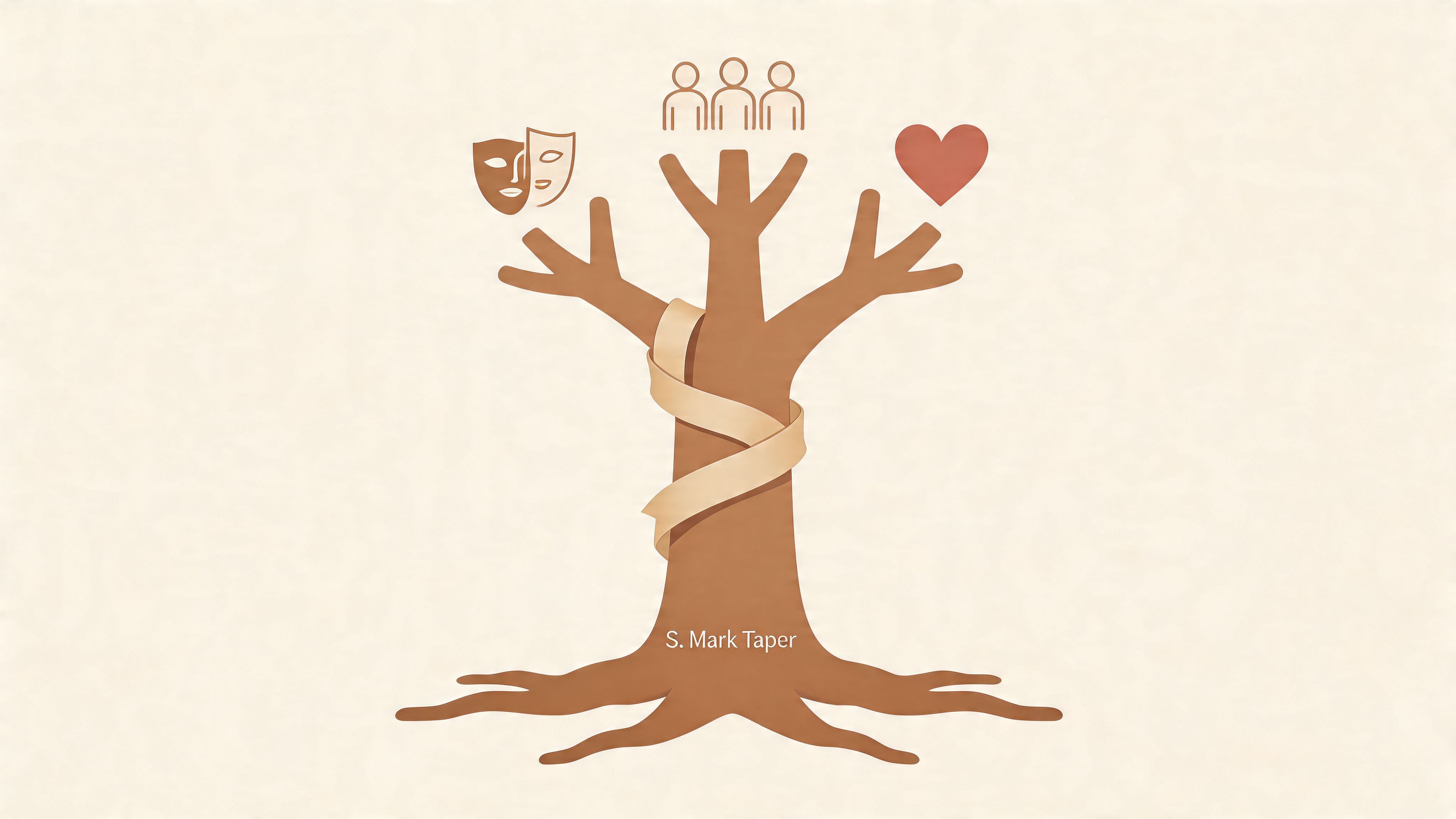
S. Mark Taper's philanthropic journey started with a deep love for the arts. His most famous contribution was the funding that brought the Mark Taper Forum to life, a venue that has since become an absolute cornerstone of L.A.'s cultural scene. This wasn't just a check; it was a foundational investment in making powerful, challenging theater accessible to everyone.
That early focus on cultural life created a clear thread that you can still see in the foundation's work. Supporting the arts was never just about appreciating art. It was about creating places for people to talk, to gather, and to share in the human experience.
This idea is still a huge part of their mission. The foundation wants to fund organizations that serve as pillars in their communities, whether that’s a theater, a museum, or a neighborhood service center. They back projects that strengthen the social fabric of Southern California.
Connecting Past Actions to Present Priorities
When you grasp this history, you can start connecting the dots to the foundation's current priorities. When you see them award a grant to a local arts program, you can trace its roots straight back to that initial investment in the Mark Taper Forum.
Think about how these historical threads apply to your own work when you write your proposal:
- Cultural Enrichment: The foundation has always backed institutions that bring art and culture to the public. If your project uses the arts to engage people, make that connection crystal clear.
- Community Building: Whether it’s a theater or a health clinic, the goal has always been to build and support spaces where people can thrive. Show how your work creates those vital social connections.
- Lasting Impact: S. Mark Taper didn’t do short-term fixes. He invested in projects built to last, and the foundation still prizes sustainability and a long-term vision.
The core idea is simple but powerful: investing in culture and community services isn't just an expense. It's an investment in a healthy, just society. That belief, born decades ago, is still the North Star for the S. Mark Taper Foundation.
You can see this continuity in their major contemporary grants. For instance, a landmark $1.5 million grant to Holocaust Museum LA in 2022 perfectly embodies these enduring values. The funding helped double the museum's space and expand its educational programs to fight antisemitism, reflecting a deep-seated commitment to both historical preservation and cultural understanding. You can read more about this significant grant to Holocaust Museum LA to see how it builds on this legacy.
By weaving this insight into your application, you show you're on the same page. You’re not just another applicant asking for funds; you're positioning your organization as a partner ready to help carry a multi-generational mission forward. That's how you make your proposal stand out.
Core Funding Areas and Strategic Priorities
So you understand the foundation's background. Now for the most important part: what do they actually fund? To get your proposal on their radar, you have to speak their language and show how your work directly supports their core mission.
The foundation channels its giving into five main areas, or "pillars," all aimed at making Southern California a more equitable and resilient place. It's best not to think of these as strict, separate boxes. The foundation knows that real-world problems are complex, and a single project can often make an impact across several categories. The key is knowing where your work has the strongest connection.
The Five Pillars of Giving
Let's break down those five pillars. As you go through them, think about where your organization’s work fits most naturally. Your proposal will need to make a crystal-clear case for how you’ll move the needle in one (or more) of these specific areas.
The five key funding areas are:
- Arts and Culture: They support projects that bring art and culture to life across the community, especially for those who might otherwise miss out. This could be anything from local theater productions and museum outreach to hands-on arts education for kids in underserved neighborhoods.
- Education: The focus here is on opening doors and closing opportunity gaps. Think after-school STEM programs, early literacy initiatives for low-income families, or mentorship programs that help first-generation students get to and through college.
- Health: This pillar is all about improving the well-being of the community. Funding often goes to local clinics that provide affordable care, mental health services for vulnerable populations, and public health programs that focus on prevention.
- Human Services: This is a broad but vital category that covers the basic needs of individuals and families. It’s where you’ll find support for food banks, homeless shelters, job training programs, and other critical safety-net services.
- Civic Engagement: The foundation also invests in strengthening the fabric of democracy and community power. This includes funding for voter education, leadership development in marginalized communities, and grassroots organizing and advocacy.
Diversity, Equity, and Inclusion as a Guiding Principle
This is absolutely crucial: Diversity, Equity, and Inclusion (DEI) isn't just another box to check. It's the lens through which the foundation views everything. It’s woven into all five pillars.
Your application can't just pay lip service to DEI. You need to provide concrete evidence showing how your organization’s leadership, your program design, and your day-to-day operations are actively working to create a more equitable community.
Simply stating that you serve a diverse population is not enough. The foundation looks for organizations that are of the community, not just in it. This means demonstrating inclusive leadership, equitable program delivery, and a genuine commitment to dismantling systemic barriers.
Ever since its formal start in 1989, the S. Mark Taper Foundation has cemented its role as a major force in Southern California’s nonprofit world, funding organizations that truly embody this vision. The numbers speak for themselves: with 70 awards in 2023 and over $6.6 million in grants in 2024, they are a serious player. You can get a feel for their latest priorities by taking a look at their recent grants on the foundation's website.
Finding Your Fit Within the Framework
So, how do you make the connection? Start by identifying the main pillar your work falls under. Then, dig deeper and ask yourself some tough questions about how you connect to the foundation's bigger picture.
For instance, if you run an after-school tutoring program (Education), how are you specifically reaching students from under-resourced schools? If your project is a community theater (Arts and Culture), how are you making sure your shows are affordable and relevant to everyone in your diverse neighborhood?
Answering these questions honestly helps you frame your work not as a simple request for money, but as a compelling invitation to partner on a shared mission. That's the kind of strategic thinking that makes a proposal stand out from the pile.
Crafting a Proposal That Gets Funded
Knowing the foundation's priorities is one thing, but turning that knowledge into a check for your nonprofit is the real challenge. A winning application to the S. Mark Taper Foundation is much more than a simple ask for money. It's a powerful story that shows you're perfectly aligned with their goals, highlights a critical need, and clearly outlines the impact you'll make.
Think of your proposal as a bridge. It needs to connect your organization's work directly to the foundation's deepest values. Building that bridge takes more than just a great idea; it requires a smart strategy that speaks their language. This means grounding your project in hard data, putting diversity and equity at the center of everything, and showing exactly how you’ll improve the lives of Southern Californians.
Building Your Proposal on a Solid Foundation
Every grant-winning proposal starts with an undeniable needs statement. For the S. Mark Taper Foundation, this means you have to get specific and local. It's not enough to say a problem exists—you must prove why it's a pressing issue for the community you serve right now.
For example, don't just say, "many local students are behind in reading." Instead, hit them with the facts: "In our service area, 45% of third-graders are reading below grade level, a rate that is 15% higher than the county average." This data-first approach transforms a vague issue into an urgent, verifiable crisis that demands action. Your proposal then becomes the clear solution.
Next, you need to weave the principles of Diversity, Equity, and Inclusion (DEI) into the very fabric of your story. For this foundation, DEI is a non-negotiable.
- Show, Don't Just Tell: How does your board, staff, and volunteer base mirror the community you work with?
- Program Design: How are your services built to break down barriers and create real opportunities for marginalized groups?
- Community Voice: How do you involve community members in planning, delivering, and evaluating your programs?
A successful proposal makes it obvious that DEI isn't just a buzzword or a single paragraph. It has to be part of your organization's DNA, influencing everything from who holds leadership positions to how you deliver services on the ground.
This diagram helps visualize how your project idea can connect with the foundation’s main funding areas while keeping DEI at the core.
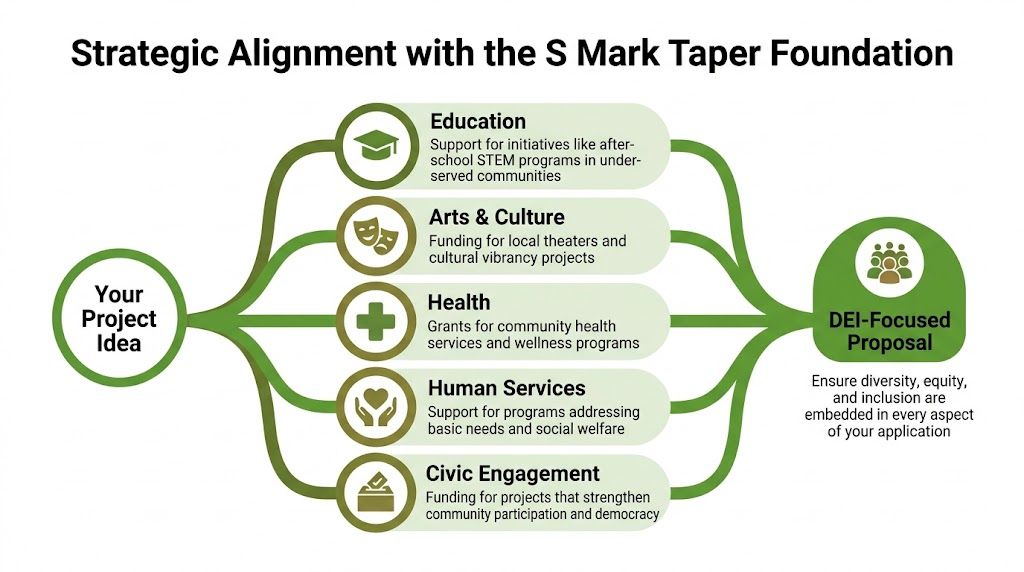
As you can see, no matter which funding pillar you aim for, your proposal must be built around intentional DEI principles to stand a chance.
Before you start writing, use this checklist to make sure your project is a good fit.
Proposal Alignment Checklist
Use this checklist to ensure your grant proposal directly addresses the key values and requirements of the S. Mark Taper Foundation.
| Checklist Item | Action Step | Why It Matters |
|---|---|---|
| Data-Driven Need | Find local, specific data that highlights the problem you are solving. | Foundations want to fund urgent, verifiable needs, not general problems. |
| DEI Integration | Review your program design, leadership, and outreach through an equity lens. | The foundation requires proof that DEI is central to your organization’s mission. |
| Clear Outcomes | Define what success looks like with specific, measurable goals. | Reviewers need to see a clear return on their investment in the form of real-world impact. |
| Community Focus | Confirm your project directly serves residents of Los Angeles County. | This is a fundamental geographic requirement for all applicants. |
| Core Value Alignment | Match your project to one of the foundation's five key funding pillars. | A proposal outside their stated interests is an automatic "no." |
This quick check helps ensure you're not wasting time on a proposal that's misaligned from the start.
Presenting a Measurable Impact Model
Once you’ve established the need and shown how your values align, the final piece of the puzzle is demonstrating how you'll create change. The foundation funds outcomes, not just good intentions. Your proposal needs a clear, logical plan for achieving results you can actually measure.
This means defining your success metrics from the get-go. Will you increase graduation rates, reduce food insecurity, or improve access to mental health care? Get specific. A strong goal sounds like this: "Our program will provide weekly tutoring to 100 students, aiming to raise their average reading scores by one full grade level within the school year."
Modern grant-writing tools can help you pull this all together. For smaller nonprofits that don’t have a full-time grant writer, they can be a huge help in organizing your data and framing your story in a way that resonates with reviewers. To help you structure a compelling narrative, take a look at our nonprofit grant proposal template.
By combining a data-backed need, a genuine commitment to DEI, and a clear model for impact, you're no longer just asking for money. You're presenting a credible, well-researched partnership opportunity to help the S. Mark Taper Foundation achieve its mission of building a better Southern California.
Eligibility Rules and Geographic Focus
Before you spend a single minute writing a proposal, let's talk about the most important step: making sure your organization is a good fit for the S Mark Taper Foundation. There’s nothing worse than pouring your heart and soul into a grant application only to get turned down for a reason you could have spotted from the start.
Think of these rules less as roadblocks and more as a clear map. They show you exactly who the foundation is built to support. By getting a handle on their non-negotiables upfront, you can decide with confidence whether to proceed or to focus your energy on funders who are a better match.
Defining the Geographic Boundaries
The single most important factor for the S Mark Taper Foundation is geography. Their mission is laser-focused on improving communities within Southern California, and they simply do not fund work outside this specific area.
To even be considered, your organization must primarily serve the people of Los Angeles County. While the foundation might have supported groups in neighboring counties in the past, its focus today is squarely on L.A. County. If your programs are based and delivered elsewhere, your application won't move forward.
This screenshot from their website says it all without using a single word.
The first thing you see is a powerful image that screams Los Angeles. This isn't just a design choice; it’s a clear signal to every potential applicant that having a deep, provable impact on the local community is the price of admission.
Core Organizational Requirements
Beyond the strict geographic lines, your organization has to meet a few key legal and operational standards. This is how the foundation ensures it’s partnering with stable, legitimate, and mission-focused nonprofits.
The absolute must-have is your tax-exempt status. Every applicant needs to be a registered 501(c)(3) public charity, as defined by the IRS. The foundation won’t provide grants to any organization that doesn't have this official designation. This is standard practice for most private foundations and a simple yes-or-no qualifier. For more on this topic, you can find some excellent resources on securing grants for nonprofit organizations.
On top of your 501(c)(3) status, the foundation is also looking for a few other signs of a healthy organization:
- A Proven Track Record: They want to see that you have a history of running your programs successfully and managing your finances responsibly.
- Strong Leadership: An active, engaged Board of Directors is often a key indicator of a well-run nonprofit.
- Financial Stability: You don't have to be a huge organization, but you do need to show that you have solid financial management practices in place.
What the Foundation Does Not Fund
Knowing what the foundation doesn't fund is just as critical as knowing what it does. The S Mark Taper Foundation has a clear list of exclusions to make sure its resources are channeled effectively toward its main goals. Submitting a proposal for something on this list is a guaranteed rejection.
The foundation's exclusions aren't a judgment on the value of other causes. They are a strategic choice to focus their impact where they believe they can make the most significant difference, in line with their founder's vision and core mission.
As a general rule, grants are not given for the following:
- Grants made directly to individuals
- Political campaigns or lobbying efforts
- Sectarian or religious projects that don't serve the wider community
- Endowments or building campaigns (unless the foundation initiates them)
- General fundraising events or annual appeals
By reviewing these geographic, organizational, and programmatic rules carefully, you can make an informed decision. If you check all the boxes, you’re in a great position to move forward. If not, you’ve just saved yourself a lot of valuable time and can now find a funder that’s the perfect fit for your mission.
Next Steps to Secure Foundation Funding
Alright, you've done your homework on the S Mark Taper Foundation. You understand its history, what it cares about, and the rules of engagement. So, what's next? It's time to channel all that knowledge into a focused plan that gets your proposal funded.
This isn't just about checking boxes on an application. Approaching a foundation like this is a strategic exercise. It forces you to sharpen your organization's message, get crystal clear on your impact, and prove you're the right team to serve your community.
Your Final Pre-Submission Checklist
Before you start writing the proposal itself, take a step back. Walking through these final checks will ensure your application speaks directly to the foundation’s core mission and values.
Show, Don't Just Tell, Your Commitment to DEI: A boilerplate diversity statement won't cut it. Your proposal needs to actively demonstrate how diversity, equity, and inclusion are woven into the fabric of your organization—from your leadership and staff to your program design and the community you engage.
Connect Your Work to the Foundation's Legacy: A truly compelling proposal will resonate with the philanthropic DNA of S. Mark Taper himself. Frame your project as a modern extension of his vision, whether that's by enriching cultural life, supporting vulnerable populations, or creating lasting change in Southern California.
Make an Irrefutable Case for Your Impact: Use specific, local data to paint a clear picture of the need you're addressing. Then, define exactly what success looks like with concrete, measurable outcomes. Remember, the foundation is looking to fund results, not just good intentions.
A winning proposal is more than just a request for money; it's an invitation to partner. It shows the S Mark Taper Foundation that you're a vital collaborator in its mission to build a more equitable and vibrant Southern California.
With these key elements in place, your application transforms from a simple request into a powerful story of shared purpose. You’re no longer just another applicant—you're a potential partner.
That partnership often begins with a single, well-crafted inquiry. To get that crucial first communication right, you can learn more about writing a compelling grant inquiry letter and start the conversation on the best possible footing.
Frequently Asked Questions
When you're looking at a major funder like the S Mark Taper Foundation, a lot of questions are bound to come up. Let’s walk through some of the most common ones we hear from grant seekers to help you fine-tune your approach.
Can We Apply if We Are a New Nonprofit?
This is a big one for new organizations. While the foundation definitely likes to see a proven track record, being new isn't an automatic disqualifier. It just means you have to work a bit harder to prove you're a solid bet.
Your application needs to make a powerful case for your mission. You’ll have to show rock-solid leadership, smart financial planning, and genuine community buy-in. Since you don't have years of history, lean on what you do have—successful pilot programs, key partnerships, or the deep experience of your founding team. You're essentially showing them you can deliver on your promises right out of the gate.
Does the Foundation Offer Multi-Year Funding?
Generally, no. The S Mark Taper Foundation typically funds projects in one-year cycles. They focus on providing support for a specific program over a 12-month period. But that's not the end of the story.
If your organization delivers impressive results and builds a good relationship, you'll often be encouraged to apply again. Think of that first grant as your foot in the door. It's your chance to prove your impact and build the trust needed for a longer-term funding partnership down the road.
What Is the Best Way to Start a Conversation with the Foundation?
Don't pick up the phone or send a casual email to a program officer. The foundation has a very structured process and prefers you to follow it. The right first step is to submit a formal letter of inquiry (LOI) through their online portal.
This system ensures everyone gets a fair shot, judged on the strength of their proposal. A sharp, concise, and data-driven LOI that clearly connects your work to their specific priorities is the single best way to get their attention and start a real conversation.
Your letter of inquiry is your official handshake. It has to quickly and clearly convey your mission, the problem you're solving, and why you're a perfect match for the foundation's goals—all while respecting their formal process.
What Are Common Mistakes to Avoid in an Application?
It's heartbreaking, but many great proposals get tossed aside because of simple, avoidable mistakes. Here are the top tripwires to watch out for:
- Wrong Location: This is the fastest way to get a "no." If your project isn't primarily serving communities within Los Angeles County, you're not a fit.
- Fuzzy Goals: Avoid vague promises like "we will improve the community." Get specific. Use measurable outcomes like, "we will provide 5,000 hot meals to unhoused individuals."
- Ignoring DEI: Failing to show a real, authentic commitment to diversity, equity, and inclusion in your organization’s DNA and its programs is a major red flag.
- A Generic Feel: Sending a copy-paste proposal that could have gone to any foundation. You must show that you've done your homework on the S Mark Taper Foundation’s history, values, and specific interests.
Steering clear of these pitfalls will instantly put your application in a much stronger position and give you a real chance at securing the funds you need.
At Fundsprout, we believe a strong application starts with a deep understanding of the funder. Our AI-powered platform helps you identify perfectly aligned opportunities and craft compelling narratives that speak directly to what foundations like the S. Mark Taper Foundation want to see. Learn more at https://www.fundsprout.ai.
Try 14 days free
Get started with Fundsprout so you can focus on what really matters.