Paul M Angell Foundation Grants: 2026 Guide
Paul M Angell Foundation: Your guide to grants. Discover program areas, eligibility, grant sizes, and how to write a winning proposal for 2026 funding.

Abdifatah Ali
Co-Founder
You are probably in the same spot I see many nonprofit leaders in every winter. You have a serious program, a real funding gap, and a shortlist of foundations that could change your trajectory if one says yes.
Most profiles of the paul m angell foundation do not help much at that moment. They tell you the broad areas, repeat the website language, and leave out the part you need. Is this a realistic target, what does this funder value beneath the surface, and how should you position your work if you want to be taken seriously?
That is where strategy matters. A foundation at this scale can make meaningful, multi-year commitments. It can also reject a technically eligible proposal quickly if the logic is weak, the geography is off, or the outcomes read like aspirations instead of a funding thesis.
Is the Paul M Angell Foundation Your Next Big Grant
A common scenario goes like this. An executive director finds the paul m angell foundation while looking for a grant that is bigger than the usual local family fund award. The organization is growing. The program has traction. What is missing is a funder with enough capacity and patience to back something more substantial than a one-year pilot.
That instinct is not wrong.
The Paul M. Angell Family Foundation was established in 2011 to honor Paul M. Angell, founder of Newly Weds Foods, and it has grown into a major philanthropy with distinct priorities in conservation, performing arts, and social impact, according to this funder profile on Hinchilla.
What makes this foundation attractive also makes it demanding. It is not looking for a generic “important work” pitch. It looks more like a strategic investor than a broad community chest. That means your proposal has to do more than show need.
It has to show fit.
The first filter is ambition with discipline
Organizations tend to over-focus on the size of the foundation and under-focus on the precision of its interests. PMAFF can be highly impactful for the right applicant, but it is not a catch-all for worthy projects.
Practical rule: If your proposal could be sent to ten unrelated foundations with only minor edits, it is probably too generic for this one.
The best prospects usually have three things already in place:
- A clear program match with one of the foundation’s funding lanes, not just a broad mission overlap.
- A credible measurement plan that shows cause and effect, not just activities completed.
- A leadership team ready for scrutiny on model, geography, partnerships, and long-term execution.
If that sounds like your organization, this foundation is worth serious attention. If it does not, the better move is to learn from PMAFF’s standards and use that intelligence to target a different funder.
The Foundation's Story and Financial Scale
You find a foundation with serious assets and assume the opportunity is broad. Then you read more closely and realize the opposite is usually true. At PMAFF, scale appears to support selectivity, not loosen it.
The paul m angell foundation grew out of a family philanthropy tied to an entrepreneur’s legacy. For applicants, that history matters less as biography and more as operating context. Entrepreneur-led foundations often favor focused bets, clear decision logic, and grantees that can explain how money turns into measurable progress.
What the foundation’s evolution signals
PMAFF was established in 2011 and moved quickly from a family vehicle to a staffed foundation with professional leadership. That is an important clue. Foundations that build staff capacity early usually intend to set priorities actively, review proposals against strategy, and manage a portfolio rather than respond to worthy requests.
That has practical consequences for how proposals are judged.
A staffed funder with significant resources usually has enough patience to wait for tight alignment. It can say no to decent ideas that fall outside its frame. It can also support larger or longer commitments when the case is strong.
Those are very different conditions from a lightly staffed family foundation where relationships and broad goodwill carry more weight.
Why the financial scale matters
PMAFF has substantial balance-sheet strength and a grant budget large enough to matter across multiple program areas. The point is not that big foundations are easier. In my experience, they are often harder because they do not need to stretch for fit.
That is the look behind the curtain many profiles miss.
Financial scale changes the internal question from “Can we afford this grant?” to “Is this one of the best uses of our capital right now?” Once a foundation reaches that point, average proposals lose quickly, even when the mission overlap looks reasonable on paper.
For applicants, the trade-off is straightforward:
| Signal | What it means for your proposal |
|---|---|
| Professional staff structure | Expect closer review of strategy, implementation, and measurement |
| Large endowment and active grantmaking | The foundation can fund meaningful work, but has no reason to back loosely framed projects |
| Focused program design | Your case has to fit a defined thesis, not just a charitable theme |
| Capacity for larger commitments | Multi-year or sizable requests can work if the logic, timing, and outcomes are credible |
How to read PMAFF like an insider
I would treat PMAFF as a disciplined strategic funder with family-foundation roots, not as a broad discretionary giver. That distinction should shape the first draft of your pitch.
Start with the decision they are likely making internally. Why this intervention, through this organization, now? If your answer depends on general community need, the case is weak. If your answer shows a specific problem, a plausible path to results, and a use of funds that fits the foundation’s priorities, you are speaking their language.
The competitive edge here is not knowing that PMAFF is large. It is recognizing what that size lets staff demand: sharper fit, stronger evidence, and clearer execution than many applicants bring.
Decoding the Three Core Program Areas
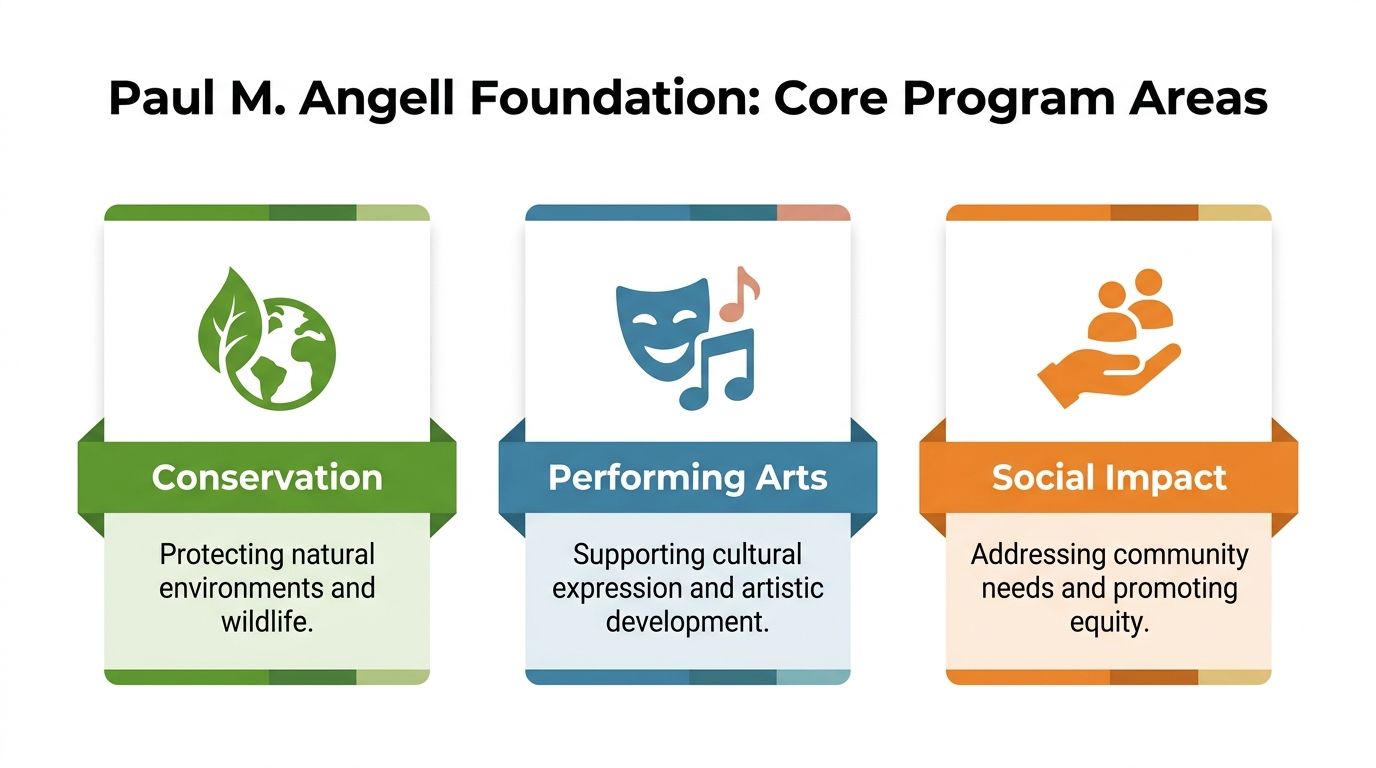
The easiest way to waste time with the paul m angell foundation is to stop at the program labels. Conservation, Performing Arts, and Social Impact sound broad. In practice, each one has boundaries, and those boundaries tell you what success looks like.
Conservation means targeted influence
PMAFF’s Conservation program targets seven underfunded interventions, including sustainable MPAs and coral reef resilience, according to the program analysis published by the University of Arizona source page. That detail matters because it reveals the foundation’s mindset.
This is not “we like the environment.” It is “we back intervention points where focused funding can move systems.”
A strong conservation proposal for PMAFF usually does three things well:
- It identifies an underfunded bottleneck. Not just a broad environmental threat.
- It explains the intervention logic clearly. Why this action, in this geography, with this partner mix.
- It connects outputs to ecological outcomes. The foundation appears to care about measurable consequences, not just program activity.
If your conservation work is diffuse, educational, or only loosely tied to ecological outcomes, you may be eligible but not competitive.
Performing Arts is narrower than many applicants expect
Many organizations self-screen too late at this stage.
The performing arts portfolio is geographically limited and discipline-specific. The broad takeaway is that PMAFF is not trying to fund every type of arts activity. It appears to be building depth in selected regions and forms rather than breadth across the sector.
That tells you something important about review behavior. In performing arts, the foundation likely values institutional role, artistic distinctiveness, and regional relevance more than a generic claim about access or community enrichment.
A weak application says, “We bring arts to underserved audiences.”
A stronger one says, “We fill a specific artistic gap in a priority geography, and our programming advances the ecosystem the foundation already funds.”
Social Impact rewards evidence, not just urgency
The same University of Arizona source notes that PMAFF’s Social Impact program mandates evidence-based models for Chicago youth and highlights K-12 completion programs that can increase postsecondary enrollment by 10 to 20%. That is a strong clue about how reviewers think.
They do not just want a compelling problem statement. They want confidence that your model has a basis in evidence and that your organization can execute it well.
If your strongest argument is that the need is overwhelming, you are only halfway there. PMAFF appears to fund models that can explain why this intervention should work.
What success looks like across all three
The three portfolios differ, but they share a pattern.
A fit proposal usually shows these traits
- Focused scope instead of a sprawling wish list
- A theory of change with teeth instead of broad aspiration
- Evidence or precedent that supports the chosen intervention
- A clear reason PMAFF is the right funder for this exact work
The hidden test is whether your proposal sounds like a specialist wrote it for this funder, not like a development team repurposed a standard deck.
Eligibility and Grant Award Realities
Before you draft anything, get honest about eligibility and grant size expectations. This foundation has room for substantial support, but that does not mean every eligible organization is a plausible fit.
The practical question is not “Can we apply?” It is “Would a reviewer see us as aligned enough to spend real time on this?”
The basic screen
PMAFF supports U.S. 501(c)(3)s, with international exceptions in Conservation, and the program areas carry different geographic boundaries and review dynamics, as reflected in the Instrumentl 990 overview.
Conservation is the broadest lane geographically. Social Impact is much tighter, with Chicago-centered priorities. Performing Arts is also restricted by region and discipline.
That means organizational eligibility and program eligibility are separate questions. A national nonprofit may be legally eligible but strategically weak if its proposal does not sit inside the foundation’s real footprint.
The grant size reality
Many teams either under-ask or fantasize at this point.
The Hinchilla profile notes that typical grants range from $50,000 to $500,000 and that decisions often take 3 to 4 months. It also notes the foundation’s ability to make much larger awards in certain cases, including a set of large grants.
So what should you infer?
- Most applicants should not lead with a transformational ask unless the program scale and organizational credibility clearly warrant it.
- Small requests can backfire if they make the project look marginal or underdeveloped.
- Multi-year support is realistic when the work requires it and the outcomes unfold over time.
PMAFF At-a-Glance Funder Snapshot (2026)
| Category | Details |
|---|---|
| Legal eligibility | U.S. 501(c)(3) public charities, with international exceptions in Conservation |
| Program areas | Conservation, Performing Arts, Social Impact |
| Typical grant range | $50,000 to $500,000 |
| Decision timeline | Often 3 to 4 months |
| Conservation timing | Bi-annual cycles, with a January 30, 2026 application deadline noted by Instrumentl |
| Best-fit profile | Organizations with strong program fit, geographic alignment, and quantifiable outcomes |
What reviewers likely want to see
Instrumentl’s summary also notes that successful proposals often demonstrate quantifiable outcomes, giving the example that MPA implementation can increase fish biomass by 20 to 50% within five years. Whether or not you work in conservation, the lesson generalizes.
PMAFF seems to prefer proposals that draw a direct line from intervention to result.
Your budget request should feel proportionate to the evidence, partnerships, and execution capacity behind it.
If your outcomes are difficult to measure, that does not automatically disqualify you. But you will need a much sharper explanation of what progress looks like and how you will know whether the work is succeeding.
Navigating the Application from LOI to Decision
Operational mistakes kill good opportunities. The paul m angell foundation may care about strategy, but an application still moves through a process, and your team needs to manage it cleanly.
The foundation uses the Foundant online portal. If your team is small, the smartest move is to treat the process like a production calendar, not a writing task.
Start with the LOI
The Letter of Inquiry is where most organizations either earn momentum or remove themselves from contention.
An LOI for PMAFF should be short, but it should not be thin. You need enough specificity for a reviewer to answer four questions quickly:
- Is this in a priority lane
- Is the geography right
- Is the organization credible
- Is there a believable path from funding to outcome
If your team needs a practical refresher on structure, this guide to a grant letter of intent is useful because it breaks the format into the parts reviewers scan for first.
Build your internal checklist before opening the portal
Do not start by typing into Foundant.
Start by gathering the materials that usually slow teams down:
- Program summary with one-sentence problem, intervention, and outcome logic
- Budget narrative that matches the ask and avoids vague line items
- Organizational positioning showing why your group is the right implementer
- Evidence base for the model, especially in Social Impact and Conservation
- Board and leadership review plan so approvals do not bottleneck submission week
This sounds basic. It is not. Many rushed applications fail because the narrative, budget, and supporting materials were drafted by different people with slightly different versions of the project.
Expect a disciplined timeline
The available profiles indicate that decisions are often made in 3 to 4 months. For applicants, that means two things.
First, submit only when the proposal is internally solid. Second, do not build a budget that assumes an immediate decision.
A clean submission process will not rescue weak strategy, but a messy process can certainly sink a strong proposal.
If invited to a fuller proposal stage, tighten alignment further. Do not add side projects, extra audiences, or loosely related program components just because you have been asked for more detail. More detail should increase precision, not sprawl.
Crafting a Proposal That Stands Out
The hardest part of applying to the paul m angell foundation is that the public guidance does not tell you everything you want to know. PMAFF does not disclose success rates, and that leaves many smaller nonprofits trying to reverse-engineer what competitiveness looks like from limited public signals, as noted on the foundation’s site overview.

That uncertainty is exactly why proposal framing matters more here than at some foundations with looser criteria.
The same PMAFF overview notes 2026 deadlines of January 23 for Social Impact and January 30 for Conservation, and also notes that many small nonprofits find unclear funder criteria a major barrier. That matches what I see in practice. When guidance is sparse, average applications get vaguer. Strong applications get sharper.
Read for the unstated criteria
PMAFF appears to reward proposals that answer questions the guidelines only imply.
The hidden questions usually sound like this
- Why this intervention instead of the obvious alternatives
- Why now
- Why your organization
- Why this geography
- Why would this funding create influence beyond one grant period
If your draft does not answer those questions directly, the reviewer has to infer too much. That is dangerous.
Show evidence without sounding mechanical
Many teams hear “data-driven” and then submit a proposal full of metrics but no argument. That does not work. The evidence should support a claim, not replace one.
For Social Impact, that means naming the model, showing why it is relevant to the population served, and explaining what implementation quality looks like in your setting.
For Conservation, it means showing the chain from intervention to ecological improvement in language a reviewer can follow quickly.
If your writing needs tightening, especially around clarity and persuasive framing, this roundup of 10 Powerful Copywriting Tips is worth reviewing before your final draft. Grant writing is not sales copy, but the lessons on specificity and structure carry over well.
Here is a useful benchmark for your team discussion:
A PMAFF-ready proposal does not just describe good work. It makes a strategic case that this funder can see itself wanting to back.
A short training video can also help teams sharpen how they position narrative and evidence before final submission:
What usually weakens an otherwise good application
I see the same avoidable mistakes over and over.
- Mission-first, model-second writing that spends too long on values and too little on intervention logic
- Evaluation language without decision value such as long lists of metrics that do not show what success means
- Over-claiming scale before proving implementation strength
- Generic funder fit language that could describe almost any major foundation
If your team wants a deeper practical resource before redrafting, this guide on writing grant proposals for nonprofits is a good complement to your internal review process.
The winning tone
The right tone for PMAFF is confident, specific, and restrained.
Do not oversell. Do not under-explain. Do not write as if urgency alone should carry the proposal.
Write as if the reviewer is asking one question the entire time: “Why should this foundation believe this organization can convert our capital into meaningful progress in this priority area?”
Alternative Funders and Your Next Steps
Not every organization that admires the paul m angell foundation should apply to it. That is not failure. That is portfolio discipline.
If you are a strong fit, your next move is straightforward.
Your short readiness checklist
- Confirm program match down to the sub-priority level, not just the category name
- Check geography carefully before you invest writing time
- Build a concise evidence brief that supports your intervention model
- Set an internal review calendar well before the posted deadline
- Prepare a right-sized ask that matches both project scope and organizational credibility
If PMAFF is not the right fit
Use what you learned here as a filter for the rest of your prospecting.
Look for other funders that share one or more of these traits:
| If your strength is | Look for funders that prioritize |
|---|---|
| Ocean or species protection | Targeted conservation interventions and measurable ecological outcomes |
| Regional arts leadership | Place-based performing arts support with clear artistic focus |
| Youth outcomes in urban settings | Evidence-based social impact models and prevention-oriented programs |
That kind of realignment saves time. It also improves your win rate because your team stops chasing prestige and starts chasing fit.
If you do win funding, do not wait until the public announcement to think about communications. This guide on how to write a compelling press release is a practical resource for shaping the announcement in a way that supports stewardship and future fundraising.
For teams expanding the search beyond one marquee foundation, a broader directory of sources of funding for nonprofits can help you build a stronger second and third tier pipeline.
A more effective next step is not “apply everywhere.” It is to create a shortlist where your program model, evidence base, geography, and ask size all make sense together.
If you want a faster way to build that shortlist and turn funder criteria into stronger applications, Fundsprout helps nonprofits find aligned grants, screen eligibility, organize deadlines, and draft proposals with structured support from discovery through renewal.
Try 14 days free
Get started with Fundsprout so you can focus on what really matters.