Top 10 Nonprofit Grants Michigan for 2026
Discover the best nonprofit grants michigan for 2026! Our guide covers state, community, & foundation funding with eligibility, deadlines, and tips.

Abdifatah Ali
Co-Founder
Funding can get messy fast when you're running a Michigan nonprofit. One deadline lives in a portal you forgot to bookmark. Another opportunity looks promising until you read the eligibility line about matching funds, prior-year financials, or geographic fit. Meanwhile, your team still has programs to run.
That's why most organizations need more than a long list of nonprofit grants in Michigan. They need a shortlist of funders that fit their mission, budget size, geography, and internal capacity. The state has a dense funding environment. The IRS lists about 59,828 active tax-exempt organizations in Michigan, including 48,497 501(c)(3)s, and those organizations reported $119 billion in revenue on their most recent filings, according to ProPublica's Michigan nonprofit database. That scale explains why smart grant strategy matters so much here.
There is real opportunity. One Michigan grant directory shows more than 100 active opportunities for nonprofits, with $21,905,999 in funding available and a median grant size of $17,500, according to Instrumentl's Michigan grants page. In practice, that means many awards are useful for pilots, targeted expansions, and specific program costs, but few will carry an entire organization on their own.
The list below focuses on funders and tools I'd keep in a live Michigan grants pipeline. It's built for executive directors, development staff, and program leads who need realistic advice on fit, timing, and effort.
1. Michigan Arts & Culture Council (MACC)
If your organization works in arts, culture, public programming, or community-based creative engagement, MACC belongs near the top of your Michigan funding list. Its grant structure is useful because it isn't one-size-fits-all. Organizations can look at mission support, project support, and regional minigrant pathways through local partners on the Michigan Arts & Culture Council grants page.
The practical advantage is predictability. State arts agencies tend to publish clearer guidelines than many private foundations, and MACC is one of the better options for organizations that need an annual calendar instead of chasing scattered one-off opportunities.
Where MACC fits best
MACC works best for groups that can clearly connect their work to arts and cultural outcomes, not just community benefit in a broad sense. A social service nonprofit with an arts-based program can still be competitive, but only if the arts component is central rather than decorative.
- Best-fit applicants: 501(c)(3) arts groups, museums, cultural organizations, and community nonprofits presenting arts programming
- Best-fit requests: General operations, defined projects, local cultural access efforts, and regionally administered smaller grants
- Weak-fit requests: Programs where the arts piece is secondary to another service model
Practical rule: If your narrative leads with "we serve people in need" and only mentions the artistic work halfway through, MACC probably isn't your strongest first target.
Before you build your list, it helps to tighten your prospecting criteria. This guide on how to find grants for nonprofits is a useful way to separate plausible matches from wishful submissions.
2. Michigan Humanities
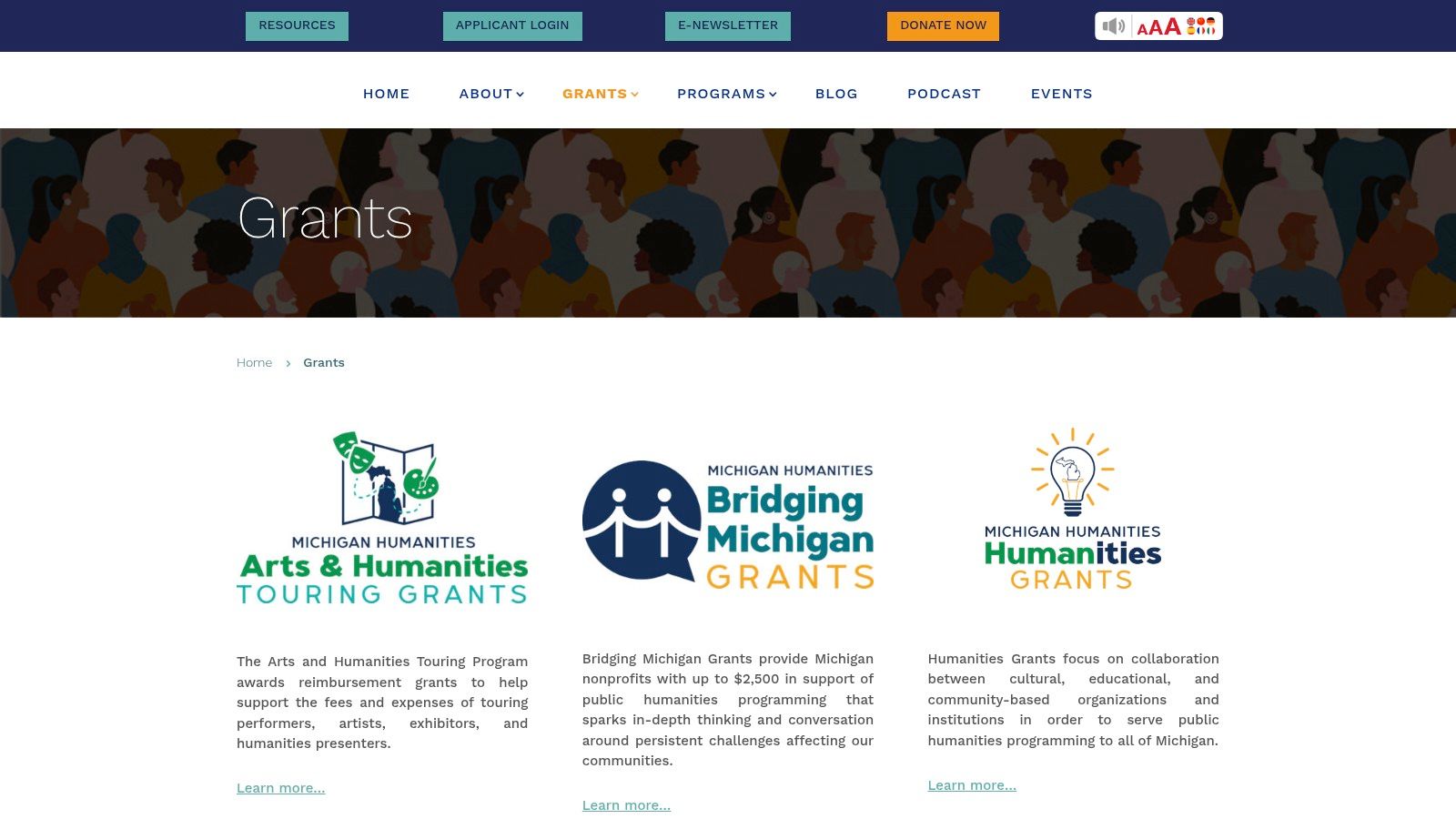
Michigan Humanities is a better fit than many nonprofits realize. If you run oral history, civic dialogue, cultural interpretation, local history, archives, book programs, exhibits, or community learning work, you may be in the humanities lane even if you don't use that label internally. The main hub for current options is the Michigan Humanities grants page.
What makes this funder attractive is narrative accessibility. Smaller organizations often do well here when they can explain who the public audience is, what people will engage with, and why the project deepens understanding rather than delivering a service.
What usually works
The strongest applications don't just say a program is educational. They show a public-facing learning experience with a clear humanities frame. Partnerships with libraries, museums, schools, and community institutions also tend to make the project feel more rooted and more credible.
A few trade-offs matter:
- Strong approach: Lead with the public question your program explores, then explain activities.
- Common mistake: Writing the proposal like a direct-service grant and tacking on "history" or "culture" language at the end.
- Important limit: If you're hoping to fund the same project repeatedly, build a diversification plan early because repeat support for the same effort can be constrained.
This is one of the cleaner entry points for first-time grant seekers in Michigan, especially for organizations with compelling community programming but modest grant infrastructure.
3. Community Foundation for Southeast Michigan (CFSEM)
CFSEM is one of the first places I'd look for Southeast Michigan organizations because it covers broad issue areas and has enough depth that mission-aligned groups can often find more than one potential opening over time. The nonprofit entry point is the Community Foundation for Southeast Michigan nonprofit page.
The biggest strategic advantage is process. Through the Michigan funding ecosystem, staged applications are becoming more common, and CFSEM is a good example. The foundation uses a two-stage process in which applicants first submit a short proposal summary and then, if selected, a full application, with initial decisions typically returned in 4 to 6 weeks, as described through the MI Funding Hub statewide resource. For lean teams, that matters because it reduces wasted drafting time.
How to approach CFSEM well
Don't treat CFSEM like a generic upload-and-wait funder. The organizations that get more traction usually pressure-test regional fit before they write a full case.
Contact staff early if your project sits across categories. A short conversation can tell you whether your idea fits a community grant round, a special initiative, or not at all.
A few practical notes:
- Geography matters: Your project needs to benefit Southeast Michigan in a concrete way.
- Measurement matters: Vague claims about community impact won't hold up here.
- Portal discipline matters: Keep proposal summaries concise and specific. This is not the place for a sprawling organizational history.
If you're outside the region, move on quickly. If you're inside it and your outcomes are clear, CFSEM can be one of the more worthwhile nonprofit grants Michigan organizations pursue.
4. The Kresge Foundation (Detroit Program)

Kresge is not a casual prospect. It's a serious target for Detroit-based or Detroit-serving organizations with a strong place-based case and a project that connects to systems, neighborhoods, civic infrastructure, arts, or community development. The clearest starting point is the Kresge Detroit program page.
This funder rewards sharp positioning. "We do good work in Detroit" isn't enough. You need to show why your organization, your neighborhood relationships, and your delivery model are the right vehicle for that investment.
What strong Kresge prep looks like
For Kresge, I'd prepare before drafting. That means board-ready project language, a realistic implementation path, and a credible story about resident benefit. Some programs are invitation-based or tied to specific initiatives, so wasting time on a broad, generic pitch usually backfires.
- Lead with place: Name the neighborhood, corridor, or community context.
- Show partnership quality: Funders in Detroit can tell the difference between real collaboration and a logo parade.
- Be honest about capacity: If you're still building systems, frame that clearly instead of overselling readiness.
Good writing still matters. This practical guide to writing grant proposals for nonprofits is especially relevant for funders like Kresge, where framing and alignment carry as much weight as raw need.
Kresge tends to respond better to organizations that can explain change at the neighborhood level, not just at the organizational level.
5. The Skillman Foundation

If your work centers Detroit youth, Skillman deserves close attention. It has strong local credibility, and that cuts both ways. A good fit can be compelling. A weak fit is obvious quickly. The place to start is the Skillman Foundation grants page.
The foundation is especially relevant for youth-serving organizations that can connect direct work with broader equity and systems concerns. Smaller or emerging groups should pay attention to the discretionary track when available, because that's often the more realistic entry point than waiting for a large strategic initiative to open.
Where applicants stumble
Many proposals talk about youth need in broad terms but don't show why the program is distinct, trusted, or embedded in Detroit communities. Skillman tends to reward organizations that can name the specific youth population served, the barriers they face, and the mechanisms through which the work changes outcomes.
Try this frame:
- Who exactly benefits: Age range, neighborhood, and access barrier
- What changes: Skills, opportunity, safety, belonging, leadership, or educational pathway
- Why your team can deliver: Community relationships, program track record, and operational readiness
If your work touches youth but isn't truly youth-centered, this probably isn't your first stop. If Detroit youth are the mission, not a side audience, Skillman can be a very high-value relationship to build over time.
6. Ralph C. Wilson, Jr. Foundation

The Ralph C. Wilson, Jr. Foundation is one of the stronger options for organizations in eligible Southeast Michigan counties that think beyond single-year programming. The application entry point is the Ralph C. Wilson, Jr. Foundation how-to-apply page.
This isn't the best fit for loosely defined projects. It tends to suit organizations with partnership-driven ideas in active communities, caregivers, entrepreneurship, economic development, or youth sports and recreation. If the project has civic visibility, cross-sector partners, and a sustainability story, it becomes much more compelling.
Best use case
I'd place this funder in the "bigger strategic swing" category. Not every nonprofit should prioritize it first. But if your organization is planning a community asset, corridor project, caregiver support model, parks improvement, or recreation system partnership, it can be worth the effort.
The strongest submissions usually show that the project will still matter after the grant period ends.
Practical trade-offs to weigh:
- Good fit: Multi-partner community projects with durable public benefit
- Harder fit: Small standalone programs with limited ecosystem relevance
- Important screen: County eligibility and regional geography aren't negotiable
If you're still proving the concept of a small program, go after a more accessible local or thematic funder first. Come to Wilson when the project is mature enough to justify the lift.
7. Michigan Health Endowment Fund

The Michigan Health Endowment Fund is one of the most useful statewide health funders because it isn't limited to one narrow intervention style. Nonprofits, Tribes, and units of government can all find relevant pathways on the Michigan Health Endowment Fund website.
This funder also matters for a different reason. Michigan nonprofits often hit eligibility barriers before reviewers even reach the program idea. State and foundation opportunities commonly expect 501(c)(3) status, financial stability, regulatory compliance, and sometimes operating history or matching capacity, as outlined in Michigan opportunities for nonprofits guidance. For smaller organizations, that administrative threshold is often the main obstacle.
Why this funder is worth a close read
The Health Endowment Fund is notable because fiscal sponsorship may be allowed under certain conditions. That won't fix every readiness problem, but it can create a path for organizations with strong community access and limited back-office infrastructure.
If you're a small health-focused nonprofit, pay attention to these issues before applying:
- Capacity proof: If you don't have a large team, show partner roles, reporting workflows, and program oversight clearly.
- Financial readiness: Be prepared to explain how funds will be managed and tracked.
- Health fit: Frame the work around health and wellness outcomes, not just general community benefit.
This is one of the better Michigan options for organizations willing to do the homework on eligibility before investing in a full narrative.
8. Blue Cross Blue Shield of Michigan Foundation

The Blue Cross Blue Shield of Michigan Foundation is a credible statewide health funder, especially for nonprofits working at the intersection of community programs, care access, health equity, and evaluation. The best starting point is the Blue Cross Blue Shield of Michigan Foundation site.
What I like here is the blend of community and research-oriented funding. What I don't like is that small organizations sometimes underestimate the operational lift. Matching components, evaluation expectations, and collaboration requirements can make a seemingly attractive grant heavier than it looks on first read.
Who should prioritize it
This funder makes the most sense for nonprofits that already collect meaningful program data or can partner with an academic or evaluation-minded organization. If your program team is already stretched and your data systems are light, be careful.
A smart screening question is simple: can you prove what changed, not just what you did?
- Strong fit: Pilot programs with defined health objectives and a plan to assess results
- Moderate fit: Community health work with a solid partner handling evaluation
- Weak fit: Programs with soft goals, limited data discipline, or no clear measurement plan
For the right organization, this can be an excellent funder. For the wrong one, it creates reporting stress that follows you long after the award letter.
9. Consumers Energy Foundation

Consumers Energy Foundation is one of the more practical corporate funders to keep in a Michigan grants mix because its priorities are clear. People, Planet, and Prosperity are broad enough to include many nonprofit models, but still focused enough that you can usually tell whether a project belongs. The entry point is the Consumers Energy Foundation grant seekers page.
This is a good prospect for organizations that can connect project outcomes to community vitality, environmental benefit, or economic resilience in the Lower Peninsula. It's less useful if you're trying to force-fit a program that only loosely matches those themes.
How to improve your odds
Corporate foundations often respond best to crisp alignment. Don't write like you're appealing to a general private foundation. Write like someone inside the company should be able to see exactly why the project belongs in the portfolio.
A tight one-page concept note often surfaces misalignment faster than a full draft. Use that before you invest real writing time.
A few practical filters help:
- Theme fit first: Start with People, Planet, or Prosperity and build from there.
- Geography check: Make sure the project footprint makes sense for the foundation's service area and community focus.
- Pre-application contact: If the option exists, use it. Corporate funders often give more directional feedback than applicants expect.
For nonprofits that need a statewide corporate prospect with recognizable priorities, this is one of the stronger nonprofit grants Michigan organizations should watch.
10. Fundsprout: Your AI Grant-Seeking Partner

A Michigan nonprofit has three live prospects on the table. One is statewide but requires matching funds. One is restricted to Southeast Michigan. One looks promising until the eligibility language rules out the applicant's fiscal structure. Teams rarely lose time on the writing alone. They lose it in prospect qualification, deadline tracking, document control, and follow-up.
Fundsprout helps handle that work earlier in the process. Instead of acting like a simple grant directory, it supports the full workflow from finding opportunities to organizing drafts and post-award requirements. For organizations sorting through state funders, community foundations, and corporate giving programs in Michigan, that matters because the primary bottleneck is often deciding what deserves staff time.
The practical fit is strongest for nonprofits that have program staff wearing grant duties part time, or a small development team managing too many cycles at once. In that setting, speed only helps if the screening is accurate.
A few features stand out in day-to-day use:
- Opportunity screening: Fundsprout helps sort prospects by fit, geography, and organizational readiness before a team commits to a full application.
- RFP analysis: Long guidelines become structured tasks, which makes it easier to assign work and catch missing attachments early.
- Draft development: Teams can build first drafts using existing organizational materials, then revise for funder fit instead of starting from a blank page.
- Grant management: Reporting dates, compliance steps, and supporting files stay tied to the award record after submission.
There is a real trade-off. AI can reduce administrative drag, but it cannot make judgment calls about relationship history, local politics, board credibility, or whether a proposal is too thin to submit. Strong grant teams still review every recommendation, rewrite generic language, and decide when to pass on a weak-fit opportunity.
For organizations that want a clearer qualification process, this article on using AI tools to find and sort grant opportunities is a useful starting point. The examples focus on business grants, but the same filtering logic applies to nonprofit prospecting.
That is why Fundsprout belongs in a Michigan grant guide like this one. The challenge is not finding more links. The challenge is building a workable pipeline across public, regional, and corporate funders without wasting a small team's writing hours.
Top 10 Michigan Nonprofit Grantmakers: Comparison
| Funder | 👥 Target | ✨ Core focus / Fit | ★ Quality / Experience | 💰 Value / Price |
|---|---|---|---|---|
| Michigan Arts & Culture Council (MACC) | Arts nonprofits & community orgs (statewide) | General operating, project & regional minigrants; NTEE arts focus | ★★★★☆ Predictable cycles; strong local reach | 💰 Public grant awards vary; budget-dependent |
| Michigan Humanities | Nonprofits, libraries, museums, community groups | Public humanities, touring & engagement; partnership-friendly | ★★★★☆ Accessible for first-time/smaller applicants | 💰 Project grants; will not fund same project >2 yrs |
| Community Foundation for Southeast Michigan (CFSEM) | SE Michigan nonprofits (7 counties) | Broad issue areas; rolling & initiative-specific funding | ★★★★☆ Strong regional reputation; competitive | 💰 Competitive grants; significant investments; region-limited |
| The Kresge Foundation (Detroit Program) | Detroit-centered orgs & neighborhood initiatives | Place-based grants, PRIs, capacity-building; equity focus | ★★★★★ High-profile, catalytic investments | 💰 Large/strategic awards; some invite-only; neighborhood-specific |
| The Skillman Foundation | Organizations serving Detroit youth (children & teens) | Education, youth leadership, discretionary small grants | ★★★★☆ Strong youth focus; outcome-driven | 💰 Discretionary small grants accessible; larger grants selective |
| Ralph C. Wilson, Jr. Foundation | SE Michigan & Western NY nonprofits (county-focused) | Capital, program & ecosystem-building; multi-year projects | ★★★★☆ Year-round applications; transformative funding possible | 💰 Open submissions; can support multi-year/catalytic projects |
| Michigan Health Endowment Fund | Health nonprofits, Tribes, gov units (statewide) | Thematic health rounds, capacity-building, grantee supports | ★★★★☆ Statewide reach; concept-paper stages lengthen process | 💰 Grants + capacity supports; some tracks for past grantees |
| Blue Cross Blue Shield of Michigan Foundation | Community health orgs, research partners | Community health matching grants; research & partnership funding | ★★★★☆ Recognized statewide; collaborative emphasis | 💰 Matching & evaluation expectations; award sizes vary |
| Consumers Energy Foundation | Lower Peninsula nonprofits aligned to People/Planet/Prosperity | Quarterly grants + signature competitive awards; pre-LOI contact advised | ★★★★☆ Consistent annual giving; signature rounds competitive | 💰 Multiple tracks; signature awards have limited LOIs |
| Fundsprout: Your AI Grant‑Seeking Partner 🏆 | 👥 Small teams, nonprofits, grantseekers wanting AI workflows | ✨ AI prospecting, RFP Analyzer, DraftAI, eligibility screening, tracking & reporting | ★★★★★ Saves time; improves pipeline fit; versioning & citations | 💰 Free get-started + 14‑day trial; contact sales for pricing |
From List to Action Secure Your Next Grant
The best Michigan grant strategy isn't "apply to more." It's "apply to the right few with discipline."
That matters even more in a state with a large, competitive nonprofit sector. Plenty of organizations are pursuing the same broad categories of support, but not all of them are equally prepared for the administrative side of grant seeking. Some funders want a short proposal first. Some want deep regional alignment. Some are open to smaller, newer organizations. Others tend to favor applicants with stronger financial systems, clearer measurement plans, or longer operating histories.
A workable plan starts by sorting the list above into three buckets. First, name your highest-fit targets. Those are the funders where your geography, mission, and project type all line up cleanly. Second, mark the stretch opportunities. These may be worth pursuing, but only if you can show strong partnership, readiness, or a more developed case. Third, cut the weak-fit prospects, even if the funder is prestigious. Prestige doesn't pay off if the match isn't there.
Then build around effort. If your team is small, don't begin with the heaviest application on the list. Start with one or two funders where the path is clearer and the narrative burden is manageable. Use those applications to sharpen your core case for support. Once your outcomes language, budget framing, and supporting documents are tighter, larger and more competitive opportunities become easier to pursue.
This is also where a real workflow helps. Michigan nonprofits often juggle state opportunities, community foundations, corporate giving, and health funders at the same time. That creates version-control problems, deadline misses, and a lot of duplicated work. A platform like Fundsprout helps turn scattered grant chasing into a repeatable process by narrowing the pipeline, organizing requirements, speeding up draft development, and keeping post-award obligations visible.
The goal isn't to automate judgment. It's to preserve it. Your team should spend its energy on fit, strategy, relationships, and program design, not on rebuilding the same calendar and document stack for every new opportunity.
Pick one statewide funder and one place-based or issue-specific funder from this list. Check eligibility first. Outline the required documents. Decide who owns each step. Then move. That's how nonprofit grants Michigan teams win. Not by collecting links, but by building a grant engine that can keep producing results over time.
If you're ready to stop chasing low-fit opportunities and start building a focused pipeline, try Fundsprout. It helps nonprofits find relevant grants, organize deadlines, draft stronger proposals, and manage reporting in one place, which is exactly what lean Michigan teams need when funding work starts piling up.
Try 14 days free
Get started with Fundsprout so you can focus on what really matters.