A Practical Guide to Your Nonprofit Code of Ethics
Build trust and secure funding with a solid nonprofit code of ethics. Our guide helps you draft, implement, and enforce a policy that wins grants.


Abdifatah Ali
Co-Founder
A nonprofit code of ethics is more than just a formal document. It’s a public promise that spells out the core values and ethical standards your organization lives by. Think of it as a compass for your staff, board members, and volunteers, making sure every decision and action aligns with your mission and protects the public's trust.
Why Your Code of Ethics Is a Fundraising Superpower
Too many nonprofit leaders see creating a code of ethics as another box to check—a document to draft, file away, and forget. Honestly, that’s a massive missed opportunity. In the crowded, competitive world of fundraising, your code of ethics isn't just bureaucratic paperwork; it’s a powerful tool that can directly boost your ability to raise money.
It’s the very foundation of your relationship with every single donor, grantor, and partner. Before anyone cuts a check, they’re really investing in your integrity. They need to trust that you’ll use their money responsibly to create the change you’ve promised.
A well-written code of ethics that you actually use is tangible proof of that commitment. It takes you beyond simply saying you have good intentions and gives you a concrete framework for accountability. This is exactly what today’s savvy funders want to see.
Building Trust in a Skeptical World
The ground has shifted under our feet. Donors and grantmakers aren't just glancing at your financials anymore. They’re digging into your organizational culture, demanding transparency, and looking for hard evidence of responsible leadership.
This is all happening at a time when public trust is shaky. Recent governance trend analysis shows that only about 57% of the public trusts nonprofits. That means even a small ethical slip-up can have huge consequences. A clear ethical framework isn't a "nice-to-have"; it's essential. You can find more insights on nonprofit trends from BDO.
Your code of ethics is your number one tool for building and holding onto that trust. It proves you’ve thought ahead about tough situations and have clear rules for handling them.
A nonprofit's reputation is its most valuable currency. A code of ethics is the vault that protects it, assuring donors their investment is secure and will be used to advance the mission with integrity.
From Guiding Principles to Winning Grant Proposals
This link between ethics and funding isn't just a theory—it plays out every time you write a grant proposal. Grant applications are packed with questions about governance, board oversight, and your internal controls.
Think about these common questions on grant applications:
- Conflict of Interest Policy: Grantors need to see you have a system to stop board members or staff from making decisions that benefit them personally.
- Financial Accountability: Funders want proof you have solid procedures for handling money, which is a cornerstone of any ethics code.
- Transparency and Reporting: Being ethical means being open about your wins and your challenges—a quality that foundations highly value.
When you can attach a formal, board-adopted nonprofit code of ethics to your application, your answers suddenly carry so much more weight. It shows a level of professionalism that makes you stand out from the crowd, turning your principles into a genuine fundraising superpower.
Drafting Your Code with Core Principles and Essential Clauses
This is where the rubber meets the road—moving from the idea of being an ethical organization to actually putting it down on paper. Drafting a code of ethics can feel like a huge undertaking, but you don't need to be a lawyer to get it right. It’s really about translating your mission into a practical guide for day-to-day decisions.
The biggest mistake I see small nonprofits make is just grabbing a template off the internet and calling it a day. While templates are a great place to start, your code has to reflect the unique work you do. The ethical tightropes an environmental group walks are completely different from those of a community health clinic.
Your goal is to create a document that feels helpful and relevant to your team, not one that reads like a dense legal contract. Think of it as a shared agreement on how you’ll all work with integrity.
The Building Blocks of an Effective Code
The best ethics codes I've seen all start with a strong foundation of core principles. These aren't the nitty-gritty rules; they're the big-picture value statements that set the tone for everything else. They're your organization's North Star, guiding behavior even when a specific rule doesn't quite fit.
You can’t go wrong starting with principles that are universal to the nonprofit world:
- Honesty and Integrity: A straightforward promise to be truthful in everything you do and say.
- Responsibility and Accountability: Taking ownership of your work—the wins and the losses—and being transparent about it.
- Respect and Fairness: A commitment to treating everyone you interact with (staff, clients, donors, partners) with dignity.
- Stewardship: A pledge to responsibly manage every asset entrusted to you, from cash donations to donor data.
Starting with these principles gives you the "why" behind the specific rules that come next. It helps the whole team understand that the guidelines aren't arbitrary but are rooted in your shared values.
This is more than just good practice; it's a direct line to building the trust you need to secure funding and grow your impact.
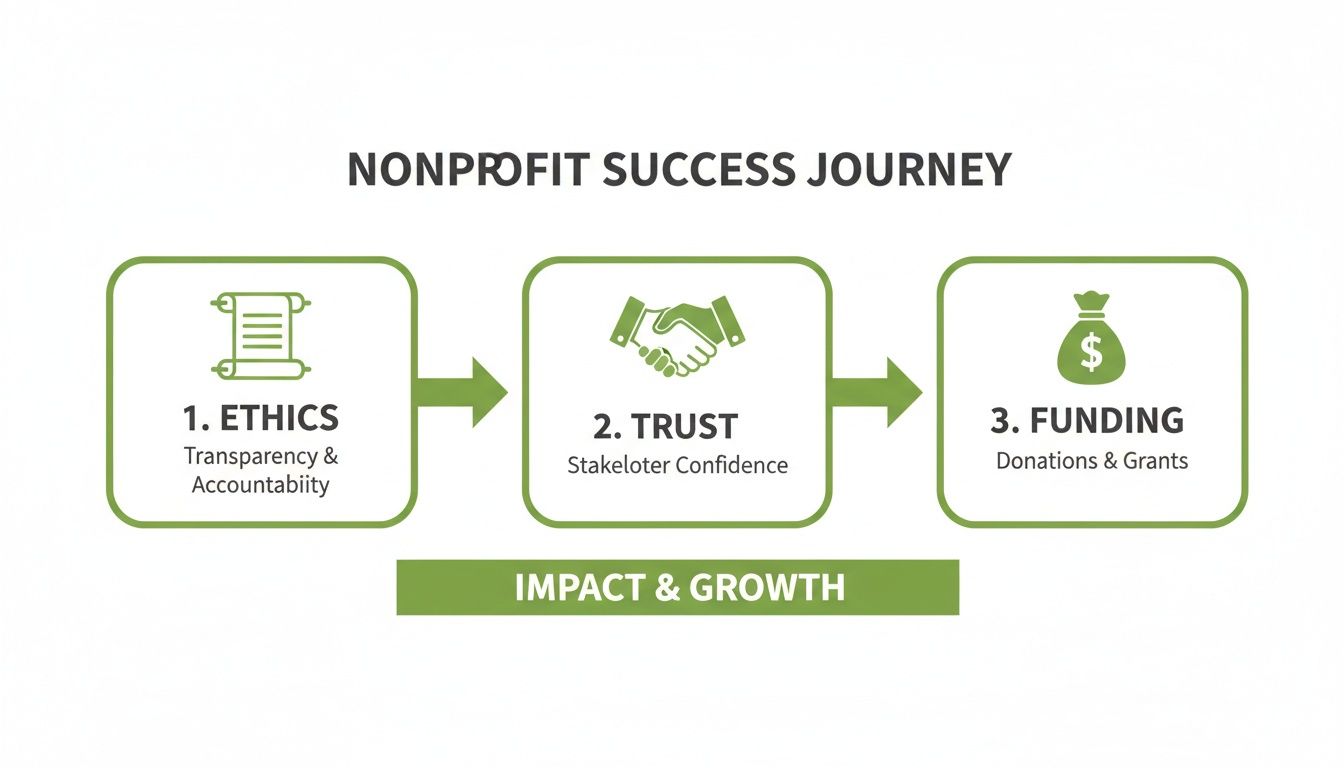
As you can see, a strong ethical foundation isn't just a "nice-to-have." It’s the first, most critical step toward earning the community trust that unlocks the support you need to thrive.
Essential Clauses Every Nonprofit Needs
With your principles in place, it's time to build out the specific sections of your code. Each clause should tackle a key area where ethical questions are likely to pop up. To get you started, here’s a breakdown of the clauses that virtually every nonprofit should have.
This table covers the fundamentals. Think of these as the non-negotiable building blocks for a comprehensive and trustworthy code.
A conflict of interest clause is absolutely critical. This section needs to clearly define what a conflict is—essentially any situation where a board or staff member’s personal interests could clash with their duties to the nonprofit—and lay out a simple process for disclosing and managing those situations. If you need a deeper dive, our guide on crafting a conflict of interest policy for nonprofits has you covered.
Equally important is a section on confidentiality. You handle sensitive data on everyone from clients to donors. This clause must state your commitment to protecting that information and get specific about how it’s used and stored.
Your nonprofit code of ethics is a promise to your community. Each clause is a specific commitment to upholding the trust that donors and beneficiaries place in your hands. It transforms abstract values into concrete actions.
From Vague to Valuable: Customizing Your Code
This is where you make the code your own. The key is to avoid generic, formal language and use clear examples that resonate with your team's day-to-day reality.
Let’s take a fundraising clause. Instead of something vague, get specific:
"All fundraising materials will truthfully represent our programs and financial needs. We will never use high-pressure or manipulative tactics to solicit a gift. 100% of restricted donations will be used solely for their donor-designated purpose."
See the difference? That's language your development team can actually use. It’s clear, direct, and sets a standard that leaves no room for misinterpretation.
Think about two very different nonprofits: a local food bank and a digital rights advocacy group. Their codes will—and should—look quite different.
The Food Bank’s conflict of interest section might zero in on procurement. A clause could state, "Board members and their immediate family may not hold a significant financial interest in any vendor from which the food bank purchases food or supplies."
The Advocacy Group’s code would likely focus more on public communications. You might see a clause like, "All public statements and research must be rigorously fact-checked and non-partisan, clearly distinguishing the organization's official positions from personal opinions."
By tailoring each section this way, you turn your code of ethics from a document that sits on a shelf into a living, useful tool that helps your team navigate the real world.
Getting Your Team and Board on Board
A code of ethics is only as good as the paper it's printed on unless your whole team truly buys into it. The most important step after you’ve drafted the document is to make it real. That means getting genuine commitment from everyone, from the board chair right down to your newest volunteer.
If the code feels like a mandate handed down from on high, it'll be met with eye-rolls and quickly forgotten. But if it's something everyone has a hand in creating, it becomes a living, breathing part of your culture.
This isn't just about getting a formal sign-off. It’s a chance to have a real conversation about what your organization stands for and to reinforce that acting ethically is a shared responsibility. When your team sees the code as a promise you’re all making to each other and your community, that’s when it starts to work.
Presenting the Draft for Feedback
How you introduce the draft code of ethics really sets the tone. Don't just fire off an email with a "please review" and a deadline. You need to frame this as a team effort from the get-go.
Set aside dedicated time—maybe a special board meeting or an all-hands workshop—to go through the document together. The goal here is a productive discussion, not a one-way presentation.
Here are a few tips I've seen work well:
- Start with the 'Why'. Before diving into the details, bring everyone back to the mission. Explain that this document is here to protect your reputation, deepen donor trust, and make everyone's lives easier when those tricky gray areas pop up.
- Talk Through Real Scenarios. Nobody wants to listen to you read legal clauses aloud. Make it practical. Use real (or at least realistic) examples relevant to your work. Ask things like, "How would this conflict of interest policy help us if a board member’s business wanted to bid on our annual gala contract?"
- Ask for Specific Input. Guide the conversation with pointed questions. "Does our confidentiality section feel strong enough to protect our client data?" or "Is the language we used around fundraising clear for the development team and volunteers?"
This approach changes the whole dynamic. It turns a passive review into an active workshop where people can actually see how the code applies to their daily work and feel empowered to make it better. A solid understanding of what is a code of conduct helps people see it less as a rulebook and more as a practical guide for behavior.
Moving from a Checkbox to a Competitive Edge
When you bring the final draft to the board for a vote, it's all about how you frame it. Yes, it’s about compliance, but the real power lies in its strategic value. In today's world, unwavering ethical leadership is a massive competitive advantage for any nonprofit.
Donors and foundations are increasingly looking for organizations they can trust. Volunteers want to give their time to groups with integrity. Research from sources like the National Council of Nonprofits shows how ethical leadership drives success, and many state associations even have programs like the Standards for Excellence® to prove it.
By adopting this code, you're doing more than just managing risk. You're building a more resilient organization and actively strengthening your case for support. Think of it as a direct investment in your long-term sustainability.
Once your board members—the ultimate guardians of the organization's mission and finances—see that connection, approving the code becomes an easy decision. They'll recognize it as a core part of their fiduciary responsibility and a vital governance tool. If you want to dive deeper into their roles, our guide on the duties of nonprofit board of directors is a great place to start.
That final vote to adopt the code should feel like a victory lap—a celebration of your shared values. It’s the moment your organization puts a stake in the ground, sending a clear message to everyone that integrity comes first. That collective ownership is what turns a document into a compass.
Integrating Your Ethics Code into Daily Operations
A board vote and a signed document are great first steps, but they're just that—the beginning. The real test of your nonprofit’s code of ethics is whether it lives in your team’s daily actions or just gathers dust in a forgotten folder. A code that isn't actively used becomes a liability, creating a false sense of security while leaving your organization vulnerable.
The goal now is to weave your ethical principles into the very fabric of your operations. This means moving beyond a one-time announcement and building a continuous loop of training, conversation, and reinforcement. It’s about creating a culture where ethical considerations are a natural part of every decision, from managing program budgets to drafting a donor thank-you letter.
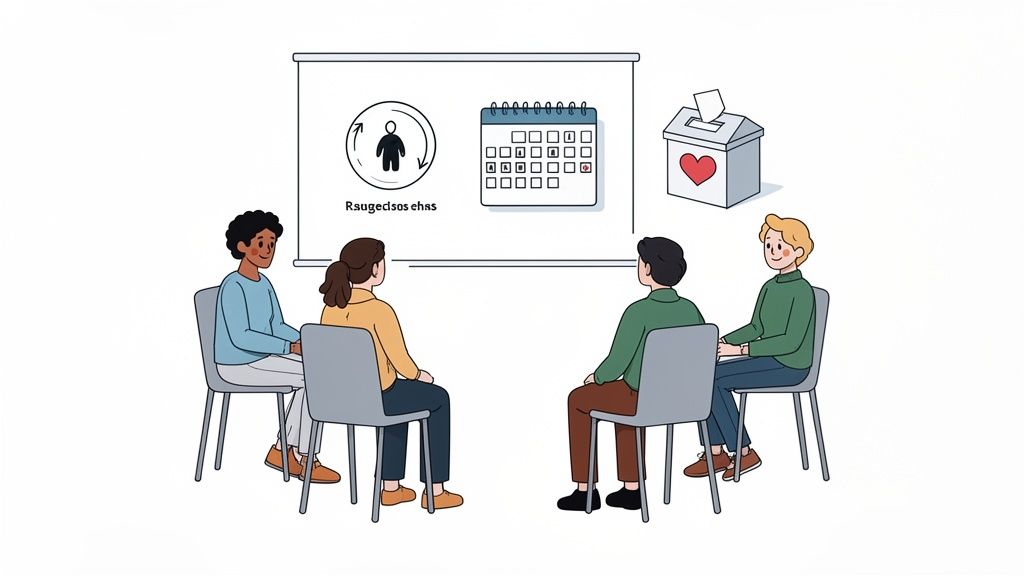
From Policy to Practice Through Ongoing Training
For smaller nonprofits, the idea of a formal training program can sound overwhelming and expensive. The good news? It doesn't have to be. Effective ethics training is less about polished presentations and more about consistent, practical application.
Your code should be a cornerstone of the new-hire onboarding process. On their very first day, every employee, intern, and long-term volunteer should get a copy and have a real conversation about what it means for their specific role. This sets a clear expectation from the start: here, ethics are a priority.
But it can’t stop there. Regular reinforcement is what keeps the code top of mind.
- Annual Refreshers: At least once a year, dedicate time for a team-wide review. This is a perfect opportunity to discuss any new challenges or "gray areas" that have popped up over the past 12 months.
- Board Engagement: The board absolutely must participate in annual training, too. Their commitment signals that ethical oversight is a core governance function, not just another operational task.
Creative Training for Resource-Limited Organizations
You don't need a big budget to make ethics training stick. In my experience, some of the most effective methods are low-cost and can be integrated right into your existing routines.
The most powerful tool at your disposal is scenario-based discussion. Instead of just reading the code aloud, present your team with realistic ethical dilemmas they might actually face.
A code of ethics gains its power not from being memorized, but from being wrestled with. When your team debates a tough scenario, they are internalizing the principles and learning how to apply them under pressure.
Here’s a simple way to make this work:
- Prep Short Scenarios: Write a few one-paragraph ethical dilemmas. Think about real-world situations. For example: "A major donor offers a large, unrestricted gift but strongly hints they expect their underqualified nephew to be hired for our open program coordinator position. What do we do?"
- Use Existing Meeting Time: Dedicate just 15 minutes of a regular staff meeting to discuss one scenario. You can break people into small groups to talk it through, then have everyone share key takeaways.
- Focus on the Process: The goal isn't always to find one "right" answer. The value is in the discussion itself—hearing different perspectives and walking through the decision-making process using your code as a guide.
This approach costs nothing but a little time and transforms your code from a static document into a dynamic tool for critical thinking.
Establishing Safe and Clear Reporting Procedures
A code of ethics is pretty much useless without a safe, clear process for reporting potential violations. Your team members have to believe they can raise a concern without fear of punishment or awkwardness. If reporting feels risky, your code becomes unenforceable.
Your reporting process needs two key components: clarity and safety.
First, be crystal clear about the reporting channels. Don't just say "report concerns to management." Specify who to talk to—a supervisor, the Executive Director, or maybe a designated board member. It’s absolutely crucial to provide an alternative in case the primary contact is the subject of the complaint.
Second, build a non-retaliation clause directly into your policy. This is a firm promise that anyone who reports a concern in good faith will be protected from any negative consequences. Following up with a fair, confidential, and timely investigation is essential to maintaining trust in the entire system.
To truly embed these practices, nonprofits also have to integrate them into their financial systems. A practical guide to fund accounting for nonprofits offers crucial insights for managing restricted funds ethically and transparently. By building this culture of trust and accountability, you empower every single team member to be a guardian of your organization's integrity.
Tackling Today's Ethical Curveballs: AI and Data Privacy
A code of ethics isn't something you can just write once and file away. It has to breathe and grow with your organization, especially with how fast technology is changing things. Right now, two of the biggest ethical minefields are the explosion of artificial intelligence (AI) and the ever-present concerns around data privacy.
You simply can't afford to ignore this stuff. Your donors, the people you serve, and your own staff are all wondering how you're handling their sensitive information and whether you're using powerful new tools like AI responsibly. A modern, forward-thinking code of ethics gives you the guardrails you need to stay innovative without sacrificing your integrity.
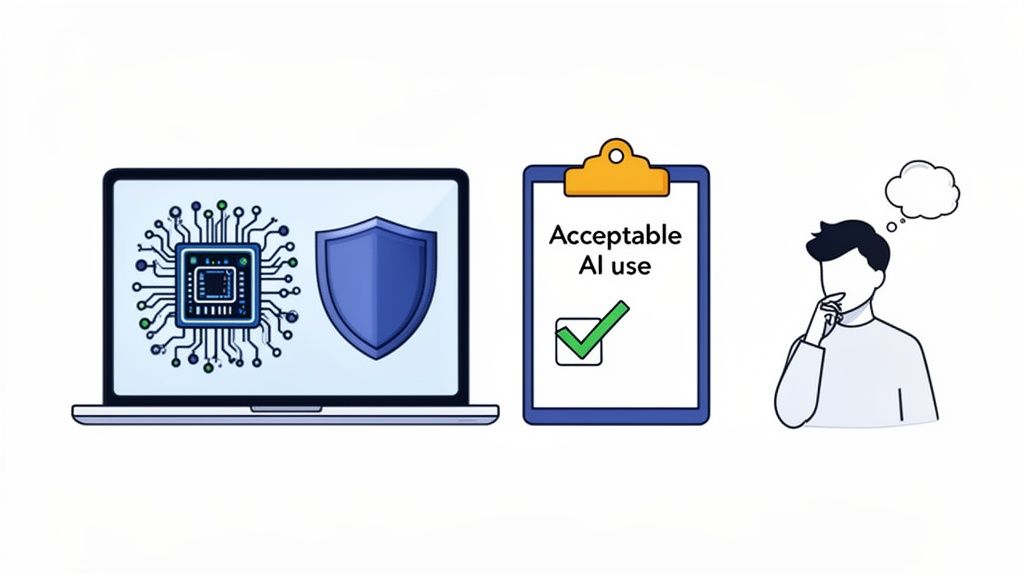
This isn't just a hypothetical issue; it's where the entire sector is headed. A recent survey from Vega IT showed that while nonprofits currently rate AI's importance at about a 6 out of 10, they expect that to skyrocket to nearly 9 out of 10 in the next three years. The problem? Most organizations don't feel ready, citing major worries about ethics and bias. That's why having a clear policy isn't just a good idea—it's essential.
How to Build an Acceptable AI Use Policy
It’s time to add a section on technology ethics to your code, specifically an Acceptable AI Use policy. This shouldn't be a dry list of "don'ts." Think of it more as a set of guiding principles that help your team use these new tools in a way that aligns with your mission.
The policy needs to be practical and speak directly to the tools your team is actually using. For instance, many smaller nonprofits are dipping their toes into AI for things like grant writing. A good policy makes it crystal clear that these tools are there to assist, not to invent facts or plagiarize. For a deeper dive on this, our guide on using AI for grant writing shows how to apply these tools the right way.
Your AI policy should cover a few key bases:
- Protecting Data: Make it non-negotiable. Any donor, client, or staff data put into an AI tool must be anonymized or handled with the strictest confidentiality.
- Being Transparent: Be upfront about where you're using AI in significant ways. This could be anything from automated decisions about program eligibility to personalizing a major fundraising appeal.
- Keeping Humans in Charge: A human must always review, fact-check, and approve AI-generated content. Always. This ensures everything is accurate and, most importantly, true to your mission.
- Watching for Bias: AI models can inherit and even amplify societal biases. Your policy should include a commitment to actively check AI outputs for fairness and equity.
An AI use policy isn't about shutting down innovation. It's about giving your team the green light to explore new tools responsibly. It creates a safe space for them to experiment, knowing they're backed by a clear ethical framework that protects your people and your reputation.
Bringing Your Policy to Life with Real Scenarios
To make sure your policy doesn't just sit on a shelf, ground it in the real world. Including practical examples helps your team see how the rules apply to their day-to-day work.
For example, your code could explicitly state: "Using an AI assistant to brainstorm ideas for a grant proposal is a great use of the tool. Using it to invent client testimonials or program statistics is a serious violation of our ethical standards."
Imagine a social services nonprofit using an AI tool to spot trends in client intake forms. Your policy should guide them to strip out all personally identifiable information first. It should also require that any insights the algorithm finds are double-checked by experienced program staff before they're used to make any changes to service delivery.
By thinking through these modern challenges, your nonprofit code of ethics transforms from a static document into a living guide that steers your organization toward a more trusted and sustainable future.
Answering Your Questions About Nonprofit Ethics
When you're pouring your heart and soul into building a nonprofit, the formal side of governance can sometimes feel overwhelming. You’ve put in the work to create a nonprofit code of ethics, but that often just leads to more questions. Let's tackle some of the most common ones I hear from leaders just like you.
My goal here is to cut through the noise and give you clear, practical answers. These are the real-world sticking points that can get you bogged down. Let's get them sorted so you can focus on your mission with confidence.
How Often Should We Be Looking at Our Code of Ethics?
Think of your code of ethics as a living document. It’s not something you create once, file away, and forget. The general rule of thumb is to schedule a formal review every 2 to 3 years. That cadence is usually enough to keep it from getting stale as your organization naturally changes over time.
However, some things just can't wait for the next scheduled review. Certain events should trigger an immediate look at your code to make sure it still holds up.
You'll want to pull it out for an immediate review when you have:
- Major shifts in your programs: Launching a big new initiative can bring up ethical questions you've never had to consider.
- New kinds of funding: That big government grant or corporate sponsorship? It often comes with its own set of compliance rules that need to be baked into your code.
- A jump in technology: Maybe you're starting to use AI to analyze donor data or new software to manage client information. Your code needs to catch up to address the new privacy and usage issues that come with it.
A great way to handle this is to task a board committee, like your governance committee, with leading the review. Make sure they get input from staff, too—they're the ones living these policies day-to-day. Keeping your code current sends a powerful signal to funders that your commitment to good governance is active, not just for show.
What’s the Difference Between a Conflict of Interest Policy and a Code of Ethics?
This is a fantastic question, and it's one I get all the time. They are definitely related, but they play very different roles. The easiest way to think about it is in terms of scope.
Your Conflict of Interest (COI) policy is a specific, mandatory chapter within the larger book of your Code of Ethics. One is a detailed rulebook for a single issue; the other is the guiding philosophy for your entire organization.
The COI policy is laser-focused. Its job is to define and manage situations where a board or staff member’s personal interests could clash with their duties to the nonprofit. It spells out what a conflict is, how to disclose it, and what happens next.
Your Code of Ethics, on the other hand, is the big picture. It sets the ethical compass for your entire organization, covering a whole range of areas:
- Confidentiality and how you handle sensitive information
- Ethical fundraising practices
- Responsible use of the organization's money and property
- Creating a respectful and fair workplace
- Protecting whistleblowers who speak up
So, while your COI policy is absolutely critical, it’s just one piece of your broader nonprofit code of ethics.
We’re a Really Small Nonprofit. Do We Actually Need a Formal, Written Code?
Yes. 100% yes. In my experience, a formal written code is even more important for a small or new nonprofit than it is for a huge, established one.
Think about it: in a small team, everyone wears multiple hats. Lines can get blurry. Unwritten rules and informal ways of doing things can easily lead to confusion, or worse, an ethical misstep that you never saw coming.
A written code brings immediate clarity and sets a professional tone from the get-go. It’s also one of your most powerful tools for building credibility with your first major donors and grantmakers. When a funder sees you’ve already taken the time to formalize your commitment to integrity, it builds an enormous amount of trust.
This doesn't have to be a 50-page legal document. A straightforward 2-4 page guide covering the basics—honesty, fairness, accountability—is infinitely better than nothing. It gives you a solid foundation that you can build upon as your organization grows and the challenges you face become more complex.
At Fundsprout, we believe strong governance is the bedrock of fundraising success. Our AI-powered platform helps you find the right grants and manage compliance, ensuring your ethical commitments are reflected in every proposal you submit. Learn how you can build trust and win more funding.
Try 14 days free
Get started with Fundsprout so you can focus on what really matters.