A Nonprofit Branding Guide to Build Trust and Win Grants
Discover how to build a powerful mission-driven brand with our nonprofit branding guide. Learn actionable steps to engage donors and win more grants.


Abdifatah Ali
Co-Founder
A strong brand is so much more than a pretty logo—it's the very soul of your organization. It’s the promise you make to your community, your donors, and the foundations you ask for support. A promise of real impact, unwavering reliability, and shared values. When that brand is clear, compelling, and consistent, it doesn't just make your mission memorable; it makes fundraising fundamentally easier.
Why a Strong Brand Is Your Nonprofit's Greatest Asset
Think of your brand as your nonprofit’s personality. Is it compassionate and nurturing? Bold and disruptive? Maybe it's steady and reliable. This personality infuses every single touchpoint, from a quick social media post to a detailed grant proposal. A well-defined brand builds the deep-seated trust that is the absolute currency of the nonprofit world.
When people trust you, they invest in you—with their time, their money, and their voice. This isn't just a warm, fuzzy feeling; it translates directly into tangible results. A consistent brand story can turn a casual follower into a passionate advocate and a one-time donor into a monthly supporter.
In a crowded funding space, a powerful brand makes you stand out. Grantmakers sift through mountains of proposals. A clear, professional identity instantly signals that your organization is credible, organized, and capable of delivering on its promises. It shows them you're built to last.
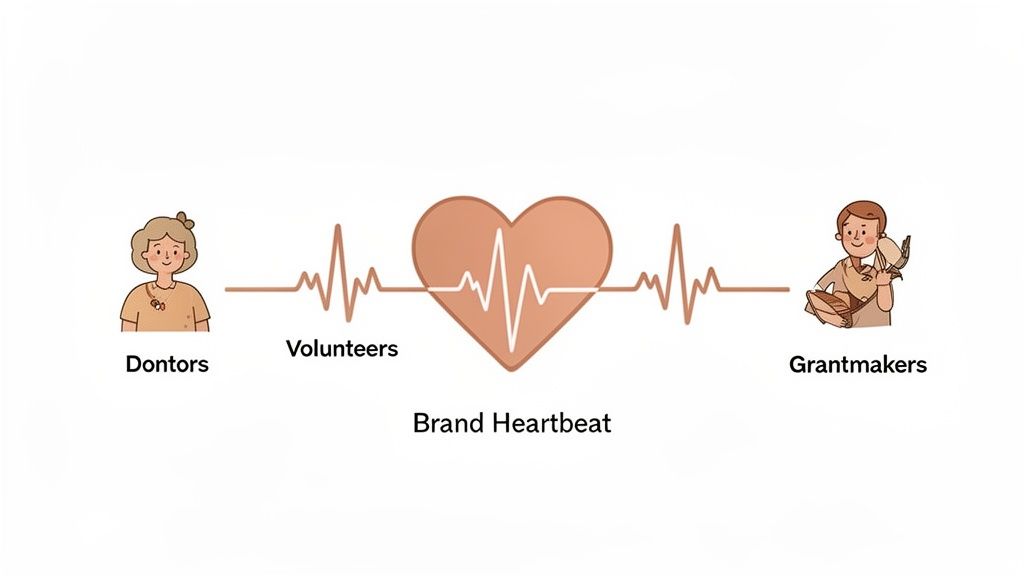
This simple visual breaks down how the core pillars of branding work together to drive success.

As you can see, building trust and clarifying your mission are the foundation. Get those right, and your fundraising becomes dramatically more effective.
Connecting Brand Strength to Real-World Results
The need for a distinct brand has never been more urgent. In 2021, nonprofits boosted their digital ad budgets by an average of 19% just to get noticed online. It worked. Search ads delivered a remarkable $3.72 return on ad spend. Email marketing was just as crucial, with lists growing by 7% and 26% of donors saying an email inspired them to give. You can dig deeper into these numbers in HubSpot's roundup of nonprofit marketing statistics.
These figures prove a critical point: branding isn't an overhead expense. It's a strategic investment with a measurable return, ensuring your message cuts through the noise and connects with the right people.
A strong brand doesn't just tell people what you do; it makes them feel why it matters. That emotional connection is what drives action, from a five-dollar donation to a multi-year grant.
Ultimately, everything in this nonprofit branding guide is designed to help you build a cohesive identity that serves one purpose: to advance your mission. A powerful brand becomes your hardest-working asset, tirelessly building credibility, attracting support, and securing the funding you need to make a real difference.
The Five Pillars of a Successful Nonprofit Brand
To build a brand that resonates and drives results, it helps to break it down into five core components. Think of these as the essential building blocks for creating a memorable and effective identity that funders and donors will trust.
By deliberately building out each of these five pillars, you create a brand that is not only authentic to your mission but also strategically positioned to attract the resources you need to grow.
Defining Your Core Brand Strategy
Think of your brand strategy as your nonprofit's internal compass. It's the blueprint that guides every single decision, from the emails you send to the programs you launch, ensuring everything points directly back to your mission. It goes far beyond what you do; it’s about answering the fundamental question of why you exist and what unique space you hold in the hearts and minds of your supporters.
This whole process kicks off with a really honest internal conversation. You have to be able to answer this one question: "Why should someone support us over any other organization?" This isn't about claiming to be better than everyone else. It’s about being crystal clear on your specific value and the unique impact you deliver. Without that clarity, your message is just more noise.
Uncovering Your Unique Position
Before you can define your position, you have to understand the landscape you're operating in. Who else is out there working toward a similar goal? And what makes your approach different? Your sweet spot—your unique position—is found where your community’s needs, your organization's strengths, and the gaps left by others all overlap.
Try getting your team together and wrestling with these questions:
- If our nonprofit vanished tomorrow, what specific void would be left in our community?
- What is the one thing we do better than anyone else?
- What core belief is the engine behind every program we run and every dollar we raise?
The answers you come up with are the bedrock of your brand. They help you build a compelling story that connects with donors and grantmakers, proving that your work isn't just important—it's indispensable. This strategic clarity is a vital part of your organization's plan of record, which you can learn more about here: https://www.fundsprout.ai/resources/plan-of-record.
Moving Beyond Demographics in Audience Segmentation
Knowing who your audience is is crucial, but great branding goes deeper than just demographics. Sure, it’s helpful to know the age, location, and income of your donors. But what’s far more powerful is understanding their motivations, their values, and what truly drives them. This is the leap from demographics to psychographics.
Instead of thinking about "female donors, age 45-65," you start targeting "community-minded leaders who value transparency and want to see a tangible local impact from their contributions." See the difference? That deeper understanding lets you communicate in a much more personal and effective way.
A powerful brand can transform donor priorities. Recent trends show a shift where psychographics have overtaken basic demographics, allowing organizations to connect on deeper levels of aspiration and motivation. This has led to tactics where mission and wit speak louder than logos, making brands feel more authentic.
This nuanced approach helps you tailor your message for completely different groups. Grant reviewers, for instance, are their own distinct audience. They’re motivated by hard data, proven outcomes, and how well your work aligns with their foundation's priorities. Your brand strategy has to equip you to speak their language just as fluently as you speak to your grassroots volunteers.
Creating Actionable Audience Personas
To make these audience segments feel real, you need to create detailed personas. A persona is basically a semi-fictional character who represents a key group you're trying to reach. Give them a name, a backstory, and a set of goals and challenges that relate to your mission.
Example Persona: "The Engaged Advocate"
- Name: Sarah Chen
- Role: Corporate professional, monthly donor, and occasional volunteer.
- Motivations: Believes deeply in social responsibility and wants to feel connected to her community. She needs to see tangible proof that her support is making a real difference.
- Communication Style: Prefers quick, impactful updates via email and is active on LinkedIn. Stories of individual success really resonate with her.
Creating just 2-3 of these key personas—for major donors, corporate partners, or even grant program officers—can transform your strategy from an abstract idea into a practical, day-to-day tool. It helps your team actually visualize who they’re talking to, making sure every single message hits the mark.
If you need help developing a robust strategy and visual identity, exploring specialized branding and identity services can solidify the foundation for all your future fundraising and outreach.
Crafting Your Message to Inspire Action
Your brand strategy gives you the "why," but your messaging is all about the "what" and "how." It's where you take those big, beautiful ideas from your mission and turn them into words that actually connect with people. Words that build trust and, most importantly, move them to donate, volunteer, or fund your work.
Great messaging isn’t about sounding slick or corporate. It’s about making your impact feel personal and urgent.
Think of it like building a bridge. On one side, you have all your organization’s amazing work, data, and programs. On the other, you have a potential supporter who wants to make a difference but is short on time and attention. Your messaging is the bridge that connects the two—making your work understandable, relatable, and impossible to ignore.
Developing Your Core Value Propositions
A value proposition is just a fancy way of saying: "Here's the good we do, and here's why you should care." It’s a clear, simple promise of the value you deliver.
The trick is, you don't just have one. Your messaging has to shift depending on who you're talking to. A major donor is listening for something completely different than a grant reviewer or a corporate partner.
For example, you might frame the same program in three different ways:
- For a Major Donor: "Your investment gives 100 kids a safe place to go after school, providing tutoring and mentorship that builds their confidence to succeed." (This focuses on direct, human impact).
- For a Grant Foundation: "Our evidence-based program has a proven 92% success rate in improving literacy scores, which directly aligns with your foundation's goal of closing the educational achievement gap." (This speaks their language: data, scale, and alignment).
- For a Corporate Partner: "A partnership with us gives your team meaningful volunteer opportunities and publicly showcases your company's commitment to the community, boosting your brand reputation." (This highlights the mutual benefit).
Nailing these distinct messages means you’re always hitting on what your audience values most. It’s a non-negotiable part of any solid nonprofit branding effort.
Your brand message isn't a single script; it's a collection of core talking points. The goal is to get everyone in your organization telling the same story, just with a different emphasis depending on who's in the room.
The Art of the Elevator Pitch
You've got 30 seconds in an elevator with someone who could change everything for your organization. What do you say? That's your elevator pitch—a quick, memorable summary of what you do, who you help, the problem you solve, and the difference you make.
A truly effective pitch usually follows a simple rhythm:
- The Hook: Start with the problem in a way that makes people lean in.
- The Solution: Briefly explain how you’re fixing it.
- The Impact: Hit them with a powerful result or a statistic that proves it works.
- The Ask: End with a simple call to action, like, "I'd love to tell you more over coffee sometime."
And it’s not just for elevators. This is your go-to for networking events, board meetings, and the opening lines of a fundraising email. It's your brand, spoken out loud.
Weaving Stories with Data for Maximum Impact
Storytelling is the beating heart of nonprofit messaging. A statistic can show the scale of an issue, but a personal story makes it real. It gives it a face and a name.
The real magic happens when you blend the two. A powerful story about one person's journey, backed by the data that proves you can replicate that success, creates a message that hits both the heart and the head. It’s emotionally resonant and logically compelling.
This is absolutely crucial when you’re trying to secure funding. For instance, when you learn how to write a strong statement of need for a grant, you’ll see it’s not about just listing statistics—it’s about telling the story of the community you serve and why your work is the answer.
Introducing the Messaging Matrix
So how do you keep all this straight? Create a Messaging Matrix. This is a simple, one-page document that becomes your team's cheat sheet for communication. It organizes all your key talking points in one place.
Here’s a simple way to structure it:
A tool like this ensures that no matter who is speaking for your nonprofit, their words are strategic, consistent, and crafted to inspire action.
Building a Cohesive Visual Identity
Think of it this way: if your brand strategy is your nonprofit’s personality, then your visual identity is how it shows up in the world. It’s the collection of colors, fonts, and images that create an instant, gut-level feeling about who you are and what you stand for. A professional and consistent look signals credibility and stability—two qualities that are absolutely essential when you're asking for funding.
You don't need a massive budget to create a powerful visual brand. The secret isn't throwing money at the problem; it's about being thoughtful and strategic. Every visual element should work together to tell the same story, creating a seamless experience whether someone sees a social media post, opens an email, or reads your annual report.

This process is all about making smart choices that reinforce your mission and make your organization instantly recognizable.
Your Logo Is Your Handshake
Your logo is the most concentrated version of your brand. It's often the very first thing people see, so it has to communicate your organization's essence in a single glance. A great nonprofit logo is simple, memorable, and full of meaning.
As you develop your logo, keep these core principles in mind:
- Simplicity: A complicated logo is tough to remember and looks messy when scaled down for a mobile screen or printed on a pen. Keep it clean.
- Relevance: The design should hint at your mission without being too on-the-nose. For example, a literacy organization might subtly incorporate a book or a lightbulb.
- Timelessness: Steer clear of trendy designs that will look dated in a few years. You want a classic look that can grow right alongside your organization.
You don't need a high-priced agency for this. Working with a freelance designer or using accessible tools like Canva can deliver fantastic, professional results without breaking the bank. The goal is a symbol you can be proud of—one that stands as a consistent marker for all the good work you do.
Choosing a Color Palette That Speaks Volumes
Color is a shortcut to emotion. The specific shades you choose for your brand can instantly make people feel trust, urgency, compassion, or optimism. Having a well-defined color palette is one of the easiest ways to keep your brand looking consistent across everything you produce.
Think about the psychology behind your color choices:
- Blues often communicate trust and professionalism, which is why you see them used by so many health and advocacy groups.
- Greens are tied to growth, nature, and well-being, a perfect fit for environmental or community wellness nonprofits.
- Reds and Oranges create a sense of energy and passion, which can be incredibly effective for driving action in fundraising campaigns.
Your visual identity is the silent ambassador for your mission. When consistent, it builds subconscious trust and recognition, making every piece of communication more effective and every funding request more credible.
A good rule of thumb is to limit your primary palette to 2-3 main colors. This prevents your materials from looking chaotic. You can always add a couple of secondary or accent colors for more flexibility. The real magic happens when you use them consistently, so that over time, people automatically connect those colors with your mission.
Empowering Your Team with Simple Templates
Consistency is where a visual brand truly comes to life. The absolute best way to make sure everyone on your team—staff and volunteers alike—stays on-brand is by giving them easy-to-use templates for everyday materials. This empowers people, even those with zero design experience, to create professional, cohesive documents.
Start by building templates for your most-used items:
- Social Media Graphics: Pre-made layouts for Instagram posts or Facebook banners with your logo and brand colors already locked in place.
- Email Newsletters: A standard header and footer that makes every email instantly recognizable in a crowded inbox.
- Program Summaries: A clean, one-page document layout for sharing updates with stakeholders and funders.
Templates take the guesswork out of the equation. They stop the "brand drift" that happens when everyone is left to create their own materials from scratch. They are a practical, non-negotiable part of any nonprofit branding effort, ensuring your visual identity stays strong and unified across every single touchpoint.
Putting Your Brand into Practice Consistently
You've done the hard work of crafting a brilliant brand strategy and designing a stunning visual identity. But here's the thing: those elements only make a real-world impact when they're used consistently, every single time. This is where the rubber meets the road, turning your brand from a concept on a whiteboard into a living, breathing part of your nonprofit’s daily life.
Think of your brand as a promise you make to your community. Every interaction—a website visit, a social media post, an email newsletter—should feel familiar and reinforce that promise. This consistency is what builds recognition, and more importantly, the deep-seated trust you need to inspire donors, rally volunteers, and win over grantmakers.
Creating Your One-Page Brand Guidelines
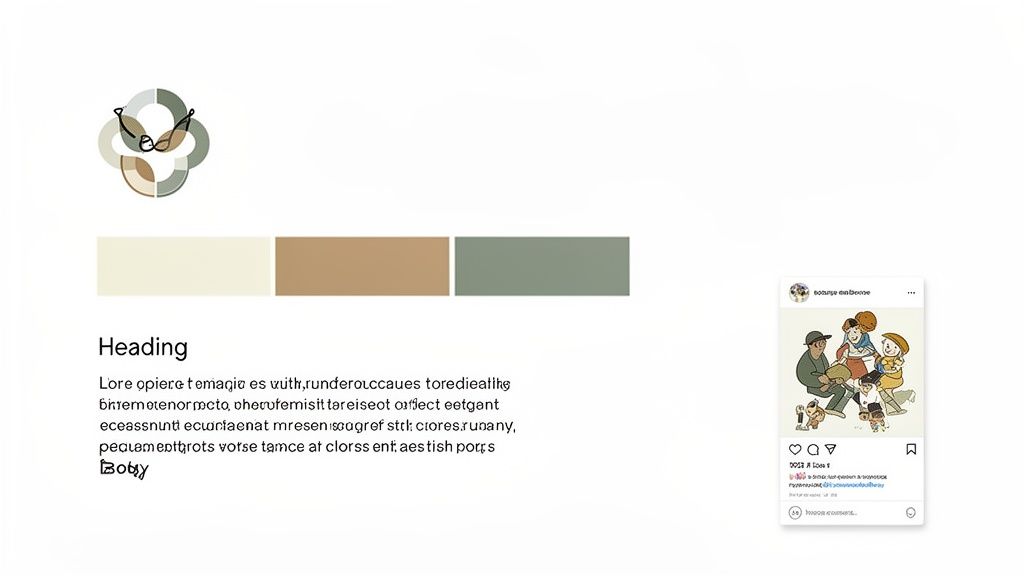
The single most powerful tool for keeping everyone on the same page is a set of brand guidelines. Forget those massive, 100-page binders that no one ever reads. For most nonprofits, a simple, one-page "cheat sheet" is infinitely more practical and effective.
This document empowers every single person—from your executive director to your newest volunteer—to be a confident brand ambassador. It should be highly visual, easy to scan, and cover the essentials without getting bogged down in jargon.
Here’s what to include:
- Logo Usage: Show the main logo and any approved variations. Add simple rules for spacing and, crucially, how not to use it (e.g., no stretching, recoloring, or squishing!).
- Color Palette: Display your primary and secondary colors. Be sure to include the specific HEX or RGB codes for digital use and CMYK for print materials.
- Typography: Clearly list your main fonts for headings and body text, with a quick note on when to use each one.
- Brand Voice: This is huge. A few bullet points can capture your personality. Are you "empowering, knowledgeable, and compassionate" or "bold, urgent, and direct"?
A guide like this removes all the guesswork.
Rolling Out Your Brand Internally and Externally
A successful brand launch always starts from the inside out. Your own team members are your most important advocates. They need to understand the "why" behind the brand and believe in it before they can share it with the world.
Internal Rollout:
- Host a Launch Meeting: Get everyone together to unveil the brand. This is your chance to tell the story behind the changes and connect it directly to your mission.
- Provide Training: Don't just email the guidelines—walk your team through them. Show them where to find the new logos, templates, and other assets.
- Create Brand Champions: Appoint a few enthusiastic team members who can be the go-to people for any brand-related questions.
External Rollout:
Once your team is on board, it's time to introduce your brand to the community. This isn't just a logo swap; it’s a golden opportunity to re-engage your audience and tell your story with fresh energy.
A great brand launch is more than an announcement—it's a strategic campaign. It's your chance to retell your story, re-energize your supporters, and reaffirm your commitment to the mission with renewed clarity and purpose.
Make sure your external launch is a coordinated push across all your channels. Update your website, social media profiles, email signatures, and print materials all at once for maximum impact. To make sure your digital home base is ready, it's a good idea to brush up on Nonprofit Website Best Practices.
Maintaining Brand Integrity Over Time
Keeping your brand consistent isn't a one-and-done project; it’s an ongoing commitment. The nonprofit communications world is always changing, and your brand needs to keep up.
Recent data shows that as competition for attention increases (68.3% of marketers report challenges), a clear and consistently applied brand is what helps you stand out. With 77% of nonprofit marketers saying their work is adding more value than ever, a solid style guide is essential. It ensures all your communications, even those drafted with AI, perfectly reflect your unique voice and ultimately boost your grant success.
This long-term dedication to consistency is what transforms your brand from a project into a core part of your culture. It ensures every single thing you do reinforces the mission you work so hard to achieve.
5. Measuring Your Brand's Impact on Funding
A powerful brand feels great, but for nonprofit leaders and grantmakers, the real question is always: does it actually work? Proving the value of your brand means connecting all that great design and messaging work directly to the numbers that matter most—donations, grant approvals, and supporter growth.
This is how you shift the conversation about your brand from a "marketing expense" to a core, mission-driving asset.
Think of it this way: your brand is the wind in your sails. You can't see the wind itself, but you can absolutely measure the speed and direction of your ship. In the same way, you can track the direct effect your brand has on the key performance indicators (KPIs) that dictate your organization's financial health.
This isn't about vanity metrics. It’s about focusing on the hard data that shows how a trusted, recognizable brand makes every single fundraising effort more effective.
From Awareness to Acquisition
The journey starts by tracking brand awareness. When your brand grows stronger, more people know who you are and what you stand for, which naturally creates a bigger pool of potential donors and advocates.
Keep an eye on these key awareness metrics:
- Website Traffic: Are more people finding you by searching for your organization's name directly? A spike in this "branded search" traffic is a crystal-clear sign that your name recognition is on the rise.
- Social Media Engagement: Look past the simple "likes." Are you seeing a genuine increase in shares, meaningful comments, and organic mentions? This signals that your message is truly connecting and being amplified by your community.
- Media Mentions: Pay attention to how often your nonprofit is mentioned by news outlets, industry blogs, or community partners. This is a powerful signal of your growing influence and credibility.
When you see an upward trend here, you know your brand is gaining traction. This visibility is what feeds your fundraising pipeline and makes every subsequent ask a little bit easier.
Connecting Brand Health to Fundraising Outcomes
The next step is to draw a direct line from that growing awareness to your fundraising results. A strong, trusted brand should make it easier and more cost-effective to bring in new donors and keep them for the long haul.
Proving your brand’s ROI isn't just about celebrating wins; it’s about making a data-backed case to your board and funders for continued investment in the very thing that builds long-term trust and financial stability.
Here’s how to connect the dots between your brand and your bottom line:
- Donor Acquisition Cost (DAC): As your brand becomes more familiar and respected, it should cost less to acquire a new donor. People are simply more willing to give to an organization they already know and trust.
- Donor Retention Rate: A deep, emotional connection to your brand's mission is what keeps donors coming back year after year. A small improvement in this metric can be a massive financial win over time.
- Average Gift Size: When donors feel a real sense of alignment with your brand, they are often inspired to give more generously. Track this to see if trust is translating into larger contributions.
- Grant Success Rate: Grantmakers are always looking for credible, stable partners. A professional, consistent brand signals that your organization is well-managed and a smart investment, which can directly improve your odds of securing funding.
For a deeper dive into the financial side of things, check out our complete guide on nonprofit fundraising best practices.
Key Brand Metrics and Their Impact on Funding
To truly demonstrate the power of your brand, you need to track the right data. This table breaks down the essential metrics that show how brand strength directly translates into tangible fundraising results.
By tracking these metrics, you can build a simple dashboard that tells a powerful story. It proves that a strong brand isn't a luxury—it's a fundamental asset for hitting your funding goals and securing your nonprofit's future.
Frequently Asked Questions About Nonprofit Branding
Taking on a branding project can feel a little daunting. A lot of questions pop up, especially when you're working with a tight budget and every move counts. Let's tackle some of the most common concerns we hear from nonprofit leaders to give you some clarity and confidence.
Think of this as your go-to troubleshooting guide for the real-world hurdles you might face, from getting everyone on board to making the case for the investment.
How Much Does a Rebrand Cost for a Small Nonprofit?
This is always the first question, and for good reason. The truth is, the cost can vary wildly, but a rebrand doesn't have to break the bank. While a big project with a full-service agency can certainly cost tens of thousands, many smaller nonprofits get fantastic results on a much smaller scale.
You can often find skilled freelance designers for a few thousand dollars to build out a new logo and visual identity. Tools like Canva also provide incredibly affordable ways to create professional-looking materials yourself. The trick is to define your scope clearly and tackle the most important elements first, like your logo and basic brand guidelines.
How Do I Get My Board to Approve a Branding Budget?
Your board is laser-focused on being good stewards of the organization's money, as they should be. To win their support, you need to frame this project as a strategic investment in your fundraising machine, not just a "nice-to-have" expense.
It's all about connecting the dots with data. Show them how a clear, professional brand directly impacts the bottom line through higher grant success rates, better donor retention, and even lower costs to acquire new supporters.
When you present it as a tool that makes every single fundraising dollar work harder, you shift the conversation from cost to a clear return on investment for the mission.
Can We Just Refresh Our Logo Instead of a Full Rebrand?
Absolutely. A full-blown rebrand isn't always the answer. If your mission, vision, and core strategy are still rock-solid but your visual identity just looks a bit tired, a logo refresh and a new color palette might be exactly what you need. This is often a much faster and more budget-friendly approach.
The important thing is to be honest with yourself about the real problem. Is it just the visuals, or does it go deeper? If your messaging isn't resonating anymore or your position in the community has changed, a simple facelift won't fix the core issue. After all, a new logo slapped on a confusing message is still just a confusing message.
A good diagnostic process helps you figure out what you truly need. Sometimes, a focused visual update is the perfect way to breathe new life into an already strong brand.
Fundsprout is an AI grant success platform that helps nonprofits find perfect funding opportunities, write compelling proposals in their own voice, and manage compliance effortlessly. Stop chasing grants and start winning them. Discover how Fundsprout can accelerate your mission.
Try 14 days free
Get started with Fundsprout so you can focus on what really matters.