Mastering Non Profit Donation Receipts: 2026 Guide
Create compliant non profit donation receipts. Our 2026 guide covers IRS rules, templates for all gift types, & automation tips.

Abdifatah Ali
Co-Founder
You've closed a campaign, the event team is packing up signage, online gifts are still coming in overnight, and your inbox already has questions from donors asking, “Will I get a receipt?” That moment tells you a lot about how your organization runs. If receipts come quickly and accurately, donors feel confident. If they're delayed, inconsistent, or missing key language, small administrative problems turn into trust problems.
For a small nonprofit, this work can feel deceptively minor. It isn't. A non profit donation receipt sits at the intersection of fundraising, finance, compliance, and donor care. It's one of the few documents almost every donor sees, and it often arrives right after the emotional high point of giving.
Why Your Donation Receipt Is More Than Just a Thank You
The busiest receipt periods usually follow your busiest fundraising moments. That's when the weaknesses in your process show up fast. One staff member exports online donations, someone else checks mailed checks, and a third person tries to remember which gala purchases included dinner, parking, or auction items.

The pressure exists because most nonprofits manage two very different receipt realities at once. In major-market fundraising data, 76.12% of all donors gave less than $100, while 68.43% of donation revenue came from the 0.77% of donors who gave over $5,000. The same source reports an average donation amount of $327.66 in 2023. Those figures show why every receipt matters, whether you're processing a high volume of small gifts or carefully stewarding a handful of major ones through the same system (fundraising statistics data examples).
Receipts carry three jobs at once
A receipt is obviously a thank-you. But in practice, it does three jobs:
- It confirms the transaction: the donor needs a written record of what they gave.
- It supports stewardship: the tone and accuracy tell the donor whether your organization is organized and respectful.
- It protects compliance: certain gifts require very specific wording if the donor wants to claim a deduction.
That combination is why receipting shouldn't be handed off as an afterthought. The donor who gives a modest online gift may never call you about a missing receipt, but they still notice how your organization communicates. The donor who gives a large gift almost certainly will.
A sloppy receipt tells a donor that the back office is shaky, even if your program work is strong.
What good receipting does for a small team
Small nonprofits often think they need a “perfect” system before they can improve. They don't. What works is a repeatable process that handles common gifts correctly and flags unusual ones for review.
In real operations, the strongest receipting systems are usually boring. They use standard templates. They define who approves special cases. They don't rely on one person's memory. They don't force staff to reconstruct details weeks later from event spreadsheets and email threads.
Here's the practical shift I'd make with any new team member: stop thinking of the non profit donation receipt as a courtesy note that accounting sends later. Treat it as a frontline fundraising document. When you do, you write better templates, send them faster, and make fewer avoidable mistakes.
Meeting IRS Requirements for Tax-Deductible Gifts
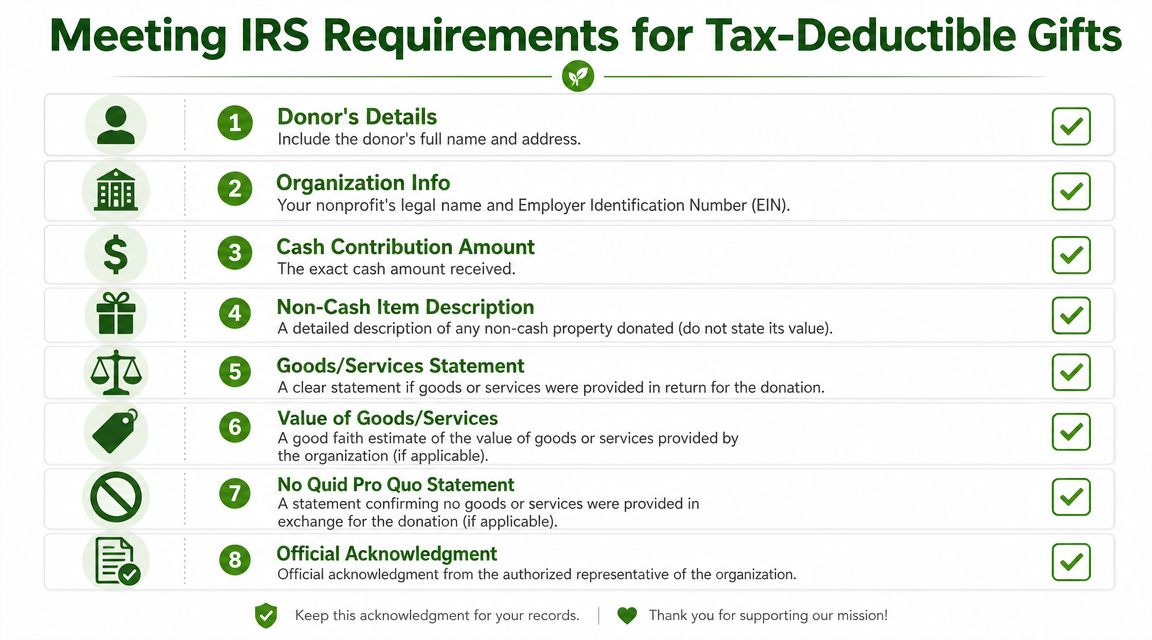
If you're building or fixing your receipt process, start with the legal minimum. In the United States, the IRS requires a contemporaneous written acknowledgment for any single charitable contribution of $250 or more if the donor wants to claim a tax deduction. That acknowledgment must include specific details, including whether the nonprofit provided any goods or services in exchange for the gift (donation receipt guidance).
The non-negotiable checklist
When I audit receipt templates, I look for these elements first:
- Donor identification: include the donor's name as it appears in your records.
- Organization identification: include your nonprofit's legal name.
- Gift date: use the date the contribution was received.
- Cash amount or non-cash description: list the amount for cash gifts, or describe non-cash property without assigning a value.
- Goods or services disclosure: state clearly whether the donor received anything in return.
- Value statement when applicable: if the donor received something in return, include the value information required for that situation.
- Written format: email or letter is acceptable. A verbal thank-you is not.
- Clean organizational details: adding your EIN and 501(c)(3) status is best practice because it helps donors verify deductibility and keeps records cleaner.
That last point isn't always legally required in every receipt scenario, but it's smart. Donors forward receipts to accountants, family offices, and tax preparers. The easier your document is to understand, the fewer follow-up questions your staff has to answer.
Where teams get tripped up
Most compliance errors aren't dramatic. They're simple omissions.
A receipt says “Thank you for your support” but never states whether goods or services were provided. A gala donor gets a receipt that lists the ticket price but not the value of the meal. A staff member enters a non-cash donation and adds an estimated value, even though that valuation shouldn't appear on the acknowledgment.
Practical rule: If your template leaves room for interpretation, staff will fill the gap differently each time.
For multinational donors or organizations with supporters outside the U.S., tax documentation can become even more confusing. If you work with donors who need to confirm eligibility in another jurisdiction, resources on verifying DGR status for tax purposes can help staff understand why tax language and entity status matter so much in donor communications.
Here's a simple way to think about receipt review before anything is sent:
- Check the gift type first. Cash, non-cash, and event-related gifts shouldn't use the exact same template.
- Check the tax language second. The disclosure line often matters more than the thank-you paragraph.
- Check the legal donor name last. The receipt should match the actual donor of record.
This short explainer is useful for training newer staff on the basics of acknowledgment language and timing:
What a compliant template should feel like
A strong receipt doesn't read like legalese, but it does need legal precision. That balance is what many teams miss. They either overcomplicate the language until the donor can't follow it, or they strip it down so much that a required disclosure disappears.
If your team is small, don't create one “master template” and force every gift into it. Create a few approved versions instead. One for standard cash gifts. One for non-cash contributions. One for event and benefit situations. That's easier to train, easier to audit, and much safer than improvising receipt language under deadline.
Handling Cash, In-Kind, and Quid Pro Quo Donations
Even experienced teams can make mistakes concerning non-profit donation receipts. The content of a non profit donation receipt changes based on what the donor gave and what, if anything, the donor received back. If you use the same wording for all gift types, you'll eventually send a receipt that's wrong.
Cash gifts are the simplest, but still need discipline
Straight cash gifts are the easiest to receipt. A normal acknowledgment should identify the donor and organization, show the date received, list the cash amount, and include the correct statement about whether goods or services were provided in exchange.
What doesn't work is mixing stewardship language with vague tax language. For example, a note that says “Thanks for sponsoring our work” may sound fine internally, but if the donor purchased a benefit package, that wording blurs the nature of the gift. Precision matters.
In-kind gifts require description, not valuation
For donated goods, staff should describe what was donated without assigning a value on the receipt. That rule matters because the organization acknowledges receipt of the property, but it doesn't determine the donor's tax value in the acknowledgment itself.
Common trouble spots include donated auction items, furniture, equipment, and supplies. Teams often want to be helpful by adding an estimated dollar amount. Don't do that in the receipt for the donated property itself. Describe the item clearly enough that the donor can identify it later.
If your staff can't tell, from the receipt alone, what item came in and when it arrived, the description is too vague.
Donated services create another point of confusion. Staff time, volunteer labor, and professional services may be extremely valuable to the organization, but they aren't handled the same way as donated property. The safest practice is to route unusual service-related scenarios through finance or legal review before issuing any tax-focused language.
Quid pro quo gifts need the clearest wording
The hardest category for most organizations is the quid pro quo contribution, where the donor gives money and receives something in return, such as a dinner, event admission, membership benefit, or item purchased at auction.
For quid pro quo contributions over $75, the IRS requires a written disclosure informing the donor that the deductible amount is limited to the excess of the contribution over the value of the goods or services provided. The receipt must include a good-faith estimate of that value (IRS written acknowledgment rules).
That requirement affects more gifts than many teams realize. Gala tickets are the classic example, but sponsorship packages can trigger the same issue depending on what the sponsor receives. If your team is building event packages or prospecting corporate support, it helps to review practical strategies for getting event sponsors alongside your receipt process, because sponsorship benefits and acknowledgment language should be planned together, not separately.
Donation Receipt Requirements by Gift Type
| Gift Type | What to Include on Receipt | Key Compliance Note |
|---|---|---|
| Cash donation | Donor name, organization name, date received, cash amount, statement about whether goods or services were provided | Use clear no-benefit language if nothing was provided |
| Non-cash goods | Donor name, organization name, date received, description of property, statement about whether anything was provided in return | Describe the item. Don't assign a value to the donated property on the receipt |
| Quid pro quo contribution | Donor name, organization name, date, total amount paid, statement that deductible amount is limited to the excess over value received, good-faith estimate of value provided | Extra disclosure applies when the donor receives something in return and the situation meets the IRS threshold |
| Auction purchase | Organization name, donor details, item description, amount paid, value of item or benefit received, deductible portion if any | Separate the purchase value from any charitable amount |
| Membership or event-related payment | Payment date, total paid, description of benefits, statement of whether goods or services were provided, value estimate when applicable | Don't assume every membership payment is fully deductible |
What works in practice
For small teams, the best approach is to assign one receipt category before the gift ever reaches accounting. Your donation form, event checkout flow, and CRM coding should identify whether the gift is:
- A pure donation
- A non-cash contribution
- An event-related payment
- A sponsorship or benefit-bearing contribution
- An exception that needs review
What fails is asking the person sending receipts to interpret the gift after the fact from payment notes. By then, the context is gone, and staff start guessing.
The easiest way to avoid mistakes is to make the gift type visible in the system from day one. Then the right template follows the transaction, instead of the transaction being squeezed into whatever template happens to be handy.
Timely Delivery and Smart Recordkeeping
A correct receipt sent late still causes problems. Donors want the document while the gift is fresh, and your team needs the paper trail while the transaction details are easy to verify. Prompt delivery also reduces the year-end scramble when supporters start looking for records all at once.
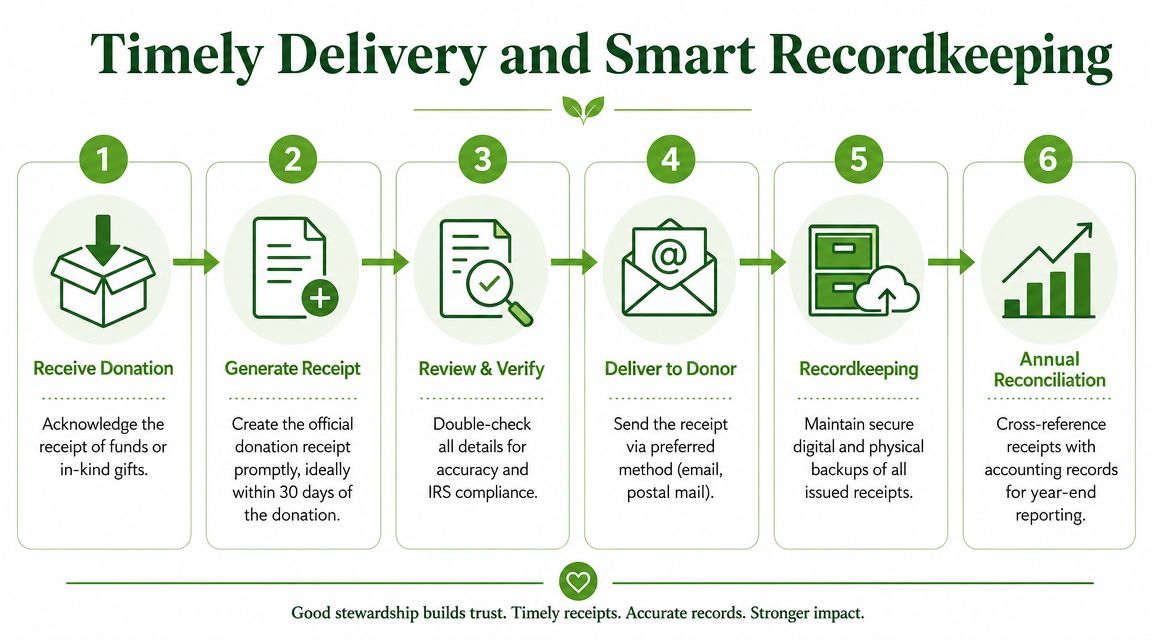
Industry guidance recommends issuing receipts within 48 hours of receiving the gift and providing year-end summaries for recurring donors. Verbal confirmations don't count for IRS purposes. Written letters or emails do (guidance on issuing donation receipts for different gift types).
Speed matters because memory fades
If a donor calls about a receipt two days after making a gift, your team can usually fix the issue quickly. If they call months later, the answer may depend on old spreadsheets, event notes, and staff members who no longer remember the transaction.
That's why I prefer a short operating window. Process the gift, generate the receipt, review the tax language, and send it while the details are still clear. For small nonprofits, speed is less about impressing donors and more about preventing avoidable errors.
A simple process a small nonprofit can maintain
You don't need a complicated workflow. You need one that survives busy weeks and staff turnover.
- Receive and code the gift: mark the transaction correctly at entry, including gift type and campaign.
- Generate the right template: don't draft from scratch unless the gift is unusual.
- Review before sending: check donor name, date, amount or property description, and disclosure language.
- Deliver in writing: use email when possible because it's faster and easier to store.
- Save the final version: keep it where development and finance can retrieve it.
- Reconcile at year-end: make sure receipts align with accounting records and donor summaries.
Good recordkeeping isn't glamorous. It's what lets you answer donor questions in minutes instead of rebuilding history from scratch.
Electronic beats paper for most teams
Paper receipts still have a place, especially for some major donors or older supporter segments. But for most organizations, email is the practical default. It's faster, searchable, and easier to archive.
The key is to make electronic delivery look intentional. Use a clear subject line, keep the body of the email short, and attach or embed a receipt that's easy to read on a phone. If your accounting and gift processing practices are still evolving, it also helps to tighten the underlying financial setup, especially around cash handling and reconciliation. A guide to nonprofit bank accounts is useful because receipting works best when your banking and bookkeeping flows are clean.
What to store every time
At minimum, your system should let you retrieve:
- The donor record
- The transaction date
- The amount or property description
- The receipt version that was sent
- The delivery method
- Any notes about goods or services provided
When organizations struggle with receipts, the issue often isn't the wording. It's the missing trail. If the final acknowledgment isn't saved in a consistent place, every future question becomes a mini-investigation.
Choosing the Right Tools to Automate Your Receipt Process
Manual receipting breaks first in small nonprofits because the same people are also running campaigns, booking meetings, reconciling deposits, and answering donor emails. Automation isn't a luxury here. It's how you keep quality from collapsing when volume spikes.
The best tools solve boring problems
A useful receipt system should do the routine work without creating new cleanup. Look for tools that can automatically generate receipts for online donations, store the exact acknowledgment sent, and apply different templates based on gift type.
A good system should also let you edit the stewardship message without touching the compliance language every time. That separation matters. You want room to personalize the donor experience, but you don't want staff rewriting tax statements in a hurry.
Features worth prioritizing
If budget is tight, don't buy based on the longest feature list. Buy based on the problems your team has.
- Template control: you need separate receipt templates for standard donations, non-cash gifts, and event-related transactions.
- Automatic triggers: online gifts should produce a written acknowledgment without staff intervention.
- CRM integration: receipts should live with the donor record, not in a disconnected inbox.
- Exception handling: unusual gifts should pause for review rather than auto-send with the wrong language.
- Searchable archives: staff should be able to pull a prior receipt quickly during donor calls.
- Year-end summary support: recurring and multi-gift donors shouldn't require a manual rebuild every winter.
If your office still handles mailed checks, paper forms, or receipts from field activity, document capture also matters. Before choosing a workflow, it's worth reviewing how small teams compare receipt scanning solutions so paper records don't stay trapped in filing cabinets and desk piles.
What doesn't work
The weakest setup is usually a patchwork of exports, shared drives, and one employee who “knows how it's done.” That system looks manageable until that person goes on leave or an audit question lands.
Another common mistake is over-automating before the receipt logic is clean. If your coding for event gifts, sponsorships, and non-cash donations is inconsistent, automation will send incorrect receipts faster. Fix the categories first. Then automate.
For teams shopping for donor systems, a practical way to narrow options is to compare platforms designed around fundraising workflows rather than generic contact management. This roundup of best CRM software for nonprofits is a good starting point for evaluating whether a tool can support both stewardship and compliance.
Building Donor Trust One Receipt at a Time
Most donors won't compliment your receipt process. They'll notice when it's smooth, clear, and dependable. That's the point. A strong non profit donation receipt process removes friction from giving and reinforces the sense that your organization is careful with both money and relationships.
The trust signal donors actually see
Donors rarely see your internal procedures, but they do see your follow-through. They notice whether the acknowledgment arrives promptly. They notice whether the language is clear. They notice whether your organization seems to understand the kind of gift they made.
That's why receipting is more than back-office administration. It's one of the clearest signals of professionalism you send after the gift itself.
A receipt doesn't have to be warm and lengthy to build trust. It has to be accurate, timely, and easy to understand.
The standard worth holding
Strong receipting comes down to a few habits:
- Use the right template for the right gift
- Send written acknowledgments promptly
- Keep disclosures precise
- Store every final receipt where your team can retrieve it
- Automate routine work, but review exceptions carefully
For small nonprofits, this discipline also strengthens the broader donor experience. The same organizations that send clear receipts tend to send clearer appeals, cleaner reports, and better renewal communications. If you're refining the way your organization shows up across donor touchpoints, a practical nonprofit branding guide can help align tone, clarity, and consistency.
A receipt won't replace strong fundraising strategy or meaningful stewardship. But it does support both. When your process is dependable, your staff spends less time fixing avoidable mistakes and more time building the relationships that sustain the mission.
Fundsprout helps nonprofits spend less time buried in compliance details and more time winning funding. If your team needs a better way to find grants, organize requirements, draft proposals, and stay audit-ready from application through renewal, explore Fundsprout.
Try 14 days free
Get started with Fundsprout so you can focus on what really matters.