Non Profit Consulting Services: A Leader's Guide
Your guide to non profit consulting services. Learn to identify needs, vet experts, compare costs, and decide if a consultant or a tool is right for you.

Abdifatah Ali
Co-Founder
Growth creates a strange kind of stress in nonprofit leadership. A program starts working, demand rises, the board gets excited, and suddenly the same success you wanted is exposing every weak spot behind the scenes. Donor stewardship slips. Reporting gets messy. Staff start carrying work that belongs to systems you never had time to build.
That's usually when people start searching for non profit consulting services.
Sometimes that's the right move. Sometimes it isn't. I've seen organizations hire a consultant when they really needed a better workflow, a clearer decision-maker, or a tool that could keep grant work from living in twelve spreadsheets and someone's inbox. I've also seen teams wait too long, hoping grit would solve a problem that required outside expertise.
The smart question isn't “Should we hire a consultant?” It's “What problem are we trying to solve, and what kind of support fits it?” If your organization is trying to build capacity, nonprofit capacity building grants can also shape what support is realistic and sustainable.
Your Mission Is Growing But Your Team Is Stretched Thin
A familiar pattern shows up in growing nonprofits. Program demand rises before infrastructure does. The executive director becomes the backup grant writer, backup operations lead, and backup board wrangler. Managers spend their week putting out fires instead of building a repeatable way to work.
That's where outside help starts to look attractive. And in many cases, it should.
The broader market reflects that demand. Independent market research projects the global nonprofit consulting service market at USD 0.73 billion in 2026 and USD 1.34 billion by 2035, with roughly 6.4% CAGR, driven in part by technology-enabled consulting that uses data analytics, CRM tools, and impact measurement to improve donor engagement and operational efficiency (Business Research Insights).
What growth pressure actually looks like
Most organizations don't say, “We need consulting.” They say things like:
- “Our board wants a strategic plan.” But no one has time to run a real planning process.
- “We need more grants.” But the underlying issue is weak grant readiness, not a lack of opportunity.
- “Our donors have gone quiet.” But stewardship is inconsistent because roles are unclear.
- “Staff are burning out.” Because systems live in people's heads, not in documented processes.
Those are not the same problem. They shouldn't get the same solution.
Practical rule: Don't buy consulting to relieve anxiety. Buy it to solve a defined organizational problem.
The real decision
Outside support usually falls into three buckets. You need a person, a process, or a platform.
A person helps when your team lacks judgment, facilitation skill, or specialized experience. A process helps when work is happening, but it's inconsistent and dependent on heroic effort. A platform helps when recurring work needs structure, visibility, documentation, and follow-through.
Leaders get in trouble when they skip diagnosis and jump straight to procurement. If the issue is board alignment, software won't fix it. If the issue is recurring grant workflow, a strategy memo alone won't fix it either.
The strongest nonprofits I've worked with treat consulting as one tool in a larger operating strategy. That mindset prevents two expensive mistakes. Hiring a consultant for work staff should own, and expecting staff to solve a problem they're not equipped to solve alone.
What Do Nonprofit Consultants Actually Do
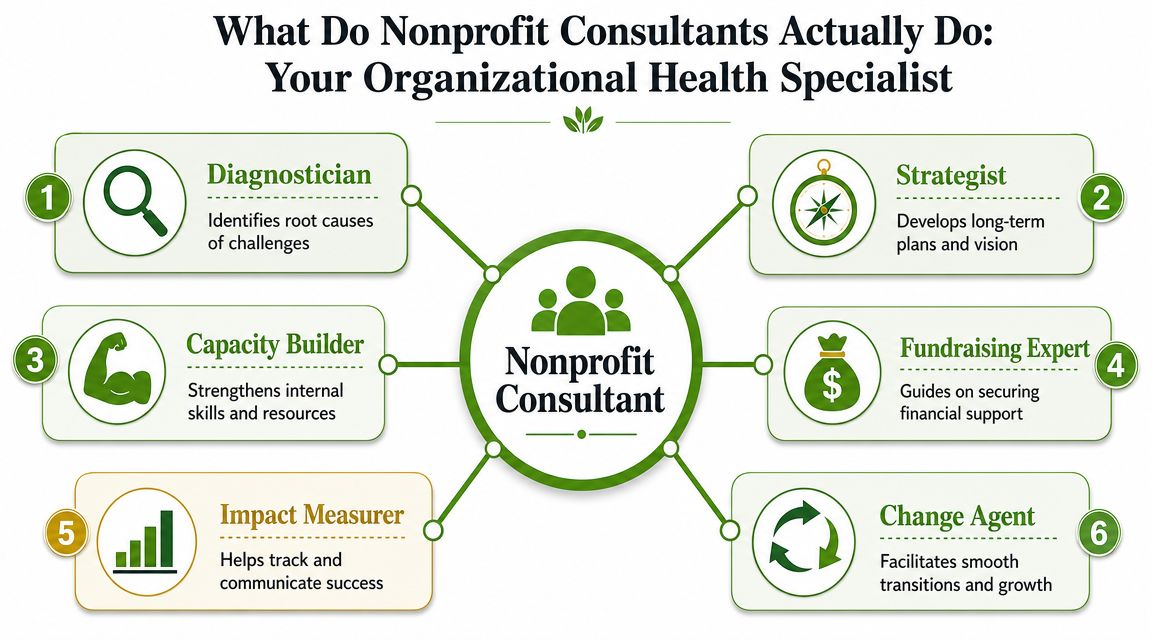
A good nonprofit consultant is part specialist doctor, part translator, part temporary operator. They diagnose what's really wrong, separate symptoms from causes, and help the organization decide what to change first.
The field has expanded well beyond fundraising advice. Yale's nonprofit consulting employer list shows firms offering organizational development, fundraising and resource development, executive search, knowledge management, strategic planning, marketing, and operational alignment. It also highlights firms with offices in eight major cities, which tells you this is a broad professional market, not a niche side service (Yale Office of Career Strategy).
Strategic planning and direction
This is the work most boards understand. A consultant gathers input, facilitates conversations leadership can't easily facilitate themselves, and turns broad ambition into a usable roadmap.
That matters because internal strategic planning often gets derailed by politics, history, or simple lack of time. The right consultant can push for choices. Not just aspirations.
If your team wants to prepare before hiring outside help, a free strategic plan template for non-profits can help you sharpen goals, assumptions, and decision points before you pay someone to facilitate the process.
Fundraising and resource development
Fundraising consultants work at several levels. Some focus on campaign strategy. Some build donor systems. Some assess whether your case for support, stewardship rhythm, and portfolio management are coherent.
Leaders often misidentify their true needs. They say they need fundraising help, but what they really need is one of these:
- A clearer donor pipeline: Gift officers are reacting, not managing relationships intentionally.
- A stronger case for support: The organization can describe activity, but not urgency or outcomes.
- Board participation: The board approves the budget but doesn't help open doors.
- A development structure: Data, moves management, and follow-up are inconsistent.
A consultant can help with any of those. But if the consultant leaves behind only recommendations and not ownership, the gains fade quickly.
Governance and board development
Some of the most valuable consulting work happens in rooms that aren't glamorous. Board recruitment. Role clarity. Committee design. Decision rights. CEO-board communication.
Boards often create drag without meaning to. They ask staff for strategic growth while keeping approval processes vague and expectations scattered. A board development consultant can reset that.
A consultant earns their fee when they help your board make fewer, clearer decisions and stand behind them.
Operations, systems, and evaluation
This is the part many leaders underestimate. Good consultants also work on execution: workflows, internal coordination, technology use, and program measurement. If your CRM is half-used, reporting is manual, or teams duplicate work, consulting may focus less on ideas and more on operating discipline.
In practice, this often overlaps with non-profit project management. The problem isn't a lack of commitment. It's that projects don't have clear owners, deadlines, dependencies, or a shared source of truth.
Some consultants are excellent diagnosticians but weak implementers. Others are steady builders who can map a process, train staff, and leave behind something people will use. Knowing which kind you need matters more than picking the biggest firm.
How to Know if You Really Need a Consultant
Before you start interviewing firms, answer one question. Is this an expertise gap, a capacity gap, or a perspective gap?
Those sound similar in a board meeting. They are not similar in practice.
You have an expertise gap
An expertise gap means your team doesn't know how to do the work at the required level. That might be campaign design, governance repair, executive search, CRM restructuring, or grant compliance process design.
In that case, a consultant makes sense. You're buying judgment, pattern recognition, and a method your staff doesn't already have.
Signs this is your issue:
- Your team keeps restarting the same initiative because nobody knows the right sequence.
- Internal debate stays circular because there isn't enough specialized knowledge to settle it.
- The margin for error is slim, and trial-and-error would cost too much in time, trust, or missed funding.
You have a capacity gap
A capacity gap is different. Your team knows what to do. They just can't absorb one more major project without breaking something else.
Leaders often overspend, opting to hire a senior advisor to solve a workload problem that may be better addressed through temporary support, clearer prioritization, or better operating tools.
A capacity problem often sounds like this:
- “We know our grant calendar is weak, but nobody owns it consistently.”
- “We know donor follow-up should happen faster, but the development team is underwater.”
- “We know the board packets need work, but leadership keeps pushing it to the last minute.”
Sometimes a short engagement is enough. Sometimes a contractor is better than a consultant. Sometimes the answer is to build managerial discipline first.
You have a perspective gap
This is the hardest one to admit. You may have capable staff and decent capacity, but the leadership team is too close to the problem. History, personalities, and sacred cows keep getting in the way.
That's where an outsider earns their keep. Not because they're smarter, but because they can say what insiders can't say without creating collateral damage.
If everyone agrees something is broken but nobody can name the root issue in the room, you probably need outside perspective.
For smaller, bounded challenges, paid consulting may be too much. Some nonprofits benefit more from pro bono or volunteer consulting when the issue is defined and the organization can't absorb traditional fees (CCT Atlanta on volunteer consulting).
A practical filter helps. If the work requires sustained internal leadership judgment, invest in your own team first. If it requires specialized knowledge or neutral facilitation your team doesn't have, bring in outside help. If you're not sure which is true, strengthen the basics of executive director skills before signing a contract. Weak internal leadership can make even a good consultant look ineffective.
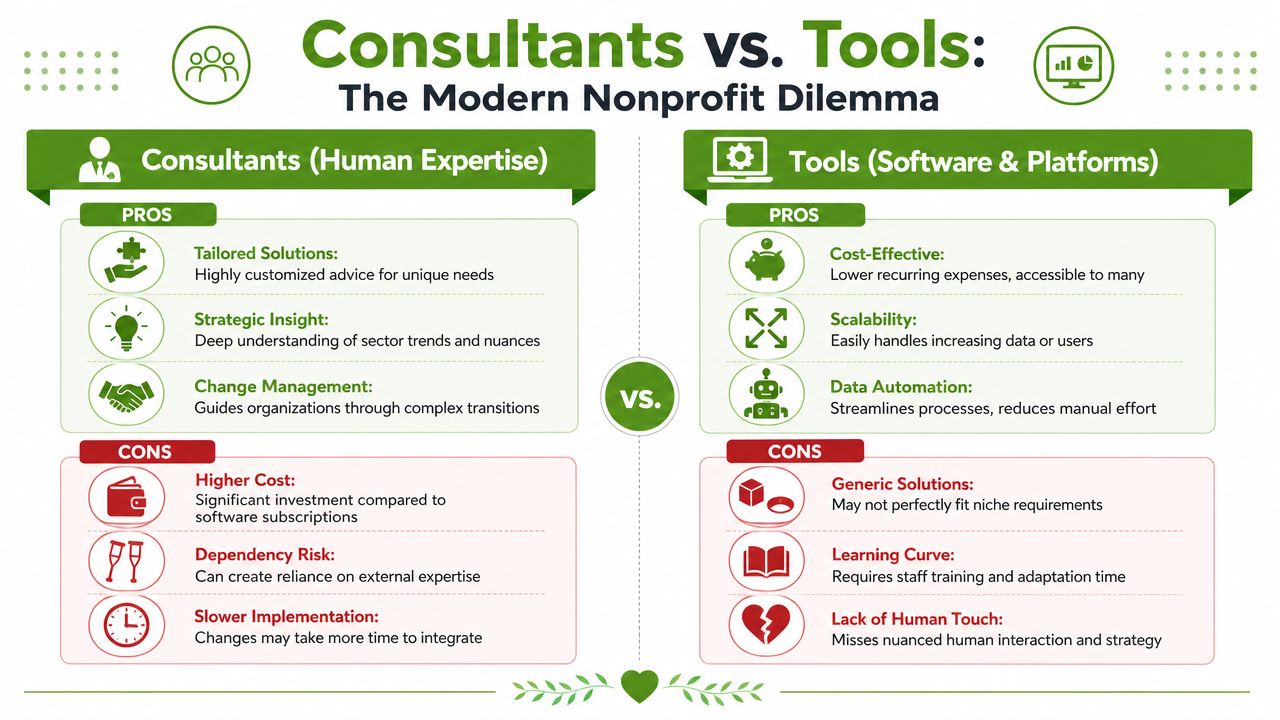
Consultants Vs Tools The New Nonprofit Dilemma
A familiar scene plays out in nonprofit leadership meetings. The team is buried in grant deadlines, nobody can find the latest budget narrative, reporting dates live in three different places, and someone suggests hiring a consultant to fix the process.
Sometimes that is the right call. Often it is not.
For grant-focused organizations, a key decision is whether you need outside judgment or better operating infrastructure. Those are different purchases with different returns. Development Guild notes that grant readiness often gets less attention than broader fundraising strategy, even though the day-to-day work includes proposal workflows, documentation, compliance tracking, and renewals that can strain a small team (Development Guild).
When a consultant is the right answer
Hire a consultant when the work depends on judgment, not just execution.
That usually means questions like these:
- Your strategy needs a reset: You need to rethink funding priorities, board expectations, or the role grants should play in the revenue mix.
- The change is politically sensitive: Staff and board members do not agree, and someone neutral needs to facilitate decisions.
- The stakes are high: A campaign, merger, leadership transition, or planning process requires experience your team does not have in-house.
I have seen good consultants create value fast in these situations. They name trade-offs clearly, push leadership to make hard choices, and keep a project from getting stuck in internal dynamics.
When a tool is the better investment
A tool is usually the better buy when the problem repeats every month and the staff already know what needs to happen. They just cannot keep it organized.
Grant management falls into that category for many nonprofits. The issue is rarely a lack of commitment. It is scattered files, inconsistent workflows, missed approvals, weak version control, and no reliable system for tracking compliance after the award comes in.
In that case, software can produce more lasting value than a short consulting engagement because it supports the actual work instead of describing how the work should happen. A platform like Fundsprout can help teams manage grant discovery, review RFPs, draft narratives, track submissions, and maintain records for reporting and audit purposes. That is a different investment from paying a consultant to deliver recommendations your staff still have to operationalize later.
Leaders who are weighing software against service models may also find this guide to AI automation for business leaders useful. It treats automation as an operating choice tied to capacity and accountability.
A simple decision test
Use this filter before you approve a contract or buy a platform:
| Situation | Better fit |
|---|---|
| You need board alignment on fundraising direction | Consultant |
| You need a grant workflow your staff can run every month | Tool |
| You need help diagnosing why revenue strategy is stalling | Consultant |
| You need visibility into deadlines, documents, and compliance tasks | Tool |
| You need a temporary expert to lead a sensitive transition | Consultant |
| You need repeatable execution after strategy is set | Tool |
The expensive mistake is buying advice when you need a system, or buying software when you need leadership judgment. Consultants help organizations decide, align, and change course. Tools help teams execute the same work consistently without rebuilding the process each cycle.
Finding and Vetting the Right Nonprofit Consultant
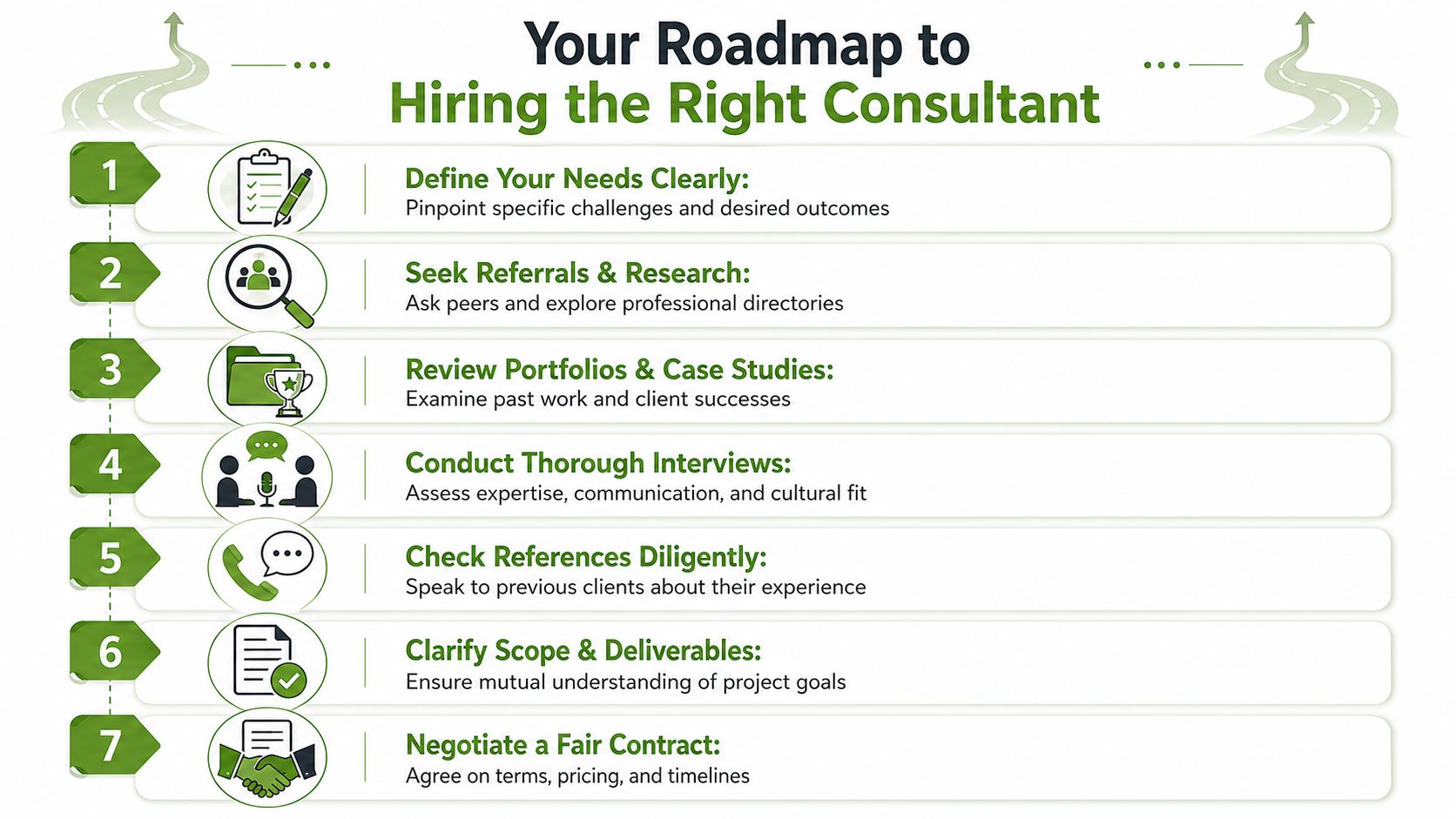
Most hiring mistakes happen before the first interview. The organization writes a vague scope, collects impressive proposals, and ends up choosing based on polish instead of fit.
The better approach is slower at the front end and much less painful later.
Start with a scope that names the real problem
Weak scopes ask for broad help. Strong scopes describe the decision, capability, or deliverable the organization needs.
Bad brief: “We need fundraising consulting.”
Better brief: “We need an outside advisor to assess our major gifts approach, clarify board expectations, and produce a practical donor stewardship system our development team can run.”
That level of specificity helps good consultants say yes or no quickly. It also helps you compare proposals on substance instead of style.
Interview for working style, not just credentials
Resumes don't tell you how someone behaves when a project gets messy. Your interview should.
Ask questions like:
- Tell me about an engagement that got off track. What happened, and what did you change?
- What do you need from staff and board members to make this succeed?
- What work do you expect us to own internally instead of outsourcing to you?
- How do you transfer knowledge so we're not dependent on you later?
The consultant's answers should sound concrete. If everything sounds smooth, elegant, and universally successful, be careful.
Here's a useful video overview before you start your selection process:
Check references like you mean it
A reference call isn't a formality. It's where you learn how the consultant performs once the proposal phase is over.
Ask former clients:
- What changed because of this engagement?
- How responsive were they when priorities shifted?
- Did they adapt to your culture, or try to impose their own way of working?
- Would you hire them again for this exact kind of project?
The best reference question is simple. “What should I watch out for if we hire this person?”
Listen for hesitation. It's often more informative than praise.
Look for fit with your mission and your pace
A technically strong consultant can still be wrong for your organization. Some are built for large institutions with layers of staff and long timelines. Others are better in lean environments where the executive director still covers real operational ground.
You need someone who understands your decision speed, your board culture, and your tolerance for process. If they can't adjust to that reality, the engagement will feel heavier than it should.
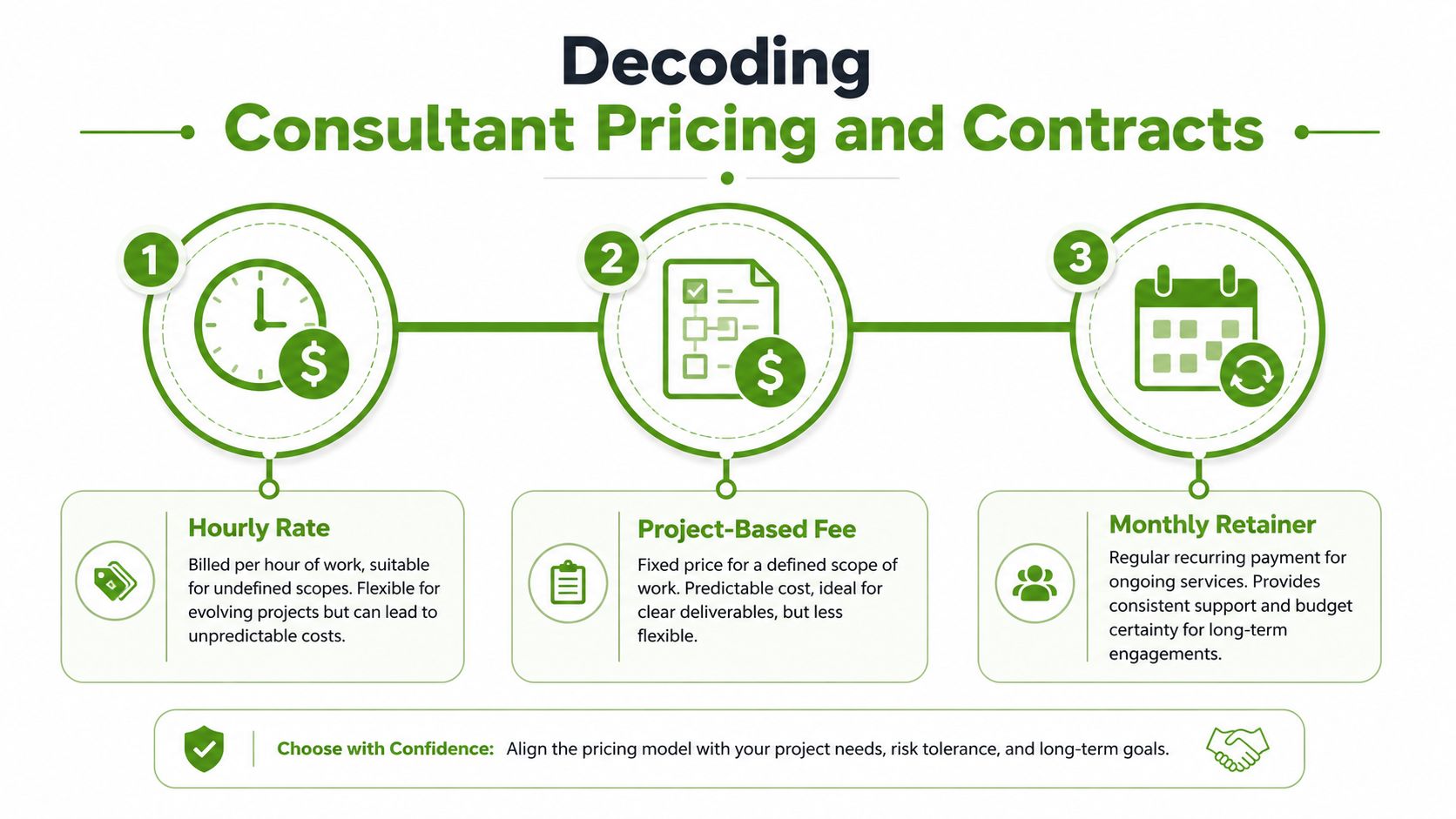
Decoding Consultant Pricing And Contracts
Consulting costs can feel slippery because the same project can be priced three different ways. That doesn't make one consultant honest and another overpriced. It usually reflects how they define risk, scope, and involvement.
Still, leaders need a baseline. A 2024 survey reported that the average hourly rate for nonprofit consultants was just over $150, and average annual income was roughly $100,000. The same source notes earlier surveys placed average income closer to $200,000, which suggests substantial variation by specialization, client size, and consulting model (Funding for Good).
How pricing models work
The pricing model should match the kind of work you're buying.
- Hourly work fits exploratory or variable projects. It gives flexibility, but it also puts pressure on you to monitor scope carefully.
- Project-based fees work best when deliverables are specific. This is usually easier for nonprofits to budget and easier for boards to approve.
- Monthly retainers fit ongoing advisory relationships. They can be useful when leadership needs regular access, but they can also drift if the scope stays fuzzy.
A simple rule helps. The less clear the work, the more likely hourly pricing appears. The clearer the deliverable, the more you should push for project pricing.
What the contract must make explicit
Consulting agreements don't need to be complicated. They do need to be precise.
Look closely at these clauses:
| Contract area | What to confirm |
|---|---|
| Scope of work | What exactly is included, and what is out of scope |
| Deliverables | What you will receive in usable form |
| Timeline | When drafts, meetings, and final outputs are due |
| Payment terms | When invoices are issued and what triggers payment |
| Ownership | Who owns plans, templates, data, and work product |
| Termination | How either party can end the engagement |
| Confidentiality | How organizational information will be handled |
What usually goes wrong
Most bad consulting experiences aren't caused by rates. They're caused by sloppy scope.
If the proposal promises “support,” ask what that means in practice. If the consultant says they'll help with implementation, ask who is doing what by when. If the contract mentions strategy, ask whether that includes board facilitation, staff training, document creation, or just recommendations.
The more expensive mistake is not paying a high rate. It's paying any rate for ambiguous work.
Building A Partnership For Lasting Impact
Three months after kickoff, the consultant has delivered a polished deck, your staff is back to putting out daily fires, and nobody is using the new process. I have seen that outcome more than once. It usually has less to do with the consultant's talent and more to do with how the engagement was managed.
Lasting value comes from ownership on both sides. One person on your team should own the engagement, clear roadblocks, and make decisions. Staff need enough time to participate genuinely, not just attend meetings and nod through them. If your team hides actual bottlenecks, the consultant solves the wrong problem.
Good partnerships also leave something behind. That might be a repeatable workflow, stronger managers, cleaner reporting, or a grant process staff can run without outside help. If the work depends on the consultant staying involved forever, the return drops fast.
This is also where the consultant-versus-tool decision becomes practical. If you need judgment, change management, board alignment, or a tough leadership conversation, hire a person. If you need a consistent operating system for grant readiness, document management, proposal drafting, and follow-through, a tool may give you better value at a lower ongoing cost. Fundsprout is one example worth evaluating for that kind of work.
The test is simple. Outside help should increase clarity, build internal capacity, and make next year easier than this year. If it produces dependency, unused deliverables, or another strategy memo your team cannot execute, it was the wrong investment.
If your organization needs grant capacity more than another strategy memo, take a close look at Fundsprout. It helps nonprofits find relevant funding, organize proposal work, draft narratives using existing documents and impact data, and maintain the compliance trail required from application through renewal. For teams deciding between hiring more outside help and building an internal grant engine, that's a practical place to start.
Try 14 days free
Get started with Fundsprout so you can focus on what really matters.