Mastering Executive Director Skills for Nonprofit Success
Unlock essential executive director skills for mission-driven leadership. Explore practical strategies in fundraising, finance, and strategic management.

Abdifatah Ali
Co-Founder
Great executive director skills are what separate a nonprofit that just survives from one that truly thrives. It's a powerful blend of seeing the big picture and knowing how to manage the day-to-day, a mix of strategic leadership, financial stewardship, and rock-solid fundraising.
What It Really Takes to Lead a Modern Nonprofit
Let's toss out the old, dusty job description. The modern Executive Director is the beating heart of a nonprofit. They are the central hub connecting the mission, the board, the staff, and the community they serve.
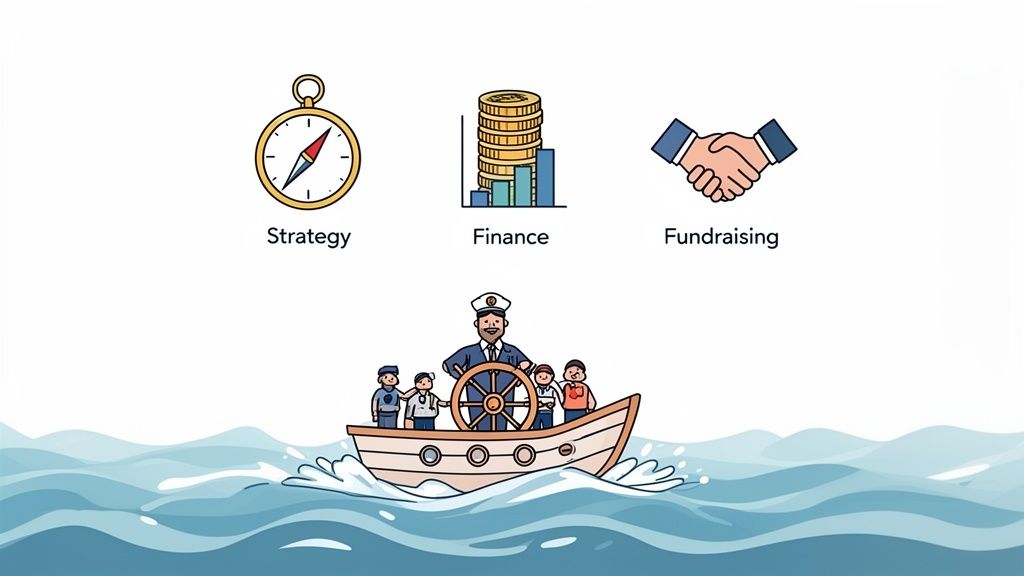
Think of it this way: the ED is like a ship's captain. They're not just steering the vessel; they're navigating the long-term journey (strategy) while managing the immediate, sometimes turbulent, operational waters. A captain has to manage the crew, watch the budget for supplies, and, most importantly, inspire everyone to believe in the voyage's purpose.
The Three Pillars of Nonprofit Leadership
To really succeed, an Executive Director needs to build their expertise on three core pillars. Each one supports the others, creating a stable foundation for growth and impact. When you see how they lock together, you start to grasp the true scope of the role. A solid understanding of your https://www.fundsprout.ai/resources/nonprofit-organizational-structure is also a huge help in seeing how these duties play out across the team.
We'll be diving deep into these three essential pillars throughout this guide:
- Strategic Leadership: This goes way beyond just managing people. It’s about painting a clear picture of the future and creating a culture where everyone—from the board chair to the newest volunteer—feels connected to the mission and motivated to push it forward.
- Financial Stewardship: This is all about safeguarding the organization's financial health. It means making sure every single dollar is used effectively and transparently to achieve the mission. We're talking compliance, smart budgeting, and planning for long-term sustainability.
- Fundraising Excellence: This is the powerful combination of storytelling and relationship-building that fuels everything you do. It’s the art of connecting a donor's passion with the real-world outcomes your organization delivers.
To get a clearer picture of how these skills fit together, here’s a quick summary.
Core Executive Director Skill Pillars at a Glance
This table shows just how interconnected these areas are. Without one, the others falter.
The Modern Executive Director's Toolkit
In a small nonprofit, the ED often has to be the expert in all three of these areas at once. That makes a versatile, hands-on skill set absolutely essential.
Success today also means embracing new tools and approaches. For instance, developing strong skills in digital marketing for nonprofits has become crucial for reaching new audiences and building a sustainable base of support. New technologies are also changing the game by automating routine tasks and giving leaders data-backed insights, freeing them up to focus on the high-impact work that actually moves the needle.
Inspiring Action Through Strategic Leadership
Great leadership isn't just about managing tasks and ticking boxes. It's the art of taking a powerful vision and turning it into a concrete plan that gets everyone—from your board members to your newest volunteer—genuinely excited to be a part of the mission. One of the most critical executive director skills is cultivating a resilient, mission-driven culture where people feel seen, valued, and deeply connected to the work.

Think of yourself as the organization's "Chief of Enthusiasm." Your ability to talk about the vision with real passion and conviction is what fuels your team, especially when things get tough. It’s on you to make sure everyone is rowing in the same direction, with the same purpose.
Fostering Collaboration and Trust
Unbreakable trust is the bedrock of any high-performing team. You build it piece by piece through transparent communication, consistent follow-through, and a genuine willingness to listen. A strong leader creates a space where healthy debate is not just allowed but encouraged, and where people feel safe enough to voice a new idea or a concern without fear of being shut down.
To make this happen, you need to focus on a few key practices:
- Communicate with Clarity: Don't keep people in the dark. Regularly share updates on strategic goals, celebrate the wins, and be honest about the setbacks. When your team understands the "why" behind your decisions, they become far more invested in the outcome.
- Delegate with Confidence: Show your team you trust them by giving them real responsibility. This not only empowers them but also gives them a chance to develop their own leadership skills.
- Navigate Difficult Conversations: You have to tackle conflict and performance issues head-on, but with grace. Avoiding those tough conversations just lets small problems fester until they become major roadblocks, and it absolutely kills morale.
An ED must be comfortable embracing ambiguity because sometimes they need to proceed when the field ahead isn’t obvious. Leadership means being able to navigate dysfunctional conflict while embracing functional, healthy disagreement about strategy and direction.
This mix of soft skills is exactly what elevates a manager into a true strategic leader. Often, these abilities are sharpened in the trenches. For instance, recent data shows that 65% of leaders build their board governance skills by serving on a nonprofit board. In the same way, 58% get better at networking and 54% improve their communication, which ultimately helps 72% land top leadership roles. If you're curious, you can explore more about how nonprofit experience builds leaders to get the full story.
Aligning Your Board and Team
One of the most common traps for nonprofits is a disconnect between the board's high-level governance and the staff's day-to-day work. As the Executive Director, you are the essential bridge between these two groups. It's your job to make sure everyone is working from the same strategic playbook.
Running a productive board meeting is the perfect place to put this skill into action. Instead of letting meetings get bogged down in endless reports, frame them around key strategic decisions. Kick off discussions with clear, action-oriented questions like, "Here's the challenge we're facing; what are our three best options?" This simple shift can transform your board from a passive audience into active, strategic partners.
By mentoring emerging leaders within your staff and facilitating decisive, forward-thinking discussions with your board, you create an environment where every single action contributes directly to the mission. That powerful alignment is the true sign of exceptional strategic leadership.
Driving Sustainability With Fundraising Excellence
For a lot of executive directors, fundraising can feel like a chore—a necessary evil you have to manage instead of something you truly lead. But seeing it that way misses the point entirely. Fundraising isn't just about asking for money. It's the engine of your mission, powered by great storytelling and genuine relationships.
When an ED has exceptional executive director skills in this area, they treat fundraising as the strategic core of the organization. It stops being about just hitting a number and becomes about building a sustainable financial future. Think of your role as a connector, bridging the gap between a donor's desire to make a difference and the incredible impact your nonprofit delivers.
Beyond the Bake Sale: Building Diverse Revenue
Relying on a single source of funding is like trying to build a house on one pillar. It’s shaky, and one bad gust of wind could bring the whole thing down. A truly resilient fundraising strategy is all about diversifying your revenue, creating a solid foundation that can weather any storm.
This means looking beyond that one big annual gala and exploring multiple streams of income. The most effective ones usually include:
- Grant Writing: This is about making a powerful, data-backed case to foundations and government agencies to secure their support.
- Major Donor Cultivation: It’s a long game. This involves building deep, personal relationships with individuals who can make transformative gifts, all based on shared values and trust.
- Corporate Sponsorships: Think partnerships, not just handouts. You’re finding businesses that align with your mission to support specific programs or events.
- Digital Campaigns: This is where you meet people where they are—online. You can run crowdfunding campaigns, participate in giving days, and build a base of recurring donors.
The real magic happens when you can blend these approaches. That's what separates a good fundraiser from a truly great one. In fact, data consistently shows that nonprofits led by strong fundraisers see much higher revenue growth. An ED with a smart, diversified strategy can often boost annual funding by 20-30%.
Writing Grants That Connect and Convert
If you're an ED pulling double duty as your organization's chief fundraiser, grant writing can feel especially daunting. The secret is to stop thinking of it as “filling out an application” and start seeing it as “starting a conversation.” Your proposal is your chance to tell a story that connects directly with a funder’s own goals.
"I like to say, ‘We’re stewards of donations.’ Community members entrust us with their resources—money, time, goods—and it’s our job to use them effectively to help."
To make your proposals pop, you have to connect the dots for the person reading it. State the problem clearly, show them your unique solution, and back it up with measurable outcomes that prove you’re making a real difference. You want the funder to feel less like a bank and more like a partner in your mission.
And you don't have to do it all alone. Modern tools can take a lot of the grunt work off your plate. There are platforms that help you find the right grants and AI assistants that can help you draft a powerful narrative. This tech handles the administrative heavy lifting, so you can focus on what matters most: building real connections with funders and showing them the incredible return on their investment. To learn more, check out our guide on nonprofit fundraising best practices.
2. Ensuring Long-Term Health With Financial Acumen
Let's be honest: for many nonprofit leaders, "financial management" can sound intimidating, like a language you never learned. But mastering it is one of the most powerful things you can do for your mission. This isn't about becoming a CPA overnight. True financial acumen is about financial stewardship—making smart, strategic decisions that guarantee your organization's health for the long haul.
Think of your nonprofit's financial reports as its vital signs. They give you a clear picture of your organization's health, showing you where you're strong, where you might be vulnerable, and whether you have the energy reserves to chase big new goals. Flying blind just isn't an option when your mission is on the line.
Translating Dollars into Mission Impact
It's easy to fall into the trap of seeing the budget as just a spreadsheet of restrictions. A much better way to look at it is as your organization's story, told in numbers. A well-crafted budget shows your board, staff, and donors exactly how you're turning their investment into impact. It connects every single dollar to the mission.
One of the most effective ways to tell this story is with a program-based budget. This method ties every expense to a specific program outcome, which is absolute gold for grant writing. Instead of a vague line item for "food supplies," you can confidently say, "Your $5,000 will provide 100 hot meals." If you want to see what this looks like in practice, this detailed budget example for a nonprofit is a fantastic place to start.
From Compliance to Confidence
Beyond telling a story, good financial management is about building unshakeable trust. Airtight compliance and total transparency aren't just about avoiding trouble with the IRS; they prove to your supporters that you are a responsible guardian of their investment in the community. To get there, leaders need a solid grasp of the fundamentals, including reading balance sheets to truly understand the organization's financial footing at any given moment.
This isn't just theory. A study of 99 human services leaders in New York found that 85% of those with strong financial skills led organizations that were better able to weather unpredictable funding environments.
"An executive director must demonstrate competence in reading, creating, and understanding financial documents, including budgets, cash flow, income statements, balance statements, and statements of functional expenses."
Thankfully, you don't have to do it all manually. Modern reporting tools can be a huge help, simplifying everything from maintaining a clean audit trail to generating custom reports for funders. They give your board the real-time data needed for effective governance. By embracing both the high-level strategy and the day-to-day tools of financial management, an executive director becomes more than just a manager—they become the guardian of the mission's future.
How to Build Your Executive Director Skillset
Becoming a great executive director is a journey, not a destination. It’s a process of constant learning and refinement. Whether you’re just stepping into the role or you’re a seasoned leader looking to sharpen your skills, having a real plan for growth is what separates the good from the great. This roadmap is designed to help you pinpoint where you shine and where you have room to grow, giving you clear, actionable steps to master your role and boost your organization's impact.
The first step, and it's a big one, is to be brutally honest with yourself. Real growth starts with a clear-eyed look at where you are right now. By asking some tough questions, you can uncover hidden strengths and, more importantly, identify the areas that need your attention. This turns a vague goal like "get better at my job" into a focused, achievable plan.
Start With Honest Self-Assessment
Before you can build, you need to know what you're building on. Take a minute to think about how confident you really feel across the core skill areas. This isn’t about judgment or getting a passing grade; it's about taking a personal inventory to guide your growth.
Ask yourself these questions:
- Strategic Leadership: How good am I at turning our big vision into a clear, actionable plan that actually gets the board and staff excited? When was the last time I led a board conversation that resulted in a real, meaningful strategic change?
- Fundraising Excellence: What's my actual process for finding and connecting with new major donors? And how do I really feel when it's time to make a direct ask? Can I tell our story in a way that truly connects with funders and makes them want to give?
- Financial Acumen: On a scale of 1 to 10, how comfortable am I standing in front of the board, explaining our financials, and fielding tough questions? Do I see the budget as a strategic roadmap for our mission, or just a bunch of numbers I have to stay within?
Your gut answers to these questions are gold. If you find yourself hesitating on the fundraising question, for instance, you've just found the perfect starting point for your development plan.
This is especially true for financial skills. It's not just about knowing the numbers; it's about responsible stewardship, which is built on a solid foundation of smart budgeting and strict compliance.

As you can see, you can't get to high-level strategic stewardship without first mastering the day-to-day discipline of managing the money and following the rules.
Create Your Personalized Development Plan
Once you know where you stand, it's time to build a plan that mixes formal learning with real-world practice. You can’t learn to be a great leader just by reading a book; it takes a combination of new knowledge, guidance from people who’ve been there, and actually doing the work.
Think of your development plan like a balanced diet. You need different things to get strong. A course gives you the theory, but a good mentor helps you figure out how to apply that theory to the unique, messy challenges you face every day.
A great leader doesn't just manage tasks; they cultivate their own abilities with the same care they give to their organization's mission. Proactive skill development is a direct investment in your nonprofit's future.
Here’s a simple framework to help you map out your growth. Use it as a starting point to identify specific, concrete actions you can take to build your expertise.
Your Executive Director Skill Development Plan
This table provides a structured way to think about your growth. It's not just about what you'll learn, but how you'll learn it—through formal training, valuable mentorship, and practical, on-the-ground experience.
By taking this kind of intentional approach, professional development stops being a fuzzy concept and becomes an active, energizing part of your job. When you proactively choose your learning path, you're not just building your career—you're securing the future of your organization.
So, What's Next on Your Leadership Journey?
We've covered a lot of ground, haven't we? Think of this guide as a map, and the skills we've explored—from crafting a vision that truly inspires to mastering the nuts and bolts of finance and fundraising—are the key landmarks on your path to becoming a more effective leader. These aren't just separate items on a checklist; they're all deeply connected, each one making the others stronger.
As you step back into the day-to-day, remember that you don't have to have all the answers, and you certainly don't have to do it all by yourself.
"We’re stewards of donations. Community members entrust us with their resources—money, time, goods—and it’s our job to use them effectively to help."
That idea of stewardship is the heart of it all. It applies to your finances, sure, but it also applies to your own time and energy. By using smart strategies and the right tools, you can get the administrative busywork off your plate. This frees you up to focus on the work that only you can do: leading your people, building genuine connections in your community, and driving the impact your organization was created to make.
Ultimately, great leadership starts with the decision to never stop learning. It takes guts to build something that lasts, something resilient enough to weather any storm. Investing in yourself and these skills is the single best investment you can make for your mission. It’s what will ensure your organization doesn't just hang on, but truly thrives for years to come.
Frequently Asked Questions
Stepping into nonprofit leadership brings up a lot of questions. We've gathered some of the most common ones from new and aspiring executive directors to give you clear, practical answers.
What Skill Should a New Executive Director Focus on First?
For a brand new ED, especially at a smaller nonprofit, financial acumen is priority number one. Before you do anything else, you need an ironclad understanding of your organization's financial health.
This means getting intimately familiar with your cash flow, how you're tracking against your budget, and where every single dollar comes from. This knowledge is the bedrock of every other decision you'll make, whether you're thinking about adding a new program or hiring another team member. Once the numbers make sense to you, you can fundraise with genuine confidence and lead with real clarity. A classic mistake is to jump into high-profile external work before you truly know what's happening with the money.
How Can I Demonstrate My Leadership Skills to the Board of Directors?
Show your board you're a leader, not just a manager, through proactive communication and strategic reporting. Don't just tell them what happened last month; show them where you're going next, complete with clear goals and ways to measure success.
Instead of saying, "donations were down last quarter," try this: "Donations dipped, and our analysis points to X and Y. Here's our three-point plan to turn that around." This simple shift proves you're a strategic partner who comes with solutions, not just problems.
Your job in a board meeting is to facilitate strategic conversations, not just read a list of updates. Send out concise board packets ahead of time that clearly outline the decisions you need from them and why.
I Am Not a Natural Fundraiser. What Is the Best Way to Improve?
Good news: fundraising is a skill you can build, not a talent you're born with. The absolute best way to start is to stop thinking about it as "asking for money" and start seeing it as building relationships.
Begin by connecting with your most loyal donors. Take them out for coffee and just listen. Ask them why they give and what inspires them about your work. At the same time, get really good at telling your organization's story in a way that’s both powerful and quick to share.
For a great on-the-job exercise, ask to tag along with a seasoned board member or your development director on a donor visit. Just watch and learn. Remember, modern tools can take care of the heavy lifting on things like grant writing, freeing you up to focus on what really matters—connecting with the people who believe in your mission.
Ready to supercharge your fundraising efforts? Fundsprout uses AI to help you find the perfect grant opportunities, write winning proposals, and manage your reporting with ease. Stop searching and start succeeding. Discover your next grant today at Fundsprout.
Try 14 days free
Get started with Fundsprout so you can focus on what really matters.