Memorandum of Understanding vs Contract for Nonprofits
Memorandum of understanding vs contract: A clear guide for nonprofits. Learn when to use an MOU or a contract to protect your partnerships and grant funding.

Abdifatah Ali
Co-Founder
You're probably dealing with one of these situations right now. A funder wants proof that partner roles are settled before submission. A coalition partner says, “Let's just sign an MOU for now.” Or your program team has already started work with another nonprofit, and nobody has decided whether the relationship needs a real contract.
Small documentation choices create significant operational problems. In nonprofit work, memorandum of understanding vs contract isn't a technical distinction for lawyers to argue about later. It affects whether you can enforce deliverables, satisfy grant requirements, protect data, defend intellectual property, and survive an audit without scrambling for paperwork.
Busy Executive Directors often get bad advice from both directions. Some people treat every collaboration like it needs a full legal agreement on day one. Others use an MOU for everything because it feels collaborative and low-friction. Neither approach works consistently. The right document depends on what is at stake.
The Fundamental Difference Between an MOU and a Contract
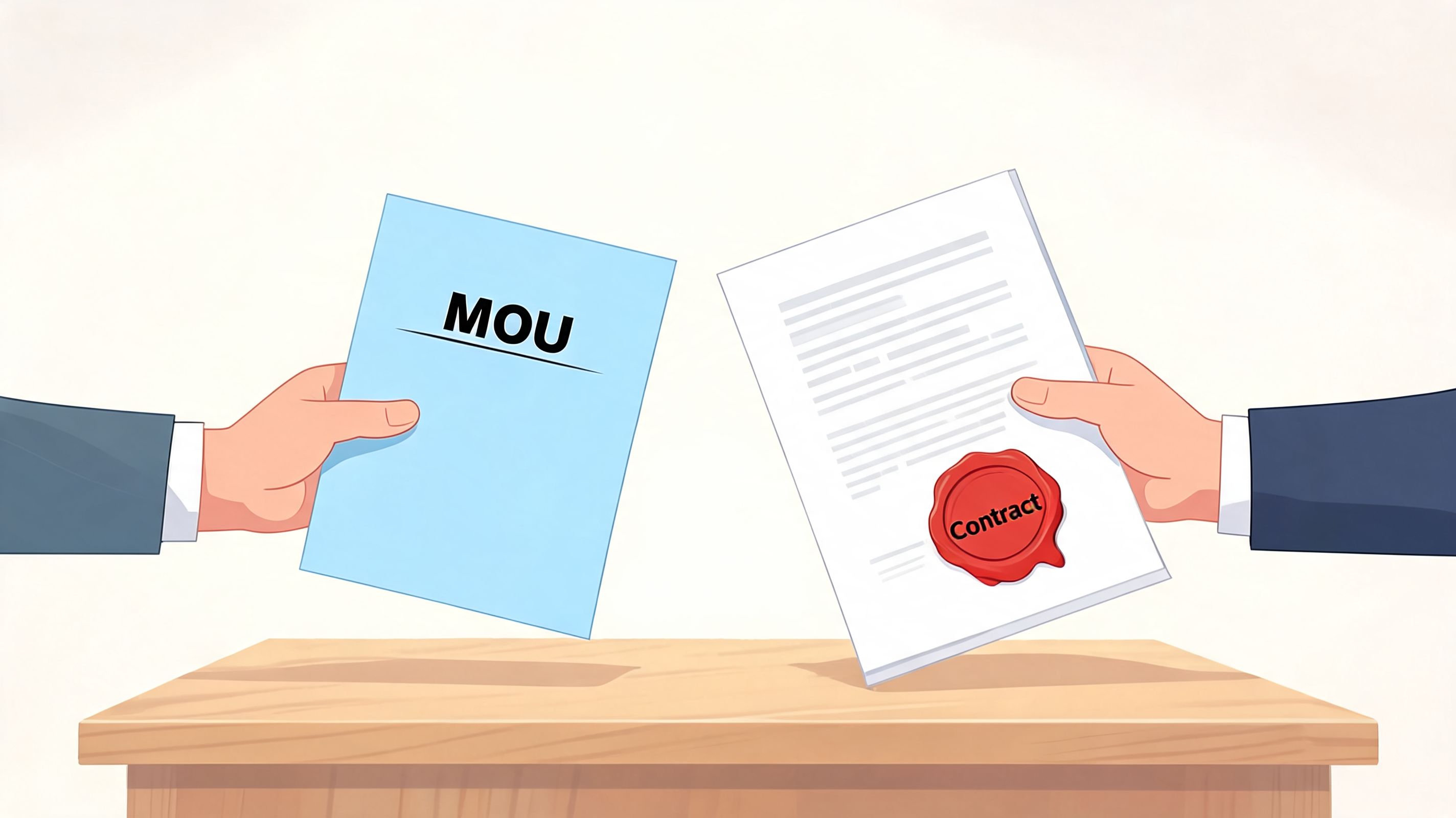
A memorandum of understanding, or MOU, records shared intent. A contract creates enforceable obligations. That's the cleanest distinction, and for nonprofits it matters because partnerships often begin with goodwill and then quickly move into money, reporting, deliverables, and compliance.
Think about it this way. An MOU is like two organizations agreeing to co-host a community event and writing down who will handle outreach, space, and volunteers. A contract is what you use when one party is being paid to deliver specific services, meet deadlines, or take on legal risk.
What an MOU actually does
An MOU helps parties align around purpose, roles, timelines, and working expectations without fully committing to legal enforcement. That's useful when a nonprofit is testing a partnership, coordinating a coalition, or documenting collaboration before the project is fully defined.
As Dropbox Sign explains in its discussion of MOUs and contracts, MOUs document mutual understanding and roles but often lack the detailed terms, conditions, and enforcement mechanisms needed to prevent disputes. That makes them stronger than a verbal promise, but weaker than a binding agreement if something goes wrong.
Practical rule: If the relationship depends on trust and flexibility, an MOU can work. If the relationship depends on performance and consequences, it usually won't.
What a contract actually changes
A contract changes the legal posture of the relationship. It doesn't just say what each party hopes to do. It defines what each party must do, what happens if they don't, and what remedies are available.
That matters because nonprofit disputes rarely start with dramatic misconduct. More often, they start with missed deadlines, vague deliverables, unapproved spending, ownership questions over materials, or a partner claiming they understood the arrangement differently. If you've ever reviewed examples of contract disputes with LA Law Group, you've seen the basic pattern. Unclear obligations become expensive very quickly.
Why this distinction matters before you apply
A lot of nonprofits first confront this issue during grant planning. The proposal may describe a partner's role with confidence, but the underlying paperwork may still be informal. That gap becomes visible when the funder asks for documentation, or when your team starts organizing scopes of work and procurement materials such as RFPs and RFQs.
If you remember one thing, make it this. An MOU is a written expression of collaboration. A contract is a written commitment the law can enforce. Nonprofits need both, but not for the same job.
A Clause-by-Clause Comparison for Nonprofits
The fastest way to understand memorandum of understanding vs contract is to compare how each document handles the clauses that matter in day-to-day nonprofit operations.
| Issue | MOU | Contract |
|---|---|---|
| Primary purpose | Documents shared goals and roles | Creates binding obligations |
| Enforceability | Often non-binding unless drafted like a contract | Intended to be legally enforceable |
| Payment terms | Usually broad or omitted | Specific amounts, timing, conditions, and consequences |
| Deliverables | General responsibilities | Defined scope, milestones, and acceptance standards |
| Termination | Often informal or loosely stated | Clear termination rights and procedures |
| Dispute handling | Rarely detailed | Typically addresses remedies and dispute process |
| Confidentiality | May mention expectations | Usually includes enforceable confidentiality terms |
| Intellectual property | Often vague | Allocates ownership, use rights, and restrictions |
| Liability | Commonly silent | Addresses risk, indemnity, and responsibility |
| Best fit | Early-stage, low-risk collaboration | Funded, operational, or high-stakes work |
Enforceability and legal intent
This is the first clause area to check, even if the document doesn't label it clearly.
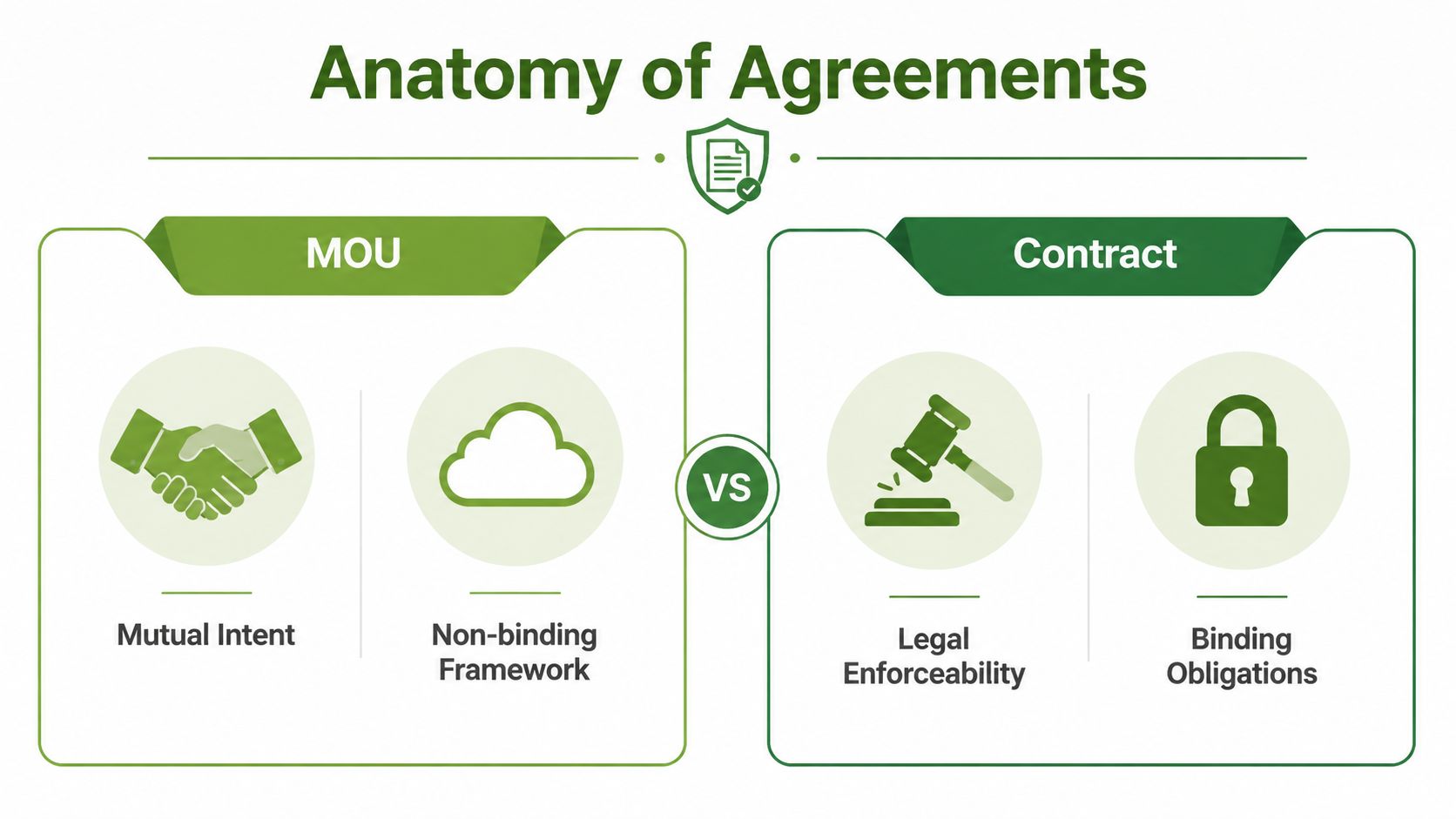
A contract is enforceable because it's built around legal commitment. According to Roger's explanation of MOUs and contracts, a binding contract must contain offer, acceptance, consideration, and mutual agreement. Those four elements are what turn a working arrangement into something a court can enforce.
An MOU may describe many of the same activities, but if it doesn't show that legal structure and intent, it often remains a non-binding framework instead of a true obligation.
Money and scope
Many nonprofits encounter difficulties at this stage. An MOU might say a partner will “support program delivery” or “assist with outreach,” but it usually doesn't define what that means in a measurable way.
A contract should answer practical questions such as:
What is being delivered
Services, reports, training sessions, outreach events, curriculum, evaluation work, or technical support.When it is due
Dates, milestones, reporting periods, review windows, and completion triggers.How payment works
Invoice timing, reimbursement rules, documentation required, and what happens if deliverables are late or incomplete.
If money is changing hands, broad language is a liability. It invites disagreement while your finance team still has to process payments.
Confidentiality, IP, and data handling
Many nonprofit leaders still think of contracts as “payment documents.” That's too narrow. Contracts are often even more important when the core issue is control over sensitive assets.
Those assets can include:
- Donor or beneficiary information
- Training materials or curriculum
- Research findings or data sets
- Brand assets and public messaging
- Grant reporting content created by a contractor or partner
An MOU can acknowledge these topics, but it often doesn't define ownership, permitted use, storage requirements, or what happens after the project ends.
If your organization would feel exposed seeing the disputed issue in a board packet, it belongs in a contract, not a handshake document.
For nonprofit teams reviewing proposed language, it helps to study common warning signs in avoiding risky agreement terms. The red flags are usually familiar: vague deliverables, one-sided termination language, undefined approval rights, and clauses that shift risk without notice.
Disputes and termination
Most MOUs don't do much here beyond saying the parties intend to work cooperatively. That sounds fine until the relationship sours.
A contract should tell you:
- How either party can end the relationship
- What notice is required
- What happens to unpaid invoices or unfinished work
- Whether materials must be returned or destroyed
- How disputes get handled if the parties disagree
That level of detail doesn't make a partnership adversarial. It makes expectations visible while everyone is still cooperative.
When to Strategically Use an MOU
An MOU is not a failed contract. It's a useful document when your real objective is alignment rather than enforcement.
That distinction matters because nonprofit leaders often face pressure to formalize partnerships before the work is mature enough for a full legal agreement. In those early phases, forcing contract-level detail can slow momentum, increase legal expense, and make community partners feel like they're being pushed into a business transaction before trust exists.
Good nonprofit use cases for an MOU
An MOU works well when the collaboration is still exploratory, low-risk, or primarily relational.
Common examples include:
Coalition building
Several organizations agree on advocacy goals, meeting cadence, and public roles, but no one is paying the others for services.Joint outreach or event planning
A food pantry, school, and health clinic outline who will provide volunteers, venue coordination, and communications support for a community event.Pilot partnerships
Two nonprofits want to test whether a referral system or shared program model works before they commit to a funded implementation structure.Community referral relationships
Partners want written clarity about how clients move between organizations, who serves which population, and how communication will happen.
Why an MOU helps in these situations
The main advantage is controlled flexibility. You can put expectations in writing without pretending that every detail is final.
That can be especially useful when the partnership still depends on outside variables, such as a pending grant decision, board approval, or a yet-to-be-finalized work plan. In those moments, an MOU creates a record of serious intent while leaving room to revise the operating details later.
A good MOU lowers confusion. It doesn't try to solve every legal problem before the project even exists.
What works in practice
The strongest nonprofit MOUs are plain and specific about operational roles, even if they stay non-binding. They identify the parties, define the purpose, describe each organization's responsibilities, list a start date, and state how the arrangement can be revisited or ended.
What doesn't work is the vague one-page MOU that tries to sound formal but doesn't answer basic questions. If a staff member can't use the document to understand who is doing what next month, it won't help much.
A useful MOU should still clarify:
- Who the organizations are
- What they are trying to accomplish together
- Which party handles which function
- How long the understanding lasts
- Whether any limited provisions, such as confidentiality, are intended to be binding
That last point matters. If you want some provisions enforceable, say so clearly and get legal review. Don't leave it to implication.
When a Contract Is Non-Negotiable for Your Nonprofit
Some situations don't call for flexibility. They call for protection.
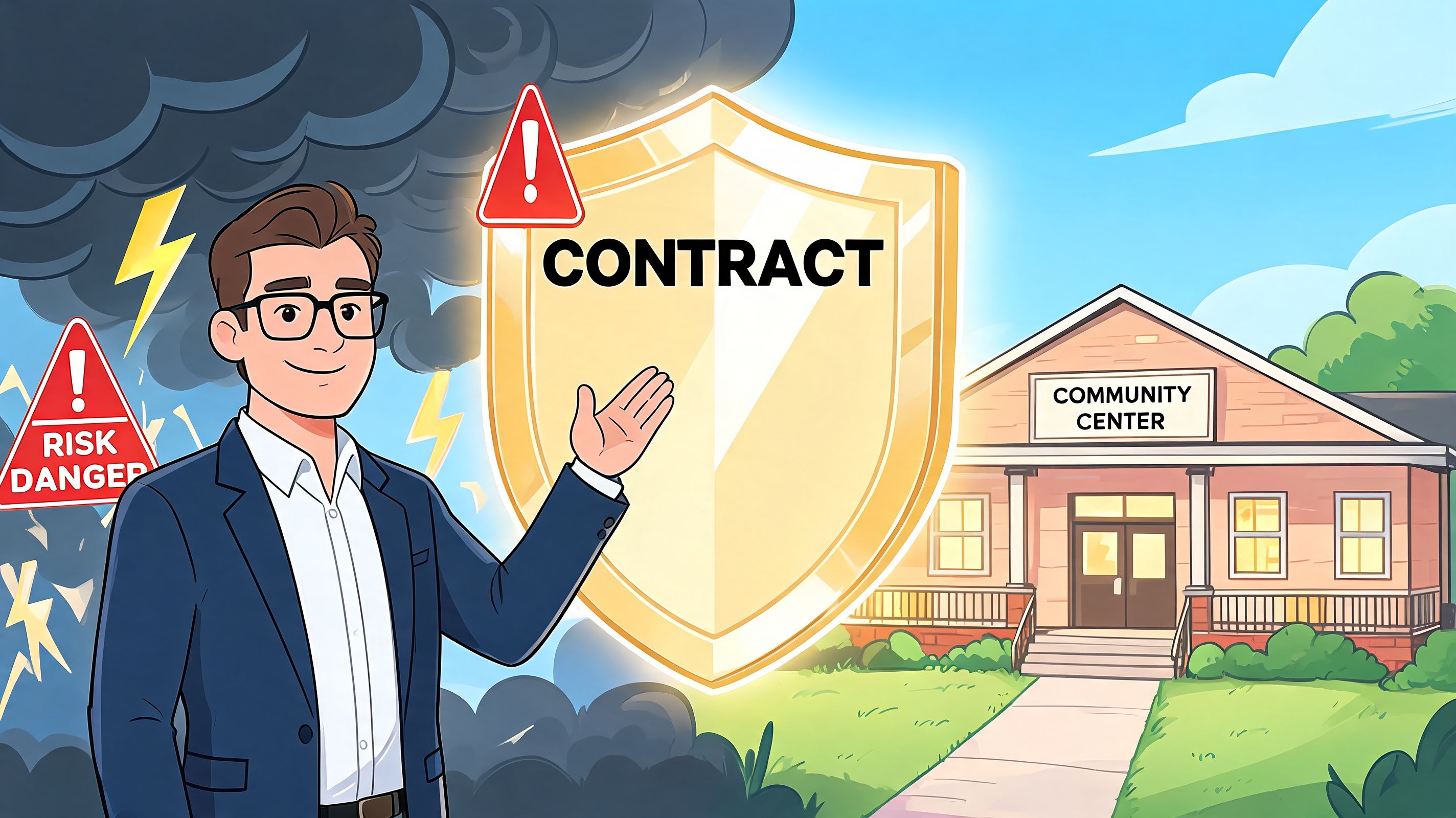
If your nonprofit is dealing with grant money, subawards, intellectual property, liability exposure, or sensitive information, a contract is the right instrument. In those settings, an MOU usually leaves too much unresolved, and unresolved issues become operational problems fast.
Grant-funded partnerships need enforceable terms
This is the nonprofit-specific issue that gets missed in generic legal articles. Many funders don't just want evidence that partners are friendly. They want evidence that roles, accountability, and compliance obligations are enforceable.
As Sirion notes in its library on MOUs and contracts, many federal and foundation grants require binding agreements or specific contract language for partnership commitments. The same source explains that federal grants, including examples such as HHS and NSF, often require formal subaward agreements with defined payment terms, liability clauses, and compliance requirements. A non-binding MOU may not be adequate for audit trails or funder accountability.
That should shape your decision early, especially if your team is preparing partner scopes and submission materials in response to a solicitation like those discussed in how to respond to an RFP.
Four situations where an MOU is not enough
Use a contract when any of these are true:
Grant funds are being passed through to a partner
If one organization is subawarding or paying another, you need defined payment terms, reporting obligations, and consequences for nonperformance.A partner will create or use intellectual property
Curriculum, branding, evaluation tools, recorded content, software, and research outputs all raise ownership and licensing questions.Sensitive data is involved
Beneficiary records, donor information, or program data require enforceable confidentiality and handling rules.The project has clear deliverables
If the work has deadlines, outputs, reporting schedules, or approval checkpoints, that belongs in a contract.
Here's a practical explainer on why legal structure matters once obligations become real:
What nonprofit leaders should push back on
The most common bad suggestion is, “Let's just start with an MOU and sort the rest out later,” even after funding has been awarded or implementation has begun.
That approach usually creates three avoidable problems. Finance doesn't have clean authority for payments. Program staff rely on assumptions instead of documented scope. And when the funder asks for backup, the organization has to retrofit a legal structure after the work is already underway.
This is not optional when the partnership affects restricted funds, reporting obligations, or legal exposure.
A contract may feel heavier at the outset, but for mission-critical partnerships it protects both the relationship and the grant.
Advanced Strategies for Grant-Funded Partnerships
Advanced nonprofit partnerships often need more than a simple choice between MOU or contract. They need a sequence.
A practical approach is to use the MOU during relationship formation and then transition to a contract once funding, scope, and accountability requirements are clear. That's often better than forcing a full agreement too early or relying on an MOU too long.
Use a staged agreement model
The staged model works like this:
Start with an MOU for alignment
Use it to document purpose, partner roles, planning assumptions, and collaboration norms while the opportunity is still developing.Make a few provisions explicitly binding if needed
Some nonprofits include a clear statement that the MOU is non-binding except for limited provisions such as confidentiality or publicity controls.Convert to a contract before implementation or fund flow
Once grant terms, budget allocations, reporting demands, or subaward details are known, move to a binding agreement.
This isn't just a stylistic preference. In Vocare Law's analysis of commercial MOUs, MOUs in nonprofit grant partnerships show approximately 80-90% lower legal binding probability compared to contracts. The same source recommends embedding “non-binding except confidentiality” clauses for 100% intent clarity, and reports that this approach can reduce dispute rates by 65%. It also advises using contracts after the MOU stage for financial exchanges above $50K, linking that practice to audit-trail compliance in federal grants and a 40% boost in renewal success.
Watch for accidental contracts
One advanced risk is the overly detailed MOU that starts acting like a contract without saying so clearly. That happens when teams copy legal clauses into a “friendly” document without understanding what those clauses imply.
Problematic signals include:
- Detailed remedies for breach
- Penalty language
- Highly specific performance obligations
- Payment commitments that look final
- Legal language that suggests intent to be bound
If your MOU starts reading like a services agreement, pause and have counsel review it. Ambiguity is expensive because it creates uncertainty for both enforcement and compliance.
Tie agreement type to grant administration
Legal structure and financial management should match. If your finance team is tracking restricted funds, subrecipient payments, and reporting deadlines, the underlying agreement needs to support that workflow.
Operational discipline matters as much as legal drafting in this context. Teams that want a stronger grant administration process should also review practical resources on nonprofit finance systems, such as this fund accounting for nonprofits guide, alongside their internal controls and accounting for grants procedures.
The agreement should match the ledger, the reporting calendar, and the funder file. If those three don't line up, renewal season gets messy.
A board-facing way to explain the issue
If you need to justify legal review to a board or reluctant partner, don't frame it as paperwork for its own sake. Frame it as risk control.
A useful explanation is simple: the organization uses MOUs to document collaboration and contracts to govern funded performance. That policy protects restricted funds, clarifies accountability, and gives the nonprofit the records it needs for audits, reporting, and renewal decisions.
That's a stronger governance position than treating every partnership as either casual or fully litigated. It shows the organization knows how to scale trust into enforceable commitments when the stakes rise.
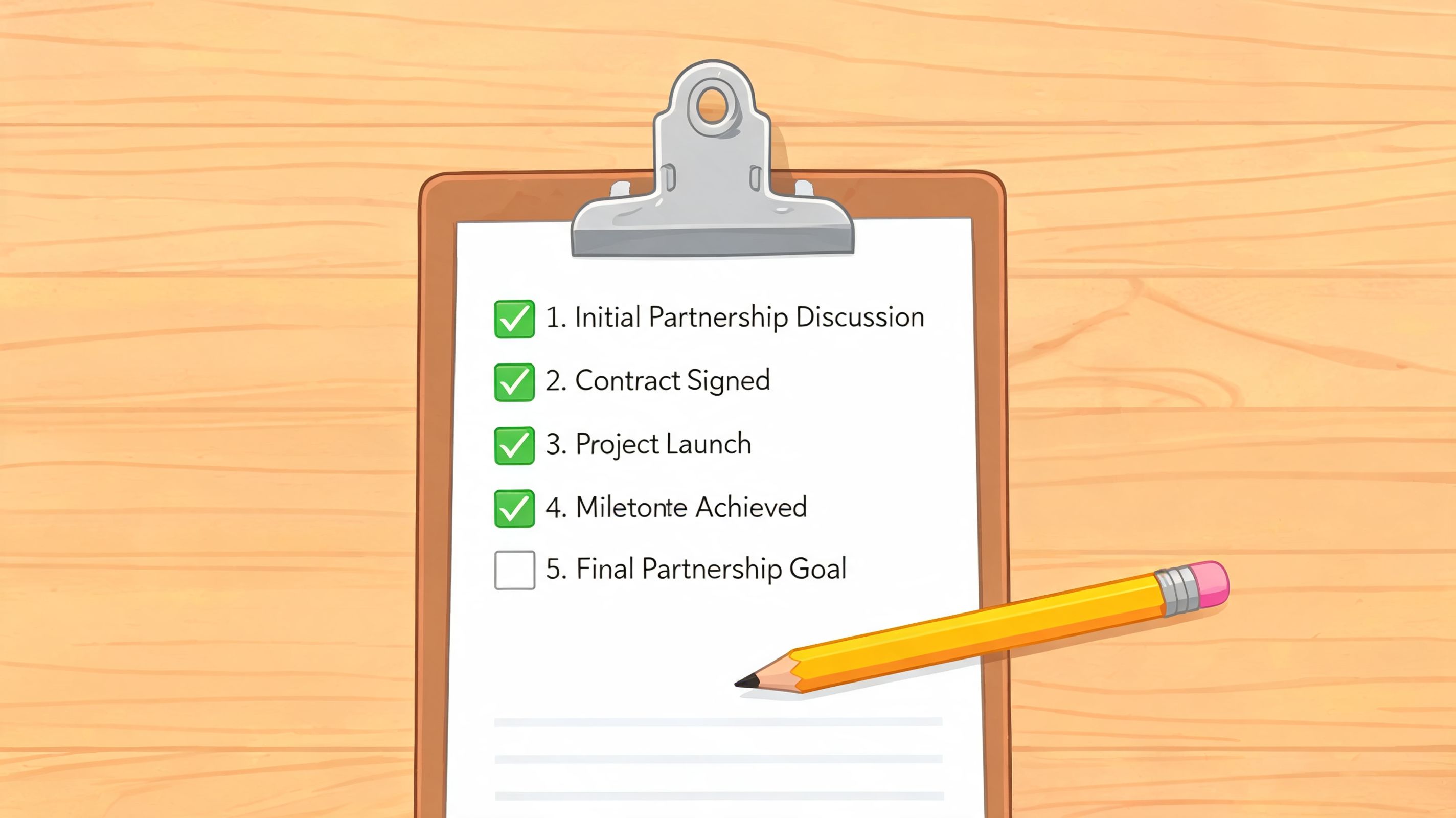
Your Partnership Agreement Checklist
When a new partnership lands on your desk, don't start by asking which template you already have. Start by asking what the relationship requires.
Questions to answer before drafting
Use this decision list with your program lead, development staff, and finance team.
Is money changing hands
If yes, move toward a contract. Payment terms, deliverables, invoicing, and reporting need enforceable language.Are we applying together or implementing together
Joint planning can often start with an MOU. Funded implementation usually needs a contract.What does the funder require
If the grant terms or subaward rules call for binding commitments, don't rely on an MOU.Will anyone handle confidential or regulated information
If a partner will access sensitive data, use a contract with clear obligations.Are we creating materials, curriculum, data, or branded content
If yes, define ownership and use rights in a contract.Do we need remedies if the partner misses deadlines or underperforms
If the answer is yes, you're describing a contract problem, not an MOU problem.
What to put in an MOU
Choose an MOU when the work is collaborative, early-stage, and low-risk. Include the parties, purpose, roles, timeframe, communication expectations, and a clear statement about whether the document is non-binding.
Keep it readable. If staff can't use it operationally, it's too vague.
What to put in a contract
Choose a contract when the work affects funding, compliance, assets, or liability. Include scope, deliverables, payment rules, confidentiality, ownership, termination, and dispute provisions.
Get signatures from authorized people. That sounds obvious, but many nonprofits still circulate agreements signed by staff who don't have contracting authority.
Language you can use with partners
Sometimes the hardest part isn't choosing the document. It's asking for it.
Try language like this:
We're happy to use an MOU while we define the collaboration. Once funding or deliverables are finalized, our policy is to move to a contract so both organizations are protected.
Or this:
Because this project involves grant compliance and reporting, we need a binding agreement that clearly sets out roles, payment terms, and documentation requirements.
That framing is firm without sounding adversarial. It explains that the contract protects both sides and supports the work, rather than signaling mistrust.
The practical test is simple. If the relationship can succeed with clarity and flexibility, an MOU may be enough. If the relationship requires accountability, payment, ownership, compliance, or legal protection, use a contract.
Fundsprout helps nonprofits move from opportunity to compliant execution without losing track of partner requirements, grant deadlines, and reporting obligations. If your team needs a better way to find grants, analyze funder requirements, manage proposal workflows, and stay renewal-ready, explore Fundsprout.
Try 14 days free
Get started with Fundsprout so you can focus on what really matters.