Max and Victoria Dreyfus Foundation Grants: A 2026 Guide
Your complete guide to Max and Victoria Dreyfus Foundation grants. Learn about eligibility, deadlines, proposal writing tips, and how to secure funding in 2026.

Abdifatah Ali
Co-Founder
You’re probably looking at the Max and Victoria Dreyfus Foundation because most foundation applications feel out of reach for a small team. You need real funding, but you don’t have time for a dense portal, a logic model, multiple attachments, and a polished narrative that reads like it came from a consulting firm.
That’s exactly why this funder keeps showing up on smart prospect lists. The process is lean. The grants are sized for practical needs. The foundation is known for backing community nonprofits where a relatively modest award can matter.
The catch is that a short application isn’t the same as an easy one. With max and victoria dreyfus foundation grants, the difference between a strong request and a forgettable one usually comes down to how well you handle the three-page Letter of Request, especially the two short summaries that drive review. If you understand that constraint and write for it, the process becomes much more manageable.
An Accessible Funding Source for Community Nonprofits
Small nonprofits often waste time chasing grants built for organizations with full development shops. The Max and Victoria Dreyfus Foundation is different in a way that matters operationally. It has a reputation for supporting community-based organizations through a simpler request format, which makes it worth serious attention if your team needs a practical funding target rather than a months-long writing project.
The foundation’s fit is strongest for nonprofits that can explain their work clearly and show why a modest grant would make a meaningful difference. That tends to favor organizations that know their programs well, have a grounded sense of community need, and can write plainly without leaning on jargon. In my experience, that’s often a better match for local operators than funders that reward polished but inflated narratives.
Why this funder stands out
A simpler process changes who can realistically apply. When a foundation accepts a short letter instead of a full proposal package, smaller teams can compete without outsourcing the work or pulling program staff into weeks of drafting.
That doesn’t mean you can send a casual note. It means the funder is forcing clarity.
Practical rule: Short applications raise the standard for precision. If you can’t explain your mission, the need, and the use of funds in plain language, a longer application wouldn’t save you anyway.
This is also where internal systems matter. If your nonprofit is trying to tighten how strategy and operations connect, it’s worth looking at expert product strategy for nonprofits. The value isn’t grant writing advice. It’s the discipline of turning broad mission language into clear user, program, and outcome thinking, which is exactly what a concise funder-facing request requires.
What strong applicants do differently
The strongest Dreyfus applicants usually do three things well:
- They lead with mission fit. They don’t try to make a random project look fundable. They show why the organization belongs in the foundation’s worldview.
- They ask for a usable amount. The request feels proportionate to the program and to the funder’s style.
- They write for a fast reader. Every sentence helps the reviewer understand purpose, need, and likely community benefit.
That combination is what makes max and victoria dreyfus foundation grants feel accessible without being casual.
Decoding the Foundation's Mission and Priorities
Before drafting anything, decide whether your organization sounds like a natural match. This foundation supports U.S.-based community nonprofits across a broad range of fields, but its giving has a recognizable center of gravity.
Arts and culture is the clearest expression of that identity. According to Inside Philanthropy’s profile of the Max and Victoria Dreyfus Foundation, arts and culture represents the largest grantmaking area, supporting music, dance, theater, visual arts, and writing organizations. The same profile notes significant investments in K-12 education, public media such as National Public Radio and WETA, environmental protection, and healthcare.
What that means in practice
This isn’t a niche arts-only funder, but arts and culture helps reveal its broader philosophy. The foundation appears to favor organizations that deliver visible public benefit, especially when programs are rooted in community participation, access, education, or care.
That has a few practical implications for positioning:
- Arts groups should stress public value. Don’t describe only artistic excellence. Show audience reach, education, access, or neighborhood relevance.
- Education organizations should stay concrete. Focus on students served, what the program does, and why the intervention matters locally.
- Health and environmental applicants should avoid abstract framing. Keep the need and the benefit close to real people or communities.
- Media organizations need a civic case. The strongest angle is community service, not brand prestige.
How to test alignment fast
A quick internal screen can save time. Ask these questions before you write:
| Alignment question | What a good answer sounds like |
|---|---|
| Is our work community-based? | We serve a defined population, place, or public audience. |
| Is the public benefit easy to describe? | A reviewer can understand the value in a few sentences. |
| Would a modest grant matter? | The request funds a real piece of work, not a vague aspiration. |
| Can we connect mission to impact without hype? | We can explain need, activity, and expected result clearly. |
If your request depends on a long theory of change to make sense, this probably isn’t the right funder.
The foundation’s nationwide scope is useful for nonprofits outside the major coastal grant hubs, but geography alone won’t carry an application. The mission fit still has to feel immediate. If your organization can show community benefit in plain terms, you’re much closer to a viable Dreyfus request.
Navigating Eligibility Grant Cycles and Amounts
This is the paper-fit section. Before anyone drafts a letter, confirm that the basics line up. That means legal status, timing, and the size of request you’re planning to make.
The foundation is known for high-volume grantmaking and modest awards that can support a project, a program, or general operations. According to Instrumentl’s 990-based profile of the Max and Victoria Dreyfus Foundation, the foundation awarded 345 grants in 2021 and 269 grants in 2022, with typical awards ranging from $1,100 to $30,000 and most grants falling between $5,000 and $20,000. The same profile notes that requests for the Fall 2026 round are accepted until May 11, 2026.
Dreyfus Foundation grants at a glance 2026
| Attribute | Details |
|---|---|
| Applicant type | U.S.-based community nonprofits with 501(c)(3) status |
| Funding range | Typical awards range from $1,100 to $30,000 |
| Common award band | Most grants fall between $5,000 and $20,000 |
| Grant volume | 345 grants in 2021 and 269 grants in 2022 |
| Current timing note | Fall 2026 requests accepted until May 11, 2026 |
How to interpret the numbers
High grant volume is encouraging, but don’t read it as a reason to submit a weak fit. It means the foundation makes many awards. It doesn’t mean every worthy nonprofit should apply. The better takeaway is that the funder appears comfortable making many smaller commitments rather than concentrating a small number of large ones.
That has two practical effects on strategy.
First, ask for an amount that fits a specific, understandable need. A request that sits comfortably within the foundation’s usual band will generally feel more believable than an ask that stretches your narrative.
Second, choose a use of funds that can stand on its own. A staff position, a discrete program slice, artist fees, classroom materials, community outreach, a season component, or direct service support often reads more cleanly than a broad institutional transformation pitch.
Eligibility judgment calls
A few gray areas come up often:
- If your nonprofit is eligible but your project is overly specialized, the paper fit may still be weak. The foundation’s pattern suggests a preference for community-facing benefit.
- If your organization is large, don’t assume that helps. The process feels more naturally suited to requests where a modest grant still matters.
- If your ask is technically within range but operationally thin, revise it. “Support our mission” is less persuasive than a defined use tied to visible benefit.
For teams building a broader private foundation pipeline, this roundup of foundation grants for nonprofit organizations is useful as a comparison point. It helps frame where Dreyfus sits in the wider context: approachable, concise, and best for nonprofits that can make a compact case well.
Crafting Your Compelling Three-Page Letter of Request
The success or failure of most applications hinges on the submitted materials. The foundation’s own guidelines make clear that the review process relies on two mandatory 100-150 word summaries and a three-page Letter of Request, with decisions based on those materials for the biannual cycles closing May 10 and November 10, as stated in the Max and Victoria Dreyfus Foundation application guidelines.
That requirement changes how you should write. You are not building toward an executive summary after pages of explanation. The summaries are the front door. If they’re vague, inflated, or hard to parse, the rest of the letter won’t rescue the application.
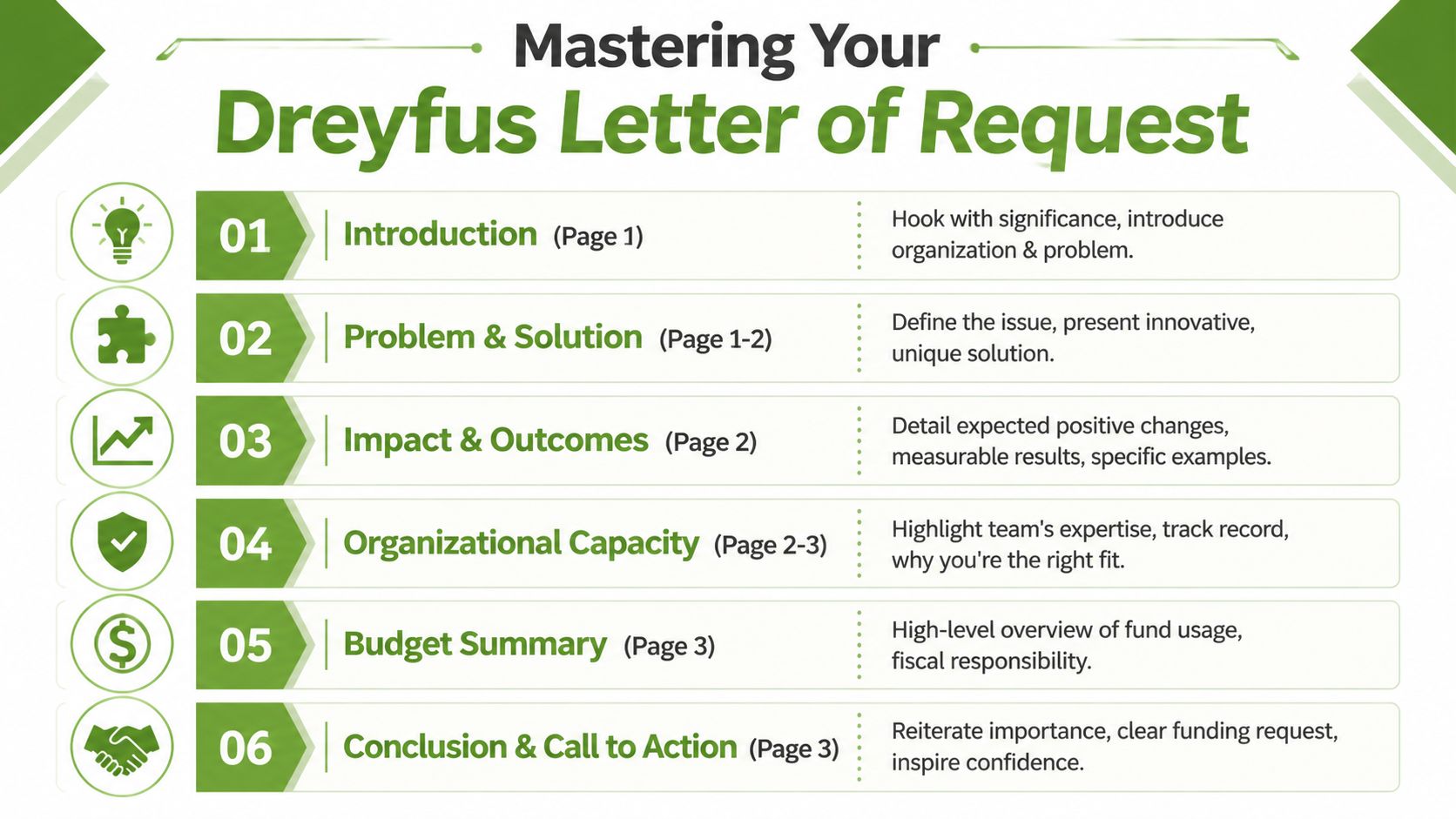
Treat the two summaries as the real application
The first summary covers the organization’s purpose. The second explains how the funds will be used. Both have to work as stand-alone pieces.
Here’s the standard I use.
The organizational summary
This summary should answer four things in one compact block:
- Who you are
- What you do
- Who you serve
- Why the work matters
What works:
- A plain-English mission statement
- A concrete description of core programs
- A defined population, community, or audience
- Language that sounds like a practitioner wrote it
What doesn’t:
- Generic claims about “transforming lives”
- A list of every program you run
- Internal language that only your staff understands
- A long origin story
A workable pattern looks like this:
[Organization name] is a [type of nonprofit] serving [community or population] through [core programs]. Our work focuses on [primary need or purpose], with an emphasis on [community benefit or access point]. We provide [brief program examples] for [served group], helping [community or participants] gain [clear benefit].
The funding use summary
This is not a budget note. It’s a mini impact case. The reviewer should understand what the grant will support and why that use matters.
Good versions usually include:
- The exact purpose of the request
- The program or activity being funded
- The people or audience affected
- The practical result the funding enables
Weak versions usually:
- Restate the mission without naming the use
- Ask for “general support” with no context
- Overpromise
- Mention budget categories without explaining what they enable
A clean pattern looks like this:
We seek support for [specific purpose or program]. Grant funds would be used for [clear use of funds], allowing us to [deliver activity or service]. This support would help [population or audience] by [expected benefit], and it would strengthen our ability to [practical organizational outcome such as sustain access, expand participation, or maintain service quality].
Structure the three-page letter with discipline
The letter itself should be short, direct, and organized for a fast read. A practical structure is:
| Page area | What belongs there |
|---|---|
| Opening | Who you are, the request amount, and the purpose of the request |
| Core narrative | Need, program, why this work matters, and why your organization is equipped to deliver it |
| Final section | Request recap, concise budget context, and any closing note on community value |
The guidelines also matter at the formatting level. Keep the letter plain. Don’t add decorative elements, charts, images, or extra materials that weren’t requested. If the funder asks for a three-page letter, treat that as a hard ceiling, not a suggestion.
The organizations that struggle with concise applications are often the ones that haven’t decided what matters most. The writing problem is usually a decision problem.
What to include and what to leave out
A strong Dreyfus letter usually includes:
- A precise ask: Name the amount and purpose early.
- A recognizable need: Explain the problem in community terms.
- A focused program description: Stay on the funded activity, not everything the organization does.
- A capacity signal: Give the reviewer a reason to trust execution.
- A restrained close: End clearly, not dramatically.
Leave out:
- Board lists unless requested
- Graphic design elements
- Dense institutional history
- Long quotes or testimonials
- Attachments added “just in case”
If your team needs a model for shaping concise introductory grant language, this guide on how to write a letter of inquiry is a useful parallel reference. The Dreyfus process is its own format, but the discipline is similar: short space, high consequence, no room for drift.
Examples of Funded Projects and Grantees
The easiest way to understand this funder is to look at the kinds of organizations it supports. The public examples point to a broad but coherent pattern: community-facing work, visible public benefit, and institutions or programs that people can readily understand.
Arts and culture examples
Arts and culture is the foundation’s most prominent area, and that shows up in the range of organizations associated with its support. The category includes music, dance, theater, visual arts, and writing organizations, which suggests that applicants in this field don’t need to force themselves into one preferred art form. What matters more is whether the work reaches a community and can be explained as public benefit.
A useful way to frame an arts request is not “we create important art,” but “we make cultural participation, education, or access possible for a defined audience.” That aligns more closely with how this funder appears to think.
Public media and education examples
Named grantees and recipients associated with the foundation’s giving include National Public Radio, Connecticut Radio Information System, and WETA public television serving greater Washington, D.C. These examples help clarify the foundation’s comfort with organizations that serve broad audiences through information, education, and cultural infrastructure.
That doesn’t mean smaller nonprofits need institutional scale. It means the reviewer is likely open to requests that make a clear civic case. A local literacy nonprofit, school-linked arts education program, or youth-serving afterschool initiative can learn from that pattern: explain the public value directly.
Community benefit is the common thread
Across funding areas, successful “Dreyfus-style” requests tend to have the same feel:
- The program is easy to picture.
- The audience is clearly defined.
- The benefit is local, public, or community-facing.
- The grant request feels proportional and usable.
Don’t chase novelty for its own sake. This foundation’s pattern suggests it values understandable, mission-rooted work more than clever framing.
If you’re trying to decide whether your project belongs here, ask a simple question: would an outsider understand, in a few sentences, who benefits from the funding and why that matters? If yes, you’re probably thinking in the right direction.
Common Application Pitfalls and How to Avoid Them
The biggest problem with max and victoria dreyfus foundation grants isn’t complexity. It’s false simplicity. Public guidance on the three-page letter is limited, and that gap leaves many nonprofits unsure how to show the “large difference” their request could make. The Vanderbilt limited submission note on the Max and Victoria Dreyfus Foundation grants program points to that exact issue, noting that common questions about metrics, priorities, and how to demonstrate impact often go unanswered.
Mistake one: sending a generic foundation letter
A lot of nonprofits already have a standard two- or three-page case statement. That’s not the same thing as a Dreyfus letter.
A generic letter usually talks broadly about mission, includes too much background, and never sharpens the request around one practical use of funds. For this funder, specificity beats polish. Write to the actual constraints of the application.
Mistake two: treating the summaries like admin fields
Those short summaries aren’t filler. They are central review material.
Weak summaries tend to be abstract, repetitive, or loaded with mission language but light on program substance. Better summaries read like compressed program briefs. They name the organization, the work, the audience, the request, and the expected benefit without wandering.
Mistake three: ignoring format discipline
Nonprofits sometimes hurt otherwise good requests by adding things the foundation didn’t ask for. Extra attachments, visual branding, charts, and long supplements can signal that the applicant didn’t follow directions or didn’t trust the format.
Use restraint instead:
- Stay within the page limit. Tight editing is part of the job here.
- Keep the document plain. Simple formatting is safer than creative presentation.
- Submit what was requested. No bonus materials unless the guidelines call for them.
Mistake four: using weak evidence of impact
Many applicants know they need to show a “large difference” but don’t know how. The answer isn’t to stuff in complicated measurement language. It’s to choose a few grounded indicators of usefulness.
That might mean describing who will be served, what activity the grant will support, and what practical change the funding enables. In this process, clarity usually carries more weight than technical evaluation vocabulary.
Streamline Your Dreyfus Application with Fundsprout
A Dreyfus application is short, but the prep work still takes coordination. You need the right opportunity in your pipeline, a clear eligibility check, a clean summary of the ask, and a draft that doesn’t drift past what the funder wants.
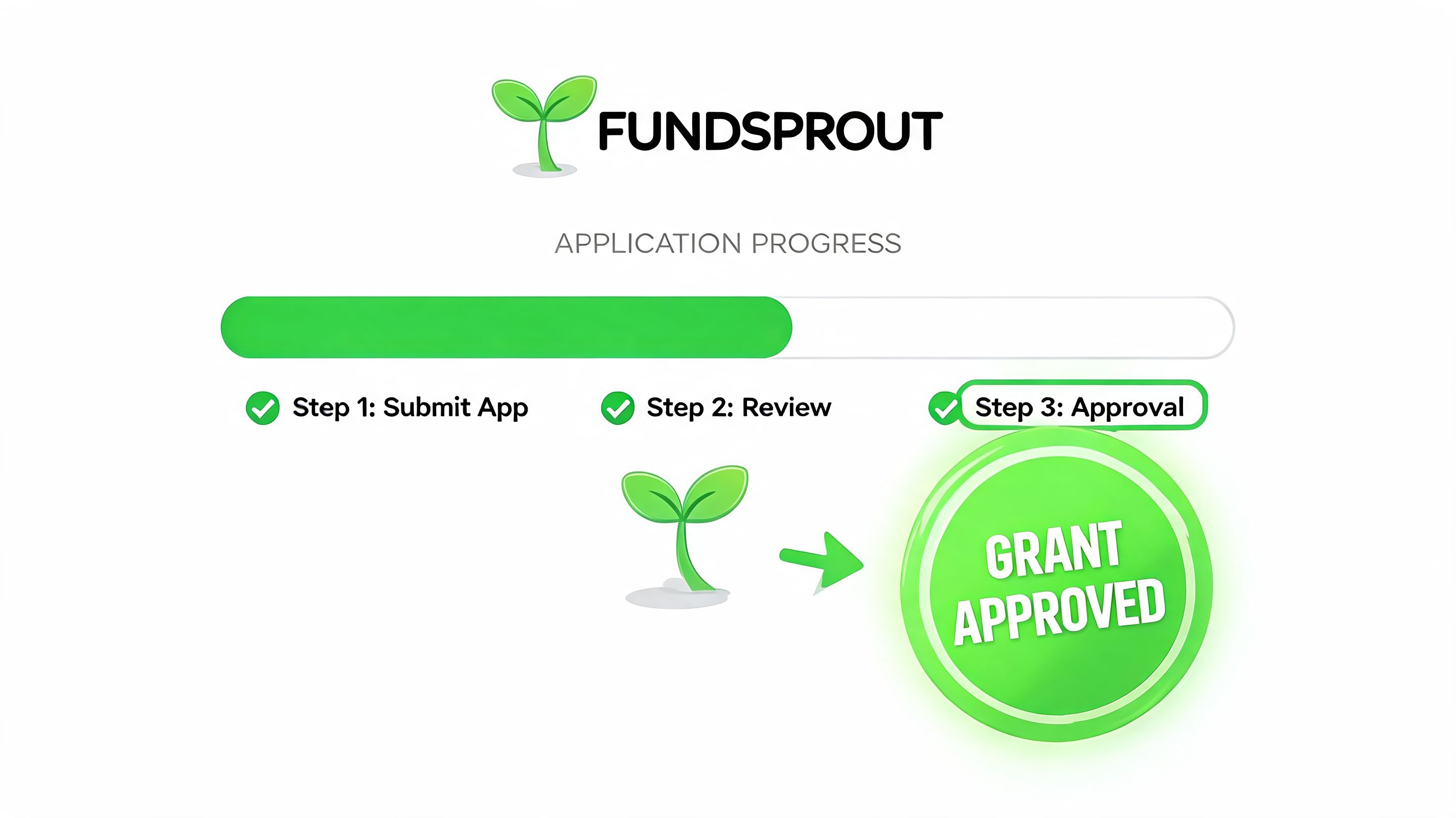
Fundsprout is built for exactly that kind of work. Instead of treating grant seeking like a pile of disconnected documents, it gives nonprofit teams one place to identify fit, break down requirements, draft in the organization’s voice, and keep deadlines from slipping.
Where the platform helps most
The strongest use case for a funder like Dreyfus is requirement control. A short application leaves very little room for wasted motion, so teams benefit from tools that reduce ambiguity early.
Fundsprout helps in practical ways:
- Discovery and screening: The platform surfaces relevant opportunities and helps teams verify whether a funder belongs in the active pipeline.
- Requirement breakdown: The RFP analyzer turns funder instructions into a structured outline, which is especially useful when the key challenge is a tightly constrained letter.
- Drafting support: The writing assistant can build narrative sections from your existing organizational materials, which is useful when you need concise summaries without starting from a blank page.
- Workflow visibility: Planning tools make it easier to assign drafting, budget review, document collection, and submission tasks across a small team.
A deeper look at AI for grant writing is useful if you’re weighing where automation helps versus where human judgment still matters. For Dreyfus, the best split is simple: let software organize, extract, and structure. Let staff decide what the most compelling case really is.
One more look at the workflow makes the value clearer:
The point isn’t to automate judgment. It’s to remove avoidable friction so your team can spend its time on the parts that matter, especially the ask, the summaries, and the discipline of a strong three-page letter.
Fundsprout helps nonprofits find aligned grant opportunities, turn funder requirements into usable writing plans, and draft stronger applications without losing compliance. If you want a faster, cleaner way to manage max and victoria dreyfus foundation grants and the rest of your pipeline, explore Fundsprout.
Try 14 days free
Get started with Fundsprout so you can focus on what really matters.