Your Essential LOI Template Grant Guide For Nonprofits
Stop staring at a blank page. Download our proven loi template grant package and learn how to write a Letter of Inquiry that truly gets you noticed.

Abdifatah Ali
Co-Founder
A strong Letter of Inquiry (LOI) is your best tool for getting a funder’s attention. Think of a solid loi template grant as your blueprint—it helps you build a case that’s compelling, concise, and, most importantly, respectful of a funder's limited time.
This isn't just a summary; it's a strategic introduction designed to pique their interest and earn you that coveted invitation to submit a full proposal.
Your Essential LOI Template Grant Toolkit
I've seen it time and again: a well-crafted LOI is the most strategic first move in the entire grant-seeking game. Funders are absolutely swamped with requests. Your LOI acts as their first filter, letting them quickly spot the projects that truly align with their mission. A good template ensures you hit all the critical points without burying them in details.
Why Structure Matters More Than Ever
Let's be blunt: a generic, rambling letter is a one-way ticket to the "no" pile. The secret is to present a logical, compelling story that anticipates a funder’s core questions: What problem are you solving? Why is your team the one to do it? And how exactly will our money make a real difference?
A proven structure isn't about being rigid; it's about making sure you answer those questions clearly and efficiently. To see what a finished product looks like, check out this complete sample grant letter of inquiry. It really helps to see how all the pieces come together.
Anatomy Of A Winning Letter Of Inquiry
Here’s a quick-reference guide to the essential sections of a grant LOI. I've broken down what each part does and a suggested length to keep your message sharp and impactful.
Following this framework is the best way to ensure your LOI is comprehensive without wasting a moment of the funder's time.
A successful LOI isn't just about what you say, but how you say it. It’s a test of your ability to be clear, compelling, and concise—qualities that funders look for in a potential partner.
Of course, writing the perfect LOI is only half the battle. It's also critical to understand the bigger picture and explore different funding sources, including grants to build a sustainable financial base for your organization. Think of this toolkit as your starting point for creating a document that doesn't just get read, but gets a "yes."
Crafting Each Section Of Your Letter Of Inquiry
Moving from a blank page to a compelling Letter of Inquiry is a bit of an art form. While a good template gives you the skeleton, the real magic happens when you infuse each section with a story that connects with the funder. This is where you turn raw data into a narrative and a project into a mission.
Let's break down how to tackle each critical piece, turning your ideas into persuasive, fundable prose. I'll walk through it using two very different examples: a local food bank fighting immediate hunger and an after-school arts program focused on teen development. This should give you some practical, adaptable advice you can use for your own unique work.
The Introduction: Your Hook
Your first paragraph is your handshake. Make it firm, confident, and immediate. Skip the long-winded pleasantries and get right to it—state who you are, what you need, and why you’ve chosen this specific funder.
For the food bank: The intro should lead with a stark, local statistic. Something like, "With a 25% increase in food insecurity in our county this past year, [Your Organization's Name] is requesting $25,000 to expand our Mobile Pantry Program. This project directly aligns with the [Funder's Name] Foundation's commitment to alleviating poverty."
For the arts program: Here, the focus shifts to opportunity. You might write, "To address the critical gap in creative outlets for at-risk teens, [Your Organization's Name] seeks $20,000 to launch 'Studio 25,' our new digital arts program. We see a powerful parallel between this project and your foundation's goal of fostering youth resilience."
In both scenarios, the opening sentence immediately connects the organization’s work to the funder's stated mission. It shows you’ve done your homework.
Organization Background: Building Credibility
This isn't the place for your entire history. Think of it as a highlight reel designed to build trust and prove you can deliver on your promises. You’ve got one short paragraph to convince them you’re a safe and effective investment.
Key Takeaway: Frame this section as your "why us." Zero in on one or two key achievements or metrics that showcase your track record. Did you double your service numbers last year? Did a previous program hit a 90% success rate? Lead with that.
The food bank might say, "For over a decade, our food bank has been a pillar of community support, distributing over 2 million pounds of food to more than 50,000 individuals annually. Our established network of 30 local partners ensures every donation is distributed efficiently and with dignity."
The arts program, maybe a newer organization, could focus on its unique expertise: "Founded in 2018, we are the only organization in the city dedicated to providing free, high-tech arts education. Our staff of professional artists has successfully guided over 300 teens through programs that resulted in award-winning projects and strong college portfolios."
Statement Of Need: Creating Urgency
This is the heart and soul of your LOI. Your job is to paint a vivid picture of the problem you're solving, using both hard data and human-centered language. You want to create a sense of urgency without being overly dramatic. This is where you prove the problem is real, significant, and needs attention now.
A powerful Statement of Need balances statistics with a touch of storytelling. For example, stating that "1 in 5 children in your city faces hunger" is a strong start. But if you follow that with a brief, anonymized story about a family who relies on your services, that statistic becomes unforgettable. For a deeper look, our guide on how to write a compelling statement of need offers more advanced techniques.
Project Description: Presenting The Solution
Okay, you've established the problem. Now it's time to present your clear, logical, and exciting solution. You need to crisply describe the who, what, where, and how of your project.
- Who are you serving? Be specific.
- What are the core activities?
- Where will this take place?
- How will you measure success? What are your key outcomes?
This section is absolutely critical. Project-based funding dominates the grant landscape—research shows that project-specific grants make up 41.6% of all awards, compared to just 24.2% for general operating support. A precise, data-driven project description is your key to standing out. If you want to discover more about current grant writing trends, it's always smart to stay informed.
Let’s see how our two organizations would handle this:
Budget Summary: Showing Financial Clarity
Finally, the budget summary is where you get to be direct and transparent. In one concise paragraph, state the total project cost, the amount you're requesting from this funder, and briefly mention what their funds will cover. No fluff.
For the food bank: "The total budget for our Mobile Pantry Program expansion is $50,000. We are requesting $25,000 from your foundation to cover the costs of fuel, vehicle maintenance, and the purchase of fresh produce for one year."
For the arts program: "This project has a total budget of $40,000. We respectfully request $20,000 to fund software licenses, computer hardware, and stipends for our teaching artists."
This straightforward approach shows you've done your financial planning and helps the funder see exactly how their contribution fits into the bigger picture.
How To Customize Your LOI For Different Funders
Sending the same generic Letter of Inquiry to every potential funder is one of the fastest ways to land in the "no" pile. You have to think of it this way: every foundation, agency, and corporation has its own unique personality, its own set of priorities, and its own language. Your job is to be a master translator. A solid loi template grant is your starting point, not the final product.
The real art of this process goes way beyond just swapping out the funder's name. It’s about digging deep into their mission, mirroring their language, and strategically shining a spotlight on the parts of your project that perfectly match their goals. When you do this, you’re not just asking for money; you’re showing them you're a serious, thoughtful potential partner who has done their homework.
The core components of your LOI will stay the same, but how you frame them is what makes all the difference.
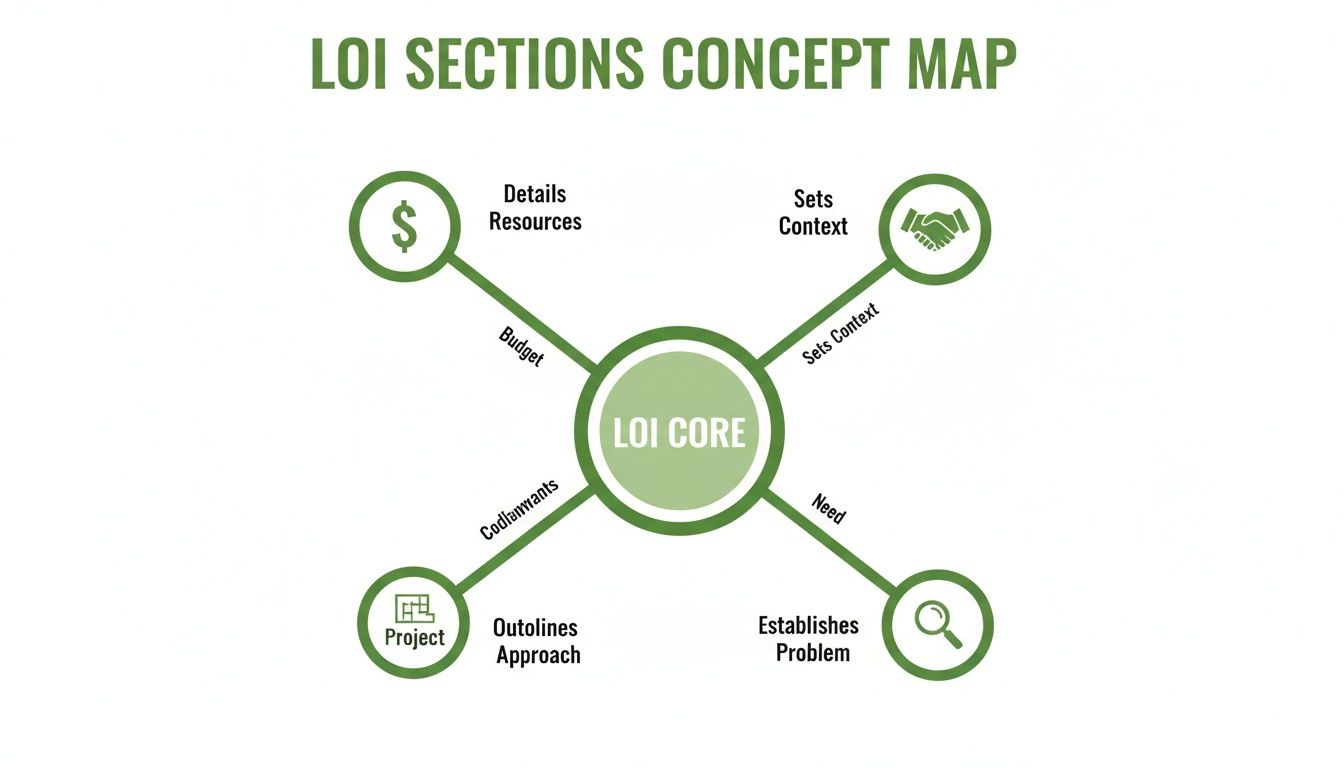
As you can see, the foundation—your project, your budget—is constant. But the story you tell, the needs you highlight, and the language you use have to change for every single audience.
Tailoring for Community Foundations
Community foundations are, by their very nature, all about local impact. Their program officers and board members are your neighbors. They live and work in the same areas you serve, so your approach needs to be grounded in storytelling, human connection, and tangible, neighborhood-level results.
They need to feel the difference their investment will make on streets they recognize. Forget the vague, academic jargon; it just won't fly here. You need to speak from the heart while backing it up with hard, local data.
- Lead with a Story: Start with an anonymized, relatable story of a real person whose life was changed by your work. Instead of saying you "serve at-risk youth," talk about how Maria, a local high school student, found her confidence and landed an internship through your program.
- Go Hyper-Local with Data: National statistics are meaningless to them. Pull data from your city, county, or even a specific zip code. Mention local landmarks, school districts, or community centers to firmly root your project in a reality they understand.
- Show You're a Team Player: Make sure to highlight your partnerships with other local nonprofits, schools, or government offices. Community foundations love seeing organizations working together—it shows their investment will create a ripple effect across the community.
Pro Tip: Try framing your request as an "investment in our shared community." This language shifts the dynamic from a handout to a partnership, which is exactly how these funders see themselves.
Customizing for Government Agencies
Writing an LOI for a government agency—whether it's city, state, or federal—demands a complete shift in tone. Here, it's all about policy alignment, measurable outcomes, and following the rules to the letter. Personal stories take a backseat to hard data, and emotional appeals are replaced by evidence-based arguments.
Remember, government funders are accountable to taxpayers. They need a clear, logical, and defensible case for why your project fulfills a public mandate. Your language must be formal, precise, and completely objective.
Key Differences in Approach
When you're writing for a government grant, you have to meticulously connect every part of your project back to the specific language in the funding announcement. Use their exact terminology. If the RFA is for "workforce development initiatives," then you run a "workforce development initiative."
Pitching to Corporate Foundations
Corporate foundations are playing a different game entirely. They are often guided by a "double bottom line"—they want to create social good, but that good also needs to align with the company's brand, employee engagement goals, and broader business objectives. Your LOI has to speak to both of these motivations at once.
You have to show them how partnering with you provides value beyond a simple philanthropic transaction. This calls for a professional, confident, and results-oriented tone.
How to Frame Your Corporate LOI:
- Show Brand Alignment: Explicitly connect your work to their corporate social responsibility (CSR) pillars. If a tech company's foundation focuses on digital literacy, frame your after-school coding club as "building their future workforce."
- Offer Employee Engagement: Don't just ask for a check; suggest concrete ways their team can get involved. Pitch volunteer days, skills-based mentoring, or board service opportunities. Research shows 71% of employees prefer to work for socially responsible companies, so this is a huge value-add for them.
- Highlight Visibility and PR: Subtly point out the positive PR that comes with supporting your work. Mention co-branding opportunities at your annual gala or in your newsletter. They are always looking for authentic stories to tell about their community involvement.
- Speak in Quantifiable Impact: Just like government funders, corporations want to see a return on their investment (ROI). Use business-like language. Talk about metrics, efficiency, and measurable outcomes. Give them a clear "social ROI" they can report to their stakeholders.
In the end, customizing your LOI is all about empathy. It's about stepping into the funder's shoes and directly answering their number one question: "Why should we, specifically, invest in this project right now?" By tailoring your language, focus, and data, you stop being just another application in a giant pile and become a compelling, can't-miss partner.
Common LOI Mistakes You Need To Avoid
You've poured your heart into crafting a compelling story and tailored it perfectly to the funder. But before you hit "submit," you need to do one last, critical self-edit to avoid the common pitfalls that sink even the most promising proposals. Think of this as your final quality check—a way to make sure a simple, avoidable error doesn’t derail all your hard work.
So many of these mistakes come down to rushing the process. But to a funder, they all send the same message: a lack of attention to detail.
Ignoring The Funder's Instructions
This is, without a doubt, the number one reason LOIs get tossed out before they’re even read. Funders provide guidelines for a reason. Ignoring them signals that you either didn't bother to do your research or simply don't respect their process.
- Page or Word Limits: If they ask for two pages, sending three isn’t giving them a bonus—it’s getting you disqualified.
- Formatting Requirements: Did they specify a font size, margin width, or PDF-only submission? Follow those instructions to the letter.
- Specific Questions: Many funders now use online portals instead of accepting traditional letters. Don’t try to shoehorn your pre-written narrative into their boxes. Answer exactly what they ask, not what you wish they'd asked.
Failing to follow the rules is the quickest way to suggest you’ll be a difficult partner. It instantly erodes the trust you've been working so hard to build.
Using Vague Language And Jargon
Your passion for your work is a huge asset, but it can also lead you down the path of using internal jargon that leaves reviewers scratching their heads. Drop the acronyms and technical terms that someone outside your specific field wouldn't immediately grasp. Clarity is king.
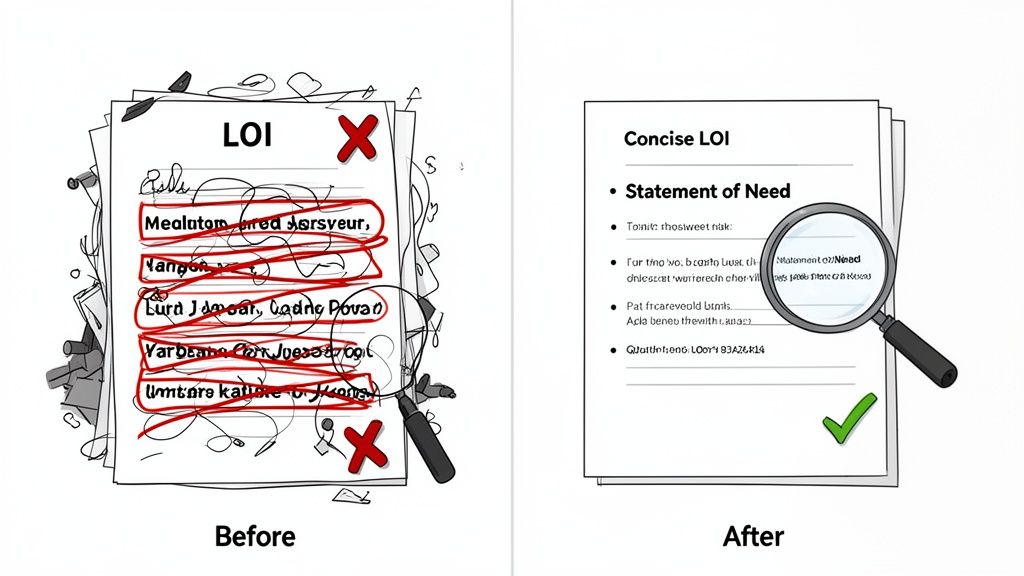
Vague statements are just as bad. They completely undermine your credibility. I can't tell you how many times I've read a line like, "Our program will improve outcomes for at-risk youth." What does that actually mean?
Before: "Our program will empower disadvantaged community members."
After: "Our program will provide financial literacy training to 150 low-income single mothers, helping 70% of them create a household budget for the first time."
See the difference? Specificity shows you have a concrete plan, not just a noble idea. Using a solid loi template for a grant can provide a great structure, but it’s your job to fill it with sharp, specific details that bring your project to life.
A Misaligned Budget Request
Another classic mistake is a budget that feels completely disconnected from the project you’ve described. The numbers and the narrative have to tell the same story. If they don't, it raises immediate red flags.
What Funders Spot Right Away:
- An Ask That's Too High or Too Low: Requesting $100,000 for what sounds like a $20,000 project is just as damaging as asking for too little. It suggests you haven't done your financial homework.
- A Lack of Justification: The line "We are requesting $50,000" is fine. But "We are requesting $50,000 to cover the salaries of two part-time project coordinators and all program supplies" is infinitely better.
- Ignoring the Funder's Typical Range: If a foundation’s average award is $25,000, asking them for $250,000 is a waste of everyone's time. A quick search of their past grants will tell you if your request is in the right ballpark.
Your budget summary is a direct reflection of your organization's planning and realism. Make sure it's logical, well-justified, and perfectly aligned with both your project's scope and the funder's capacity.
Using Technology To Streamline Your Grant Seeking
Let's be honest. For most nonprofits, the biggest hurdle isn't a lack of incredible, world-changing ideas. It's the clock. There are never enough hours in the day, and crafting a thoughtful, personalized Letter of Inquiry for every promising funder can feel like an impossible task. This is where smart technology can make all the difference, moving from a "nice-to-have" to a core part of your fundraising strategy.
The right grant-seeking tools help even the smallest teams get more done, automating the grunt work so you can focus on building relationships and telling a powerful story. Instead of spending days sifting through databases, imagine a system that surfaces and ranks the best-fit funders for you. Every hour you invest is an hour spent on a real, viable opportunity.
Amplifying Your Expertise, Not Replacing It
The idea here isn't to let a robot take over your job. It's about giving you a co-pilot. A platform like Fundsprout handles the repetitive, time-consuming tasks that often lead to burnout, letting you scale up your efforts without overwhelming your team. You get to send out more high-quality proposals, which is the name of the game.
This is a very real problem for most of us in the field. GrantStation's 2025 State of Grantseeking Report found that a staggering 64.9% of nonprofits rely on just one or two people to manage their entire grants process. When asked about their biggest challenge, the number one answer was a lack of time and staff. This makes efficiency a matter of survival, not just convenience.
From Manual Drudgery to Smart Automation
To really see a change, it helps to understand what workflow automation entails. It’s not just about doing things faster; it’s about creating a smooth, connected system that eliminates redundant work and frees up your time for what matters.
Here's how this plays out with a tool like Fundsprout:
- Funder Matching: The platform does the heavy lifting, delivering a ranked pipeline of federal, state, and foundation grants that actually align with your programs and location. No more guesswork.
- AI-Assisted Drafting: You can get a huge head start on your LOI. The writing assistant learns your organization's voice from past proposals and documents you upload, helping you draft compelling sections that sound like you.
- Centralized Management: Everything—your research, drafts, deadlines, and submissions—lives in one place. You can see your entire grant pipeline at a glance.
This screenshot gives you a sense of how a modern platform can turn a messy, chaotic process into a clear and manageable workflow.
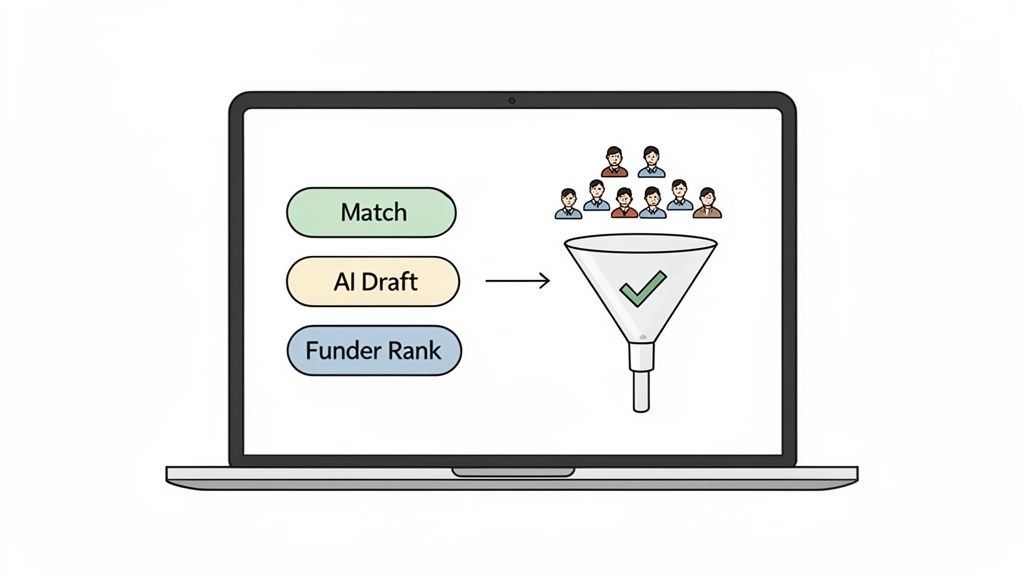
It maps out the journey from finding the right funder to crafting the perfect LOI, breaking a complicated procedure down into simple, logical steps.
Key Insight: Adopting grant management technology is one of the smartest ways to build your nonprofit's capacity. It frees up your team from administrative headaches so they can focus on what they do best: strengthening your programs and building relationships with funders.
Bringing an AI-powered platform into your loi template grant process gives you a serious competitive advantage. It helps you stay consistent, work faster, and ultimately submit more thoughtful, better-aligned proposals. If you want to dig deeper into the nuts and bolts, https://www.fundsprout.ai/resources/ai-for-grant-writing. It offers a closer look at how these tools can truly reshape your fundraising approach.
Answering Your Top Questions About Grant LOIs
Even with a solid template, you're bound to have some questions once the writing is finished. Sending off an LOI can feel just as nerve-wracking as writing it in the first place. Let’s clear up some of the most common questions grant seekers have so you can submit your letter with total confidence.
Think of this as your final pre-flight check. Getting these last few details right can make all the difference in creating a professional, polished first impression.
What’s the Ideal Length for a Grant LOI?
This is a big one. The golden rule is to keep it to two or three pages, maximum. Remember, funders are sifting through huge stacks of these. A concise letter shows that you respect their time and can communicate your project's core value efficiently.
Exceeding the page limit is a rookie mistake that immediately suggests you might not be great at following directions later on. Stick to standard one-inch margins and a classic, readable 12-point font like Arial or Times New Roman. This ensures your content is easy on the eyes and fits neatly within the limit.
Should I Contact a Program Officer Before I Submit?
It's a smart question, and the answer is a firm "maybe." It all comes down to how and why you reach out. Never call just to say hello or ask something you could have found in their guidelines. That’s a waste of everyone's time.
Instead, your goal should be to ask a specific, insightful question that proves you've done your research.
A great reason to get in touch is to clarify a subtle point about your project's eligibility or to quickly check if your focus aligns with a new funding priority they've recently announced. A short, professional email is almost always the best way to do this.
What Should I Expect After Hitting "Submit"?
Once your LOI is sent, the waiting period starts. The funder's review timeline can be anything from a few weeks to several months, so patience is key. Generally, you can expect one of three outcomes:
- An invitation to submit a full proposal: Congratulations! This is the goal. Your LOI did its job and piqued their interest.
- A declination letter: This is a "no" for now. It means your project wasn't a fit for this particular funding cycle.
- Radio silence: It's frustrating, but some foundations simply don't have the staff to reply to every single submission.
If the funder published a decision date and you haven't heard anything by then, it's perfectly fine to send a brief, polite follow-up email. And one last piece of advice: never, ever send the exact same LOI to different funders. Each letter needs to be carefully customized to speak directly to the funder's unique mission and interests.
Ready to stop guessing and start winning? Fundsprout uses AI to match you with the right funders, helps you draft tailored proposals in your organization's voice, and keeps your entire grant pipeline organized. Discover how Fundsprout can streamline your grant seeking today!
Try 14 days free
Get started with Fundsprout so you can focus on what really matters.