Winning a Letter of Intent Grant
Transform your grant seeking with a compelling letter of intent grant. Learn proven strategies to capture funder interest and secure your invitation to apply.

Abdifatah Ali
Co-Founder
Think of a grant letter of intent as the professional handshake before the in-depth meeting. It’s a brief, preliminary document that a nonprofit sends to a funder before diving into a full-blown proposal. This letter acts as a quick introduction, outlining your project, its purpose, and—most importantly—how it perfectly aligns with the funder’s mission.
It’s a smart way to gauge a funder's interest and save precious time for everyone involved.
The First Handshake: How a Grant LOI Opens Doors

Before you pour dozens of hours into crafting a massive grant proposal, you have to know if you're even knocking on the right door. This is where the Letter of Intent (LOI) becomes one of your most valuable strategic tools. It's not just a formality; it’s a crucial first move that can define your entire funding journey.
An effective LOI is a nod of respect to a grant reviewer's packed schedule. It gets straight to the point, showing you understand their priorities and have a project worthy of their attention.
More Than Just an Introduction
A truly great LOI does more than just say hello—it starts building the case for a genuine partnership.
Let’s imagine a small, community-based arts program that wants to offer free after-school classes in an underserved neighborhood. The project has heart and a clear impact, but they need funding for art supplies and to pay their instructors.
Instead of carpet-bombing foundations with a 30-page proposal, they start with a tight, two-page LOI. This document quickly lays out the essentials:
- The Community Need: A quick snapshot of the local youth's lack of access to arts education.
- The Proposed Solution: An overview of the after-school program, what it does, and what it aims to achieve.
- Organizational Credibility: A brief mention of the nonprofit's track record and past successes.
- Alignment with Funder's Mission: A direct line connecting their project to the foundation's goal of supporting youth development through the arts.
This focused approach makes their project stand out in a sea of inquiries. A program officer can scan this LOI in minutes and know right away if it’s a potential fit. If the answer is yes, they’ll invite a full application—a huge signal that you've already made it past the first gatekeeper.
A strong LOI transforms your application from a cold submission into a warm introduction. It’s the difference between showing up unannounced and being an invited guest.
Improving Your Chances of Success
For major grantmakers, requiring an LOI is a standard practice to streamline their review process. But it's also a huge benefit for you. Research shows that roughly 30% of grant applications are rejected because the proposals are vague or lack clear objectives. The discipline of writing a targeted LOI forces you to sharpen your project's core message, which in turn makes your final proposal much stronger.
At the end of the day, the LOI saves you an incredible amount of time and energy. Instead of chasing dead ends, you can concentrate your efforts on funders who have already shown real interest. To make this even more efficient, it pays to have a solid system to find grants for nonprofits that are a good match from the start. That way, your LOI is landing on the right desk every single time.
Anatomy of a Compelling Grant LOI

Think of your Letter of Intent not as a dry, formal document, but as a compelling story. It’s your first real chance to convince a program officer that your project is the one they’ve been waiting to fund. It’s not about ticking off boxes; it’s about weaving a narrative where every piece logically leads to the next, making it impossible for them to say no.
Each section has a specific job to do, from grabbing their attention to proving your project is a smart investment. Let's break down the key parts that will make your LOI stand out.
Your Introduction and Organizational Credibility
This is your first impression, so make it count. The opening paragraph needs to immediately connect your mission with the funder's priorities. Don't beat around the bush. Right away, answer the big questions: Who are you, what are you trying to solve, and why are you knocking on their door specifically?
Think of it like a firm handshake. You want to establish credibility fast, but without drowning them in a long list of your greatest hits. A single, powerful accomplishment that proves you can handle this project is far more effective.
The Heart of the Matter: The Problem Statement
Here's where you make the case for why your work is so urgently needed. A truly great problem statement does more than just describe an issue—it uses sharp, pointed data to create a sense of immediacy. Vague claims like “many people in our area need help” get glossed over.
Instead, put a number on it. Saying, "42% of elementary students in our county read below grade level, a figure that's jumped by 15% in the last three years," is impossible to ignore. It grounds the problem in reality and perfectly sets the stage for your solution. This section, often called the Statement of Need, is the bedrock of your entire proposal.
A well-framed problem statement isn't just about showing a gap; it's about demonstrating that this gap has real, measurable consequences that align with the funder’s focus areas.
The Solution and Project Description
Now that you’ve outlined the problem, it’s time to present your solution with clarity and confidence. This is where you describe the specific activities you'll undertake, who you'll be helping, and what success will look like when you're done.
The key here is to stay out of the weeds. The reviewer doesn't need a day-by-day schedule. They just need to understand the "what" and the "how" from a 30,000-foot view.
- Key Activities: What are you actually going to do? Think, "We will launch a mobile health clinic providing free check-ups in three underserved rural communities."
- Target Population: Who benefits? Be specific. For instance, "Our services will focus on uninsured adults over the age of 50 in Jefferson and Madison counties."
- Measurable Outcomes: How will you know you succeeded? Try something like, "Our goal is for 75% of participants to show a measurable improvement in key health indicators within 12 months."
This structure shows the funder you’re not just dreaming; you have a concrete, actionable plan with real goals.
The Budget Summary and Funding Request
When it comes to the money, be direct and transparent. The budget in a letter of intent grant isn’t a detailed spreadsheet. It’s a quick snapshot that gives the funder the essential numbers they need.
Your goal is to show them you’re fiscally responsible and that your request makes sense for the project's size. Clearly state the total project cost and exactly how much you’re asking for.
Here’s a look at the essential components that make up a strong grant LOI. Each part plays a crucial role in building a persuasive case for your project.
Essential Components of a Grant Letter of Intent
By presenting the financial picture in this straightforward way, you give the reviewer exactly what they need without getting bogged down in details. You’re saving the full, line-item budget for when they invite you to submit a complete proposal.
Writing with Persuasion and Passion
A letter of intent has to do more than just lay out the facts. It needs to tell a story that connects with the reader on a human level. Your real goal is to create a document that feels urgent and credible, one that genuinely inspires the person reading it. This is where persuasion and passion become your most important assets.
The key is striking the right balance. You need to sound professional and competent, of course, but your letter should also be infused with the authentic passion you have for your work. This isn't about using dramatic, over-the-top language. It’s about letting the real conviction behind your mission come through in your writing.
Adopt a Confident and Active Voice
One of the simplest ways to project confidence is to write in an active voice. It’s a small change, but it makes a huge difference. An active voice positions your organization as the one making change happen, not just watching from the sidelines.
Look at the difference here:
- Passive Voice: “The after-school program was created by our team to help students.”
- Active Voice: “Our team created the after-school program to help students.”
See how the second one feels more direct? It has more energy and authority. It shows you own your work and your results, which is a critical trait funders want to see. When you consistently use an active voice throughout your letter of intent grant, you build a subconscious sense of your organization's power and effectiveness.
The Power of Narrative and Emotional Connection
Hard data is crucial for proving your project is necessary, but numbers alone rarely win a funder's heart. That’s where a good story comes in. Weaving in a brief, powerful narrative can turn abstract statistics into a real, tangible human problem.
For example, instead of just stating that "40% of local seniors report feelings of isolation," you could share a quick story. Describe how one person, let's call him Arthur, found a new sense of purpose and friendship through a small pilot program you ran. This creates an emotional hook, making the impact of your project feel personal and unforgettable.
A well-told story allows a program officer to see the faces behind the data. It shifts their perspective from merely reviewing a document to investing in a cause.
This isn't just a nice-to-have; it's a strategic move. The LOI is your first chance to persuade. As detailed in the guidelines from major foundations, it's often a mandatory first step to demonstrate your project's relevance and your organization's credibility. A powerful narrative is essential to making that case. You can learn more about leveraging project data in your LOI from FundSource26.com.
Make It Easy to Read
Even the most brilliant ideas will fall flat if they're buried in a dense wall of text. Smart formatting isn't just about making your letter look pretty; it's about respecting the reviewer's time and ensuring your most important points stand out.
Here are a few simple ways to make your LOI incredibly easy to scan:
- Use Clear Headings: Break your letter into logical parts like "The Problem," "Our Solution," and "Our Request." This acts as a roadmap for the reader.
- Embrace White Space: Keep your paragraphs short—just two or three sentences is often perfect. The space between them makes the document feel less intimidating and much easier to process.
- Lean on Bullet Points: Lists are your friend. Use bullet points for project objectives, key activities, or expected outcomes. They are clean, clear, and a welcome sight for busy reviewers.
When you combine a passionate voice with persuasive storytelling and clean, scannable formatting, your LOI becomes exponentially more effective. For more help with crafting compelling narratives, check out our complete guide on writing grant proposals for nonprofits. Remember, your letter of intent is your first and best chance to get a funder truly excited about what you do.
How to Customize Your LOI for Each Funder
Submitting a generic, one-size-fits-all letter of intent is one of the surest ways to land your grant application in the rejection pile. Funders can spot a boilerplate document from a mile away, and it sends a clear message: you haven't taken the time to understand them.
A customized LOI, on the other hand, signals a genuine interest in partnership. It shows you respect their work and dramatically increases your odds of getting that coveted invitation to submit a full proposal. This isn’t about contorting your project's core mission for every application. It's about strategically framing your work to highlight the aspects that resonate most deeply with a specific funder’s priorities, values, and even their preferred language.
Before you even start writing, you need a clear process. The best letters start by finding the right voice for the audience, then weaving a compelling story, and finally, packaging it all in a clean, professional format.
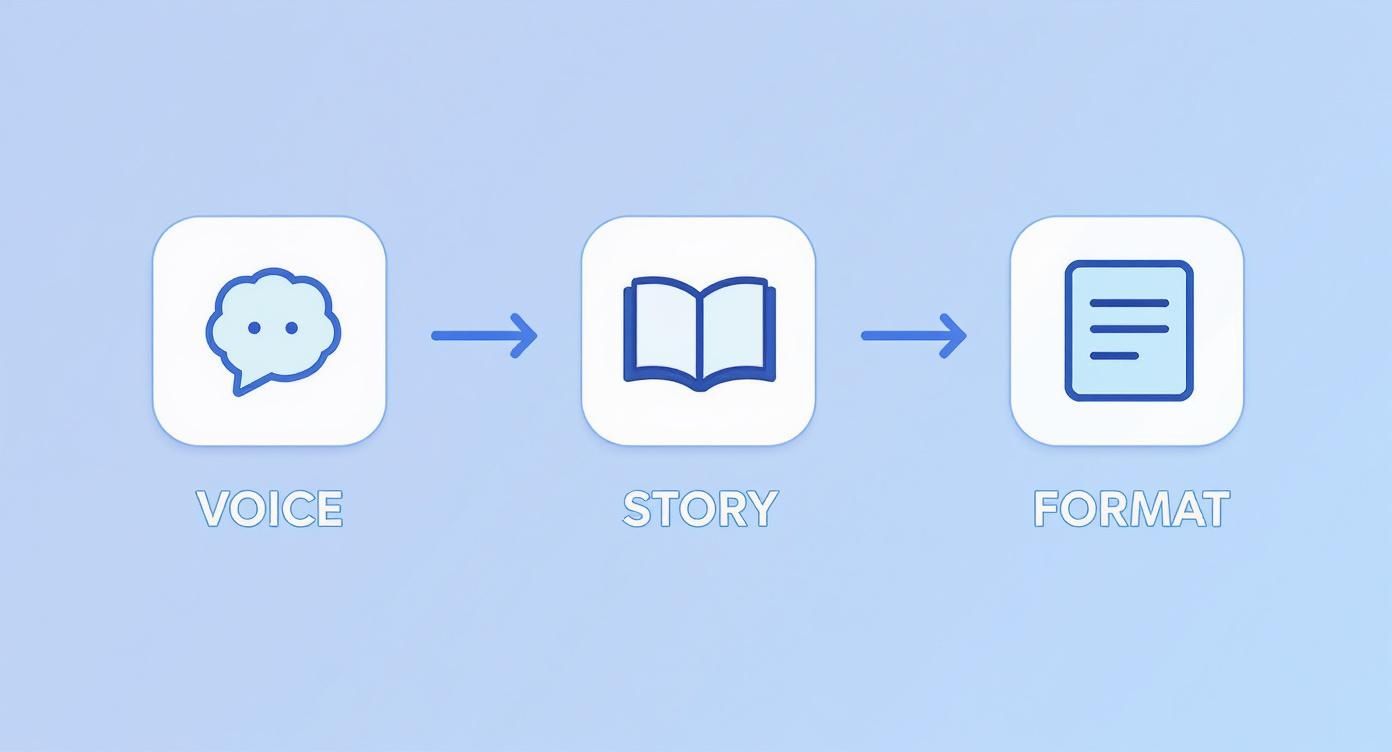
Think of it this way: your voice sets the tone, your story makes the case, and the format ensures it gets read. Each step is crucial for making a strong first impression.
Become a Funder Detective
Before you write a single word, you need to do some serious homework. The goal is to understand the funder’s DNA—what they care about, who they fund, and how they talk about their work. This intelligence gathering is the foundation of any great customized LOI.
Start by immersing yourself in their world. Scour their website, paying close attention to these key areas:
- Mission and Vision Statements: These are your north star. What are their core values? What specific change do they want to see in the world?
- Funding Priorities: Look for sections labeled "What We Fund," "Grant Programs," or "Areas of Focus." These explicitly tell you what they’re looking for.
- Annual Reports and Newsletters: These documents are absolute goldmines. They often feature stories of past grantees, highlight key achievements, and use very specific language to describe success.
This research will help you understand not just what they fund, but why. You'll start to see patterns in their interests and the types of projects that get them excited.
Mirror Their Language and Priorities
Once you have a clear picture of the funder, it’s time to align your LOI. This is where you connect the dots for the reviewer, making it incredibly easy for them to see your project as a perfect match. The key is to mirror their language without just copying and pasting their text. It has to feel natural.
If a foundation repeatedly uses terms like "community empowerment" or "systemic change," find organic ways to incorporate those phrases when describing your project's impact. If their annual report celebrates projects that are "scalable and replicable," make sure you dedicate a sentence to explaining how your program model could be adapted elsewhere.
Customization is about drawing a bright, unmissable line from your project’s outcomes directly to the funder’s strategic goals. You are translating your work into their language.
Many grant-making bodies now mandate LOIs specifically to filter proposals against their priorities. The AASM Foundation’s Strategic Research Grants, for example, require a concise LOI that is competitively reviewed to ensure alignment. This forces applicants to precisely tailor their project aims right from the start. You can explore the AASM Foundation’s detailed LOI guide for a real-world look at these strict requirements.
See the Difference Customization Makes
Let’s look at a quick before-and-after. Imagine we're writing to a fictional foundation focused on youth workforce development.
The generic statement is true, but it's completely forgettable. The tailored version, however, uses the funder's likely language ("career pathways"), includes hard data (150 low-income youth), and connects the project to a relevant industry ("high-growth tech sector").
This level of detail shows you’ve done your research. It proves you’re serious about becoming a strategic partner, not just another applicant asking for money.
Common LOI Mistakes That Lead to Rejection
https://www.youtube.com/embed/hrX3VPAj6hs
Even the most incredible projects can get a "no" before they even have a chance to make their case. It often comes down to a few surprisingly common, and totally avoidable, errors in the letter of intent grant. These small missteps can signal a lack of preparation or attention to detail, giving a busy reviewer an easy reason to pass.
Think of this as your troubleshooting guide. Knowing what not to do is just as important as knowing what to do. A polished, error-free LOI shows respect for the funder's time and proves your organization is professional from the get-go.
The Vague and Generic Request
One of the fastest ways to land in the "no" pile is to send a letter that feels like a copy-and-paste job. Funders, like the W.T. Grant Foundation, are very clear—they're looking for well-developed proposals that tackle a specific, identified problem. A generic LOI fails that test right out of the gate.
It really comes down to the difference between a weak statement and a powerful one:
- Weak: "We help people in our community."
- Powerful: "We provide job training for 200 formerly homeless individuals in the downtown corridor, with a 75% placement rate in sustainable employment."
See the difference? The second example is loaded with specifics—who you help, how many, where, and what the results are. It turns a vague plea into a compelling opportunity for impact. Always be precise about your target population, your goals, and your outcomes.
Using Unexplained Jargon
Every industry has its own shorthand, but your LOI is not the place to flex your vocabulary. Dropping in acronyms or technical jargon without any explanation is a great way to confuse and alienate a reviewer who isn't a specialist in your niche. Your goal is to connect, not to create a puzzle.
If you absolutely have to use a technical term, just define it briefly. For instance, instead of assuming the reader understands a "trauma-informed care model," you could say, "we use a trauma-informed care model, an approach that recognizes and responds to the impact of past trauma on health." That tiny bit of clarification makes your work accessible and keeps the reader engaged.
An LOI should be clear enough for an educated layperson to understand. If a reviewer has to stop and Google a term, you've already lost momentum and credibility.
Ignoring Submission Guidelines
This one is a classic, and it's probably the most painful because it's so easy to avoid. Foundations are explicit about their requirements for a reason. They lay out everything from page limits and font sizes to deadlines and attachments. Ignoring those rules is a massive red flag.
If a funder asks for a two-page letter, sending five shows you can't follow directions. If they set a hard deadline, like the ABIM Foundation's July 15th cutoff for its LOI submissions, missing it by even an hour means you’re out of the running. No exceptions.
I recommend creating a simple checklist for every single LOI you send. It’s a lifesaver.
- Deadline: What’s the exact date and time? Don't forget the time zone.
- Formatting: Are there rules for margins, font, or file type (e.g., PDF only)?
- Length: Is there a strict page or word count limit? Adhere to it.
- Content: Does the funder ask for specific sections or answers to certain questions?
- Submission Method: Is it through an online portal, an email address, or snail mail?
Spending five minutes double-checking these details before you hit "send" is one of the most important things you can do. It shows you’re meticulous, respectful, and ready to be a good partner. You’d be surprised how many applicants stumble on these basic points.
Common Questions About Grant Letters of Intent
Getting ready to send off a letter of intent can feel like the final, nerve-wracking moments before a big presentation. You've done the work, but a few nagging questions always seem to pop up. Let's clear the air on some of the most common ones so you can submit your LOI with total confidence.
Here are the straightforward answers I've learned to rely on after years in the field.
How Long Should a Grant LOI Be?
Think short and powerful. The sweet spot for a letter of intent is usually between one and three pages. The absolute first rule, though, is to follow the funder's instructions to the letter. If they say two pages or a 500-word limit, that's what you give them. No exceptions. It's your first test, and it shows you can follow directions.
If the funder doesn’t give you a specific length, aim for two pages. That’s generally enough space to tell a compelling story without bogging the reviewer down. Remember, this isn't a mini-proposal; it's a high-level pitch designed to make them want to know more. Brevity is your friend here.
Think of your LOI as a movie trailer, not the full film. It should be just long enough to capture their imagination and leave them wanting to see the rest of the story.
Is a Letter of Inquiry the Same as a Letter of Intent?
You'll see these terms thrown around, and honestly, they often mean the same thing in practice. But there can be a slight difference in how funders think about them.
- A Letter of Inquiry sometimes feels a bit more exploratory, like you're testing the waters to see if a funder might be interested in your idea.
- A Letter of Intent can feel more formal, often serving as a required first step in a very structured application process.
At the end of the day, they both do the same job: introduce your organization and project to see if there's a good fit. The most important thing? Use the exact term the funder uses. If their website says "Letter of Inquiry," call it that in all your correspondence. It shows you've done your research.
Should I Include a Full Budget in My LOI?
Absolutely not, unless they specifically ask for one. Dropping a dense, line-item budget into an LOI is like handing someone a complex schematic when they just asked what you're building. It's too much information too soon.
Instead, stick to a simple, high-level summary. All you really need are two key figures: the total cost of the project and the amount you're requesting. For example, you could say, “To launch our community literacy program, we are requesting $50,000 towards a total project budget of $120,000.” This gives the reviewer a clear picture of the project's scale and what you need from them, without getting lost in the details. Save the full budget spreadsheet for the full proposal.
Can I Send the Same LOI to Multiple Funders?
I get why people ask this—it would save so much time! But the answer is a hard no. Sending a generic, copy-and-pasted letter of intent grant is one of the fastest ways to get a rejection.
While the core of your project won't change, each letter needs to be meticulously customized for the funder you're sending it to. They each have their own language, mission, and specific priorities. A smart LOI shows you understand that.
- Speak Their Language: Weave in keywords and phrases you find on their website or in their annual reports.
- Connect to Their Mission: Explicitly state how your project's goals align with their strategic vision.
- Acknowledge Their Priorities: If they’re focused on "youth empowerment," spell out exactly how your program empowers young people.
Program officers can spot a form letter from a mile away. Taking the time to tailor your LOI shows genuine interest in a partnership, not just a handout. It turns your letter from a generic ask into the start of a meaningful conversation.
Ready to stop chasing dead ends and start winning more grants? Fundsprout is your AI-powered partner for grant success. Our platform helps you discover perfectly matched funders, analyze RFP requirements in seconds, and draft compelling narratives with AI assistance. Find your next opportunity and streamline your entire workflow at https://www.fundsprout.ai.
Try 14 days free
Get started with Fundsprout so you can focus on what really matters.