Letter of Intent Format for Grants: Quick Guide to Winning LOIs
Learn the letter of intent format for grants and craft a concise, compelling LOI that boosts your funding chances. Step-by-step tips and examples.


Abdifatah Ali
Co-Founder
Think of your Letter of Intent (LOI) as the strategic handshake that opens the door to a funder. It’s a brief but powerful document—usually just one to three pages—that makes the first critical impression and, when done right, earns you an invitation to submit a full proposal.
Why Your Grant LOI Is More Than Just a Formality
It’s tempting to see the LOI as just another hoop to jump through, a piece of paperwork standing between you and the "real" work of writing the full grant proposal. That’s a huge mistake. Honestly, the LOI is one of the most strategic documents you'll create in the entire grant application process. It’s not a formality; it’s your first and best chance to sell your project.

A Strategic Filter for Funders
Grantmakers are absolutely swamped with applications. The LOI is their go-to filtering tool, letting them quickly weed through the noise and spot projects that genuinely click with their funding priorities. Put yourself in their shoes: an LOI saves them from wading through dozens of lengthy proposals that were never a good match to begin with.
This initial screening isn't just a trend; it's now standard practice. As of 2023, more than 70% of foundation and government grant programs require an LOI before they’ll even look at a full proposal. This isn't about creating more work for you; it's about funders focusing their limited time and resources on the most promising ideas.
For you, the grant seeker, this is actually a golden opportunity. A sharp, well-written LOI that respects the funder's time and nails the mission alignment will make your project stand out immediately.
Differentiating the LOI from Other Documents
It’s crucial to know exactly what an LOI is—and what it isn't. This isn't a casual email or just a shrunken-down version of your final proposal. Each document plays a unique role.
To help clear things up, here’s a quick comparison to help you understand the distinct roles of a Letter of Intent and a full grant proposal.
LOI vs Full Proposal At a Glance
The LOI has to hit that sweet spot: detailed enough to be compelling but concise enough to be read in minutes. A great LOI shows a funder you understand their process and are a professional, organized partner. If you want to see how this fits into the bigger picture, check out our complete guide on how to apply for grants.
Key Takeaway: The Letter of Intent is your strategic audition. It proves you've done your homework, your project is a perfect fit for the funder's mission, and you are a credible partner worthy of a larger investment of their time and resources.
The Blueprint for a Winning Grant LOI
Alright, we've covered the 'why'—now let's get into the 'how.' The key to a powerful LOI isn't just what you say, but how you structure it. Think of it less like a long letter and more like an architectural blueprint for your project. Each section has a specific job to do, and they all work together to build a rock-solid case for funding.
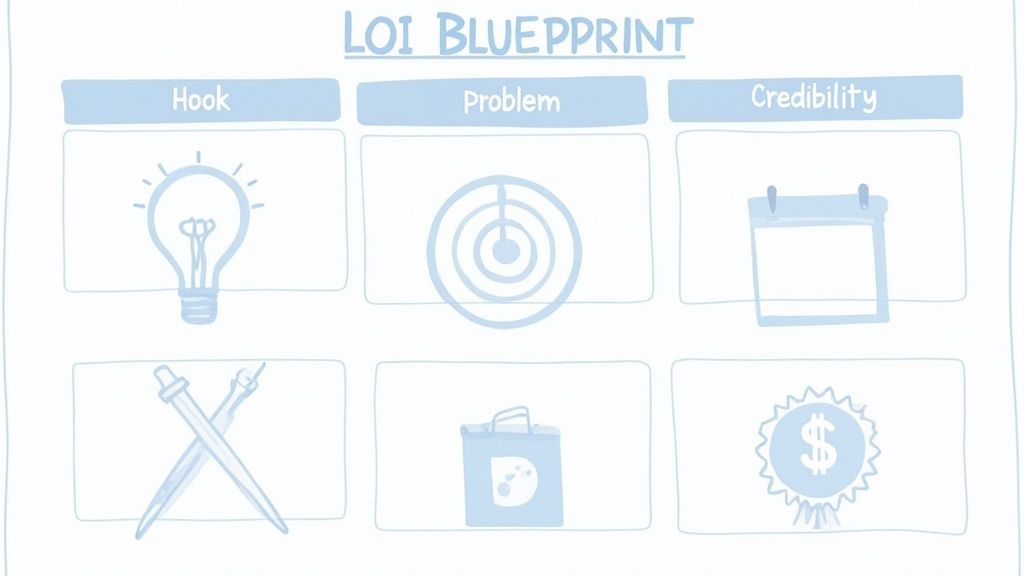
The standard letter of intent format for grants is all about clarity and impact. It’s designed to walk a busy reviewer through your logic, making your proposal easy to grasp and hard to forget.
Crafting a Compelling Introduction
Your first paragraph is everything. This is your hook. It needs to immediately answer the reviewer's silent question: "Why should I keep reading?" Your goal here is to draw a straight line between your mission and the funder's priorities. Don't bury the lead.
Get right to the point. State why you're writing and name the specific grant opportunity, if there is one. Follow that with a clear, punchy statement about who you are and what you do.
Here’s an example of how to phrase it:
"At the Green Futures Initiative, our mission is to empower urban communities with sustainable food sources. We are writing to seek support for our 'City Sprouts' program, which directly aligns with The Meadowbrook Foundation's commitment to fostering local resilience and food security."
See how that works? It’s direct, it shows you’ve done your homework on the funder, and it sets a collaborative tone right from the start.
Defining the Problem with Urgency
Now that you have their attention, you need to paint a vivid picture of the problem you're tackling. This is your "Statement of Need." Skip the broad, sweeping generalizations and get specific. Use hard data and local context to make the issue feel real and urgent.
What makes this problem so critical right now? Who is it affecting? Whenever you can, use local stats to really bring the point home.
- Quantify the need: Don't just say "many kids struggle to read." Instead, try: "Over 45% of third-graders in our school district are reading below grade level, a critical indicator of future academic challenges."
- Humanize the data: Briefly touch on the real-world impact. What does that statistic actually mean for a child's life and future?
- Show the gap: Explain why the current resources just aren't cutting it. What’s missing?
This section creates the tension your solution will resolve. It proves you have a deep, nuanced understanding of the community's challenges.
Insider Tip: Try to frame the problem in a way that echoes the funder's previous work. If you know they've funded early childhood education before, you can explicitly connect your literacy project to their established track record in that area.
Presenting Your Proposed Solution
With the problem clearly defined, it’s time to introduce your project as the smart, effective solution. This is where you lay out what you'll do, who you'll serve, and what results you expect. Be confident and specific.
Don't just give them a to-do list. Explain the strategy—the "how" and "why"—behind your activities. This is your moment to showcase your innovative thinking.
Key Elements to Include:
- Project Name and Goal: Give your project a clear name and state its main goal.
- Major Activities: Briefly outline the core actions. (e.g., "We will host weekly after-school tutoring sessions...")
- Target Population: Be precise about who benefits. (e.g., "...for 150 elementary students identified by local teachers.")
- Expected Outcomes: Describe the measurable changes you aim to achieve. (e.g., "Our goal is to increase participants' reading scores by an average of 15% within one academic year.")
This part of the letter of intent format for grants shifts the narrative from problem to action, assuring the funder that you have a well-designed plan ready to go.
Demonstrating Organizational Credibility
At this point, you have to answer the big question: "Why are you the right people for the job?" Funders need to know their money will be in capable hands. This is where you build trust and prove you're a safe bet.
Briefly highlight your track record, your team's expertise, and your deep roots in the community.
- Relevant Experience: Mention past projects that prove you can get results in this specific area.
- Key Staff: Briefly introduce the main players and their qualifications. No need for full bios, just a sentence or two.
- Community Ties: Emphasize your established relationships. Are you a trusted partner for local schools, families, or other organizations?
For example: "Our organization has successfully run the 'Summer Readers' program for five years, consistently exceeding our literacy goals and earning the trust of local schools and families."
Outlining the Budget and Your Ask
Finally, it's time to talk money. Be direct, clear, and confident. State the total amount you need and offer a simple, high-level breakdown of where it will go. Remember, the full, detailed budget comes later in the full proposal.
For the LOI, all you need is a clean snapshot that shows you've done the math.
Budget Snapshot Example
This simple table gives them the essential numbers without getting bogged down in detail. Wrap up your LOI with a warm closing, thanking them for their time and inviting further conversation. This completes the blueprint, leaving the funder with a clear, compelling, and professional impression of your project.
Writing Content That Connects and Persuades
A flawless blueprint is your starting point, but it's the words you fill it with that truly capture a grant reviewer's attention. Think of the LOI format as the skeleton; now it's time to give it a soul. This is where we stop thinking about structure and start mastering the art of storytelling.
The difference between an LOI that gets a polite "no" and one that earns an enthusiastic "tell me more" often boils down to the writing itself. It’s about turning a dry, data-heavy Statement of Need into a story that makes your project feel not just important, but absolutely urgent.

From Data Points to Human Stories
Numbers are essential for credibility, but they rarely inspire action on their own. The best LOIs I've ever seen weave hard data into compelling, human-centered stories. Your goal is to make the problem you're solving feel immediate and real to someone reading your letter miles away.
A simple but powerful technique is to ground your big-picture data in a single, memorable anecdote. Instead of just stating a statistic, frame it with the story of one person whose life embodies that number. This gives the reviewer an emotional anchor.
Here’s how you can put that into practice:
- Start with the macro view: "In our community, 35% of high school seniors from low-income households do not enroll in any post-secondary education."
- Zoom in to a personal story: "This isn't just a number for us. It’s the story of Maria, a brilliant student with a passion for engineering who believed college was completely out of reach until our mentorship program showed her a path forward."
- Connect it back to your solution: "Our project aims to create hundreds more stories like Maria's, turning a stark statistic into a wave of community success."
This simple arc—from a broad problem to an individual's story to your scalable solution—is incredibly effective. It makes your project stick in the reviewer's mind long after they've finished reading. For a deeper look at this part of your proposal, check out our guide to crafting a powerful Statement of Need.
The Power of Localized Data
Anyone can pull a national statistic from the internet. But what funders really want to know is why their investment is needed in your specific community, right now. This is where targeted, local data becomes your secret weapon.
Using local numbers shows you have an intimate, ground-level understanding of the community you serve. In the hyper-competitive world of grants, this matters. Consider that in 2020, NIH federal grant programs funded only about 21% of proposals submitted. An LOI has to cut through the noise.
Instead of a generic statement, a powerful LOI uses specific data to show deep alignment, like stating that "68% of local residents over 65 are experiencing loneliness due to digital disconnection." That single data point powerfully illustrates an urgent community need. You can find more tips on leveraging data in grant writing on grantboost.io.
Expert Tip: Don't just drop a number and walk away. You have to interpret it. Explain what the data means. A statistic is just a fact until you connect it to a consequence, showing the funder the real-world stakes if nothing is done.
Tailoring Your Voice for Different Sectors
Your writing should always feel authentic to your organization, but it also needs to be tuned to the funder's specific sector. The language that excites a foundation focused on environmental conservation will be very different from what resonates with one dedicated to youth arts programs.
Let’s look at a couple of before-and-after examples to see how this works.
Scenario 1: Environmental Conservation
- Before: "Our project will clean up the local river."
- After: "Our 'RiverRevive' initiative will restore 1.5 miles of critical riparian habitat along the Sparrow River, removing invasive species and reintroducing native flora to support the recovery of local trout populations and improve water quality for downstream communities."
Scenario 2: Youth Arts Program
- Before: "We offer after-school art classes for kids."
- After: "Our 'Creative Futures' program provides a safe, structured arts mentorship space for 75 at-risk middle schoolers, using disciplines like mural painting and digital design to build self-confidence, foster collaboration, and provide a positive alternative to out-of-school idleness."
See the difference? The "after" versions are packed with specific, active language. They quantify their impact and speak directly to the core values of their respective sectors—ecological health and positive youth development.
Finding a Professional Yet Passionate Tone
The final piece of the puzzle is hitting that perfect tone. You need to sound professional and capable, but not cold or academic. Remember, grant reviewers are people. They want to feel the passion behind your work.
A few tips for striking the right balance:
- Embrace the active voice. Instead of "The program was created by our team," say "Our team created the program." It’s more direct and sounds more confident.
- Ditch the jargon. Never assume your reviewer knows the acronyms and technical terms of your field. When in doubt, explain it simply.
- Show, don’t just tell. Rather than saying you are "passionate," let your detailed, thoughtful description of the problem and your elegant solution show your passion.
By weaving together compelling stories, laser-focused data, and a confident, authentic voice, your LOI becomes much more than a request for money. It becomes a persuasive invitation for a funder to partner with you in your mission.
The Common Mistakes That Will Sink Your LOI
You can have the most brilliant project in the world, but a few simple, avoidable mistakes in your Letter of Intent can get it tossed aside before it’s ever truly considered. It's a tough reality, but funders are often looking for reasons to say "no" just to manage the sheer volume of requests.
Think of this as your pre-flight check. Let's walk through the missteps I see most often so you can steer clear of them.
Ignoring the Funder's Instructions
This is, without a doubt, the cardinal sin of grant seeking and the #1 reason LOIs get rejected. It’s also the easiest one to avoid. When a funder specifies a two-page limit, a 12-point font, or a specific file naming convention, they aren’t making suggestions. They're testing you.
Ignoring their guidelines screams, "I don't pay attention to detail." It’s a massive red flag.
How to get it right: Before you write a single word, create a simple checklist. Copy and paste every single instruction from the funder’s guidelines—length, format, submission portal, deadline, everything. Check each item off as you go. It’s a five-minute task that can save you from instant disqualification.
Sending a Generic, Copy-and-Paste Letter
Grant reviewers have seen it all, and they can spot a form letter from a mile away. You know the one—it’s so generic it could be sent to a community foundation, a corporate funder, and a federal agency without changing a word. This approach doesn't signal efficiency; it signals a lack of genuine interest.
You're not just asking for money; you're trying to build a partnership. A copy-paste job shows you haven't bothered to learn anything about your potential partner.
My biggest piece of advice: Make them feel like you wrote it just for them. Your LOI should be a mirror, reflecting the funder’s own language, priorities, and passion back at them.
How to get it right: Spend 30 minutes on their website. Find the exact words they use to describe their mission and values. Note the projects they’ve funded in the past. Weave that specific language into your narrative. If they talk about "community-led initiatives," use that exact phrase.
Being Vague About What You'll Actually Do
Fuzzy, jargon-filled language is the kiss of death. Phrases like “we will empower at-risk youth” or “we will enhance community well-being” sound nice, but they don't actually mean anything to a reviewer. They want to know how you’ll do it and what will change as a result.
Ambiguity makes your project feel more like a dream than a plan. Funders invest in plans.
How to get it right: Be brutally specific. Quantify everything you can.
- Instead of: We will provide resources to underserved students.
- Try this: We will provide 150 elementary students from the Lincoln School District with 90 minutes of one-on-one literacy tutoring each week for the entire school year.
A Budget That Doesn't Match the Story
I've seen funders get whiplash from budgets that just don't add up. Requesting $100,000 for a tiny pilot program that seems to only require a part-time staffer and some supplies is a huge red flag. The same goes for asking for a mere $20,000 to launch a statewide, multi-year initiative.
Both scenarios erode trust and make it look like you haven't thought through the financial realities of your work.
How to get it right: Your budget needs to tell the exact same story as your narrative, just with numbers. Every line item should have a clear purpose tied directly to the activities you've described. If you're asking for money for a project coordinator, the scope of your project should make it obvious why that person is essential.
Customizing Your LOI and Preparing to Submit
You've done the hard work of building a solid structure and filling it with your project's story. Now it's time for the final, crucial step where precision and a personal touch can make or break your chances.
Sending a generic, one-size-fits-all LOI is probably the fastest way to land in the "no" pile. This last mile is all about tailoring every single detail to the specific funder you’re approaching.
Think of it from their perspective. Grantmakers are often buried in proposals, and the LOI is their first line of defense—a quick way to see if a project truly fits their mission before they invest time in a full review. A generic letter signals you haven't done your homework.
That's why tailoring your LOI is non-negotiable. Funders like Canada's Azrieli Foundation openly state they use it as their primary filter. It’s your first and best chance to show you're a perfect match. For a deeper dive, check out this great resource on how funders use LOIs at fundsource26.com.
Your Pre-Submission Customization Checklist
Before you even think about hitting send, you need to run your LOI through a final customization check. This goes way beyond just swapping out the funder’s name. It's about aligning your message so deeply with their identity that it feels like it was written just for them.
Mirror Their Language: Go to the funder's website and read their mission statement, annual reports, and descriptions of projects they've funded. Do they use phrases like “empowering communities” or “building local capacity”? Weave their exact terminology into your LOI. It creates an instant, subconscious connection.
Reference a Specific Initiative: If you can, name-drop one of their past projects that resonates with yours. For instance, you could write, "We were so inspired by your support for the 'City Gardens Project,' and our 'Urban Sprouts' initiative aims to achieve similar outcomes in our own neighborhood." This shows you're paying attention.
Check the Hidden Formatting Rules: Dig deep into the grant guidelines. I mean really dig. Some foundations have surprisingly specific rules about font size, margins, or even how you should name your digital file. Ignoring these little things suggests you might miss big details later on.
This infographic lays out the most common—and avoidable—reasons an LOI never even gets a serious read.
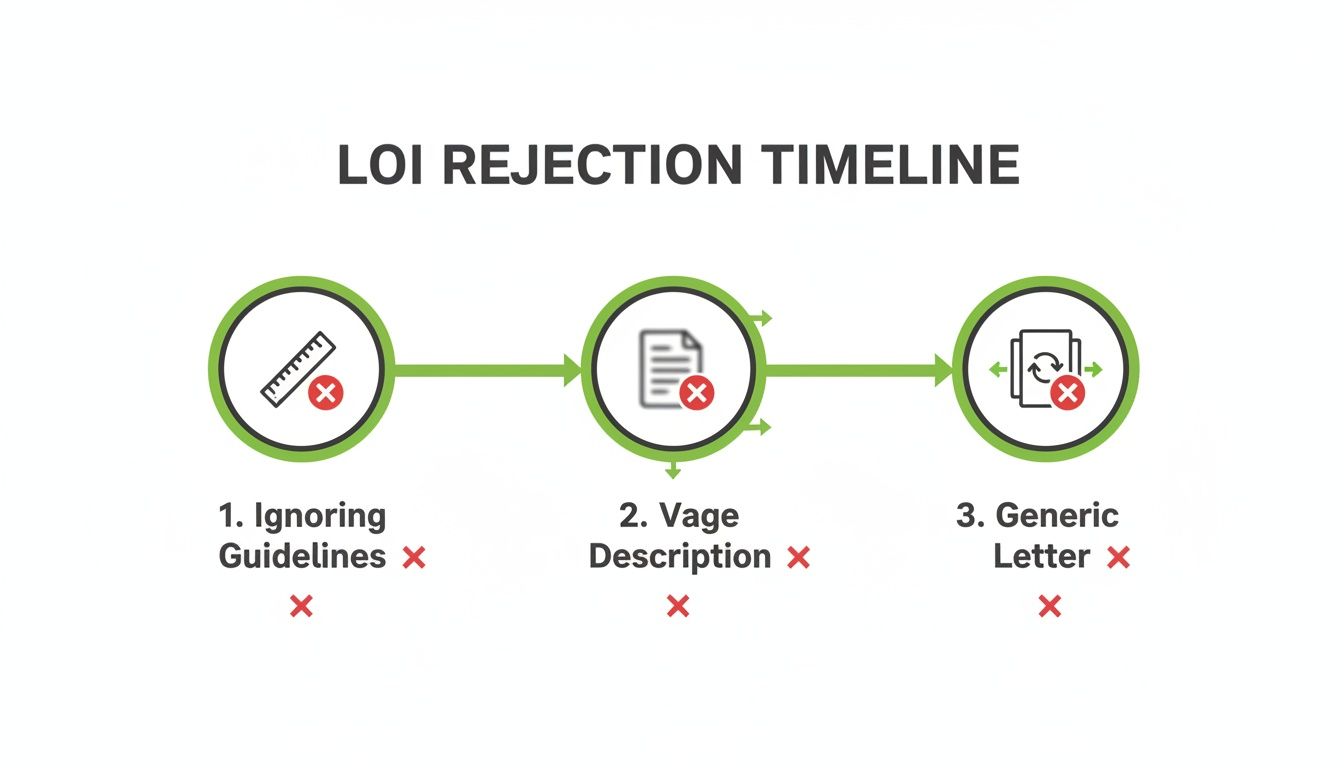
As you can see, it's often the simple mistakes that trip people up. A generic letter or a failure to follow basic guidelines are top reasons for rejection.
Mapping Out a Realistic Submission Timeline
The enemy of a great LOI is last-minute chaos. When you procrastinate, you invite typos, overlooked guidelines, and a rushed, uninspired final product. The best way to fight this is with a structured timeline.
My Personal Tip: I can't stress this enough—always have someone from outside your project read your final draft. A fresh pair of eyes is your secret weapon. They'll spot jargon, confusing sentences, and logical holes that you’ve become blind to after reading it a dozen times.
Here’s a sample timeline you can adapt for your own process:
- Weeks 3-4 Before Deadline: Get your project plan and core narrative finalized. Draft a detailed outline of the LOI itself.
- Week 2 Before Deadline: Write the first full draft. This is also when you need to make sure your budget numbers are rock-solid. If you need a hand getting organized, our grant budget template can be a real lifesaver.
- Week 1 Before Deadline: Send the draft out for review. Give it to key people on your team and, most importantly, to your external reader.
- 3-4 Days Before Deadline: Collect all the feedback and polish your final version. This is the time for final edits and meticulous proofreading.
- 1-2 Days Before Deadline: Submit it! Never, ever wait until the last day. I've seen too many people foiled by a sudden website crash or a Wi-Fi outage.
Navigating the Submission Process
Getting your LOI into the funder's hands is the final step, and how you handle the logistics says a lot about your organization's professionalism.
If You’re Using an Online Portal:
- Register for the portal days in advance. Don't wait until the last minute to discover you need to be approved.
- Write your LOI in a Word or Google Doc, then copy and paste the text into a plain text editor (like Notepad) before putting it into the portal's fields. This strips out any weird formatting that can cause errors.
- Save your work constantly. Many of these portals have aggressive time-out features.
If You’re Sending by Email:
- Your subject line should be clear and professional. Something like: "Letter of Intent Submission: [Your Organization Name] – [Project Name]" works perfectly.
- Always attach the LOI as a PDF. Give the file a professional name, such as "OrgName_LOI_FunderName_2024.pdf".
- Keep the email itself short and sweet. A simple, polite note saying your LOI is attached for their review is all you need.
Following these steps will let you submit your LOI with the confidence that you’ve done everything possible to present your project in its best light.
Common Questions About Grant LOI Formatting
Even with a great template, you're bound to hit a few snags when you're deep in the writing process. The specifics of the letter of intent format for grants can be a bit fuzzy, especially when a funder’s guidelines are vague. Let's walk through some of the questions I hear all the time from grant writers.
Getting these little details right shows you’re a pro and can make a real difference in how your LOI is perceived.
How Long Should a Letter of Intent for a Grant Be?
While some funders give you a hard page or word count, a good rule of thumb is to keep your LOI between one and three pages. Honestly, a crisp, powerful one-pager is the gold standard in my book. It shows you respect the reviewer's time and can get straight to the point.
That said, if a funder asks for a specific length, give them exactly that. If they ask for two pages, don’t try to be a hero and cram it all onto one. Brevity is a skill, but so is following directions. A tight page limit forces you to be ruthless in your editing, which is almost always a good thing.
Key Takeaway: Aim for a powerful one-page LOI unless the funder's guidelines specify otherwise. Clarity and conciseness almost always win out over length.
What if a Funder Does Not Request an LOI?
This is a big one: if a funder doesn't ask for an LOI, don't send one. Just move on to whatever their stated application process is, which is usually submitting the full proposal. Sending an unsolicited document, even if your intentions are good, can come across as not following instructions—a huge red flag for any grant reviewer.
Now, there's a tiny exception. If you already have a great relationship with a program officer, you could casually ask if a brief one-page summary might be helpful before you put together the full application. But you have to frame it as a professional courtesy, not like you're trying to skip a step. When in doubt, just stick to their published rules.
Can I Include Attachments or Links in My LOI?
The short answer is almost always no. Don't include unsolicited attachments like brochures, annual reports, or research papers with your letter. The whole point of an LOI is to be a quick, self-contained preview of your project. Throwing in extra materials suggests you don’t quite get the purpose of this initial step.
The same goes for hyperlinks. Avoid embedding links in your letter unless the funder’s online portal has a specific field for them. Your writing has to be persuasive enough to stand on its own. You'll get your chance to share all the supplementary documents later if you get the green light for a full proposal. Let your words do the work here.
Ready to stop guessing and start winning? Fundsprout is your AI-powered partner for the entire grant lifecycle. Our platform helps you find perfectly matched funding opportunities, drafts compelling narratives in your voice, and manages deadlines so you never miss a beat. Transform your grant writing process by visiting the Fundsprout website to see how we can help you secure the funding your mission deserves.
Try 14 days free
Get started with Fundsprout so you can focus on what really matters.