Knight Foundation Grants: A 2026 Guide to Winning Funds
Your deep-dive guide to Knight Foundation grants. Understand their 2026 priorities, eligibility, and application process to craft a proposal that gets funded.

Abdifatah Ali
Co-Founder
You've probably had this moment already. Someone on your board says, “What about the Knight Foundation?” and the room goes quiet for a second. Everyone knows the name. Everyone assumes the money is substantial. Almost nobody feels certain about how an organization gets through the door.
That hesitation is understandable. Knight Foundation grants sit in an unusual category. They're prestigious, strategically targeted, and often less open than many nonprofit teams expect. If you're used to foundations with a standing application portal, a broad interest statement, and a straightforward letter of inquiry process, Knight can feel opaque.
That doesn't mean it's inaccessible. It means you need a sharper read on how the foundation thinks.
In practice, Knight isn't just funding worthy work. It's backing specific kinds of civic, cultural, and information infrastructure in specific places, with a strong preference for projects that can show local relevance and a plausible path from idea to public value. That's a different exercise from writing a generic community impact proposal.
If your team is still building its broader funding mix, it helps to understand where Knight fits in the broader context of foundation grants for nonprofit organizations. Knight is rarely the “send one standard proposal and see what happens” option. It's the “build the right case for the right moment” option.
An Introduction to Knight Foundation Grants
The usual Knight conversation starts the same way. A leadership team sees the foundation's name, assumes there must be a standard path in, and starts asking who can draft the proposal. That is often the first mistake.
Knight is a high-capacity institutional funder with a long record of backing journalism, arts, civic participation, and place-based work. But access is narrower than the name recognition suggests. The foundation funds from a defined strategic point of view, and in 2026 that point of view matters even more because Knight is adjusting where it wants to see public value created.
Two shifts are shaping the opportunity right now. First, the relaunched Knight Cities Challenge signals renewed interest in ideas that improve how residents experience public life in Knight communities, especially projects that can show civic participation, local adoption, and a believable path beyond the pilot phase. Second, the recent pause in parts of journalism funding should not be read as a blanket retreat from local information work. It reads more like a reset. Knight appears to be sorting between legacy newsroom assumptions and models that strengthen the full local information ecosystem, including civic media, distribution infrastructure, audience trust, and community use of information.
That distinction changes how applicants should approach the foundation.
A traditional newsroom nonprofit cannot rely on “we produce important reporting” as a complete case. A non-traditional media nonprofit cannot assume the pause creates an opening just because its model looks newer. Knight tends to respond to organizations that can show local relevance, strategic fit, and a clear reason their work matters to how a community functions.
I tell clients to place Knight in the same category as other selective institutional funders, not in the broad pool of foundation grants for nonprofit organizations that accept generalized community-impact proposals year-round. The practical question is not whether your mission sounds worthy. It is whether your work fits Knight's current theory of change, in the places and formats it wants to support.
Practical rule: Approach Knight with a strategy case, not a generic need statement.
That is where many strong organizations lose ground. They submit polished language about equity, access, creativity, or civic health, but they do not show why Knight should view their project as part of the infrastructure of an informed and engaged community. In my experience, Knight gives more weight to alignment and timing than to rhetorical quality alone.
Public materials from the foundation itself make the operating model clear. Knight runs a mix of invited funding, targeted initiatives, and time-bound open calls such as the Cities Challenge, rather than a permanent broad-access grant portal, as described on the Knight Foundation website. For applicants, that creates a simple reality. The best opportunities come when your organization already fits the strategy before the application window opens.
Understanding Knight's Core Mission and Funding Priorities
A strong Knight proposal usually fails for one of two reasons. The applicant describes a worthy program without showing how it changes civic life in a specific place, or it pitches an old priority after Knight has already shifted its attention.
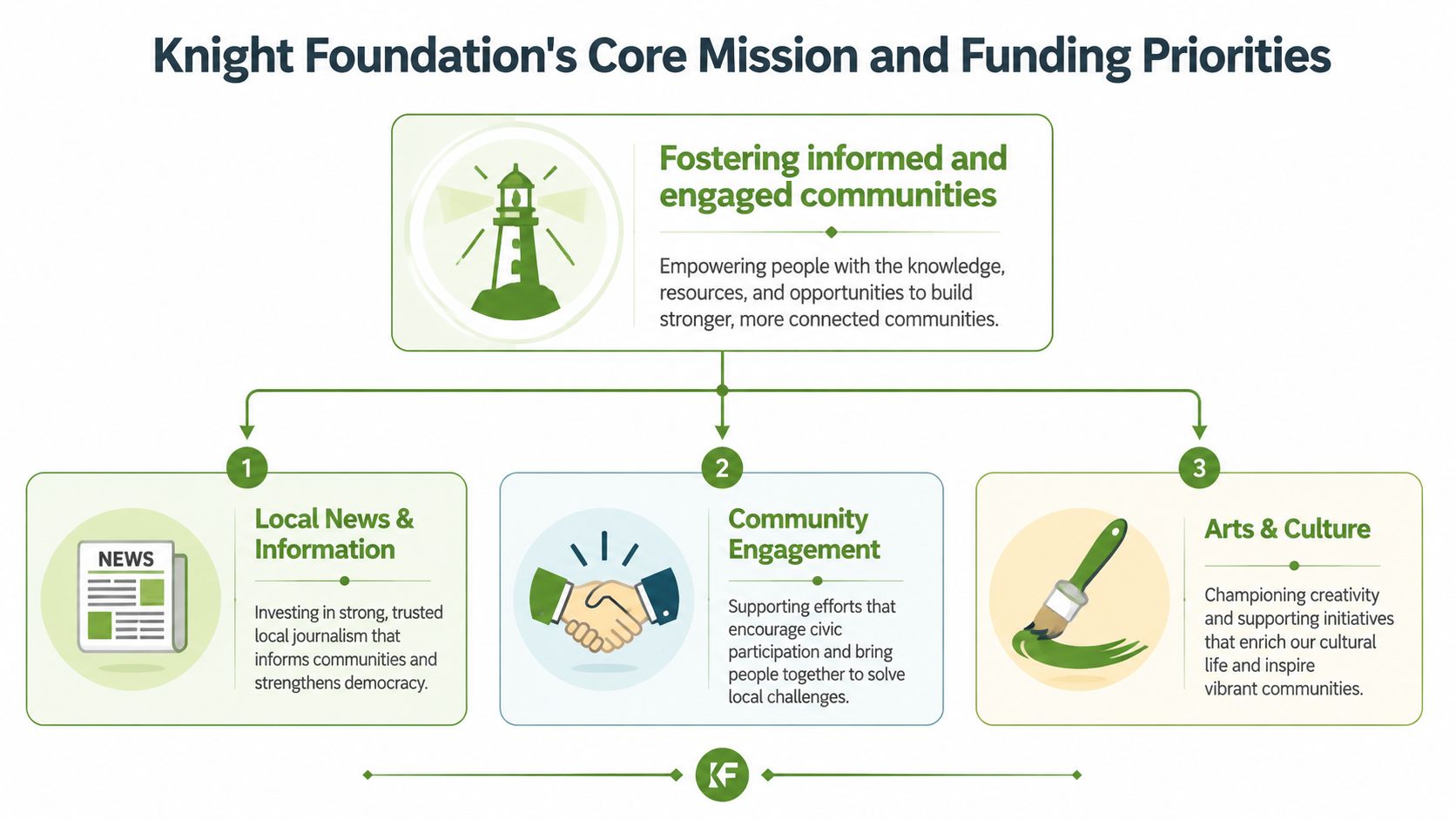
Knight still centers its work on informed and engaged communities. What matters in 2026 is how that mission is being applied. The relaunch of the Cities Challenge signals renewed interest in visible, place-based civic problem solving. At the same time, the pause in journalism funding has pushed applicants to read the foundation more carefully. Knight has not abandoned local information work. It has raised the bar on what kind of information infrastructure it wants to support, who it wants to see leading it, and how clearly the public benefit is defined.
Local news and information
For journalism and media applicants, the key shift is strategic, not semantic. Knight is less interested in broad claims about saving local news and more interested in whether your work helps a community access trustworthy information, participate in public life, and solve a defined local problem.
That has real implications for both traditional and non-traditional media nonprofits.
A newsroom cannot rely on “we produce accountability reporting” as a complete case for support. A stronger case shows how reporting reaches residents, how it builds trust with a defined audience, and how it connects to civic action, public understanding, or local decision-making. A nonprofit that is not a newsroom can still fit if it operates as part of the local information system. Community listening networks, civic technology groups, participatory information projects, and trusted messengers can all be relevant if the proposal is concrete and rooted in place.
The journalism pause should be read as a filtering mechanism, not a blanket no. Knight appears to be scrutinizing business-as-usual media proposals and looking harder at models that rebuild local information capacity in ways residents will use.
Community engagement
Knight funds participation, not just service delivery. That distinction shapes almost every competitive proposal I have seen.
Applicants often write that residents will benefit. Knight wants to know whether residents will shape the work. Who helped define the problem? Who will test the solution? What changes in public life if the project works? Those questions matter more than polished language about inclusion.
Place matters here too. Knight tends to respond better when the geography is specific and the civic mechanism is visible. A proposal tied to one neighborhood, one city process, or one local barrier to participation is usually stronger than a broad regional concept with diffuse ownership.
Arts and culture
Arts proposals perform better when they are framed as civic infrastructure. Knight is usually not looking for a detached cultural program with a short public run and no afterlife. It is more interested in how artists, cultural organizations, and creative projects contribute to public space, local identity, community connection, or civic participation.
That is one reason arts applicants should pay attention to the 2026 strategy shifts. The Cities Challenge relaunch reinforces Knight's preference for ideas that are public-facing, locally embedded, and capable of changing how a city works or feels for residents. An arts project can fit well if it operates in that lane.
A quick screen helps:
| Question | Strong Knight fit | Weak Knight fit |
|---|---|---|
| What's being funded | Civic, cultural, or information infrastructure with a clear local use case | A one-off program with limited public effect |
| Who shapes it | Residents, users, or community partners have a defined role | The organization designed it internally and will present it to the public |
| Why now | The project addresses a current local condition or opening | The proposal mainly seeks support to continue standard programming |
The practical read on Knight is straightforward. It funds mission-aligned work, but it favors projects that match its current strategy, geography, and theory of civic change. Applicants who treat Knight's priorities as fixed categories usually submit generic proposals. Applicants who read the 2026 shifts closely can position the same work much more convincingly.
Decoding the Major Grant Programs for 2026
A team spends three weeks drafting a journalism proposal for Knight, only to realize the funder is not asking the question they answered. For 2026, Knight is sorting ideas much more aggressively by program logic. If you do not match the right lane, even a strong concept can miss.
The program to watch is the Knight Cities Challenge. Its relaunch matters because it gives applicants an open entry point at a moment when parts of Knight's journalism portfolio are paused. Beyond that, it reveals how Knight currently envisions civic change occurring. Through local experiments, visible public benefit, and ideas that can improve how people participate in city life.
What the Cities Challenge is really funding
The public language around the challenge is broad by design. Reviewers still look for a narrow set of qualities.
They want a project rooted in one place, shaped by a real local condition, and capable of producing public value that residents can feel. That can include civic technology, public space activation, cultural participation, local information tools, neighborhood problem-solving, or resident-driven pilots. The common thread is usefulness. Knight is not rewarding abstraction here.
I tell clients to test their concept with one blunt question: what changes for a resident if this gets funded?
If the answer is vague, the proposal is usually weak. If the answer points to a specific user, a clear setting, named community partners, and a realistic implementation path, the project is much closer to competitive.
A stronger Cities Challenge proposal usually has these traits:
- A defined place, not a city mentioned loosely in the narrative
- A resident-facing outcome, not only institutional benefit
- Credible delivery partners, especially if the applicant is new to the community
- A pilot scope that fits the team's capacity
- Some evidence that the idea could continue, spread, or inform local practice after the grant period
The journalism pause: what it means for applicants
Many applicants misread the signal. The pause in new journalism grant-making does not mean every information-related project is frozen. It means Knight is being more selective about what kind of media and information work fits its 2026 priorities.
For traditional news organizations, this is a harder environment. A request centered on producing more reporting, adding a beat, or expanding general operations will face a steeper climb if it does not connect to a current program vehicle. Knight's current posture points more clearly toward information infrastructure, civic participation, and community use cases than toward straightforward content support.
For non-traditional media nonprofits, the door is not wide open, but it is open enough for the right idea. Community information networks, civic technology groups, digital literacy organizations, and trusted messengers can make a strong case if they improve how residents find, share, verify, or act on local information.
That distinction matters.
Knight is not treating all media applicants the same right now. It is separating editorial production from public-serving systems that help communities access and use information.
How to position different types of applicants
A newsroom has to frame its project as a public utility with a clear local function. That might mean a tool, distribution system, community listening mechanism, or partnership model that improves information flow in a Knight community. A proposal that stops at “we will publish important stories” is unlikely to stand out on its own.
A non-news applicant has a different burden. It needs to prove that the work is firmly tied to local information needs, not just adjacent to them. I have seen civic engagement groups overreach here by calling every outreach effort an information project. Reviewers usually spot that quickly. If the project does not improve access, trust, usability, or participation in a concrete way, the fit is weak.
Use this quick read before investing time:
- Stronger fit in 2026: Place-based projects that improve local information flow, civic participation, public space use, or resident connection
- Possible fit with careful framing: Media-adjacent work that builds community information infrastructure rather than producing content
- Weaker fit: General operating support requests, broad awareness campaigns, and editorial expansion proposals without a clear infrastructure or civic-use component
The practical takeaway is simple. Knight still funds ambitious ideas. In 2026, those ideas need to sit inside the right program and solve a public problem in a way the foundation can recognize immediately.
Assessing Your Eligibility and Strategic Alignment
Many teams ask, “Are we eligible?” The more useful question is, “Would Knight see us as credible within its strategy?” Those are not the same thing.
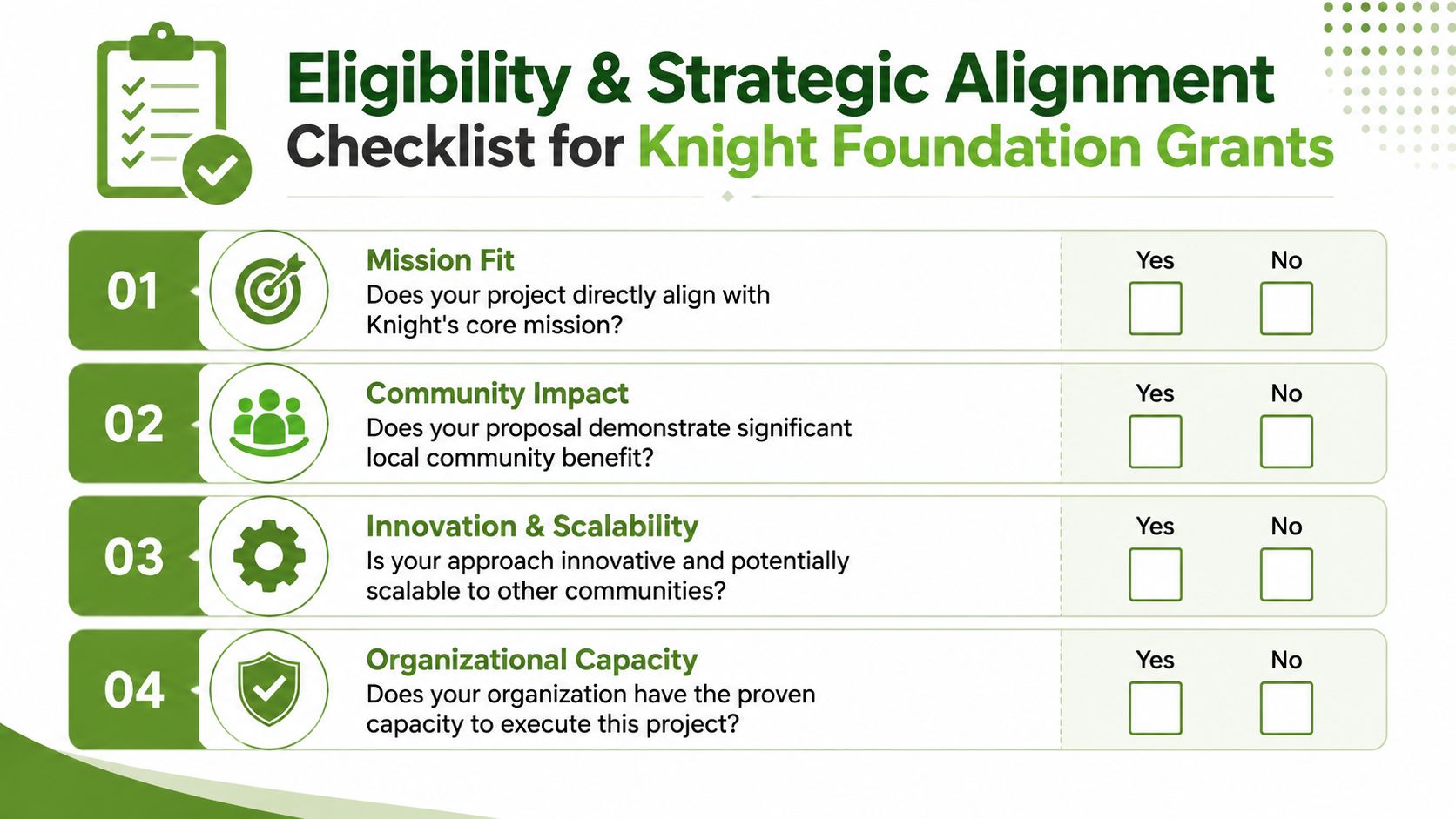
You can technically qualify for an open call and still be nowhere near competitive. Knight's review logic, as publicly described, prioritizes alignment with strategic focus areas, a clear theory of change with measurable outcomes, and community relevance, with community relevance acting as a gatekeeper. Proposals are also rejected when they don't demonstrate organizational capacity to execute or innovation and field-building value.
The first hard screen is geography
Knight's work is concentrated in 26 target communities. For many applicants, that's the end of the conversation.
If your project is national in scope and only loosely touches a Knight city, don't try to force local language into a distinctly nonlocal idea. Reviewers can spot that immediately. A stronger move is to redesign the project around one specific Knight community or skip this opportunity and pursue another funder.
A realistic self-check before you write
Use this as a pre-application filter.
- Strategic fit: Does your project sit clearly inside Knight's current priorities, not just your own mission language?
- Local grounding: Can you identify the specific community, partners, residents, and local problem your project addresses?
- Theory of change: Can you explain how the activities lead to a visible local result without relying on vague hoped-for effects?
- Execution capacity: Do you have staff, partnerships, operational systems, and a workplan that show you can deliver?
- Innovation value: Are you contributing a new model, a useful adaptation, or a field-building insight, rather than repackaging standard programming?
What capacity actually looks like to reviewers
Applicants often misread “capacity” as organizational size. Knight's lens is stricter and more practical. Capacity means your team can do the work you're proposing, in the setting you're naming, with the budget and timeline you've laid out.
That's why a smaller nonprofit can still be competitive if it shows strong partnerships, clear internal ownership, and evidence that it understands local implementation. A larger organization can still fail if it submits a polished concept without a convincing delivery structure.
Reality check: If your strongest argument is your mission statement, you're not ready. If your strongest argument is your local proof, operating plan, and partner structure, you might be.
One more caution. Many proposals fail because they're “aligned” only at the level of topic. Being in journalism, arts, or civic work is not enough. Knight is looking for projects that fit its current strategy inside those areas, in the places it cares about, with a model it believes can produce local value.
Navigating the Application Process and Timelines
A common Knight mistake looks like this: a team spends three weeks polishing a proposal for a program that is not open, then rushes an open-call submission without the local proof, partner commitments, or budget detail Knight expects. The problem is rarely writing quality. It is using the wrong process for the wrong opportunity.
Invite-only versus open-call reality
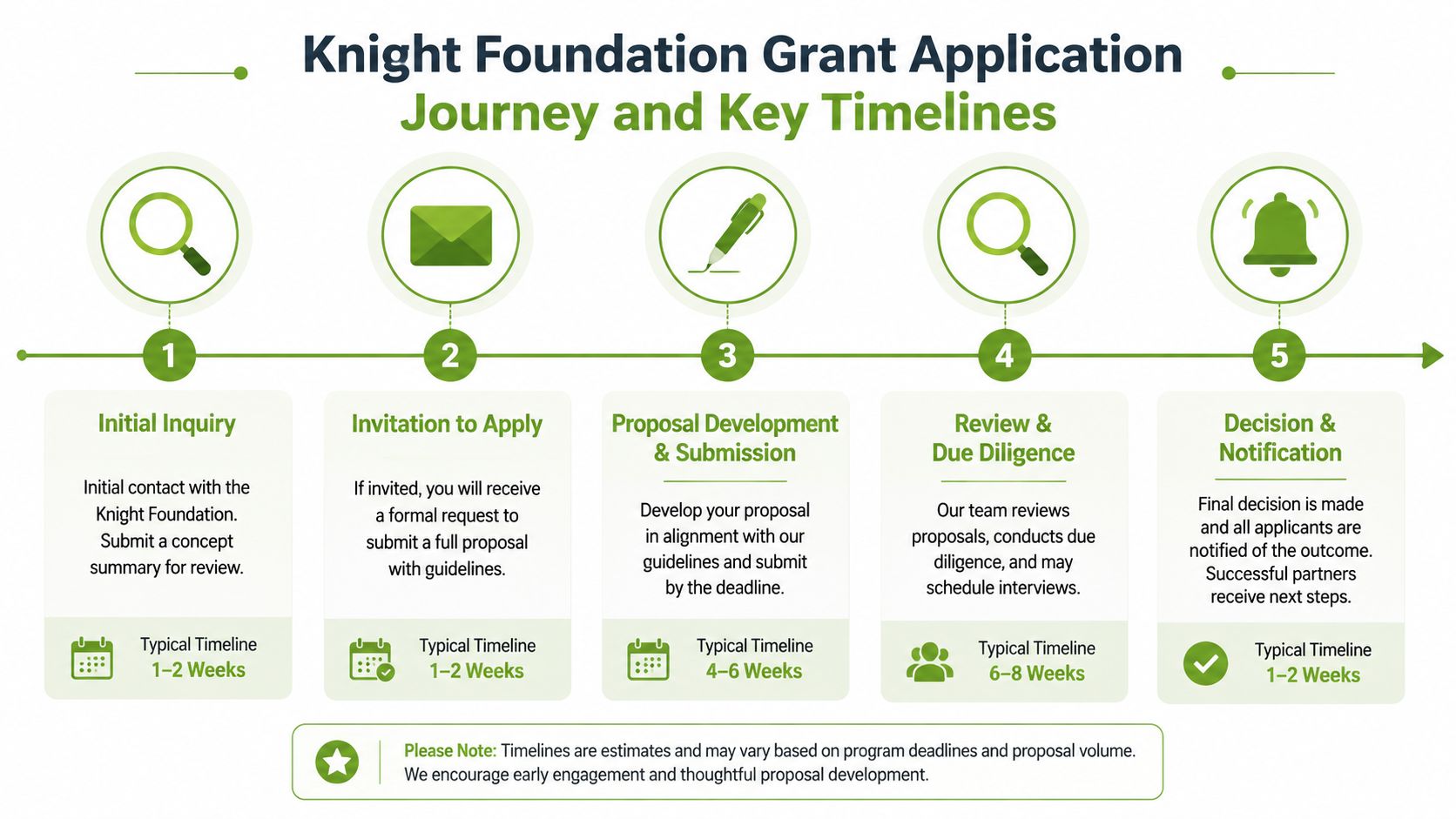
Knight does not operate like a foundation with one standard portal and one predictable calendar. In practice, applicants usually face two routes. One is relationship-driven and often invite-led. The other is a public challenge or time-bound call tied to a specific strategic priority.
That distinction matters more in 2026 because Knight's strategy is shifting in visible ways. The relaunched Cities Challenge creates a clearer public entry point for place-based ideas. At the same time, the pause on new journalism funding has changed how media organizations should read the room. Traditional news outlets cannot assume prior fit still carries them. Non-traditional media nonprofits should not assume the pause means Knight has lost interest in local information needs. It means the framing standard is tighter. Reviewers are looking harder at infrastructure, civic use, community relevance, and whether the work strengthens how residents get and act on information.
For invite-led opportunities, the work starts before any form opens. Program staff need to see that your organization is already operating in the problem space with credible partners, local trust, and a project shape that fits Knight's current priorities.
For open calls, the discipline is different. Published criteria control the process. A warm introduction can help with context, but it will not rescue a weak fit or a vague implementation plan.
What to prepare for the 2026 open-call cycle
For an open call such as the relaunched Knight Cities Challenge, assume reviewers will look for four things early: a specific local problem, a project that can be executed in the named community, a budget that matches the work, and evidence that Knight is not the only pillar holding the plan up.
The co-funding point matters. Knight does fund ambitious ideas, but it rarely responds well to proposals that read like the foundation is being asked to absorb all execution risk. If your budget depends on future money you have not lined up, say so plainly and show the fallback plan. If partner support is verbal but not documented, fix that before you submit.
Media applicants should make one adjustment here. If you are coming from journalism, avoid building the application around content volume alone. In the current funding situation, a proposal framed around distribution, trust, participation, civic utility, or local information access is easier to defend than one framed only around newsroom output.
If your team needs a better way to organize drafts, attachments, owners, and deadlines, this guide on how to apply for grants is a useful operational checklist.
A working timeline that won't put your team in panic mode
Knight review periods vary by program, so treat any published decision timing as program-specific and subject to change. For planning purposes, assume several months from submission to final determination, with staff review, internal discussion, and follow-up questions along the way.
Use an internal schedule that is stricter than the funder's.
- Run a fit screen first. Confirm the project matches Knight's current strategy, geography, and theory of change before anyone writes full narrative.
- Lock the budget framework early. Build costs, outside revenue, and partner contributions at the concept stage, not in the final week.
- Collect proof while drafting. Gather letters, implementation commitments, examples of local demand, and evidence that the community wants what you plan to build.
- Plan for diligence. Assume Knight may ask how decisions will be made, who owns delivery, what happens if a partner drops out, and how the work continues after the grant period.
Teams that handle this process well treat submission as the start of scrutiny, not the end of work. That mindset usually leads to better proposals and far fewer surprises once Knight starts asking harder questions.
How to Craft a Winning Knight Foundation Proposal
A program officer opens your proposal and gets to the second paragraph without learning what changes for residents in a Knight community. That application is already in trouble.
Knight rarely funds abstract promise. It funds projects that improve how a place works, how people participate, or how local information reaches them. In 2026, that standard matters even more because applicants are reading the foundation's journalism pause too narrowly. The better read is this: pure content plays face a harder path, while proposals that strengthen local news and information infrastructure, civic connection, or community problem-solving have a clearer case. The relaunched Cities Challenge reinforces that shift. Knight is looking for practical local solutions with visible public value.
Start with the place, then earn the right to talk about your organization
Strong Knight proposals diagnose a local condition with precision. Weak ones open with institutional history, broad mission language, and a long description of programs the reviewer did not ask about.
The first page should make four points clear:
- What is broken, missing, or underperforming in this specific community
- Who feels that problem most directly
- Why existing responses are falling short
- What will improve if your project works
That framing sounds simple, but it is where many teams drift off course. A journalism nonprofit may describe editorial excellence when Knight wants to see how residents get more usable local information. An arts group may emphasize programming volume when the better argument is stronger cultural participation, public space use, or neighborhood connection. A civic tech applicant may sell the tool before proving the local demand.
Build the proposal around a credible chain of results
Reviewers do not need inflated certainty. They need a believable path from activity to outcome.
Use a structure like this:
| Proposal element | Weak version | Stronger version |
|---|---|---|
| Problem statement | “Our community lacks engagement” | Identifies a specific local participation, access, or information gap |
| Activities | A list of events, stories, or workshops | Activities tied to a named barrier, user group, and delivery plan |
| Outcomes | General awareness or inspiration | Observable changes in access, use, participation, trust, or coordination |
| Sustainability | “We will seek more funding” | Names who will own the work, what revenue or partners support it, and what continues after the grant |
If your team needs help shaping the draft, use a nonprofit grant proposal template that forces clarity on problem, method, outcomes, and budget.
One test I use with clients is blunt. If a reviewer removed your organization's name from the draft, would the project still read as clearly designed for one place and one public need? If not, the narrative is still too generic.
Show innovation through usefulness
Knight has always liked new approaches, but novelty by itself is weak evidence. In the current funding posture, useful innovation beats flashy innovation.
That can mean a stronger partnership between a newsroom and a library, a better resident feedback loop, a shared distribution model for neighborhood information, or a repeatable public-space activation that another city could adapt. It can also mean better execution of an old idea if you can show why this version solves a real local bottleneck. For inventor-led or product-centered applicants trying to make that case, PledgeBox's guide to funding for inventors is a helpful reference on positioning innovation around funder priorities rather than just the invention itself.
A short briefing like this can help teams think about clarity and structure before drafting the final narrative:
Treat the budget as proof that the project can happen
At Knight, the budget carries as much weight as the prose because it shows whether the plan can survive contact with reality.
A convincing budget matches the delivery model. If you promise deep community engagement, the budget should show staff time, outreach costs, partner support, and follow-through. If you pitch a local information project during the journalism pause, the numbers should show system-building, distribution, community listening, or infrastructure, not just content production. If the grant appears to be the only thing holding the project together, reviewers will notice.
The best budgets also reveal restraint. They show a team that knows what it can deliver, what it will not attempt in year one, and where Knight's money fits inside a broader operating picture. That is often the difference between an interesting concept and a fundable one.
Common Pitfalls and Your Next Best Funder Options
The most common Knight rejection reason isn't bad writing. It's strategic mismatch.
A team submits a thoughtful proposal that would interest many foundations, but it doesn't fit Knight's place-based priorities, current program posture, or local impact test. That's why so many applicants feel blindsided. They mistake “good proposal” for “good Knight proposal.”
The rejection patterns that show up again and again
Here are the failure modes I see most often:
- Topic-only alignment: The proposal sits in journalism, arts, or community work, but doesn't reflect Knight's current strategy inside that category.
- Thin local proof: The project mentions a community but doesn't show real local design, resident relevance, or grounded partnerships.
- Output-heavy framing: The application promises stories, convenings, or programming, but not a stronger local system.
- Weak execution case: The organization has passion but not a convincing delivery plan.
- Budget disconnect: The numbers may be technically complete, but the budget doesn't match the scope, staffing, or sustainability story.
If your project only becomes “local” in the final draft, reviewers will notice.
When Knight isn't the right target
Some organizations should decide against applying, at least for now. That's not defeat. It's good grantsmanship.
If your work is national, if your strongest value is content rather than infrastructure, or if your project doesn't operate in one of Knight's focal communities, your effort may go further elsewhere. The same is true if your team still needs to sharpen its theory of change or prove capacity through smaller grants first.
A practical next move is to map adjacent funder types rather than chasing one famous name. Look at:
- Regional foundations that care about one city or metro area
- Community foundations with civic engagement, arts, or media literacy interests
- Issue-specific funders in local democracy, public space, youth media, or creative economy work
- Corporate and innovation funds when your project has a strong technology or civic design component
For organizations building applied tools, prototypes, or community-facing inventions, PledgeBox's guide to funding for inventors is a useful resource because it broadens the search beyond traditional nonprofit grant assumptions.
What to do next if you still want Knight later
Don't respond to a rejection, or a likely no-fit, by trying to write a more polished version of the same idea. Rebuild the case from the ground up.
Start by asking:
- Which Knight community is this for
- What local system gets stronger because of this work
- What can we prove about our ability to execute
- What partner or pilot evidence would make this idea more credible next cycle
That kind of revision does more than improve one application. It makes your whole funding strategy sharper.
Knight can be an excellent target. It's just not a forgiving one.
If your team wants a faster, cleaner way to identify best-fit grant opportunities, analyze requirements, and turn complex funder criteria into a workable proposal plan, Fundsprout is built for exactly that workflow.
Try 14 days free
Get started with Fundsprout so you can focus on what really matters.